 Twice Told
Mysteries
Beasts
TaleWawel hill, Kraków, Poland, the end of the 12th century to 1597
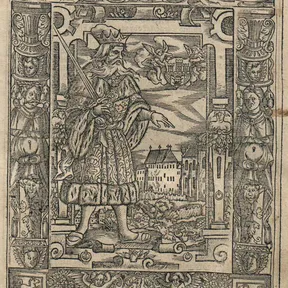
Kraków's Wawel dragon had no cobbler until 1597
The oldest telling of the Wawel dragon, Kadłubek's, has a crag, no cave and no cobbler. The cobbler Skuba first appears in Bielski's chronicle of 1597.
Biblioteka Jagiellońska, BJ St. Dr. Cim. 8176, cropped TaleRiver Bagrada (Medjerda), Tunisia, 256 or 255 BC
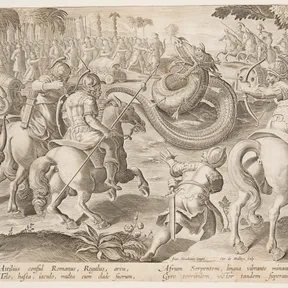
The serpent of the Bagradas: Regulus's monster without a witness
Pliny says a 120-foot serpent held off Regulus's army and that its skin hung in a Roman temple. Polybius, who tells the same campaign, never mentions it.
Cooper Hewitt, 1952-37-15 CaseBasel, Switzerland, 1474 to 1906
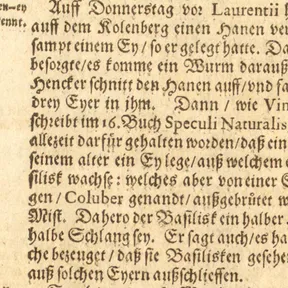
Basel's burned rooster
Books say Basel's magistrates sentenced a rooster in 1474. The diary that records the burning names none; the magistrate first appears in a travel book of 1808.
Universitätsbibliothek Basel, UBH EJ IV 28:2, e-rara.ch, cropped TaleLake Champlain, New York and Vermont, 1609 to 1970
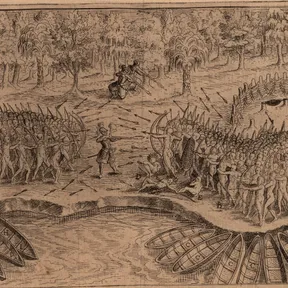
Champ of Lake Champlain: the serpent Champlain never described
Champlain described a five-foot fish in the lake. The 20-foot, horse-headed serpent said to be his is first in print, as far as we found, in a 1970 magazine.
John Carter Brown Library, E613 C453v [R], cropped CaseVärend, Småland, Sweden, 1883 to 1889
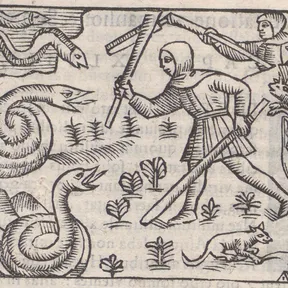
The lindworm reward in Småland was never claimed
In May 1884 a former chargé d'affaires in Småland offered up to 1,000 crowns for a dead lindworm. A Växjö paper joked it had been found; nobody brought a snake.
Uppsala University Library, Westin Sv. hist. Allm. fol. (Ex. 2), cropped CaseEsquel and Epuyén, Chubut, Argentina, 1922
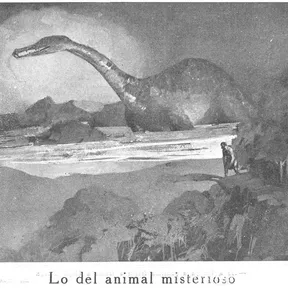
How the Patagonian plesiosaur of 1922 got its name
A hunter's letter to the Buenos Aires zoo never says plesiosaur. A headline did, and a party from the zoo went to his lagoon in April 1922 and found him gone.
Biblioteca Nacional de España, Hemeroteca Digital, Caras y Caretas no. 1224, cropped TaleEdam and Haarlem, Holland, Netherlands, 1403 to 1786
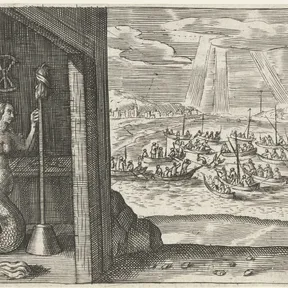
Before the Edam mermaid had a tail
Edam says a mermaid named Minne was caught in 1403 and taught to spin. The chronicles name no one and give no tail; the tail first shows in a print of 1645.
Rijksmuseum, RP-P-OB-78.246, cropped TaleUasin Gishu and the Nandi forest, Kenya, 1909 to 1927
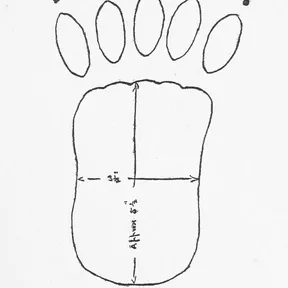
The Nandi bear and the devil called Chemosit
The first detailed account of the Nandi bear, printed in 1912, gives no year for the sighting. A 1909 book on the Nandi calls Chemosit a one-legged devil.
Biodiversity Heritage Library TalePars and Kerman, Iran, Sasanian era to 1010
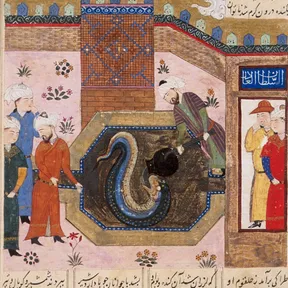
Haftvad and the worm in the Kārnāmag, Tabari and the Shahnameh
In the Pahlavi Book of Ardashir the worm of Haftānbōxt drinks blood and dies of molten brass; the girl with the apple appears only in Ferdowsi.
Los Angeles County Museum of Art, M.73.5.411, www.lacma.org TaleVrhnika (Ober-Laybach), Slovenia, 1684 to 1689
Vrhnika's baby dragons: Valvasor's lizard and the olm
A tourism page says Valvasor wrote of a dragon that spews out its young. His 1689 chapter has one dead, lizard-shaped animal a postmaster hung up for weeks.
National and University Library of Slovenia, dLib.si CaseLucerne, Switzerland, 1420 to 2006
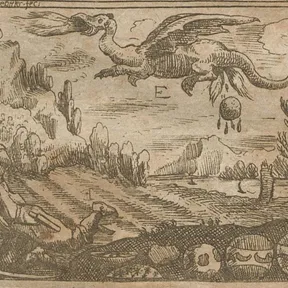
The Lucerne dragon stone: a pledge, a charter and a CT scan
In 1523 Lucerne's council certified a dragon's stone as a cure for plague. In 2006 a CT scan showed a painted clay ball.
Zentral- und Hochschulbibliothek Luzern, e-rara, cropped TaleBretten, Kraichgau, Germany, 1504 to 1816
How the dog of Bretten got its siege
Bretten's tailless dog is said to have ended a siege in 1504. The oldest telling, printed in 1805, gives no year, and the real siege ended in a truce.
Badische Landesbibliothek Karlsruhe, O 50 A 379, cropped TaleHigo (Kumamoto), Japan, 1843 to 1882
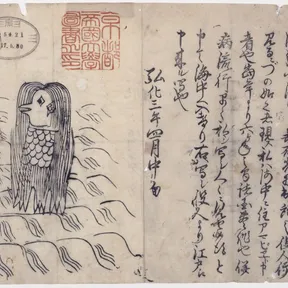
Amabie, from a single news sheet of 1846
In 1846 a news sheet drew a long-haired sea creature from Higo and named it Amabie. Every other known paper about the creature calls it amabiko.
Main Library, Kyoto University, RB00000122, cropped CaseGévaudan, France, 1764 to 1767
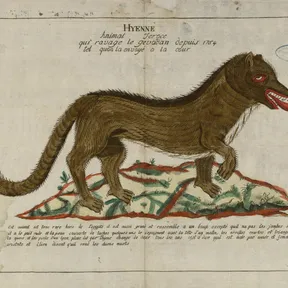
The Beast of Gévaudan outlived the king’s wolf
In 1765 the king's gunbearer shot a wolf, and the Gazette declared the Beast of Gévaudan dead. Five months later a new beast was killing in the same hills.
Archives départementales de l'Hérault, C 44-2, Licence Ouverte TalePine Barrens, New Jersey, 1687 to 1939
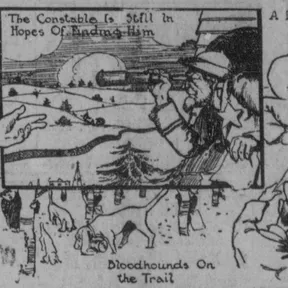
The Jersey Devil was first called Leeds’s devil
In 1700 a Quaker writer called the almanac maker Daniel Leeds “Satan’s Harbinger”. By 1859 a devil born to a woman named Leeds was a tale of the Pine Barrens.
Library of Congress, Chronicling America TaleLikouala, Republic of the Congo, 1776 to 1997
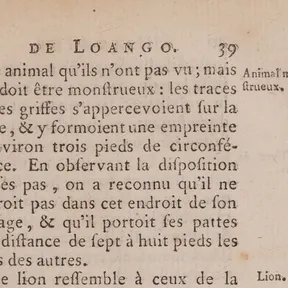
Mokele-mbembe, report by report, since 1776
The oldest text behind Mokele-mbembe is a 1776 note on claw prints. The name reached print in 1929, in a report that kept the animal out of the Likuala rivers.
Wellcome Collection TaleChina; the earliest texts are from Shanghai, 1933 to 2009
The earliest Nian beast we could find dates from 1933
The Nian, the beast driven off with red paper and firecrackers, is said to be thousands of years old. The oldest text naming it that we found is from 1933.

The Cleveland Museum of Art, 2025.93 CaseTsavo River, Kenya, 1898
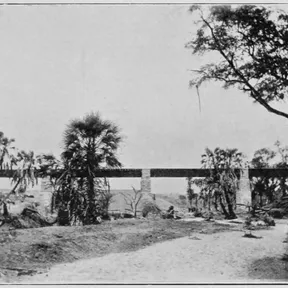
The Tsavo man-eaters: 28 counted in 1907, 135 by 1925
In 1907 Patterson wrote that the Tsavo lions ate 28 Indian workers. In 1925, when they went on show in Chicago, his figure was 135.
Biodiversity Heritage Library CaseBedburg, near Cologne, Germany, 1589 to 1590
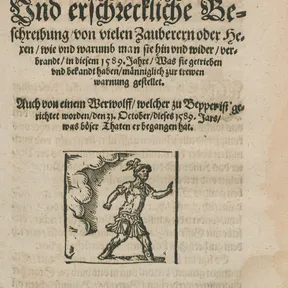
The werewolf of Bedburg in the Cologne papers of 1589
A London pamphlet of 1590 says the werewolf of Bedburg killed two pregnant women. No German text of 1589 mentions them, and no trial record has been found.
ULB Sachsen-Anhalt, Nm 302 (9)