 Twice Told
Haftvad and the worm in the Kārnāmag, Tabari and the Shahnameh
In the Pahlavi Book of Ardashir the worm of Haftānbōxt drinks blood and dies of molten brass; the girl with the apple appears only in Ferdowsi.
Contents
Published 6 Oct 2026. Sources checked 6 Oct 2026.
Ardashir I, the Sasanian king9, kills the worm of Haftvad by pouring molten metal into its mouth, and the books cannot agree which metal.3 In the Middle Persian Kārnāmag, Sanjana’s English has brass and Nöldeke’s German has “Erz”, while Shahbazi, summarising the same book in the Encyclopaedia Iranica, says lead.5 In Ferdowsi’s Shahnameh the Warners give lead, Mohl tin and Márkus-Takeshita brass.6 Behind the quarrel is a plainer difference: the apple, the spinning girl and the worm’s rise are told only in Ferdowsi, and the older book brings in the worm and its lord with no account of where they came from.2
This is the story as Ferdowsi tells it, in Warner and Warner’s English.
A poor man named Haftvad lived in a crowded town by the sea in Pars. He was called Haftvad because he had seven sons, and he had one daughter, whom he thought of no account. Every day the town’s girls climbed a mountain with distaff cases and unspun cotton. At mealtime one of them, Haftvad’s daughter, picked up a windfall apple, bit it and found a worm inside. She put it in her distaff case and said that in the name of God she would show them wondrous spinning by the luck of an apple-worm. The others laughed. That day she spun double, and the next day she spun double again.41011
She fed the worm apple. Her father took it for an omen and gave up his work. The worm outgrew the case, then a box, and Haftvad grew rich and strong with it. He took the town from its governor, built a hold on the mountain and put the worm in a tank, where it ate rice, milk and honey until its neck and limbs were as thick as an elephant’s. His daughter was its guardian. He named the hold Kirman.12
King Ardashir sent a host against him and lost it. Ardashir fled, and two young men told him that the worm came from the brain of Ahriman and that a blood-thirsty div sat in its skin. He went back as a merchant of Khurasan, with ten asses, two boxes of lead and solder and a brazen pot. He made the keepers drunk, melted the lead and poured it down the worm’s throat. Haftvad was taken and hanged from a gibbet by the sea.131415616
The book that has no girl
The Kārnāmag ī Ardašīr ī Pābagān, the Book of the Deeds of Ardashir son of Pabag, is a short Middle Persian prose life, and its only independent manuscript identified so far, codex MK, was copied in Gujarat in 1322.9 Cereti calls the text we have a late redaction that probably rests on an older and longer book17, and if Grenet’s reading of the title tegin in its fourteenth chapter is right, it was put together after 706.18 Cereti also thinks the Kārnāmag and Ferdowsi drew on the same source or on closely related ones.19
Haftānbōxt arrives with no introduction. After his war on the Kurds, in Sanjana’s English, “the army of Haftân-bôkht, the lord of the Worm, struck against them” and carried their baggage into Gûzârân, “one of the boroughs of Gular, where the Worm had its abode”.1 There is no chapter on how a worm came to have a lord. Antia says so in a footnote: “The Karnamak does not contain that chapter.”2 Warner guessed that the book may have left out Haftvad’s rise as foreign to its purpose, and thought Ferdowsi would hardly have invented it.20
What the Kārnāmag does tell is a siege that goes wrong. Haftānbōxt has seven sons, each governing a city with a thousand men.21 The eldest comes by sea with an army, though the translators disagree about whose: soldiers from Arabia and Mazenderan in Sanjana, Arabs and Egyptians in Nöldeke, Arabs and Makranians in Shahbazi.22 Ardashir’s camp is cut off from food.23 Then an arrow comes down from the fortress and pierces the roast lamb on his table, with a message: “we ought not to kill a great man like you, so we have struck that (roasted) lamb.”24
Ardashir gets away alone along the coast and is taken in by two brothers, Bûrjak and Bûrj-âtarô.25 They tell him how to reach the Worm: go in as a worshipper from a distant city, with two religious men who will chant the yazishne, and have molten metal ready for the moment the Worm comes to feed. The druj in its spirit form, they say, is undone by prayer, and the druj in its body by the metal.26 Ardashir goes in dressed as a man of Khurasan and gets the keepers drunk at breakfast.14 When the Worm turns up its mouth to drink the blood of cattle it is given each day, he pours the metal in, and the Worm “burst asunder into two pieces”.273 He razes the fortress, has a city called Gûzârân built on the site and has a Wahrām fire enthroned in it.28
Brass, lead, tin
Nöldeke’s German of the killing is close to Sanjana’s, except for one word.
„Sobald aber der Wurm den Rachen aufriss, um das Blut zu trinken, goss ihm Artachsîr das geschmolzene Erz in den Rachen“3
“But as soon as the worm opened its jaws to drink the blood, Artachsîr poured the molten metal (Erz) into its jaws”
Nöldeke leaves the Middle Persian word as “Erz”, where Sanjana and Antia both write “brass”.5 Sanjana’s note explains the choice: he glosses the Middle Persian word with Persian rûyîn, “brazen” or “bronze”, and adds that it is “probably some compound metal more fusible than ordinary brass”.29 Shahbazi’s summary of the Kārnāmag has Ardashir feed the worm “molten lead instead of the blood of bulls and sheep”.5
The poem repeats the split. In the Warners’ English, Ardshir packs “two boxes full of lead and solder” and “a brazen pot”, and the worm’s meal is “boiling lead”.156 Mohl’s French fills two chests with “plomb et d’étain”, lead and tin, and has the king call from the wall, “J’ai donné au ver de l’étain fondu”: I have given the worm molten tin.15306 Márkus-Takeshita writes of molten brass, and the Aga Khan Museum’s text on a painting of about 1540 says boiling lead.631 Darmesteter, summarising Ferdowsi in 1883, has Ardashir pour in “du lait empoisonné”, poisoned milk, which is in none of the texts we read.32
Two fragments in Tabari
Tabari has no worm at all.33 Nöldeke, who translated the Sasanian section of his chronicle, gives Tabari’s dates as born in the autumn of 839 and dead at Baghdad on 17 February 923.34 Two short, separate notices in it touch the Gulf coast. In the first, a king on the coast of the Persian sea, who was given divine honour; Ardashir marched on him, killed him and cut him in two with his sword.35 In the second, a queen in the village of Alar, in the district of Kujaran, enjoyed divine worship and had much wealth and many soldiers; Ardashir fought her priests, killed her and took her treasure.36
Nöldeke’s footnotes read both as what is left of the dragon fight once the dragon has been edited out.3738
Dies ist die erste, rationalistisch zurecht gemachte Gestalt des Kampfes mit dem als Gott verehrten Drachen37
This is the first, rationalised shape of the fight with the dragon revered as a god
The queen is the second weakening of the fight, and he notes that where Tabari has Alar the Pahlavi text has Gulār.38 He read the king’s name as Astawadh, with a question mark, and took it for a corrupted Haftānbōxt. Shahbazi reads the name, in the edition he used, as ʾbtnbwd and says it is not Astawadh.39
Tabari also puts Kerman first: Ardashir takes it, defeats its king Balash and makes his own son governor before Ardawan falls.40 The Kārnāmag and Ferdowsi send the army to Kerman only after the worm is dead.41 Al-Tha’alibi’s history of the Persian kings lacks the story altogether, according to Zotenberg’s preface to his edition.42
Side by side
| Text | Date | Girl and apple | Worm’s food | The metal | The enemy |
|---|---|---|---|---|---|
| Kārnāmag | Older; one copy of 13229 | None2 | Blood of cattle27 | Brass, Erz or lead, by edition5 | Haftānbōxt, seven sons21 |
| Tabari | Died 92334 | None33 | No worm33 | Sword, no metal3533 | A god-king, or a queen3536 |
| Shahnameh | Completed 101043 | Apple, distaff, double spinning4 | Rice, milk, honey12 | Lead, tin or brass, by translator6 | Haftvad, seven sons10 |
What Ferdowsi put in front
Ferdowsi gives the worm a beginning and changes its character. The girls of a town by the sea spin cotton on the mountainside; Haftvad’s daughter finds the worm in an apple, keeps it in her distaff case and boasts that its luck will make her spinning wonderful.4 The thread is cotton, a point to hold on to for the silk reading below.11 Her father is “so named because he had seven sons”.10 The worm outgrows its case and a box, ends in a tank on the mountain hold, eats rice, milk and honey, and has the girl as its keeper; Haftvad names the hold Kirman.12 Where the Kārnāmag’s worm drinks blood27, Nöldeke notes in a footnote to the killing that in Ferdowsi the dragon “oddly” feeds on milk rice.44
The two brothers of the book become two young men in the poem, and what they tell Ardashir is theology of a different shape. The worm comes from the brain of Ahriman, and in its skin there is “a combative, blood-thirsty div”.13 In the Kārnāmag the brothers talk of a druj to be undone by prayer and by metal.26 At the end Haftvad and his eldest son are taken and hanged alive on gibbets by the sea.16
Márkus-Takeshita points out that once the daughter is made the worm’s guardian she fades out of the poem, and that the Kārnāmag does not know her, or has good reason to ignore her.45 She adds that ruins called the Maiden’s Castle stand near ruins called the Castle of Ardashir outside Kerman, a pairing she takes from Bastani-Parizi (1977), which we have not seen.46
One painting, one pot
A page in the Los Angeles County Museum of Art, from a Shiraz Shahnama of about 1485 to 1495, is titled “Ardashir Feeds Molten Metal to Haftvad the Worm”.47
This paragraph is our own description of the picture, not the museum’s: a man in a striped green robe leans over the edge of an eight-sided tank and tips a black pot toward a coiled blue-and-gold worm, men watch from the left and from a doorway at the right, and a cloud of smoke rises above the wall.
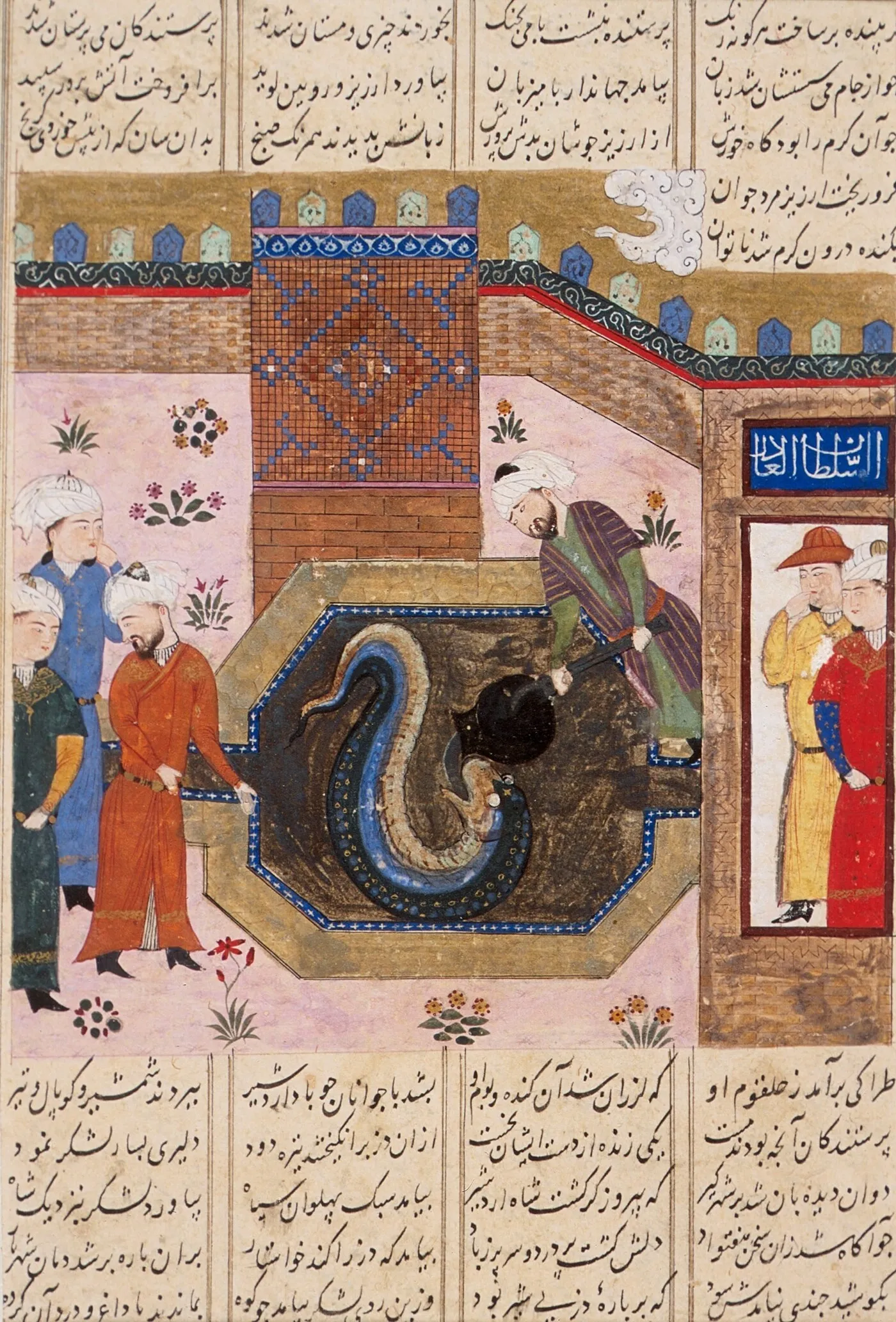
Ardashir Feeds Molten Metal to Haftvad the Worm, page from a Shahnama manuscript, Iran, Shiraz, circa 1485 to 1495. Los Angeles County Museum of Art, The Nasli M. Heeramaneck Collection, gift of Joan Palevsky, M.73.5.411, photo © Museum Associates/LACMA, www.lacma.org. Downscaled.
The title names no metal.47 The Aga Khan Museum’s text on a page from Shah Tahmasp’s Shahnameh, attributed to Dust Muhammad and dated about 1540, puts the apple and the girl at lower left and Ardashir pouring boiling lead in the same painting.31
Seven sons, seven heads
The Kārnāmag calls the lord of the Worm Haftānbōxt and Ferdowsi calls him Haftvad, and both give him seven sons.2110 The name has three readings with named holders. Nöldeke read Haftānbōxt as “the Seven have redeemed”, the Seven being the Ahrimanic planets.48 Sanjana’s note gives that reading and the plainer one, “having seven sons”, which is also what Ferdowsi says.4849 Darmesteter thought Nöldeke’s reading too ingenious and took the sons for the worm doubled: he has seven sons as he would have seven heads.50 Shaki records a third: Henning derived a form Haftōwād from an Achaemenid title for the guardian of the seventh part of a province, attested in an Aramaic document from Elephantine.51
Silk, pirates, dragons
One reading takes the worm for a dragon. Sanjana’s note sets the fight beside Apollo and Python, Heracles and the Hydra, Indra and Vritra52, and Nöldeke and Darmesteter took Haftānbōxt to be the dragon in person.53 Liebrecht noticed in 1862 that Saxo Grammaticus tells of Thora, who reared a worm that grew, guarded gold and was killed by Ragnar Lodbrok, and compared it with Haftvad’s daughter.54
Three of the writers above point to a pun. Kirm means worm, and Kirman was popularly heard as “land of the worm”.55 Warner adds that Kirman is better known for dates than for silk.56 Shahbazi offers a second pun: Kōčārān was a fort of a local king, Gōčihr, whom Tabari has killed at Ardashir’s instigation, and in cosmology Gōčihr is a snake-like star destined to burn in molten metal at the end of the world.57
The silk reading is Mohl’s. In the preface to his volume he calls the episode “un vague souvenir de l’introduction du ver à soie en Perse”, a vague memory of the silkworm’s arrival, and illustrates the idea with a Breton prefect’s report about hand-spinners who invented a fairy called Machine with seven steel fingers.5859 Darmesteter agreed that this could sit beside the dragon myth.60 Shahbazi thinks it quite possible that a silk industry had grown up on the Gulf whose patrons jealously guarded its secret in their strongholds.61 Warner offered a king of Hormuz grown rich on the silk or cotton trade.56 In our reading one detail sits awkwardly with it: the thread in the poem is cotton.11
Shahbazi himself writes that the story is “clearly woven around a historical base”, Ardashir’s effort to conquer the Persian coast, Makrān and Kermān, and he records Henning’s reading of the episode as a rationalised fight with a pirate on the Gulf shore, influenced by an Indian Nāga cult and which had earned the enmity of Zoroastrian priests.8 Márkus-Takeshita reads the war against the worm as the state Zoroastrianism of the rising Sasanians against a local popular cult, and the story as a cautionary tale for royal authority (farr) against the luck (baxt) of commoners.62 She also assigns it two folktale types from Aarne and Thompson (1961), 300, the Dragon-Slayer, and 500, the Magic Spinner.63
In our reading, these readings work at different levels: the name, the plot, the history and the religion. The place itself is lost. Warner calls the situation of Kujaran unknown, and Nöldeke could not find where Gulār or Kōčārān lay either.7
The line in the footnote
Sanjana’s English reaches the killing on page 36, and a footnote to that sentence prints six couplets of the poem in Persian type.64 The first begins biyāvard arzīz u rūyīn and goes on to a word printed لویه: he brought arzīz, and something of rūyīn. In the lines after it only arzīz comes back. Boiling arzīz is the worm’s feed, Ardashir brings hot arzīz, and he pours the arzīz down.65
Rūyīn is the word Sanjana had glossed as “brazen, bronze” three pages earlier.29 Steingass’s Persian dictionary of 1892 gives it as “Brazen; bell-metal”, and arzīz as “Lead”.6667 The word printed لویه looks like Steingass’s lawīd, “a large cauldron or kettle, especially of brass”.66 In our reading, then, the brass in this printing is the pot and the lead is what goes in it, which is how the Warners have it: “a brazen pot” and “boiling lead”.156 Mohl’s tin would be another reading of arzīz. That holds for Ferdowsi, and only for the six couplets as Sanjana prints them. The Kārnāmag’s own word is the one Sanjana glossed rūyīn, and its editors still have brass, Erz and lead.529
What we could not verify
Sources we have not seen
- Grenet’s 2003 edition and translation of the Kārnāmag (La geste d’Ardashir, Die). It would give a current reading of the metal word and of the text’s date. A web search and an archive.org search on 2026-10-06 turned up no open copy.
- The Persian text of the Shahnameh, in the Moscow edition (vol. 7, verses 740 to 744, as Shahbazi and Márkus-Takeshita cite it) or Khaleghi-Motlagh’s. It would show whether the couplets Sanjana prints are the critical text. We found no open copy of either; apart from those six couplets we read the story in translation.
- Bal’ami’s Persian Tabari and the Mojmal al-tawarikh (ed. Bahār), which Shahbazi lists among the texts that repeat or derive from the others. They would show how Persian chroniclers handled the two Tabari fragments and the poem. We found no open copy of Bahār’s editions; a keyword search of the OCR of Zotenberg’s French translation of Bal’ami, vol. 2 (1869), found no worm, which is not a reading.
- Al-Tha’alibi’s Ardashir chapter in Arabic. It would confirm that the worm is missing. The library’s scan prints the Arabic as page images whose OCR is unusable, and the French beside it we could only search by keyword, so we rely on Zotenberg’s preface.
Seen only where others quote them
- Henning’s reading of the episode as a fight with a pirate and an Indian Nāga cult, and his Achaemenid title for the name, which we know only from Shahbazi and Shaki; his 1968 article was not found online.
- Markwart’s view that the story rests on Ardashir’s conquest of the coast, which we know only as Shahbazi cites it.
- Saxo’s story of Thora and Ragnar, and Liebrecht’s 1862 comparison, which we know from Darmesteter, Shahbazi and Márkus-Takeshita; we have not seen Saxo or Liebrecht.
- Bosworth’s translation of Tabari (1999), which we know as Márkus-Takeshita cites it; we read Tabari in Nöldeke’s German.
Resting on a single source
- Shahbazi’s account of Kōčārān as the fort of a king Gōčihr and of Gōčihr as a snake-like star, which no other source we read repeats.
- Márkus-Takeshita’s report, from Dehkhoda, that the town of Bam took its name from the sound of the worm bursting; we have not seen Dehkhoda.
Questions we could not settle
- Whether the critical editions of the Shahnameh print the same couplets as Sanjana’s footnote, and why Mohl put tin where Steingass has lead.
- Where Kōčārān and Gulār lay. Warner and Nöldeke could not say, and Shahbazi puts the story on the Gulf coast without naming a site.
- When the Kārnāmag took its present form. Cereti gives a possible date after 706 on one reading of one word; the one manuscript is of 1322.
Read next
TaleShush (Susa), Khuzestan, Iran, 638 to 1869
One writer hangs Daniel's coffin from a bridge at Susa
CaseVärend, Småland, Sweden, 1883 to 1889
The lindworm reward in Småland was never claimed
CaseEsquel and Epuyén, Chubut, Argentina, 1922
How the Patagonian plesiosaur of 1922 got its name
Sources
- Sanjana, The Karname i Artakhshir i Papakan (Bombay, 1896), Chapter VI, 1, p. 24 (primary) transcription
- Antia, Karnamak-i Artakhshir Papakan (Bombay, 1900), Chapter X, 1, p. 22 (primary) transcription
- Nöldeke, Geschichte des Artachsir i Papakan (Göttingen, 1878), p. 50 transcription
- Shahbazi, Haftvād, Encyclopaedia Iranica XI/5 (2002), pp. 534-536, paragraph on the older version↑
- Antia, Karnamak-i Artakhshir Papakan (Bombay, 1900), p. 22, footnote 1 (primary) transcription
- Warner and Warner, The Shahnama of Firdausi, vol. 6 (London, 1912), Introduction, §12, pp. 205-206
- Márkus-Takeshita, From Iranian Myth to Folk Narrative, Asian Ethnology 60/2 (2001), p. 210
- Shahbazi, Haftvād, Encyclopaedia Iranica XI/5 (2002), pp. 534-536, paragraph on the older version ("It starts abruptly")↑
- Sanjana, The Karname i Artakhshir i Papakan (Bombay, 1896), Chapter VIII, 10-11, p. 36 (primary) transcription
- Antia, Karnamak-i Artakhshir Papakan (Bombay, 1900), Chapter XIII, 13-14, p. 31 (primary) transcription
- Nöldeke, Geschichte des Artachsir i Papakan (Göttingen, 1878), p. 56 transcription
- Shahbazi, Haftvād, Encyclopaedia Iranica XI/5 (2002), pp. 534-536, paragraph on the older version↑
- Warner and Warner, The Shahnama of Firdausi, vol. 6 (London, 1912), p. 233 transcription
- Mohl, Le livre des rois, vol. 5 (Paris, Imprimerie nationale), pp. 247-248 transcription
- Márkus-Takeshita, From Iranian Myth to Folk Narrative, Asian Ethnology 60/2 (2001), p. 205
- Shahbazi, Haftvād, Encyclopaedia Iranica XI/5 (2002), pp. 534-536, first paragraph (Šāh-nāma, Moscow ed. VII, pp. 139-154)↑
- Sanjana, The Karname i Artakhshir i Papakan (Bombay, 1896), Chapter VII, 11, pp. 33-34, and VIII, 10, p. 36 (primary) transcription
- Antia, Karnamak-i Artakhshir Papakan (Bombay, 1900), Chapter XII, 17, p. 29, and XIII, 13, p. 31 (primary) transcription
- Nöldeke, Geschichte des Artachsir i Papakan (Göttingen, 1878), p. 56 transcription
- Shahbazi, Haftvād, Encyclopaedia Iranica XI/5 (2002), pp. 534-536, paragraph on the older version ("molten lead instead of the blood of bulls and sheep")↑
- Warner and Warner, The Shahnama of Firdausi, vol. 6 (London, 1912), pp. 242-244 ("lead and solder", "boiling lead") transcription
- Mohl, Le livre des rois, vol. 5 (Paris, Imprimerie nationale), pp. 260 and 263 ("plomb et d'étain", "étain fondu") transcription
- Márkus-Takeshita, From Iranian Myth to Folk Narrative, Asian Ethnology 60/2 (2001), p. 206 ("molten brass", verses 740-744) and p. 211
- Shahbazi, Haftvād, Encyclopaedia Iranica XI/5 (2002), pp. 534-536, summary of the Šāh-nāma
- Aga Khan Museum, AKM164, Haftvad and the Worm (text by Sheila R. Canby), curatorial text ("boiling lead")↑
- Shahbazi, Haftvād, Encyclopaedia Iranica XI/5 (2002), pp. 534-536, last two paragraphs (Markwart, Ērānšahr, p. 44; Henning 1968, pp. 139-145, which we have not seen)↑
- Cereti, Kār-nāmag ī Ardašīr ī Pābagān, Encyclopaedia Iranica XV/6 (2011), Vol. XV, Fasc. 6, pp. 585-588, first paragraph↑
- Warner and Warner, The Shahnama of Firdausi, vol. 6 (London, 1912), p. 233 transcription
- Mohl, Le livre des rois, vol. 5 (Paris, Imprimerie nationale), p. 247
- Shahbazi, Haftvād, Encyclopaedia Iranica XI/5 (2002), pp. 534-536, first paragraph (Moscow ed. VII, p. 140, v. 510)
- Darmesteter, Études iraniennes, vol. 2 (Paris, 1883), p. 81 and note 1 transcription↑
- Warner and Warner, The Shahnama of Firdausi, vol. 6 (London, 1912), pp. 235-236
- Márkus-Takeshita, From Iranian Myth to Folk Narrative, Asian Ethnology 60/2 (2001), pp. 205-206
- Shahbazi, Haftvād, Encyclopaedia Iranica XI/5 (2002), pp. 534-536, first paragraph↑
- Sanjana, The Karname i Artakhshir i Papakan (Bombay, 1896), Chapter VIII, 2-4 and 10, pp. 34-36 (primary) transcription
- Warner and Warner, The Shahnama of Firdausi, vol. 6 (London, 1912), pp. 242-243
- Shahbazi, Haftvād, Encyclopaedia Iranica XI/5 (2002), pp. 534-536, summary of the Šāh-nāma and the older version↑
- Warner and Warner, The Shahnama of Firdausi, vol. 6 (London, 1912), pp. 236-237 and 242 transcription
- Mohl, Le livre des rois, vol. 5 (Paris, Imprimerie nationale), p. 260 transcription
- Shahbazi, Haftvād, Encyclopaedia Iranica XI/5 (2002), pp. 534-536, first paragraph (host destroyed; "a huge brazen pot and two boxes full of lead and solder")↑
- Cereti, Kār-nāmag ī Ardašīr ī Pābagān, Encyclopaedia Iranica XV/6 (2011), pp. 585-588, second paragraph
- Shahbazi, Haftvād, Encyclopaedia Iranica XI/5 (2002), Vol. XI, Fasc. 5, pp. 534-536, paragraph on the older version (citing Nöldeke 1878, p. 51 n. 1, and Christensen 1936, p. 78)↑
- Cereti, Kār-nāmag ī Ardašīr ī Pābagān, Encyclopaedia Iranica XV/6 (2011), pp. 585-588, second paragraph (citing Grenet 2003, pp. 26, 116-117, 125, which we have not seen)↑
- Cereti, Kār-nāmag ī Ardašīr ī Pābagān, Encyclopaedia Iranica XV/6 (2011), pp. 585-588, second paragraph↑
- Warner and Warner, The Shahnama of Firdausi, vol. 6 (London, 1912), Introduction, §12, pp. 205-206↑
- Sanjana, The Karname i Artakhshir i Papakan (Bombay, 1896), Chapter VI, 14, p. 27 (primary) transcription
- Nöldeke, Geschichte des Artachsir i Papakan (Göttingen, 1878), p. 51
- Shahbazi, Haftvād, Encyclopaedia Iranica XI/5 (2002), pp. 534-536, paragraph on the older version↑
- Sanjana, The Karname i Artakhshir i Papakan (Bombay, 1896), Chapter VI, 15, p. 27 and note 7 (primary) transcription
- Nöldeke, Geschichte des Artachsir i Papakan (Göttingen, 1878), p. 52
- Shahbazi, Haftvād, Encyclopaedia Iranica XI/5 (2002), pp. 534-536, paragraph on the older version↑
- Sanjana, The Karname i Artakhshir i Papakan (Bombay, 1896), Chapter VI, 16-17, pp. 27-28 (primary) transcription
- Warner and Warner, The Shahnama of Firdausi, vol. 6 (London, 1912), p. 237
- Shahbazi, Haftvād, Encyclopaedia Iranica XI/5 (2002), pp. 534-536, first paragraph↑
- Sanjana, The Karname i Artakhshir i Papakan (Bombay, 1896), Chapter VI, 21-23, pp. 29-30 (primary) transcription
- Warner and Warner, The Shahnama of Firdausi, vol. 6 (London, 1912), pp. 238-239 (§14)
- Shahbazi, Haftvād, Encyclopaedia Iranica XI/5 (2002), pp. 534-536, summary of the Šāh-nāma and the older version↑
- Sanjana, The Karname i Artakhshir i Papakan (Bombay, 1896), Chapter VI, 25, p. 30, and Chapter VII, 1-4, pp. 30-31 (primary) transcription
- Antia, Karnamak-i Artakhshir Papakan (Bombay, 1900), Chapter XII, 3-8, pp. 28-29 (primary) transcription
- Shahbazi, Haftvād, Encyclopaedia Iranica XI/5 (2002), pp. 534-536, paragraph on the older version↑
- Sanjana, The Karname i Artakhshir i Papakan (Bombay, 1896), Chapter VII, 11-13, pp. 33-34 (primary) transcription
- Antia, Karnamak-i Artakhshir Papakan (Bombay, 1900), Chapter XII, 15-19, p. 29 (primary) transcription↑
- Sanjana, The Karname i Artakhshir i Papakan (Bombay, 1896), Chapter VIII, 10, p. 36 (primary) transcription
- Antia, Karnamak-i Artakhshir Papakan (Bombay, 1900), Chapter XIII, 13, p. 31 (primary) transcription
- Nöldeke, Geschichte des Artachsir i Papakan (Göttingen, 1878), p. 56 and note 4 transcription↑
- Sanjana, The Karname i Artakhshir i Papakan (Bombay, 1896), Chapter VIII, 16-17, p. 37 (primary) transcription
- Antia, Karnamak-i Artakhshir Papakan (Bombay, 1900), Chapter XIII, 18, p. 31 (primary)
- Shahbazi, Haftvād, Encyclopaedia Iranica XI/5 (2002), pp. 534-536, paragraph on the older version↑
- Sanjana, The Karname i Artakhshir i Papakan (Bombay, 1896), p. 33, note 11 (primary) transcription↑
- Nöldeke, Geschichte des Artachsir i Papakan (Göttingen, 1878), p. 57, note 3 transcription
- Nöldeke, Geschichte der Perser und Araber zur Zeit der Sasaniden (Leiden, 1879), p. 11, note 1, and p. 19, note 2 transcription
- Shahbazi, Haftvād, Encyclopaedia Iranica XI/5 (2002), pp. 534-536, paragraph on Tabari ("highly rationalized and fragmentary")↑
- Nöldeke, Geschichte der Perser und Araber zur Zeit der Sasaniden (Leiden, 1879), Einleitung, first page transcription↑
- Nöldeke, Geschichte der Perser und Araber zur Zeit der Sasaniden (Leiden, 1879), pp. 10-11 and note 1 transcription
- Shahbazi, Haftvād, Encyclopaedia Iranica XI/5 (2002), pp. 534-536, paragraph on Tabari (Ṭabari I, p. 817)↑
- Nöldeke, Geschichte der Perser und Araber zur Zeit der Sasaniden (Leiden, 1879), p. 19 and note 2 transcription
- Shahbazi, Haftvād, Encyclopaedia Iranica XI/5 (2002), pp. 534-536, paragraph on Tabari
- Márkus-Takeshita, From Iranian Myth to Folk Narrative, Asian Ethnology 60/2 (2001), p. 212 (citing Bosworth's Tabari translation, 1999)↑
- Nöldeke, Geschichte der Perser und Araber zur Zeit der Sasaniden (Leiden, 1879), p. 10 and p. 11, note 1 transcription
- Shahbazi, Haftvād, Encyclopaedia Iranica XI/5 (2002), pp. 534-536, paragraph on Tabari↑
- Nöldeke, Geschichte der Perser und Araber zur Zeit der Sasaniden (Leiden, 1879), p. 10
- Shahbazi, Haftvād, Encyclopaedia Iranica XI/5 (2002), pp. 534-536, paragraph on Tabari↑
- Sanjana, The Karname i Artakhshir i Papakan (Bombay, 1896), Chapter IX, 2, p. 38 (primary)
- Warner and Warner, The Shahnama of Firdausi, vol. 6 (London, 1912), p. 205 (Introduction) and p. 245
- Nöldeke, Geschichte des Artachsir i Papakan (Göttingen, 1878), p. 57 transcription↑
- Aga Khan Museum, AKM164, Haftvad and the Worm (text by Sheila R. Canby), curatorial text, first sentence↑
- Nöldeke, Geschichte des Artachsir i Papakan (Göttingen, 1878), p. 49, note 4 transcription
- Shaki, Haftānbōxt, Encyclopaedia Iranica XI/5 (2002), pp. 530-531
- Sanjana, The Karname i Artakhshir i Papakan (Bombay, 1896), p. 24, note 3 ("freed from the evil influence of the seven planets") (primary) transcription↑
- Sanjana, The Karname i Artakhshir i Papakan (Bombay, 1896), p. 24, note 3 (primary) transcription
- Darmesteter, Études iraniennes, vol. 2 (Paris, 1883), pp. 82-83 transcription↑
- Shaki, Haftānbōxt, Encyclopaedia Iranica XI/5 (2002), pp. 530-531 (citing Henning 1968, pp. 143-144, which we have not seen)↑
- Sanjana, The Karname i Artakhshir i Papakan (Bombay, 1896), p. 24, note 4 (primary) transcription
- Shahbazi, Haftvād, Encyclopaedia Iranica XI/5 (2002), pp. 534-536, paragraph on the legendary elements↑
- Darmesteter, Études iraniennes, vol. 2 (Paris, 1883), p. 83 transcription
- Shahbazi, Haftvād, Encyclopaedia Iranica XI/5 (2002), pp. 534-536, paragraph on the legendary elements
- Márkus-Takeshita, From Iranian Myth to Folk Narrative, Asian Ethnology 60/2 (2001), p. 207 and note 4↑
- Warner and Warner, The Shahnama of Firdausi, vol. 6 (London, 1912), pp. 204-205
- Darmesteter, Études iraniennes, vol. 2 (Paris, 1883), p. 82 transcription
- Shahbazi, Haftvād, Encyclopaedia Iranica XI/5 (2002), pp. 534-536, paragraph on the legendary elements↑
- Warner and Warner, The Shahnama of Firdausi, vol. 6 (London, 1912), Introduction, pp. 204-205↑
- Shahbazi, Haftvād, Encyclopaedia Iranica XI/5 (2002), pp. 534-536, paragraph on the legendary elements (Ṭabari I, pp. 814-816; Bundahišn)↑
- Mohl, Le livre des rois, vol. 5 (Paris, Imprimerie nationale), Preface, pp. iv-v transcription
- Darmesteter, Études iraniennes, vol. 2 (Paris, 1883), p. 81 (citing Mohl, vol. V, Introduction, p. IV) transcription
- Shahbazi, Haftvād, Encyclopaedia Iranica XI/5 (2002), pp. 534-536, paragraph on the historical base (Mohl, pp. iv-v)
- Warner and Warner, The Shahnama of Firdausi, vol. 6 (London, 1912), pp. 203-204↑
- Shahbazi, Haftvād, Encyclopaedia Iranica XI/5 (2002), pp. 534-536, paragraph on the historical base↑
- Márkus-Takeshita, From Iranian Myth to Folk Narrative, Asian Ethnology 60/2 (2001), pp. 203 (abstract), 204↑
- Márkus-Takeshita, From Iranian Myth to Folk Narrative, Asian Ethnology 60/2 (2001), pp. 203 (abstract), 208-209↑
- Sanjana, The Karname i Artakhshir i Papakan (Bombay, 1896), p. 36, note 7 (primary) transcription↑
- Sanjana, The Karname i Artakhshir i Papakan (Bombay, 1896), p. 36, note 7 (primary)↑
- Steingass 1892, p. 598, headword royīn; p. 1133, headword lawīd↑
Documents quoted
- Antia, Karnamak-i Artakhshir Papakan (Bombay, 1900): Chapters X, XII and XIII, English translation and a note (transcribed from the page image)
- Darmesteter, Études iraniennes, vol. 2 (Paris, 1883): the worm of Haftvâd, pp. 81 to 83 (transcribed from the page image)
- Mohl, Le livre des rois, vol. 5 (Paris, Imprimerie nationale): preface pp. iv to v and the Heftwad passages, pp. 260 and 263 (transcribed from the page image)
- Nöldeke, Geschichte der Perser und Araber zur Zeit der Sasaniden, aus der arabischen Chronik des Tabari (Leiden, 1879): Ardashir's coast king and the queen of Alar, pp. 10 to 11 and 19 (transcribed from the page image)
- Nöldeke, Geschichte des Artachsîr i Pâpakân (Göttingen, 1878): the name Haftânbôcht, p. 49, and the Worm's end, pp. 56 to 57 (transcribed from the page image)
- Sanjana, The Karname i Artakhshir i Papakan (Bombay, 1896): the Worm chapters, English translation and notes (transcribed from the page image)
- Warner and Warner, The Shahnama of Firdausi, vol. 6 (London, 1912): Haftwad and the Worm, pp. 233 to 245 (transcribed from the page image)
- Zotenberg, preface to Thaʿâlibî, Histoire des rois des Perses (Paris, Imprimerie nationale, 1900), p. xxxv (transcribed from the page image)