 Twice Told
How the Patagonian plesiosaur of 1922 got its name
A hunter's letter to the Buenos Aires zoo never says plesiosaur. A headline did, and a party from the zoo went to his lagoon in April 1922 and found him gone.
Contents
Published 10 Oct 2026. Sources checked 10 Oct 2026.
The letter that set off Argentina’s plesiosaur hunt never uses the word. Martin Sheffield, a hunter writing from Esquel on 19 January 1922, told the director of the Buenos Aires zoo about a trail through the grass and an animal in a lagoon with a head like a swan.1829 The word plesiosaur came later, in a headline over a note that Clemente Onelli, the director, had sent to a newspaper himself.3 A party that included the zoo’s administrator reached Sheffield’s lagoon on 20 April and found that he was not there.10611
This is the story as foreign newspapers told it between March and June 1922.
At the foot of the Andes, hunters told of a monstrous prehistoric reptile seen disporting itself in remote pools.12 An Englishman hunting in the Chubut region found a trail of flattened vegetation and saw an animal with a colossal neck like a swan’s.13 It was a plesiosaur, a marine reptile known until then only from fossils.13 Professor Onelli, who ran the Buenos Aires zoo, was certain it existed.5 He pressed the government to send an expedition armed with harpoons.13 An engineer led it out with motor-waggons of provisions, and any specimen taken would go to Buenos Aires.5 It came back empty-handed.7
What Sheffield asked for
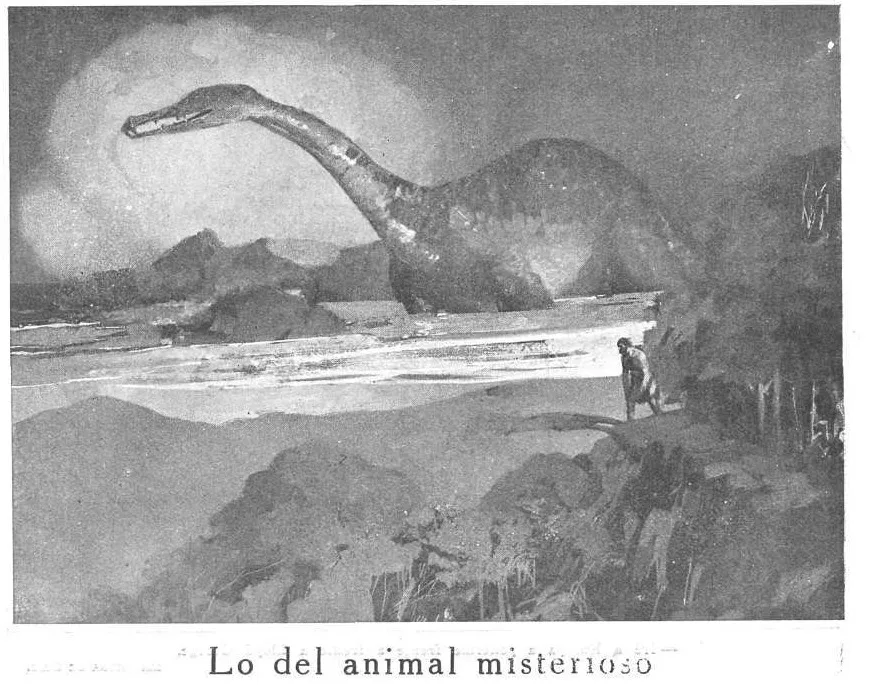
The head of Onelli’s article in Caras y Caretas, 18 March 1922, with Sheffield’s letter printed below it. Unsigned illustration, “Lo del animal misterioso”, Caras y Caretas no. 1224 (1922). Imágenes procedentes de los fondos de la Biblioteca Nacional de España, Hemeroteca Digital, CC BY 4.0, cropped.8
Caras y Caretas printed the letter on 18 March 1922, in a boxed panel inside Onelli’s own article, “Lo del animal misterioso”.8 Sheffield is not reporting a plesiosaur there. He is asking for money and equipment: a launch, which he says can be built at Esquel, harpoons, and embalming material in case the animal cannot be taken alive, with a firm in Esquel, Pérez-Gabito, to advance the means.14 The lagoon has no name in the letter, and the date line is the only place it gives.2
he podido apercibir en medio de la laguna un animal enorme con cabeza parecida a un cisne de formas descomunales, y el movimiento del agua me hace suponer un cuerpo de cocodrilo1
I have been able to make out, in the middle of the lagoon, an enormous animal with a head like a swan, of monstrous proportions, and the movement of the water makes me think its body is that of a crocodile
The rest of the animal is a trail like the track of a very heavy chata, a flat wagon, with the grass flattened and not springing back.1 Onelli says in the same article that he met Sheffield in 1898 or 1899, when Sheffield was about thirty, tall and stout, wearing gaucho trousers and in the habit of firing his revolver between his horse’s legs as he rode away from visitors.15 Sheffield was North American, according to Perez, Toledo, Vizcaíno and Tonni (2024) and to a Caras y Caretas diarist, who calls him “el norteamericano que ha escrito a Onelli”.9 The whole letter is transcribed and translated.
A question mark in a headline
Onelli did not publish at once. Per Perez and colleagues, he sent La Nación a note printed on 6 March 1922 under a headline that ended “¿Será un plesiosauro?”; in it he said he had held the news back for a while to be first to mount an expedition, and had already told the director of the Museo de La Plata.3 The authors argue that the headline gave the animal its new identity.2 On 18 March his article in Caras y Caretas called the plesiosaur “problemático” and said none of those beasts had been seen ni por el padre Adán, “not even by Father Adam”, who had no Kodak with him anyway.816
The press took it from there. Caras y Caretas ran Redondo’s cartoons, and on 8 April a mock letter signed “El Plesiosauro”, written from Epuyén, addressed to the president of the animal-protection society and invoking law 2786.17 Tangos, cigarettes and a fashion brooch took the name.17 The governor of Chubut, Orestes Franzoni, decreed a ban on hunting the plesiosaur, per Perez and colleagues, and Onelli had to go to the minister to have it annulled.18 Frederic Loomis of Amherst College, who had collected fossils in Patagonia in 1911, told La Nación that the animal would be a water snake, probably an anaconda.19
The mock letter puts the animal at Epuyén on 8 April, although the printed letter names only Esquel.217 How the place became public is not explained in anything we read.
The animal Onelli said he wanted
Onelli’s own answer to the plesiosaur question, as Perez and colleagues report it, was to disown the word. They quote him telling the New York Times on 16 March that “Plesiosaurus is a pseudonym the newspapers have given it”, and telling Mundo Argentino six days later that he had not declared it a plesiosaur at all; he expected an edentate, a form between anteaters and armadillos and a close relative of the giant ground sloth Megatherium.4
The idea was older than the letter. Florentino Ameghino had announced in 1898 that a ground sloth survived in southern Patagonia, and hunting parties went out over the next three years. Hesketh Prichard, who led one, wrote that he had found “no single scrap of evidence”.20 Perez and colleagues conclude that Onelli’s purpose in 1922 was to keep that search going, and that calling the plesiosaur a pseudonym suggests he did not think it realistic.21 They also note that the party still looked into the evidence for a water animal.21
On 12 June the Star in Christchurch printed that Onelli was not sure of the monster’s scientific name but “certain of its existence”, and that the creature was covered with reddish hair and protected by horny plates, against which Remington rifles had proved useless; the same column describes a plesiosaur as an extinct marine reptile with four limbs developed as paddles.5 On our reading the two descriptions do not match. Perez and colleagues quote Onelli’s October 1922 article as saying the expedition also carried a programme for surveying the region’s resources, to curb a drain of more than 100,000,000 gold pesos a year spent abroad on raw material.22
Epuyén, where Sheffield was not
The party was led by an engineer, Emilio Frey, who left ahead of the others.23 Perez and colleagues add Santiago Andueza, a marksman, Alberto Merkle, a taxidermist of the Museo de La Plata, and the journalists Guillermo Estrella of La Nación and Augusto Vaccari of Caras y Caretas.23 The zoo’s administrator, José M. Cinaghi, was the deputy chief; Caras y Caretas prints his name that way under the party’s photograph.10
Onelli told La Nación the party would go by sea to San Antonio and take the Patagonian railway to Punta de Rieles. That was a false route, and the others went straight to Neuquén.24 Vaccari had suspected it: Lo hizo usted para despistar, he tells Onelli in his diary, “you did that to throw us off”.24
The main party left on 23 March, drove from Neuquén to Bariloche, and reached Lake Nahuel Huapi on 30 March, per Perez and colleagues.6 On 17 April they set out for the Hoyo de Epuyén and came to Sheffield’s lagoon on 20 April.6 Sheffield was not there. He was convalescing in a town near Esquel, and they met his wife and children instead.11 They searched the shallow lagoon beside the family’s hunting post, once on a raft, and left on 24 April.6 They were back in Bariloche on 28 April, tried Lake Gutiérrez, and set off down the Limay on 3 May.6
The commission found neither the plesiosaur nor the sloth Onelli expected, and a cable dated 28 April, printed in New Zealand in May, said the party had come back “empty-handed, unable to find the reported plesiosaurus, if such ever existed in Patagonia”.7
Cinaghi doubted the name too. In Vaccari’s diary he tells the journalist that the animal “no será plesiosaurio, será otra cosa”, but that it is not hard to believe it exists, because the hunter asked for the means to catch and keep it rather than for an expedition.25
What the cables made of it
New Zealand newspapers show how the story shifted on its way abroad. The Southland Times of 22 March printed a London cable of 20 March, from the Daily Mail’s Buenos Aires correspondent, saying an expedition had left to search for the plesiosaurus and that scientists ridiculed the idea.12 Perez and colleagues have only Frey leaving on 16 March and the main party on 23 March.6 By 5 May the Star had an Englishman who hunted in Chubut and found a trail of flattened vegetation.13 By 12 June it had a commander called Señor Frers.5 Sheffield was North American, and we take Frers to be Frey, though no source says so.923
| The story | The record | Verdict |
|---|---|---|
| The hunter saw a plesiosaur | A swan-headed animal; no plesiosaur in the letter; the word comes with a headline of 6 March123 | Added later (1922) |
| Onelli was sure it was a plesiosaur | A “pseudonym”, per Perez; name unsure, per the Star45 | Contradicted |
| The expedition returned empty-handed | Neither plesiosaur nor sloth found7 | Confirmed |
| The hunter was English | North American9 | Contradicted |
A float at the Bariloche carnival
At the Bariloche carnival of 12 and 13 February 1923, per Perez and colleagues, a float in the “El Plesiosauro” troupe carried a mechanical plesiosaur with figures that included journalists and “Don Clemente” holding a syringe.26 The troupe was run by Primo Capraro, a wealthy Italian resident of Bariloche who had offered the party his help.26 The float was used in later carnivals until a sawmill fire destroyed it.26
Onelli died on 20 October 1924, and Perez and colleagues say the search was nearly forgotten after it.27 They say the name Nahuelito for the lake monster of Nahuel Huapi was given by the Bariloche journalist Carlos Bustos in the 1970s, and that Patagonian mentions of a plesiosaur in fresh water came before those for Loch Ness.28
What we could not verify
Sources we have not seen
- Onelli’s “El mamífero misterioso” (Revista Cultural del Jardín Zoológico, 1922), which would give his aim in his own words. It is not on the Internet Archive and we found no digitised copy.
- La Nación of 6 March 1922, with Onelli’s note and its headline, and the New York Times of 16 March, with his interview. We found no digitised La Nación for 1922, and the Times archive refused our fetch.
- Brinkman and Vizcaíno (2014), which Perez and colleagues cite for the date the party left. Its abstract is about Onelli’s 1888 to 1889 trip on the Río Santa Cruz.29 The publisher’s page and the CONICET copy refused access.
Seen only where others quote them
Questions we could not settle
- Who paid for the expedition, and whether the plesiosaur story helped raise money: nothing we read says so.
- How Epuyén became public by 8 April.
- What became of Sheffield after April 1922.
Read next
CaseVärend, Småland, Sweden, 1883 to 1889
The lindworm reward in Småland was never claimed
TaleEdam and Haarlem, Holland, Netherlands, 1403 to 1786
Before the Edam mermaid had a tail
TaleUasin Gishu and the Nandi forest, Kenya, 1909 to 1927
The Nandi bear and the devil called Chemosit
Sources
- Onelli, "Lo del animal misterioso", Caras y Caretas no. 1224, leaf n54 (primary) transcription
- Perez et al. 2024, p. 225 (place), p. 226 (headline)↑
- Perez et al. 2024, pp. 225-226 (La Nacion, 6 March 1922, cited as 1922a; not seen)↑
- Perez et al. 2024, pp. 227-228 (NYT and Mundo Argentino not seen)↑
- Star (Christchurch), 12 June 1922, p. 6, column "Monster of the lake", Papers Past TS19220612.2.63↑
- Perez et al. 2024, pp. 229-230 (from letters in the Museo de la Patagonia dated 22 March and 3 May 1922 and from La Nacion; the 23 March date is cited to Tonni et al. 2003 and Brinkman and Vizcaino 2014, not seen)↑
- Perez et al. 2024, p. 230
- Manawatu Standard, 11 May 1922, p. 5, "Plesiosaurus not found", Papers Past MS19220511.2.28
- Feilding Star, 13 May 1922, p. 4, "Expedition fails", Papers Past FS19220513.2.66↑
- Onelli, "Lo del animal misterioso", Caras y Caretas no. 1224, leaf n54 (primary) transcription
- Perez et al. 2024, p. 225↑
- Augusto Vaccari, "El premio a la perseverancia", Caras y Caretas no. 1227, leaves n69-n70 (primary)
- Perez et al. 2024, p. 225↑
- Vaccari, "El premio a la perseverancia", Caras y Caretas no. 1227, leaf n69 (caption), leaves n69-n70 ("administrador del Zoo... uno de los expedicionarios") (primary)
- Perez et al. 2024, p. 228↑
- Perez et al. 2024, pp. 229-230 (letter in the Museo de la Patagonia, 3 May 1922, not seen)↑
- Southland Times, 22 March 1922, p. 5, "The plesiosaurus", Papers Past ST19220322.2.35↑
- Star (Christchurch), 5 May 1922, p. 6, "Here and there", Papers Past TS19220505.2.56↑
- Onelli, "Lo del animal misterioso", Caras y Caretas no. 1224, leaf n54 (primary) transcription
- Perez et al. 2024, p. 230↑
- Onelli, "Lo del animal misterioso", Caras y Caretas no. 1224, leaf n54, left and right columns (primary)↑
- Onelli, "Lo del animal misterioso", Caras y Caretas no. 1224, leaf n54, left column (primary)↑
- Caras y Caretas no. 1227, 8 April 1922, "Carta del plesiosaurio al Dr. Albarracin", leaf n7 (primary)
- Perez et al. 2024, pp. 226-228↑
- Perez et al. 2024, p. 227 (El Chubut not seen)↑
- Perez et al. 2024, p. 227 (La Nacion not seen)↑
- Perez et al. 2024, pp. 218-223 (Prichard 1902, p. xiv, quoted on p. 223)↑
- Perez et al. 2024, p. 230, p. 236↑
- Perez et al. 2024, p. 230 (Onelli 1922, Revista Cultural del Jardin Zoologico 66-68, pp. 153-155, not seen)↑
- Vaccari, "El premio a la perseverancia", Caras y Caretas no. 1227, leaves n69-n70 ("El jefe de la expedicion acaba de marcharse... el ingeniero Frey") (primary)
- Perez et al. 2024, pp. 228-229↑
- Vaccari, "El premio a la perseverancia", Caras y Caretas no. 1227, leaf n69 ("la expedicion sale por via acuatica, lleva a San Antonio... Punta Rieles... Lo hizo usted para despistar") (primary)
- Perez et al. 2024, p. 229↑
- Vaccari, "El premio a la perseverancia", Caras y Caretas no. 1227, leaf n70, in the exchange that follows "Fui en busca del senor Cinaghi" (primary)↑
- Perez et al. 2024, pp. 229-230 (Capraro as a wealthy Italian resident of Bariloche on p. 229; La Nueva Era and La Patria degli Italiani, 1923, not seen)↑
- Perez et al. 2024, p. 231, p. 236↑
- Perez et al. 2024, p. 236↑
Documents quoted
- Martin Sheffield to Clemente Onelli, Esquel, 19 January 1922 (transcribed from the page image)