 Twice Told
The Nandi bear and the devil called Chemosit
The first detailed account of the Nandi bear, printed in 1912, gives no year for the sighting. A 1909 book on the Nandi calls Chemosit a one-legged devil.
Contents
Published 8 Oct 2026. Sources checked 10 Oct 2026.
The first detailed description of the Nandi bear that we found, in the Journal of the East Africa and Uganda Natural History Society, gives no year for when the animal was seen.32 Geoffrey Williams wrote only that it was “several years ago” and “just after the Nandi expedition”.2 The Journal ran his letter in July 1912.1
The name was older than the letter. In 1909 A. C. Hollis’s book on the Nandi had described a devil called Chemosit, half man and half bird, with one leg.5 Apart from Hollis’s book, the reports below were printed in that one Journal, and each is dated by its issue.11112131415 What the Nandi said reaches us only in the writers’ own words; none of them quotes a speaker.16
The story, as the Journal’s writers of 1912 and 1914 said the Nandi told it, goes like this.
It went about at night. It was large and fierce, and at times it stood up on its hind legs.17 It killed people or animals.17
Years ago one climbed up on the roof of a hut and broke through, and it killed the people inside.18 The others burnt the hut down with the animal in it.18 Otherwise it was never killed, because it came only at night, was very rare, and attacked only people who were alone, who never returned to tell the tale.18
In the Maraquet district another one grew so bad that the men made great preparations to kill it. They put a dummy man in the doorway of a hut and sat inside, and when the animal came to take the dummy they shot it with arrows.19
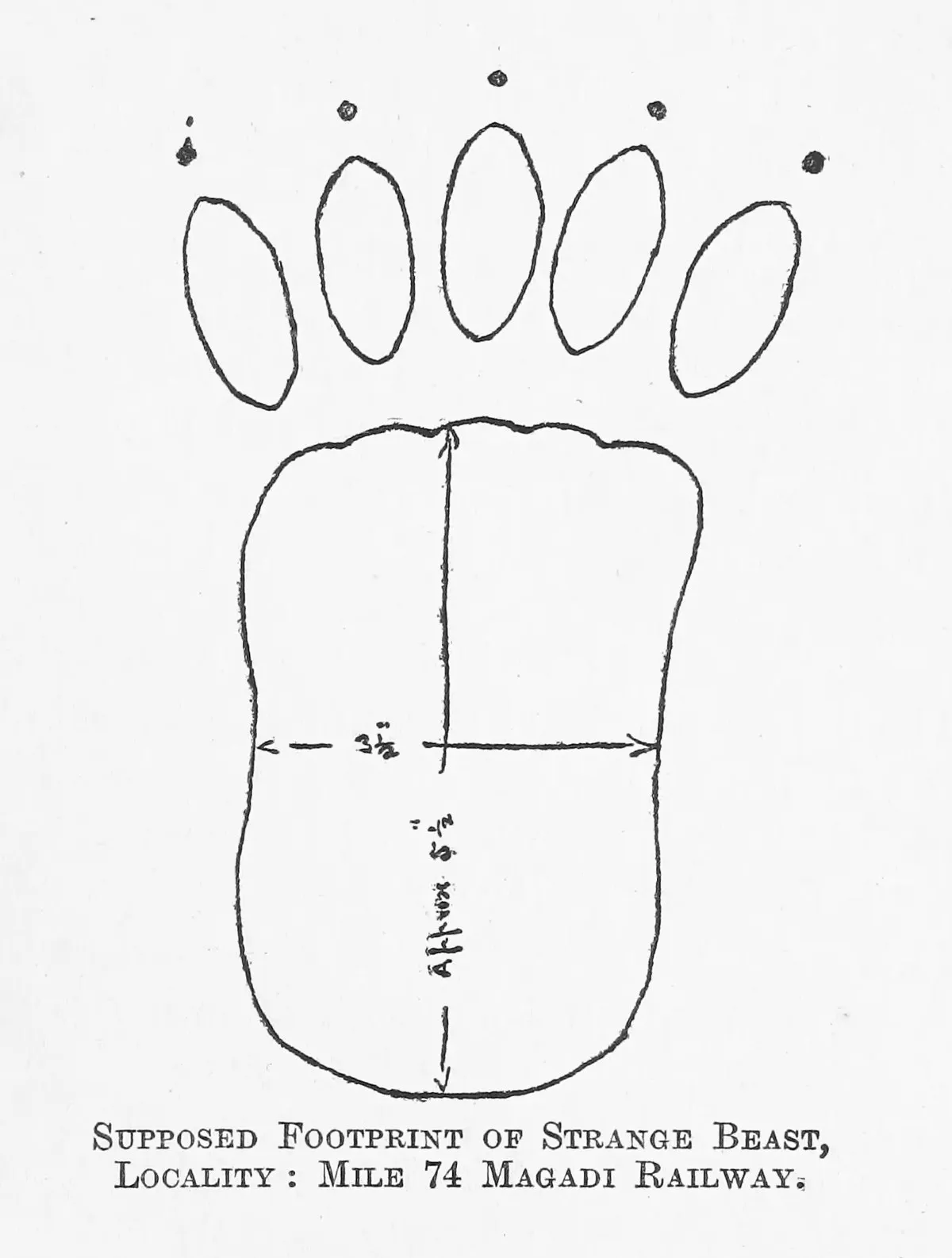
Supposed footprint of a strange beast, Mile 74, Magadi Railway, from C. W. Hobley, Journal of the East Africa and Uganda Natural History Society, vol. III, no. 6 (1913), p. 49. Image from the Biodiversity Heritage Library. Contributed by Smithsonian Libraries.20
A devil in a book, 1909
The earliest text we found that uses the name Chemosit describes a devil, not a bear. Hollis wrote:5
There is also a devil called Chemosit, who is supposed to live on the earth and to prowl round searching to devour people, especially children.5
He adds that the devil is half man and half bird, has one leg “but nine buttocks”, leans on a spear-like stick as a crutch, and lures children at night with a song.5 Sir Charles Eliot’s introduction to the book calls it “a fantastically shaped ogre rather than a spirit”.21 Neither writer gives the word a meaning in Nandi.22
Hobley’s bear in the forest, before March 1911
C. W. Hobley already had the animal on paper by 1911. In a short note on a potto in the Journal’s first volume, he wrote that for some years he had been collecting stories of “a queer beast which inhabited the Nandi forest”.4 One European had seen a specimen on the Uasingishu plateau “and declared it was a bear”, and from Nandi came stories of an animal that attacked women gathering firewood.4 Hobley does not name the European in the note.4
The note stands in the second number of volume I, which came out before the number dated March 1911.23 Hobley thought the matter closed. A native had brought a young potto, a “lemuroid beast” about two feet long, to a Mr. Brett from the Kakamega Forest, and its head was said to look “extraordinarily like that of a bear” at a little distance.8 Hobley wrote that he believed “we have solved the question of the mysterious beast of the Nandi Forest”.8
Williams, July 1912
The letter describes the animal in detail. Williams and a cousin were walking ahead of their safari on the Uasingishu in a thick mist.3 When it lifted, he saw a large animal sitting up on its haunches not more than 30 yards away, nearly 5 feet high, in the attitude of “a bear at the ‘Zoo’ asking for buns”.3 It had thickly furred fore quarters and legs, bare hind quarters and a long pointed head, and it shambled off before he could fire a second shot.3
The date is the problem. Williams says only that it happened several years before and “just after the Nandi expedition”, when nobody had yet settled on the plateau.2 Hollis dates the Nandi punitive expedition to 1905 and 1906 and says it closed in April 1906.24 If Williams means that expedition, which is our reading and not his statement, he saw the animal in 1906 or after, and his letter followed it by about six years at most. The sighting could be later than that, and it could be earlier than the letter by only a few years. Williams never gives a year.
The name came to him afterwards. “Since then I have learnt,” he writes, that the Nandi know the animal as Chemosit, and their description “tallies with mine”.25 He had shown the boy who was with them a book of animal pictures, and the boy picked a brown bear.25 A few days before he wrote, a friend brought one of his old Nandi servants down to Nairobi, and he was shown the Jungle Book illustrations and picked Baloo, the Indian bear.25 Each man was choosing from the pictures he was given, which is our observation, not Williams’s.
He heard of a similar beast near Kabras, where people warned him not to sleep with his tent door open for fear of the “Shivuverre”, something like a hyena “only infinitely larger”.18 He was certain, he adds, that it was not a baboon or an ant-bear.26 The early-morning hour of his own sighting, he writes, is explained by the Nandi: the mist hid the daylight from it.27
Hobley’s paper, July 1913
Hobley’s paper “On some unidentified beasts” says that since Williams’s letter he has made “extensive inquiries” and that the animal “still eludes the collector, but the circle is narrowing”.7 He sets out the accounts from Toulson and Corbett, and Hickes’s note is a separate piece in the same issue. They differ.282930
Major Toulson, a settler on the plateau, saw one at dusk, about 18 to 20 inches high at the shoulder, black, with “long hair behind” and a bear’s shuffling walk; he also passed on what Dutchmen had told him about a bear-like animal seen at dusk.28 N. E. F. Corbett, the District Commissioner at Eldoret, walked “right into” an animal that was “evidently drinking” in the Sirgoi River, “only a yard or so away”, reddish-brown with a streak of white, “rather bigger than a hyena”.29 The third report is from the Magadi Railway. G. W. Hickes, the engineer in charge of construction, writes that he saw an animal from his motor-trolley, first took it for a hyena, and then saw it was about as high as a lion, tawny and very shaggy.30
The figure on this page shows a footprint that Hobley says railway engineers found on the cart-track that came before the railway.20 His caption puts it at Mile 74; Hickes says engineers saw a strange spoor “at about Mile 71”, sketched and described as a bear’s.2031 Hickes meant to stop for the spoor of his own animal on the way back, but heavy rain made him drive on.30
| Report | Seen | Printed |
|---|---|---|
| Williams | After the Nandi expedition, no year2 | July 19121 |
| Toulson | “Some time ago”28 | July 191311 |
| Corbett | March 191329 | July 191311 |
| Hickes | 8 March 191330 | July 191311 |
Corbett and Hickes were printed within months of what they saw, and Hickes’s note is dated 11 April 1913.3032 Williams and Toulson give no date for theirs.228
Hobley asks the obvious question. Some sceptics think the animal is only the hairy ant bear, he writes, but most who have seen it know the ant bear, and an ant bear seen in broad daylight would be “an almost unique phenomenon”.33 He allows that the animal near the railway “may not be the same as that seen on the Uasin-Gishu”.33 The rest of the paper goes on to a lake monster of Lake Victoria and a forest beast of the Tana valley.34
Percival, August 1914
Percival’s note “The Chemosit” is the first text we read that calls the animal “the chemosit or chimiset or Nandi bear”.17 Williams’s letter and Hobley’s paper use neither “Nandi bear” nor “chimiset”, on our reading of both.35 Percival collected the stories and was not convinced by them.36
He lists what the stories agree on: a fairly large animal, nocturnal, very fierce, standing on its hind legs at times.17 He rules out a monkey, since “all native accounts” make it nocturnal.37 He is “quite in the dark about the beast” and “still a bit doubtful about its existence as a new animal”.36 In the Sotik country he followed a similar description to a ratel: a picture of one settled it, once he learned the animal was “light on the back and dark below”.36
His own view is that “the chimiset consists of a number of animals”, with the chimpanzee as a base, then ratel, leopard, lion, baboon, bush pig and hunting dog.9 Among white men, he adds, “any animal that cannot be recognised is apt to be put down at once to the ‘undescribed’ animal”.9 He also says the strongest point in favour of the animal is that it has a native name and appears to be well known among the Nandi, and that the Nandi and Magadi reports are of “totally different animals”.38
Percival says Hobley “quoted” Williams.39 Hobley’s paper names Williams in a sentence and prints nothing of his text.
Andrews, November 1924
A different answer arrived ten years later. C. W. Andrews, in a note the Journal published after his death, wrote that a chalicothere, a clawed fossil ungulate, “may have survived till the present day and may form the basis of the numerous stories of strange animals”.10 He cites Hobley, Williams and Hickes and says both of their animals are described as “a heavily built, bear or hyaena-like creature”.10 Percival had said the Nandi and Magadi reports were of different animals; Andrews treats them as one description.3810
Andrews cites Williams’s note as “vol. II., 1911, p. 123”. The issue is dated July 1912.40 The note is in the number dated November 1924.13
What the name was said to mean
By 1926 the name had acquired a theory of its own. C. Cardale Luck, in an essay on the origin of the Maasai in the Journal for August 1926, wrote that the Nandi devil was, “we believe”, originally the sun-god of the ancient Moabites, Chemosh, “degraded to an evil deity” on his way through Egypt.4114 Bolton answered in the Journal for January 1927 that Luck “gives no evidence of a Moabite migration to central Africa” and asked, if Chemosit derives from a Moabite god, “why does he rank as a devil amongst the Nandi?”42
The same number carried a letter from I. Q. Orchardson, who asked among the Kipsigis.156 “One finds no belief”, he wrote, “that the Chemosit is a devil or spirit or god or man”.6 His informants said it is “only an animal”: some said it looks like a huge man at a distance because it stands up on its hind legs, a few old men said they had seen it at night, and their descriptions “include fur, whiskers”.6 The crutch in Hollis’s book “is quite unknown here”.43 The young men “deny having seen it”, he adds, “but love to tell children and unsuspecting Europeans fancy tales of it”.43
The name, Orchardson writes, was not said at night; people then used another, “Gononet”, “of which I do not know the derivation”.44 Chemosit itself is “a fairly common man’s name”, and mothers use it to make children obey.44 None of these writers gives the meaning of the word.22
What we could not verify
Sources we have not seen
- R. I. Pocock, “The Story of the Nandi Bear”, Natural History Magazine (1930), which later writers cite on the animal; it would show whether a zoologist of the 1930s settled on a known animal. We found no scan of the magazine on the Internet Archive, and the Biodiversity Heritage Library refused our automated requests, so we could not search its holdings.
Questions we could not settle
- When Williams saw the animal. His letter says only “just after the Nandi expedition”; the year 1905 attached to it in later retellings is in none of the Journal pieces we read.
- Who Hobley’s “one European” of 1911 was. He is not named; Williams is the obvious candidate, but Hobley does not say so.
- What the Nandi word chemosit means, and whether the devil Hollis heard of and the animal Williams was told of were ever the same figure in Nandi speech.
Read next
CaseTsavo River, Kenya, 1898
The Tsavo man-eaters: 28 counted in 1907, 135 by 1925
TaleLikouala, Republic of the Congo, 1776 to 1997
Mokele-mbembe, report by report, since 1776
CaseVärend, Småland, Sweden, 1883 to 1889
The lindworm reward in Småland was never claimed
Sources
- G. Williams, "An Unknown Animal on the Uasingishu", Journal of the East Africa and Uganda Natural History Society 2 (4): 123-125, p. 123 (heading and first lines) (primary) transcription
- Journal of the East Africa and Uganda Natural History Society, vol. II, no. 4, contents page, contents page, "July, 1912. VOL. II. No. 4", which lists the Williams article (primary)
- C. W. Hobley, "On some unidentified beasts", Journal 3 (6): 48-52, p. 48, first sentence (primary)↑
- G. Williams, "An Unknown Animal on the Uasingishu", Journal 2 (4), pp. 123-124 (primary) transcription↑
- G. Williams, "An Unknown Animal on the Uasingishu", Journal 2 (4), p. 124 (the OCR reads "80 yards"; the page image reads "30 yards") (primary) transcription↑
- C. W. Hobley, "Kavirondo Potto", Journal 1 (2): 111, p. 111, second and third paragraphs (primary)↑
- A. C. Hollis, The Nandi (1909), p. 41, paragraph 5 (religious beliefs) transcription↑
- I. Q. Orchardson, "III. The Chemosit", Journal no. 28: 19-23, p. 23, first paragraph (primary) transcription↑
- C. W. Hobley, "On some unidentified beasts", Journal 3 (6): 48-52, p. 48, first paragraph (primary)↑
- C. W. Hobley, "Kavirondo Potto", Journal 1 (2): 111, p. 111, fourth and fifth paragraphs (primary)↑
- A. B. Percival, "The Chemosit", Journal 4 (8), p. 128 (primary) transcription↑
- C. W. Andrews, "Notes on the occurrence of a species of chalicothere in Uganda", Journal no. 20 (November 1924), p. 23 (the note begins on the page before, which we did not read as an image) (primary)↑
- Journal, vol. III, no. 6, cover and contents pages ("July, 1913. VOL. III. No. 6"), cover page; contents list "Some unidentified beasts ... 48" (primary)↑
- Journal, vol. IV, no. 8, cover ("August, 1914. VOL. IV. No. 8"), cover page (primary)↑
- Journal, no. 20, cover ("November, 1924. No. 20."), cover page (primary)↑
- Journal, no. 26, cover and contents page ("August, 1926. No. 26."; Luck, chapter V, "Religious beliefs ... of various Central African tribes", p. 138), cover page, read on the page image (primary)↑
- Journal, no. 28, cover and contents pages ("January, 1927. No. 28"; "Date of publication April, 1927"), cover and contents pages (primary)↑
- G. Williams, "An Unknown Animal on the Uasingishu", Journal 2 (4), pp. 124-125 (primary)
- A. C. Hollis, The Nandi (1909), p. 41; the three informants are named only in the preface
- A. B. Percival, "The Chemosit", Journal 4 (8), p. 127, paragraph 2 (primary)
- I. Q. Orchardson, Journal no. 28, p. 23, section III (primary)↑
- A. B. Percival, "The Chemosit", Journal 4 (8): 127-128, p. 127, paragraphs 1 to 4 (primary) transcription↑
- G. Williams, "An Unknown Animal on the Uasingishu", Journal 2 (4), p. 125, paragraphs 5 to 8 (primary) transcription↑
- A. B. Percival, "The Chemosit", Journal 4 (8), p. 127, paragraph 6 (primary) transcription↑
- C. W. Hobley, "On some unidentified beasts", Journal 3 (6), pp. 48-49, text on p. 48 and the figure and caption on p. 49 (primary)↑
- C. Eliot, introduction to A. C. Hollis, The Nandi (1909), p. xx, lines 1 to 3↑
- A. C. Hollis, The Nandi (1909), p. 41
- I. Q. Orchardson, Journal no. 28, p. 23, section III (primary)↑
- Journal, vol. I, no. 2, contents page (lists "Kavirondo Potto. C. W. Hobley ... 111") and vol. II, no. 3, cover ("March 1911"), no. 2 contents page; no. 3 cover page. The no. 2 pages carry no month in the scan we read. (primary)↑
- A. C. Hollis, The Nandi: their language and folk-lore (Oxford: Clarendon Press, 1909), preface, p. vi ("the punitive expedition of 1905-6"; preface signed October 1908) and p. iv (the warrior employed "after the close of the Nandi punitive expedition in April, 1906"; OCR only for the second)↑
- G. Williams, "An Unknown Animal on the Uasingishu", Journal 2 (4), p. 125, paragraphs 2 to 4 (primary) transcription↑
- G. Williams, "An Unknown Animal on the Uasingishu", Journal 2 (4), p. 125, last paragraph (primary) transcription↑
- G. Williams, "An Unknown Animal on the Uasingishu", Journal 2 (4), p. 125, second to last paragraph (primary) transcription↑
- C. W. Hobley, "On some unidentified beasts", Journal 3 (6), p. 48, paragraphs 2 and 3 (primary)↑
- C. W. Hobley, "On some unidentified beasts", Journal 3 (6), pp. 48-49 (page 49 begins "account is as follows"; the OCR reads "12.80", the page image "12.30") (primary)↑
- G. W. Hickes, "Notes on the unknown beast seen on the Magadi Railway", Journal 3 (6): 53-54, pp. 53-54 (dateline at the foot of p. 54) (primary)↑
- G. W. Hickes, "Notes on the unknown beast seen on the Magadi Railway", Journal 3 (6), p. 54, paragraphs 4 to 8 (primary)↑
- C. W. Hobley, "On some unidentified beasts", Journal 3 (6), pp. 48-50 (Corbett on pp. 48-49, Hickes on p. 50) (primary)↑
- C. W. Hobley, "On some unidentified beasts", Journal 3 (6), p. 50, paragraphs 2 to 4 (primary)↑
- C. W. Hobley, "On some unidentified beasts", Journal 3 (6), pp. 50-53 (primary)↑
- G. Williams, "An Unknown Animal on the Uasingishu", Journal 2 (4), pp. 123-125, every page read on the page image (primary)
- C. W. Hobley, "On some unidentified beasts", Journal 3 (6), pp. 48-52, every page read on the page image (pp. 48-50 as images, pp. 51-52 in OCR) (primary)↑
- A. B. Percival, "The Chemosit", Journal 4 (8), pp. 127-128 (primary) transcription↑
- A. B. Percival, "The Chemosit", Journal 4 (8), p. 127, paragraph 5 (primary) transcription↑
- A. B. Percival, "The Chemosit", Journal 4 (8), p. 128, last two paragraphs (primary) transcription↑
- A. B. Percival, "The Chemosit", Journal 4 (8), p. 127, paragraph 1 (the 1913 paper as we read it refers to Williams's article but does not quote it) (primary)↑
- C. W. Andrews, Journal no. 20, p. 23, p. 23, the paragraph beginning "Mr. C. W. Hobley in a paper" (primary)
- Journal, vol. II, no. 4, contents page, contents page, "July, 1912" (primary)↑
- C. C. Luck, "The origin of the Maasai and kindred African tribes", Journal no. 26, p. 139, first sentences (the essay dates its name for the Nandi devil as "Chemos" with the definite article "Chemosit", on the page before, which we did not read as an image) (primary)↑
- C. L. Bolton, "On the origin of various tribes of Kenya and Uganda other than Bantu", Journal no. 28, from p. 11, p. 12, section IV (primary)↑
- I. Q. Orchardson, "III. The Chemosit", Journal no. 28, p. 23, first paragraph, sentences 6 to 8 (primary) transcription↑
- I. Q. Orchardson, "III. The Chemosit", Journal no. 28, p. 23, second paragraph (primary) transcription↑
Documents quoted
- A. Blayney Percival, The Chemosit, Journal of the East Africa and Uganda Natural History Society, August 1914 (transcribed from the page image)
- A. C. Hollis, The Nandi (1909), p. 41: the devil called Chemosit (transcribed from the page image)
- Geoffrey Williams, An Unknown Animal on the Uasingishu, Journal of the East Africa and Uganda Natural History Society, July 1912 (transcribed from the page image)
- I. Q. Orchardson, The Chemosit, Journal of the East Africa and Uganda Natural History Society, January 1927 (transcribed from the page image)