 Twice Told
The Tsavo man-eaters: 28 counted in 1907, 135 by 1925
In 1907 Patterson wrote that the Tsavo lions ate 28 Indian workers. In 1925, when they went on show in Chicago, his figure was 135.
Contents
- Patterson’s papers, 1900 to 1925
- 135, the Chicago figure
- Twenty-eight Indians, uncounted Africans
- About 35, from isotopes
- Nine feet eight inches
- A broken canine
- Cattle plague
- Bodies on the caravan road
- Hair in the teeth
- Checking the museum’s version
- Quotations that changed
- Twenty-eight to 135
- What we could not verify
- Sources
Published 24 Sept 2026. Updated 6 Oct 2026. Sources checked 24 Sept 2026.
The number most people know comes from a pamphlet sold in Chicago. In 1925 the Field Museum of Natural History put two stuffed lions on show and printed a 40-page leaflet about them, Zoology Leaflet 7, written by the man who had shot them.83 Its first sentence reads:
When the visitor to the Field Museum pauses before the life-like forms of the Tsavo man-eaters, it will be hard for him to realize that these two ferocious brutes killed and devoured, under the most appalling circumstances, one hundred and thirty-five Indian and African artisans and laborers employed in the construction of the Uganda Railway.3
The leaflet doesn’t say where 135 comes from. Eighteen years earlier, in The Man-Eaters of Tsavo, the same author had given a different count, and only half of it was a number:4
Well had the two man-eaters earned all this fame; they had devoured between them no less than twenty-eight Indian coolies, in addition to scores of unfortunate African natives of whom no official record was kept.4
The opening page of the leaflet is transcribed on its own page, with notes on what changed since 1907.39
This is the story as the Field Museum tells it to its visitors, and as Patterson told it before that.
In March 1898 the British began building a railway bridge over the Tsavo River. Over the next nine months two maneless male lions killed and ate the railway workers. The crews built campfires and thorn fences, and nothing kept the lions out.10 The Indian workmen decided that these were not animals at all but devils in lions’ shape, the angry spirits of two dead chiefs who objected to a railway through their country.11
In December the lions brought the works to a standstill. Hundreds of workers fled, some of them throwing themselves across the line in front of the trains for Mombasa.12 On 9 December the railway engineer J. H. Patterson shot the first lion, and three weeks later the second.1 By then, the story says, they had killed 135 railway workers and Africans.10
That is where the museum’s version ends.
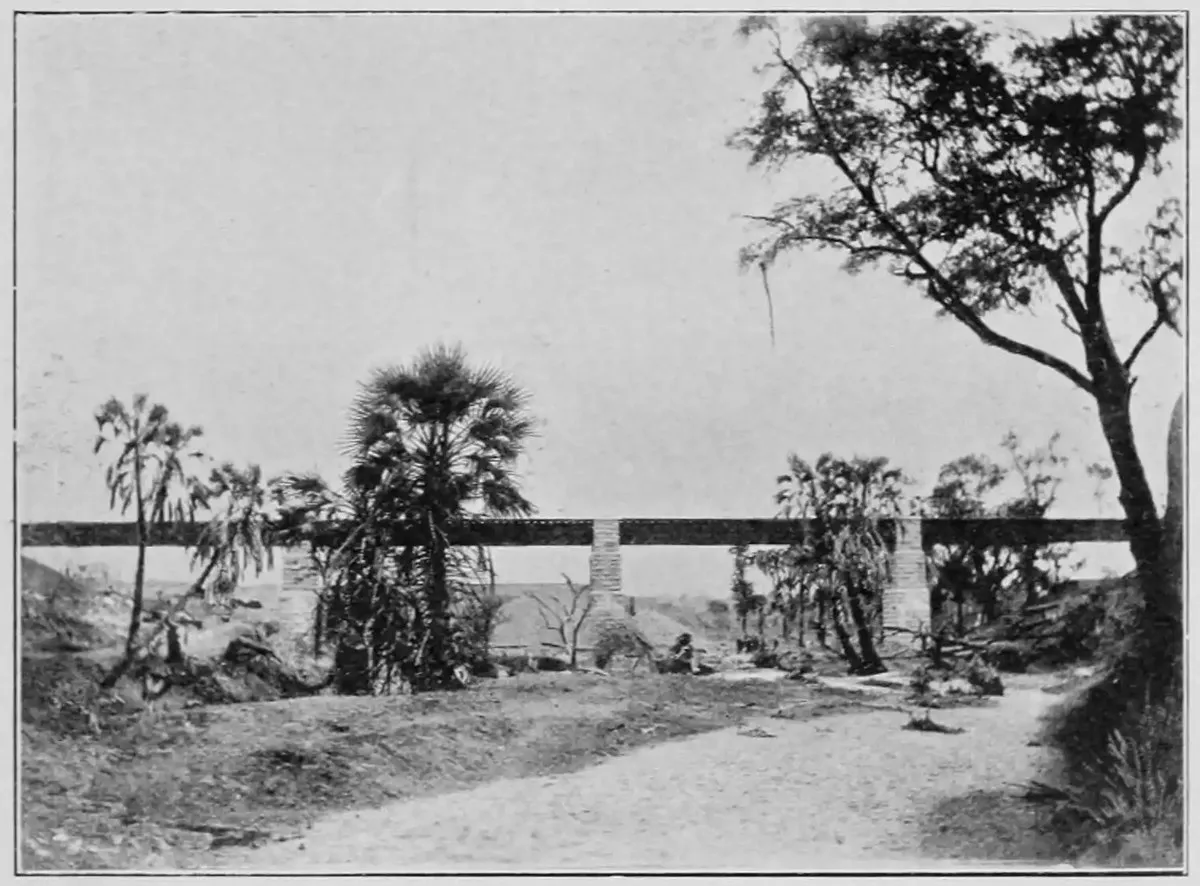
The completed Tsavo Bridge, from J. H. Patterson, The Man-Eaters of Tsavo (1907), p. 111, in the 1908 printing. Image from the Biodiversity Heritage Library. Contributed by University of Toronto, Gerstein Science Information Centre.1
Patterson’s papers, 1900 to 1925
Every count of the Tsavo dead from the time that we have read goes back to one man. John Henry Patterson, an engineer, was in charge of the bridge and the works around Tsavo, and it was his rifle that killed both lions, on 9 and 29 December 1898.1 His first account appeared in The Field on 17 and 24 February 1900. We have not read those two issues.13 What we have is a summary in The Spectator of 3 March 1900, which gives the earliest count we have found:4
In this time they killed and ate twenty-eight Indians, and it is believed at least twice this number of natives, Swahilis and the like; besides wounding and attacking others.4
Twenty-eight and at least twice as many again makes at least 84, our sum. The Spectator’s paragraph is on its own page.4
Patterson’s book followed in October 1907, with a foreword by the hunter Frederick Selous, who had first read the story in The Field.13 It keeps the 28 Indians and turns the Africans into “scores”, with no official record kept.4 On 29 November 1924 Patterson lectured at the Field Museum; he told its president, Stanley Field, that he still had the skins, and Field bought them for the museum.8 The skins had been kept for years as trophy rugs, never prepared for display.8 The museum’s taxidermist, Julius Friesser, mounted them, and the 1925 leaflet was printed for the new exhibit.8
The first victim Patterson names is one of his jemadars, a Sikh called Ungan Singh, seized from the tent he shared with other workmen about three weeks after Patterson reached Tsavo.14 Most of the others have no names in any of these texts.
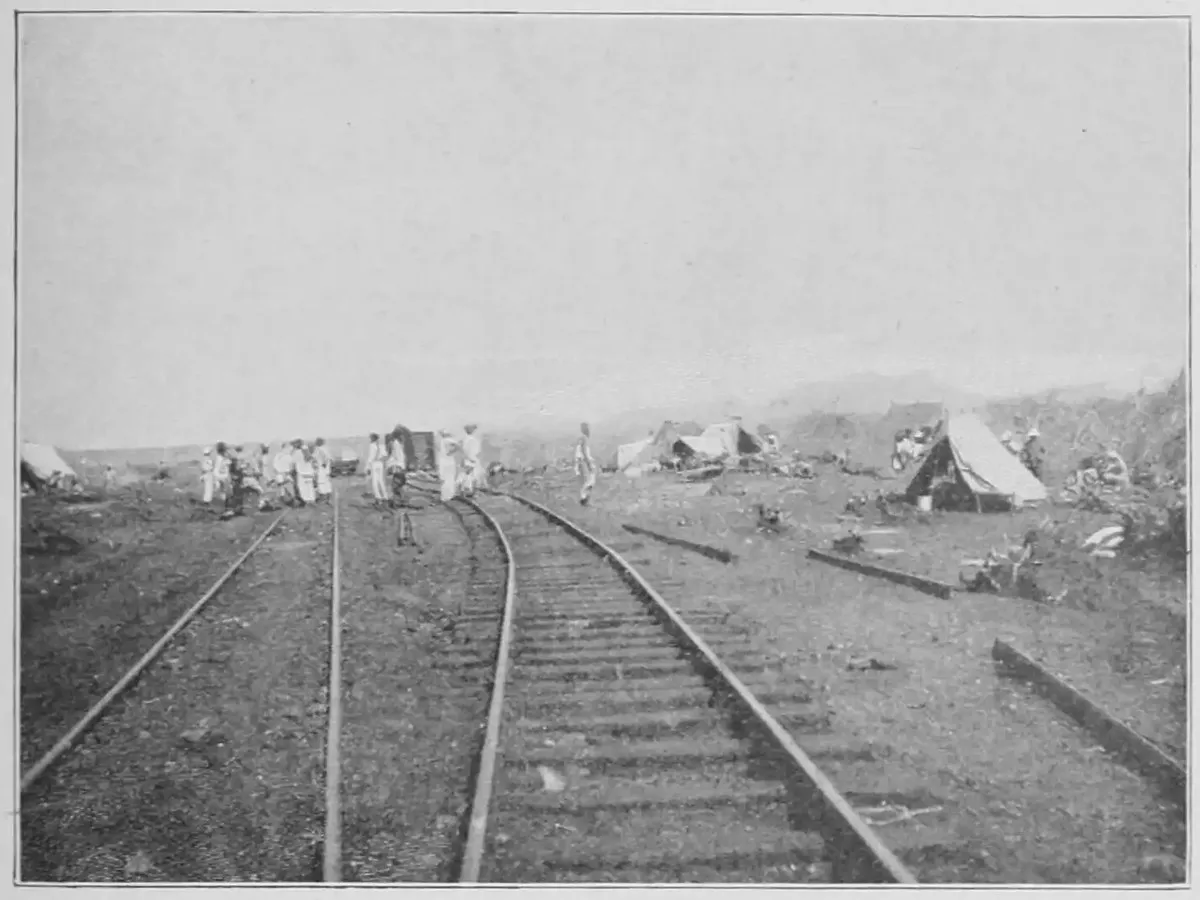
“The tent from which Jemadar Ungan Singh was carried off”, from J. H. Patterson, The Man-Eaters of Tsavo (1907), p. 23, in the 1908 printing. Image from the Biodiversity Heritage Library. Contributed by University of Toronto, Gerstein Science Information Centre.14
135, the Chicago figure
The figure of 135 has one author, writing in 1925, 27 years after the attacks.3 Kerbis Peterhans and Gnoske, who reviewed the Tsavo case for the Journal of East African Natural History in 2001, trace it to the 1925 leaflet, which they read as adding 107 Africans to the 28 Indians.3 The pages of the leaflet we read give no breakdown, only the total.
The museum took the number over at once. Its annual report for 1925 says the two lions “killed and, in most cases, devoured more than 130 human beings”.15 Its pages today still repeat 135 as Patterson’s figure, and add that later research brought it down to 35.15 DeSantis and Patterson (2017) and Yeakel and colleagues (2009) cite 135 to the 1925 leaflet.3 No scholar we read defends it.
Twenty-eight Indians, uncounted Africans
The 28 is the only part of any count that stays the same from 1900 to 1907.4 Kerbis Peterhans and Gnoske treat it as the documented minimum: between March and December 1898, at least 28 people were taken.16 They accept it because, they write, “the British maintained precise accounting details”, and they add three deaths from other writers, two railhead workers recorded by the engineer R. O. Preston before Patterson arrived and one man from a caravan in 1896, for a possible 31.16 Yeakel and colleagues call 28 “the Uganda Railway’s documented value”, but the reference they give for it is Patterson’s book.16
The African dead are the gap. Patterson’s own phrase, “scores … of whom no official record was kept”, admits there was no count.4 The 1900 summary’s “at least twice this number” is an estimate, which The Spectator offers as a belief, not a count.4 Nothing we read replaces either with a number.
About 35, from isotopes
In 2009 Justin Yeakel and seven colleagues, among them Bruce Patterson of the Field Museum (no relation to the colonel), measured carbon and nitrogen isotopes in the lions’ bone collagen and in the hair of their tail tufts. Bone records diet over years; the tail hair covers roughly the last three months of life.2 To stand in for human prey they used the skulls of Taita people collected in 1929, set against Tsavo’s grazing and browsing animals.2
The first lion shot, FMNH 23970, got about 30 percent of its food from people in its final months; the second, FMNH 23969, about 13 percent.2 From an intake of about 6 kilograms a day and about 20 kilograms eaten per person, they reckon 8.1 and 3.5 people in those three months, and 24.2 and 10.5 over the nine months of recorded attacks.2 That makes 34.7 in all, with a possible range of 4 to 72.2
The model counts people eaten, not people killed, and it stretches three months of hair across the nine months of attacks.2 Its median lands above the 28 and far below the 135.216
Nine feet eight inches
How big the lions were rests on one man’s tape. In The Man-Eaters of Tsavo, Patterson gives the first lion, shot on 9 December, as nine feet eight inches “from tip of nose to tip of tail” and three feet nine inches high, and says it took eight men to carry it back to camp.117 The second, shot on 29 December, measured nine feet six inches and stood three feet eleven and a half inches high.17 He does not say how he measured, or whether “high” means at the shoulder.
The same book offers a comparison. Later, on the Athi Plains, Patterson shot a lion he calls “a young, but full-grown lion in fine condition” and measured it at nine feet eight and a half inches, half an inch longer than the first man-eater.18 By his own tape, then, the man-eaters were no longer than a lion he met in the ordinary course of railway work; the comparison is ours. What the museum stressed in 1925 was not their size but their type: “two large males of the short-haired maneless type”.19
The mounts in Chicago can’t settle the question. The skins were trophy rugs until 1925,8 and the museum’s annual report says they “had been preserved for a number of years and were not prepared originally with a view to museum exhibition”, which gave its taxidermist “unusual difficulty”.20
A broken canine
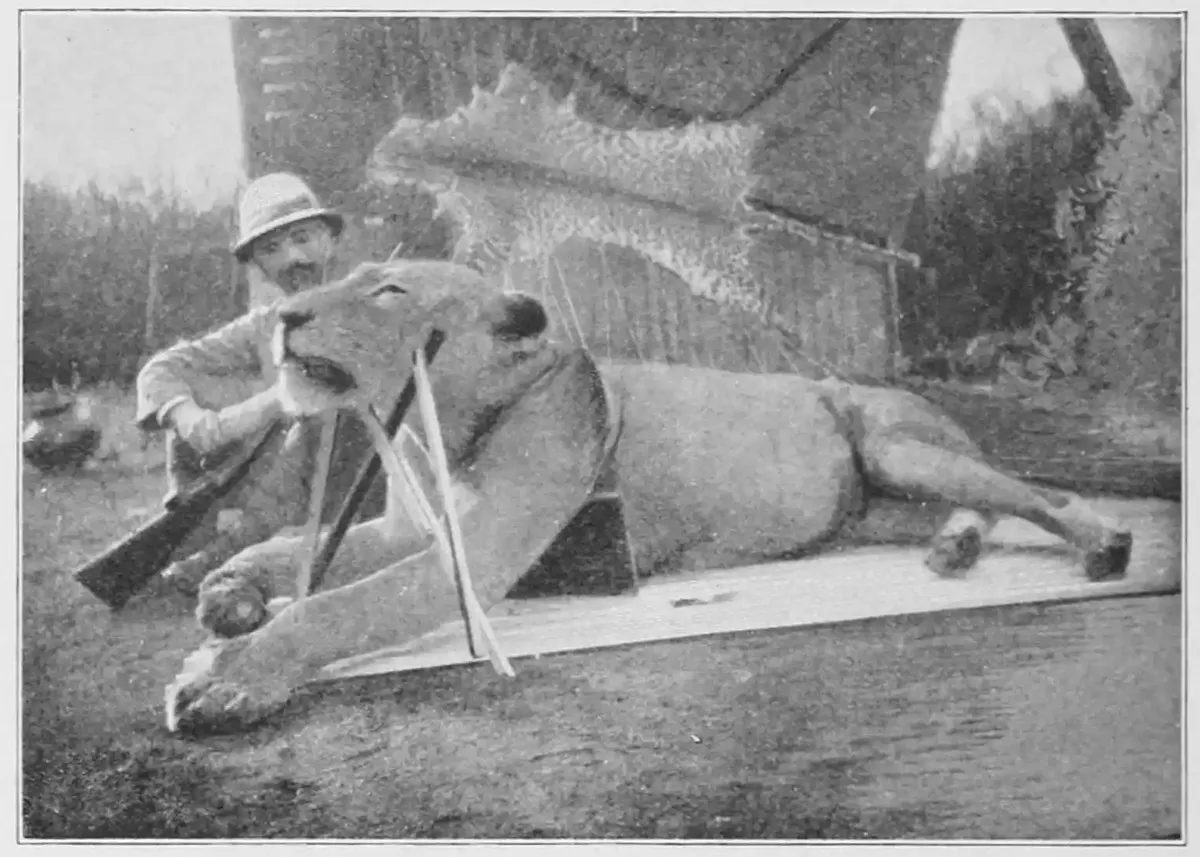
Patterson with the first man-eater, from the chapter on its death in J. H. Patterson, The Man-Eaters of Tsavo (1907), p. 92, in the 1908 printing. Its printed caption gives its length as nine feet eight inches. Image from the Biodiversity Heritage Library. Contributed by University of Toronto, Gerstein Science Information Centre.1
The first lion’s skull is the reason the teeth get so much attention. Its lower right canine was broken off with the pulp exposed, the root had an abscess, lower incisors were missing, and the jaws no longer met properly.21 Kerbis Peterhans and Gnoske think the injury happened early in its life and may have kept it from subduing its normal prey.215 Patterson had his own explanation, which appears in the 1925 leaflet and not in the 1907 book: on examining the head he found that “a .303 bullet had smashed out one of his tusks, for the track of the bullet was left in the tooth stump”, and he “must have given him a bad toothache” the night the lion attacked him and Dr Brock in a freight car.22 Yeakel and colleagues found that this lion was also the one that ate the most people, which they say “agrees well with the infirmity hypothesis”.52
The second lion’s case is weaker. It had a broken upper carnassial (Kerbis Peterhans and Gnoske also list a broken lower canine), an injury DeSantis and Patterson call fairly common in lions, and they suggest it “may have simply shared meals” with the first.215 Patterson, Neiburger and Kasiki (2003), who looked at lion skulls across museum collections, found tooth breakage normal and rarely serious; they allow the infirmity theory for Tsavo but explain most attacks on people and livestock by prey depletion.5
A 2017 study of microscopic wear on the man-eaters’ molars adds something the skulls alone can’t. The wear looks like that of ordinary wild lions and close to that of zoo lions fed soft meat.23 Larisa DeSantis and Bruce Patterson conclude that the lions were not crunching and eating whole carcasses in their last weeks, and that Patterson’s accounts of bone-crunching outside the camps are not supported.23 The Field Museum now sums up the current view in one line: people were easier to catch and chew.5
Cattle plague
Kerbis Peterhans and Gnoske also look past the teeth, at the land. Rinderpest, the cattle plague, reached Somalia in 1889 and had run through Kenya by the early 1890s, with another outbreak in 1897.6 Buffalo and cattle, the main prey of Tsavo’s lions, were still scarce in the late 1890s.6 Yeakel and colleagues add the Mwakisenge drought of 1897 to 1900 and read their isotope results as support for the idea that scarce prey pushes individual animals toward unusual food.6
Bodies on the caravan road
The railway followed a caravan route that had been used for decades. Kerbis Peterhans and Gnoske collect travellers’ accounts of porters and slaves left dead or dying along such routes, and of local burial customs. The Wataita dug up their dead and put the skulls in rock shelters, and the Wakamba were said to leave some bodies in the bush.7 The Taita skulls that Yeakel’s team used came from exactly such a practice: after about a year in the ground, skulls were exhumed and placed in ancestral caves.7
The argument is that lions at Tsavo had long had access to human bodies. The same review lists lions taking people near Tsavo before 1898, as far back as 1886 by the authors’ dating, and after: an engineer named O’Hara near Voi in March 1899, and the police superintendent C. H. Ryall, dragged from a railway carriage at Kima in June 1900.24 Patterson tells both of those stories himself.24 On the review’s list, the pair of 1898 were neither the first nor the last lions to take people near Tsavo.24
Hair in the teeth
In the early 1990s Thomas Gnoske, a Field Museum collections manager, noticed thousands of hairs packed into the lions’ broken teeth.25 A first look, reported in 2001, found hair from zebra, porcupine, warthog, impala, eland and oryx, and none from people.26 In 2024 Alida de Flamingh and colleagues read the DNA. They identified giraffe, human, oryx, waterbuck, wildebeest and zebra, as well as the lions’ own hair; the giraffe hair came from at least two Masai giraffes.25 Wildebeest are the odd one out: the nearest population in the late 1890s was about 50 miles away.25
Human hair in the teeth confirms what nobody doubted. The rest of the list matters more. It fits the first lion shot over a dead donkey, the second taking goats, and what the isotopes say: people were part of the lions’ food, not all of it.2627
Checking the museum’s version
| The story | The record | Verdict |
|---|---|---|
| They killed men only, ignoring game (1900) | Donkeys, goats, giraffe, zebra, oryx262527 | Contradicted |
| Bones crunched outside the tents | No bone-eating wear on the teeth23 | Disputed |
| Works stopped for three weeks | Patterson and The Spectator12 | Confirmed |
| Two maneless males | The Spectator, 1900; museum report, 192519 | Confirmed |
| Salisbury’s “enthusiastic sportsman” | Not in the Hansard debates we searched28 | Unsupported |
| 135 dead | 28 Indians counted; about 35 eaten on the isotope model42 | Disputed |
Quotations that changed
The number was not the only thing that changed between the book and the leaflet. In 1907 Patterson quoted Lord Salisbury, the prime minister, telling the House of Lords that “the whole of the works were put a stop to for three weeks because a party of man-eating lions” had “a most unfortunate taste for our porters”.28 In the 1925 leaflet the same quotation has no three weeks, a “pair” instead of a party, and “workmen” instead of porters.28 The Spectator in March 1900 says Salisbury spoke of the lions in the Lords.28 In the Lords debate on the Uganda Railway Bill of 21 June 1900, the Earl of Kimberley remarked that the planners had not reckoned with lions eating a number of the coolies, and Salisbury answered that the lions did not feed only on coolies and had recently taken a medical man. Neither version of Patterson’s quotation is in that debate.28
Theodore Roosevelt’s praise moved the same way. Selous’s foreword of 1907 quotes a letter in which Roosevelt calls “the incident of the Uganda man-eating lions, described in those two articles you sent me” the most remarkable account on record.9 In 1925 the leaflet has Roosevelt saying “the story of the Man-Eaters of Tsavo is by far the most remarkable account of which we have any record”.9
After Chicago the story went to Hollywood. The Ghost and the Darkness, in 1996, was the third Hollywood film based on Patterson’s Tsavo, and DeSantis and Patterson credit it with making the two lions famous.29 Kerbis Peterhans and Gnoske summed up the whole century in one line of their 2001 paper: “Over the years however, these figures have changed and the legend has grown.”10
Twenty-eight to 135
The Indian dead were counted, by Patterson, and his count is 28 in both of his accounts from before 1925 that we have read.4 No count of the African dead survives in anything we read.4 The isotope model, which cannot tell one group from the other, puts the people eaten at about 35 and allows anything from 4 to 72.2 Patterson’s last figure, printed when the skins went on show in Chicago, is 135.3 Between 28 and 135 is as far as the documents go.16
What we could not verify
Sources we have not seen
- Mervyn Hill’s Permanent Way, the history of the railway, which Kerbis Peterhans and Gnoske cite for the British accounts behind their trust in the 28. It would show whether a railway record gives a figure. The book is in copyright, and the Internet Archive copy is lent only to signed-in borrowers.
- The full text of de Flamingh and colleagues (2024), which would let us check what we take from its abstract and the University of Illinois announcement. Current Biology sells it by subscription, and it is not in PubMed Central.
Seen only where others quote them
- Patterson’s articles in The Field, 17 February 1900 (p. 25) and 24 February 1900 (pp. 22 and 23), his first account and the source of the 1900 count. The British Newspaper Archive holds them but shows only search snippets without a subscription, so we know them through The Spectator’s summary.
- Patterson’s journals of 1898 and 1899, which Kerbis Peterhans and Gnoske say mention the deaths of only 14 people. They cite the manuscripts in the Bodleian Library, Oxford, and we found no published or digitised copy.
- R. O. Preston’s book The Genesis of Kenya Colony (Nairobi, undated), which Kerbis Peterhans and Gnoske cite for 17 Punjabi workers killed by lions during his time near Tsavo. They doubt these are extra to Patterson’s 28. We found no copy on HathiTrust, the Internet Archive or Open Library.
Questions we could not settle
- Whether a railway, Foreign Office or Parliamentary record of the lion deaths exists. We found none.
- The speech in which Salisbury is supposed to have spoken of the lions before March 1900. We did not find it in Hansard’s Lords debates for 1899 or early 1900.
Read next
TaleUasin Gishu and the Nandi forest, Kenya, 1909 to 1927
The Nandi bear and the devil called Chemosit
TaleLikouala, Republic of the Congo, 1776 to 1997
Mokele-mbembe, report by report, since 1776
CaseVärend, Småland, Sweden, 1883 to 1889
The lindworm reward in Småland was never claimed
Sources
- Patterson 1907, p. 84 (chapter VIII opens "on December 9") (primary)
- Kerbis Peterhans and Gnoske 2001, p. 7
- Yeakel et al. 2009, introduction
- Field Museum Library, "Tsavo Lions: Key Resources", Key Resources page
- Patterson 1925 leaflet, p. 3 (primary)
- "Tsavo Lions", Field Museum blog, 2018, section "The rise and fall of the Tsavo lions"↑
- Yeakel et al. 2009, Discussion
- Yeakel et al. 2009, Results and Discussion
- DeSantis and Patterson 2017, introduction
- "Tsavo Lions", Field Museum blog, 2018, section "How we study the Tsavo lions"
- "Tsavo Lions", Field Museum blog, 2018, sections "The rise and fall" and "How we study"
- Yeakel et al. 2009, abstract; Results and Discussion↑
- J. H. Patterson, The Man-Eating Lions of Tsavo, Field Museum of Natural History, Zoology Leaflet 7 (Chicago, 1925), p. 1 (volume p. [89]), bound in Zoology Leaflet vols 1-14, IA leaf n126 (primary) transcription
- J. C. Kerbis Peterhans and T. P. Gnoske, "The science of 'man-eating' among lions Panthera leo with a reconstruction of the natural history of the 'man-eaters of Tsavo'", Journal of East African Natural History 90 (2001): 1-40, p. 7, search "135 Indian and African"
- J. D. Yeakel et al., "Cooperation and individuality among man-eating lions", PNAS 106 (2009): 19040-19043, introduction, ref. 15
- L. R. G. DeSantis and B. D. Patterson, "Dietary behaviour of man-eating lions as revealed by dental microwear textures", Scientific Reports 7 (2017): 904, introduction, ref. 12↑
- J. H. Patterson, The Man-Eaters of Tsavo and Other East African Adventures (London: Macmillan, 1907), pp. 106-107, IA leaf n129 (primary)
- "The Lions that Stopped the Railway", The Spectator, 3 March 1900, p. 307, left column (primary) transcription
- Kerbis Peterhans and Gnoske 2001, p. 7, search "twenty-eight"
- Yeakel et al. 2009, introduction, citing ref. 16↑
- Kerbis Peterhans and Gnoske 2001, abstract; p. 7
- Yeakel et al. 2009, Results, "Calculation of Prey Contribution to Diet"
- B. D. Patterson, E. J. Neiburger and S. M. Kasiki, "Tooth breakage and dental disease as causes of carnivore-human conflicts", Journal of Mammalogy 84 (2003): 190-196, abstract
- DeSantis and Patterson 2017, discussion
- "Tsavo Lions", Field Museum blog, 2018, section "How we study the Tsavo lions"↑
- Kerbis Peterhans and Gnoske 2001, abstract; pp. 23-24
- Yeakel et al. 2009, introduction; Discussion↑
- Kerbis Peterhans and Gnoske 2001, pp. 9-11
- Yeakel et al. 2009, Fig. 1 legend↑
- Field Museum of Natural History, Annual Report of the Director for the year 1924 (Jan. 1925), Report Series vol. 6, p. 278, IA leaf n399
- Patterson 1925 leaflet, p. 1, footnote (primary)
- Field Museum of Natural History, Annual Report of the Director for the year 1925 (Jan. 1926), Report Series vol. 6, p. 449, IA leaf n614
- "Tsavo Lions", Field Museum blog, 10 February 2018, section "The lions' journey to Chicago"↑
- Selous, Foreword, in Patterson 1907, p. xi, IA leaf n14 (primary)
- Patterson 1925 leaflet, p. 1 (primary)↑
- "Tsavo Lions", Field Museum blog, 2018, opening sections
- Field Museum Library, "Tsavo Lions: Key Resources", Key Resources page
- Kerbis Peterhans and Gnoske 2001, p. 7↑
- Patterson 1907, pp. 20-21 (primary)
- The Spectator, 3 March 1900, p. 307 (primary)↑
- Patterson 1907, p. 20 (primary)
- The Spectator, 3 March 1900, p. 307 (primary)
- "Tsavo Lions", Field Museum blog, 2018, section "The rise and fall of the Tsavo lions"
- Patterson 1907, pp. 72-73 (primary)↑
- The Spectator, 3 March 1900, p. 307, left column: "in the Field of February 17th and February 24th" (primary)
- Patterson 1907, title page verso ("First Edition October, 1907") (primary)
- F. C. Selous, Foreword, in Patterson 1907, pp. ix-xi (primary)↑
- Patterson 1907, pp. 21-22 (primary)
- The Spectator, 3 March 1900, p. 307, right column (primary)
- Patterson 1925 leaflet, pp. 6-7 (volume pp. [94]-[95]) (primary)↑
- Field Museum, Annual Report for 1925, p. 449
- "Tsavo Lions", Field Museum blog, 2018, section "The rise and fall of the Tsavo lions"
- Field Museum Library, "Tsavo Lions: Key Resources" (LibGuide, updated 2 July 2026), Key Resources page↑
- Patterson 1907, p. 93, IA leaf n116; pp. 102-103, IA leaves n125-n126 (primary)↑
- Patterson 1907, p. 203, IA leaf n226 (primary)↑
- The Spectator, 3 March 1900, p. 307, right column (primary)
- Field Museum, Annual Report for 1925, p. 449
- "Tsavo Lions", Field Museum blog, 2018, opening section↑
- Kerbis Peterhans and Gnoske 2001, pp. 5-7
- Yeakel et al. 2009, introduction and Fig. 1
- DeSantis and Patterson 2017, introduction and discussion
- "Tsavo Lions", Field Museum blog, 2018, section "How we study the Tsavo lions"↑
- Patterson 1925 leaflet, p. 34 (volume p. [122]), IA leaf n163 (primary)↑
- DeSantis and Patterson 2017, results and discussion
- "Tsavo Lions", Field Museum blog, 2018, section "How we study the Tsavo lions"↑
- Kerbis Peterhans and Gnoske 2001, pp. 18-19
- Patterson 1907, pp. 175-178; pp. 282-283 (primary)↑
- A. de Flamingh et al., "Compacted hair in broken teeth reveals dietary prey of historic lions", Current Biology 34 (2024): 5104-5111, abstract (PubMed 39395415); full text not read
- University of Illinois News Bureau, 11 October 2024, paragraphs 3-9↑
- Kerbis Peterhans and Gnoske 2001, p. 8
- Patterson 1907, p. 84 (primary)↑
- The Spectator, 3 March 1900, p. 307, right column (primary)
- Kerbis Peterhans and Gnoske 2001, p. 8
- DeSantis and Patterson 2017, discussion↑
- Patterson 1907, p. 104, IA leaf n127 (primary)
- Patterson 1925 leaflet, p. 2, IA leaf n127 (primary)
- The Spectator, 3 March 1900, p. 307 (primary)
- Hansard, HL Deb 21 June 1900 vol 84 cc583-8, cc587-588↑
- Field Museum Library, "Tsavo Lions: Key Resources", Key Resources page
- Yeakel et al. 2009, abstract
- DeSantis and Patterson 2017, introduction↑
Documents quoted
- Patterson, The Man-Eating Lions of Tsavo, Field Museum leaflet, 1925: the opening (OCR, checked against the page image)
- The Spectator, 3 March 1900: The Lions that Stopped the Railway (first paragraph) (OCR, checked against the page image)