 Twice Told
The lindworm reward in Småland was never claimed
In May 1884 a former chargé d'affaires in Småland offered up to 1,000 crowns for a dead lindworm. A Växjö paper joked it had been found; nobody brought a snake.
Contents
Published 10 Oct 2026. Sources checked 10 Oct 2026.
On 26 July 1884 the Växjö paper Smålandsposten told its readers that the lindworm had been found.7 The monster was coal-black, 14 feet long and hard as a board, and had been driven through the middle of town on a haycart.7 The joke gives itself away in the last lines: he is to be rowed on a lake with two pairs of oars, and his name is painted on the bow.7
Att det var den “rigtige lindormen” kunde man tydligt se, ty namnet stod med stora bokstäfver måladt å bogen.7
That this was the “real lindworm” one could plainly see, for the name was painted in big letters on the bow.
The lindworm shown in Växjö was a boat.7
The joke followed a printed offer. Two months earlier Gunnar Olof Hyltén-Cavallius, a former chargé d’affaires who had founded the Småland Museum, had promised between 100 and 1,000 crowns to anyone who brought a dead lindworm to his farm.891 The farm was Sunnanvik, in Skatelöv parish.10 Nobody ever delivered a lindworm.2
The story, as Hyltén-Cavallius collected it in Värend and as Thomas Malm retells it, goes like this.
A man who buries treasure and then dies is changed into a great snake, a dragon, and lies on his hoard.11 By day he is a giant snake, thick as a man’s thigh, with a mane running down his back, rolling in his gold and silver and spraying poison at anyone who comes near.11 By night he flies over the old graves, dropping sparks.11
At Sannaböke in Stenbrohult parish a man named Ingemar Larsson killed one in the 1620s, Malm reports.12 A club said to be the dragon-slayer’s weapon is kept in the Småland Museum.13 Larsson went home with the silver the dragon had been guarding.12
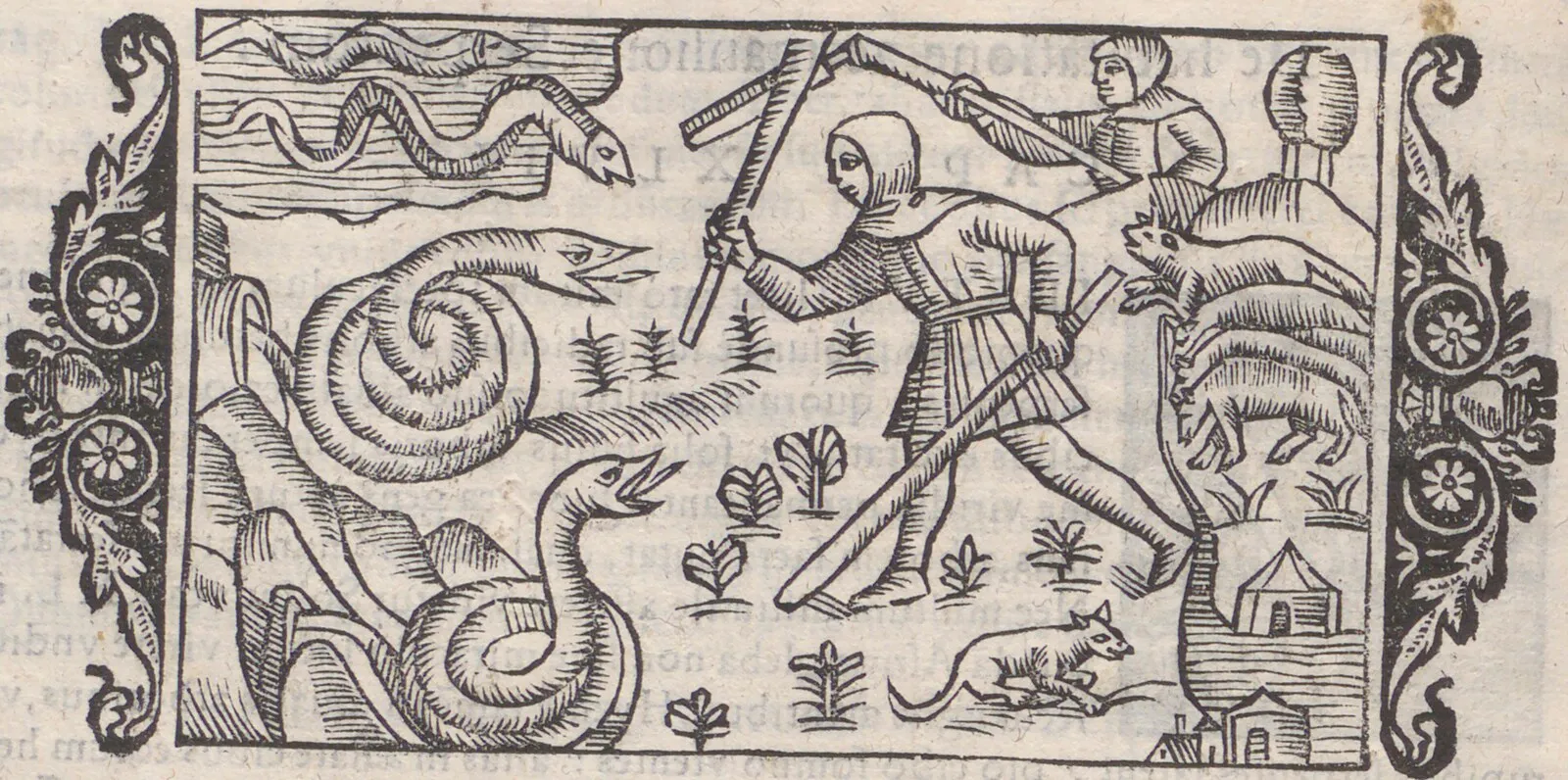
A woodcut of shepherds fighting serpents, “De pugna pastorum contra Serpentes”, from Olaus Magnus’s Historia de gentibus septentrionalibus, Rome, 1555 (book 21, chapter 48, page 776). It is a sixteenth-century picture of northern snakes and has nothing to do with the events of 1884. Uppsala University Library, Westin Sv. hist. Allm. fol. (Ex. 2), Public Domain Mark, via Alvin, cropped.
One line in the proceedings
Hyltén-Cavallius had taken the lindworm to the Academy of Sciences first, as a memoir, Om draken eller lindormen, “On the dragon or lindworm”.14 At the Academy’s meeting of Wednesday 9 January 1884, Smitt presented it.14 The printed proceedings give it one entry and record no discussion.15 The memoir came out at Växjö in 1884 as a booklet of 42 pages.16 A second, longer edition followed in 1885.16
Malm, who edited the 2017 edition of the booklet,17 reports that Smitt, curator of vertebrates at the Swedish Museum of Natural History, wrote to Hyltén-Cavallius on 11 January.18 Smitt thought fantasy had played a large part in the visions, and said his museum would pay 100 crowns for the first specimen over 8 feet long.18 On 1 February the Academy’s secretary, Lindhagen, relayed that Smitt thought the animal had probably been a grass snake.19
So the Academy offered nothing in the sources we read. The money in this story is Hyltén-Cavallius’s own, plus one museum’s conditional offer.118
The offer
The notice we read is in the Växjö weekly Smålandspostens veckoblad of 29 May 1884.1 It describes the animal as Hyltén-Cavallius did: usually about 10 feet long, thick as a man’s thigh, with long hair or scales on the neck of old ones, which the folk legends liken to a horse’s mane.20 Malm gives the booklet’s own wording as “about 10 feet”, with some seen at 18 or 20.20
The paper lists where it had been seen in recent years: Sannaböke, the forests of Ylfvehult and Husaby, Ramnhult in Hinneryd, Sirkönäs in Urshult, Hårestorp in Kalfsvik parish, and Skäggålösa Persgård.21 Then it prints his undertaking.1
Den, som på Sunnanviks gård aflemnar ett dödadt exemplar af nämnde Orm, undfår en belöning af ifrån Ett Hundra intill Ett Tusen kronor, i mån af exemplarets storlek och öfriga beskaffenhet, så snart detta, i tätt laggkärl med påhäld sprit eller bränvin eller och nyss dödadt, aflemnas till undertecknad.1
Whoever hands over at Sunnanvik farm a killed specimen of the said snake will receive a reward of from one hundred up to one thousand crowns, depending on the size and other condition of the specimen, as soon as it is delivered to the undersigned in a tight cask with spirits or brännvin poured over it, or freshly killed.
Malm dates the announcement to May and June 1884.1
Sixteen, twenty, forty-eight
The booklet’s weight was in its witness statements. Hyltén-Cavallius told the Academy’s librarian on 4 March 1884, Malm says, that he had sixteen sworn depositions so far.22 The count then grew with each printing.
| Date | Statements |
|---|---|
| 4 March 1884 | 16 sworn depositions22 |
| First printing, 1884 | About 204 |
| Second edition, 1885 | 485 |
Malm writes that the second edition added twenty-six to those of the first, which would make 46.3 The cover of the new set that he reproduces is numbered 22 to 48, which would make 27 new ones.5 We give the counts as the sources state them and do not settle the sum.
The witnesses made their statements under oath.23 Malm says they swore on their honour and immortal soul.23 A Stockholm writer in 1889 quotes one, dated 1884, from Petter Johansson at Sunnanvik.24 Johansson describes a black snake of about 7 Swedish alnar, roughly 4 metres by our conversion.24 Its head was 8 or 9 inches long.24 Behind the head, he says, it had black bristles about 1½ inches long, running back nearly a foot and parted to both sides like the mane of a horse.24
Men det märkligaste var, att han bakom hufvudet på nära en fots längd hade svarta borst, vid pass 1½ tum långa, hvilka skildes åt begge sidor, likasom manen på en häst.24
But the most remarkable thing was that behind the head, for nearly a foot’s length, he had black bristles about 1½ inches long, parted to both sides like the mane on a horse.
He went at it with a stick and it reared up about a foot, and he did not dare strike.24 A corporal named Dacke from Bergunda parish, Johansson says, told him he had seen probably the same snake, gone home for his gun, and come back to find it gone.24 We have not read the statement in the booklet itself.
What the papers made of it
Smålandsposten’s squib did not stay in Växjö. In the Royal Library’s archive it reappears in other papers on 29 to 31 July, among them Korrespondenten in Landskrona, Eskilstunaposten and Östgöta correspondenten.25 We read the OCR lines of those reprints, not the pages.
The same page of Smålandsposten carries a letter from Allbo under the heading “Ormhistorier”.26 Its writer says the whole press has taken up the snakes of southern Allbo and Sunnerbo with some irony, and that Hyltén-Cavallius has been mocked by the humour papers.26 He does not think the snakes were invented. Big snakes do live in the district, he says, but of 4 to 5 alnar, perhaps 6, far short of the lengths reported.26 That is about 2.4 to 3.6 metres by our conversion.26 Such snakes, he writes, are what has been called dragons or lindworms.26 Malm says the ridicule fell on the peasants who searched the forests with guns in hand.27
Malm adds the naturalists’ side. The bryologist Hjalmar Mosén, he reports, mocked the lindworm reports in his 1885 book on snakes and suggested that someone in Värend buy a camera.28 We know Mosén only through Malm.
1885 to 1889
Malm says Hyltén-Cavallius sent the enlarged second edition to the Academy in October 1885, with a letter saying the animal’s existence “cannot be doubted by anyone” who read the accounts.29 He did not live to see anyone deliver a snake: until his death in 1889 he waited in vain, Malm writes.2
A front-page item in a Stockholm paper on 17 July 1889 says the obituaries of Hyltén-Cavallius had not mentioned the lindworm booklet.30 It repeats the reward offer and ends with one sentence.12
Det spordes icke att denna avis ledde till någon efterföljd.2
It is not reported that this notice led to anyone following it up.
A memorial stone six metres tall was raised over his grave in Skatelöv churchyard on 5 July 1894, Malm reports, showing a serpent dragon biting its own tail.31 Malm lists what the witnesses may actually have met: otters, polecats, badgers, capercaillies, sheatfish or unusually large grass snakes.6
The folklorist Jan-Öjvind Swahn said in 1989 that he still got letters from drivers who claimed to have nearly hit such a snake on the road.32
The telling beside the papers
| The story | The record | Verdict |
|---|---|---|
| Larsson killed a dragon, 1620s | A club in the museum is said to be his1213 | Unsupported |
| A great snake lives in Värend | No specimen delivered by 18892 | Unsupported |
| It flies by night, dropping sparks | The collector called this pure myth11 | Unsupported |
| A reward for a dead lindworm | Offered in print, 18841 | Confirmed |
What we could not verify
Sources we have not seen
- The booklet beyond its introduction and first statements. Only the first pages of the 1884 edition open as a preview in Google Books, and the 1885 edition shows no text; we found no other digitised copy, and the second edition’s postscript and all 48 statements stay unread. Reading them would show what Hyltén-Cavallius counted as a statement and what he did with the ones he left out.
- Thomas Malm’s 2017 edition, Drakormens gåta. It holds the full text and Malm’s analysis of the accounts; the Lund record gives no full text and the book is in copyright.
- Hyltén-Cavallius’s correspondence and papers in the National Library of Sweden and the Academy’s archive, including his letters of 1884 and 1885. They are held in manuscript collections and we found no digitised copy; they would show how the Academy answered him.
Seen only where others quote them
- Mosén’s Ormhistorier (1885), known only through Malm. We searched archive.org and Runeberg for it on 10 October 2026 and found no digitised copy.
- Smitt’s and Lindhagen’s letters of 1884, which we know only through Malm; the originals are in manuscript collections we did not reach.
- The advice of a Danish museum inspector, relayed by George Stephens in May 1884, to raise the reward to 1,000 or 2,000 crowns. We have only Malm’s account of Stephens’s letter.
Questions we could not settle
- Whether anyone brought a snake to Sunnanvik and was turned away. The sources we read say no specimen was delivered, and none says whether an animal was offered and judged an ordinary grass snake.
- Whether two reprints of the Växjö notice that read “three thousand” in the Royal Library’s OCR were misprints or OCR errors; the original reads one thousand.
- What the press said when the second edition appeared in the autumn of 1885, which we did not find.
Read next
TaleEdam and Haarlem, Holland, Netherlands, 1403 to 1786
Before the Edam mermaid had a tail
TaleVrhnika (Ober-Laybach), Slovenia, 1684 to 1689
Vrhnika's baby dragons: Valvasor's lizard and the olm
CaseLucerne, Switzerland, 1420 to 2006
The Lucerne dragon stone: a pledge, a charter and a CT scan
Sources
- Smålandspostens veckoblad, 29 May 1884, page 2, item "Om Draken eller Lindormen", fourth paragraph, the author's "förbindelse" (primary) transcription
- Hvad nytt från Stockholm?, 17 July 1889, page 1, "Draken eller Lindormen", the announcement quoted from "första upplagan" (primary) transcription
- Malm 2020, p. 6: in May and June 1884 he announced "from one hundred to one thousand crowns, depending on the size and other conditions", pickled in schnapps or freshly killed, delivered to his estate↑
- Malm 2020, p. 8: "until his death in 1889, Hyltén-Cavallius waited in vain for someone to knock on his door and deliver the corpse of a serpent dragon"
- Hvad nytt från Stockholm?, 17 July 1889, page 1: "framlidne Hyltén-Cavallius" and "Det spordes icke att denna avis ledde till någon efterföljd" (primary) transcription↑
- Malm 2020, p. 6, "the twenty depositions that he... had forwarded in his memorandum"
- Hvad nytt från Stockholm?, 17 July 1889, page 1, "Dessa berättelser voro ursprungligen endast 20" (primary) transcription↑
- Malm 2020, p. 8, Fig. 9 caption: "Second edition. With 48 appendices. Växjö, 1885"; p. 7, Fig. 8 caption: "Original Narratives, No. 22-48"; p. 7 text: "another twenty-six eyewitness accounts"
- Hvad nytt från Stockholm?, 17 July 1889, page 1: a later edition "upptog närmare ett halft hundrade vitnesmål" (nearly half a hundred) (primary) transcription
- Lund University record of Hyltén-Cavallius and Malm, Drakormens gåta (2017), summary: the book "includes 48 eyewitness accounts from people who claim to have seen, and in some cases killed, large snakes"↑
- Smålandsposten, 26 July 1884, page 2, centre column (primary) transcription
- Malm 2020, p. 6, the squib in Malm's translation, citing Smålandsposten 1884:(86, 26 July): 2↑
- Malm 2020, title and p. 1 give the full name Gunnar Olof; p. 2: chargé d'affaires at the Imperial Court of Brazil
- Smålandspostens veckoblad, 29 May 1884, page 2, the notice names him "charge d'affaires G. O. Hyltén-Cavallius" (primary) transcription
- Öfversigt 1884, no. 1, p. 1: "f. d. Charge d'affaires G. O. HYLTEN-CAVALLIUS" (primary)↑
- Smålandspostens veckoblad, 29 May 1884, page 2, fifth paragraph: "Smålands museums första och egentlige stiftare" (primary) transcription
- Malm 2020, p. 2: "founded societies for science and art as well as the first Swedish provincial museum, Småland's Museum in Växjö"↑
- Pamphlet 1884 (Google Books), pg=PA4, introduction signed "Sunnanvik, den 29 Oktober 1883"; pg=PA5, statements dated "Sunnanvik, den 15 Oktober 1883" (OCR, unchecked; line edges missing) (primary)
- Malm 2020, p. 2: "for almost twenty years, the landlord of Sunnanvik in Torne, Skatelöv parish"; p. 6: deliver a serpent dragon "to his estate"↑
- Pamphlet 1884 (Google Books), pg=PP5, the introduction's footnote on "Wärend och Wirdarne I. § 85", daytime and night-time forms of the dragon (OCR, unchecked; line edges missing) (primary)
- Malm 2020, p. 3 (treasure-keeper belief, citing Hyltén-Cavallius 1863-64: 461 and Sydow 1917); p. 2 (hoop and flying forms, which Hyltén-Cavallius "dismissed as pure myths")↑
- Pamphlet 1884 (Google Books), pg=PA4, "Wärend har ännu talrika sägner... förvaras i Smålands museum en grof påk af masur-björk" ... "dödade en drake" ... "Sannaböke lycka i Stenbrohults socken" (OCR, unchecked; line edges missing) (primary)
- Malm 2020, p. 4: the cudgel "said to have been used by the dragon slayer was donated in 1884 to the museum founded by Hyltén-Cavallius"↑
- Öfversigt 1884, no. 1, meeting of 9 January, p. 1: "Hr SMITT föredrog en af f. d. Charge d'affaires G. O. HYLTEN-CAVALLIUS insänd uppsats om berättelser angående Draken eller Lindormen" (primary)
- Malm 2020, p. 5, "The First Edition and the Offer of a Reward", citing Kongl. Vetenskaps-Akademien 1884, Öfversigt 41(1): 1-2↑
- Öfversigt 1884, no. 1, p. 1, the entry above; the lines before and after it are other communications, with no remark on this one (primary)
- Malm 2020, p. 5: "in the record it was simply stated that Smitt had reviewed the memorandum... Nothing was mentioned about how the audience had reacted"↑
- Svenskt biografiskt lexikon, Hyltén-Cavallius (Nils-Arvid Bringéus), band 19 (1971-1973), p. 552, printed works: "Om draken eller lindormen. Wexiö 1884. 42 s. 2. uppl Sthlm 1885. 91 s."
- Malm 2020, p. 1 and reference list p. 10: Hyltén-Cavallius 1884a, 42 p.; 1885a, 2nd ed., 91 p.; both Smålandspostens boktryckeri, Växjö
- Öfversigt 1884, list "Skänker till Vetenskaps-Akademiens Bibliotek" (continued from p. 52), under "Från Författarne": "HYLTEN-CAVALLIUS, G. O. Om draken eller Lindormen. Vexiö 1884. 8:o." (primary)↑
- Malm 2020, p. 1 and reference list p. 10 (Hyltén-Cavallius and Malm 2017, 199 p.)
- Lund University record of Hyltén-Cavallius and Malm, Drakormens gåta (2017), record fields: publisher Kronobergs läns hembygdsförbund, 2017, ISBN 978-91-86870-23-2; summary says "third edition"↑
- Smålandspostens veckoblad, 29 May 1884, page 2, item "Om Draken eller Lindormen" (primary) transcription
- Pamphlet 1884 (Google Books), pg=PA4, the introduction's description in quotation marks (OCR, unchecked; line edges missing) (primary)
- Malm 2020, p. 2, block quotation of the 1885 edition pp. 4-5 in Malm's translation: "about 10 feet (c. 3 m); but specimens of up to 18 or 20 feet have been observed"↑
- Smålandspostens veckoblad, 29 May 1884, page 2, item "Om Draken eller Lindormen", second paragraph (primary) transcription
- Pamphlet 1884 (Google Books), pg=PA4, end of the introduction's quoted description, the list of places "likaledes 1883" (OCR, unchecked; line edges missing) (primary)↑
- Pamphlet 1884 (Google Books), pg=PA5, statements dated "Sunnanvik, den 15 Oktober 1883" and "Hemset... den 20 Oktober 1883", closing "intygar jag under eds-förpligtelse" and "Om så påfordras, bestyrkes sanningen af denna... med ed" (OCR, unchecked; line edges missing) (primary)
- Malm 2020, p. 2: informants "swore upon their honor and immortal soul"; p. 5: "sworn depositions"↑
- Hvad nytt från Stockholm?, 17 July 1889, page 1, the quoted statement (centre and right columns) (primary) transcription↑
- Korrespondenten, Landskrona, 29 July 1884, page 3; OCR line in the Royal Library's search hit: "Lindormen är funnen och förevisad i Yexiö, se derpar åror. Att det var den rigtige lindormen" (page image not opened) (primary)
- Eskilstunaposten, 29 July 1884, page 3; OCR line in the search hit, same sentence (page image not opened) (primary)
- Östgöta correspondenten, 31 July 1884, page 3; OCR line in the search hit, same sentence (page image not opened) (primary)↑
- Smålandsposten, 26 July 1884, page 2, centre column, item "Ormhistorier. Från Allbo skrifves till oss" (primary) transcription↑
- Smålandsposten, 26 July 1884, page 2, the Allbo letter: "öfver allmogens enfald har skämtats duktigt och... Hyltén-Cavallius har hånats af skämttidningarna" (primary) transcription
- Malm 2020, p. 6: "cartoonists and newspaper journalists began to ridicule the peasants who searched the dense forests with gun in hand"↑
- Hvad nytt från Stockholm?, 17 July 1889, page 1, first paragraph of "Draken eller Lindormen" (primary) transcription↑
Documents quoted
- Hvad nytt från Stockholm?, 17 July 1889: "Draken eller Lindormen", a writer's note after Hyltén-Cavallius's death (transcribed from the page image)
- Smålandsposten, 26 July 1884: the squib "Lindormen är funnen och förevisad i Wexiö" and a letter from Allbo (transcribed from the page image)
- Smålandspostens veckoblad, 29 May 1884: the notice of Hyltén-Cavallius's booklet and his reward (transcribed from the page image)