 Twice Told
The Lucerne dragon stone: a pledge, a charter and a CT scan
In 1523 Lucerne's council certified a dragon's stone as a cure for plague. In 2006 a CT scan showed a painted clay ball.
Contents
Published 5 Oct 2026. Sources checked 5 Oct 2026.
In 1523 the Schultheiss, Lucerne’s chief magistrate, and the city council sealed a charter saying that a stone owned by the surgeon Martin Schryber had cured plague sores, bloody flux and other illnesses, and that the stone had come from a dragon.16 Benedict Hotz, who reported the stone’s CT scan in 2007, writes that it then served as a remedy for nearly 200 years.7 It now sits in the earth sciences display of the Natur-Museum Luzern. A scan in early summer 2006 showed a ball of fired clay with a painted band round the middle.8910
The charter and the story the museum tells today do not match. The museum has a farmer, Stämpfli, haymaking near Rothenburg when a dragon flew over from the Rigi towards Pilatus in 1421.211 The oldest deed about the stone that we could read, a court judgment of 1509 printed in 1661, has no such scene. Rudj Stempflin is in court as a debtor who cannot redeem the stone he pawned, and the dragon belongs to his grandfather.123
This is the story as the Natur-Museum Luzern told it in 2013, with the details Feierabend added in 1862.
On a hot August day in 1421 the farmer Stämpfli was making hay near Rothenburg.2 A fiery dragon flew over him from the Rigi towards Pilatus and let something fall.11 Stämpfli fainted from fright.13 When he came round he found a lump of clotted blood, and when he stirred it with his rake handle the stone lay in the middle.13
The stone healed the sick. A descendant of Stämpfli sold it to the surgeon Martin Schryber, who used it against the plague of 1519 and worked great wonders.1415 In 1523 the council of Lucerne confirmed its cures in writing.1
The museum’s telling ends there.
A judgment about a pledge
The oldest deed is a judgment by the bailiff of Rothenburg, given on the Monday after St Martin’s Day 1509.12 In Cysat’s print the bailiff is Peter zu Käß; Feierabend calls him Peter Zuckäs.12 Martin Schryber, surgeon and citizen of Lucerne, tells his court that Rudj Stempflin of Rothenburg pledged him a stone for a sum of money, and that the time for redeeming it ran out long ago.12
ein Pfand versetzt hab / namblich ein Stein / so von einem Drachen syn solle12
had pledged him a stone, namely one that is said to come from a dragon
Stempflin does not argue. It is true, he says; he should have redeemed the stone long ago, and he never had the means and still has not.12 The bailiff rules that Schryber and his heirs keep it as their own property.12 Hotz writes that a descendant of the farmer sold the stone to Schryber in 1509.14 The deed has no sale in it. The stone was pawned, the pledge lapsed, and a court awarded it. Feierabend, who had the parchment deeds in front of him in 1862, tells the same sequence.12
Before the ruling Stempflin explains why the stone mattered, and this is the first place the dragon appears in the paper record.3
daß sein Aeni selig disen Stein funden hab / in einer Matten / als er gehewet hab3
that his grandfather, God rest him, had found this stone in a meadow while haymaking
The grandfather was cutting hay when a dragon shot through the air close beside him, from the Rigi to Fräckmont.11 Fräckmont is Pilatus; Cysat says so in his own text.11 The man lost his senses, and when he got up he found blood that the dragon had spattered, set like jelly, with the stone lying in it.13 Feierabend and the museum both put Stämpfli himself under the dragon.11 In the deed he is a man handing on what he heard from his forebears.3
The deed gives no year. Feierabend dates the sighting to “a sultry summer day in 1420”, and the geologist K. von Fritsch, writing in 1864, also says 1420.2 Hotz gives summer 1421 at midday, following Renward Cysat (1545-1614), who wrote the story down towards the end of the 16th century; the museum’s blog says a hot August day in 1421.2 We have not seen Renward Cysat’s manuscript. The charter of 1523 is vaguer: the stone was found long ago and kept in secret for about eighty years or more.16
Witnesses under oath, 1523
Fourteen years after the judgment Schryber, by now court clerk as well as surgeon, appeared before the Schultheiss and council and asked them to take testimony on the stone in the city’s customary way.1 The charter, which repeats what Schryber told them, calls it a stone that came from a great dragon, found long ago in the city’s territory and kept in secret while princes, emperors, kings and the Venetians tried to buy it.11617
ein Stein / so von einem grossen / vngehüwren Drachen kommen1
a stone that came from a great, monstrous dragon
The council did not stop at Schryber’s word. It sent its sworn judge, several councillors and the sworn clerk to swear witnesses on the saints and ask what they knew of the stone.6 The witnesses are named. Jacob Franckhuser, of the council, says that in a plague year the sickness took him by the neck below the right ear, that he gave up on his life, and that Schryber came, stroked the sore with the stone and bound it on; the stone drew the sore out and he was well in a short time.6 Moritz von Mettenweil, also a councillor, had a bloody flux no doctor could stop. Schryber tied the stone into his right hand with a cloth, and after about two hours the flow ended.6 Heinz von Cham says the stone was bound to his baby, about a year old, for one night, and the child recovered at once.6
Feierabend sums the charter up as a long list of miracle cures, mostly in plague and dysentery patients.6 It ends on the council’s seal.
daß wir jhme mit vnser Statt Secret angehencktem Insigel besiglet geben haben / vff Donstag nach S. Martins Tag Anno 15231
that we have given it to him, sealed with our city’s secret seal hung on it, on Thursday after St Martin’s Day, in the year 1523
Our reading: the council certified what sworn witnesses said about cures. It did not examine a dragon. After Schryber’s death the stone was auctioned in 1527 to Dorothea Moser; later owners were the city clerk Johannes Kraft (1564), Ludwig Schürf, and the Cloos, Fleckenstein and Meier von Schauensee families.18 How long it kept its reputation is disputed. Feierabend writes that it seems to have lost its shine soon after 1527, Hotz that it counted as a remedy for nearly 200 years, and Cysat that it had been tried on many people over about 60 years by 1661.19720
Three printed accounts, 1661 to 1723
Johann Leopold Cysat wrote his book on the Lake of Lucerne in 1645 and it was printed in Lucerne in 1661.11 In a short chapter on the stone he promises “two authentic instruments” kept with it, and prints both.11
Denselbigen hat ein Drach Sommerszeit / als er von dem Berg Rige / an den anderen Berg Fräckmont / das ist der Pilatus Berg / vber See geflogen / nechst bey einem Bawrsmann / so in der Matten Graß gemeyet / auff die Matten fallen lassen11
A dragon, flying in summertime across the lake from the mountain Rigi to the other mountain, Fräckmont, which is Mount Pilatus, let it fall on the meadow right beside a farmer who was mowing grass
He gives no year and no name. The stone, he writes, is large, almost perfectly round, white, black and blood-coloured, “oddly divided”, and weighs nine ounces.20 Against plague you stroke the sore with it and bind it on for 24 hours, or tie it into the right hand with a cloth.20 He says it had been proved on many people in Lucerne over about 60 years.20
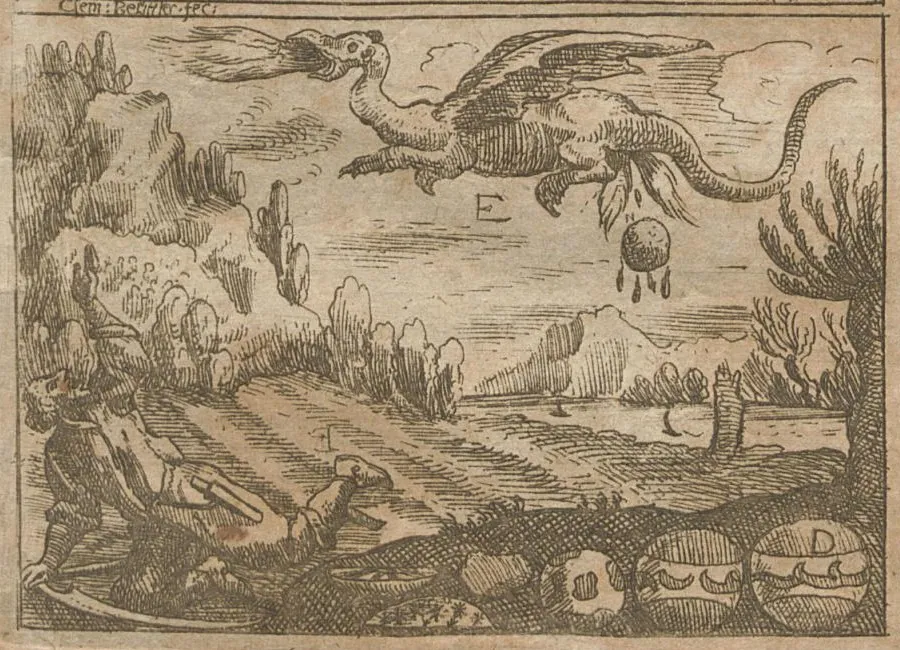
The dragon lets the stone fall, and a man lies in the field. The round figures at the bottom edge are the stone. Fallen dragon stone (letters E and D), plate in Johann Leopold Cysat, Beschreibung dess Berühmbten Lucerner- oder 4. Waldstätten Sees, Luzern 1661. Zentral- und Hochschulbibliothek Luzern, F1.170.8 (1), e-rara, doi.org/10.3931/e-rara-86774. Public Domain Mark. Cropped.11
Athanasius Kircher took the story into his Mundus subterraneus in 1664, naming Cysat as his source. He has the dragon go from Mount Pilatus to the opposite mountain, where Cysat has it fly from the Rigi to Pilatus.2111
illum à se liquorem quendam dimittere, quem in se reversus in prato quodam invenit sub concreti sanguinis specie, & intra eum lapidem varii coloris21
that the dragon let some liquid fall from itself, which the man, once he had come to himself, found in a meadow in the form of clotted blood, and inside it a stone of many colours
Johann Jakob Scheuchzer, the Zurich naturalist, saw the stone on his journey of 1706 and wrote it up in 1723. It was then with the Cloos family.22 He ranks it above the curiosities of every museum, since it has no equal in the cabinets of kings, princes or private men, and he prints the first charter in Latin.2223 He also takes up the question of fraud.
sed prodit ex manibus simplicis, cum Paupertate luctantis, Rustici24
but it comes from the hands of a simple farmer, struggling with poverty
Such a man, Scheuchzer argues, had no means of painting a jasper globe and passing it off, and no way of getting a stone with no equal in Europe.24 He gives the cures less credit: marble and jasper are not to be trusted for virtues like these, he writes, “except perhaps against haemorrhage”.24 Hotz lists Scheuchzer with the Lucerne physician Moritz Anton Kappeler as the first to doubt that the ball formed in a dragon’s body, and to take it for a worked flint.25 On the pages of Scheuchzer we read, he defends the finder’s honesty and doubts only the cures.
Kappeler, who printed his name as Cappeller, answered the poor-farmer argument in his Latin history of Mount Pilatus in 1767. He retells the 1509 deed from Renward Cysat’s papers and the 1661 print, grandfather included, and then declines to accuse anyone, at some length.26
Nec accusabimus fraudis alicujus rusticum vafrum forte, & ex iis quorum simplicitas jam cum ipso Saeculo aureo, non nisi Calendis graecis reditura, evanuit: arguendo Lapidem, cujus Stempflino veri natales forte melius perspecti essent, pro pecunia obtrudere eum calluisse27
Nor will we accuse the farmer of any fraud, though he was perhaps a sly one, and one of those whose simplicity vanished with the golden age and will never come back: by arguing that, since Stempflin perhaps knew better where the stone really came from, he was shrewd enough to palm it off for money
The sentence ends by noting that Lucerne would have had far more generous buyers if there had been no suspicion of fraud at all.27 Kappeler also thought he saw a painter’s brush strokes in the pattern.28
Feierabend weighs it, Fritsch measures it
In 1862 M. A. Feierabend gave the Lucerne natural history society’s talk for the visiting Swiss society. He calls the stone “a fallen greatness” of the city, one the red Swiss guidebooks of his day no longer mention.29 He handled it. A knife does not scratch it; it weighs 18 Loth; under a lens the surface is netlike, rough and shiny; a chemical analysis was refused.30 His verdict, 144 years before the CT scan, was that texture and density both argue against an ordinary meteorite.309
sondern vielmehr Beide für ein Gebilde von gebrannter Thonerde. Dieses konnte aber offenbar nicht als Meteorstein vom Himmel gefallen sein.30
but rather both for a thing made of fired clay. This, obviously, could not have fallen from the sky as a meteorite.
He guessed further that Schryber was the one who gave the stone its final form.
Es ist sehr wahrscheinlich, dass Martin Schryber es war, welcher den Stein nach Uebung der Alten einer Umgestaltung mittelst Drehscheibe, Pinsel und Feuer unterwarf.30
It is very likely that Martin Schryber was the one who, as the ancients did, reshaped the stone with a lathe, brush and fire.
Nothing we read supports the guess. The 1509 deed says Schryber’s pledge had lapsed “years and days” before, so he had the stone in his hands for some time by then, and that is all it says.12 Feierabend’s own dragon was weather: a glowing electric cloud over Stämpfli’s head, like the one reported over Hauptmannsdorf in 1847, and the blood trade-wind dust like the red dust seen in Calabria in 1813.31 The Calabrian dust was collected and kept. “Das hat leider unser Stämpfli mit dem vermeintlichen Drachenblute nicht gethan”, he writes: unfortunately our Stämpfli did not do that with the supposed dragon’s blood.31 He adds that for centuries the local saying had been “es ist ein feuriger Drack oder eine feurige Kugel gefahren”, a fiery dragon or fiery ball has gone by.32
Two years later K. von Fritsch, who examined the stone at the house of Hauptmann Meyer von Schauensee, measured a specific gravity of 2.23, which he thought too low; found no iron and no effect on a magnetic needle; and judged it not meteoric but stoneware-like fired clay, quartzite or jasper-like felsite.33 He doubted that a meteorite fell at all in 1420, since lightning could have frightened the farmer, and passed on Kappeler’s hint that fraud may have crept into the telling and into Schryber’s acquisition of the stone.34 Hotz says the verdict ended further research for almost 100 years.33 Ernst Chladni, whom Hotz calls the founder of the meteorite theory still held today, had taken the stone for a small stone meteorite (1819, in Hotz’s account); Feierabend has him call it a meteorite rounded and painted by art.35
Weighed, then scanned
In November 1954 the stone went on loan to the Pharmacy History Museum in Basel, which had it examined at the University of Basel.36 Its specific gravity came to 2.26 g/cm3, too light for sandstone or quartzite. O. Grütter took it for a hand-formed clay ball but could not rule out a hollow or clay core, since the stone could not be damaged.36 In 1986 a seminar paper at the University of Zurich found no link with known meteorites and no magnetic field, and read it as a silica concretion.37
Two more ideas came before the scan. Schumacher (1998) suspected a meteorite later given a baked clay coat, and Beda Hofmann and Edwin Gnos of Bern, who study meteorites, took the description of 1421 at face value as a possible fall.38 In early summer 2006 the stone went through the industrial CT scanner at EMPA in Dübendorf, together with meteorites from Oman.9
The sections show a homogeneous, fine-grained mass with voids from under a millimetre to a few millimetres, about 2.5% of the volume by Hotz’s estimate, and nothing foreign in the core.3910 Hotz compares its density and pore volume with fired clay sherds of the 14th century measured by Schifer in 2003 and finds them close; he reads the voids as air trapped when the ball was shaped.39 His summary says the scan clearly refuted the meteorite hypothesis. His conclusion leaves one door open.
Es könnte deshalb sein, dass der Bauer Stempfflin effektiv einen Meteoritenfall beobachtet hat. Allerdings bleibt dann die Frage, wo der Meteorit von 1421 geblieben und weshalb er durch eine bemalte Tonkugel ersetzt worden wäre.40
So it could be that the farmer Stempfflin really did see a meteorite fall. But then the question remains where the meteorite of 1421 went, and why it would have been replaced by a painted clay ball.
The museum asks the same question.40 Hotz, like the museum, has Stempfflin himself under the dragon; the 1509 deed puts the sighting a generation earlier.3
Where the story leaves the papers
| The story | The record | Verdict |
|---|---|---|
| Stämpfli saw the dragon | His grandfather did, in the 1509 deed3 | Contradicted |
| It happened in 1421 | 1420 in Feierabend and Fritsch, 1421 in Hotz2 | Disputed |
| A dragon dropped the stone | “Is said to come from a dragon,” 150912 | Unsupported |
| A descendant sold it in 1509 | Pledged, lapsed, awarded by court12 | Contradicted |
| The council vouched for its cures in 1523 | Sealed charter, sworn witnesses16 | Confirmed |
| It is a meteorite | Fired clay, painted10 | Contradicted |
| Its radioactivity is a mystery | About natural background; the placement unexplained5 | Disputed |
Radioactivity in the light band
The radioactivity in the last row is weak. Barmettler measured 5 to 11 microroentgen per hour on the stone, which Hotz says is at most about the natural external radiation of the Lucerne region. All the weak zones lie in the light middle band, framed by the wavy brown lines painted on it.5 Hotz explains the radioactivity by potassium, uranium and thorium in the clay. What he cannot explain is the painting.5
Was es allerdings mit der Bemalung auf sich hat und wie der Künstler die strahlenden Zonen eruiert hat, bleibt ein Rätsel.5
What the painting has to do with it, and how the artist found the radiating zones, remains a riddle.
The museum says the same: it is unexplained why the zones of raised radioactivity lie in the light middle band.5 The Luzerner Zeitung adds two more gaps, that nobody knows when the clay ball was made, or what the brown arcs are painted with.4 Hotz counts six of those arcs and Feierabend seven crescents.41
What we could not verify
Sources we have not seen
- Renward Cysat’s Collectanea, where Hotz says the sighting is first written down and dated 1421, and where Kappeler (1767) found the deeds, in volume D from page 4. It would show whether the year, the midday hour and the farmer’s name are in Cysat’s own words. The manuscript is in Lucerne, and on 5 October 2026 we could not reach a digitised copy of the volume.
Seen only where others quote them
- Grütter’s examination of 1956 and the density figure of 2.26, Schifer’s comparison sherds of 2003, and Chladni’s view of 1819, which we know only through Hotz (and, for Chladni, Feierabend). The originals are a report from a Basel museum, a measurement series and a 19th-century physics book, and web searches on 5 October 2026 turned up no digitised copy of any of them.
- Barmettler’s seminar paper of 1986 on the radioactivity, which we know only through Hotz. It is a university seminar paper and we found no copy online.
Resting on a single source
- The Luzerner Zeitung’s statement that nobody knows when the clay ball was made. We found it in no other source.
Questions we could not settle
- Where the parchment deeds of 1509 and 1523 are now. Feierabend had them in 1862, and Cysat’s print is a copy.
- Whether the sighting is dated 1420 or 1421 in any document written before the 1590s.
- Who painted the ball, when, and with what.
Read next
CaseVärend, Småland, Sweden, 1883 to 1889
The lindworm reward in Småland was never claimed
TaleEdam and Haarlem, Holland, Netherlands, 1403 to 1786
Before the Edam mermaid had a tail
TaleVrhnika (Ober-Laybach), Slovenia, 1684 to 1689
Vrhnika's baby dragons: Valvasor's lizard and the olm
Sources
- Cysat (1661), the charter of 1523 as printed, pp. 178-181 (primary) transcription
- Feierabend (1862), pp. 91-92
- Hotz (2007), p. 11↑
- Feierabend (1862), p. 90: "An einem schwülen Sommertage im Jahr 1420"
- Fritsch (1864), p. 145
- Hotz (2007), p. 10 (the Collectanea not opened)
- Natur-Museum Luzern, Objekt des Monats, Aug 2013, first paragraph↑
- Cysat (1661), the deed of 1509 as printed, p. 177: "daß sein Aeni selig disen Stein funden hab" (primary) transcription↑
- Mathis, Luzerner Zeitung, 11 Sep 2021, section "Welchen Zweck verfolgte der Künstler?"↑
- Hotz (2007), pp. 12, 15 (Barmettler 1986, a seminar paper, not opened)
- Natur-Museum Luzern, Objekt des Monats, Aug 2013, paragraph beginning "Die Untersuchung konnte aber nicht"↑
- Cysat (1661), the charter of 1523 as printed, pp. 179-181 (primary) transcription
- Feierabend (1862), p. 92↑
- Hotz (2007), p. 11↑
- Hotz (2007), p. 9: "Seit der Wiedereröffnung des Museums am Kasernenplatz 1978"
- Natur-Museum Luzern, Objekt des Monats, Aug 2013, photo caption↑
- Hotz (2007), p. 13, section 2.2: "Im Frühsommer 2006"; "industriellen Computertomografen der EMPA in Dübendorf"
- Natur-Museum Luzern, Objekt des Monats, Aug 2013, paragraph beginning "Erst 2006"↑
- Hotz (2007), p. 15, section 3 "Schlussbemerkungen"; summary p. 8
- Natur-Museum Luzern, Objekt des Monats, Aug 2013, paragraph beginning "Erst 2006"
- Mathis, Luzerner Zeitung, 11 Sep 2021, paragraph on the newest examination↑
- Johann Leopold Cysat, Beschreibung dess Berühmbten Lucerner- oder 4. Waldstätten Sees (Luzern: David Hautt, 1661), ZHB Luzern F1.170.8 (1), p. 176: "Denselbigen hat ein Drach Sommerszeit" (primary) transcription
- Cysat (1661), the deed of 1509 as printed, pp. 177-178 (primary) transcription
- M. A. Feierabend, "Der Luzerner Drachenstein", Verhandlungen der Schweizerischen Naturforschenden Gesellschaft 46 (1862), pp. 90-91
- Natur-Museum Luzern, Objekt des Monats, Aug 2013, first paragraph↑
- Cysat (1661), the deed of 1509 as printed, pp. 177-178 (primary) transcription
- Feierabend (1862), p. 91↑
- Cysat (1661), the deed of 1509 as printed, p. 178: "ein Schwäre Bluts ... als ein Sultz" (primary) transcription
- Feierabend (1862), p. 91
- Natur-Museum Luzern, Objekt des Monats, Aug 2013, first paragraph↑
- Hotz (2007), p. 10: "verkaufte diesen Drachenstein im Jahr 1509 an Gerichtsschreiber Martin Schryber"↑
- Hotz (2007), p. 11
- Natur-Museum Luzern, Objekt des Monats, Aug 2013, paragraph beginning "Bis Ende des 18. Jh."↑
- Cysat (1661), the charter of 1523 as printed, p. 178: "bey den achtzig Jahren oder mehr / in Heimblikeit behalten" (primary) transcription
- Feierabend (1862), p. 92↑
- Cysat (1661), the charter of 1523 as printed, pp. 178-179: "etlich Fürsten, Nationen, Keyser vnnd König sampt den Venedigern" (primary) transcription
- Feierabend (1862), p. 92↑
- Feierabend (1862), pp. 92-93
- Hotz (2007), p. 10 (Weber 1929 not opened)↑
- Feierabend (1862), p. 92↑
- Cysat (1661), p. 176 (primary) transcription↑
- Scheuchzer (1723), p. 370 (primary)↑
- Scheuchzer (1723), p. 374 (primary)↑
- Hotz (2007), p. 11↑
- Mauritius Antonius Cappeller, Pilati montis historia (Basel: Im-Hof, 1767), p. 130, checked against the page image (primary)↑
- Cappeller (1767), p. 131, checked against the page image (primary)↑
- Hotz (2007), p. 11 (Kappeler 1767 not opened)
- Feierabend (1862), p. 93↑
- Feierabend (1862), pp. 89-90↑
- Feierabend (1862), pp. 91, 96↑
- Feierabend (1862), pp. 96-97↑
- Feierabend (1862), p. 90↑
- K. Fritsch, "Ueber den sog. Luzerner Drachenstein", Vierteljahrsschrift der Naturforschenden Gesellschaft in Zürich 9 (1864), Notizen, pp. 143-145, pp. 144-145 (Internet Archive scan, leaves n155-n156)
- Hotz (2007), p. 11↑
- Fritsch (1864), p. 145↑
- Hotz (2007), p. 11 (via Stocker-Steiner 1911, not opened)
- Feierabend (1862), p. 94↑
- Hotz (2007), pp. 11-12 (Lutz 1956, Aregger 1978 not opened)↑
- Hotz (2007), p. 12↑
- Hotz (2007), p. 13↑
- Hotz (2007), pp. 13-15 (Schifer 2003 not opened)↑
- Hotz (2007), p. 15
- Natur-Museum Luzern, Objekt des Monats, Aug 2013, last paragraph before the images↑
- Hotz (2007), p. 10
- Feierabend (1862), p. 95↑
Documents quoted
- Johann Leopold Cysat, Beschreibung des Vierwaldstättersees (1661): the dragon stone and the deeds of 1509 and 1523, pp. 176-181 (transcribed from the page image)