 Twice Told
Before the Edam mermaid had a tail
Edam says a mermaid named Minne was caught in 1403 and taught to spin. The chronicles name no one and give no tail; the tail first shows in a print of 1645.
Contents
Published 8 Oct 2026. Sources checked 10 Oct 2026.
In Edam they say she was called Minne.9 None of the five older accounts we read gives her a name.7 In the Latin chronicle her captors are “girls”, and in the Dutch Divisiekroniek “women and girls”.10 None of the five gives her a tail.3
The story, as Edam’s museum and heritage society tell it now, goes like this.
In the autumn of 1403 the dike of the Purmer-Ye broke and flooded the region.11 Girls from Edam, crossing the lake to milk their cows, found a filthy, naked woman in the water.11 In the end two milkmaids won her trust and brought her to Edam, and there they taught her to eat, drink and spin.9 She was called Minne, and people knew her as the Zeewijf.9
Haarlem, where the regents sat, sent out a small force to fetch her.9 She lived in Haarlem for many years.11 When she died she was buried in consecrated ground.9
What Edam can point to
Edam’s version has plenty of physical marks. Oud Edam lists her on a stained-glass window in the Grote Kerk and on the weathervane of Haarlem’s town hall.9 The Edams Museum describes a small statue at a town gate with three lines of verse.11
Dit beeld hier opgericht tot een gedachtenis / Wat in het Purmer-meyr voorheen gevangen is. / Anno 1403.12
This statue erected here in remembrance of what was once caught in the Purmer lake. Year 1403.
The Volksverhalenbank prints those lines in a retelling from Sinninghe (1975), where they stood on the Purmerpoort, a gate pulled down in 1835.12 The same retelling has her living in Haarlem in the “Gat van de Grote Houtstraat”.12
Theo Meder, in a comment on that item, puts the first carved stone with her, on the Purmerpoort, about two centuries after the supposed event.13 We could not trace the name Minne or the two milkmaids to any older text, and the Houtstraat only to Sinninghe’s retelling.
The tail is a print
The earliest tail we found is in a printed plate. Casparus Wachtendorp wrote a rhymed history of Holland,14 and the Rijksmuseum holds a plate from its 1645 edition: a woman with a fish’s tail sits at a spindle while boats crowd the water behind her.4
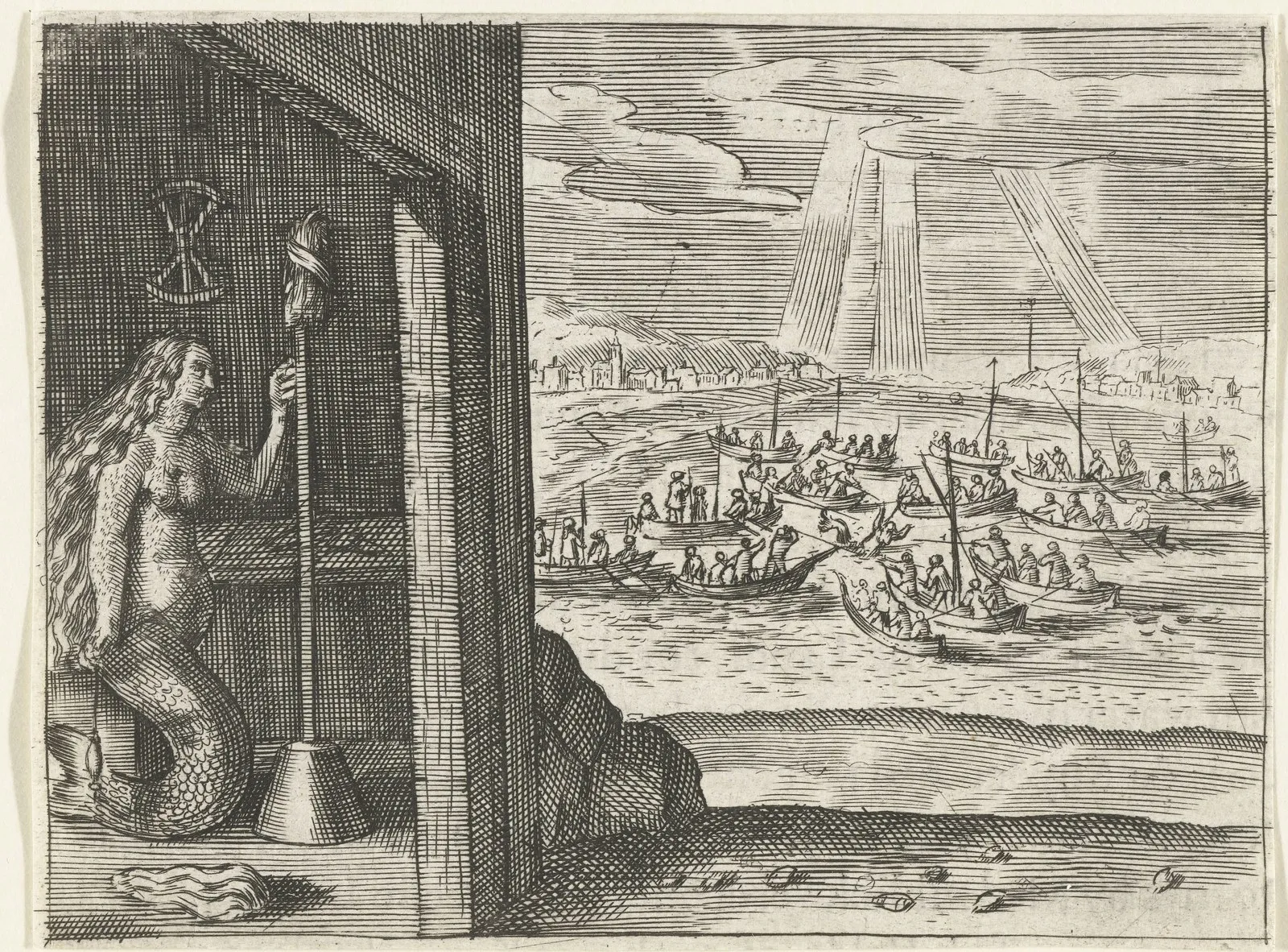
“Zeemeermin van Edam spinnend in een huisje, 1403”, anonymous, an illustration from Wachtendorp’s Oude Hollandsche geschiedenissen ofte corte rijmkronyck, Amsterdam, 1645. Rijksmuseum, RP-P-OB-78.246, Public Domain Mark, cropped.
The verse beside the plate does not match it. In the 1648 printing she comes in through “the new Texel gap”, sings, howls like a dog at midnight and catches fish with her hands.14 At the markets people talk of a devil in the lake, and the farmers who go out to fight it drag her out of the water instead.14 And her body is human:
maer menschelijcke leden, / Van voor, van achteren, van aensicht, en van mondt14
but human limbs, front and back, face and mouth
The Edams Museum, too, points to Wachtendorp’s book of 1645, “illustrated by a spinning woman with a fish tail”.4
Edam had a picture of its own. A print of 1784 to 1786 in the Rijksmuseum copies a painting that then hung in the Prinsenhof at Edam, and calls her “Groenne Wyf”, the green woman.5 Here she stands on two legs with long hair, holding a spindle and a reel.5
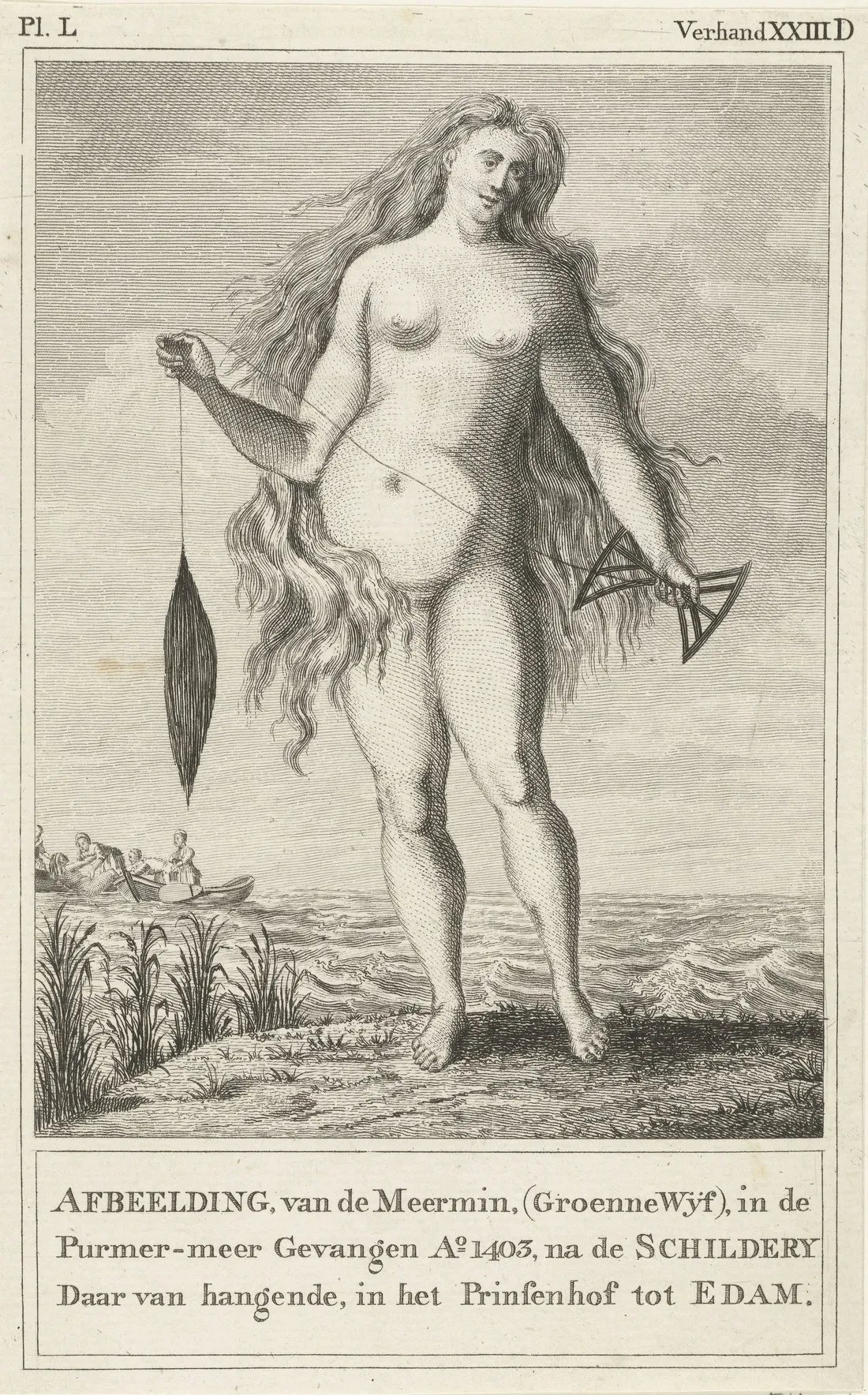
“Afbeelding van de Meermin, (Groenne Wyf), in de Purmer-meer gevangen A.o 1403, na de schildery daar van hangende, in het Prinsenhof tot Edam”, anonymous, 1784 to 1786, plate L in a Haarlem learned society’s Verhandelingen. Rijksmuseum, RP-P-OB-78.242, Public Domain Mark, cropped.
So the painting as copied in 17865 and the plate of 16454 disagree about her legs. We found no source that dates the painting.
From mute to monster
Three writers, in 1567, 1588 and 1628, added to her.151617 Lodovico Guicciardini, describing Haarlem in his Description of the Low Countries, is the first of the texts we read to call her mute, and the first to print the year, 1403.1815 His Dutch translation of 1612 calls her a “Meerminne oft Zeewijf” and names her mistress as a widow.15
Hadrianus Junius, in his Batavia of 1588, says the story seemed hard to believe.16 His sea-monster is “viridi musco turpe”, foul with green moss, and it makes a strange sighing sound instead of speech.16 He doubts one detail, that she spun thread, because she would have needed hands with separate fingers, as humans have.16 He then counts her among the Nereids, to whom, he says, Pliny gives bodies bristling with scales.16
Samuel Ampzing’s verse history of Haarlem, in 1628, retells her in rhyme17 and gives her no tail:
De vrouwen gansch gelijk/ den huyd maer uytgenomen/ Doch stom/ en sprakeloos17
Exactly like a woman, except for the skin, but dumb and speechless
Ampzing then prints the Divisiekroniek, Junius and Guicciardini one after another, so that three of the older texts sit together in one book.17
A wild woman in 1517
The chronicle that Ampzing reprints is the Divisiekroniek, printed in Leiden on 18 August 1517.19 Its author is not named; the Leiden University Libraries say it must be Cornelius Aurelius.19
Its chapter is titled “Van een wilde vrouwe dye in dye zee gevangen worde”, of a wild woman caught in the sea.1 The text calls her “een wilt ende ongetammet wijf”.1 She is naked and covered in watery matter, which the Dutch names as moss, slime and muck.2
Si was heel naect van lichaem, sonder clederen an te hebben, mer si was behangen mit enigerley wateringe materie, als mosch, sliver ende ander slijm2
She was completely naked, without any clothes, but hung about with all kinds of watery matter, such as moss, slime and other muck.
The women and girls who milked their cows across the lake pulled her out and took her to Edam, where nobody understood her speech.10 The people of Haarlem pressed Edam hard for her, and she learned to spin there and died there.20 She was buried in the churchyard because she often honoured the Holy Cross.20
The chronicle says where it got this.21 Old and trustworthy men who had seen her in Haarlem vouched for it, and that is why, in the chronicle’s words, it is set down “as a novelty”.21 The chapter opens “Omtrent dese tijt”, about this time, and sits between chapters for 1403 and 1404.6
The Latin chapter
A Latin version tells the same events.1020 It sits in a chronicle that Sweertius printed at Frankfurt in 1620 under the name of Joannes Geerbrandi of Leiden, a Carmelite.8
quaedam indomita mulier ex longinquis partib. perpulsa est ad latitudinem maris australis122
a certain untamed woman, driven from far-off parts, was swept into the southern sea
Here too she is naked, her body covered with “watery matter clinging to it”.2 The girls of Edam who went for the cows’ milk are in this version too.10 The chapter closes on the respectable men of Haarlem who said they had often seen her.21 The chapter has no year.6
Oud Edam says a monk named Joannes Gerbrandis van Leyden wrote it down in 1470.9 Meder, without naming the chronicle, says the first chronicle account came almost 70 years after 1403, so no eyewitness could have told it.13 Both point at about 1470. The Latin chronicle may or may not be the work they mean: Sweertius dates nothing in the chapter.6
Meder adds a version in which a fisherman pulls her from the lake, raises her and marries her, printed as true in later almanacs.13
The telling beside the record
| The story | The record | Verdict |
|---|---|---|
| It happened in 1403 | Chronicles: no year, a chapter between 1403 and 14046; the year printed in 156718 | Added later (1567) |
| She could not speak | Chronicles: nobody understood her10; Guicciardini: mute15 | Added later (1567) |
| She had a fish’s tail | First seen in the plate of 16454; the five older texts have none3 | Added later (1645) |
| She was named Minne | No older text gives a name7 | Unsupported |
What we could not verify
Sources we have not seen
- The printed Divisiekroniek of 1517. It would show the wording as printed; we searched archive.org and the web on 10 October 2026 and found no open scan, so we read the DBNL edition by Aarnoud de Hamer (2011).
- Jacob Meyer’s Annales Flandriae, book 14, which Guicciardini and Ampzing cite for the story. It would show whether 1403 comes from Meyer; we found no scan of the annals on archive.org.
- Arnout Vosmaer’s essay on the Haarlem mermaid in the Haarlem learned society’s Verhandelingen of 1786, volume 23. It would date the painting in the Prinsenhof and say what it showed; we found no online copy.
Seen only where others quote them
- Sinninghe’s Spokerijen in de Zaanstreek en Waterland (1975), read only through the Volksverhalenbank’s retelling of it, which gives the Houtstraat and the Purmerpoort verse.
Questions we could not settle
- When the Latin chronicle was written and by whom. The edition we read gives no date for the chapter, and the 1470 of Oud Edam has no text behind it that we found.
- Where Edam’s “Minne”, the milkmaids and the stained-glass window first appear, and when the painting in the Prinsenhof was made.
- Whether any text or picture before the plate of 1645 gives her a tail.
Read next
CaseVärend, Småland, Sweden, 1883 to 1889
The lindworm reward in Småland was never claimed
TaleVrhnika (Ober-Laybach), Slovenia, 1684 to 1689
Vrhnika's baby dragons: Valvasor's lizard and the olm
CaseLucerne, Switzerland, 1420 to 2006
The Lucerne dragon stone: a pledge, a charter and a CT scan
Sources
- Johannes Gerbrandi (Johannes a Leydis), Chronicon, in F. Sweertius (ed.), Rerum Belgicarum annales (Frankfurt, 1620), Chronic. Belgic. lib. XXXI, cap. LXIII, p. 323 (primary) transcription
- Die cronycke van Hollandt, Zeelandt ende Vrieslant (Divisiekroniek, 1517), ed. A. de Hamer (DBNL, 2011), chapter 57, "Van een wilde vrouwe dye in dye zee gevangen worde. Dat LVII capittel", fol. 239r to 239v by DBNL's markers (primary)↑
- Sweertius 1620, Latin chronicle, p. 323: "erat enim nuda vestimentis, nihilominus tamen corpus tegebatur ex materia aquatica sibi adhaerente" (primary)
- Divisiekroniek, DBNL edition, chapter 57: "Si was heel naect van lichaem ... behangen mit enigerley wateringe materie, als mosch, sliver ende ander slijm" (primary)↑
- Sweertius 1620, Latin chronicle, p. 323, whole chapter (primary)
- Divisiekroniek, DBNL edition, chapter 57, whole chapter (primary)
- Guicciardini 1567, p. 180, whole passage (primary)
- Junius 1588, pp. 304 to 305, whole passage (primary)
- Ampzing 1628, pp. 376 to 379, verse and prose (primary)↑
- Rijksmuseum, "Zeemeermin van Edam spinnend in een huisje, 1403", RP-P-OB-78.246 (anonymous, 1643 to 1645), catalogue description ("De zeemeermin met vissenstaart zit in een huisje te spinnen") and note "Illustratie uit: C. Wachtendorp ... Amsterdam 1645"; the image itself
- Wachtendorp, Oude Hollandsche geschiedenissen (1648 printing), plate on scan leaf n174, above the eighth book's verse: a seated woman with a fish's tail at a spindle, boats behind (primary)
- Edams Museum, "Finally home: the mermaid of Edam", paragraph on Wachtendorp: "illustrated by a spinning woman with a fish tail"↑
- Rijksmuseum, "Zeemeermin van Edam, 1403", RP-P-OB-78.242, title and description on the record; the image itself↑
- Divisiekroniek, DBNL edition, chapter 56 ("Int jaer M CCCC ende III"), chapter 57 ("Omtrent dese tijt"), chapter 58 ("Int jaer ... M CCCC ende IIII") (primary)
- Sweertius 1620, Latin chronicle, p. 323, cap. LXIII has no year; cap. LXIV opens "Anno Domini millesimo quadringentesimo quarto" (margin "Anno 1404") (primary)↑
- Sweertius 1620, Latin chronicle, p. 323, whole chapter (primary)
- Divisiekroniek, DBNL edition, chapter 57, whole chapter (primary)
- Guicciardini 1567, p. 180, whole passage (primary)
- Junius 1588, pp. 304 to 305, whole passage (primary)
- Ampzing 1628, pp. 376 to 379, verse and prose (primary)↑
- F. Sweertius (ed.), Rerum Belgicarum annales (Frankfurt, 1620), title page of the chronicle (scan leaf n10); running head p. 324 (scan leaf n351) (primary)↑
- Vereniging Oud Edam, "De Zeemeermin van Edam" (credited to Landschap Noord-Holland), the page's text (no author, no date)↑
- Sweertius 1620, Latin chronicle, p. 323: "puellae Edammensis opidi ... pro lacte vaccarum", "Locutionem autem eius non intelligebant" (primary)
- Divisiekroniek, DBNL edition, chapter 57: "Die vrouwen ende maechden ... melcken die coyen", "Niement en konde haer sprake verstaen" (primary)↑
- Edams Museum, "Finally home: the mermaid of Edam", the page's text (no author, no date)↑
- Theo Meder, commentary on item SWATER39 "De meermin van Edam", Volksverhalenbank van de Lage Landen (broadcast text, autumn 2005), commentary section, paragraphs 3 to 6↑
- Casparus Wachtendorp, Oude Hollandsche geschiedenissen ofte corte rym-kronyck (1648 printing), Achtste Boeck, scan leaves n174 to n176 (primary) transcription↑
- Guicciardini, Descrittione (Antwerp, 1567), p. 180, Haarlem entry (primary)
- Lodovico Guicciardini, Beschrijvinghe van alle de Neder-landen (Amsterdam, 1612; facsimile reprint scan), p. 202, right column, Haarlem entry: "een Meerminne oft Zeewijf ... al naeckt ende stom", "haere vrouwe, welcke een weduwe was" (primary)↑
- Hadrianus Junius, Batavia (Leiden, 1588), pp. 304 to 305 (primary) transcription
- Samuel Ampzing, Beschryvinge ende lof der stad Haerlem (Haarlem, 1628), pp. 377 to 379, Junius's Latin printed after the Divisiekroniek prose (primary)↑
- Samuel Ampzing, Beschryvinge ende lof der stad Haerlem (Haarlem, 1628), pp. 376 to 379 (primary) transcription↑
- Lodovico Guicciardini, Descrittione di tutti i Paesi Bassi (Antwerp, 1567), p. 180, Haarlem entry (primary) transcription
- Hadrianus Junius, Batavia (Leiden, 1588), p. 304, "circiter annum ... tertium supra millesimum quadringentesimum", margin "Ann. 1403" (primary) transcription↑
- Sweertius 1620, Latin chronicle, p. 323: "Tunc Harlemenses ... petierunt", "nere didicit", "sepelitur in coemiterio pro eo quod crucifixo reverentiam exhibere consuevit" (primary)
- Divisiekroniek, DBNL edition, chapter 57: "deden grote instancie ende versoeken an die stede van Edam", "leerde si spinnen", "worde opt kerchof begraven om des willen, dat si dicwils dat Heylighe Cruyce eer ende reverencie dede" (primary)↑
- Sweertius 1620, Latin chronicle, p. 323, last sentences (primary)
- Divisiekroniek, DBNL edition, chapter 57, last sentences: "Waerom datter in dese cronike voer een nyewicheit is gheset" (primary)↑
- Sweertius 1620, Latin chronicle, p. 323: "quaedam indomita mulier ex longinquis partib. perpulsa est ad latitudinem maris australis infra opidum Campen & Edam quae natando per Purmerye pervenit ad Purmermeer" (primary)
- Divisiekroniek, DBNL edition, chapter 57: "is comen driven ende swemmen een wilt ende ongetammet wijf in die Zuderzee, tusschen Campen ende Edam ... swemmende in Purmer Yee, is si gecomen doer een gebroken gat van den dyke in Purmermeer" (primary)↑
Documents quoted
- Ampzing, Beschryvinge ende lof der stad Haerlem (1628): the sea-monster woman, verse and the Divisiekroniek passage (transcribed from the page image)
- Chronicon Belgicum, book 31, chapter 63: the woman the girls of Edam caught (in Sweertius, 1620) (transcribed from the page image)
- Guicciardini, Descrittione di tutti i Paesi Bassi (1567): the sea-woman of Haarlem (transcribed from the page image)
- Hadrianus Junius, Batavia (1588): the sea-monster of the Purmer (transcribed from the page image)
- Wachtendorp, Oude Hollandsche geschiedenissen ofte corte rym-kronyck (1648 printing): the sea-woman, eighth book (transcribed from the page image)