 Twice Told
Vrhnika's baby dragons: Valvasor's lizard and the olm
A tourism page says Valvasor wrote of a dragon that spews out its young. His 1689 chapter has one dead, lizard-shaped animal a postmaster hung up for weeks.
Contents
Published 6 Oct 2026. Sources checked 6 Oct 2026.
A page from the Ljubljana Tourist Board, September 2022, says that Valvasor wrote of the dragon Lintvern, who spews out water and his young.8 Valvasor’s chapter, printed in 1689 in Die Ehre dess Hertzogthums Crain (vol. 1, Book IV, chapter XXXI), does have a young dragon, a junger Lindwurm.910 It is one dead animal that a postmaster said he had hung up in his house for three weeks.1 The dragon in it is a Lindwurm, and the water is called Bella.1112
This is the story as the Tourist Board’s page tells it.
In the gorge of the Bela stream above Stari Malin at Vrhnika, a Temple of the Lintvern dragon has grown up, and dragons live in it as guardians of the “white water”, a wondrous spring.8 Lintvern, the spring of the Bela, inspired Valvasor, who writes of the dragon Lintvern, who spews out water and his young.8
Valvasor does have a dragon that drives the water out, and he does have a young one. He has no dragon that spews out its young, and no olm. Aljančič and his co-authors, in their 1993 book on the olm, say Valvasor’s dragon turned into one.6 The earliest suggestion of an olm that we found is a museum’s, from 1846.7
A water that runs when it is poked
On 24 June 1684 Valvasor was riding home from Cornial and stopped for the night not far from Loitsch, where he asked some peasants about local curiosities and heard of a water in the hills that ran only when touched.13 Aljančič (2019) places the peasants between Logatec and Vrhnika.3 The next day they led him there through the wilderness, and he had to work to get his horse down into the valley.13
The water is called Bella in Carniolan, he writes, and Weiss in German. It does not flow all the time: once at night around twelve, once by day around nine.11 He had printed the story of the same stream earlier, in Book III, where a Dr. Schönleben had been told it ran only every fourth or fifth day. Valvasor corrects him from his own inspection and test: once by day and once by night.14
A woman who lived nearby told him her father once had a mill on the dry gully, the Stare malen, the Old Mill. When there was grain to grind, the family went up to the source, pushed a long stick into the hole and stirred, and the water came out white and ran for a quarter of an hour. The hole had been closed with a great rock four years before.15
The herders and a peasant he met gave a different reason. They firmly believed Lindwürme were in the mountain. There was a spring where the Lindwurm lay, the peasant said, and when the water collected until it was too much for him, he drove it out.12 Steinberg’s book on Lake Cerknica (1758 to 1761) says the herders near Ober-Laibach believed a big Lindwurm rolled about in the hollow mountain and pressed the water out. Steinberg had not been to the spring, and he did not bother to repeat Valvasor’s long account.1216
The peasant said he had seen three Lindwürme in his life. Two years before, a young one had come out of the hole, and the hillside had fallen in behind it until it lay dead. For a witness he named the postmaster of Ober-Laybach, Herr Hofmann, who had carried it home dead.10 Valvasor took it all for “Narrethey und Fabeley” (“foolishness and fable”).10 He could hardly hold back his laughter at the peasant’s talk.10
Hofmann at the inn
As soon as he reached Ober-Laybach, Valvasor sent for the postmaster, who came to him at the inn. Hofmann said yes to what Valvasor had heard of the water, and then added that he had caught a Lindwurm two years before, carried it home and hung it up in his house, where it hung three weeks.1 That differs from the peasant’s version, in which Hofmann carried it home dead. Valvasor gives both.101
From the postmaster’s description Valvasor draws this sentence:
der vermeynte Lindwurm einer kleinen Spannen lang / und einer Eydexen gleich geformirt gewest1
the supposed Lindwurm had been a small span long and shaped like a lizard
“Summa”, he continues, “it was an earth-worm and vermin” (ein Erdwurm / und Ungeziefer).2 He explains how the people made a dragon of it. It had rained hard those days, rainwater had torn earth and stones down from the mountain, and a good deal had been undercut at the side where tufa was dug. The little creature was then found dead half an hour below the hole, and the simple people (“einfältige Leute”) took it for a young Lindwurm.2 Hofmann also told him that only small trout, about a finger long, ever came out of the spring.17
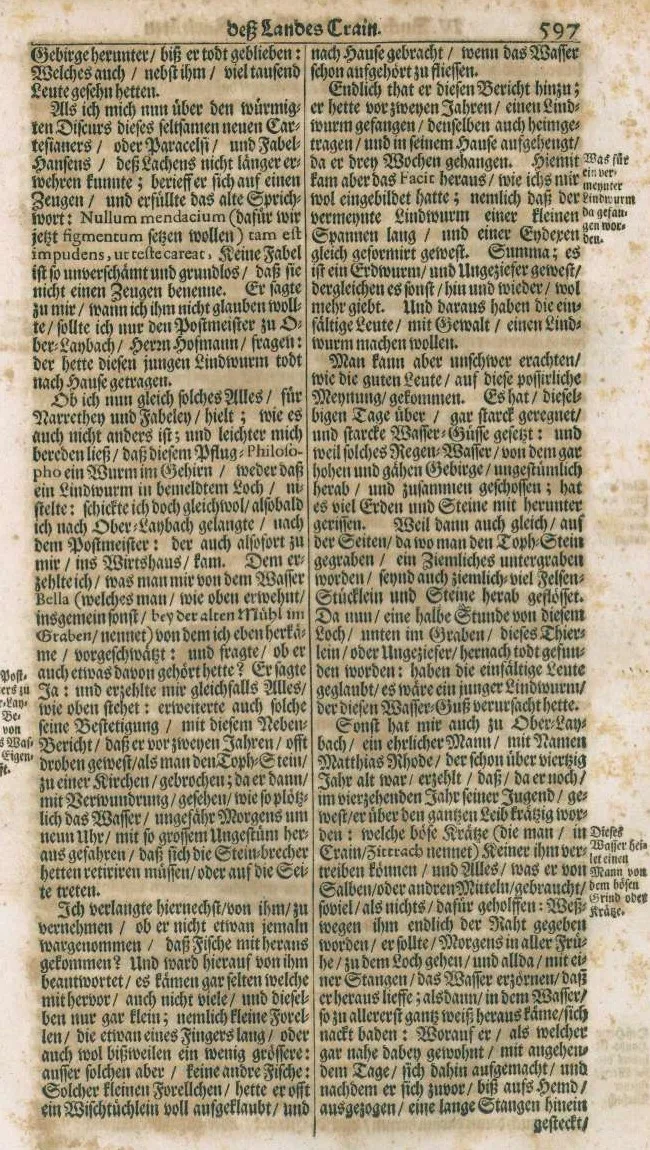
Page 597 of vol. 1 of Johann Weikhard Valvasor, Die Ehre dess Hertzogthums Crain (Nuremberg, 1689), cropped. National and University Library of Slovenia, dLib.si (record), Public Domain Mark.1
Valvasor does not claim to have seen the animal. It had hung in Hofmann’s house for three weeks, two years before, and Aljančič (2019) says he never saw it.118 His words do not settle what it was: a lizard-shaped earth-worm and vermin, found dead.2
He went back on 11 September 1684 with four peasants, who cleared the rocks from the hole.13 He pushed a two-fathom pole into it himself and stirred, and the water burst out white as soapy water.19 Valvasor put it down to air loosened by the pounding and a siphon inside the hill.19 Steinberg gave a siphon too.20
A fish from another river
Steinberg’s book has another early report of an animal a span long. In 1751, he writes, Primus Sicherte caught five unknown fish in the Unz river after a flood. They were a span long, with snow-white skin and four feet, and they screamed and whined when they were brought into the boat.21 The Unz is not the spring at Ober-Laibach, and Steinberg does not connect the two, though both are in the same book.2116 Aljančič (2019) notes that Steinberg never saw the resemblance to Valvasor’s animal.22
A sawmiller in 1846
In what we read, the olm first appears in 1846, 162 years after Valvasor’s visit, and the idea comes from a museum. Anton von Schöppl wrote in 1903 that reading Valvasor’s small, lizard-like “vermin” made the administration of the Carniolan provincial museum suspect olms in the Bela brook. Nobody had looked, so the museum’s custodian, Freyer, went on 4 November 1846.7 The museum’s report on the visit, as Schöppl quotes it, gives the place as per lintvernu, two hours beyond Oberlaibach.7 That is the earliest use we found of the name Lintvern for the spring; Valvasor’s chapter has Bella.1123
The mouth of the spring had collapsed and was blocked with masses of stone. A sawmiller dammed the water with a weir and let it off twice a day. He knew nothing of Valvasor’s swelling and vanishing water, and he had never seen a proteus in his pond; he promised to watch for one. Freyer believed him and dropped the inquiry, since the place had no proteus.7 In 1885, according to Schöppl, Deschmann spoke to the Carniola section of the Alpine Club and held that the wonders Valvasor ascribed to the spring belonged to fancy and that the brook had lost any intermittent quality it ever had.24
Schöppl himself says the spring had dropped out of Carniola’s literature between Valvasor and 1847. In his own year, he writes, articles by Putick in the Laibacher Zeitung and the efforts of Oberlaibach’s mayor Jelovšek had drawn attention to it again.25 Steinberg’s section on it, in his book of 1758 to 1761, shows it was not quite forgotten.16
How the dragon became an olm
Laurenti named the olm Proteus anguinus in 1768 and gave Lake Cerknica as its home.26 The books that tie it to Vrhnika come much later, and they do not agree on how sure to be.
| Text | What it says of the story | The animal |
|---|---|---|
| Museum report, 18467 | Place called per lintvernu | Olms suspected; sawmiller had seen none |
| Aljančič and others, 199364 | Ride dated 24 June 1682 | The dragon “turned into” the olm, “with certainty” |
| Makarovič, 20015 | Dragon story near Vrhnika | “Most likely” an olm |
| Aljančič, 2019318 | Visit 25 June 1684 | Earliest published description of a cave animal; Valvasor never saw it |
| Tourist Board, 20228 | Spews water and its young | No olm in the page text |
Of these, the 1993 book dates the visit two years early. It gives 24 June 1682, where Valvasor’s chapter has 1684.413 It also says the spring above Stari Malin has since been tapped for a water supply.6 Makarovič reads the story as the earliest written evidence of how ordinary people pictured a dragon, a real animal, not a symbol of evil, and notes that even then the belief was not general.27 Aljančič (2019) calls Valvasor’s account the earliest known published description of any cave animal.3
Each of those is a reading of a text that does not say “olm”. Freyer’s visit of 1846 found no proteus, and Hofmann, who says he had the animal in his house, described it to Valvasor two years after it hung there.17 What the sawmiller saw afterwards is not in anything we read.
What we could not verify
Seen only where others quote them
- Freyer’s museum report of 1846, and the list in the Illyrisches Blatt of 26 June 1847 that Schöppl names. We know Freyer’s visit and the sawmiller only as Schöppl quotes them; the reading would show who at the museum proposed olms. ANNO answered our request with a security page, and a dLib full-text search for “lintvernu” returned only twentieth-century newspapers.
- Deschmann’s lecture of 4 May 1885, known from Schöppl’s quotation of a report in the Laibacher Wochenblatt of 16 May 1885. The dLib search above did not return it.
- Laurenti’s Specimen medicum (1768), whose entry for the olm we read only through Stejneger (1936) and Aljančič (2019). The Biodiversity Heritage Library’s search page refused our request, and we found no other open scan.
Questions we could not settle
- Whether Hofmann’s animal was an olm: Valvasor says only that it was small, lizard-shaped and dead, and he does not claim to have seen it.
- Whether an olm has ever been recorded from the Bela or the spring: none appears in the sources we read, and we did not check the Slovenian olm locality lists.
- Who at the Carniolan museum first proposed olms in the Bela: Schöppl names only its administration.
Read next
CaseVärend, Småland, Sweden, 1883 to 1889
The lindworm reward in Småland was never claimed
TaleEdam and Haarlem, Holland, Netherlands, 1403 to 1786
Before the Edam mermaid had a tail
CaseLucerne, Switzerland, 1420 to 2006
The Lucerne dragon stone: a pledge, a charter and a CT scan
Sources
- Valvasor, Die Ehre dess Hertzogthums Crain (Nuremberg, 1689), vol. 1, Book IV ch. XXXI, p. 597 (primary) transcription↑
- Valvasor, Die Ehre dess Hertzogthums Crain (Nuremberg, 1689), vol. 1, Book IV ch. XXXI, p. 597 (primary) transcription↑
- Visit Ljubljana, "Nova družinska dogodivščina – Tempelj zmaja Lintverna" (Pisma iz Ljubljane, September 2022), page text, paragraphs 1 and 3↑
- Valvasor, Die Ehre dess Hertzogthums Crain (Nuremberg, 1689), vol. 1, Book IV ch. XXXI, pp. 594 to 599 (primary) transcription
- Schöppl, "Intermittierende Quellen in Krain", Die Erdbebenwarte III (1903/04), offprint p. 1 ("I. Bd., IV. Buch, S. 594") transcription
- Makarovič, "Zmajske predstave in njihovi pomeni na Slovenskem", Traditiones 30/2 (2001), p. 40 ("Valvasor 1689: IV. knjiga, str. 594-597")↑
- Valvasor, Die Ehre dess Hertzogthums Crain (Nuremberg, 1689), vol. 1, Book IV ch. XXXI, pp. 596 to 597 (primary) transcription↑
- Valvasor, Die Ehre dess Hertzogthums Crain (Nuremberg, 1689), vol. 1, Book IV ch. XXXI, pp. 594 to 595 (primary) transcription↑
- Valvasor, Die Ehre dess Hertzogthums Crain (Nuremberg, 1689), vol. 1, Book IV ch. XXXI, p. 596 (primary) transcription
- Steinberg, Gründliche Nachricht von dem Czirknitzer-See (Laibach, 1758 to 1761), pp. 209 to 210 (primary) transcription↑
- Valvasor, Die Ehre dess Hertzogthums Crain (Nuremberg, 1689), vol. 1, Book IV ch. XXXI, pp. 594, 595 and 598 (primary) transcription↑
- Valvasor, Die Ehre dess Hertzogthums Crain (Nuremberg, 1689), vol. 1, Book III, p. 305 (PDF page 351) (primary) transcription↑
- Valvasor, Die Ehre dess Hertzogthums Crain (Nuremberg, 1689), vol. 1, Book IV ch. XXXI, pp. 595 and 596 (primary) transcription↑
- Valvasor, Die Ehre dess Hertzogthums Crain (Nuremberg, 1689), vol. 1, Book IV ch. XXXI, p. 597 (primary) transcription↑
- Valvasor, Die Ehre dess Hertzogthums Crain (Nuremberg, 1689), vol. 1, Book IV ch. XXXI, p. 598 (primary) transcription↑
- Valvasor, Die Ehre dess Hertzogthums Crain (Nuremberg, 1689), vol. 1, Book IV ch. XXXI, p. 598 (primary) transcription
- Steinberg, Gründliche Nachricht von dem Czirknitzer-See (Laibach, 1758 to 1761), p. 210 (primary) transcription↑
- Schöppl, "Intermittierende Quellen in Krain", Die Erdbebenwarte III (1903/04), offprint p. 1
- Aljančič, Bulog, Kranjc, Josipović, Sket and Skoberne, Proteus: skrivnostni vladar kraške teme (Ljubljana: Vitrum, 1993), p. 22 ("ljudje še naprej imenujejo Lintvern (tj. zmaj)")↑
Documents quoted
- Schöppl, Intermittierende Quellen in Krain (Die Erdbebenwarte, 1903/04): Freyer's visit of 4 November 1846 and Deschmann in 1885 (transcribed from the page image)
- Steinberg, Gründliche Nachricht von dem Czirknitzer-See (Laibach, 1758 to 1761): the spring at Ober-Laibach and the white fish of 1751 (transcribed from the page image)
- Valvasor, Die Ehre dess Hertzogthums Crain (1689), vol. 1, Book IV, chapter XXXI: the water near Ober-Laybach that runs only when it is stirred (transcribed from the page image)