 Twice Told
Mokele-mbembe, report by report, since 1776
The oldest text behind Mokele-mbembe is a 1776 note on claw prints. The name reached print in 1929, in a report that kept the animal out of the Likuala rivers.
Contents
- The versions, 1776 to 1997
- A trail beside a forest, 1776
- Half elephant, half dragon, in Rhodesia
- Von Stein’s report reaches print, 1929
- Willy Ley’s English, 1941
- Mackal on the Likouala, 1980 to 1981
- Herman Regusters at Lake Télé, 1981
- Agnagna at Lake Télé, 1983
- Nugent at Boha, 1993
- Lake Télé measured, 1997
- What we could not verify
- Sources
Published 24 Sept 2026. Updated 25 Sept 2026. Sources checked 24 Sept 2026.
In 1776 the abbé Liévin-Bonaventure Proyart published in Paris a history of Loango, Kakongo and the other kingdoms on the near side of the Congo River, written up from the memoirs of the prefects of the French mission there.7 Between a note on elephant ivory and a note on lions, it gives two sentences to an animal nobody saw:89
Les Missionnaires ont observé, en passant le long d’une forêt, la piste d’un animal qu’ils n’ont pas vu ; mais qui doit être monstrueux : les traces de ses griffes s’appercevoient sur la terre, & y formoient une empreinte d’environ trois pieds de circonférence.8
Passing along the edge of a forest, the missionaries saw the trail of an animal they did not see, but which must be monstrous. The marks of its claws showed on the ground and made a print about three feet round.
The report of the American expedition of 1981 puts it first in its history of large unknown animals in Central Africa.9 It mentions no long neck, no swamp and no name, only a trail beside a forest.
This is the story as the expedition reports of the early 1980s told it, and as most retellings still tell it.
In the swamps of the Likouala, in the north of the Republic of the Congo, and in Lake Télé at their centre, lives an animal the size of an elephant, with a long neck, a small head and a long tail. It is a dinosaur, a sauropod, that never died out.10 Its Lingala name, mokele-mbembe, means “one who stops the flow of rivers”.11
It eats only plants, the fruit of the riverbanks above all. But it attacks any canoe that comes near, overturns it and kills the people in it, though it never eats them.12
Once, people living by Lake Télé trapped one behind a barricade of stakes and killed it with spears. They cut it up and ate it, and all who ate of it died.3
That is the animal the expeditions went looking for.
The versions, 1776 to 1997
| Text | Date | What it adds |
|---|---|---|
| Proyart, Histoire de Loango | 1776 | claw prints; no animal8 |
| Hagenbeck, Von Tieren und Menschen; Beasts and Men | 1909 | half elephant, half dragon; “brontosaurus”; Rhodesia1 |
| Von Stein’s report, in Bölsche, Drachen | 1929 (report 1913/14) | the name; neck, tooth or horn, canoes512 |
| Ley, The Lungfish and the Unicorn | 1941 | the English text; a dinosaur, by conclusion13 |
| Mackal and others, Cryptozoology 1 | 1982 (journeys 1980, 1981) | the Likouala swamps; a killing at Lake Télé23 |
| Regusters, Munger Africana Library Notes 64 | 1982 (journey 1981) | sightings on the lake; “one who stops the flow of rivers”1411 |
| Agnagna, Cryptozoology 2 | 1983 | a Congolese zoologist’s sighting15 |
| Nugent, Drums along the Congo | 1993 | a god that changes its shape16 |
| Laraque and others, Comptes rendus | 1997 (survey 1992) | the lake measured4 |
The sauropod enters with Hagenbeck, the name with von Stein, the Likouala and Lake Télé with the Americans of 1980 and 1981.1122 Daniel Loxton and Donald Prothero, in their sceptical history Abominable Science! (2013), read the lore as a blend of many different stories from regions far apart, not as knowledge of a population of animals.17
A trail beside a forest, 1776
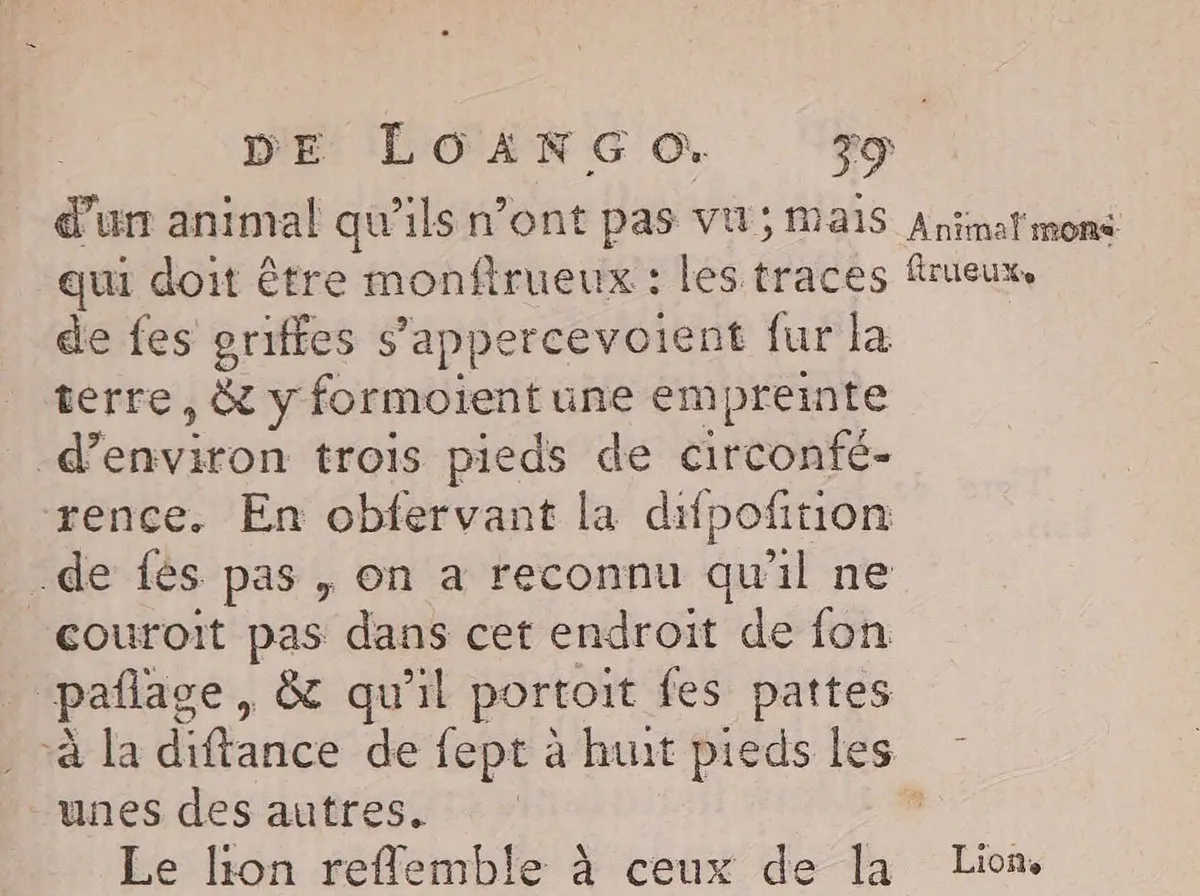
The end of the passage, on page 39 of Proyart’s Histoire de Loango (Paris, 1776). Wellcome Collection, Public Domain Mark.8
The passage runs over two pages. Its second sentence adds that, from the way the steps were set, the missionaries could tell the animal was not running there, and that it put its feet down “à la distance de sept à huit pieds les unes des autres”, seven or eight feet apart.8 The next paragraph, with the margin note “Lion”, begins on lions.9 Proyart gives no place beyond a forest, no date and no witness by name. The three feet are the distance around the print, not its width. The passage and our translation are on a page of their own.
Loxton and Prothero point out that the two sentences are the whole story, and see no reason other than geography to connect them with the modern animal.9
Half elephant, half dragon, in Rhodesia
Carl Hagenbeck, the Hamburg animal dealer, put a dinosaur into the story in his memoir, Von Tieren und Menschen, and its abridged English translation, Beasts and Men, first printed in November 1909.1 Some years before, he wrote, two informants who had entered Rhodesia from opposite sides, one of his own travellers and an English big-game hunter, had brought him the same story:
Beide Berichte stimmten merkwürdigerweise darin überein, daß ihnen die Eingeborenen von dem Vorkommen eines Ungeheuers erzählt hätten, das, halb Elefant, halb Drache, in den unzugänglichsten Sümpfen hauste.1
Oddly enough, both reports agreed that the local people had told them of a monster, half elephant and half dragon, that lived in the most inaccessible swamps.
His traveller Menges had heard something similar decades earlier, he added, and there were drawings of the creature on cave walls. “From what I have heard of the animal, it seems to me that it can only be some kind of dinosaur, seemingly akin to the brontosaurus.” He sent an expedition, which came home with nothing proved, laid low by fever and, he wrote, attacked by the people of the region.1
The two versions of the book do not start in the same place. The German page opens with reports of paintings “auf Felsen und in Höhlen im Innern von Rhodesia”, on rocks and in caves in the interior of Rhodesia; the English abridgement leads with the two travellers and moves the drawings to “certain caverns in Central Africa”.18 Neither version of the passage mentions the Congo. Rhodesia covered what are now Zambia and Zimbabwe, and by Loxton and Prothero’s reckoning Hagenbeck’s swamps lay about 1,200 miles from Lake Télé.19
The sauropods themselves were new to the public. The first mounted sauropod skeletons went on show in New York and London in 1905, and casts of Diplodocus followed in Berlin in 1908 and Paris in 1910. In 1907 a mining engineer and a palaeontologist found the bones of a giant sauropod at Tendaguru in German East Africa. Hagenbeck put a cement Diplodocus in his own zoo.20
Von Stein’s report reaches print, 1929
The name appears, in the earliest printing we have found, in a German book about dragons. Wilhelm Bölsche’s Drachen: Sage und Naturwissenschaft, published by Kosmos in Stuttgart in 1929, quotes at length from the report of Captain Freiherr von Stein zu Lausnitz, leader of the German Likuala-Kongo expedition of 1913/14.5 Bölsche had the passage from von Stein, out of the expedition’s still unpublished zoological and botanical results, and printed it with his permission “möglichst im Wortlaut”, as close to word for word as he could.5
Von Stein wrote with care. The matter might exist only in the imagination of the people who lived along the rivers, he said, but more probably had some real basis; his information came from local sources and from experienced guides who told the same story independently of one another.21 The riverside people of the lower Ubangi and the Sanga, up to about Ikelemba, called the creature mokéle-mbêmbe and feared it greatly.12
His next sentence is the one the modern story drops: “In den weniger großen Strömen, wie in den beiden Likuala, soll es gänzlich fehlen”, it was supposed to be entirely absent from the smaller rivers, such as the two Likualas, and rare even in the large ones.12 One was supposed to be active on the Sanga between the mouth of the Mbaio and Pikunda, a stretch the expedition never reached because it was broken off so abruptly.512 Then comes the description:
Das Tier wird beschrieben als von graubrauner Farbe, mit glatter Haut und in Elefanten-, mindestens aber Flußpferdgröße. Es soll einen langen, beweglichen Hals und einen einzigen, sehr langen Zahn, der aber auch als Horn beschrieben wurde, besitzen. Einige sagten ihm auch einen sehr langen, kräftigen Schwanz in Alligatorenart nach. Kanus, die in seine Nähe kommen, sollten sofort angegriffen und umgeworfen, die Besatzung zwar getötet, aber nicht gefressen werden.12
The animal is described as grey-brown, with smooth skin, the size of an elephant or at least of a hippopotamus. It is supposed to have a long, flexible neck and a single, very long tooth, which was also described as a horn. Some also gave it a very long, powerful tail like an alligator’s. Canoes that come near it were supposed to be attacked at once and overturned, and the crew killed but not eaten.
It lived, the accounts said, in deep eddies where the river turned sharply, and in hollows washed out of the clay banks below the waterline. It ate only plants, a bankside liana with large white flowers, milky sap and apple-like fruit above all. On the Ssombo arm von Stein was shown a fresh break through the bush near such plants, but the hippo and elephant paths there made it impossible to pick out any single track.12 A guess that it was a manatee, Bölsche adds, had proved untenable. In a private note to Bölsche he added that the Ndsimu of the upper Sanga told the same story, and that two Fulbe men from the Garua area knew of it in the Benue, far away in the Niger system; so wide a spread, von Stein thought, made a legend a little more likely.21
Bölsche called the link to a brontosaur natural (“natürlich”) but not compelling (“kein zwingender”), and repeated the specialists’ guess that sauropods stood in shallow water grazing on soft water plants.22 That was the picture of the time. Prothero, a palaeontologist, points out that trackways and teeth have since shown animals of dry land that ate tough plants.22
On the same pages Bölsche mentions two Belgians who said they had seen, in the eastern Congo basin, a brontosaurus-like monster with a horn on its snout and a thick kangaroo tail, a story he says the English and American press turned into a nonsensical sensation.23 Loxton and Prothero trace it to Fungurume in the Belgian Congo in 1919 and to a practical joke by a railway man, David Le Page; the second witness, “Gapelle”, was an anagram of his name.23 The whole of Bölsche’s passage is transcribed and translated.
Willy Ley’s English, 1941
English readers met von Stein through Willy Ley’s The Lungfish and the Unicorn (1941), reissued in 1948 as The Lungfish, the Dodo, and the Unicorn.13 Ley says the official report was still in manuscript, spells the name Mokéle-mbémbe, and writes that nobody knew whether the name meant anything.13 His translation follows the phrases Bölsche prints, from the imagination of the river people to the two Likualas, though our full-text search of both editions finds no mention of Bölsche.1221 Where von Stein left the question open, Ley closed it: central Africa, he concluded, could still be a home for dinosaurs, and the stories suggested it was.13
Loxton and Prothero write that von Stein’s account is known to cryptozoologists only from Ley’s translation, and call the reliance on him a major gap in the scholarship. They ask when the manuscript was written, whether it survives, and whether Ley translated it accurately.6 The German text Bölsche printed twelve years before Ley at least lets a reader check the translation.513 The manuscript itself we have not found.6
Mackal on the Likouala, 1980 to 1981
Roy Mackal, a University of Chicago biologist, went to the Congo with James Powell in early 1980. They went to Impfondo on the Ubangi and on to Epena on the Likouala, and found that people there did speak of the animal.24
Mackal’s second expedition, from late October to early December 1981, went into the Likouala swamps with an American missionary as guide and Lingala interpreter, a Congolese biologist assigned by the government, and armed security men.2 Its sonar found fish and crocodiles in the deep holes of the Bai River and nothing else. It never reached Lake Télé. It brought back a wake on the Likouala, an old trail shown to them by an elephant hunter, and evidence that, by the report’s own account, proved nothing.225
At Moungouma Bai, villagers told the Congolese members of the team that they knew where the animal could be seen but would not tell white outsiders, particularly Americans.26 Loxton and Prothero read Mackal’s own account of what followed as pressure on people who had said they never saw it.26
The report also carried the story of a killing at Lake Télé in the late 1950s.3 As Loxton and Prothero show, it reached Mackal and Powell as hearsay, from a man who had been a small child at the time; in that telling the animal was speared behind a barricade of stakes, and all who ate the meat died.3
Herman Regusters at Lake Télé, 1981
Herman Regusters, an aerospace engineer who had once planned to travel with Mackal, left for Africa on 6 September 1981 with his wife Kia and flew north to Epena on 9 October.14 His report, published by Caltech’s Munger Africana Library in July 1982, describes a long neck seen far off on the lake on 29 October, a roar from the forest on 4 November, and on 27 November a long neck and small head that Kia saw rise about two metres from the water, some 30 metres from the boat.14 At a press conference in Los Angeles on 22 December he did not produce the photograph or the tape recording he had promised. Mackal said he was not qualified.1425 The report’s editor, Ned Munger, wrote in its preface: “This editor does not believe that a dinosaur was seen or that one exists.”14
It is the earliest text we found with the translation that Loxton and Prothero call the usual one: “In the Lingala dialect the animal is called ‘mokele mbembe,’ interpreted as ‘one who stops the flow of rivers.’” In the Bomitaba dialect of the area, Regusters writes, it is emeula natuka, “eater of the tops of the palms”.11 He gives no source for either gloss, and we have not found a Lingala dictionary that confirms them.
Regusters puts the killing at Lake Télé “in the 1930s”, with two animals dead, not one.3 And he writes that his team “measured depths of more than 200 meters” in the lake.4 In his concluding comments he writes that the Congo Basin “could well be a living museum for the sauropod species Antarctosaurus”.10
Agnagna at Lake Télé, 1983
Marcellin Agnagna, a biologist at the Brazzaville zoo who had gone on one of the 1981 American expeditions for the Congolese government, led the first Congolese government expedition in April and May 1983.15 At Boha, whose people hold Lake Télé as theirs, the team waited a week before the villagers agreed to guide them; Agnagna puts that down partly to their bad experience with an American expedition in 1981. Before the team set out, the village elders prayed to their ancestors for its safety.27 A later visitor reported that Boha villagers were angry the Regusters party had not kept its promises of gifts and money.27
On 1 May 1983, by Agnagna’s account, he and two villagers watched an animal with a wide back, a long neck and a small head, about 240 metres away, for 20 minutes. He had been filming monkeys, and he filmed it with the lens cap on.15 Loxton and Prothero note that he later gave another reason for the useless film, that the camera had been set to macro.15 He also wrote that people in the region are slow to talk about these animals, for fear of falling ill or dying.27
He found the lake shallow: 2 to 3 metres, with holes of about 6, and he printed a French survey sketch of 1976 that gives 280 centimetres at the centre.4
Nugent at Boha, 1993
The writer Rory Nugent, in Drums along the Congo (1993), describes meeting a religious specialist at Boha who had no interest in a living dinosaur. To him Mokele-mbembe was a powerful god that changed its appearance by divine whim, so that every differing description brought to him could be true.16 None of the searches that Loxton and Prothero review brought back a specimen, a bone, or a photograph, film or cast that settles anything.25
Lake Télé measured, 1997
In June 1992 a French and Congolese team from ORSTOM and the Congolese research directorate surveyed Lake Télé, and published its first results in 1997. The authors note the cryptozoologists’ interest, and that apart from Grandin’s soundings of 1976, no scientific results on the lake had been published.28
The lake is an ellipse 6.4 kilometres by 4.8, about 23 square kilometres. Its bottom is almost flat, like a saucer: 1 to 1.5 metres of mud under 2.5 metres of water, about 4 metres from the surface to firm ground.4
What we could not verify
Sources we have not seen
- Von Stein’s own report, which would show when he wrote it and how closely Bölsche and Ley follow it. Bölsche (1929) printed it from the expedition’s unpublished results, and Ley (1941) says it was still in manuscript. Kalliope, the German union catalogue of personal papers, lists nothing by him, and we found no archive that holds it.
- The expedition’s maps, which Bölsche says appeared in the Mitteilungen aus den deutschen Schutzgebieten and which would show how far up the Sanga it got. He gives no volume. The volumes online stop at 1914, and that one has no such maps; the wartime volumes are in no digital library we searched, and HathiTrust’s copy of the 1919 volume is open only in the United States.
Seen only where others quote them
- The meaning “rainbow”: Loxton and Prothero quote Roy Mackal’s A Living Dinosaur? (1987) saying a district official told him the word meant that. The book is in copyright, and the only full copy we found online is an unauthorised upload, which we did not use.
Resting on a single source
- Laraque and colleagues (1997) mention local legends of a strange bird of fire falling where the lake is.
Questions we could not settle
- Whether Ley translated from Bölsche’s printed text or from the manuscript.
- What mokele-mbembe and the Bomitaba emeula natuka mean. We found no Lingala dictionary or ethnographic study that glosses them.
Read next
TaleUasin Gishu and the Nandi forest, Kenya, 1909 to 1927
The Nandi bear and the devil called Chemosit
CaseTsavo River, Kenya, 1898
The Tsavo man-eaters: 28 counted in 1907, 135 by 1925
CaseVärend, Småland, Sweden, 1883 to 1889
The lindworm reward in Småland was never claimed
Sources
- Carl Hagenbeck, Beasts and Men, trans. H. S. R. Elliot and A. G. Thacker (London: Longmans, Green, first printed November 1909; 1912 reissue), pp. 95-97 (primary)
- Carl Hagenbeck, Von Tieren und Menschen (Berlin: Vita, 1909 printing), pp. 380-381 (primary)
- Loxton and Prothero 2013, pp. 270-271
- Mackal et al. 1982, p. 63↑
- Mackal et al. 1982, pp. 62-70
- Loxton and Prothero 2013, pp. 282-283
- Searcy 2021, whole article↑
- Mackal et al. 1982, pp. 64-65
- Herman A. Regusters, "Mokele-Mbembe: An Investigation into Rumors Concerning a Strange Animal in the Republic of the Congo, 1981", Munger Africana Library Notes 64 (July 1982), pp. 5, 14 (primary)
- Loxton and Prothero 2013, pp. 280-282↑
- Agnagna 1983, pp. 108-110, fig. 5
- A. Laraque et al., "Reconnaissance scientifique du lac Télé (Nord-Congo): premiers résultats et interprétations", Comptes rendus de l'Académie des sciences, Sciences de la terre et des planètes 325 (1997): 49-56, p. 50
- Regusters 1982, p. 11 (primary)↑
- Bölsche 1929, pp. 50-51 (primary) transcription
- Mackal et al. 1982, p. 63
- Loxton and Prothero 2013, pp. 274-275↑
- Loxton and Prothero 2013, p. 275
- Mackal et al. 1982, p. 63↑
- Proyart, Histoire de Loango (Paris: Berton and Crapart, 1776), BnF copy, title page, view 2 (primary)
- Wellcome Collection catalogue, EPB/A/42319, record nag9qscw
- Daniel Loxton and Donald R. Prothero, Abominable Science! (Columbia University Press, 2013), p. 266
- Proyart 1776, BnF copy, pp. 208-209, view 214 (primary)↑
- Proyart 1776, BnF copy, pp. 38-39, views 44-45 (primary) transcription
- Proyart 1776, Wellcome copy, p. 39, image b33008681_0053 (primary)
- Loxton and Prothero 2013, p. 266, n. 13↑
- Loxton and Prothero 2013, p. 266
- Proyart 1776, BnF copy, pp. 38-39, views 44-45 (primary)
- Roy P. Mackal, J. Richard Greenwell and M. Justin Wilkinson, "The Search for Evidence of Mokele-Mbembe in the People's Republic of the Congo", Cryptozoology 1 (1982): 62-72, p. 62↑
- Loxton and Prothero 2013, p. 266
- Mackal et al. 1982, p. 62
- Agnagna 1983, p. 103
- Regusters 1982, p. 17 (primary)↑
- Regusters 1982, p. 4 (primary)
- Loxton and Prothero 2013, p. 265↑
- Bölsche 1929, pp. 50-51 (primary)
- Willy Ley, The Lungfish and the Unicorn: An Excursion into Romantic Zoology (1941), pp. 138-139 (leaves 152-153)
- Loxton and Prothero 2013, pp. 274-275↑
- Ley 1941, pp. 138-142 (leaves 152-156)
- Willy Ley, The Lungfish, the Dodo, and the Unicorn (1948), pp. 164-168 (leaves 182-186)
- Loxton and Prothero 2013, pp. 275, 278↑
- Regusters 1982, pp. 6, 13-14 (primary)
- UPI, "A man who claims he saw a huge creature...", Los Angeles, 22 December 1981, whole article
- UPI, Joan Goulding, Los Angeles, 21 December 1981, whole article
- Loxton and Prothero 2013, p. 284
- Regusters 1982, preface by Ned Munger, p. 3 (primary)↑
- Marcellin Agnagna, "Results of the First Congolese Mokele-Mbembe Expedition", Cryptozoology 2 (1983): 103-112, pp. 103-109
- Loxton and Prothero 2013, p. 283↑
- Rory Nugent, Drums along the Congo (Boston: Houghton Mifflin, 1993), pp. 163-164 (leaf 183)
- Loxton and Prothero 2013, p. 379, n. 6↑
- Loxton and Prothero 2013, p. 273
- Bölsche 1929, pp. 49-52 (primary)↑
- Hagenbeck, Von Tieren und Menschen, 1909, p. 380 (primary)
- Hagenbeck, Beasts and Men, 1912 reissue, p. 96 (primary)↑
- Loxton and Prothero 2013, p. 271
- Mackal et al. 1982, p. 63↑
- Loxton and Prothero 2013, pp. 267-271
- Wilhelm Bölsche, Drachen: Sage und Naturwissenschaft (Stuttgart: Kosmos, 1929), p. 53 (primary)↑
- Bölsche 1929, p. 50 (primary)
- Ley 1941, p. 138 (leaf 152)
- Bölsche 1929, p. 52 (primary)↑
- Bölsche 1929, p. 53 (primary)
- Loxton and Prothero 2013, pp. 276, 288↑
- Bölsche 1929, p. 52 (primary)
- Loxton and Prothero 2013, pp. 276-277↑
- Mackal et al. 1982, pp. 63-64
- Loxton and Prothero 2013, p. 278
- Maureen Searcy, "Roy Mackal's wild speculation", University of Chicago Magazine, Summer 2021, whole article↑
- Loxton and Prothero 2013, pp. 283-284
- Mackal et al. 1982, p. 62
- UPI, 22 December 1981, whole article↑
- Mackal et al. 1982, p. 66
- Loxton and Prothero 2013, pp. 282-283↑
- Agnagna 1983, pp. 105-106, 111
- Loxton and Prothero 2013, p. 279↑
- Laraque et al. 1997, p. 50
- Agnagna 1983, p. 108, fig. 5↑
Documents quoted
- Bölsche, Drachen (1929): von Stein's report on the mokéle-mbêmbe (transcribed from the page image)
- Proyart, Histoire de Loango (1776): the tracks of an unseen animal (transcribed from the page image)