 Twice Told
One writer hangs Daniel's coffin from a bridge at Susa
Al-Tabari has Daniel's remains found at Susa in 638 and hidden on 'Umar's order. Benjamin of Tudela, about 1167, has his coffin hanging from a bridge.
Contents
Published 9 Oct 2026. Sources checked 10 Oct 2026.
About 1167, Benjamin of Tudela writes, the coffin of Daniel hung from the middle of a bridge at Shushan, inside a second coffin of crystal, on an iron chain.410 The Arabic writers who tell of the same body say it was buried.13 Al-Baladhuri has it laid in the bed of a river that Abu Musa al-Ash’ari had dammed for the purpose.2
Susa is the town in most of the accounts, but not in all of them.11 Al-Muqaddasi writes of feuds between the people of Tustar and the people of Sus over the coffin.7
Jane Dieulafoy told the story as one piece in A Suse in 1888, and this is her telling.12
In the eighteenth year of the hijra, under the caliph ‘Umar, Abu Musa al-Ash’ari took Susa.12 His soldiers broke open a door made of a single stone in the palace of the beaten prince and found a sarcophagus.12 In it lay a giant forty metres long, wrapped in brocade.12 He was a Chaldean named Daniel, and rain fell when he prayed.12
In a drought, the people of Susa had sent fifty notables as hostages to their neighbours, to borrow him.12 Rain came. The Susians sacrificed the hostages and kept Daniel, alive and then dead.12
‘Umar asked his officers who Daniel was, and only ‘Ali knew.12 ‘Umar ordered the relics respected. Abu Musa turned the river aside, laid the body in the dry bed under heavy stones, and let the river back.12
Benjamin of Tudela, in her telling, found fourteen synagogues at Susa.12 The bank that held the relics was rich and the other bank was poor, and the rabbis settled the quarrel by moving the coffin to the other bank every year.12 Then the sultan Sanjar, the victor of Samarkand, came to Susa, ordered a bridge built over the river, and had the body, in a glass coffin, hung under the central arch.12
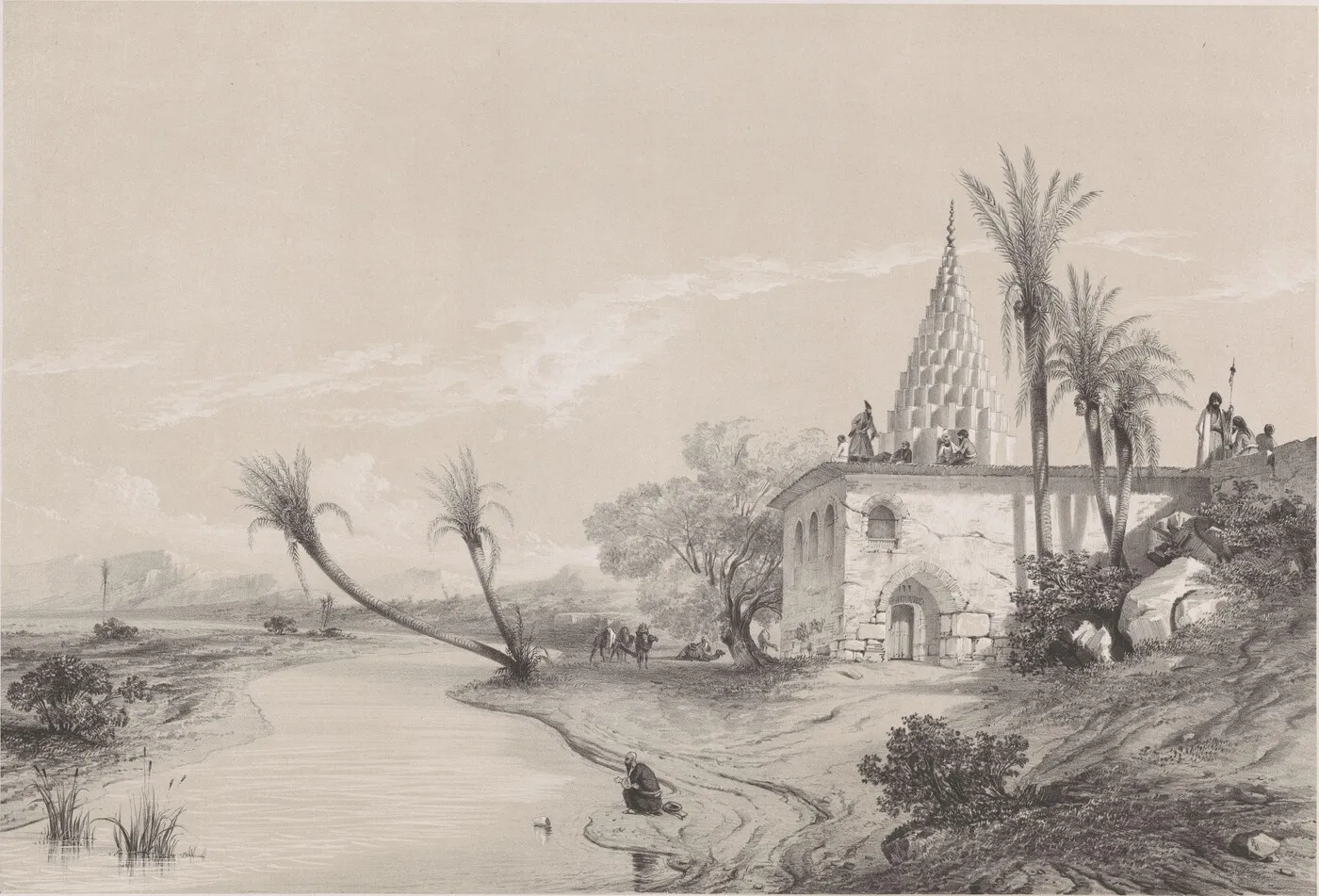
“Tombeau de Daniel (Chouster)”, a lithograph by Eugène Flandin, plate C of Perse moderne, Paris, 1843 to 1854. Flandin’s own title puts the tomb at Chouster, Shushtar; the museum catalogues it as the shrine at Shush. Rijksmuseum, Amsterdam, RP-P-1966-445, Public Domain Mark, cropped.
Two conquerors, one grave
Al-Baladhuri and al-Tabari agree that Daniel’s body was found at Susa and buried, and they disagree on who took the city.51
Al-Baladhuri has Abu Musa besiege and take Susa.5 In the citadel Abu Musa sees a house with a veil on it and is told that the remains of Daniel the prophet are inside.13 The people of Susa, the passage goes on, had once asked the Babylonians to send Daniel for rain.11 Abu Musa writes to ‘Umar, who answers: “Wrap him in a shroud and bury him.”1 Abu Musa dams a river, buries Daniel in the bed, and lets the water run over him.2
Al-Tabari tells it with another conqueror. In his account Abu Sabra has taken the city.5 Someone tells him that the remains of Daniel are buried there, and he asks what concern that is of his.14 Abu Musa arrives later and writes to ‘Umar.5 ‘Umar’s answer is to hide the grave, and the body is wrapped in shrouds and buried.151 Al-Tabari puts the episode in the year 17 of the hijra, which Juynboll’s translation gives as 638.16
Al-Tabari adds a detail. Abu Musa writes that they found a signet ring on the body, and ‘Umar answers that it must go back.17 The stone of the ring showed a man between two lions.17
In Juynboll’s translation, al-Tabari’s passage has no coffin and no river.18 Al-Baladhuri’s has the river, and in Murgotten’s translation no coffin.213
The coffin arrives
The coffin comes in later tellings. William Loftus printed one in 1857, from Sir William Ouseley’s English translation of a Persian version of Ibn A’tham al-Kufi’s Book of Victories.19 Abu Musa breaks the lock on a chamber in the palace, sealed with lead, and finds a stone hollowed into a coffin, with a dead man in a gold brocade shroud.19 They measure the nose and decide he was far taller than other men.19 ‘Umar asks his officers about Daniel, only ‘Ali answers, and on ‘Ali’s advice ‘Umar orders the body taken where the people of Sus can no longer have it.20 Abu Musa has them turn their stream aside and buries it in the dry channel.2
Istakhri, whom Le Strange dates to 951, gives the story as hearsay.21 It had reached him, he writes, and God knows best, that a coffin said to hold Daniel’s bones was found in Abu Musa’s days.3 The People of the Book used to carry it around and seek rain through it.3 Abu Musa cut a channel from a river at the gate of Sus and lined three graves in it with brick.3 He buried the coffin in one of them and let the river run over all three.3
والنهر يجري عليها إلى يومنا هذا3
The river runs over them to this day.
Ouseley’s 1800 translation of a manuscript attributed to Ebn Haukal has a coffin found in Abu Musa’s time, three coverings made for it, and a bay of the river over the grave.6 Istakhri has three graves where Ouseley’s text has three coverings. We have not compared the Arabic behind Ouseley’s English.
Al-Muqaddasi, whom Le Strange dates to 985, puts the grave in a river behind the town.2221
وقبر دانيال في نهر خلف المدينة وعلى حافة النهر قبال القبر مسجد حسن22
The grave of Daniel is in a river behind the town, and on the bank of the river opposite the grave there is a fine mosque.
By the tenth century two towns were quarrelling over the same coffin.721 Muqaddasi also reports what people told him.23 The coffin was carried about to bring rain, went back to Tustar and was held there, and ten elders went there as hostages until it came back.23 Then a river was cut for it, a vault built, and the water let over it, and the hostages stayed.23 The speakers say this is how the feuds between them arose.23 We read this Arabic ourselves and mark some words uncertain in the document file.
The bridge
In Benjamin’s Shushan a river divides the city and a bridge joins the two halves.24 The Jews on the bank with the markets, and with Daniel’s sepulchre, grew rich.24 Those on the other bank, who had only gardens and plantations, were poor and said the others’ prosperity was due to Daniel.24 They fought for many days and then agreed that the coffin would cross to the other side each year.24
Sinjar, who ruled Persia, ordered the wooden coffin put inside another of crystal and hung from the middle of the bridge on an iron chain.4 A synagogue was to be built at the spot.4 Benjamin writes that “to this very day the coffin is suspended from the bridge”, and that no fisherman was to fish within a mile above or below.4 Netzer identifies Sinjar as the Saljuq sultan Sanjar, who ruled from 1118 to 1157.10
English versions of Benjamin do not agree on the river or the coffin. Adler’s 1907 translation has “the river Tigris” and a coffin “of crystal”; the English Loftus quotes has “the river Ulai” and “another coffin made of glass”.25 We have not read the Hebrew. Jane Dieulafoy has Sanjar order the bridge built, where Adler’s Benjamin says the bridge already joins the two parts.1224
In the 14th century Mustawfi puts the tomb west of Susa and says no one molests the fish of the river, out of respect for the prophet.26 Benjamin’s ban on fishing near the coffin is a similar rule.4 We read no writer who links the two, and the comparison is ours.
The building
The shrine stands at the foot of the great mound of ancient Susa, beside the small river Shaour.27 Jews and Muslims both held it sacred in the 1800s, and pilgrims came.28 Loftus, Layard and Dieulafoy describe a plain building under a tall conical dome.29 Layard called it “a high conical dome of irregular brickwork, somewhat resembling in shape a pine-cone”.29
Layard doubted the whole thing. There was, he wrote, “absolutely nothing to connect the building on the banks of the Shaour with the tomb of Daniel, except that it is on or near the ruins of the ancient city of Susa, and that there exists a Musulman tradition”.9 Varjavand writes in the Encyclopaedia Iranica that the medieval tomb, probably built in the 12th century, was destroyed by a flood in 1869 and the present brick dome built in its place.8 Ouseley, who visited in 1816, had described the earlier dome as a conical muqarnas dome, and the crypt holds an uninscribed grave.8
The man who kept the shrine told Layard a different story.30 Daniel came from Egypt to stop a plague in Khuzistan, and Pharaoh kept twenty nobles as hostages.30 The king kept Daniel, and Daniel traced mystic characters on a black stone that protected the province.30 Later the people of Susa diverted the Shaour and buried his coffin in its bed, so the Egyptians could not take the body.30 Layard also saw a slab by the steps down to the Shaour, “described as a man between two lions”, which a lively imagination had made into Daniel in the lions’ den.31
Other places claim him. In the Bakhtiyari mountains near Mal Amir a second shrine of Daniel stands, which the Bakhtiyari hold to be the better one.32 Netzer writes that the rabbinic sources have Daniel dying in the Holy Land.33 E. N. Adler, as M. N. Adler quotes him, reports a tradition that Tamerlane carried the sarcophagus from Susa to Samarkand.34
Side by side
| Text | Date | The body | Where | What happens |
|---|---|---|---|---|
| al-Baladhuri | Ninth century35 | Remains in a veiled house13 | Citadel of as-Sus13 | Shroud, buried in a dammed river12 |
| al-Tabari | 839 to 92336 | Remains, then the body141 | al-Sus11 | Hidden, shrouded, buried; signet ring1517 |
| Istakhri | 95121 | Coffin said to hold bones3 | River at the gate of as-Sus3 | Three brick graves under the river3 |
| al-Muqaddasi | 98521 | Grave in a river22 | Behind Sus22; Tustar claims it7 | Vault under a cut river23 |
| Benjamin of Tudela | About 116710 | Coffin of Daniel24 | Bridge at Shushan24 | Crystal coffin on an iron chain4 |
| Mustawfi | 14th century26 | Tomb of Daniel26 | West of Susa26 | River fish left alone26 |
| Ouseley’s Ebn Haukal | Translated 18006 | Coffin said to hold bones6 | River at Sus6 | Three coverings, buried6 |
| Ibn A’tham, via Ouseley and Loftus | Printed 185719 | Stone coffin, a giant19 | Palace chamber19 | Buried in a dry riverbed2 |
| Layard’s guardian | Printed 188730 | Daniel from Egypt30 | Susa30 | Coffin buried in the Shaour’s bed30 |
| Jane Dieulafoy | 188812 | Giant in a sarcophagus12 | Palace of Susa12 | Riverbed, then glass coffin on a bridge12 |
The early Arabic accounts put the body of Daniel at Susa, and al-Muqaddasi records Tustar as a rival claimant.117 In the writers we read, the bridge appears first in Benjamin.4 Whether anyone wrote of it before him, or apart from him, we could not tell.
What we could not verify
Sources we have not seen
- Ibn Hawqal (BGA II, p. 174 per the Jewish Encyclopedia, p. 255 per Iranica). It would show whether his text adds the Jews’ circuit of the tomb that the Jewish Encyclopedia reports. We found no scan of the Leiden volume with his text among the archive.org items we searched; Le Strange says his work is a revision of Istakhri’s, which we read.
- The Mojmal al-tavarikh (ed. Bahar, pp. 426 and following) and Yaqut’s Mu’jam al-buldan (III, pp. 188 to 189), which Iranica cites for the riverbed burial. They would show how Persian and Arabic compilers retold it. We did not find an open scan of either.
- Benjamin’s Hebrew text, printed in the same volume as Adler’s translation. It would settle “crystal” or “glass” and the river’s name. We opened the translation only.
- Herzfeld’s study in Ars Islamica 9 (1942), which Iranica cites for the 12th-century date of the medieval tomb. We did not find an open copy.
Seen only where others quote them
- Ibn Taymiyya’s version, in which the body was found at Tustar and put in one of thirteen graves dug at night. We know it only as the Jewish Encyclopedia summarises it, citing the Zeitschrift der Deutschen Morgenlandischen Gesellschaft, vol. 53, p. 58.
- Pethahiah of Regensburg’s fourteen synagogues, one behind the tomb, which we know only from the Jewish Encyclopedia.
- Mustawfi’s own text on the tomb and the fish, which we know through Le Strange and Iranica.
- E. N. Adler’s Jews in Many Lands (p. 224), on the sarcophagus at Samarkand, which we know only as M. N. Adler quotes it.
Questions we could not settle
- What the feminine pronoun in al-Baladhuri’s “fa-qubida bi-ha” refers to, and where Murgotten’s “Manadhir” comes from.
- Whether any text before Benjamin, or independent of him, mentions the bridge.
- What the shrine is used for today. We read no source later than 2011.
Read next
TalePars and Kerman, Iran, Sasanian era to 1010
Haftvad and the worm in the Kārnāmag, Tabari and the Shahnameh
CaseLucerne, Switzerland, 1420 to 2006
The Lucerne dragon stone: a pledge, a charter and a CT scan
TaleNasu, Tochigi, Japan, About 1400 to 2022
The killing stone of Nasu and a fox with two tails
Sources
- al-Tabari, History, vol. XIII, transl. Juynboll (1989), p. 147 (Leiden ed. 1, 2567), last paragraph on the page: "He wrote to 'Umar about Daniel's grave... Abu Musa had the body wrapped in shrouds and the Muslims buried it" (primary) transcription
- al-Baladhuri, Kitab Futuh al-buldan, transl. Francis Clark Murgotten, The Origins of the Islamic State, Part II (New York, 1924), p. 115, "Abu-Musa wrote about this to 'Umar, who replied, 'Wrap him in a shroud and bury him'" (primary) transcription↑
- al-Baladhuri, transl. Murgotten (1924), p. 115, "Abu-Musa dammed up a river until he could bury him [in the river bed] while it was stopped. Then he let the water flow above him" (primary) transcription
- Loftus, Travels and Researches in Chaldaea and Susiana (London, 1857), quoting Sir William Ouseley's translation of a Persian version of Ibn A'tham al-Kufi's Book of Victories, Chapter XXV, pp. 319-320, "obliged the people of Sus to turn the stream... a grave should be made in the dry channel of the river... the waters of Sus now flow over the body of Daniel" (primary) transcription
- Layard, Early Adventures in Persia, Susiana, and Babylonia, vol. II (London, 1887), Chapter XVII, p. 300 footnote 3 (continues on p. 301): "Arabian writers give a different version... Abu Musa Ashari... dug a canal from the Shaour and buried the prophet's coffin in its bed before admitting the stream" (Layard's own summary; he names no text) (primary)↑
- al-Istakhri, Kitab masalik al-mamalik, ed. de Goeje, Bibliotheca Geographorum Arabicorum I (Leiden, 2nd ed., 1927), p. 92, lines 4 to 11 (primary) transcription↑
- Benjamin of Tudela, ed. Adler (1907), pp. 52-53 (English translation, from "In the course of time Sinjar Shah-ben-Shah" to "a mile above or a mile below") (primary) transcription↑
- al-Baladhuri, transl. Murgotten (1924), p. 114, "The taking of as-Sus. Abu-Musa went to as-Sus and attacked its people. Then he besieged them" (primary)
- al-Tabari, History, vol. XIII, transl. Juynboll (1989), p. 146 (Abu Sabra's reply about Daniel), p. 147 ("when Abu Sabrah had departed from them and gone to Jundaysabur, Abu Musa came and stayed in al-Sus"), p. 148 ("When Abu Sabrah had finished what he had to do in al-Sus") (primary)↑
- Ouseley (transl.), The Oriental Geography of Ebn Haukal (London, 1800), p. 76, paragraph beginning "In the city of Sus" (primary)↑
- al-Muqaddasi, Ahsan al-taqasim, BGA III, 2nd ed., p. 417, lines 4 to 10 (primary) transcription
- Gottheil and Konig, Daniel, Tomb of, Jewish Encyclopedia IV, Vol. IV, pp. 429-430, third paragraph: "Al-Muqaddasi (ed. De Goeje, p. 417) refers to the contention between the people of Susa and those of Tustar"↑
- Varjavand, Danial-e Nabi, part iii, The Tomb of Danial, Encyclopaedia Iranica VI/6 (1993), pp. 657-660, part iii, second paragraph (citing Herzfeld, Ars Islamica 9, 1942, p. 36 and fig. 69) and third paragraph↑
- Layard, Early Adventures, vol. II (1887), Chapter XVII, pp. 298-299 (primary)↑
- Netzer, Danial-e Nabi, part i, Encyclopaedia Iranica VI/6 (1993), pp. 657-660, part i, the paragraph beginning "According to Jerahmeel": the sentences "Benjamin of Tudela, who visited the city of Sus in about 562/1167" and "Benjamin went on to report that the Saljuq sultan Sanjar"↑
- al-Baladhuri, transl. Murgotten (1924), pp. 114-115, "Now the people of as-Sus had been smitten with drought, and had asked the Babylonians to send Daniel to them in order that they might secure rain by his help" (primary) transcription
- al-Tabari, History, vol. XIII, transl. Juynboll (1989), p. 147 (Leiden ed. 1, 2567), "Daniel died at al-Sus and there, near his tomb, people used to pray for rain" (primary) transcription
- Loftus (1857), quoting Ouseley's translation of Ibn A'tham, Chapter XXV, pp. 318-319, from "It happened once that Sus likewise suffered from excessive drought" to "at length he died" (primary) transcription↑
- Jane Dieulafoy, A Suse (1888), Chapter XI, entry of 20 April, paragraphs 1 to 12 (Gutenberg #70821 transcription; printed page not marked) (primary)↑
- al-Baladhuri, transl. Murgotten (1924), p. 114 (last paragraph, "The tomb of Daniel") and p. 115 ("Thus Daniel came to die in Manadhir"); the Arabic is de Goeje p. 378, lines 12 to 16 (primary) transcription↑
- al-Tabari, History, vol. XIII, The Conquest of Iraq, Southwestern Persia, and Egypt, transl. Gautier H. A. Juynboll (SUNY Press, 1989), p. 146 (Leiden ed. 1, 2566), the paragraph beginning "According to al-Sari" (primary) transcription↑
- al-Tabari, History, vol. XIII, transl. Juynboll (1989), p. 147 (Leiden ed. 1, 2567): "'Umar wrote back and ordered him to hide it" (primary) transcription↑
- al-Tabari, History, vol. XIII, transl. Juynboll (1989), p. 147 running head "The Events of the Year 17" and p. 148, "In this year, I mean the year 17 (638), the peace treaty of the Muslims with the inhabitants of Jundaysabur was concluded", which follows directly after the Daniel passage (primary)↑
- al-Tabari, History, vol. XIII, transl. Juynboll (1989), pp. 147-148 (Leiden ed. 1, 2567-2568) (primary) transcription↑
- al-Tabari, History, vol. XIII, transl. Juynboll (1989), pp. 146-148 (Leiden ed. 1, 2566-2568), read whole (primary) transcription↑
- Loftus (1857), quoting Ouseley's translation of Ibn A'tham, Chapter XXV, p. 318, the quotation from "Then he entered the castle and palace of that Prince" (primary) transcription↑
- Loftus (1857), quoting Ouseley's translation of Ibn A'tham, Chapter XXV, pp. 319-320, from "After this, Abu Musa remained some time at Sus" to "could no longer enjoy the possession of it" (primary) transcription↑
- Le Strange, The Lands of the Eastern Caliphate (1905), Introduction, list of authorities (the table of abbreviations: Ist., I.H., Muk.); the printed page was not noted↑
- al-Muqaddasi, Ahsan al-taqasim, ed. de Goeje, Bibliotheca Geographorum Arabicorum III (Leiden, 2nd ed.), p. 407, line 15, "wa-qabr Daniyal fi nahr khalf al-madina wa-ala hafat al-nahr qubal al-qabr masjid hasan" (primary) transcription
- Le Strange, The Lands of the Eastern Caliphate (Cambridge, 1905), Chapter XVI, Khuzistan, p. 240, first paragraph, "Tradition asserted that the tomb of the prophet Daniel had been made in the bed of the Karkhah river which ran on the further side of Sus, and a fine mosque marked the place on the bank which lay nearest to his supposed grave" (Le Strange cites the geographers by page in the footnote, Muk. 405, 407, 408 among them)↑
- al-Muqaddasi, Ahsan al-taqasim, BGA III, 2nd ed., p. 417, lines 5 to 10 (primary) transcription↑
- Benjamin of Tudela, The Itinerary of Benjamin of Tudela, ed. and transl. Marcus Nathan Adler (Oxford, 1907), p. 52 (English translation, from "In front of one of the synagogues is the sepulchre of Daniel" to "for another year to the other side. This they did, and both sides became rich") (primary) transcription↑
- Benjamin of Tudela, ed. Adler (1907), pp. 52-53, "The river Tigris divides the city" and "another coffin of crystal" (primary)
- Loftus (1857), quoting Benjamin, Chapter XXV, p. 320 ("The river Ulai divides the city") and p. 321 ("another coffin made of glass"); the footnote on p. 321 names Bohn's Antiquarian Library, Early Travels in Palestine, p. 105, as his source (primary)↑
- Le Strange, The Lands of the Eastern Caliphate (1905), p. 240, first paragraph, "Mustawfi, who describes the city as a flourishing place in the 8th (14th) century, speaks of the tomb of the prophet Daniel as standing (apparently on dry ground) to the west of it"; Mustawfi himself not opened
- Netzer, Danial-e Nabi, part i, Encyclopaedia Iranica VI/6 (1993), pp. 657-660, part i, "The 14th-century author Hamd-Allah Mostawfi (Nozhat al-qolub, ed. Le Strange, p. 109)... located the tomb of the prophet Danial west of the city and added that, in the prophet's honor, none of the fish in the river was ever molested by men"↑
- Loftus (1857), Chapter XXV, p. 317, "a building at the west foot of the great mound is consecrated to him" (primary)
- Layard, Early Adventures, vol. II (1887), Chapter XVII, pp. 295-296, "The vast mound which marks the site of the ancient city of Susa... We rode first to the tomb"; "[the building] stands on the bank of a small sluggish stream" (primary)
- Jane Dieulafoy, La Perse (1887), Chapter XXXIX: "Le tombeau de Daniel se presente au pied et a droite de la haute terrasse designee dans le pays sous le nom de kale Chous (forteresse de Suse)" (primary)↑
- Loftus (1857), Chapter XXV, p. 317, first paragraph ("By general consent of Jews, Sabaeans, and Mohammedans... Pilgrims from all parts flock to 'Danyel' to offer up prayers and bury their dead") (primary)
- Layard, Early Adventures, vol. II (1887), Chapter XVII, p. 299, "The dervish... entertained no doubt as to the tomb being that of the prophet, who is held in as much veneration by Musulmans as by Jews and Christians" (primary)
- Jane Dieulafoy, A Suse: Journal des fouilles, 1884-1886 (Paris, 1888), Chapter XI, entry of 20 April: "Les pelerins arrivent en troupes nombreuses"; "Les mollahs de Dizfoul et de Chouster tiennent le gabre Danial pour parfaitement authentique" (Gutenberg #70821 transcription; printed page not marked) (primary)↑
- Layard, Early Adventures, vol. II (1887), Chapter XVII, p. 295: "a building of comparatively modern date... surmounted by a high conical dome of irregular brickwork, somewhat resembling in shape a pine-cone"; p. 296, "stands on the bank of a small sluggish stream, called by the Arabs the Shaour" (primary)
- Loftus (1857), Chapter XXV, pp. 321-323: "Seen from across the little river Shaour... its conical white spire rising above all"; "the tall white spire... in resemblance to the fir-cone" (primary)
- Jane Dieulafoy, La Perse, la Chaldee et la Susiane (Paris, 1887), Chapter XXXIX (contents list gives p. 659): "un cours d'eau marecageux, le Chaour... baigne les murs du saint edicule"; "un clocher en pain de sucre se dresse au centre des constructions" (Gutenberg #62108 transcription; printed page not marked) (primary)↑
- Layard, Early Adventures, vol. II (1887), Chapter XVII, pp. 297-300 ("There had formerly been preserved within the tomb a black stone" and "The dervish further related to me") (primary)↑
- Layard, Early Adventures, vol. II (1887), Chapter XVII, pp. 296-297 (primary)↑
- Layard, Early Adventures, vol. I (1887), Chapter IX, p. 428 ("the tomb of Daniel as the true burial-place of the prophet, the 'greater Daniel'... That on the river Shaour... they assign to Daniel Askar, or the 'lesser Daniel'"); pp. 417-419 (his visit to the Susan valley tomb); scan earlyadventures01layagoog, read as OCR text (primary)
- Jane Dieulafoy, A Suse (1888), Chapter XI, entry of 20 April: "A cinq jours de marche de Dizfoul, dans le voisinage de Mal Amir, s'eleve un second imam-zade consacre au meme personnage. Les Bakhthyaris le considerent comme le meilleur" (primary)
- Gottheil and Konig, Daniel, Tomb of, Jewish Encyclopedia IV, Vol. IV, p. 430, last paragraph: "five days journey from Dizful, near Mal Amir, there is another tomb sacred to Daniel"↑
- Netzer, Danial-e Nabi, part i, Encyclopaedia Iranica VI/6 (1993), pp. 657-660, part i, paragraph beginning "In the rabbinical sources, however"↑
- Benjamin of Tudela, ed. Adler (1907), p. 53, footnote 1, last paragraph; we have not read E. N. Adler (primary)↑
- Gottheil and Konig, Daniel, Tomb of, Jewish Encyclopedia IV, Vol. IV, p. 430, third paragraph (we did not open Istakhri or Ibn Hawqal; the JE summary of al-Baladhuri differs from Murgotten's text: it says Abu Musa found "the coffin" and that 'Umar had it sunk "in one of the streams near by"; see Where sources disagree)↑
- al-Tabari, History, vol. XIII, transl. Juynboll (1989), front matter, series and author statement (the library record text reads "Tabari, 838?-923" and the volume's description "al-Tabari (839-923)"); the printed page was not noted (primary)↑
Documents quoted
- al-Baladhuri, Futuh al-buldan, transl. Murgotten (New York, 1924): the taking of as-Sus and the tomb of Daniel, pp. 114 to 115 (transcribed from the page image)
- al-Istakhri, Kitab masalik al-mamalik (BGA I, Leiden, 2nd ed.): the coffin of Daniel at as-Sus, p. 92 (transcribed from the page image)
- al-Muqaddasi, Ahsan al-taqasim (BGA III, Leiden, 2nd ed.): the grave of Daniel at Sus, p. 407, and the feud over his coffin, p. 417 (transcribed from the page image)
- al-Tabari, History, vol. XIII (SUNY, 1989), transl. Juynboll: the remains of Daniel at al-Sus, pp. 146 to 148 (transcribed from the page image)
- Benjamin of Tudela, Itinerary, transl. Adler (Oxford, 1907): Shushan and the coffin of Daniel, pp. 52 to 53 (transcribed from the page image)
- Loftus, Travels and Researches in Chaldaea and Susiana (London, 1857): Daniel's body in Ouseley's translation of Ibn A'tham, pp. 318 to 320 (transcribed from the page image)