 Twice Told
The killing stone of Nasu and a fox with two tails
The killing stone at Nasu split in two in March 2022. In the oldest written versions of its legend, the fox has two tails, not nine.
Contents
Published 24 Sept 2026. Updated 6 Oct 2026. Sources checked 24 Sept 2026.
On the afternoon of 5 March 2022 a tourist posted a photo of the Sesshō-seki, the killing stone on the hillside above the Nasu Yumoto hot spring, and staff of the Nasu tourism association confirmed it on site: the stone had split in two. The Shimotsuke Shimbun reported that cracks had been visible in it for several years.67 The stone has been a historic site of Tochigi Prefecture since 1957, and part of a national Place of Scenic Beauty since 2014.8
On 26 March the association held a memorial rite for the fox and a prayer for peace, attended by about 150 people.9 The association’s announcement, issued three days earlier, hoped the split would prove a good omen, from “蘇った瑞獣 神獣 九尾の狐”, the nine-tailed fox come back to life as an auspicious, divine beast, for an end to Covid and for world peace.9
That was the nine-tailed fox’s first meaning. The Engishiki, a Heian-period book of court procedure, lists “九尾狐 神獣也”: the nine-tailed fox is a divine beast. Terashima Shūichi, in a 2024 essay for the Japanese literature department at Mukogawa Women’s University, points out that it was originally a sign of good fortune, and Kyokutei Bakin, writing around 1810, cites Chinese books that treat it as a lucky omen.10 The fox of the killing stone was something else, and for most of the stone’s written history it didn’t have nine tails.
This is the story as the Edo-period novels settled it, and as Japanese dictionaries sum it up today.
A fox with golden fur and nine tails brought kings to ruin in three countries. In China it was Daji; in India, Lady Kayō; in China again, Bao Si.11 Then it crossed to Japan and became Lady Tamamo, the favourite of the retired emperor Toba, a woman so learned that she could answer any question put to her.12
The emperor fell ill. A court diviner, Abe no Yasuchika, saw what she was, and she turned back into a fox and fled to the moor of Nasu, in Shimotsuke.12 Two warriors, Miura-no-suke and Kazusa-no-suke, were sent to hunt her. They shot the fox, and its spirit became a stone that killed any bird or beast that touched it.13
Long afterwards a monk named Gennō performed a rite before the stone. It split in two, the fox appeared, and it swore to do no more harm.14
That is where the Noh play ends, and where most tellings end.
Eight texts, oldest first
| Text | Date | What it adds |
|---|---|---|
| Shinmeikyō, a chronicle | about 1400 | Tamamo, the diviner, the two warriors; the stone as the fox’s spirit12131 |
| Kagakushū, a dictionary | 1444 | the fox itself turns to stone; the origin of dog-shooting13215 |
| Sesshōseki, a Noh play | by 1503 | the monk Gennō splits the stone1416 |
| Tamamo-no-mae monogatari, printed | 1661 to 1673 | a fox 800 years old, with two tails17 |
| Bashō, Oku no hosomichi | 1689 visit | dead bees and butterflies1819 |
| Kange hakkotsū | 1766 | Daji, and a golden nine-tailed fox11 |
| Sekien, Konjaku hyakki shūi | 1781 | a date for Gennō: 13953 |
| Ehon Sangoku yōfuden | 1803 to 1805 | the nine-tailed fox of India, China and Japan11 |
The sections below take them backwards, from the novels to the chronicle.
Where the nine tails came from
None of the medieval texts calls Tamamo’s fox nine-tailed. Terashima notes that the Muromachi tale Tamamo no sōshi states plainly that the fox had two.17
The medieval fox had earlier lives, but not Daji’s. In the old texts it was first something in India, the tomb god of King Hanzoku in one version and his cruel queen in another, then Bao Si in China, then Tamamo in Japan.20 The examiners of Feng Chaohong’s doctoral thesis at Waseda, a study of the Edo-period versions, summarise his finding that before 1766 the chain never goes further than that.20 Hints came earlier: a puppet play that opened in 1751, Tamamo-no-mae asahi no tamoto, already mentions Daji at its opening.21 Then Kange hakkotsū, printed in 1766, put Daji into the chain, with what Terashima quotes as “金毛九尾の野干”, a golden-furred fox with nine tails.11
The story was complete in Takai Ranzan’s illustrated novel Ehon Sangoku yōfuden, published in three parts between 1803 and 1805, where the fox is Daji, then Lady Kayō, then Bao Si, then Tamamo.11 Nakayama Mikio, in the Heibonsha encyclopedia, says the tale of the golden nine-tailed fox grew above all after the Edo period began.11
The diviner’s name moved too. The medieval texts call him Abe no Yasunari; the Nihon kokugo daijiten has Abe no Yasuchika.12
Sekien’s picture
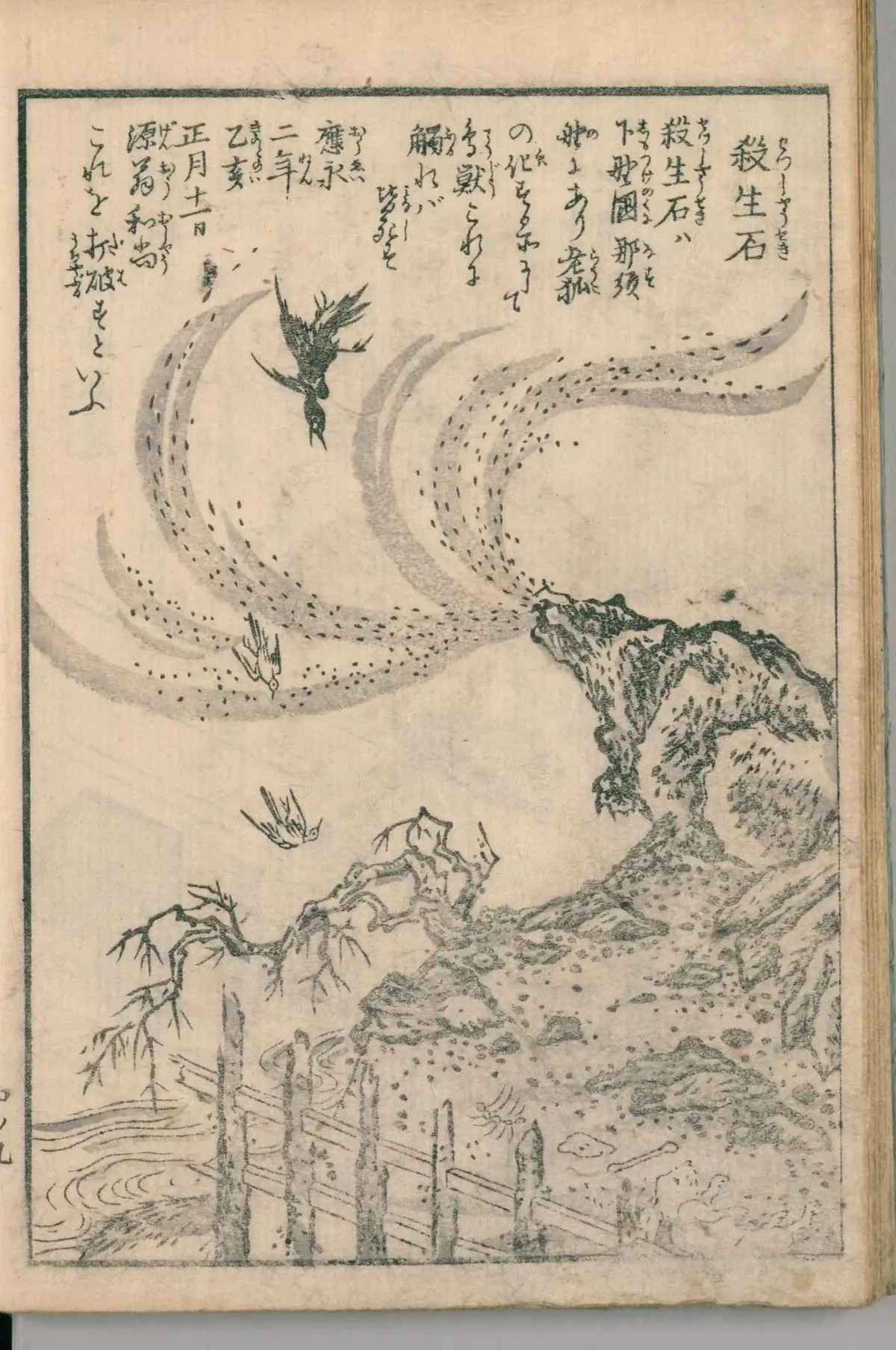
The killing stone, by Toriyama Sekien, from Konjaku hyakki shūi (1781), in the 1805 printing. National Diet Library Digital Collections.13
Toriyama Sekien drew the stone in 1781 for Konjaku hyakki shūi. His caption says the stone is on Nasu moor in Shimotsuke, that an old fox turned into it, and that birds and beasts die if they touch it.13 Then it gives a date:
應永二年乙亥正月十一日 源翁和尚これを打破すといふ3
On the eleventh day of the first month of Ōei 2, a kinoto-i year, the priest Gennō broke it, they say.
Ōei 2 is 1395.3 Gennō was a real monk. Gennō Shinshō, a priest of the Sōtō school of Zen, founded temples across eastern Japan, among them Senkeiji in the Nasu district in 1360.3 Hirose Yoshihiro, in the Nihon daihyakka zensho, gives 1385 as the traditional year he broke the stone.3 The reference works don’t agree on his life either: 1329 to 1400, or 1326 to 1396.3 Both years for the breaking fall inside either lifespan.
He left a word behind. Gennō is the Japanese name for a kind of iron hammer, and dictionaries trace it to this story; the earliest use the Nihon kokugo daijiten cites is from 1583.22
What Bashō saw
The poet Matsuo Bashō came to the stone on the nineteenth day of the fourth month of Genroku 2, 6 June 1689. His companion Sora noted in his diary that the innkeeper, Gozaemon, showed them the way.18 In Oku no hosomichi, Bashō wrote:
The killing stone lies at the foot of the hill where the hot spring comes out. The stone’s poison has not yet died away: bees, butterflies and the like lie dead in heaps so thick that you cannot see the colour of the sand.
He says nothing about the fox there. He had come across the story a week earlier, near Kurobane, where he went out to look at “犬追物の跡”, the site of the dog-shooting, and made his way through the bamboo grass of Nasu to “玉藻の前の古墳”, Lady Tamamo’s old tomb.23 Sugiura Shōichirō’s edition places the dog-shooting site at Hachisu, north-west of Kurobane, and notes a fox mound in the grounds of the Shinohara shrine.23
Gas from the ground
The ground there still gives off volcanic gas. Muramatsu Yōichi, in a 2021 study of the Nasu hot springs, cites measurements by Kamata and colleagues (1985) at the Sesshō-seki fumaroles: 69.7% carbon dioxide and 29.4% hydrogen sulfide, with sulfur dioxide at 0.1% or less.4 The Ministry of the Environment’s trail page says the hydrogen sulfide still keeps plants from growing around the stone.4
In the Heibonsha encyclopedia’s entry for the stone, Murai Isamu and Totsuka Hiromi suggest that legends of this kind probably arose because people thought the poison came from the rock itself.5 A local Edo-period writer, quoted in the Kurobane town history, had already rejected the fox: calling it the fox’s spirit was wrong, he wrote, and he judged it an arsenic stone.5 The medieval texts say nothing about gas. The Kagakushū speaks of the stone’s “殺氣”, its killing breath.2
Two tails
The printed tale Tamamo-no-mae monogatari survives in the National Diet Library in a Kanbun-era edition (1661 to 1673) that follows one of 1653. Its diviner, Abe no Yasunari, tells the court what it is dealing with:12
八百歳を經たる狐あり。かの狐はたけ七ひろ、尾二つ有べし。17
There is a fox that has lived eight hundred years. It is seven fathoms long, and it should have two tails.
The Muromachi text that Terashima quotes gives different numbers, 80,000 years and seven shaku, but it too has two tails.17 So does the Nezu Museum’s scroll of the tale, which Wu Zhangdi (2019) says earlier studies take as the oldest form of the text, and so does the Suntory Museum of Art’s scroll, going by the museum’s summary.17
The tale is much older than the printing. Wu Zhangdi gives a copy made in 1470, once in the Akagi Bunko, as the oldest dated manuscript of the tale, and, following Kawashima Tomoko, a diary entry of 1433 as the first mention of a “Tamamo monogatari”.24
On stage by 1503
On the nineteenth day of the ninth month of Bunki 3, in 1503, the courtier Sanjōnishi Sanetaka noted in his diary a programme of twelve plays by boy actors. Sesshōseki is on the list.16 Its author is unknown; it is sometimes attributed to Saami.16 In the play a travelling monk, Gennō, performs a rite at the stone, it splits in two, and the fox appears and promises to do no more harm.14 Neither of the two older texts has Gennō in it.
A dictionary entry about dogs
The Kagakushū, a dictionary of everyday words compiled in 1444, tells the story under a word that has nothing to do with foxes: inuoumono.2 That was a samurai exercise in which riders shot at dogs let loose in a fenced ring, using blunt arrows meant not to injure them; it is first recorded in the early 1200s.25
In the dictionary, the fox was first the cruel queen of King Hanzoku in India, then Bao Si in China, then Tamamo in Japan.20 When the people of the time set out to drive it off, they practised first by chasing dogs from horseback, and the white fox, knowing it, turned into a stone.215 The entry ends:
于今在下野那須野原也。犬追者始于茲矣。但聴之古老之口号、雖不知本説、且載之而已。2
It is still on the moor of Nasu in Shimotsuke. This is where dog-shooting began. I have only heard it from old people; I don’t know where it comes from, but I record it here anyway.
This is the 1617 printing; the National Diet Library also has a late-Muromachi manuscript copy with the same entry.2 The whole entry is transcribed and translated. The compiler says he had the story from talk. A written version already existed.
The oldest text
The Shinmeikyō is a chronicle of Japan’s reigns. Sakurai Yoshirō, in the Heibonsha encyclopedia, dates it to the late fourteenth century; the Britannica Japan edition says it was compiled at the end of the Nanbokuchō period and continued to 1430.1 Terashima calls it the first appearance of the Tamamo story.1 The National Diet Library’s copy was written out in 1540.12
The story sits in the entry for Toba’s reign. It happens “in the time of the Konoe emperor”, in the first year of Kyūju, 1154, at the retired emperor’s palace.12 The Noh libretto and the Nihon kokugo daijiten make her Toba’s favourite.12 Most of the later tale is already there: the beautiful, learned Lady Tamamo, the emperor’s illness, the diviner Yasunari, the flight to Nasu.12 Yasunari names her earlier lives, the tomb god to whom King Hanzoku offered a thousand heads, and Bao Si.20 Miura-no-suke and Kazusa-no-suke hunt the fox on Nasu moor and bring it back to the capital. The delighted court has them shoot a red dog in their hunting clothes, and the chronicle says that is how one-rider inuoumono got its name.1315
The ending is not the one people know. In the fox’s belly the hunters find a golden jar of the Buddha’s relics; on its forehead, a white jewel; at the tip of its tail, two needles.13 Then:
狐ヲハ宇治宝蔵ニ被納ケリ。那須ノ殺生石ハ此霊也。13
The fox itself was placed in the treasure house at Uji. The killing stone of Nasu is its spirit.
The whole passage is transcribed and translated. In this version nobody turns into a stone. The body went to Uji, and only the spirit stayed on the moor.
What we could not verify
Sources we have not seen
- Kawashima Tomoko’s study of the tale’s manuscripts (Kokugo kokubun 73-8, 2004), cited as finding that the oldest copies lack the stone episode, which would date when the stone joined the written tale. We found no copy online: the National Diet Library holds it on paper only, and neither CiNii nor Kyoto University’s repository has the text.
- Ōyama Yuri’s 2011 study of the 1470 manuscript (Kokubungaku ronshū 32), which would show how the oldest dated copy tells the story and whether it has the stone. The National Diet Library holds it on paper only, and Kokushikan University’s repository, which has other papers from the journal, does not have it.
Resting on a single source
- Bakin’s theory (1810) that Tamamo was invented to criticise Toba’s consort Bifukumon-in. We read Bakin’s text but found no modern scholar who discusses it.
- Eight wild boar found dead beside the stone in December 2022, reported by one local newspaper.
Questions we could not settle
- Whether the nine tails appear anywhere before 1766.
- Whether the split stone will be repaired. The Ministry of the Environment said in March 2022 that there were no plans to restore it, and a decision was expected around the end of May 2022; we found no later decision.
Read next
TaleMiyoshi, Hiroshima, Japan, 1749 to 1859
The Inō mononoke roku: where the demon king's mallet came from
CaseShimoda, Izu, Japan, 1884 to 1891
Kokkuri-san came ashore at Shimoda, or so Inoue Enryō heard
TaleHanyū, Shimōsa (now Jōsō, Ibaraki), Japan, 1672 to 1859
Kasane's spirit left Hanyū village twice
Sources
- 寺島修一, 「玉藻前はいつから九尾の狐になったのか」, Mukogawa Women's Univ. Dept. of Japanese Language and Literature essay series 7, Nov 2024 (faculty essay, not peer-reviewed), p. 1: "玉藻前の伝承が初めて表れるのは南北朝期の歴史書『神明鏡』"
- 桜井好朗, 改訂新版 世界大百科事典, 神明鏡 (Kotobank), "14世紀後半,後円融天皇のころの成立かと推測される"
- ブリタニカ国際大百科事典 小項目事典, 神明鏡 (Kotobank), "南北朝時代末期に成立し,永享2 (1430) 年まで書き継がれた"
- Shinmeikyō, NDL 丑-26, frames 66-67 (primary)↑
- 下学集, NDL WA16-121, frames 32-33, entry 犬追物 (primary)
- 精選版 日本国語大辞典, 下学集 (Kotobank), "文安元年(一四四四)成立"
- 下學集, printed Genna 3 (1617), NDL せ-24, frame 38: "于今在下野那須野原也 犬追者始于茲矣 但聴之古老之口号 雖不知本説且載之而已" (primary) transcription↑
- 廣瀬良弘, 日本大百科全書, 源翁心昭 (Kotobank), "1360年に下野(栃木県)那須郡に泉渓寺を"; "1385年(元中2・至徳2)には…殺生石を破砕して妖怪を去らせたと伝える"; "応永7年正月7日没"
- デジタル版 日本人名大辞典+Plus, 源翁心昭 (Kotobank), "1329-1400"; "下野(栃木県)泉渓寺"
- 精選版 日本国語大辞典, 玄翁 (Kotobank), "嘉暦元~応永三年(一三二六‐九六)"
- Toriyama Sekien, 百鬼夜行拾遺, NDL わ-27, frame 11: "応永二年乙亥正月十一日 源翁和尚これを打破すといふ" (primary)↑
- 村松容一, 「那須茶臼岳周辺の温泉の水質とその地質鉱物学的解釈」, 温泉科学 71 (2021): 169-185, p. 176, §5.1.1 (citing 鎌田ら 1985)
- Ministry of the Environment, 遊行柳・殺生石コース, "周囲は今でも噴出する硫化水素のため、草木が育つことができません"
- 村井勇・戸塚ひろみ, 改訂新版 世界大百科事典, 殺生石 (Kotobank), natural-history entry
- Tochigi Prefecture, とちぎいにしえの回廊, 殺生石, "硫化水素等の有毒ガスの臭い"↑
- 村井勇・戸塚ひろみ, 改訂新版 世界大百科事典, 殺生石 (Kotobank), "有毒ガスが発生する原因を岩石自体にあると考えたところからこの種の言い伝えが成立したのであろう"
- 黒羽町誌, pp. 1005-1007, quoting 創垂可継, "狐の霊と言うは非なり。按ずるに砒霜石"↑
- Nasu Town Tourism Association, press release, 23 Mar 2022 (Kyodo News PR Wire), "殺生石が割れたことを受け" (primary)
- Shimotsuke Shimbun, "殺生石 真っ二つ 以前からひび、自然現象か 那須", 6 Mar 2022, "真っ二つに割れたことが5日、分かった"
- Yomiuri Shimbun, 6 Mar 2022, "5日午後、観光客がSNS上に殺生石が割れている写真を投稿"
- JTB Foundation, 全国観光資源台帳, entry 殺生石, signed 溝尾良隆, "2022(令和4)年3月5日に2つに割れていることが分かり"
- Justin McCurry, The Guardian, 7 Mar 2022, whole article↑
- Matsuo Bashō, Oku no hosomichi, ed. Sugiura Shōichirō (Iwanami, 1957; Aozora Bunko), section 殺生石・遊行柳: "殺生石は温泉の出る山陰にあり" (primary)
- 精選版 日本国語大辞典, 殺生石 (Kotobank), entry 殺生石
- Ministry of the Environment, 遊行柳・殺生石コース, course page↑
- Tochigi Prefecture, とちぎの文化財, 殺生石, "指定年月日 昭和32年1月29日"
- Agency for Cultural Affairs, 文化遺産オンライン, おくのほそ道の風景地, "指定年月日:20140318"
- Nasu Town, "平成26年3月18日"国の名勝"に指定"↑
- Nasu Town Tourism Association, press release, 23 Mar 2022, "九尾狐 那須殺生石 慰霊祭並びに平和祈願祭"; "蘇った瑞獣 神獣 九尾の狐によるコロナ収束や世界平和等への吉兆" (primary)
- JTB Foundation, 全国観光資源台帳, 殺生石 (溝尾良隆), "3月26日に…開催し、観光関係者や観光客ら約150人が参列した"
- Sankei Shimbun, 伊沢利幸, 10 Apr 2022, p. 2: "5月末ごろまでに結論を出す"↑
- 寺島修一 2024, p. 1: "『延喜式』に「九尾狐 神獣也」…本来、九尾の狐は吉兆を意味していた"
- 曲亭馬琴, 昔語質屋庫 (c. 1810), 2nd ed. 赤松市太郎 1889, 第拾貳「九尾の狐の裘」, p. 83 (primary)↑
- 寺島修一 2024, p. 1: "明和 3(1766)年刊行の『勧化白狐通』…『絵本三国妖婦伝』…九尾の狐の物語が完成します"
- 堀誠 et al., 博士学位論文審査要旨, 馮超鴻『近世玉藻前説話の研究』, Waseda Univ., p. 4: "「塚の神→褒姒→玉藻前」の三国変転の枠組を越えない"; pp. 5-6
- 馮超鴻, 「読本『絵本三国妖婦伝』の「修飾」をめぐって」, 早稲田大学大学院教育学研究科紀要 別冊 29-2 (2022), pp. 15-27, p. 15
- 中山幹雄, 改訂新版 世界大百科事典, 玉藻前 (Kotobank), "金毛九尾の妖狐譚は,むしろ江戸期に入ってから大きく成長をみせた"
- Waseda University Library catalogue, 絵本三国妖婦伝, catalogue record he13_03948↑
- 神明鏡 (Shinmeikyō), manuscript copied 1540, NDL 丑-26, frames 66-67: "近衛院御時也 久寿元年ニ仙洞ニ一人化女出来リ…後ニハ玉藻御方ト号ス" (primary)
- たまもの前物語, printed by 菊屋七郎兵衛, Kanbun era (1661-73), after the 1653 edition, NDL 858-76, frame 3: "主上近衛院久寿元年鳥羽院の仙洞に一人のけ女出来れり"; frame 24: "安辺の泰成が申伏" (primary)
- 〔謡本〕殺生石, Keichō era (1596-1615), NDL WA7-256, frames 10-13 (primary)
- The Met, Tamamo no Mae and the Archer Miura Kuranosuke, JP1038, object description
- 精選版 日本国語大辞典, 玉藻前 (Kotobank), "鳥羽天皇を悩ましたが、安倍泰親の法力で正体を現わし、下野国那須野に飛び去り殺生石となる"↑
- Shinmeikyō, NDL 丑-26, frame 67: "三浦介 上総介"; "那須殺生石ハ此霊也" (primary)
- 下学集 (Kagakushū), late-Muromachi manuscript, NDL WA16-121, frames 32-33: "後化成白狐…故ニ謂之殺生石 于今在下野国那須野原" (primary)
- Toriyama Sekien, 百鬼夜行拾遺 (1805 printing of Konjaku hyakki shūi, 1781), NDL わ-27, frame 11, caption 殺生石: "鳥獣これに触れば必ず死す" (printed 必死す, glossed かならず) (primary)
- Shinmeikyō, NDL 丑-26, frame 67: "狐ヲハ宇治宝蔵ニ被納ケリ 那須ノ殺生石ハ此霊也" (primary) transcription
- 中山幹雄, 改訂新版 世界大百科事典, 玉藻前 (Kotobank), "那須野に逃げるが射殺され,その霊は石と化して近寄る人や鳥獣を殺す殺生石"
- デジタル版 日本人名大辞典+Plus, 玉藻前 (Kotobank), "射殺され,その霊は下野(栃木県)那須野の殺生石となる"↑
- 横道万里雄, 改訂新版 世界大百科事典, 殺生石 (Kotobank), entry 殺生石 (Noh): "石が二つに割れて妖狐の姿(後ジテ)が現れる"
- 〔謡本〕殺生石, NDL WA7-256, frame 2: "玄翁といへる道人" (OCR checked against image) (primary)
- Toriyama Sekien, 百鬼夜行拾遺, NDL わ-27, vol. 2, frame 11: "応永二年乙亥正月十一日 源翁和尚これを打破すといふ" (primary)↑
- Shinmeikyō, NDL 丑-26, frame 67: by imperial order a red dog is released and shot before the court; "是ヲハ一騎犬追物ト名付タリ" (primary)
- 下學集, printed 1617, NDL せ-24, frame 38 (primary)↑
- 実隆公記 vol. 4 (ed. 三条西公正, 大洋社, 1935), entry for Bunki 3.9.19, p. 183: "子猿樂十二番…殺生石" (primary)
- 横道万里雄, 改訂新版 世界大百科事典, 殺生石 (Kotobank), "作者不明。佐阿弥作ともいう"
- 精選版 日本国語大辞典, 殺生石 (Kotobank), "作者不詳。佐阿彌作とも。"↑
- たまもの前物語, NDL 858-76, frame 25: "八百歳を経たる狐あり。かの狐はたけ七ひろ。尾二つ有べし"; frame 34: "極てながく大成尾。二つ有。狐" (primary)
- 寺島修一 2024, p. 1: "「九尾」とは書かれていません…尾二つ有り"
- 呉章娣, 「『玉藻前物語』考─中国文学との関わりを中心に─」, 青山語文 49 (2019): 27-39, p. 27 (plot summary): "玉藻前の正体は二尾の狐で"; p. 28: "従来の研究で最古態本とされている根津美術館本"
- Suntory Museum of Art, collection database, 玉藻前草子絵巻 (text from the catalogue 絵巻小宇宙, 2000), description: "玉藻前は那須野の双尾の大狐の化身であることが見破られ"↑
- Tochigi Prefecture, とちぎいにしえの回廊, 殺生石, "元禄2(1689)年4月19日(新暦6月6日)"
- 曾良, 奥の細道随行日記, transcription on 芭蕉DB (Yamanashi Prefectural Univ.), entry 十九日: "夫ヨリ殺生石ヲ見ル。宿五左衛門案内。" (primary)↑
- Bashō, Oku no hosomichi, ed. Sugiura, section 殺生石・遊行柳: "石の毒氣いまだほろびず、蜂・蝶のたぐひ眞砂の色の見えぬほどかさなり死す" (primary)
- 村井勇・戸塚ひろみ, 改訂新版 世界大百科事典, 殺生石 (Kotobank), "石の毒気いまだほろびず。蜂蝶のたぐひ,真砂の色の見えぬほどかさなり死す"
- Dorothy Britton, A Haiku Journey (Kodansha International, 1974), seen only as reproduced on a University of Oregon course page; check the printed page before quoting
- Bashō, おくのほそ道, Izutsuya Shōbei printing with 1770 (Meiwa 7) afterword, NDL W119-N29, frame 11 ("殺生石は温泉の出る山陰にあり"), frame 12 ("石の毒気いまだほろびず 蜂蝶のたぐひ真砂の色の見えぬほどかさなり死す") (primary)↑
- Shinmeikyō, NDL 丑-26, frame 66: "仁王経ニ有天羅国斑足王千人ノ王ノ頸ヲ取テ祭ト云塚ノ神是也 大唐ニテ褒似ト成" (primary)
- 下學集, printed 1617, NDL せ-24, frame 38: "昔西域有班足王 其夫人悪虐過人…其名曰褒姒" (primary)
- 堀誠 et al., 博士学位論文審査要旨, 馮超鴻『近世玉藻前説話の研究』, Waseda Univ., p. 4: "「塚の神→褒姒→玉藻前」の三国変転の枠組を越えない"
- 寺島修一 2024, p. 1: "中世の玉藻前伝承において説明される中国での悪行に妲己は出てきません"
- 呉章娣 2019, p. 27: "仁王経における天竺班足王が祀った塚の神であり、震旦においては、周の幽王の后となって"↑
- 歌舞伎・浄瑠璃外題よみかた辞典 (Nichigai Associates), 玉藻前 (Kotobank), "元の外題 玉藻前曦袂 初演 宝暦1.1(京・都座)"
- 堀誠 et al., 博士学位論文審査要旨, 馮超鴻『近世玉藻前説話の研究』, Waseda Univ., p. 4: "玉藻前曦袂』の冒頭に妲己にまつわる記載が認められることから、狐変妲己がすでに玉藻前説話に浸透し始めた"
- 那須野狩人那須野猟師玉藻前曦袂, woodblock print (Edo 鱗形屋孫兵衛 and others), Tokyo University of the Arts Library W768.427-Ta-19, NIJL scan, frame 3, leaf 1a, columns 4-5; our reading of the cursive ("紂王", "殷の妲妃"), not checked by a second reader, so not for quoting (primary)
- NIJL 国書データベース, record for 那須野狩人那須野猟師玉藻前曦袂, Kyoto University Library, 大惣本 4-28/マ/61, note field: "巻末に「寛延四辛未歳正月十四日」とあり,内題下に「座本豊竹越前少掾」とあり"↑
- 精選版 日本国語大辞典, 玄翁 (Kotobank), "玄翁和尚がこれで殺生石を砕いたという伝説に由来した鉄製の鎚"; earliest use cited 1583
- 廣瀬良弘, 日本大百科全書, 源翁心昭 (Kotobank), "殺生石の故事により、石を割る道具を「げんのう」と称するようになったという"↑
- Bashō, おくのほそ道, Izutsuya Shōbei printing with 1770 afterword, NDL W119-N29, frame 9: "犬追物の跡を一見し 那須の篠原をわけて玉藻の前の古墳をとふ" (primary)
- 杉浦正一郎, notes to Oku no hosomichi (Iwanami, 1957; Aozora Bunko), section 黒羽, notes 4 to 6: "黒羽の西北一里半蜂巣に遺跡あり"; "篠原神社境内に狐塚あり"; "日記によれば一二日のこと"↑
- 宮崎隆旨, 日本大百科全書, 犬追物 (Kotobank), "文献上の初見は1207年(『明月記』承元元年)"; "犬を殺傷しない犬射蟇目"
- 関幸彦, 改訂新版 世界大百科事典, 犬追物 (Kotobank), "矢は的を傷つけぬように鏃(やじり)をささず"
- 山川 日本史小辞典 改訂新版, 犬追物 (Kotobank), "「吾妻鏡」承久4年(1222)2月6日条が初見"↑
Documents quoted
- Kagakushū, the entry for inuoumono (dog-shooting), 1617 printing (transcribed from the page image)
- Shinmeikyō, the Tamamo passage (manuscript copied 1540) (transcribed from the page image)