 Twice Told
The Inō mononoke roku: where the demon king's mallet came from
In 1749 a demon king is said to have given a sixteen-year-old in Miyoshi a mallet. A comparison of four versions shows none in the text dated 1783.
Contents
Published 10 Oct 2026. Sources checked 10 Oct 2026.
Each 7 January, the Hino City Local History Museum says, a temple in Hiroshima called Kokuzenji brings out a wooden mallet for the public. It is the mallet a demon king gave to Inō Butayū, who as a boy of sixteen named Heitarō sat out a month of monsters in Miyoshi in 1749.111213 The museum devoted to the story in Miyoshi says the gift was not part of it at first: the mallet is among the content it calls 当初にない, “not there at first”, added as the story was retold.6 In Fujiwara Ayaka’s table comparing four versions, the earliest dated text we found, the notes of Inō’s colleague Kashiwa Seiho, has no mallet.5313 Yet the mallet is in a first-person account said to be Inō’s own, which ends with a ledger following it from the night it was given to the day it went to the temple.1482
This is the story as the Hino City Local History Museum retells it, with the details that the first-person account shares.
In Miyoshi, in the old-calendar seventh month of 1749, a boy of sixteen named Inō Heitarō lived in a house with a servant, Gonpei.1214 Next door lived the sumo wrestler Mitsui Gonpachi, who said he had never met a monster. On a stormy night Heitarō climbed Mt Hikuma alone and left a marker at the top.15
Then, on the first day of the seventh month, the paper doors lit up, and a huge hairy hand seized him and dragged him out. Gonpei collapsed.14 On the third night a woman’s severed head came, trailing her hair, and licked his face.16 On the fifth a red stone with eyes and fingers rolled toward him.17 On the sixth an old woman’s face filled the doorway of the hut; he drove a small knife between her eyes, and in the morning it hung in the air.18 It went on for thirty days.12 On the twenty-eighth, komusō monks crowded his room playing their flutes.19
On the thirtieth night ash rose from the kotatsu into a great head, and worms poured from it. Heitarō hated worms, and still he kept his nerve.20 Then a samurai in formal dress appeared and spoke, and gave his name: Yamamoto Gorōzaemon, chief of the monsters.21 He said that he was a demon king bound to ruin a hundred strong-willed sixteen-year-olds, and that Heitarō was the one he could not break.22 He praised the boy’s courage and gave him a wooden mallet for driving off monsters.4 Then he left in a palanquin carried by his retinue, and from inside it a huge hairy foot showed.23
Kashiwa’s notes, 1783
The earliest dated writing we found is not the first-person account. It is the record of a man named Kashiwa Seiho, who wrote down what Inō told him. The Miyoshi museum calls him Inō’s colleague, the Hino museum his friend.13 As an adult Inō bore the name Butayū; Heitarō is the name of the boy.13
An Ochanomizu University Library copy of Kashiwa’s record, made in 1872 by a copyist who signs 黒磐, carries Kashiwa’s self-preface, which ends with a date and his name.243
天明三癸卯年 柏正甫3
Tenmei 3, the year of the rabbit. Kashiwa Seiho.
Tenmei 3 is 1783, thirty-four years after the events.123 Fujiwara, quoting Shigehara Hisashi (1995), says the preface states that Kashiwa heard the story from Inō four times.25 The University of Tokyo has another copy, titled 稲亭物怪録, Tōtei mononoke roku, and its last leaf carries a postscript dated 寛政十一歳 夏四月, the fourth month of Kansei 11, which is 1799.2426 The catalogue entry for the Ochanomizu copy lists the same two dates.326
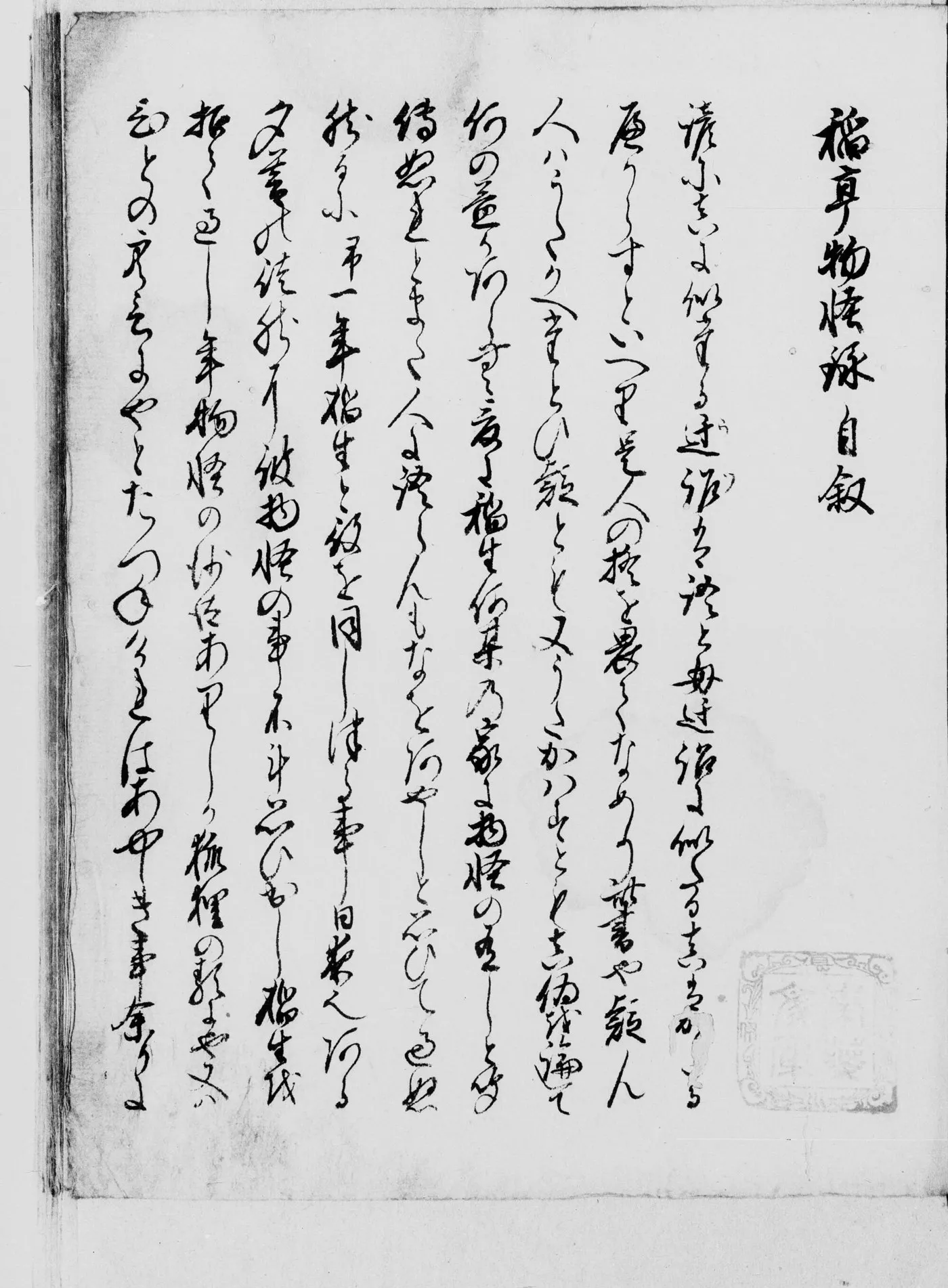
『稲亭物怪録』(東京大学総合図書館所蔵), the first page of the self-preface (自叙), cropped to the left page. From the UTokyo Digital Archive Portal, A00-5594.24
The account that says it is Inō’s
The Sanji jitsuroku monogatari, “the true record of Miyoshi”, is told in the first person. After a long opening it has one dated entry for each day of the month, thirty in all.1 The opening is an argument and a climb. Inō and the wrestler argue over whether monsters exist, he climbs Mt Hikuma on a stormy night, and on the third day of the fifth month the two sit at the top and tell hundred-story tales; nothing happens, and they come down sure that no monsters exist.1527 The rock they find at the summit is said in this text to be the tomb of “Miyoshi-dono”, and touching it means death.28
The text ends in two parts. A note after the last entry says the “direct writing” (直書), an autograph, was deposited at Kokuzenji in Kōka 1, which is 1844.9
右直書は/弘化元申辰年、自昌山、国前寺へ納之9
This autograph was deposited at Kokuzenji in Kōka 1.
Inō died in 180329, so whoever deposited it did so forty-one years after his death. The note’s year is written 申辰 where Kōka 1 would be 甲辰; we cannot say whether the slip is in the print or in the transcription.9 After the note comes a ledger headed 槌之次第覚, “record of the mallet’s course”. It has eleven dated items.8
| When | What the ledger records |
|---|---|
| Kan’en 2 (1749), last day of the 7th month | Received8 |
| 8th month, 3rd day | Buried in a box at the corner of the hut30 |
| Hōreki 3 (1753) | Carried to a place not named, then back to Miyoshi31 |
| Hōreki 8 (1758) | Carried to Hiroshima8 |
| An’ei 8 (1779) | Dug out of the ruins of a fire8 |
| Kyōwa 1 (1801) | Box found rotted, the “real thing” taken back32 |
| Kyōwa 2 (1802) | Left in the keeping of Kokuzenji8 |
The ledger has three more items, each a new hiding place after a change of house.33 Its second item repeats the demon king’s terms for keeping the mallet secret.30 Its move to Hiroshima in 1758 agrees with the Hino museum, which says the retainers of the Miyoshi domain were moved there that year.34 The whole ledger is in the document file with our translation.
Hirata’s copy, 1806 to 1811
The third group of texts comes from Hirata Atsutane and his pupils. The Hino museum says they collated the earlier texts, aiming at publication.35 Fujiwara, after Yoshida Asako (1998), says the Hirata text took Kashiwa’s text as its base and added to it from three picture books.35 The two accounts differ on whether the Sanji text was one of the sources, and we have not seen the Hirata text.
The Ochanomizu copy carries a preface by Atsutane dated Bunka 3 and a postscript by him dated Bunka 8.36 Those years are 1806 and 1811. On the page the preface ends with the date 文化三年九月十五日, the fifteenth of the ninth month, and a signature that begins 平田.36 Fujiwara, again quoting Shigehara, says the postscript explains that the Bunka 3 copy had errors, and that a pupil was made to correct it and copy it afresh.36
The mallet, text by text
Here the texts part. The Sanji account has the demon king give Heitarō a mallet and tell him to strike the veranda of the south-west room if he is ever in mortal danger.437 He must keep it to himself and show it to nobody, relatives included, for fifty years, though one very close outsider may be told after a hundred days.37
五十年過ざる内は、必ず人に見せ申こと相ならず37
Until fifty years have passed, you must on no account show it to anyone.
The fifty years ran from the night of receipt in 1749 to 1799, and Kashiwa’s preface of 1783 falls inside them.3783
| Text | Dated by | Visitor’s name | What he leaves |
|---|---|---|---|
| Kashiwa’s record | Preface, 17833 | Gorōzaemon21 | Nothing5 |
| Tōtei scroll, Hiroshima prefectural museum | Scroll with Kashiwa’s preface5 | Gorōzaemon21 | Nothing5 |
| Sanji jitsuroku monogatari | Ledger to 1802, note 184489 | Tarōzaemon38 | A mallet4 |
| Hotta scroll | Copied 18597 | Gorōzaemon21 | A mallet4 |
| Tanaka Kōtarō, Maō monogatari | Parent edition 193439 | Gorōzaemon39 | A healing scroll39 |
In Kashiwa’s record and in the Tōtei scroll the visitor says that Heitarō was due a misfortune that year and that he made the disturbances because of it, then leaves.5 The count of eighty-five victims comes in the Sanji account and the Hotta scroll.22 Fujiwara’s table spells the visitor’s name Gorōzaemon in all four of its columns, the Sanji one included, while the Aozora Bunko text of the Sanji account has Tarōzaemon and calls his rival Shin’no Akutarō.3821 We have not seen the print the Aozora text was typed from, so we cannot say which is right.
The Miyoshi museum describes the pattern this way: as the story spread, its main elements sometimes dropped away, and new content, the mallet among it, was added.6 The city says of the Hotta scroll that elements found in no other line suggest large later additions.40 Tanaka Kōtarō’s retelling, which Aozora Bunko takes from a collection of 1934, has the visitor leave for Kinkazan after giving Heitarō a scroll for healing the sick; the word 槌 does not occur in it.39 Which text is older, Kashiwa’s or the Sanji account, no source we read says.10
Scrolls
The best known of the picture scrolls is the Hotta scroll.40 It has three rolls, copied in 1859 and mounted in 1860.7 Miyoshi designated it an important cultural property in 1995 and accepted it as a donation in 2024.7 The Hino museum puts it in the Sanji line, and Fujiwara, after Sugimoto, calls it the oldest known scroll, though the copy itself is dated 1859.7
The Miyoshi museum owns a scroll that follows Kashiwa’s text, with no captions, which it says survives in few examples.41 In 2024 the museum showed all five known scrolls of the Tōtei line together for the first time.42 The Hino museum’s own scroll, 三十日の月, “the thirtieth-day moon”, was given to it in 1998. It is almost the same as the Hotta scroll, with three opening scenes that scroll lacks.43 The Hino museum counted the known texts about 2010.44 They came to 34 manuscripts, 6 picture books and 12 scrolls.44
What the story became
Fujiwara, citing Shigehara, says the Sanji account has 50 appearances of monsters, and suggests that the month of disturbances is the content of the hundred stories told on the mountain; she calls the idea open to examination.45 She also quotes the Miyoshi City History (2004) for a reading of the story as a warning to idle samurai left in Miyoshi after the domain was abolished, and as a test of courage in the year of coming of age.46 Both are secondhand here.
From Meiji on the story was used in kōdan, novels and plays, and recently in manga, opera and kagura.47 The Hino museum lists Orikuchi Shinobu, Izumi Kyōka, Inagaki Taruho, Tanaka Kōtarō, Iwaya Sazanami and Mizuki Shigeru among those who took it up.47
What can be checked
Inō Butayū belonged to the foot guards of the Miyoshi domain.29 He died in the twelfth month of 1803 at the age of 70.29 The domain, a branch of the Hiroshima Asano domain, had been abolished in 1720, twenty-nine years before the story.48 His family still lives in Hiroshima.29
His birth year is not settled. The Aozora Bunko card gives 1735 to 1803.49 The Miyoshi museum’s exhibition of 2024 marked the 290th anniversary of Heitarō’s birth, which points to 1734; that is our arithmetic.50
The places are harder. The museum says that the grave of Miyoshi Wakasa-no-kami and the cursed tengu cedar that Kashiwa-line works put on Mt Hikuma cannot be found now, and that the Inō Butayū monument of 1928, set where a later Inō family house stood, carries an inscription taken from modern kōdan.51 The site of Butayū’s own house is unknown.51
At Kokuzenji the ledger’s last item leaves the mallet with the temple in 1802.8 The Hino museum says a mallet is shown there each 7 January.11 No text we read says that the mallet shown now is the one in the ledger.
What we could not verify
Sources we have not seen
- Sugimoto Yoshinobu’s collection of the scrolls (2004) and the Miyoshi board of education’s study 『改訂版 妖怪いま甦る』 (2013) would show how Sugimoto argues that the Sanji text is Inō’s own and which text is older. Both are in copyright, and we found no scan.
- Hirata’s collated text, printed in his collected works (volume 3, 1911; volume 8, 1931), would show whether it has the mallet. The National Diet Library’s digital copy of the 1911 set, in the one volume we opened, can be read only on the library’s premises or by registered users in Japan, and we found no open scan of the volumes that hold the text.
- The Kashiwa text in the Kadokawa Sophia paperback of 2019 would give a modern reading of its thirtieth day. It is in copyright, and we have not seen it.
Seen only where others quote them
- Shigehara Hisashi’s study of how the story was made (1995) and Yoshida Asako’s study of the texts (1998), both known only where Fujiwara quotes them; they are the source for the four hearings, the postscript of 1811 and the contents of the Hirata text.
- The Miyoshi City History (2004), known only through Fujiwara’s quotation.
- Fujiwara’s comparison table is the only place we saw the day-thirty passages of Kashiwa’s text and the Tōtei scroll set against the others. We opened two manuscripts of Kashiwa’s text and read their dates, but not the cursive body.
Resting on a single source
- The Hino museum says the title 三十日の月 occurs on no other scroll and only in a manuscript found in Hiroshima the year before it wrote. We could not check it.
- The Hino museum is the only source we found for the January festival at which the mallet is shown.
Questions we could not settle
- Which is older, the Sanji account or Kashiwa’s record, and whether Inō wrote the Sanji account.
- Whether Kashiwa’s text lacks the mallet, the count of eighty-five and the rival demon king. Fujiwara’s table says so; a reading of the thirtieth day in either manuscript would settle it.
- Why Fujiwara’s table has the Sanji visitor as Gorōzaemon when the Aozora text has Tarōzaemon.
- Inō’s birth year, 1734 or 1735.
Read next
CaseShimoda, Izu, Japan, 1884 to 1891
Kokkuri-san came ashore at Shimoda, or so Inoue Enryō heard
TaleHanyū, Shimōsa (now Jōsō, Ibaraki), Japan, 1672 to 1859
Kasane's spirit left Hanyū village twice
TaleHimeji, Hyōgo, Japan, About 1577 to 1952
How Okiku came to Himeji Castle’s well
Sources
- Sanji jitsuroku monogatari, Aozora, entries "一、寛延二己巳年七月朔日" through "一、扨、晦日"; counted by us (primary)↑
- Kitamura Sumie, Hino City Local History Museum, section 〈『稲生物怪録』の諸伝本について〉 (the section does not name its source): "A 武太夫の友人柏正甫が…B 武太夫自身が書いたとされる『三次実録物語』。C…平田本"
- Fujiwara Ayaka, chapter 1, section 1, p. 157 and note 1↑
- Ochanomizu University Library copy of 稲生物怪録 (digitised by NIJL, DOI 10.20730/100239149), image 6, left page, last two lines: "天明三癸卯年 柏正甫"; the heading 稲生物怪録自叙 is on image 4, left page (primary)
- CiNii Books, record 稲生物怪録 3巻 (NCID BB14211333), Notes field: "稲生物怪録自叙 (天明3年)"↑
- Sanji jitsuroku monogatari, Aozora, entry for the last day: "此槌を以て、西南の間の椽を…御たゝき候へば" (primary)
- Kitamura Sumie, Hino City Local History Museum, story summary, 〈30日目〉: "妖怪を退治する木の槌(つち)をくれました"
- Fujiwara Ayaka, table 1, rows 42 and 45 (p. 163)↑
- Fujiwara Ayaka, table 1, rows 42 to 45 (pp. 162 to 163), columns 柏本 and 稲亭物怪録 (read on the page image); her 稲亭物怪録 is a scroll of Kashiwa's line, listed in her bibliography as held by the Hiroshima Prefectural Museum of History and Folklore, and not the University of Tokyo manuscript of the same title↑
- Miyoshi Mononoke Museum, section ≪稲生物怪録≫の紹介, third paragraph: "魔王が去っていく際に、槌を平太郎に手渡すといった、当初にない内容がつけ加えられたりします"↑
- Miyoshi city, news release 2024-08-22, section 1 寄附について
- Kitamura Sumie, Hino City Local History Museum, section 〈『稲生物怪録』の諸伝本について〉, last paragraph: "堀田静子家所蔵の絵巻(堀田本、三次市重要文化財、『三次実録物語』の系統)"
- Fujiwara Ayaka, chapter 1, section 1, pp. 157 to 158↑
- Sanji jitsuroku monogatari, Aozora, final lines, 槌之次第覚, items 1 to 11 (primary)↑
- Sanji jitsuroku monogatari, Aozora, the three lines before 槌之次第覚: "右直書は/弘化元申辰年、自昌山、国前寺へ納之" (primary)↑
- Miyoshi Mononoke Museum, section ≪稲生物怪録≫の紹介, first paragraph: "いつ、誰が作成したものか、最初はどのようなタイトルだったかなど、いまだ明確にはなっていない"↑
- Kitamura Sumie, Hino City Local History Museum, section 〈稲生武太夫の地元では…〉, item ②: "毎年1月7日には稲生祭が行なわれ、武太夫が山本五郎左衛門からもらった妖怪退治の木槌が公開されます"↑
- Miyoshi Mononoke Museum (湯本豪一記念日本妖怪博物館), page 《稲生物怪録》- 三次の妖怪物語 -, section ≪稲生物怪録≫の紹介, second paragraph: "寛延2年(1749)の7月1日、旧三次藩の町内で暮らす16歳の稲生平太郎…一か月間にわたり"
- Miyoshi city, press release on the opening of the museum, April 2019, paragraph beginning 山紫水明の地: "主人公の16歳の少年・稲生平太郎のもとに旧暦7月の30日間にわたって"
- Kitamura Sumie, Hino City Local History Museum, 日野の歴史と民俗134, page 1, second paragraph; the story summary opens "備後国三次(広島県)に、稲生平太郎という16歳の少年"
- Sanji jitsuroku monogatari, Aozora Bunko card 60788, first dated entry "一、寛延二己巳年七月朔日、夕方より小雨ふり"; entry for the last day (晦日), the visitor's speech (primary)↑
- Miyoshi Mononoke Museum, section 所蔵資料紹介, first item: "稲生武太夫(成人後の平太郎)の同僚である柏正甫が武太夫から聞いた話を記録した〈柏本〉"
- Kitamura Sumie, Hino City Local History Museum, section 〈『稲生物怪録』の諸伝本について〉↑
- Sanji jitsuroku monogatari, Aozora, entry for the 1st: "ひとかゝへほどのひげ手にて握り"; Gonpei found "うつ向にこげ死したる体" under three mats (primary)
- Kitamura Sumie, Hino City Local History Museum, story summary, 〈1日目〉↑
- Sanji jitsuroku monogatari, Aozora, first long entry (before the entry for the 1st of the 7th month), from "権八おそろしき物なく" to the climb on the night of the 28th of the 4th month; the mark is a rope tied round a rock (primary)
- Kitamura Sumie, Hino City Local History Museum, story summary, first three paragraphs ("三井権八というすもうとり"; "頂上の杉の木にしるしをつけて")
- Fujiwara Ayaka, 「『稲生物怪録』と三次」, chapter 2, opening paragraph: "三井権八と…比熊山にのぼり百物語をする…その約2か月後の7月1日から"
- Miyoshi Mononoke Museum, section ≪稲生物怪録≫ゆかりの地, 比熊山: "稲生平太郎が肝試しに登ったとされる山"↑
- Sanji jitsuroku monogatari, Aozora, entry for the 3rd: "女の切れたるくび、髪にて引出し…ぬれ舌にて顔不残ねぶり" (primary)
- Kitamura Sumie, Hino City Local History Museum, story summary, 〈3日目〉: a woman's head flies in and licks his face↑
- Sanji jitsuroku monogatari, Aozora, entry for the 5th: "あかき石…目数/\付、ゆびも数/\付" (primary)
- Kitamura Sumie, Hino City Local History Museum, story summary, 〈5日目〉: a big stone with feet and crab-like eyes crawls in↑
- Sanji jitsuroku monogatari, Aozora, entry for the 6th: "婆のしかみたる顔…小刀…宙に小刀、糸にて釣たるがごとくに" (primary)
- Kitamura Sumie, Hino City Local History Museum, story summary, 〈6日目〉: a big face blocks the doorway; the knife hangs in the air next day and drops when he looks↑
- Sanji jitsuroku monogatari, Aozora, entry for the 28th: "虚無僧三人" (primary)
- Kitamura Sumie, Hino City Local History Museum, story summary, 〈28日目〉: komusō monks fill the room with shakuhachi↑
- Sanji jitsuroku monogatari, Aozora, entry for the last day, from "火燵の内に首あり" (head) to the speech beginning "扨々、驚き入たる事にて候" (primary)
- Kitamura Sumie, Hino City Local History Museum, story summary, 〈30日目〉
- Fujiwara Ayaka, table 1, rows 43 and 44 (pp. 162 to 163), Sanji column and Tōtei column↑
- Fujiwara Ayaka, 「『稲生物怪録』と三次」, table 1, rows 44 and 45 (p. 163): "山本五郎左衛門と名乗り、魔王の類だといった"
- Kitamura Sumie, Hino City Local History Museum, story summary, 〈30日目〉: "山本五郎左衛門(さんもとごろうざえもん)という妖怪の大親分と名乗り"↑
- Sanji jitsuroku monogatari, Aozora, entry for the last day: "百人の内八十五人…御自分さまへは、我秘術を尽し候へども、中々相叶ひ申さず" (primary)
- Fujiwara Ayaka, table 1, rows 42 and 45 (p. 163): "85人をたぶらかし、平太郎が86人目"↑
- Sanji jitsuroku monogatari, Aozora, entry for the last day: "大なる駕籠を出し…髭あしふみ出し" (primary)
- Kitamura Sumie, Hino City Local History Museum, story summary, 〈30日目〉, last lines: the visitor leaves in a palanquin with his retinue; a big hairy foot shows from inside↑
- University of Tokyo Digital Archive Portal and Kokusho NW record 100052707, portal record (Description, Rights, IIIF manifest); images 1 to 4 (cover and title page 稲亭物怪録 自叙)
- CiNii Books, NCID BB14211333, Notes and 書写 fields: "明治五年といふ年の五月楳屋の黒磐寫"↑
- Fujiwara Ayaka, quoting 繁原央 「稲生物怪録」成立考 (常葉国文, 1995), chapter 1, section 2, block quote: "天明三年(一七八三)の自序によると四回稲生から聞いたという"; secondhand↑
- University of Tokyo General Library, 稲亭物怪録 (A00-5594), digitised by NIJL (DOI 10.20730/100052707), image 66, left page, date lines "自跋 / 寛政十一歳 / 夏四月 穀旦"; the signature was not read; the heading 跋 is on image 65 (primary)
- CiNii Books, NCID BB14211333, Notes field↑
- Sanji jitsuroku monogatari, Aozora, first long entry, last third, from "五月三日に相成り候時" to the end (primary)↑
- Sanji jitsuroku monogatari, Aozora, first long entry, the second climb: "此岩は三次殿御墓、当れば即死、ゆびさせば悪心又は吐血すると申伝へ" (primary)
- Miyoshi Mononoke Museum, section ≪稲生物怪録≫ゆかりの地, 比熊山↑
- Kitamura Sumie, Hino City Local History Museum, section 〈稲生武太夫の地元では…〉↑
- Sanji jitsuroku monogatari, Aozora, 槌之次第覚, item 2 (primary)↑
- Sanji jitsuroku monogatari, Aozora, 槌之次第覚, items 3 and 4 (primary)↑
- Sanji jitsuroku monogatari, Aozora, 槌之次第覚, item 10 (primary)↑
- Sanji jitsuroku monogatari, Aozora, 槌之次第覚, items 5, 7 and 9 (primary)↑
- Kitamura Sumie, Hino City Local History Museum, section 〈稲生武太夫の地元では…〉: "宝暦8年(1758)に家臣たちは広島へ引き上げたため、武太夫も広島へ移転"
- Sanji jitsuroku monogatari, Aozora, 槌之次第覚, item 6 (primary)↑
- Kitamura Sumie, Hino City Local History Museum, section 〈『稲生物怪録』の諸伝本について〉, group C: "A・Bの内容を整理し、平田篤胤と門人達が校合し、出版を目標に整理したもの"
- Fujiwara Ayaka, quoting 吉田麻子 1998 pp. 386 and 397, chapter 1, section 1, p. 158; secondhand↑
- CiNii Books, NCID BB14211333, Notes field: "平田篤胤序 文化3年", "平田篤胤跋 文化8年"
- Ochanomizu University Library copy (NIJL, DOI 10.20730/100239149), image 4, right page, last two lines (primary)
- Fujiwara Ayaka, quoting 繁原央 1995, chapter 1, section 2, block quote: "文化八年(一八一一)五月の篤胤の後記によると、文化三年の書写本は文字の誤りや…"; secondhand↑
- Sanji jitsuroku monogatari, Aozora, entry for the last day: "併、万一、右の悪太郎参り候へば…五十年過ざる内は、必ず人に見せ申こと相ならず…百日過候て御咄し置候へ" (primary)↑
- Sanji jitsuroku monogatari, Aozora, entry for the last day: "われは仮名山本太郎左衛門と申す。…仮名信野悪太郎と申" (primary)↑
- Tanaka Kōtarō, 魔王物語, Aozora Bunko card 42330, last section (八): "蒼生心経術と称うる病者を救うの呪法"; "奥州の金華山に出発する"; the word 槌 does not occur in the text (searched by us); credits: 底本の親本「日本怪談全集」改造社 1934(昭和9)年 (primary)↑
- Miyoshi city, news release 2024-08-22, section 1: "他の系統の絵巻には見られない要素をもっていることから、後に大きく創作が加えられた作品であると考えられます"↑
- Miyoshi Mononoke Museum, section 所蔵資料紹介, 『(仮称)稲生物怪録絵巻』↑
- Miyoshi city, news release 2024-05-30, 見所【その①】: "「稲亭物怪録」系統の絵巻作品5点全てを、初めて一堂に集めた展示"↑
- Kitamura Sumie, Hino City Local History Museum, opening paragraph and 〈諸伝本について〉, last paragraph
- Fujiwara Ayaka, chapter 1, section 3, p. 158↑
- Kitamura Sumie, Hino City Local History Museum, section 〈諸伝本について〉: "写本34、絵本6、絵巻12など"↑
- Fujiwara Ayaka, chapter 1, section 4, p. 159; secondhand↑
- Fujiwara Ayaka, introduction, block quote; secondhand↑
- Kitamura Sumie, Hino City Local History Museum, section 〈文芸作品・漫画・児童書などにみる『稲生物怪録』〉
- Miyoshi Mononoke Museum, section ≪稲生物怪録≫の紹介, third paragraph↑
- Miyoshi city, press release on the opening of the museum, April 2019, paragraph beginning 江戸時代、寛永九年(1632): "享保五年(1720)の廃絶まで88年間"
- Kitamura Sumie, Hino City Local History Museum, section 〈稲生武太夫の地元では…〉↑
- Aozora Bunko, card 60788, card header, 作家名 and 生年 / 没年 fields↑
- Miyoshi city, news release 2024-05-30, title of the exhibition: "稲生平太郎生誕290周年 稲生物怪録 -時空を超える物語-"↑
- Miyoshi Mononoke Museum, section ≪稲生物怪録≫ゆかりの地, 比熊山 and 稲生武太夫碑↑


