 Twice Told
Kokkuri-san came ashore at Shimoda, or so Inoue Enryō heard
In 1887 Inoue Enryō traced the kokkuri craze to an American ship at Shimoda, a story he dated to about 1884 in one book and about 1885 in the next.
Contents
Published 9 Oct 2026. Sources checked 10 Oct 2026.
In early May 1887 Inoue Enryō wrote that one strange affair had everyone talking, high and low, in the city and the country: kokkuri.5 Three people rested their hands on a lid balanced on bamboo sticks, called on Kokkuri-sama, and asked it questions, and the lid tipped to answer.6 The book that carries that preface, the first volume of his Yōkai gendan, gives a section to how kokkuri reached Japan.1 Inoue was no casual reporter. He had helped found the Philosophy Society in 1884, and in September 1887 he opened a school, the Tetsugakukan.7
The paragraph says that an American sailing ship was damaged near Shimoda, in Izu, “around the year before the year before last, so I have heard”.2 Counted from 1887 that is about 1884. When Inoue told the story again in lecture notes issued from December 1891, the ship had moved to about 1885.38
一昨々年頃の事とかや2
It was around the year before the year before last, so I have heard.
Neither version names the ship or the American. Both give the story as something Inoue was told, and in the book of 1887 he builds a chain of reasoning on it.239
This is the Shimoda story as Inoue Enryō wrote it down in 1887 and told again in lectures from 1891.23
A few years before, an American sailing ship was damaged near Shimoda in Izu.2 An American from the ship stayed on there for a long time, and taught the people a game: three bamboo sticks tied into a tripod, the lid of a rice chest laid on top, and hands resting lightly on the lid.26
The American called it by an English name. The people of Shimoda could not say it, and called it kokkuri, after the way the lid tips.10 People came to speak of it as Kokkuri-sama, and the characters 狐狗狸 were fitted to the name.10
Every night people gathered in one place or another to ask it about luck and misfortune.11 One man asked whether his wife had a lover, and told it to lift a leg if she had. The leg lifted. He went home and divorced her at once.11
Playing kokkuri in 1886
The practice needed almost nothing. A reporter whom Inoue quotes describes three bamboo sticks tied at the middle into a tripod, the lid of a rice chest set on top, and three people seated round it with their hands lightly on the lid.6 One of them chants an invitation to Kokkuri-sama for about ten minutes; then the leader asks it, if it has come, to tilt toward a named person, and the lid tilts that way.6
By Inoue’s reading of the reports sent to him, the craze spread through Izu and the provinces round it from the autumn of 1885 to the spring of 1886.12 During 1886 it spread west to Kyoto and Osaka and the San’yō, and east through the Bōsō and other eastern provinces; in 1887 it was entering Ōshū, and he had heard of none in Hokuriku.12 He has it reaching Tokyo in the autumn of 1886 and in Ushigome and Koishikawa by the spring of 1887.13 Basil Hall Chamberlain’s handbook Things Japanese lists the fashionable crazes of Japan year by year, and for 1887 it gives “Mesmerism, table-turning, and planchette”.14 He does not use the word kokkuri, but Inoue says kokkuri and table-turning are one thing.9
Inoue’s first piece on kokkuri, according to Miura Setsuo’s catalogue of his writings on yōkai, is 「こッくり様ノ話」, printed in the Tetsugaku-kai zasshi on 5 February 1887.15 We have only the phrases Miura quotes from it.
Stories Inoue turned down
Inoue began by asking interested people in the provinces how kokkuri had spread, because he wanted to know where it began and who devised it.12 He then lists four rumours about an older origin: that Oda Nobunaga first tried it, which old records are supposed to show; that it was done under the Tokugawa, on the word of old men; that it began in Satsuma; that it came from abroad.16 He calls all four street talk with nothing firm to rely on.16
It still seems to him beyond doubt that the method came from abroad. He sets aside two stories of how: that it arrived mixed up with the Christian religion centuries ago, and that Japanese who had been in America brought it home at the Restoration.17 His objection is the same for both. A method that had been in the country for years would not have stayed unknown among the people and then broken out in the last two years; and even if one or two people knew it before the Restoration, he says, the present craze undoubtedly has another source.17
The ship at Shimoda
His own first guess was Izu. From the way it had spread he supposed kokkuri began in the Tōkai provinces, and he thought it would have started in Izu.4 In the summer of 1886 he went there himself, looked into the craze, and learned for the first time, as he puts it, that his supposition was true.4
The Shimoda story comes next in the book. Over the damaged ship, he says, an American stayed in the place a long time and taught the method to the people.2 In the lectures he adds that he heard in Izu that it began at Shimoda Port and was passed on by Americans.3
| Text | Year of the ship | His wording |
|---|---|---|
| Yōkai gendan, May 1887 | About 18842 | “so I have heard” (とかや)2 |
| Lecture notes, from December 1891 | About 188538 | “they say” (という)3 |
The two years are a year apart, and the text does not say which is closer. Both are worded as hearsay.23
From the story he draws a chain of inferences that the text itself marks as his own. The American, he says, must have known table-turning at home, and with no table to hand at Shimoda they used bamboo and a lid on the spot; his word is “is imagined” (想像せらる).9 The boatmen at Shimoda who saw it must have carried it into the ports east and west, which is why, he says, it began in Tokyo at the seaside, in Fukagawa and Kyōbashi.18 He writes that it is clear the spread began at Shimoda, and that the kokkuri now in fashion began there, in his words “almost beyond doubt”.18
昨今流行のコックリは豆州下田に起縁せると殆んと疑ふへからさるなり18
That the kokkuri now in fashion began at Shimoda in Izu leaves almost no room for doubt.
Inoue’s Shimoda origin is a hearsay story joined to his own reasoning about ports. The ship and the American are the report; the boatmen and the improvised table are his reasoning.2189
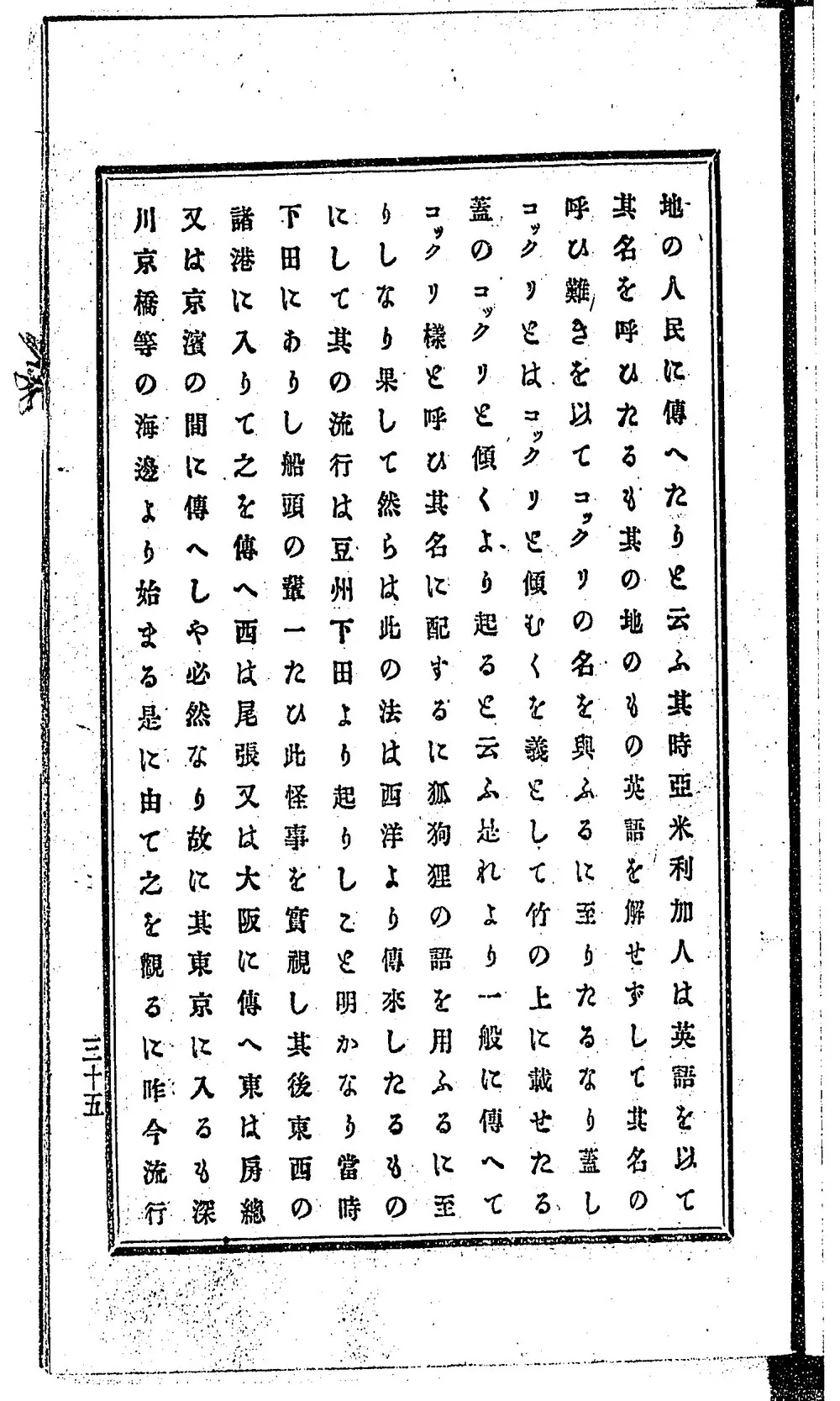
『妖怪玄談』2版 (哲学書院, 1900), p. 35, cropped. The page that gives the English name, the name kokkuri and the characters 狐狗狸. National Diet Library Digital Collections, pid 759919.10
A name that fitted afterwards
Inoue gives the name in three steps, each worded as hearsay (と云ふ). The American used an English name; the people could not say it and called it kokkuri, after the word for the lid tilting; and the characters 狐狗狸 were attached to the name afterwards.10
其名に配するに狐狗狸の語を用ふるに至りしなり10
and the characters 狐狗狸 came to be fitted to that name.
One thing in his own writing fits only a short interval. In the preface of May 1887 he already calls the affair 狐狗狸の一怪事, and in the piece of 5 February 1887, as Miura quotes it, he describes kokkuri as 狐狗狸, “a kind of yōkai like a fox or tanuki”.519 If the characters were fitted to the name only after the ship, as he says, the fitting happened between the ship, about 1884 by our count, and early 1887.21019
Why the lid moved
The book goes on from origins to cause.20 In the lectures his answer is that the sitters moved the lid themselves without knowing it.21
In the lectures he lists the explanations he rejects: foxes and tanuki, spirits, electricity, deliberate moving by the sitters, and an illusion of movement.21 He tested them himself. With four or five students of the Imperial University nothing happened, and with a young student of little learning added, very little. With the young student and a woman of about forty, it worked.22 Ten days later the three of them got results every time with different bamboo and different lids, and with three pipes, a teapot or a flat board in place of the bamboo and lid. From this he concluded that it needs no fixed apparatus.22
The 1887 book sets out three causes: the device itself; the contact of hands with it; and the mind, which he calls the most important.20 In the lectures the mind’s part has two names. Unconscious muscle movement (不覚筋動), he says, arises from expectation (予期意向): sitters who expect the lid to tilt move their hands without knowing it, and when one person’s slight push starts it the others’ force joins in.21
He also borrows from Carpenter’s psychology a table that, asked how many years the reigning queen had been on the throne and how old her son was, answered sixteen years and eleven, figures that neither of the two sitters knew; Inoue reports that the answers matched a chronological table.23
At Shimoda itself, Inoue says in the lectures, several police officers got no movement until a believer joined them, and afterwards they got it on their own, which he puts down to belief having arisen in them.11
Which edition we read
We read Yōkai gendan in its second edition of 1900, from the National Diet Library’s scan. The printed preface is dated early May 1887, and Takahashi Naomi gives 2 May 1887 for the book.1 The library’s own record for the 1900 edition, however, carries a note that the first edition came out in May 1892.24 The two dates do not fit, and we have not seen the first edition. The text we read is the print of 1900, and whether the first edition said “the year before the year before last” is a question we could not settle.224
What we could not verify
Sources we have not seen
- The first edition of Yōkai gendan (1887). It would show whether the Shimoda passage read the same then, and with what date for the ship. The NDL Search listing for the title shows only the 1900 second edition as a digitised copy.
- Newspaper reports of 1886 and 1887, which would show whether Shimoda was named before Inoue wrote. The Yomiuri’s historical database sends visitors to a login page, and the Asahi’s search page returned “Access Denied” to us.
- Michael Dylan Foster, “Strange Games and Enchanted Science: The Mystery of Kokkuri” (Journal of Asian Studies, 2006), the standard study in English, which would show how far later scholarship has gone beyond Inoue’s account. The publisher’s page offers only the metadata and a purchase option.
Seen only where others quote them
- Inoue’s 「こッくり様ノ話」 in the Tetsugaku-kai zasshi of 5 February 1887: we have only the phrases Miura quotes. It would show how Inoue first told the story. NDL Search lists the 1887 issues of the journal as paper reprints, with no digitised copy that we could find.
Resting on a single source
- The Shimoda story itself. Only Inoue tells it, in two versions, and we found no other account of the ship, the American or the people who learned the method from him.
Questions we could not settle
- Which year the ship was damaged, about 1884 or about 1885, and which ship it was.
- Where in Izu Inoue heard the story, and from whom.
Read next
TaleMiyoshi, Hiroshima, Japan, 1749 to 1859
The Inō mononoke roku: where the demon king's mallet came from
TaleHanyū, Shimōsa (now Jōsō, Ibaraki), Japan, 1672 to 1859
Kasane's spirit left Hanyū village twice
TaleHimeji, Hyōgo, Japan, About 1577 to 1952
How Okiku came to Himeji Castle’s well
Sources
- Inoue Enryō, 妖怪玄談, 2nd ed. 1900 (NDL pid 759919), frame 4 (spread): left page "妖怪玄談 第壹集 第壹段 狐狗狸の事 … 不思議庵主人 井上圓了述", right page contents (総論, コックリの仕方, コックリの傳來, コックリの源因) and "明治二十年五月上旬 著者誌" (primary)
- Josephson, 「絶対的妖怪」, Inoue Enryo Research 5, p. 197, note 8: "井上円了『妖怪玄談』(1887)「コックリの事」"
- Takahashi Naomi, 「井上円了の「妖怪学」序論」, Enryo Center annual report 13, p. 57, first paragraph: "『妖怪玄義』(明治二十年五月二日 哲學書院)第一段第一節に"↑
- Inoue, 妖怪玄談, 2nd ed., frames 23 (p. 34, 第十六節) and 24 (p. 35, first lines): "一昨々年頃の事とかや、亞米利加の帆走船豆州下田近傍に來りて破損したることあり … 此法を同地の人民に傳へたりと云ふ" (primary) transcription↑
- Inoue, 妖怪学, Aozora card 1021 (file 49269_50168), section 狐狗狸のこと, paragraph beginning "余、はじめに、コックリのいずれの地にはじめて起こり": "明治十八年ごろ、アメリカの帆走船、下田近傍に至りて破損したるものあり … この法を近辺の者に伝えたりという" (primary)↑
- Inoue, 妖怪玄談, 2nd ed., frame 23 (p. 34), lines from "是れ余かコックリは東海諸國に起源せりと想像せし所以にして" to "始めて其説の眞なるを知る" (primary) transcription↑
- Inoue, 妖怪玄談, 2nd ed., frame 3 (preface, printed page 一): "余幼にして妖怪を聞くことを好み長して其理を究めんと欲し事實を蒐集すること茲に已に五年 … 唯今は都鄙の別なく上下共に喋々するものは狐狗狸の一怪事なり" (primary)↑
- Inoue, 妖怪学, Aozora card 1021, section 狐狗狸のこと, quoted block opening "(前略)その法、生竹の長さ一尺四寸五分なるもの三本を作り" (primary)↑
- Miura Setsuo, 「井上円了の妖怪学」, p. 293 ("この明治17年に井上円了は、1月に哲学会を中心者となって創設し") and p. 297 ("井上円了は明治20年9月に、東京 湯島の麟祥院の施設を借りて哲学館を創立した")↑
- Inoue, 妖怪学, Aozora card 1021, colophon at the end of the file: "底本の親本:『哲学館講義録 第五学年』…1891(明治24)年12月25日、1892(明治25)年1月25日、5月5日…" (primary)↑
- Inoue, 妖怪玄談, 2nd ed., frames 27 (p. 38, last four columns: "是に由て之れを觀るに下田に來りし亞米利加人は …") and 28 (p. 39, first columns: "故に余はコックリは即ちテイブル、トルニングと同一なりと信す") (primary) transcription↑
- Inoue, 妖怪玄談, 2nd ed., frame 24 (p. 35, columns 1 to 7): "其時亞米利加人は英語を以て其名を呼びたるも … 其名に配するに狐狗狸の語を用ふるに至りしなり" (primary) transcription↑
- Inoue, 妖怪学, Aozora card 1021, section 狐狗狸のこと: paragraph "余、先年、豆州にありて聞くところによるに、同国下田港近辺は日本全国中最初に流行し" and paragraph "先年、豆州下田港にて、巡査数名相集まりてこれを試むる" (primary)↑
- Inoue, 妖怪玄談, 2nd ed., frames 20 (p. 31, 第十四節, from "一昨明治十八年の秋より") and 21 (p. 32, first four columns) (primary) transcription↑
- Inoue, 妖怪玄談, 2nd ed., frames 22 (p. 33, from 第十五節) and 23 (p. 34, first 12 lines) (primary) transcription↑
- Basil Hall Chamberlain, Things Japanese, 2nd ed. 1891, p. 152, entry "Fashionable Crazes", the line "1887. Mesmerism, table-turning, and planchette." (primary)↑
- Miura Setsuo, 「井上円了の妖怪学」, p. 295, paragraph "最初の論文は、明治18年7月25日の『学芸志林』の「易ヲ論ス」であり、つぎが明治20年2月5日の『哲学会雑誌』の「こッくり様ノ話」と続き"↑
- Inoue, 妖怪玄談, 2nd ed., frame 21 (p. 32): "然るに人の傳ふる所によるに此法は三百年前より已に日本に傳り信長公始めて之を試みられたると舊記に見えたりと云ひ … 皆坊間の風説に止まりて確乎として信を置くへきものなし" (primary)↑
- Inoue, 妖怪玄談, 2nd ed., frames 21 (p. 32, last two columns) and 22 (p. 33, first six columns): "此説によるに或は數百年前切支丹宗に混して … 他の起源あるによるや疑を容れす" (primary)↑
- Inoue, 妖怪玄談, 2nd ed., frames 24 (p. 35, from "果して然らは") and 25 (p. 36, first two columns): "下田にありし船頭の輩一たび此怪事を實視し … 昨今流行のコックリは豆州下田に起縁せると殆んと疑ふへからさるなり"; also "其の流行は豆州下田より起りしこと明かなり當時" (primary) transcription↑
- Miura Setsuo, 「井上円了の妖怪学」, p. 296, first paragraph: "「こっくりとは狐狗狸にして、狐か狸のようなる一種の妖怪物が、その仕掛けたるところに乗り移りて……」"↑
- Inoue, 妖怪玄談, 2nd ed., frame 30 (p. 43, 第十九節): "第一は外界のみによりて起る源因即ちコックリの裝置自體より生する源因 … 其中第三の源因を最も大切なるものとす" (primary)↑
- Inoue, 妖怪学, Aozora card 1021, section 狐狗狸のこと: the paragraph "以上、コックリの伝来を述べたれば…" (the five rejected explanations, "余が実験せるところによるに、その動くことは必然にして…") and the paragraph "第三の原因は…" and the two after it ("不覚筋動", "予期意向") (primary)↑
- Inoue, 妖怪学, Aozora card 1021, section 狐狗狸のこと, paragraph beginning "余、この怪事の、あるいは愚民の固信するところとなりて": "はじめに帝国大学学生四、五名とこれを試みしに … 平面の板を用いたりなどせしも、みな多少その効験あるを見たり" (primary)↑
- Inoue, 妖怪玄談, 2nd ed., frames 26 (p. 37, 第十七節) and 27 (p. 38, first line "其答の如し"): the passage from "今カーペンター氏心理書中に擧くる所の一例を引て" to "年表について驗するに果して"; the ending is on the next page and was read only as "其答の如し" (primary)↑
- NDL Digital Collections item record, pid 759919, item JSON, field "0040Dtct" (saved in site/src/images/kokkuri-san-meiji/licenses/ndl-759919-item.json)↑
Documents quoted
- Yōkai gendan: how kokkuri came to Japan, and the ship at Shimoda, 1887 (transcribed from the page image)