 Twice Told
How Okiku came to Himeji Castle’s well
Himeji Castle shows visitors the well Okiku is said to lie in. The oldest version of her story has no Okiku, no plates and no well.
Contents
Published 24 Sept 2026. Updated 25 Sept 2026. Sources checked 24 Sept 2026.
Below the keep of Himeji Castle, in the enclosure called Kami-yamazato, the castle’s Okiku well route leads to an old well. The city’s guide to the castle says that Okiku, the heroine of the ghost story Banshū Sarayashiki, was tortured to death and thrown into it.6 The same guide says it was originally called the Tsurubetori well, the well where buckets were drawn.7 The Hyōgo Prefectural Museum of History adds that Edo-period documents use that older name, and thinks the new one arrived in the early Taishō years, when the castle opened to visitors.7
By 1934 the castle’s own printed guide used the new name, and chose its words with care:8
上山里の中央にある井戸をお菊井戸といひます。井の石垣の間から櫻の木が生ひ茂つて居り、物語のありさうな古井戸8
The well in the middle of Kami-yamazato is called the Okiku well. Cherry trees grow thick between the stones of its wall: an old well that looks as if it has a story.
The story it was given is the one Himeji still tells.
This is the story as the Hyōgo Prefectural Museum of History tells it, following Hashimoto Masaji’s history of Himeji Castle, Himeji-jō shi (1952).9
When the Kodera family ruled Himeji, a senior retainer named Aoyama Tetsuzan wanted the castle for himself. The Kodera suspected him, and placed a woman named Okiku in his house as a servant to watch him.10 In 1505 Tetsuzan planned to poison the young lord, Kodera Norimoto, at a flower-viewing party at Zuiganji temple, north of the town. Okiku learned of the plot from Tetsuzan’s son Kogorō and warned her lord, and the poisoning failed.10 Soon afterwards war broke out in Harima. Tetsuzan took Himeji Castle, and Norimoto fled to the island of Ieshima.10
In the rainy season Tetsuzan held a feast and brought out a Kodera heirloom, a set of ten matched plates. His retainer Chōnotsubo Danshirō wanted Okiku, and she had turned him away, so he hid one of the ten and let the blame fall on her.10 He took her to his own house, hung her from a pine in the garden, beat her, and threw her into a well.10
From that night a sad voice was heard by the well, counting “one plate, two plates, three plates” up to nine, and the rattle of plates filled the house. People called it the plate mansion, Sarayashiki.10
Norimoto won his castle back. Tetsuzan died fighting, Kogorō killed himself in shame, and Okiku’s two younger sisters were allowed to take revenge on Danshirō. Norimoto built a shrine to Okiku in the grounds of the Jūnisho shrine. The pine she had hung from withered every rainy season and turned green again after it, and her spirit comes back as an insect on the anniversary of her death.10
That is where the museum’s telling ends.
Hanano’s five cups
The oldest text of the Himeji story has none of those names. It is an entry in Chikusō yawa, “Chikusō’s evening talks”, a collection of anecdotes from around Himeji and Tatsuno.11 The master of the house is Odagaki Shume-no-suke, a retainer of the Yamana family based at Aoyama. The woman is called Hanano. What goes missing is one of five matched cups made of abalone shell, a gift from the Yamana, and the man who hides it is a young samurai, Kasadera Shin’emon, who wanted her. He tortures her to death; her grudge returns night after night, and the pine she was hung from is called the hanging pine.12
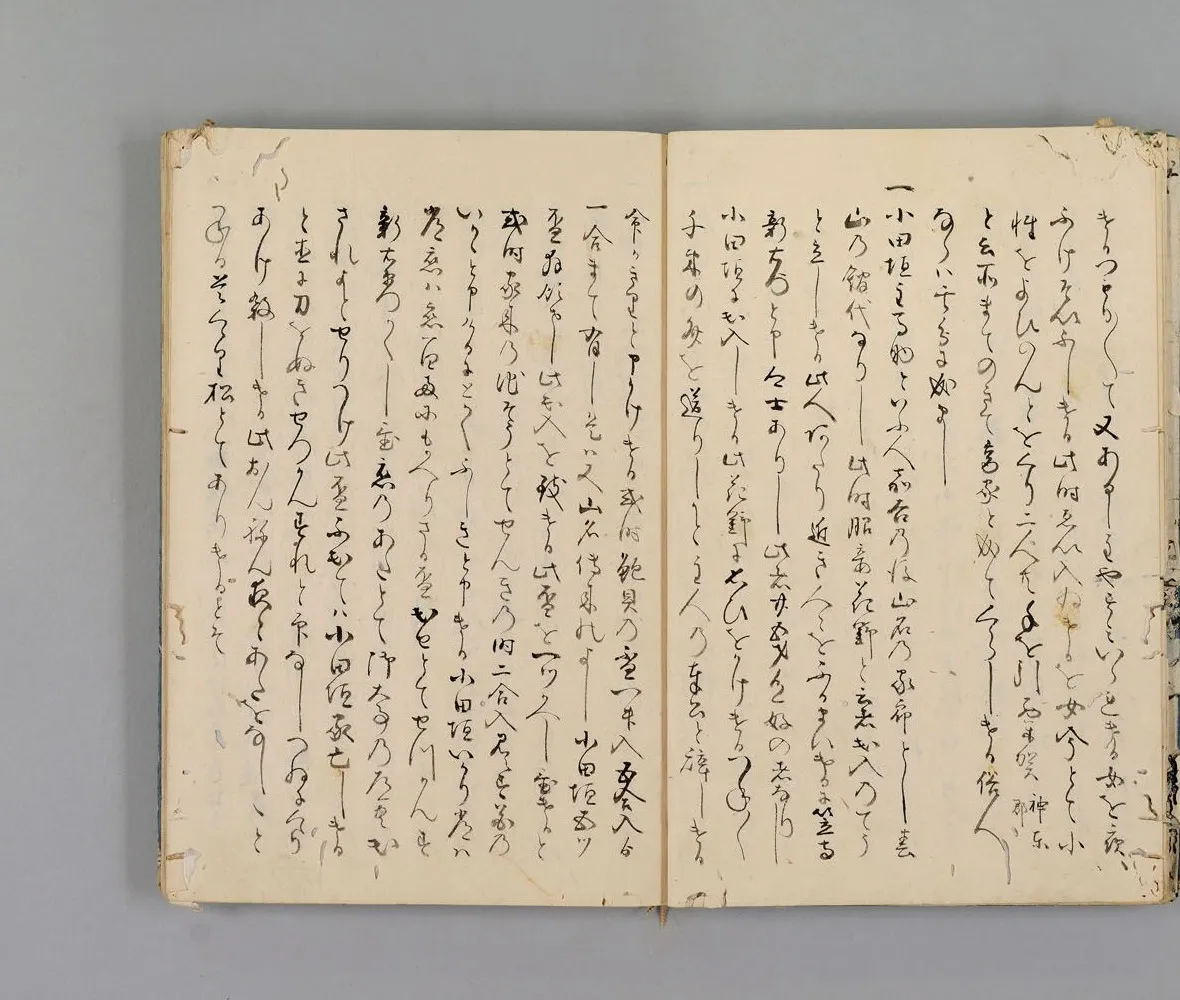
The Chikusō yawa entry on Odagaki and Hanano, in Amakawa Tomochika’s copy made between 1752 and 1760. Kobe University Library, Special Collections, 地理-22-1. Cropped.12
The manuscript is in a running hand we could not transcribe in full. We could read the names 小田垣主馬助 and 花野, Kasadera’s name, “鮑貝乃盃”, the abalone-shell cup, and the last line of the entry, which ends on the pine.12 The museum sums up what separates it from the later story: five cups, not ten plates; a heroine who is not Okiku; and no well.13
| Chikusō yawa (colophon 1577) | Himeji-jō shi (1952) | |
|---|---|---|
| Lord | Yamana, through Odagaki at Aoyama12 | Kodera, betrayed by Aoyama Tetsuzan10 |
| Woman | Hanano12 | Okiku, a spy in Tetsuzan’s house10 |
| Missing object | one of five abalone-shell cups12 | one of ten plates10 |
| Who hides it | Kasadera Shin’emon12 | Chōnotsubo Danshirō10 |
| Her death | tortured, hung from a pine12 | tortured, thrown into a well10 |
| Afterwards | her grudge returns each night12 | a voice counts the plates10 |
| Well | none13 | yes10 |
Both tellings have a pine, and the pine has a history of its own. A book of Buddhist tales printed in 1689 has an entry on the roadside pines of Himeji, which wither, turn red and come back green; in the Enpō era (1673 to 1681) the lord had them fenced. It names no maid.14 The museum reports that Harima kagami (1762) describes the rainy-season pine as a plain wonder planted by a Himeji retainer, with no word of Okiku, and concludes that the famous pine came first and was drawn into the story later.14 The 1689 entry doesn’t say when its pines turned red, so we can’t tell whether it is the same tree.
Dated 1577, copied in the 1750s
Chikusō yawa ends with a date and a name:11
天正五年九月十五夜 永良氏竹叟11
The fifteenth night of the ninth month, Tenshō 5 [1577]. Chikusō of the Nagara family.
We know the text only from the copy made by Amakawa Tomochika of Gochaku, who put it into Banyō manpō chiebukuro, fifty volumes of writings on Harima that he gathered between 1752 and 1760: about 125 of them by the museum’s count, about 130 by the gazetteer’s.11 His own manuscript is in Kobe University Library; Chikusō yawa opens volume 40.11 The museum notes that most of the texts he copied are lost in the original, and the Heibonsha gazetteer of historical place names warns that some of them were careless to begin with and that the copies are full of miscopied and missing characters.15
So the museum’s claim is conditional: if the colophon is true, Chikusō yawa is the oldest book with the Harima story.15 Shibuya Takehiro questioned the date in a 2019 article; the editor’s note in the issue of Rekishi to Kōbe that carried it says a tale reworked by many hands can’t be taken on trust just because it states a year.16 On that basis, it says, recent opinion holds that the Harima story is older than the Edo one.17 Konita Seiji, writing in 1987 without discussing Chikusō yawa, dated the written Himeji tradition no earlier than the kabuki play of 1720 and Amakawa’s compilation of 1760.17
In print, one piece at a time
Outside Himeji the pieces turn up one at a time. The table follows the date of each text.
| Text | Date | Setting | Woman | What is lost | Well |
|---|---|---|---|---|---|
| Chikusō yawa | colophon 1577; copy 1752 to 1760 | Aoyama, Harima12 | Hanano12 | an abalone-shell cup12 | none13 |
| Honchō koji innenshū | 1689 | Matsue1 | a nameless maid1 | one of ten plates, broken1 | yes1 |
| Tōsei chiekagami | 1712 | Ushigome, Edo18 | a maid her master favoured19 | one of ten Nanking plates, broken19 | none19 |
| Nishiki sara kumai yakata, kabuki | 1720 | Harima20 | Kiku20 | plates20 | unknown, playbill only20 |
| Banshū sarayashiki, puppet play | 1741 | Hosokawa house21 | Okiku21 | one plate, hidden21 | not in the summaries21 |
| Seiban kaidan jikki | 1754 | Kiri no baba, Himeji3 | a nameless maid3 | one of ten Shigaraki plates, broken3 | none3 |
| Sarayashiki bengiroku | 1758 | Banchō, Edo22 | Kiku, 1622 | one of ten Nanking plates, broken22 | yes22 |
| Yanai’s summary of a Himeji novel | 1899 | Himeji2 | Okiku2 | one of ten plates, hidden10 | Danshirō’s garden2 |
| Okamoto Kidō, Banchō sarayashiki | 1916 | Edo23 | Okiku23 | one plate, broken on purpose23 | no ghost23 |
| Jūnisho shrine’s account | before 1921 | Himeji Castle4 | Okiku4 | no plates4 | inside the castle4 |
| Himeji-jō annai, castle guide | 1934 | Himeji10 | Okiku10 | one of ten plates, hidden10 | the Okiku well8 |
| Himeji-jō shi | 1952 | Himeji10 | Okiku10 | one of ten plates, hidden10 | a well10 |
The counting ghost is older in print than any Okiku. Honchō koji innenshū, printed in 1689, tells of a samurai of Matsue in the Shōhō era (1644 to 1648) who pushed a maid down an old well because she broke one of his ten treasured plates:1
夜々井ノ端ニ現シテ其皿ノ数ヲ一ツ二ツ三ツ四ツ九ツト云テ十ト云事ヲエイハズ。ワツト叫ブ事不止。1
Night after night she appeared at the edge of the well and counted the plates, one, two, three, four, up to nine, and could never say ten. She never stopped crying out.
A wise monk ended it by calling out “ten” as soon as she reached nine. The whole passage is transcribed and translated. Konita quotes it as the earliest plate-counting story he found.1
The oldest Edo plate mansion in a surviving book, according to the museum, is the one at Ushigome in Tōsei chiekagami (1712).18 It has neither a well nor a counting ghost. The jealous wife of a man named Hattori uses a broken Nanking plate, one of a set of ten, as her excuse to starve and then strangle the maid her husband favoured; the maid’s ghost kills the four men who finished her off, then the wife.19 The name Aoyama first appears in 1720, in a kabuki play set in Harima, Nishiki sara kumai yakata. It is also the earliest text in which Konita found Kiku and the plates together.20 Only its playbill survives, at Tenri Central Library, and a play listed as Sarayashiki opened that year at the Kaneko-za in Osaka.20
Then came the puppet play. Banshū sarayashiki, by Tamenaga Tarobei and Asada Itchō, opened at the Toyotake-za in Osaka in 1741. Its chief retainer, Aoyama Tetsuzan, is overheard by Okiku plotting to poison his lord Hosokawa Masamoto, hides a plate to blame her and kills her, and her ghost drives him to ruin.21 Watanabe Shōgo, in the Nipponica encyclopedia, names this play as the version that made the story most widely known.21
Shigaraki plates at Kiri no baba
The oldest Himeji plate-counting story we could read in full is in Seiban kaidan jikki, compiled by Haruna Tadanari of Sayo and printed in 1754. Its narrator writes in the Kan’en era (1748 to 1751).3 It names nobody. In the days of the Kodera, a man of rank entertained the house elders with Shigaraki plates for ten guests; a maid broke one and hid the halves under the box. When the master had her count them, she stopped at nine, and he cut her down before she finished explaining.3 Then:
幽霊出て「壱つ二つ」とかそへ出し、「三ツ四ツ五ツ六ツ七ツ八ツ九ツやれかなしや」と鳴叫ふ声ハ耳に止りて、恐しさいふ斗なし。3
A ghost appeared and began to count, “one, two”, then “three, four, five, six, seven, eight, nine, oh, how sad”, crying out in a voice that stayed in the ears of those who heard it. It was frightening beyond words.
No priest could stop it. The family moved and soon died out, and the house at Kiri no baba, the narrator says, still stood empty “even now”.3 There is no well in it. The story is transcribed and translated from a copy of the 1754 print in the Himeji City Museum of Literature. Konita lists the book among the plate-mansion texts printed before 1758.3
Aoyama Shuzen’s Nanking plates
Four years later came the Edo version. Sarayashiki bengiroku, which Konita calls the first work of the Banchō Sarayashiki and a strong influence on the storytellers who came after, is attributed to the storyteller Baba Bunkō and dated 1758.22 In it the bannerman Aoyama Shuzen owns ten Nanking plates; on the second day of the first month of Jōō 2 (1653) his maid Kiku breaks one, and he cuts off her right middle finger.22 She throws herself into the well of the house, her ghost counts plates, and a monk, Ryōyo, lays her to rest by saying “ten”.22
Okamoto Kidō’s play Banchō sarayashiki, first staged at the Hongō-za in Tokyo in February 1916, dropped the ghost. His Okiku loves the bannerman Aoyama Harima and breaks one of his family’s plates on purpose, to test his love; when he learns why, he kills her for doubting him.23
How the well moved into the castle
In 1899 Yanai Masao’s guide to Himeji said that Okiku’s shrine stood inside the grounds of the Jūnisho shrine, where worshippers offered plates with their prayers.24 He had little patience with the story itself:2
この阿菊の話は好事者の作說にして採るに足らねど2
This tale of Okiku is the invention of busybodies and not worth taking seriously, but…
He summarised it anyway, from a thirteen-volume novel called Himeji sarayashiki whose author he did not know.2 In that version Danshirō takes Okiku to his house west of the castle, ties her to a pine in the garden, and after her death her body is thrown into the deep well in his garden; the counting is heard in that house.2 The museum’s account of the Jitsuroku behind Himeji-jō shi agrees that Danshirō tortured her at his house near the castle’s Kuruma gate, but has him take her into the castle and throw her into a well while Tetsuzan watches.2 The museum dates the Jitsuroku to the late Edo period; Konita reports a claim that the original was written by a Himeji retainer around 1748, and that the copy once kept at the Jūnisho shrine was lost in the war.9
Some time before 1921 the Edo historian Mitamura Engyo paid to see the treasures of the Okiku shrine, and heard the shrine’s own account. In it Tetsuzan cut Okiku down into a well inside the castle.4 The shrine showed him the bucket from the well she sank in and nine small red Raku dishes shaped like chrysanthemums. He noted, with a pun on sara, “plate”, that the story he had just been told had no plates in it at all.4 Konita found that Mitamura’s account matches the shrine’s printed leaflet.4 By 1934 the castle guide was pointing visitors to the Okiku well in Kami-yamazato.8
Insects with their hands tied
In 1795 people made much of an outbreak of “Okiku insects”. Yanai, citing old records, says they were believed to come out of the well each year on the anniversary of her death.25 Fujisawa Morihiko (1918) places the outbreak in the Himeji castle town; Mitamura (1921), following an account by the writer Shokusanjin, places it in the disused well of the Kida house at Amagasaki, which had its own Okiku, thrown into a well in 1696 over a needle found in her master’s rice.2526 Mitamura concluded that the Okiku insect became widely known only after 1795.25
The insect is the pupa of a swallowtail butterfly, Byasa alcinous. Takakura Tadahiro, in the Heibonsha encyclopedia, explains the name: its shape looked like a woman tied to a tree with her hands behind her back.27 The museum says the pupae were once sold at summer temple fairs in Himeji.27
Two stories joined
Plate-mansion stories are told in many places. Watanabe gives examples from Kōchi, the Gotō islands and Fukuoka, and the museum reports that Itō Atsushi (2002) found 48 sites between Iwate and Kagoshima.28
Konita’s reading of the early texts is that two separate tales were joined: one about a maid named Kiku abused by her master, and one about a ghost counting plates. He thought they were probably joined in Harima, because until 1758 only the Harima versions have Kiku break a plate.29 The museum describes the same gap from the Himeji side: Chikusō yawa lacks Okiku and the ten plates, and something had to add them.29
The step nobody has found
Neither account can say who took that step. The museum asks when the name Okiku and the ten plates were joined to the Chikusō yawa plot, and answers that the process is not clear.5 Konita could not decide whether the joining was the work of the author of the 1720 kabuki play or of an older Harima Jitsuroku.5 Between Hanano’s abalone cup, dated by a colophon to 1577, and a Kiku with plates on the kabuki stage in 1720, no text we know of connects the two, and of the 1720 play only the playbill is left.205
What we could not verify
Sources we have not seen
- Yagi Tetsuhiro’s printed edition of Banyō manpō chiebukuro (1988) would give a checked text of the whole Chikusō yawa entry, where our reading of the manuscript is partial. The National Diet Library’s scan is open only in libraries and to registered users in Japan.
- Shibuya Takehiro’s article on Chikusō yawa (Rekishi to Kōbe 58-2, 2019, pp. 29 to 39) sets out his case against the 1577 date. The National Diet Library’s scans of the journal stop at 1999, and we found no other copy online.
- Kiyose Eiji’s Himeji-jō to Okiku sarayashiki (1928, second edition 1930) is where Konita found the claim that the Himeji Jitsuroku was first written around 1748. The National Diet Library’s scan is open only in libraries and to registered users in Japan.
- Itō Atsushi’s Nihon no sarayashiki densetsu (2002) would confirm the 48 sites the museum counts from it. It is in copyright, and the National Diet Library has no scan of it.
Seen only where others quote them
- The 1720 playbill at Tenri Central Library, all that is left of the first play with Aoyama, Kiku and the plates, which we know only through Konita. Tenri offers its scans only in its reading room, and the playbill is not in the National Institute of Japanese Literature’s database.
- Hashimoto Masaji’s Himeji-jō shi (1952), which we know only through the museum’s retelling at the top of this page. The National Diet Library’s scan can be viewed only inside the library.
Resting on a single source
- The museum’s view that Odagaki is modelled on the real Yamana deputy Ōtagaki, and that Aoyama Tetsuzan was invented from “Odagaki at Aoyama”.
Questions we could not settle
- When the Kami-yamazato well was first called the Okiku well. The earliest dated use we found is the 1934 castle guide.
Read next
TaleMiyoshi, Hiroshima, Japan, 1749 to 1859
The Inō mononoke roku: where the demon king's mallet came from
CaseShimoda, Izu, Japan, 1884 to 1891
Kokkuri-san came ashore at Shimoda, or so Inoue Enryō heard
TaleHanyū, Shimōsa (now Jōsō, Ibaraki), Japan, 1672 to 1859
Kasane's spirit left Hanyū village twice
Sources
- 本朝故事因縁集, 巻2, no. 58 雲州松江皿屋敷, 元禄2 (1689), 万屋清兵衛 / 鴈金屋庄兵衛, 矢口丹波記念文庫 copy, NIJL Kokusho 100125240, frame 50, right page (primary) transcription
- 小二田誠二 1987, p. 55: "元禄二年刊の「本朝故事因縁集」が早い例である"; the passage 雲州松江皿屋敷 quoted↑
- 矢内正夫, 沿革考証姫路名勝誌 (1899), NDL, frame 55, p. 59: "この阿菊の話は好事者の作說にして採るに足らねど…爰に姫路皿屋敷といへる一部十三巻の小說あり、誰の作なるかを知らず" (primary)
- 矢内正夫, 沿革考証姫路名勝誌 (1899), frame 58, p. 64: "車屋敷とて城の西なる己が住家に連れ歸り…庭なる松の木に縛りあけて…亡骸は頓て庭の深井に棄てられける…其屋敷には夜な〳〵に怪しきもの現はれて皿を數ふる聲す" (primary)
- 小二田誠二, 「実録体小説の原像: 『皿屋舗辨疑録』をめぐって」, 日本文学 36-12 (1987), p. 58, note 10: "『姫路名勝誌』(明治三十二年、矢内書院刊。矢内正夫著)に梗概、解説があり"
- Hyōgo Prefectural Museum of History, 『播州皿屋敷』を訪ねて, section 姫路城と城下町: "町坪弾四郎が、姫路城の車門の近くにあった自らの屋敷で、庭の松につるし上げるなどしてお菊を拷問し、さらに姫路城内へ連行して鉄山が見ている前で井戸に投げ込んだ"↑
- 春名忠成, 西播怪談実記, 宝暦4 (1754) print, Himeji City Museum of Literature (Kanai collection) DIG-HCML-10544, NIJL Kokusho 300106878, vol. 1, frames 4-6, "姫路皿屋敷の事"; read against Kanai Toranosuke's transcription (文林 4, 1970, p. 44, https://shoin.repo.nii.ac.jp/records/261) (primary) transcription
- 小二田誠二 1987, p. 52: "「西播怪談実記」にも“明屋敷”という表現が見えており"; table p. 54; note 12: "宝暦四年刊、春名忠成集録、国立国会図書館蔵本"↑
- 三田村鳶魚, 足の向く儘 (1921), 怪談の皿屋敷, frames 222-223, pp. 427-429: "お菊を城中の井戸へ斬込んだ"; "お菊の沈んだ井戸の釣瓶といふのが…菊形の赤樂の小皿九枚…唯今承つたお菊の話の中には皿のことはサラに無かつたが"
- 小二田誠二 1987, p. 58, note 9: "この伝承は、お菊神社が発行している刷物…とほぼ一致する"↑
- Hyōgo Prefectural Museum of History, 『播州皿屋敷』を訪ねて, "『竹叟夜話』の筋立てに、いつ「お菊」というヒロインの名と10枚の皿が重なったのだろうか。その過程は現在のところはっきりしない"
- 小二田誠二 1987, p. 53: "それが、「錦皿九枚館」の作者の手によるものであったのか、或いは…播州皿屋敷の実録が先行するものか、明らかにはし難い"↑
- Himeji City, 姫路城公式サイト, 城の楽しみ方, section お菊井戸: "播州皿屋敷のヒロインお菊が責め殺されて投げ込まれたと言われる井戸で、もとは釣瓶取井戸と呼ばれていました"
- Hyōgo Prefectural Museum of History, ひょうご伝説紀行, 『播州皿屋敷』を訪ねて, section 姫路城と城下町: "姫路城天守閣の二段下、上山里曲輪…「お菊井戸」とされる古井戸がある"
- 史蹟姫路城管理事務所, 姫路城案内 (1934), NDL, frame 19, p. 28, item 五五 お菊井戸: "上山里の中央にある井戸をお菊井戸といひます" (primary)↑
- Himeji City, 城の楽しみ方, "もとは釣瓶取井戸と呼ばれていました"
- Hyōgo Prefectural Museum of History, 『播州皿屋敷』を訪ねて, section 姫路城と城下町: "江戸時代の文献では「釣瓶取井戸」と呼ばれており、大正初めに姫路城が一般公開されるようになったころから、「お菊井戸」と呼ばれるようになったのではないかと考えられている"↑
- 史蹟姫路城管理事務所, 姫路城案内 (1934), frame 19, p. 28: "井の石垣の間から櫻の木が生ひ茂つて居り、物語のありさうな古井戸、"播州皿屋敷"の傳說を御存じでせうか" (primary)
- Hyōgo Prefectural Museum of History, 『播州皿屋敷』を訪ねて, section 姫路城と城下町↑
- Hyōgo Prefectural Museum of History, 『播州皿屋敷』を訪ねて, and 伝説の参考書籍, section 怪談皿屋敷: "『姫路城史』(姫路城史刊行会、1952年)…江戸時代後期に書かれたと見られる、『播州皿屋敷実録』という書物を要約したもの"; books page: 姫路城史 上, 1952, 橋本政次
- 小二田誠二 1987, 日本文学 36-12, pp. 58-59, note 10: "原本は、「寛延元年の頃…藩士某の筆により書ぎ遺された」由"; "十二所神社旧蔵「播州皿屋敷実録」についてば、戦災で焼失した由"↑
- Hyōgo Prefectural Museum of History, ひょうご伝説紀行, 播州皿屋敷 姫路のお菊井戸, story page, "(『姫路城史』をもとに作成)"
- 史蹟姫路城管理事務所, 姫路城案内 (1934), frame 19, pp. 28-29, item 五六 播州皿屋敷の傳說 (primary)
- 矢内正夫, 沿革考証姫路名勝誌 (1899), frames 56-58, pp. 60-65 (primary)
- 日本歴史地名大系, 随願寺 (Kotobank), "姫路市白国増位(ますい)山の北西中腹にある天台宗寺院"↑
- Hyōgo Prefectural Museum of History, 用語解説, 『竹叟夜話』 and 『播陽万宝智恵袋』, "『播陽万宝知恵袋』巻40に収録。主に姫路や龍野の周辺にあった逸話、霊験、奇聞などを集めた書物。奥書によれば、天正5(1577)年に永良竹叟という人物が記した"; "御着…の商家に生まれた。収録された書物は…125件"
- 竹叟夜話, 播陽萬寶智恵袋 巻之40, Kobe University Library, image 11 (Kokusho canvas 1744) (primary)
- Kobe University Library, Special Collections, record 0100475870 and title page, record: "天川友親 [自筆]", "宝暦2 [1752]-", call number 地理-22-1; image 2 (contents)
- 日本歴史地名大系, 播陽万宝智恵袋 (Kotobank), "五〇巻五一冊 天川友親編成立 宝暦一〇年原本 神戸大学附属図書館"↑
- Hyōgo Prefectural Museum of History, 『播州皿屋敷』を訪ねて, section 『竹叟夜話』の皿屋敷
- 竹叟夜話, in 天川友親, 播陽萬寶智恵袋 巻之40, autograph manuscript, Kobe University Library 地理-22-1, image 7 (Kokusho canvas 1740), right page from 一 小田垣, left page to the end of the entry; our partial reading (primary)
- 門脇大, review of 横山泰子ほか『皿屋敷 幽霊お菊と皿と井戸』, 日本文学 65-2 (2016), p. 86: "播州皿屋敷の源流と目される『竹叟夜話』も紹介される"↑
- Hyōgo Prefectural Museum of History, 『播州皿屋敷』を訪ねて, "しかし、『竹叟夜話』では、皿は5枚であり、ヒロインの名前も「お菊」ではない。井戸も登場しない"
- 竹叟夜話, 播陽萬寶智恵袋 巻之40, Kobe University Library, image 7 (Kokusho canvas 1740); our reading (primary)↑
- 本朝故事因縁集, 巻1, no. 19 播州姫路並木松, frame 28, right page (primary) transcription
- Hyōgo Prefectural Museum of History, 『播州皿屋敷』を訪ねて, section 姫路城と城下町: "『播磨鑑』では、お菊との関連には触れられておらず…名物の松が先にあって、それが皿屋敷の話に取り込まれていったようだ"↑
- Hyōgo Prefectural Museum of History, 『播州皿屋敷』を訪ねて, "天正5(1577)年に永良竹叟という人物が著したとの奥書があり、これが事実であるとすれば"
- Hyōgo Prefectural Museum of History, 用語解説, 『播陽万宝智恵袋』, "これらのほとんどは、現在原本が失われてしまっており"
- 日本歴史地名大系, 播陽万宝智恵袋 (Kotobank), "原典自体にかなり杜撰なものがあるほか、筆写の際の誤写などもあって誤字・脱字が多い"↑
- 神戸史学会 (Kobe Historical Society), 「『歴史と神戸』333号を発行しました」, 15 April 2019, contents and 編集後記, contents: "「竹叟夜話」の怪……渋谷 武弘(29) ―姫路の皿屋敷伝説を深読みする―"; 編集後記: "渋谷さんは『播陽万宝知恵袋』に収録され天正五年(一五七七)の年号が記載されていて「播州皿屋敷」のお菊怪談の源流の一つとされる文献の年代に疑問を呈する。説話はさまざまな手が加えられて成立しているとみるべきで、年代が記載されているからと言って鵜のみにはできない"↑
- Hyōgo Prefectural Museum of History, 『播州皿屋敷』を訪ねて, "近年では、『竹叟夜話』の奥書に注目して、『播州皿屋敷』の方がより古いとの見方が有力"
- 小二田誠二 1987, p. 52: "この伝承そのものがいつ頃成立したのかもはっきりしていないが、文献上では宝暦十年の「播陽智恵袋」が早く…歌舞伎以前までは溯り得ない"↑
- Hyōgo Prefectural Museum of History, 用語解説, 『番町皿屋敷』, "正徳2(1712)年の『当世知恵鑑』に見える牛込を舞台とした話が…最も古いと見られている"
- 往悔子 (都の錦), 当世智恵鑑, 正徳2 (1712), NDL 京-223, pid 2554461 (vol. [2]), frame 21 (contents: "牛込の亡霊 因果は皿のわれがち"), frame 27 ("むかし江戸牛込に服部氏の妻は") (primary)
- 小二田誠二 1987, p. 51: "「当世智恵鑑」、“牛込の幽霊”の服部氏"; note 5: "正徳二年刊。往悔子(都の錦)作"↑
- 往悔子 (都の錦), 当世智恵鑑, NDL 京-223, vol. [2], pid 2554461, frames 27-29: "手をかけし女あやまりて南京の皿を一つ取落し打破ける。十の内一つ欠ては"; "終に手づから首をしめころし"; "骸を棺へ入野へ出させけるが"; "一旦主人に思ひそめられ寵愛に預りし"; phrases checked against the page images, the rest read in the NDL OCR text (primary)
- 小二田誠二 1987, p. 54, table row 6: "当世智恵鑑 正徳二刊 服部氏(妻) (女) 皿を割る — — (たたり) 関係者死亡 江戸・牛込"↑
- 小二田誠二 1987, pp. 51-53: "青山氏の初出は享保五年の歌舞伎「錦皿九枚館」で、播州の皿屋敷であった"; "菊と皿が一つの話の中に見えるのは、「錦皿九枚館」が最も早い"; note 7: "天理図書館蔵「芝居番附集」中に、番付のみ残る"
- 歌舞伎・浄瑠璃外題よみかた辞典 (Nichigai), 皿屋敷 (Kotobank), "初演享保5.11(大坂・金子座)"
- デジタル版 日本人名大辞典+Plus, お菊 (Kotobank), "歌舞伎では「播州評判錦皿九枚館」,浄瑠璃では「播州皿屋舗」が知られる"↑
- 精選版 日本国語大辞典, 播州皿屋敷 (Kotobank), "寛保元年(一七四一)大坂豊竹座初演…国家老青山鉄山が、細川政元毒殺の隠謀をお菊に聞かれたので、皿一枚を隠し、その科をお菊に負わせて惨殺するが、お菊の死霊に悩まされて自滅する"
- 渡邊昭五, 日本大百科全書, 皿屋敷 (Kotobank), "この話が人口にもっとも膾炙されたのは、1741年(寛保1)の豊竹座初演の『播州皿屋敷』で、原話は細川家の御家騒動に恋の意趣が絡んだもの"
- デジタル大辞泉, 播州皿屋敷 (Kotobank), "為永太郎兵衛・浅田一鳥作。寛保元年(1741)大坂豊竹座初演。皿屋敷の怪異巷説に細川家の御家騒動をからませて"
- 小二田誠二 1987, p. 54, table row 11: "播州皿屋舗 寛保三刊 青山鉄山 菊 お家横領の内通 … 皿かぞえ 主人自害 姫路 為永太郎兵衛・浅田一鳥作。浄瑠璃。"↑
- 皿屋舗辨疑録, in 近世実録全書 第1巻 (早稲田大学出版部, 1929), NDL, frame 217, pp. 14-15: "承應二年正月二日に皿一枚誤りて打割りしこそ是非なけれ、青山が大切にせし南京の繪皿十枚の内一枚損じければ"; "菊が右の中指を切り落し"; frame 213: "此の井戸こそ後に下女菊を殺し入れし井戸なり" (primary)
- 小二田誠二 1987, p. 49: "番町皿屋敷の物語の最初の作であり、以後の講談・実録は勿論、江戸に於ける事実としての伝承にも大きな影響を与えた"; synopsis pp. 50-51↑
- 落合清彦, 改訂新版 世界大百科事典, 番町皿屋敷 (Kotobank), "1916年2月東京本郷座初演…お菊の亡霊を出さず…青山家の重宝の皿の一つを割る…ついにお菊を手討ちにする"
- 菊池明, 日本大百科全書, 番町皿屋敷 (Kotobank), "青山鉄山に惨殺され井戸に投げ込まれたお菊の亡霊が夜な夜な皿を数えるという怪談劇を排し"↑
- 矢内正夫, 沿革考証姫路名勝誌 (1899), frame 55, p. 59: "境內別に阿菊の祠あり、詣づるもの皿を納めて祈願す" (primary)
- Hyōgo Prefectural Museum of History, 『播州皿屋敷』を訪ねて, section 姫路城と城下町: "十二所神社境内にあるお菊神社…飲食店関係の人々が皿に願いを書いて奉納する"
- 史蹟姫路城管理事務所, 姫路城案内 (1934), frame 19, p. 29 (primary)↑
- 矢内正夫, 沿革考証姫路名勝誌 (1899), frame 59, p. 66: "年忌ごとに阿菊虫とて、彼の亡魂が虫となりて井中より出づと云ひ傳へ、殊には去る寛政七年乙卯…には大にこの蟲を持て難しゝことありと舊記に見えたり" (primary)
- 藤沢衛彦, 日本伝説叢書 播磨の巻 (1918), NDL, frame 67, pp. 84-85, 阿菊蟲 (姫路市): "寛政七乙卯年には、姫路の城下へ不思議な異蟲が發生した"
- 三田村鳶魚, 足の向く儘 (1921), NDL, frame 224, pp. 430-431: "寛政七年の夏に至つて木田の舊邸の廢井から、女が裸體で縛られた樣をした小虫が夥しく出て"; "して見ればお菊虫が世間に知られたのは大分新らしい"↑
- Hyōgo Prefectural Museum of History, 『播州皿屋敷』を訪ねて, section 県域のお菊伝説
- 三田村鳶魚, 足の向く儘 (1921), frame 223, p. 429: "元祿九年、尼ケ崎の城主青山氏の老臣に木田玄蕃と云ふ人があつた。その侍婢がお菊で…飯の中に針があつた…屋敷の內の井戸へお菊を投込んだ"↑
- 高倉忠博, 改訂新版 世界大百科事典, ジャコウアゲハ (Kotobank), "女性が後ろ手にしばられて立木にしばりつけられた姿のようだとして昔はオキクムシ(お菊虫)と呼ばれた"
- Hyōgo Prefectural Museum of History, 『播州皿屋敷』を訪ねて, section 県域のお菊伝説: "アゲハチョウのさなぎのことで、かつて姫路などでは夏の縁日でも売られていたようだ"
- デジタル大辞泉プラス, お菊虫 (Kotobank), entry お菊虫↑
- 渡邊昭五, 日本大百科全書, 皿屋敷 (Kotobank), "この類型は古くから、多く地域社会に伝えられている"
- Hyōgo Prefectural Museum of History, 『播州皿屋敷』を訪ねて, section 県域のお菊伝説: "岩手から鹿児島まで、合わせて48ヶ所の伝承地が紹介されている"
- 精選版 日本国語大辞典, 皿屋敷 (Kotobank), "場所は、江戸の番町や牛込、播州、松江など諸説ある"↑
- 小二田誠二 1987, p. 53: "下女虐待主家報復譚としてのお菊伝承と、皿数えの幽霊の登場する皿数え伝承は、播州で合成されたのであろう"; "「皿屋舗辨疑録」の登場まで、菊が皿を割るのは、播州にしか見えない"
- Hyōgo Prefectural Museum of History, 『播州皿屋敷』を訪ねて, "よく知られた皿屋敷の話になるまでには、いま少し要素が不足している"↑
Documents quoted
- Honchō koji innenshū (1689): the plate mansion of Matsue (transcribed from the page image)
- Seiban kaidan jikki (1754): the plate mansion at Himeji (transcribed from the page image)