 Twice Told
The Jersey Devil was first called Leeds’s devil
In 1700 a Quaker writer called the almanac maker Daniel Leeds “Satan’s Harbinger”. By 1859 a devil born to a woman named Leeds was a tale of the Pine Barrens.
Contents
Published 24 Sept 2026. Updated 25 Sept 2026. Sources checked 24 Sept 2026.
The name is printed at the top of a single sheet from 1687: “By Daniel Leeds, Student in Agriculture.”1 The sheet is his almanac for that year, “particularly respecting the Meridian and Latitude of Burlington”, printed and sold by William Bradford near Philadelphia.1
His fellow Quakers did not like his almanacs. On the fifth day of the tenth month of 1687, which in the Quaker count of months is December, the Philadelphia Quarterly Meeting ordered Bradford to bring in every almanac he had printed in Leeds’s name, since the meeting had condemned it; Bradford was later paid £4 for the copies destroyed.7 The Burlington meeting told Leeds to send nothing to a printer without its approval, and he apologised.7 Charles Hildeburn, who printed the minute in his 1885 bibliography of Pennsylvania printing, says the offending almanac was the one for 1688. Brian Regal tells it as the reaction to the first.7
In 1859 the family name turns up in print attached to a devil.8
This is the story as it is usually told now, in the form Brian Regal and Frank Esposito use to sum it up at the start of their history of the legend (2018).9
In 1735 a witch known as Mother Leeds found herself pregnant for the thirteenth time. The birth went badly, and she cried out, “Oh, let this one be a devil!”9 The child was born with, or soon grew, a horse’s head, a bat’s wings, claws and hooves. It shrieked at the family, flew up the chimney and off into the forest of the Pine Barrens, and it has troubled travellers there ever since.9
That is the telling. The oldest printed version has the year and the name, but no thirteenth child and no curse from the mother.4
Satan’s harbinger
Leeds broke with the Friends during the Keithian schism of the 1690s, joined the Church of England and spent the next decade attacking the Quakers in print, in News of a Trumpet (1697), A Trumpet Sounded (1699) and The Great Mystery of Fox-Craft.10 Hildeburn dates this war of pamphlets from 1696 to 1706 and counts Leeds as the most prolific writer on the Anglican side.10
The Quaker Caleb Pusey answered him in 1700 with the insult in the title: Satan’s Harbinger Encountered, His False News of a Trumpet Detected.11 The title page is signed only “C. P.”; the preface names “our present Adversary Daniel Leeds”.11 Regal reads the pamphlet as the moment Leeds “stood publically accused of either working for or being a devil.”11
Poor Richard’s prediction
Daniel Leeds handed the almanac to his son Titan in 1714.2 Titan Leeds’s American Almanack ran from 1715, printed at first by the Bradfords, and his brother Felix made almanacs too.2 Leonard Labaree, who edited Franklin’s papers, calls Titan Leeds Franklin’s principal rival.3
Franklin’s first Poor Richard’s Almanack, for 1733, opens with a death foretold. Writing as Richard Saunders, Franklin says he held back from making an almanac out of regard for his friend Titan Leeds, but that Leeds will not be in the way much longer. By a calculation made at Leeds’s own request, he will die on 17 October 1733 at 3.29 in the afternoon; Leeds’s own figures, Saunders adds, give the 26th.3
An almanac in Leeds’s name for 1734 answered back. Franklin reports that it called him a false predicter, a conceited scribbler, a fool and a liar.12 His preface for 1734 takes the insults as the strongest sign yet that his friend was dead: Mr. Leeds had been far too well bred to write like that, so the almanac must be the work of someone selling a dead man’s name.12
Titan Leeds died in 1738.13 In the preface for 1740 Franklin complains that W. B. and A. B., the Bradfords, went on publishing almanacs in Leeds’s name and, when they finally admitted his death in the almanac for 1739, claimed he had died only the year before.13 Saunders then prints a letter he says he found on his desk after falling asleep over the preface: Leeds’s ghost, certifying that he died at the hour predicted, give or take 5 minutes and 53 seconds.13 Regal cites the ghost to Poor Richard for 1742; the text we read is the preface for 1740, in the Franklin Papers transcription.13
The feud has no monster in it. Regal’s case is that it added a ghost to a family already called devils in print.6
Leeds’s devil in the Atlantic
Regal found no newspaper of the colonial or early republican years that ties any of the story’s people to a monster.8 The earliest printed mention he found is in the Atlantic Monthly for May 1859, in an unsigned sketch called “In the Pines” that he attributes to W. F. Mayer.8 The narrator rides through a thunderstorm with a landowner, “B.”, to B.’s “Big House” in the forest, and later asks him for “something about Leeds’s devil”.8 B. answers:
There lived, in the year 1735, in the township of Burlington, a woman. Her name was Leeds, and she was shrewdly suspected of a little amateur witchcraft. Be that as it may, it is well established, that, one stormy, gusty night, when the wind was howling in turret and tree, Mother Leeds gave birth to a son, whose father could have been no other than the Prince of Darkness. No sooner did he see the light than he assumed the form of a fiend, with a horse’s head, wings of bat, and a serpent’s tail.4
The son beat his mother, flew out through the window and ran riot in the village, devouring children, until “a holy man” laid him, “but only for one hundred years”.4 When the century ran out in 1835 he came back, B. says, as a voice howling in the woods at night. Only Hannah Butler had met him in person, and doubters put her sighting down to “liquid Jersey lightning”.4 The whole passage is transcribed here.
The year 1735 and the name Leeds are already fixed. The father is the Devil, the mother curses nobody, and the son leaves by the window.4 The storyteller cites no source, and the writer hands the tale to the people he calls “Pine Rats”, whom he has described a page earlier as descendants of the Revolution’s Tories, “completely besotted and brutish in their ignorance”.14 Regal points out that 1735, the date the legend keeps, falls close to Titan Leeds’s death and the almanac war with Franklin.6
The next telling we could read is from 1905. John Elfreth Watkins wrote up the Pines for the Washington Evening Star of 2 September and said he had the story from Francis B. Lee of Trenton, “an astute historian”.15 His Mother Leeds lives in Burlington, is accused of witchcraft, and bears the Devil’s son in 173-, the last figure blurred on the page we read.15 The child is “normal at birth”, but before the stormy night is over it has “a serpent-like body, cloven hoofs, the head of a horse, the wings of a bat and the forked tail of a dragon”. It beats its mother and the old women at her bedside, then “flew up the chimney”.15 That is the first chimney in the texts we read. Regal writes that Henry Charlton Beck copied this section into Jersey Genesis (1945), and that a Trenton Times story of the same summer moved the birth to 1808, in the house of a Captain Leeds.16
Hoofprints in January 1909
In January 1909 newspapers around Philadelphia reported strange hoofprints in the snow around Bordentown, Mount Holly and Leeds Point.17 On 21 January the Perth Amboy Evening News ran a dispatch from Burlington: farmers had set out hundreds of steel traps, and men and boys sat up with guns. “Many old residents believe the uncanny creature, one flitting glimpse of which has terrified men, is none other than the once famous ‘Leeds Devil.’”17 Others thought only a creature of “lightning speed and supernatural nature” could have left tracks in “a thousand different localities through South Jersey”, or else some strange bird blown in by the recent storm.17 The dispatch is transcribed in full. It reports belief and tracks; the only sighting it mentions is that “one flitting glimpse”.
The next day the Evening Journal of Wilmington, Delaware, had the creature crossing the state line and listed its names: “the ‘air hoss,’ the ‘Leeds devil,’ ‘Jobbernosk’ and the ‘Grosswauk’”.18 Regal’s list for the same weeks adds Leeds Satan, Flying-Hoof and Winged Dog.18
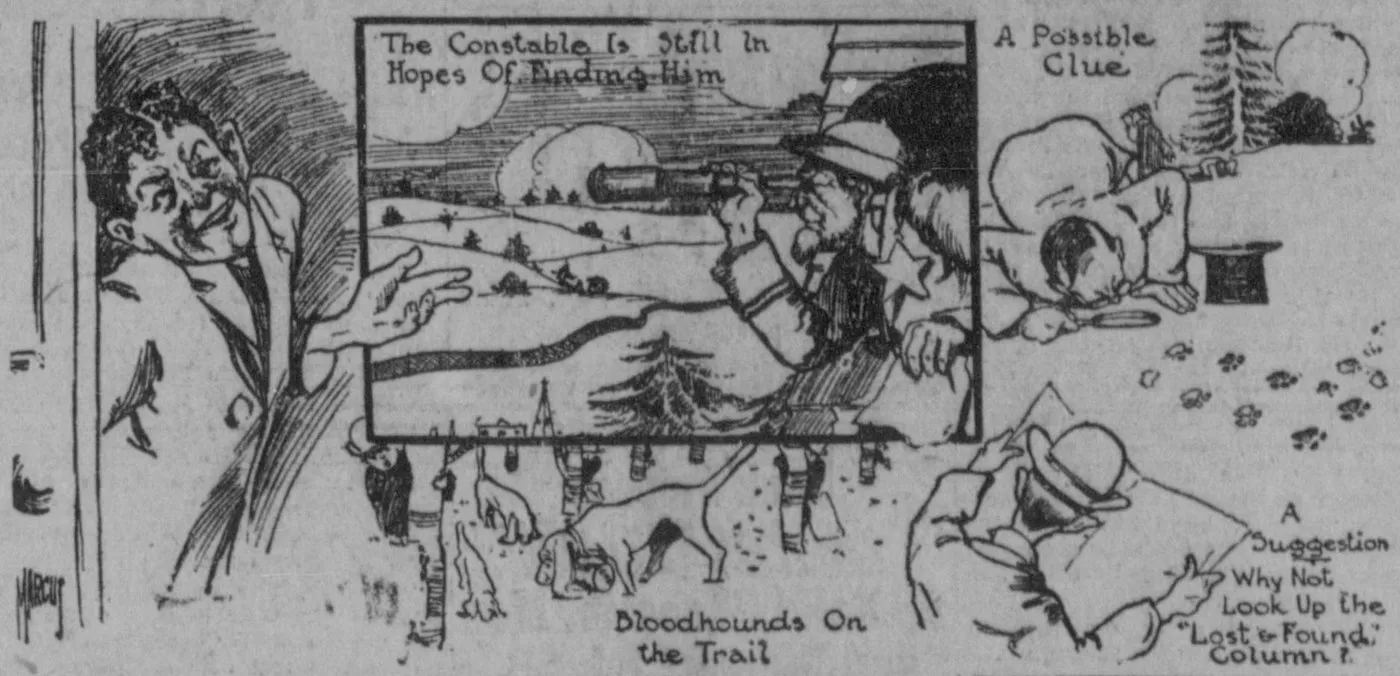
The hunt for the creature, as the Evening Journal drew it under the headline “Hist! Jobberwock here, spits fire!” The creature itself is nowhere in the picture. Cartoon signed “Marcus”, Evening Journal (Wilmington, Del.), 22 January 1909, page 1. Library of Congress, Chronicling America; image from the University of Delaware Library.19
The Journal’s front page told how Policeman Frank Kane, walking along Concord Avenue in Brandywine Village at midnight, saw something like “an open umbrella squeezed against a fence”, wrestled with it and lost it up West Street.19 The same story quotes a visiting “Belgian scientist”, Dr. Mynhaur Beeskobe, who identified the creature as a relic of the “Cos Ingeniorum”, closely related to the “Copia Verborum”, and reports that the paper had sent its office boy after it with a net and a squirt gun.19 Cos ingeniorum is Latin for a whetstone of wits and copia verborum for a flood of words; our reading is that the Journal was writing comedy and expected its readers to know it.19 On 23 January it printed a verse, “It is the ‘Jersey Devil,’ / Alias the ‘Jobberwock,’” and called the stories “supposed to be true, but as far from the truth as the ‘Jobberwock’ is from Wilmington.”1920
That verse is the earliest use of the name “Jersey Devil” we found. Regal writes that the name was not used until after 1909 and cites a Minnesota headline of October; the Wilmington paper had it in January.20 We did not read every paper of that week, so an earlier use may exist.
Some of the week’s copy may have been planted. Regal names Charles A. Bradenburgh, owner of the Ninth and Arch Street Dime Museum in Philadelphia, and his press agent Norman Jeffries. By Regal’s account Jeffries planted Leeds Devil stories in the papers, and the two then put a faked Leeds Devil on show.21 The New York Times of 23 January carried a dispatch from Philadelphia: the press agent of an animal dealer, the man behind the tales of an Australian vampire devil, had announced that the thing was caught on Allegheny Avenue and back in its cage at a museum, and he gave the museum’s name and the price of admission.21 The guide to New Jersey published in 1939 gives another name: J. F. Hope, “a Philadelphian”, who offered a reward of $500 for the devil’s capture and said it was his own, “not a devil at all but a rare Australian vampire”.21 The guide gives no date for the reward, but the Australian vampire turns up in both, so our reading is that the guide and the Times describe the same stunt.
A stork at Estelville
That 1939 guide, written by the Federal Writers’ Project, opens its chapter on folklore with the creature: “By default, the title of official State demon has rested for nearly a century with the Leeds Devil.”22 The guide is joking, and goes on to say he is writing a thesis for a doctorate from the University of Hell.5 Daniel Peretti, a folklorist reviewing Regal and Esposito’s book, notes that writers still call the Devil the official state demon, “though that fact may itself be an urban legend”.22
The guide’s Leeds is a Mrs. Leeds of Estelville, near the Great Egg Harbor River, who wished aloud that the stork would bring a devil. In one version the stork took the baby back and returned with “a red-faced little devil tied up in a napkin”.5 He is “cloven-hoofed, long-tailed, and white; with the head of a collie dog, the face of a horse, the body of a kangaroo, the wings of a bat, and the disposition of a lamb”.5 The chapter says the date of his birth is not known. The same book’s tour along State 50 says he was born at Estelville in 1887.5
| Text | Date | The birth | The creature |
|---|---|---|---|
| “In the Pines”, Atlantic Monthly | May 1859 | Burlington, 1735; the Devil’s son4 | horse’s head, bat’s wings, serpent’s tail4 |
| John Elfreth Watkins, Evening Star, Washington | 2 Sep 1905 | Burlington, 173-; the Devil’s son15 | horse’s head, bat’s wings, dragon’s tail; up the chimney15 |
| Perth Amboy Evening News | 21 Jan 1909 | not told | “Leeds Devil”, known by its hoofprints17 |
| Evening Journal, Wilmington | 22 and 23 Jan 1909 | not told | “air hoss”, “Jobberwock”, “Jersey Devil”18 |
| Federal Writers’ Project guide | 1939 | Estelville, date unknown or 1887; the mother’s wish5 | collie’s head, horse’s face, kangaroo’s body, bat’s wings5 |
| Regal and Esposito’s summary | 2018 | 1735; thirteenth child; the mother’s cry9 | horse-like head, bat-like wings, claws, hooves9 |
Mother Leeds on paper
Regal went looking for the people in the story. No contemporary source he found calls any of Daniel Leeds’s wives “Mother Leeds”, and the records of the period that he searched show no deformed birth in the Burlington region.23 Peretti puts it more briefly: Mother Leeds plays almost no part in Regal and Esposito’s book “because she’s largely a legendary creation”.23
| The story | The record | Verdict |
|---|---|---|
| Born in 1735 | 1735 in 1859; 1887 in 193945 | Disputed |
| The thirteenth child | not in the 1859, 1905 or 1939 texts4155 | Unsupported |
| A real Mother Leeds | no contemporary source uses the name23 | Unsupported |
| A deformed birth behind it | none recorded, Regal found23 | Unsupported |
| Named the Jersey Devil in 1909 | in print by 23 Jan 190920 | Confirmed |
| A museum’s fake devil, 1909 | announced by a press agent, 23 Jan 1909; who ran it, sources differ21 | Confirmed |
Regal’s political animal
Regal, a historian of science at Kean University, sets out his case in a 2015 article, “The Jersey Devil: A Political Animal”, and in the book he wrote with Frank Esposito in 2018.6 The monster, he argues, came from the family’s reputation: Daniel Leeds, called Satan’s harbinger by the Quakers he left, and his son Titan, turned into a ghost by Franklin. Over the next century the memory blurred into a tale about a woman named Leeds and her devil child.6 Peretti, writing as a folklorist, sums up the book’s claim the same way, that the Quakers’ label of “devil” stuck to the family, and notes that it is a history book that pays no attention to how the story was told aloud.6
Our reading is that no document shows the step from the pamphlets to the tale. The 1859 sketch, the first text known to tell it, says nothing about almanacs, Quakers or Franklin, and gives B.’s story no source.46
Sightings after the snow
Reports did not stop in 1909. On 19 December 1929 the New York Times reported from Woodbury Heights that police, dogs and an armed posse were out in the woods after hogs were killed and two schoolchildren told a frightened story, and that the older residents were talking of the Jersey Devil.24 In August 1930 its correspondent in Atlantic City had berry pickers at Leeds Point and Mays Landing saying the devil was back; he always came, the paper noted, when the berries were ripe and the applejack was at its best.24 The 1939 guide adds a posse of farmers with shotguns in the woods around Woodstown, and a man in Woodstown who was looking out of his window just before midnight one evening in 1935 when he saw the devil walking down the sidewalk across the street.24
“Looked to me something like a giant police dog, kind of high in the back,” he said. “He walked past the grocery store and disappeared.”24
What we could not verify
Sources we have not seen
- Norman Jeffries’s obituary of 1933 and the museum’s advertisements of January 1909, which would show what was on display and who ran it. The Philadelphia papers of those years are on Newspapers.com and GenealogyBank, both by subscription, and Chronicling America has no Philadelphia paper for 1909 or 1933.
- The Trenton Evening Times of 20 January 1909, whose cartoons, Regal says, drew the creature as a winged, dragon-like figure with hooves. The paper is on Newspapers.com and GenealogyBank by subscription, not on Chronicling America.
- Barbara Allen Woods’s note “Jersey Devil” (Western Folklore, 1957) and James McCloy and Ray Miller’s The Jersey Devil (1976), where the thirteenth child may first appear. The note opens on JSTOR only after logging in, and the book is in copyright, with the Internet Archive copy lent only to signed-in borrowers.
Seen only where others quote them
- The Trenton Times story of 15 July 1905 that Regal describes, with the birth in 1808 and a Captain Leeds. It is on the same subscription sites as the 1909 paper, and Chronicling America has no Trenton paper for 1905.
- Regal and Esposito’s book of 2018, which we know from Regal’s 2015 article and Peretti’s review. It is in copyright and not open access on Project MUSE.
Resting on a single source
- The kangaroo. A 2019 Philadelphia Inquirer article says Norman Jeffries’s obituary called the museum’s devil “a cleverly disguised kangaroo”; retellings add painted stripes and paper wings.
Questions we could not settle
- When the thirteenth child enters the story. It is in none of the 1859, 1905 or 1939 texts.
Read next
TaleNew Mexico and Texas, 1629 to 1690
The Lady in Blue had no name in 1630
TaleAdams, Robertson County, Tennessee, 1820 to 2017
Andrew Jackson and the Bell Witch: one letter from 1894
CaseVärend, Småland, Sweden, 1883 to 1889
The lindworm reward in Småland was never claimed
Sources
- Daniel Leeds, An Almanack for the Year of Christian Account 1687, facsimile copy, Library of Congress, Printed Ephemera Collection, Portfolio 140, Folder 1, page image 001dr.jpg; title block: "By Daniel Leeds, Student in Agriculture"; imprint: "Printed and Sold by William Bradford, near Philadelphia in Pennsylvania, pro Anno 1687" (primary)
- Charles R. Hildeburn, A Century of Printing: The Issues of the Press in Pennsylvania, 1685-1784, vol. 1 (Philadelphia, 1885), No. 5, pp. 6-7 (NLM OCR, search "Student in Agriculture")
- Brian Regal, "The Jersey Devil: A Political Animal", New Jersey Studies 1, no. 1 (2015): 79-103, p. 88↑
- Leonard W. Labaree, ed., The Papers of Benjamin Franklin, vol. 1 (1959), editorial note to "Extracts from the Gazette, 1729" (Founders Online), note 2
- Kelli Billings, "Almanacs", Encyclopedia of Greater Philadelphia (Rutgers-Camden), essay
- Brian Regal, "The Jersey Devil: A Political Animal", New Jersey Studies 1, no. 1 (2015): 79-103, p. 97↑
- Benjamin Franklin, Poor Richard, 1733 (Founders Online transcription of Papers of Benjamin Franklin vol. 1, from the Rosenbach copy of the first impression), preface, "Courteous Reader" (primary)
- Leonard W. Labaree, ed., The Papers of Benjamin Franklin, vol. 1 (1959), headnote to "Poor Richard, 1733" (Founders Online), headnote
- Brian Regal, "The Jersey Devil: A Political Animal", New Jersey Studies 1, no. 1 (2015): 79-103, pp. 98-99↑
- "In the Pines", The Atlantic Monthly 3, no. 19 (May 1859), p. 567, left column (primary) transcription
- Brian Regal, "The Jersey Devil: A Political Animal", New Jersey Studies 1, no. 1 (2015): 79-103, p. 81
- "In the Pines", The Atlantic Monthly 3 (Jan-Jun 1859), HathiTrust mdp.39015030143294, seq. 581 (p. 567), search result snippet only (primary)↑
- "In the Pines", The Atlantic Monthly 3, no. 19 (May 1859), p. 567 (primary)
- Federal Writers' Project, New Jersey: A Guide to Its Present and Past (New York: Viking Press, 1939), pp. 126-127 (Folklore and Folkways); p. 664 (Tour, Estelville)
- Brian Regal, "The Jersey Devil: A Political Animal", New Jersey Studies 1, no. 1 (2015): 79-103, p. 82↑
- Brian Regal, "The Jersey Devil: A Political Animal", New Jersey Studies 1, no. 1 (2015): 79-103, abstract p. 79; pp. 99-100 (1735 coincides roughly with Titan's death and the almanac war), 102-103; author note p. 103 (Kean University)
- Daniel Peretti, review of Regal and Esposito, The Secret History of the Jersey Devil, Journal of Folklore Research Reviews (2019), whole review↑
- Charles R. Hildeburn, A Century of Printing: The Issues of the Press in Pennsylvania, 1685-1784, vol. 1 (Philadelphia, 1885), No. 6 (An Almanac for 1688), pp. 7-8, quoting the Quarterly Meeting minutes
- Brian Regal, "The Jersey Devil: A Political Animal", New Jersey Studies 1, no. 1 (2015): 79-103, pp. 88-89↑
- Brian Regal, "The Jersey Devil: A Political Animal", New Jersey Studies 1, no. 1 (2015): 79-103, pp. 80-82 and n. 6 (attributes it to W. F. Mayer, pp. 560-569); p. 82: colonial and early republic newspapers show no monster story
- "In the Pines", The Atlantic Monthly 3, no. 19 (May 1859), p. 566, right column, last lines; p. 567 (primary)↑
- Charles R. Hildeburn, A Century of Printing: The Issues of the Press in Pennsylvania, 1685-1784, vol. 1 (Philadelphia, 1885), No. 5, p. 7, biographical note: "the polemical war, which raged from 1696 to 1706"
- Brian Regal, "The Jersey Devil: A Political Animal", New Jersey Studies 1, no. 1 (2015): 79-103, pp. 93-96↑
- Caleb Pusey, Satan's Harbinger Encountered, His False News of a Trumpet Detected (Philadelphia: Reynier Jansen, 1700), title page (the microfilm shows it reversed) and preface, first page; Internet Archive scan of the Early English Books microfilm (primary)
- Brian Regal, "The Jersey Devil: A Political Animal", New Jersey Studies 1, no. 1 (2015): 79-103, pp. 94, 96↑
- Benjamin Franklin, Poor Richard, 1734 (Founders Online transcription, from the Yale copy), preface dated "Octob. 30. 1733" (primary)
- Brian Regal, "The Jersey Devil: A Political Animal", New Jersey Studies 1, no. 1 (2015): 79-103, p. 99↑
- Benjamin Franklin, Poor Richard, 1740 (Founders Online transcription, Papers of Benjamin Franklin vol. 2), preface (primary)
- Brian Regal, "The Jersey Devil: A Political Animal", New Jersey Studies 1, no. 1 (2015): 79-103, p. 99 (cites Poor Richard 1742 for the ghost; see disagreements)
- Kelli Billings, "Almanacs", Encyclopedia of Greater Philadelphia (Rutgers-Camden), essay↑
- "In the Pines", The Atlantic Monthly 3, no. 19 (May 1859), p. 566, both columns (primary)
- Brian Regal, "The Jersey Devil: A Political Animal", New Jersey Studies 1, no. 1 (2015): 79-103, p. 81↑
- John Elfreth Watkins, "Demon of the Pines", Evening Star (Washington, D.C.), 2 September 1905, Part 2, p. 7 (image 23), first column; ALTO OCR read, quoted words checked on the page image (IIIF region 150,1400,1000,3900); the year is printed "173" with a smudged last figure, and the next paragraph speaks of "the 140 years that have since elapsed" (primary)↑
- Perth Amboy Evening News, 21 January 1909, "Burlington Under Arms", p. 3 (primary) transcription
- Brian Regal, "The Jersey Devil: A Political Animal", New Jersey Studies 1, no. 1 (2015): 79-103, p. 83
- Evening Journal (Wilmington, Del.), 23 January 1909, p. 1, "Local Crop of 'Devil Stories'" (primary)↑
- Evening Journal (Wilmington, Del.), 22 January 1909, p. 1, "Creature Attacks Night Officer" (primary)
- Brian Regal, "The Jersey Devil: A Political Animal", New Jersey Studies 1, no. 1 (2015): 79-103, p. 83
- Evening Journal (Wilmington, Del.), 23 January 1909, p. 1, "Local Crop of 'Devil Stories'" (primary)↑
- Evening Journal (Wilmington, Del.), 22 January 1909, p. 1 (primary)
- Evening Journal (Wilmington, Del.), 22 January 1909, p. 1, top centre; IIIF region 1555,965,1875,905 (primary)
- Evening Journal (Wilmington, Del.), 23 January 1909, p. 1 (primary)↑
- Evening Journal (Wilmington, Del.), 23 January 1909, p. 1, verse and first paragraph of "Local Crop of 'Devil Stories'" (primary)
- Brian Regal, "The Jersey Devil: A Political Animal", New Jersey Studies 1, no. 1 (2015): 79-103, pp. 83, 102↑
- Brian Regal, "The Jersey Devil: A Political Animal", New Jersey Studies 1, no. 1 (2015): 79-103, p. 101
- Federal Writers' Project, New Jersey: A Guide to Its Present and Past (New York: Viking Press, 1939), p. 127
- "South Jersey Joke Ended; Press Agent Captures the Myth He Created -- Will Now Take Profits", New York Times, 23 January 1909, p. 12; first two paragraphs only, in the Times's own digitized text on its archive page (rest and page image behind TimesMachine); read 2026-09-25 (primary)↑
- Brian Regal, "The Jersey Devil: A Political Animal", New Jersey Studies 1, no. 1 (2015): 79-103, p. 102, nn. 75-76
- Federal Writers' Project, New Jersey: A Guide to Its Present and Past (New York: Viking Press, 1939), p. 127; p. 664
- "Posse Sets Out as 'Jersey Devil' Reappears; Black and Shaggy This Time, It Kills Hogs", New York Times, 19 December 1929, p. 14; first two paragraphs only, the Times's digitized text (rest behind TimesMachine); read 2026-09-25 (primary)
- "'Jersey Devil' Returns as Applejack Mellows, And Dry Agents Investigate the Coincidence", New York Times, 6 August 1930, p. 4; first two paragraphs only, the Times's digitized text (rest behind TimesMachine); read 2026-09-25 (primary)↑


Documents quoted
- “Burlington Under Arms”, Perth Amboy Evening News, 21 January 1909 (transcribed from the page image)
- “In the Pines”, The Atlantic Monthly, May 1859: Leeds’s devil (transcribed from the page image)