 Twice Told
The Lady in Blue had no name in 1630
In 1630 the Jumano told the friars a young woman had preached to them, dressed like the nun in a portrait. Ágreda's name and the blue came later.
Contents
Published 7 Oct 2026. Sources checked 10 Oct 2026.
When the friars of New Mexico asked the Jumano why they kept begging for baptism, the answer, as Fray Alonso de Benavides printed it in 1630, was a comparison with a painting.1 A woman had preached to each of them in their own language, they said. She was dressed exactly like the woman in the portrait the friars had there, a portrait of Mother Luisa de Carrión, but her face was young and beautiful.17
The Memorial does not say who she was.2 The nun now known as the Lady in Blue, María de Jesús de Ágreda,8 does not appear in that chapter, and neither does the colour blue.2 She enters Benavides’s writing in a letter of 1631, written after he visited her, and in a revised Memorial of 1634.910 Blue appears in the letter, as the colour of her cloak.11
The story, as the Handbook of Texas tells it, goes like this.
In the 1620s a nun in Spain, María de Jesús de Ágreda, fell again and again into deep trances.8 Her alleged bilocations took her to eastern New Mexico and western Texas, where she contacted several peoples, the Jumanos among them.8 In 1629 a Jumano delegation reached New Mexico asking for missionaries and said they had been taught by the Woman in Blue.8 Fray Juan de Salas led an expedition east, where many people reportedly said the same woman had advised them about missionaries.8
Around 1631 Fray Alonso de Benavides interviewed her in Spain.8 She told him of some 500 bilocations and acknowledged that she was the Lady in Blue.8
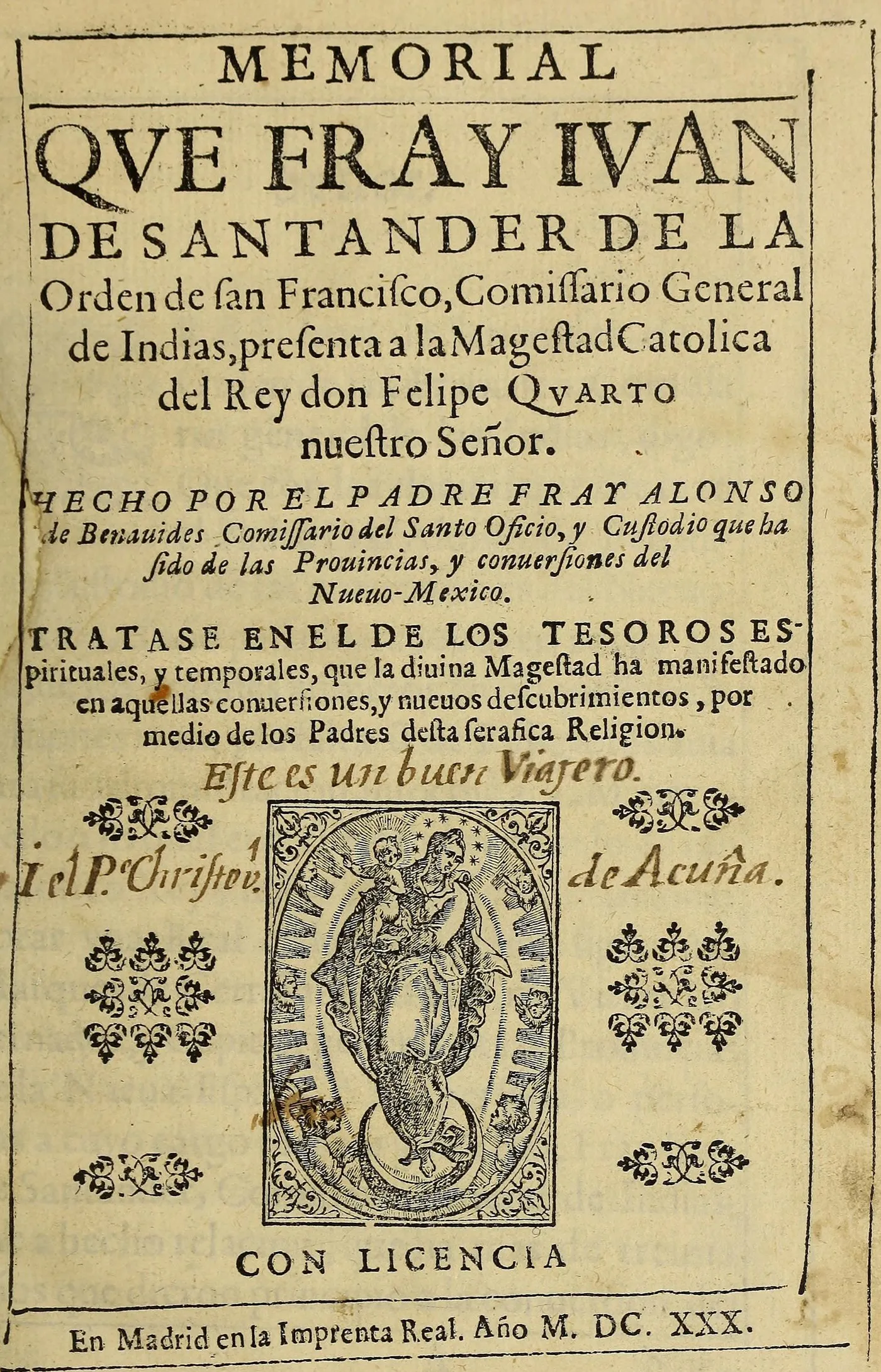
The title page of the Memorial, Madrid, Imprenta Real, 1630. The woodcut is the printer’s vignette of the Virgin and Child; the pen inscriptions are a reader’s. Courtesy of the John Carter Brown Library, BA630 .B456m, CC BY 4.0 (terms), via Americana, cropped.
The portrait in 1630
The Memorial was printed at Madrid by the Imprenta Real in 1630. Benavides, who had been custodian of the New Mexico missions, made it, and it was presented to Philip IV in the name of Fray Juan de Santander, commissary general of the Indies.12
The Jumano chapter opens with Salas. One reaches the Xumana, as Benavides spells the name, by going east from Santa Fe for more than 112 leagues across the Apache Vaquero country.13 Salas worked among the Tompira and Salinero Indians, whose land borders theirs.13 After a war between the two peoples the Xumana took to him, because he had stood up for the Salineros, and they asked him every year to live among them; for lack of friars he put them off.13 Thirty friars arrived in 1629 under Fray Esteban de Perea, and Salas and Fray Diego López were sent at once, with the Xumana as guides.14
Before they left, the Memorial says, the friars asked the Indians why they wanted baptism so badly.1 The answer was the woman, set against the portrait. Indians newly arrived from those nations, it adds, said the same when they looked at the painting.7
y que la muger que les predicaua, estaua vestida, ni mas, ni menos, como la que alli estaua pintada, pero que el rostro no era como aquel, sino que era moça y hermosa7
and the woman who preached to them was dressed exactly like the one painted there, but her face was not like that one: she was young and beautiful
The chapter then turns to the camp. The sorcerers have told the captains the friars will not come, since in six years they have not, and the tents are to be struck.15 At daybreak “the Saint” speaks to each captain and tells him not to go; twelve captains go to see, and meet the friars on the third day.15 They ask to see the portrait of the woman who preached to them.16 The Father shows them one of Mother Luisa de Carrión, and they say she was dressed like that but was more beautiful and young.16
“La Santa” is the only name the visitor gets.2 Luisa de Carrión turns up once more in the Memorial, at Moqui, where a friar carries a cross that had belonged to her.17 A Latin version printed at Salzburg in 1634 tells the Jumano passage the same way, with the portrait and without Ágreda.18 That printing is not the 1634 text below.
In 1630, then, the story is about a painted nun and a young woman dressed like her, and the Memorial leaves the second one unnamed.72
The 1634 text puts a name to her
Benavides’s revised Memorial is dated 12 February 1634 and runs to 58 pages in his own hand.19 It was written at Pope Urban VIII’s request, and the copy the editors used came from the Propaganda Fide archive in Rome.19 We read it in the English edition of 1945.
In it, the thirty friars of 1629 arrive with an account given them by the archbishop of Mexico.10 In Spain, it says, it was common news that a nun named María de Jesús de la Concepción, of Ágreda, was miraculously carried to New Mexico; the archbishop’s order to look into it is dated 18 May 1628.10
The Jumano then answer at the convent, looking at a portrait of Mother Luisa.3 A woman in similar garb wanders among them, always preaching, but her face is young, not old like the portrait’s.3 Asked why they had not said so before, they answer that the friars had not asked.3 The friars never see the nun among the Jumano, but, Benavides writes, they are all convinced she is the María de Jesús of the archbishop’s report.20
He adds that on reaching Spain in 1630 the order’s general, Fray Bernardino de Siena, told him he had looked into the matter eight years before and gave him a permit to visit her at Ágreda.21 She convinced him, he says, by describing New Mexico as he had seen it.21
| Point | 1630 Memorial | 1634 revised Memorial |
|---|---|---|
| Where the inquiry comes from | The friars’ own question1 | The archbishop’s order, May 162810 |
| When the Jumano answer | Before Salas and López leave1 | At the convent, at the portrait3 |
| The visitor’s face | Young and beautiful7 | Young, not old like the portrait’s3 |
| Captains ask to see the portrait | On the road, third day1516 | No such scene22 |
| Nun named | Luisa de Carrión only2 | María de Jesús of Ágreda10 |
| Colour of her clothes | None4 | None4 |
The two texts can only be set against each other. Neither can be checked against a third account of the same meeting.
What Ágreda told Benavides
In his letter of 1631 to the New Mexico friars, Benavides gives the nun a blue cloak.11 He reached Ágreda on the last day of April 1631,9 and his description of the abbess is plain and physical.
el manto es de sayal azul, grueso, y velo negro11
The cloak is of thick blue sackcloth, and the veil black.
Under it, he says, the habit was grey-brown sackcloth with white over it.11 She told him her first journey to New Mexico was in 1620 and that the visits went on until 1631, sometimes three or four in under a day.23 She described the journeys of Salas and López among the Jumanas, he reports, and said she had urged the Indians to call the friars.24 Asked why she showed herself to the Indians and not to the friars, she answered that they needed it and the friars did not.25
Benavides copied into the letter an account signed “Sor María de Jesús”, at Ágreda on 15 May 1631. In it she says angels carried her to New Mexico, Quivira and the Jumanas, that these were not the first kingdoms where she was taken, and that it happened from 1620 to 1631.26
That account is the only statement of hers about the journeys that we read. The letter itself first reached print at Mexico in 1730, from the original kept in the archive of the New Mexico custody.27 In September 1649 the Inquisition ordered her examined, and it suspended its case by a decree of 1650.28 Francisco Silvela, who edited her letters to Philip IV in 1885, prints one of her answers at length.28 It concerns whether she had seen God, and he quotes nothing in it about New Mexico.28
Where the blue comes from
None of the four texts we read from these years, the Memorial, the letter, the 1634 text and Manzanet’s letter below, calls the visitor the Lady in Blue.6
A blue woman appears in 1690, among the Tejas, in a letter by Damián Manzanet.5 The governor asked him one evening for a piece of blue baize to bury his mother in.5 He said the people were fond of blue, particularly for burial clothes, because in times past they had often been visited by a very beautiful woman dressed in blue who came down from the heights, and that his mother, who was aged, had seen her.5 Manzanet concluded that they meant Madre María de Jesús de Ágreda.5
Father Casañas, writing in 1691 at the Nabedache village, gave another reason. According to Bolton, he said the Indians prize woollen cloth, “especially if it is blue”, only because the sky is that colour, and Bolton thinks he meant to answer Manzanet’s opinion.29 The 1945 editors set the governor’s request beside Benavides’s description of the abbess: a grey habit, under a cloak of heavy blue sackcloth.30
The Handbook of Texas has the Jumano of 1629 call her the Woman in Blue.8 We found no such phrase in any text from 1630 to 1690.6 Bolton, in 1912, wrote that the Jumanos told “the story, now a classic in the lore of the Southwest”, of a beautiful woman in a nun’s garb, later identified as Ágreda.31
Who the Jumano were
“Jumano” is a Spanish name that covered more than one people. The Handbook of Texas says that between 1500 and 1700 it referred to at least three distinct peoples.32 Scholes, quoted by the 1945 editors, says it was used as a general term for Indians who used a form of body decoration.32 The Memorial places the Xumana by a direction and a distance from Santa Fe.13
The 1916 edition of the Memorial notes that the portrait of Luisa de Carrión was kept by Fray García de San Francisco, who founded the Socorro mission, according to Vetancurt, and that the young and beautiful nun “was afterward asserted to be” María de Jesús.33
What we could not verify
Sources we have not seen
- Clark Colahan, The Visions of Sor María de Agreda (1994), which prints Benavides’s 1634 report and letter, and Anna Nogar, Quill and Cross in the Borderlands (2018), whose chapter 5 follows the Lady in Blue through the folklore of the Southwest. They would show how scholars read the 1630 and 1634 texts against each other. Colahan’s archive.org copy is access-restricted with no text, and Nogar’s book is not open access on Project MUSE.
- The Spanish text of the revised Memorial of 1634, kept in the Propaganda Fide archive in Rome. We read only the English translation of 1945, still in copyright, so every quotation from it above is a phrase.
- Ágreda’s own deposition to the Inquisition in 1649 and 1650. The case file is described in Silvela’s introduction as held among the papers of the house of Valoria; we found no readable edition, and the one answer Silvela prints says nothing of New Mexico.
Seen only where others quote them
- Vetancurt’s Crónica (1697), known only through the 1916 and 1945 editors’ notes. It would settle who kept the portrait of Luisa de Carrión and what the friars said of it; we found no usable scan.
- Father Casañas’s report of 15 August 1691, known only through Bolton.
Questions we could not settle
- Whether the Jumano themselves ever said she wore blue. Everything we read gives their words through Benavides.
- When “Lady in Blue” first appears in print. The earliest use we found is in the Handbook of Texas entry, first published in 1952 and last revised in 2021; we could not tell which version first used it.
Read next
TaleAdams, Robertson County, Tennessee, 1820 to 2017
Andrew Jackson and the Bell Witch: one letter from 1894
TalePine Barrens, New Jersey, 1687 to 1939
The Jersey Devil was first called Leeds’s devil
TaleMiyoshi, Hiroshima, Japan, 1749 to 1859
The Inō mononoke roku: where the demon king's mallet came from
Sources
- Memorial 1630, same chapter, sig. L2 verso (images 86-87) (primary) transcription↑
- Memorial 1630, the whole chapter read on the page images (images 85-88); a search of the book's OCR text for Agreda, Aireda, monja, azul and arzobispo returns nothing (primary)
- Ayer 1916, pp. 57-60, the same chapter in Ayer's English ("the Saint", "the Mother Luisa de Carrion"; no other nun named); read in OCR text (primary)↑
- Hodge 1945, p. 94, chapter L (English translation) (primary)↑
- Hodge 1945, pp. 93-95, chapter L, read in full in English (primary)
- Memorial 1630, images 85-88, read on the page images (primary)↑
- Memorial 1630, whole book searched in OCR for azul and read in the Jumano chapter; no hit for azul (primary)
- Tanto 1730, the whole pamphlet read in OCR and the blue passage on the page image; blue appears only in the abbess's cloak, p. 3 (primary)
- Hodge 1945, chapter L (pp. 93-96) and Appendix XI (pp. 136-146) read in full; blue appears only in the abbess's cloak, p. 138 (primary)
- Manzanet, pp. 311-312: "a very beautiful woman ... dressed in blue garments"; the phrase "Lady in Blue" is not used (primary)↑
- Memorial 1630, same chapter, images 86-87 (end of sig. L2 verso, start of the next leaf) (primary) transcription↑
- Chipman (Handbook of Texas), the entry's paragraphs on the 1620s trances, the 1629 Jumano delegation and the Benavides interview (page read on 2026-10-10 through a text extractor that returns only short quotes; no exact paragraph numbers)↑
- Tanto 1730, p. 3 (image 15), left column: "llegué à Agreda vltimo dia de Abril de 1631" (primary) transcription
- Hodge 1945, p. 138, Appendix XI-A, Benavides's letter to the New Mexico friars, English translation (primary)↑
- Hodge 1945, pp. 93-94, chapter L "Miraculous conversion of the Xumana nation" (English translation) (primary)↑
- Tanto 1730, p. 3 (image 15), left column, "el manto es de sayal azul, grueso, y velo negro" (primary) transcription
- Hodge 1945, p. 138, Appendix XI-A: "Their cloak is of heavy blue sackcloth. They wear a black veil." (primary)↑
- Memorial 1630, title page (image 7) (primary)
- John Carter Brown Library, catalogue record (Americana), record fields Creator, Contributors, Publisher, Date; call number BA630 .B456m, accession 0725; saved as site/src/images/lady-in-blue-jumano/licenses/americana-record-jcbcap-991008804419706966.txt↑
- Memorial 1630, chapter "Conuersion milagrosa de la nacion Xumana", first paragraph, sig. L2 recto and verso (images 85-86) (primary) transcription↑
- Memorial 1630, same chapter, first paragraph, sig. L2 verso (image 86) (primary) transcription↑
- Memorial 1630, same chapter, images 87-88 (the "Viendo el demonio" paragraph) (primary) transcription↑
- Memorial 1630, same chapter, image 88 (top of the leaf) (primary) transcription↑
- Memorial 1630, Moqui section, image 42 (the page begins "Moqui, de la misma cantidad que la antecedente Zuñi") (primary)↑
- Relatio 1634 (Salzburg), chapter "Miraculosa conversio Nationis Xumana", about pp. 118-134 as the OCR numbers them (the running numbers are garbled); OCR text only, we did not read the page images (primary)↑
- Hodge 1945, pp. 31-32, "The Revised Memorial of 1634", quoting O'Hara in the Catholic Historical Review↑
- Hodge 1945, p. 95, chapter L (English translation) (primary)↑
- Hodge 1945, p. 95, chapter L (English translation) (primary)↑
- Hodge 1945, p. 94, chapter L, read in full (English translation) (primary)↑
- Tanto 1730, p. 3 (image 15), right column, "la primera vez que ha ido, fuè el año de 1620" (primary)
- Hodge 1945, p. 140, Appendix XI-A (primary)↑
- Tanto 1730, p. 4 (image 16), left column, "las jornadas de los Jumanas; y que los solicitó, è industrió todo este tiempo, para que fueran à llamarlos" (primary)
- Hodge 1945, p. 141, Appendix XI-A (primary)↑
- Tanto 1730, p. 4 (image 16), right column, "que ellos tenian necesidad, y nosotros no" (primary)
- Hodge 1945, p. 141, Appendix XI-A (primary)↑
- Hodge 1945, pp. 143-146, Appendix XI-B "Copy of the account which the blessed mother María de Jesús writes to the said friars", signature p. 146 (primary)↑
- Hodge 1945, pp. 8-9, bibliography of the "Tanto que se sacó", citing the printer's dedication and listing a 1631 manuscript copy in the National Library of Mexico
- Tanto 1730, dedication to the royal treasury officials, image 11 (sig. A2): "en el Archivo de aquella Custodia existe el original"; colophon "Año de 17:30" on the last page (OCR); the pamphlet is a first printing only per Hodge, so this row shows the 1730 printing and the archived original, not that nothing earlier existed (primary)↑
- Silvela (1885), vol. I, "Bosquejo histórico", p. 146 (80 questions, suspended 1650) and pp. 231-234 (1635 start, six witnesses, the printed answer); read in OCR text only↑
- Bolton 1912, p. 9 (Portal image 15), text and footnote citing Casañas, Relación, 15 August 1691, manuscript; Casañas not seen↑
- Hodge 1945, note 136, pp. 316-318↑
- Bolton 1912, p. 8 (Portal image 14)↑
- Hickerson (Handbook of Texas), whole entry, opening sections ("Jumano problem")
- Hodge 1945, pp. 264-265, editorial note quoting a letter from France V. Scholes↑
Documents quoted
- Benavides, Memorial (Madrid, 1630): the miraculous conversion of the Xumana nation (transcribed from the page image)
- Benavides's letter to the New Mexico friars, 1631: the abbess's habit (Mexico reprint, 1730) (transcribed from the page image)