 Twice Told
Andrew Jackson and the Bell Witch: one letter from 1894
A 2008 federal listing says Andrew Jackson visited the Bell Witch Cave in 1819. The 1894 book behind the story sets his visit on a road and in a farmhouse.
Contents
Published 24 Sept 2026. Updated 25 Sept 2026. Sources checked 24 Sept 2026.
“By the eternal, boys, this is better than fighting the British! I never had so much fun in my life.” That is Andrew Jackson at the Bell Witch Cave in 1819, as the cave’s listing in the National Register of Historic Places quotes him from a New Orleans paper of 1894.67 The listing calls his visit a “well documented legend”.6 The footnote to that sentence is an email from the director of preservation at the Hermitage, Jackson’s home.6
The Tennessee Encyclopedia tells the visit plainly. In William T. Turner’s entry, visitors “including Andrew Jackson” came to the Bell home, and a visitor to Adams can still see “traces of the lane down which General Jackson rode”.8 The state library’s online exhibit is more careful and begins the same episode with “Legend has it”.8
Both lines lead back to one book, and the book says something else.
This is the story as the Tennessee Encyclopedia tells it today, in William T. Turner’s entry of 2017.
John and Lucy Williams Bell came to Middle Tennessee from North Carolina in 1804 and farmed on the Red River.8 Around 1816 strange things began at the house: apparitions, then noises that grew for a year or more until the house shook.8 John Bell fell ill with painful symptoms. Others in the family were slapped and pinched, but the spirit was kind to his wife.8
The spirit came to be called Kate. It pulled the covers off sleepers, pestered the enslaved people on the farm, and kept young Betsy Bell from marrying her sweetheart. When it began to speak, it recited prayers, mimicked the neighbours and argued Scripture, and it sang along at prayer meetings.8 Friends came to help, and so did Andrew Jackson.8
John Bell died on 20 December 1820, and the spirit said it had given him a poisonous liquid. The next spring it left, promising to come back in seven years, and it did.8
That is where the encyclopedia’s telling ends.
What each telling added
The texts below run from newest to oldest, which is the order this page follows.
| Text | Date | What it has |
|---|---|---|
| Turner, Tennessee Encyclopedia | 2017 | Jackson on “the lane”8 |
| National Register nomination | 2007 | Jackson in the cave, 18196 |
| Charles Bailey Bell, The Bell Witch | 1934 | a descendant’s version, close to Ingram9 |
| Hudson and McCarter, Journal of American Folklore | 1934 | a Mississippi telling; Jackson at the gate10 |
| Ingram, Authenticated History | 1894 | Kate, Kate Batts, Jackson, 20 December 182011112 |
| Goodspeed, History of Tennessee | 1886 | one paragraph, no names but John Bell13 |
| Robertson County sketch | about 1880 | skulls, gold, poison, death in 1822414 |
| “The Tennessee Ghost”, from the Saturday Evening Post | 1856 | Betsey, Joshua Gardner, ventriloquism15 |
| Captain John R. Bell, journal | 1820 | an unnamed girl and a voice16 |
A cave in the National Register
Claudette Stager of the Tennessee Historical Commission wrote the nomination in December 2007, and the cave was listed on 21 March 2008.6 It sits about half a mile from Adams, near the Red River, on land that was once the Bell farm.17 The state library’s exhibit says it “played a relatively minor role in the original Bell Witch legend”.17 In the older texts it has no part at all.18 We searched the machine-read text of Ingram’s book for a cave and found none, and neither the Robertson County sketch of about 1880 nor Goodspeed’s county history of 1886 puts a cave at the Bells’.18 The one cave story in Goodspeed’s chapter on Robertson County belongs to Elisha Cheek’s land near the Sumner County line, and Goodspeed tells it in the paragraph just before the Bells.18
The Bell sites were selling as pictures long before the listing. The nomination reports postcards from 1908 and 1909 showing the cave, a waterfall, the Bell house and the graves, and the state library holds two cards copyrighted in 1909 by S. E. Guthrie, one of a well and one of a graveyard.19 The 1880 sketch says the Bells’ well was filled up after Mrs. Bell died; the card does not say which well it shows.1419
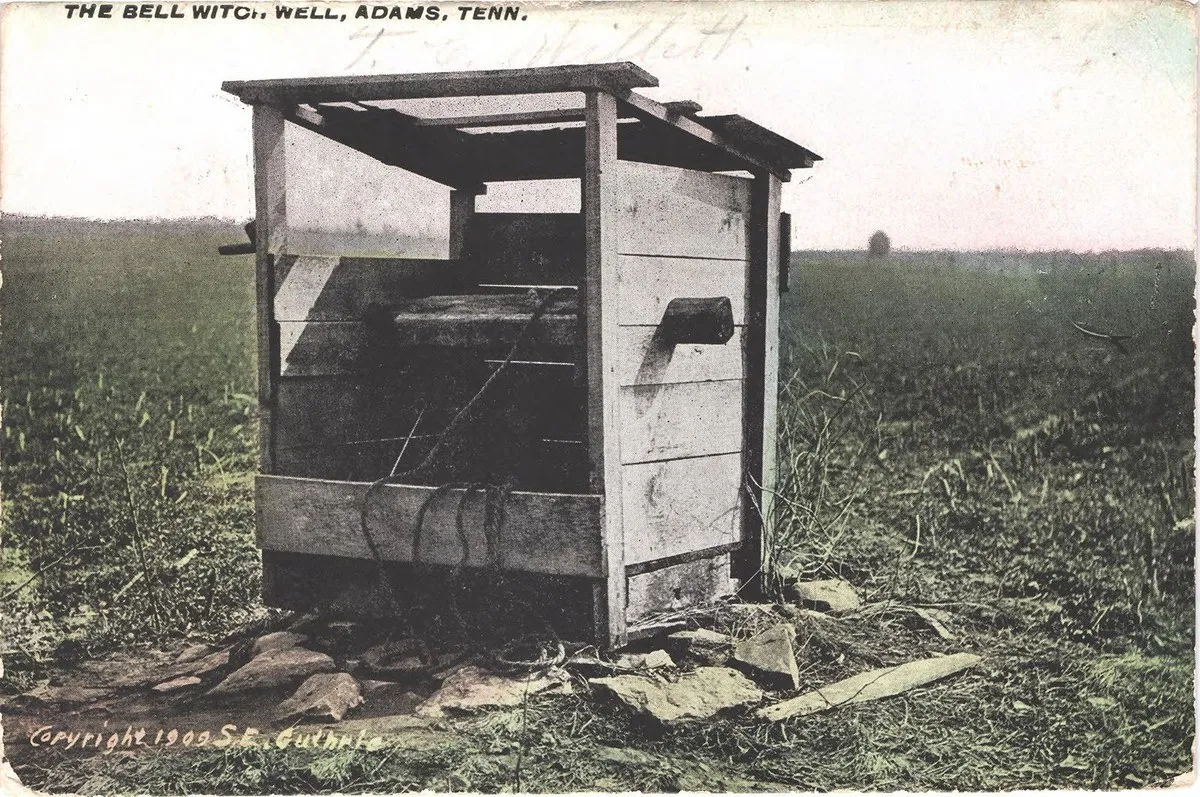
“The Bell Witch well, Adams, Tenn.”, postcard, 1909, S. E. Guthrie. Tennessee Postcard Collection, ID# 48414. Courtesy Tennessee State Library & Archives.19
The nomination credits its Jackson quote, the one at the top of this page, to a New Orleans paper of July 1894.7 A second line, credited to Harriet Parks Miller’s book and a 2006 rack card for the cave, has Jackson say he would rather fight the whole British army again than face the witch.7 Ingram’s own text has him call the witch “worse than fighting the British” on one page and, two pages later, say “I never saw so much fun in all my life. This beats fighting the British.”7
After Ingram
Two early readers treated the witch itself as a matter of belief. In 1900 the editor of the Tennessee Historical Society’s magazine called the Bell Witch a “remarkable hallucination” that had “not found a place in the annals of the State”.20 In 1919 the folklorist Tom Peete Cross summarised the book in Studies in Philology and set it beside a long run of English and American houses troubled by unseen agents and blamed on witchcraft.20
In 1934 Charles Bailey Bell, a Nashville educator descended from John Bell, published his own account, drawn from the memories of his father and grandfather.9 The Tennessee State Library and Archives, in its exhibit, judges his book and Ingram’s “essentially the same narrative differing only in detail and style”, and calls the earlier sources “dubious at best”.209 We have not read Bell’s book.
The same year the folklorists Arthur Palmer Hudson and Pete Kyle McCarter printed a version they had collected from oral tradition in northern Mississippi, where descendants of the family lived. In it the Bells settle near the Hermitage, and “old Andy Jackson”, already retired from the presidency, rides over to scoff and has his hat knocked off down the road.10 Their notes quote a letter from Donald Davidson of Vanderbilt, who taught near Springfield from 1910 and heard there that “General Jackson himself visited the Bell witch”.10
Colonel Yancey’s letter
Ingram’s chapter on Jackson is someone else’s letter, dated Clarksville, 1 January 1894, from Colonel Thomas L. Yancey, a Clarksville lawyer born four miles from the Bell home, who wrote down what older people had told him.1 “Grandfather Fort also told me the story of Gen. Jackson’s visit to the witch,” he writes, meaning his grandfather Whitmel Fort.1
In Yancey’s telling, Jackson’s party rode up from Nashville behind a wagon loaded with a tent and provisions. Near the house the wagon stuck fast on level road until a voice from the bushes let it go.1 The party then took quarters in the Bell house, with a “witch layer” who carried a horse pistol loaded with a silver bullet; the witch beat him and he ran off up the lane.1 Jackson, Yancey writes, “they say”, rolled on the ground laughing. The party spent the next night in Springfield and went home.71
The letter gives no year. It has a road, a lane and a house, and no cave.1 We read four texts about the Bells printed or written before 1894, and none of them mentions Jackson.2 Jackson’s own papers are no help either. We searched the fourth volume of The Papers of Andrew Jackson (1994), which prints or lists all but the most routine of his papers from 1816 to 1820; its chronology, its list of documents and its index name no John Bell, no Robertson County and no Springfield.21
A diary known from one book
Ingram’s book is titled An Authenticated History of the Famous Bell Witch, “copyrighted, 1894”.22 In the Harvard copy a printed slip reading “Setliff & Co., Nashville, Tenn.” is pasted over a line of the imprint, above “Wm. P. Titus, Agt., Printer and Binder”.22 Cross, whose copy had the same slip, gives the imprint as Clarksville, and so does the magazine’s editor in 1900.22
The book’s claim to authority is a manuscript. Ingram writes that Williams Bell, one of John Bell’s sons, “was the only one who kept a diary of what transpired, which he put in shape in 1846”.5 A letter from his son, J. A. Bell of Adairville, Kentucky, dated 1 July 1891, says his father wrote it “during the Fall and Winter of 1846” and wanted it kept back while any of John Bell’s immediate family lived.5 Ingram had asked for it in about 1867 and been refused.5 He prints it as the chapter “Our Family Trouble”.5 We found no other copy of that manuscript.
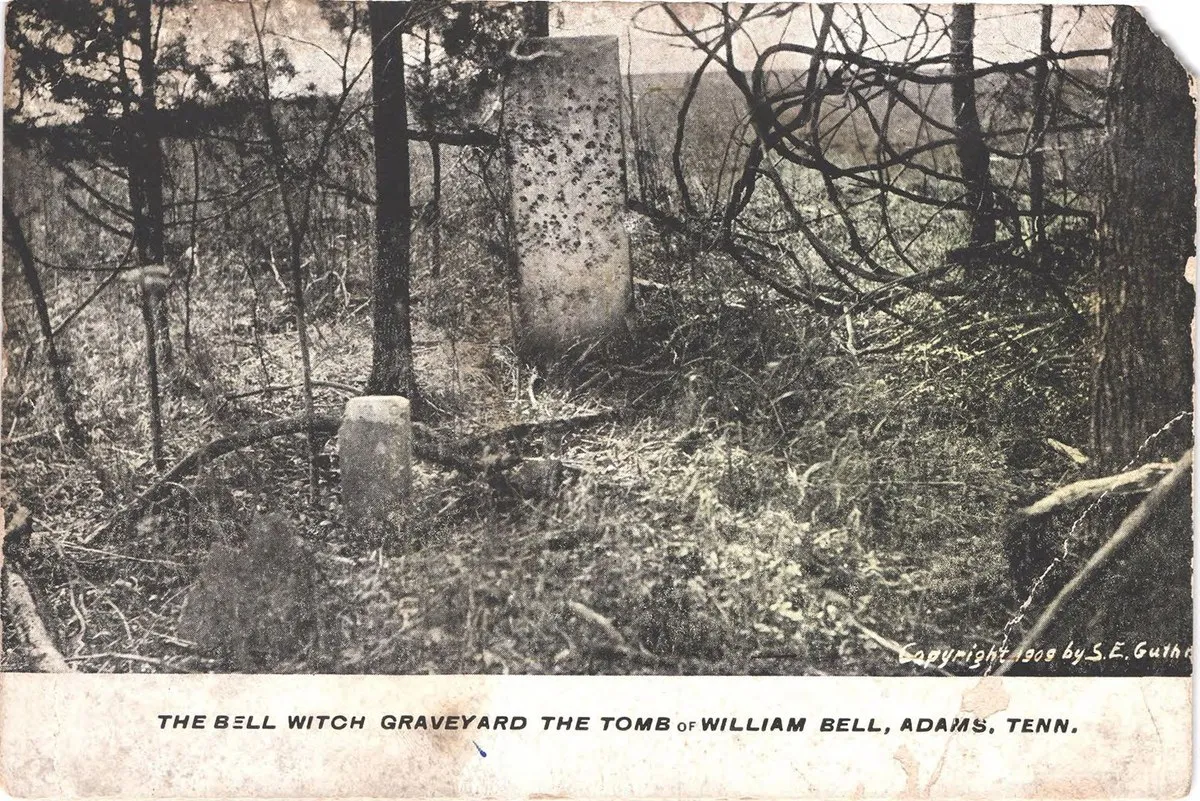
“The Bell Witch graveyard, the tomb of William Bell, Adams, Tenn.”, postcard, 1909, S. E. Guthrie. Tennessee Postcard Collection, ID# 48408. Courtesy Tennessee State Library & Archives.19
Ingram also says why it was written. Someone, he says, had spread a suspicion that young Betsy, “actuated by her brothers, John and Drewry”, was behind the demonstrations and meant to make money from them, and Williams Bell wrote to answer it.23 Ingram adds that a Saturday Evening Post sketch “about 1849” tried to connect Betsy with the demonstrations, that she hired a lawyer, and that the paper retracted.24 A nephew of Joshua Gardner, W. H. Gardner, wrote to Ingram that his uncle had kept a copy of “the Philadelphia Saturday Evening Post of 1849” until it was lost.24
In “Our Family Trouble” the witch names itself to the preacher James Gunn as “Old Kate Batts’ witch”, and from then on it is Kate; Kate Batts, the wife of Frederick Batts, was a real neighbour, and the book says of her, “No harm could be said of Mrs. Batts.”11 A vial turns up in the cupboard, the witch boasts that it dosed “Old Jack”, a cat given the liquid dies, and John Bell dies “on the morning of December 20th, 1820”.12
Goodspeed’s paragraph
Eight years before Ingram, Goodspeed’s History of Tennessee gave the Bells one paragraph. John Bell “settled near what is now Adams Station about 1804”, and people came “from hundreds of miles around” to hear a spirit with “the voice and attributes of a woman”.1325 It shook hands, took sugar from the bowls, spilled the milk, pulled off the quilts and slapped the children.13 Goodspeed names nobody else, gives no year for the disturbances, and declines to explain it: “It is merely introduced as an example of superstition”.13
The paragraph closes with “A volume might be written”, nearly the last words of an older sketch of the county.13
Box R2, No. 142
In 1880 Nashville held a Centennial Exposition and asked every county for a written history. The Robertson County sketch, whose author is unknown, went into the Tennessee Historical Society’s archives as Box R2, No. 142, and was printed in 1900 for the sake of its section on the Bell Witch.26 The whole section is transcribed here.
It is a different story. The trouble begins in 1818, and John Bell dies in 1822, his wife in 1825.43 The spirit first says it wants back some skull bones taken “from a mound near by on the river bluff”; when they are reburied it returns to talk about hidden gold.14 It slaps “a twelve year old girl, a daughter of Mr. Bell”, who is not named.27 It calls itself “Three Waters,” “Tynaperty,” and “Black Dog”, one of seven spirits.14 Ingram’s version has a spirit hunting a lost tooth, a buried treasure, and a witch family that includes a Blackdog.14
The poison is here too, in another form:
At one time a vial of poison was found in the flue of the chimney, and being taken down, Dr. George B. Hopson gave one drop to a cat, causing its death in seven seconds.4
The sketch says Mr. Bell died a number of days later, and the number is left blank in print.4 It names no Kate, no Kate Batts, no Joshua Gardner and no Jackson.214 Its sources are four named men, F. R. Miles, William Pride, W. J. Gooch and Ben. B. Batts, “and many others”.14
Betsey the ventriloquist
The oldest printed account we found names the girl and gives the other explanation. In January 1856 the New England Farmer of Boston reprinted a letter from the Saturday Evening Post under the heading “The Tennessee Ghost”, and the Green Mountain Freeman of Vermont ran it again on 7 February.15 The writer, reminded by a notice of London’s “Cocklane Ghost”, recalls a voice at the house of “an old Mr. Bell” in Robertson County “some thirty years ago, or upwards”.15 Asked how long it would stay, the voice answered:
“Until Joshua Gardner and Betsey Bell get married.”15
Then the writer’s verdict: “It turned out that Miss Betsey Bell was a ventriloquist”, in love with Gardner and hoping the voice would bring about the marriage.23 Gardner and Betsey “never married”, he adds, and the ghost “vanished into thin air”.28 He does not say how he knew, beyond having later become “well acquainted” with Gardner.15 The letter is transcribed in full.
Ingram’s book agrees on the lovers. In it, Betsy broke with Gardner in 1821 and later married her old schoolteacher, Richard Powell.28 Whether the Post letter of 1856 is the article Ingram and W. H. Gardner remembered as “about 1849”, we could not settle.24
Dinner at Murphey’s
On Thursday 19 October 1820 Captain John R. Bell, the official journalist of Stephen Long’s expedition to the Rocky Mountains, riding east toward Washington, crossed the Red River at Port Royal, passed Turnersville, and stopped to eat at a plantation he calls Murpheys.16 His entry for the day reads:
Rather a singular circumstance was here related to me, of a young girl of about 15 years of age, residing but 3 miles from Murphey, a voice accompanies her, which says she should marry a man a neighbor16
Thousands of people had come to hear it, he was told, and many thought it was “ventrelequism imposed upon the hearers either by the girl or her brother”.23 The journal lay unpublished until 1957, when Harlin Fuller and LeRoy Hafen printed it from the manuscript then at Stanford.16 The entry is transcribed here.
The entry names no family.16 The girl fits: Ingram gives Betsy Bell’s birth year as 1805, which would make her fifteen that autumn, and the older sketch has a twelve-year-old daughter as the witch’s target.27 That match is our reading. The entry has a girl, a voice, a wished-for marriage and a crowd of visitors. It has no witch, no dying father and no poison, and it was written two months before the day Ingram gives for John Bell’s death.1216 Captain Bell closed the story with “her family is respectable”, finished his dinner, and rode ten miles on to Simms.16
What we could not verify
Sources we have not seen
- John Bell’s will, estate papers and grave would settle whether he died in 1820 or 1822. The county court minutes for 1820 to 1822 and its wills and estate settlements for 1819 to 1821 are at the Tennessee State Library and Archives, on microfilm and in typed copies from the 1930s, and the only scans we found need a FamilySearch account.
- The Nashville Banner of 3 November 1893 and the New Orleans Daily Picayune of 26 July 1894 would show whether Jackson’s “better than fighting the British” comes from the Picayune, and what was announced before Ingram’s book came out. Both papers are online in paid archives, and Chronicling America has no pages of the Picayune.
- John Kendall’s recollection in the Nashville American of 4 August 1899, said to be an old man’s memory of visiting the Bells as a boy, would add a witness from the time. The one scan we found needs a FamilySearch account, and Chronicling America has no pages of the Nashville American.
Seen only where others quote them
- Richard Williams Bell’s manuscript of 1846, “Our Family Trouble”, would show what Ingram changed when he printed it. It survives only in Ingram’s book and the letters he prints, and no catalogue we searched lists the manuscript.
- Harriet Parks Miller’s articles (1924) and book, and Charles Bailey Bell’s The Bell Witch (1934), which the nomination credits for one version of Jackson’s words. We know them through the nomination and the state library: HathiTrust holds only a 1972 reprint of both and does not show it, and the Internet Archive has neither.
Questions we could not settle
- The exact wording of the 1856 letter. The two reprints differ in small ways: in Boston the ghost “vanished into thin air”, in Vermont “into air”.
- Whether the Post printed an earlier piece about the Bells in 1849, as Ingram and W. H. Gardner say.
- Who kept the plantation Captain Bell called Murpheys.
Read next
TaleNew Mexico and Texas, 1629 to 1690
The Lady in Blue had no name in 1630
TalePine Barrens, New Jersey, 1687 to 1939
The Jersey Devil was first called Leeds’s devil
TaleMiyoshi, Hiroshima, Japan, 1749 to 1859
The Inō mononoke roku: where the demon king's mallet came from
Sources
- Ingram (1894), pp. 229 to 235 (leaves n258 to n264) (primary)
- TSLA, "Tennessee Myths and Legends", Bell Witch, section "Andrew Jackson"↑
- The Journal of Captain John R. Bell, ed. Fuller and Hafen (1957), pp. 314 to 315 (primary) transcription
- "The Tennessee Ghost", New England Farmer (Boston), 26 Jan 1856, from the Saturday Evening Post, p. 4 (primary) transcription
- Anonymous sketch of Robertson County (about 1880), printed in The American Historical Magazine 5 (1900), pp. 319 to 322 (primary) transcription
- Goodspeed, History of Tennessee ... Montgomery, Robertson ... Counties (Nashville: Goodspeed, 1886), p. 833
- "The Tennessee Ghost", Green Mountain Freeman, 7 Feb 1856, credited to the Saturday Evening Post, p. 1, cols. 6 to 7 (page image checked) (primary)↑
- Turner, "Bell Witch", Tennessee Encyclopedia, para. 2
- Ingram (1894), p. 25 (primary)
- Robertson County sketch (about 1880), p. 319 (primary)
- Editor's introduction, American Historical Magazine 5 (1900), p. 310↑
- Robertson County sketch (about 1880), pp. 319 to 320 (primary)
- Ingram (1894), pp. 25, 181 to 182 (primary)↑
- Ingram (1894), pp. 10 to 14 (primary)
- Cross (1919), pp. 237 to 238↑
- National Register of Historic Places, Bell Witch Cave nomination, NRIS 08000237, Section 8, p. 4 and note 10; Section 11 (preparer); supplementary listing record ("Date Listed: 3/21/08")
- National Park Service, NPGallery asset record 08000237, record metadata
- Tennessee State Library and Archives, "Tennessee Myths and Legends" online exhibit, Bell Witch page, section "The Bell Witch Cave"↑
- NRHP nomination, Bell Witch Cave, Section 8, p. 4, notes 11 and 12
- M. V. Ingram, An Authenticated History of the Famous Bell Witch (1894), Harvard copy, Internet Archive microfilm, pp. 233, 235 (leaves n262, n264) (primary)↑
- William T. Turner, "Bell Witch", Tennessee Encyclopedia (Tennessee Historical Society; posted 8 Oct 2017, updated 1 Mar 2018), whole entry
- TSLA, "Tennessee Myths and Legends", Bell Witch, sections "Andrew Jackson", "Death of John Bell", "Modern Myth Persists"↑
- NRHP nomination, Bell Witch Cave, Section 8, p. 7
- TSLA, "Tennessee Myths and Legends", Bell Witch, introduction↑
- Hudson and McCarter, Journal of American Folklore 47 (1934), pp. 45 to 46 (n. 2), 46 to 48↑
- Ingram (1894), pp. 130 to 131 (primary)
- Cross (1919), p. 240
- TSLA, "Tennessee Myths and Legends", Bell Witch, section "Kate Batts"↑
- Ingram (1894), pp. 181 to 182 (primary)
- TSLA, "Tennessee Myths and Legends", Bell Witch, section "Death of John Bell"↑
- Goodspeed (1886), p. 833
- NRHP nomination, Bell Witch Cave, Section 8, pp. 4 to 5
- Robertson County sketch (about 1880), p. 322 (primary)↑
- Robertson County sketch (about 1880), pp. 319 to 322 (primary)
- Ingram (1894), contents (chapter VIII headings); pp. 130, 236 (primary)↑
- "The Tennessee Ghost", New England Farmer, 26 Jan 1856, p. 4 (primary) transcription
- Ingram (1894), p. 218 (primary)
- "The Tennessee Ghost", Green Mountain Freeman, 7 Feb 1856, p. 1, cols. 6 to 7 (page image checked) (primary)↑
- Journal of Captain John R. Bell (1957), pp. 314 to 315 (primary)
- Harlin M. Fuller and LeRoy R. Hafen, introduction to The Journal of Captain John R. Bell (1957), pp. 18 to 19, 25↑
- NRHP nomination, Bell Witch Cave, Section 7, p. 1; Section 8, p. 4
- TSLA, "Tennessee Myths and Legends", Bell Witch, section "The Bell Witch Cave"↑
- Ingram (1894), whole text (Internet Archive full text, searched for "cave", "cav", "cavern") (primary)
- Robertson County sketch (about 1880), p. 319 (primary)
- Goodspeed (1886), pp. 832 to 833↑
- NRHP nomination, Bell Witch Cave, Section 8, p. 5 (citing postcards in the Kirby collection)
- Tennessee State Library and Archives, Tennessee Postcard Collection, acc. 2016-033, ID# 48414, TeVA tpc/407
- Tennessee State Library and Archives, Tennessee Postcard Collection, acc. 2016-033, ID# 48408, TeVA tpc/458↑
- Cross (1919), pp. 241 to 242
- Editor's introduction, American Historical Magazine 5 (1900), p. 310
- TSLA, "Tennessee Myths and Legends", Bell Witch, introduction↑
- Harold D. Moser, David R. Hoth and George H. Hoemann, eds., The Papers of Andrew Jackson, vol. 4, 1816 to 1820 (University of Tennessee Press, 1994), editorial method p. xix; chronology pp. xxix to xxxix; calendar pp. 419 ff.; index pp. 584 (Bell), 611 (Robertson)↑
- Ingram (1894), Harvard copy, title page (leaf n0) (primary)
- Tom Peete Cross, "Witchcraft in North Carolina", Studies in Philology 16 (1919), p. 237
- Editor's introduction, "Sketches of Sevier and Robertson Counties", The American Historical Magazine 5 (1900), p. 310
- Arthur Palmer Hudson and Pete Kyle McCarter, "The Bell Witch of Tennessee and Mississippi: A Folk Legend", Journal of American Folklore 47 (1934), 45 to 63, p. 45↑
- Journal of Captain John R. Bell (1957), p. 315 (primary)
- "The Tennessee Ghost", New England Farmer, 26 Jan 1856, p. 4 (primary)
- Ingram (1894), pp. 10 to 11 (primary)↑
- Ingram (1894), p. 218 (primary)
- W. H. Gardner, letter to Ingram, printed in Ingram (1894), p. 307 (primary)↑
- Ingram (1894), p. 17 (primary)
- Goodspeed (1886), p. 833
- TSLA, "Tennessee Myths and Legends", Bell Witch, section "The Bell Family"↑
- Editor's introduction, American Historical Magazine 5 (1900), p. 310
- Robertson County sketch (about 1880), p. 322 (primary)↑
- Ingram (1894), p. 47 (primary)
- Robertson County sketch (about 1880), p. 319 (primary)
- Journal of Captain John R. Bell (1957), p. 314 (primary)↑
- Ingram (1894), pp. 216, 263 (primary)
- TSLA, "Tennessee Myths and Legends", Bell Witch, section "Betsy Bell"
- "The Tennessee Ghost", New England Farmer, 26 Jan 1856, p. 4 (primary)↑
Documents quoted
- “The Bell Witch”, from an anonymous sketch of Robertson County (about 1880, printed 1900) (transcribed from the page image)
- “The Tennessee Ghost”, New England Farmer, 26 January 1856 (transcribed from the page image)
- Captain John R. Bell's journal, 19 October 1820 (transcribed from the page image)