 Twice Told
The werewolf of Bedburg in the Cologne papers of 1589
A London pamphlet of 1590 says the werewolf of Bedburg killed two pregnant women. No German text of 1589 mentions them, and no trial record has been found.
Contents
Published 24 Sept 2026. Updated 6 Oct 2026. Sources checked 24 Sept 2026.
In June 1590 a pamphlet went on sale in Fleet Street, London, about a werewolf executed near Cologne the previous October.6 Among his victims, it says, were two women who were pregnant:
he had murdered thirteene yong Children, and two goodly yong women bigge with Child8
he had murdered thirteen young children and two fine young women who were big with child
The right-hand column only modernises the spelling. A pamphlet printed in Cologne itself in 1589 has the same thirteen children, but no pregnant women. Its adults are two men and a woman:1
er habe dreyzehen kleiner Kinder von 6. vnd 7. Jahren / zerrissen / vnd zween Männer sampt eine Fraw vmbs leben bracht1
he had torn apart thirteen small children of six and seven years, and taken the lives of two men and a woman
Hermann von Weinsberg, writing in Cologne, gives the same count as the Cologne pamphlet.5 The pregnant women appear only in the London text.5 That pamphlet is also by far the longest account of the case, so its version is told first.7
This is the story as the London pamphlet of June 1590 tells it.
In the towns of Cperadt and Bedbur near Cologne there lived a man called Stubbe Peeter.4 From the age of twelve he gave himself to sorcery, and at last the Devil gave him a girdle.7 When he put it on he became a great wolf, strong, with eyes that burned like brands in the dark; when he took it off he was a man again.7
For twenty-five years he killed in the fields round the towns while his neighbours greeted him in the streets.7 He murdered thirteen young children and two women who were big with child.8 He killed his own son in a wood.7 He kept his daughter, Stubbe Beell, as a concubine, and he took his gossip, Katherine Trompin, as a mistress.7
At last hunters with mastiffs cornered the wolf. He slipped off the girdle and stood before them as a man with a staff in his hand, walking towards the town, and they knew him. The girdle, which he said he had left in a valley, was never found.9 Put to the rack, he confessed everything.10 On 28 October 1589 he was sentenced, and on the 31st he was broken on a wheel, beheaded and burned at Bedbur. His daughter and his gossip were burned alive with his body.11 A pole was set up bearing the wheel, a wolf carved in wood and his head, with sixteen pieces of wood hung round the wheel, one for each person he was known to have killed.12
That is where the London pamphlet ends.
Summer rumours in Cologne
Hermann von Weinsberg (1518 to 1597) was a councillor of Cologne who kept a record of his life and of the news that reached him, meant for whoever would head the family after him.13 In an entry dated 31 October 1589 he wrote that “Stupe Peter” had been put to death, a farmer who lived at “E(r)perade”, three miles from Cologne, and who had been arrested and taken to Bedburg.2 E(r)perade is Epprath, a village next to Bedburg.4 Strange rumours about the man, Weinsberg adds, had been going round all summer, inside the city and outside it.2
Weinsberg was not at the execution.14 He writes “man sagt”, people say, and he names his source for the crimes: a print had come out.14
Von dissem war in truck ausgangen, das er frei bekant het, das neulich lautet, er hette 25 jar mit einer duvelinnen gebolet, auch darzwischn bei siner eigen rechten dochter gelegen.15
A print about him had come out saying he had freely confessed, as it recently ran, that for 25 years he had lain with a she-devil, and in that time had also lain with his own daughter.
The print, as Weinsberg sums it up, also had the belt, thirteen children of six or seven with his own little son among them, two men and a woman, and many cattle.15 He then describes the execution and names the two women burned with the body: the daughter, Stupe Beeln, and his “gefatterschn” Tringen Trumpen, the London pamphlet’s gossip Katherine Trompin.16 He does not say they were burned alive.16 People said, he adds, that a great crowd heard Peter make a good confession and ask God for mercy.16 The whole entry, with a translation, is on its own page.
Weinsberg thought the murders and the incest deserved the punishment.17 The sorcery was another matter:
Aber das alles war sei, was man vom zaubern sagt, dreumt und nachswetzst, das kan ich nit all gleuben. […] Wer weis, ob es versclach, bedroch, inbildung sei?17
But I cannot believe that everything people say, dream and gossip about sorcery is true. […] Who knows whether it is trickery, deceit, imagination?
Bepper, three miles from Cologne
The one German print about the case that we could read is Niclas Schreiber’s, printed in Cologne in 1589: four leaves, mostly about witches burned elsewhere that year, with the werewolf announced at the foot of the title page.18
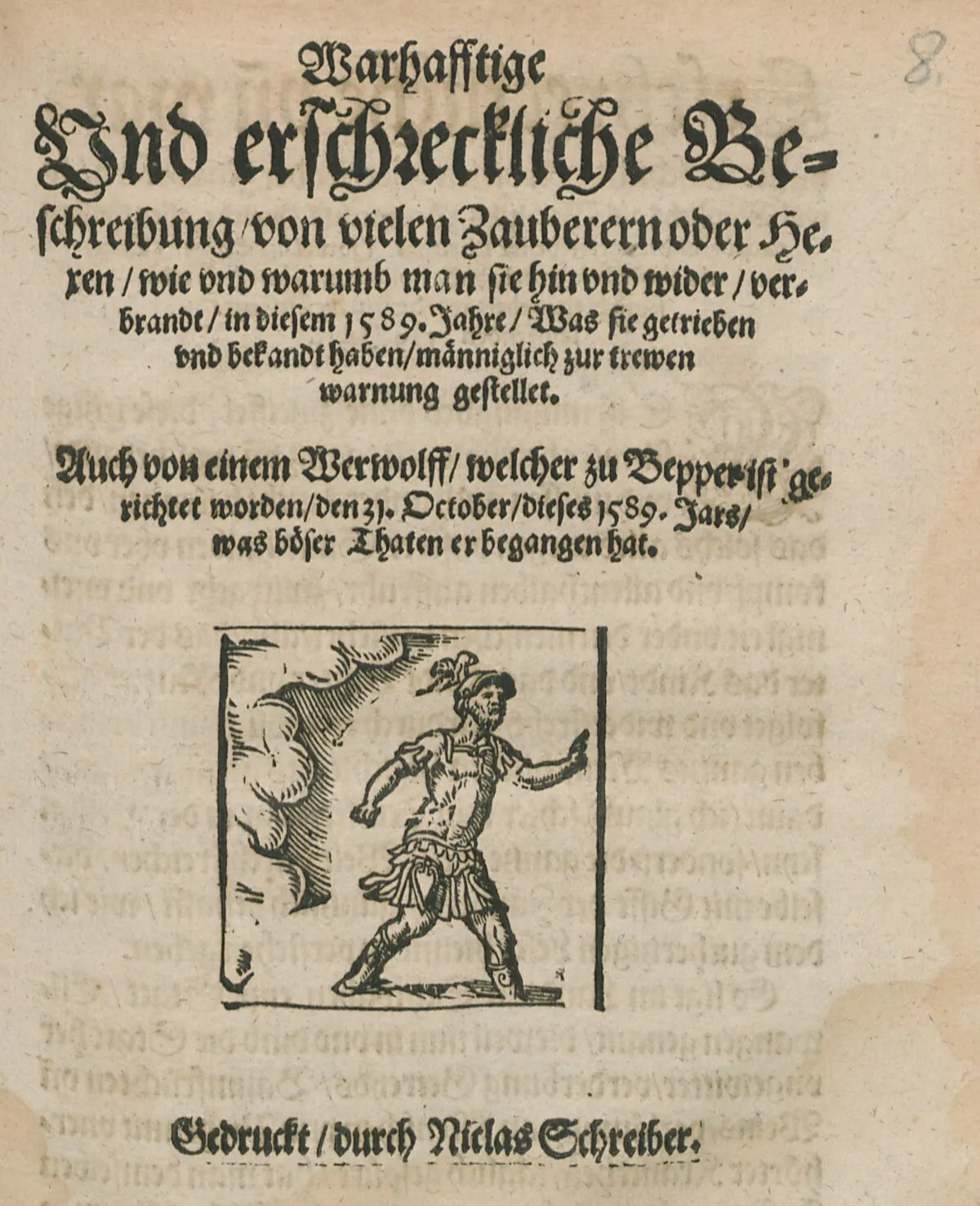
Title page of the Cologne pamphlet printed by Niclas Schreiber, 1589. Its last lines announce “a werewolf who was executed at Bepper on 31 October of this year 1589”. Universitäts- und Landesbibliothek Sachsen-Anhalt, Nm 302 (9), public domain.18
Its werewolf has no name.7 He lived “zu Bepper”, three miles from Cologne, practised sorcery for 24 years, could make himself into a wolf, and was caught and tortured before he “freely” confessed.110 The pamphlet gives seven years with his daughter, “who was burned to powder as well”, and nothing about a second woman, a belt or a son.17 It ends with a wooden wolf set on a wheel and the head nailed on top: “Also ist diesem Wolff gelohnet worden”, that was this wolf’s reward.1 The passage is transcribed and translated in full.
Pictures on sale
Two picture sheets of 1589 show the whole execution in one scene: Peter on the wheel, the tongs, the axe, the wooden wolf on its pole, and three bodies burning. The first is an etching that Erika Münster-Schröer knows under the name of Philipp Uffenbach and that the Kupferstichkabinett in Berlin catalogues under Frans Hogenberg. Its four stanzas are spoken by Peter himself, “Bey bedbur”, and they add up his victims differently again:19
Dan Ich dreyzehin Kinder klein / als Wolff zerrissen hab allein / Zwo farwen vnd ein man dartzue19
For I tore thirteen small children apart as a wolf, all by myself, and two women and a man besides
“Farwen” is, we take it, a slip for frawen, women. The sheet labels him “Stump Petter” and dates the execution 31 October 1589.193
The second is a woodcut broadsheet printed in Nuremberg by Lucas Mayer, with the same picture and a much longer poem.20 Here “Bedbur” lies four miles from Cologne, and the farmer turns into a wolf for seven hours a day. One evening a neighbour coming out of the woods fights the wolf off and cuts off a paw, which turns into a human hand. When the neighbour visits Peter, who is lying sick in bed, Peter admits that he was the wolf and begs him to say nothing.20 Under torture he confesses thirteen children, his own son among them, “drey alten”, three grown people, and twenty-five years with a she-devil, and his daughter and his “Gefader”, his gossip, are burned with his body.20
Ortelius laughs
By the end of the year the case had reached Antwerp, where a Dutch version of the Cologne pamphlet was printed on 7 December. Dries Vanysacker, who has edited it, gives the same details down to its last line, “Also is desen wolf geloont”.21 On 27 December 1589 the cartographer Abraham Ortelius wrote to his friend Dominicus Lampsonius, who had sent him verses on the werewolf.22 Ortelius liked the verses, but the engravers he showed them to would not pay for a new plate, since the picture had already been printed twice from copper.22 His own view was short:
Vis ne meum iudicium liberum de hoc Lycanthropo? Fabula mihi est mera, et non historia, eamque rideo, cum Plinio 8. cap. 22.22
Do you want my frank opinion of this lycanthrope? To me it is a mere fable, not history, and I laugh at it, as Pliny does in book 8, chapter 22.
He calls the man “Stunp Petrus”.3 Lampsonius answered in the margins of the letter on 31 January 1590. He was “between yes and no”, and he would try to get the trial record from the Count of Salm, “under whose jurisdiction this wolf was executed”.22 The letter and the replies are on their own page.
George Bores’s copy
The London pamphlet appeared in June 1590. Its title page says it was “Trulye translated out of the high Duch, according to the Copie printed in Collin”, brought to England by George Bores, “ordinary Poste”, on 11 June 1590, and printed for Edward Venge in Fleet Street.6 Lena Maria Kaiser, who compared every known print in a 2016 thesis, found none that could be that Cologne copy; Schreiber’s pamphlet is far too short to be it.7 The London text has names, the girdle, the son and the capture by hunters, none of which Schreiber prints.79
It also contradicts itself. Its closing page says the sixteen pieces of wood round the wheel stood for “the sixteene persons that was perfectly knowen to be murdered by him”.12 Its own account names more: thirteen children, two pregnant women and their unborn children, the son, and two men and a woman whom he met in the woods.12
The pamphlet says he confessed “fearing the torture” after being “put to the racke in the Towne of Bedbur”.10 The Cologne pamphlet puts the torture first as well: “gefangen / vnd gepeinigt”, caught and tortured.10
| The story | The record | Verdict |
|---|---|---|
| A devil’s girdle | In Weinsberg’s print, not Schreiber’s; never found1579 | Unsupported |
| Two pregnant women | First in the London pamphlet85 | Added later (1590) |
| Sixteen victims known | The pamphlet’s own list is longer12 | Contradicted |
| A free confession | Tortured first, in both pamphlets10 | Contradicted |
| Daughter and gossip burned alive | Weinsberg: burned with his body1611 | Disputed |
The “record” in this table is the other texts of 1589, and they are themselves prints and hearsay.14
Delrio’s fifteen boys
The Jesuit Martin Delrio put the case into his handbook on magic, first printed in 1599 and 1600.23 In the first volume, printed at Louvain in 1599, the passage begins “Annus decimus agitur”: it is the tenth year since “Stumfius Petrus” was executed at “Bebburgi”. He had kept a succubus for more than twenty years, wore a broad belt, and “seemed to himself and others to turn into a wolf”.23 The thirteen children have become “ter quinque pueros”, fifteen boys, and he has tried to devour his two daughters-in-law.23 Delrio adds that all this “is established by the court records and by copper engravings openly on sale”.23
In 1605 Richard Verstegan gave another count, in a book on the old English language, A Restitution of Decayed Intelligence:24
One Peeter Stump for beeing a were-wolf, and hauing killed thirteen children, two women, and one man; was at Bedbur not far from Cullen in the yeare 1589. put vnto a very terrible death.24
One Peter Stump, for being a werewolf and having killed thirteen children, two women and one man, was put to a very terrible death at Bedbur, not far from Cologne, in the year 1589.
Two women and one man reverses the Cologne pamphlet and Weinsberg.245 The German scholar Wilhelm Hertz, in 1862, was the first to write about the case in a scholarly book.25 He called Peter Stump of Bedburg “one of the few werewolves punished by a court”, with twenty years of a succubus and fifteen boys, two women and a man killed.25
The occultist Montague Summers reprinted the London pamphlet in full in 1933, and wrote that he knew only two copies, in the British Museum and the Lambeth library.26 In the same passage he dated the execution to “31st March, 1590”, although the pamphlet he reprinted says 31 October.26
Who held Bedburg
Bedburg belonged to the counts of Neuenahr, who were Protestants. The Reformed church order issued for their county of Moers in 1561 applied to Bedburg as well, and from 1570 Reformed synods met there, at Hüchelhoven.27 Hermann died childless on 4 December 1578, and Werner von Salm-Reifferscheid and Hermann’s kinsman Adolf von Neuenahr fought over the inheritance, partly with arms. The dispute became an episode of the war over the archbishopric of Cologne.27 By 1589 the Count of Salm held the jurisdiction under which the werewolf was executed, as Lampsonius put it.22 In November 1591 the Dutch States were still demanding that Bedburg be given back to the widowed Countess Walburgis von Neuenahr; the Jülich council answered that the Count of Reifferscheid held it.27
Erika Münster-Schröer (2017) ties the case to that quarrel. The Protestant claimant, Adolf von Neuenahr, died in October 1589, a few weeks before the execution, and she argues that so monstrous a criminal made a story that sold well as a Catholic victory, with Protestantism unmasked as the devil’s work.28 Lena Maria Kaiser’s thesis reads the case another way; it is listed at the end of this page.
The count’s file
What would settle the case is the trial file. Delrio, ten years on, wrote that court records established it.23 Lampsonius, a close friend of the Count of Salm, wrote in January 1590 that he would try to get them from him. “If he refuses,” he added, “it will make me more suspicious.”22 Nothing in his replies says whether the count answered. Münster-Schröer found no court files and no other archival record of the case, only the prints, and she asks whether it happened at all.29
The court book turns up once more, a century later. Theophil Laube’s dialogue on lycanthropy, printed at Frankfurt in 1686, has a lawyer cite “dem Gerichts-Buch zu Bebburg”, the court book at Bedburg, for “Stumpff Peter”. What he takes from it, more than twenty years with a devil, a broad belt and fifteen boys whose brains he ate, is all in Delrio.30
Homayun Sidky, an anthropologist, takes the crimes as real: Stubbe, he writes, was “very likely guilty of multiple murders”, and wolf attacks on livestock and children probably swelled the list.31
What we could not verify
Sources we have not seen
- The Cologne print that the London pamphlet says it translates, which would show where its names, the girdle and the hunters came from. No copy is known: Kaiser (2016) compared the surviving prints and found none that fits.
Seen only where others quote them
- Peter Kremer’s view (2005, 2007) that Stump was a Protestant leader executed as an example, which we know from Kaiser’s thesis; Kaiser finds no source for his religion. Kremer’s self-published book is in copyright, and we found no online copy.
Resting on a single source
- A diary entry of September 1591 by the Utrecht diarist Arnold Buchelius (Utrecht University Library, Hs. 798, vol. 2, fol. 157r): at dinner a nobleman said Peter of Bedburg had once been his servant, that he had watched him die, and that the daughter, having seen her father tortured and killed, was burned with his body.
- Kaiser’s idea that killings by soldiers in the war years were pinned on one man. Kaiser concludes the sources cannot show whether the trial and execution took place.
Questions we could not settle
- Whether Weinsberg’s “print” is the same one the London pamphlet claims to translate; nothing we read shows it.
Read next
CaseVärend, Småland, Sweden, 1883 to 1889
The lindworm reward in Småland was never claimed
TaleEdam and Haarlem, Holland, Netherlands, 1403 to 1786
Before the Edam mermaid had a tail
TaleVrhnika (Ober-Laybach), Slovenia, 1684 to 1689
Vrhnika's baby dragons: Valvasor's lizard and the olm
Sources
- Warhafftige vnd erschreckliche Beschreibung von vielen Zauberern oder Hexen ... Auch von einem Werwolff, welcher zu Bepper ist gerichtet worden (Cologne: Niclas Schreiber, 1589), ULB Sachsen-Anhalt, Nm 302 (9), VD16 W 515, title page (image 3); images 8 (foot) and 9 (top) (primary) transcription
- Kaiser 2016, pp. 26 n. 110, 34 to 36, 44, 52, 61 to 62↑
- Weinsberg, Liber Decrepitudinis, ed. Lau 1898, p. 79 (fol. 151v of the manuscript); same text in the Bonn online edition, ld3.htm#QQ1490 (primary) transcription
- Kaiser 2016, pp. 24, 27, 67↑
- Kaiser 2016, pp. 24 to 25
- Weinsberg, Liber Decrepitudinis, ed. Lau 1898, p. 79 (primary)
- A true Discourse (London, 1590), title page (primary)
- Hessels 1887, p. 414 (primary)
- Delrio 1608, p. 99 (primary)
- Delrio 1599, index, index, sig. Eee2 (IA leaf n440) (primary)
- Etching of the execution, 31 Oct 1589, Kupferstichkabinett, Staatliche Museen zu Berlin, 321-123 (catalogued under Frans Hogenberg), labels beside the figures (primary)
- Lucas Mayer, Warhafftige vnd Wunderbarlich Newe zeitung von einem pauren ... (Nuremberg, 1589), Kupferstichkabinett Berlin, 440-8, verse columns 2 and 3 (primary)↑
- Kaiser 2016, pp. 27 to 28
- A true Discourse (London, 1590), p. 3 (leaf n7) (primary)
- Weinsberg, Liber Decrepitudinis, ed. Lau 1898, p. 79 (primary)↑
- Kaiser 2016, pp. 36 to 37
- Schreiber, Warhafftige vnd erschreckliche Beschreibung (1589), image 8 (foot) (primary) transcription
- Hermann von Weinsberg, Liber Decrepitudinis, in Das Buch Weinsberg, vol. 4, ed. Friedrich Lau (Leipzig, 1898), p. 80 (primary) transcription↑
- A true Discourse (London, 1590), title page (leaf n3) (primary)
- Kaiser 2016, p. 60↑
- Kaiser 2016, pp. 60 to 61, 65
- Schreiber, Warhafftige vnd erschreckliche Beschreibung (1589), images 8 to 9 (primary)
- A true Discourse (London, 1590), pp. 3 to 12 (leaves n7 to n16) (primary)↑
- A true Discourse. Declaring the damnable life and death of one Stubbe Peeter (London: for Edward Venge, 1590), p. 7 (leaf n11): "murdered thirteene yong Children, and two goodly yong women bigge with Child" (primary)
- Lena Maria Kaiser, "Weil er geführt ein Wolff leben" (MA thesis, Universität Duisburg-Essen, 2016), p. 37↑
- A true Discourse (London, 1590), pp. 15 to 17 (leaves n19 to n21) (primary)
- Kaiser 2016, pp. 50 to 51↑
- Schreiber, Warhafftige vnd erschreckliche Beschreibung (1589), image 8 (primary)
- A true Discourse (London, 1590), p. 16 (leaf n20) (primary)
- Kaiser 2016, pp. 51 to 52↑
- A true Discourse (London, 1590), pp. 17 to 18 (leaves n21, n22) (primary)
- Kaiser 2016, pp. 43, 53↑
- A true Discourse (London, 1590), pp. 7, 9 to 12, 19 (leaves n11, n13 to n16, n23) (primary)
- Kaiser 2016, p. 36 n. 173, p. 57↑
- Kaiser 2016, pp. 66 to 67
- Hermann Weinsberg, Liber Decrepitudinis, Bonn online edition (Universität Bonn), ld3.htm#QQ1490 (primary)↑
- Weinsberg, Liber Decrepitudinis, ed. Lau 1898, pp. 79 to 80: "Man sagt", "Von dissem war in truck ausgangen" (primary)
- Kaiser 2016, pp. 67 to 69, 82↑
- Weinsberg, Liber Decrepitudinis, ed. Lau 1898, pp. 79 to 80 (primary)
- Kaiser 2016, pp. 35, 52, 67↑
- Weinsberg, Liber Decrepitudinis, ed. Lau 1898, p. 80 (primary)
- Kaiser 2016, pp. 44, 46, 54↑
- Weinsberg, Liber Decrepitudinis, ed. Lau 1898, p. 80 (primary)
- Kaiser 2016, p. 68↑
- ULB Sachsen-Anhalt, catalogue record, Nm 302 (9), VD16 W 515, record
- Kaiser 2016, pp. 61 to 62↑
- Etching, Kupferstichkabinett, Staatliche Museen zu Berlin, 321-123 (catalogued under Frans Hogenberg; image CC BY-NC-SA, not for use on the site), verse lines under the picture (primary)
- Erika Münster-Schröer, Hexenverfolgung und Kriminalität. Jülich-Kleve-Berg in der Frühen Neuzeit (Essen: Klartext, 2017), pp. 270 to 272↑
- Lucas Mayer, Warhafftige vnd Wunderbarlich Newe zeitung von einem pauren ... (Nuremberg, 1589), Kupferstichkabinett, Staatliche Museen zu Berlin, 440-8 (image CC BY-NC-SA, not for use on the site), verse columns 1 to 4 (primary)
- Erika Münster-Schröer, Hexenverfolgung und Kriminalität. Jülich-Kleve-Berg in der Frühen Neuzeit (Essen: Klartext, 2017), p. 273 and n. 7↑
- J. H. Hessels (ed.), Abrahami Ortelii ... epistulae (Cambridge, 1887), letter 171, pp. 413 to 414 (primary) transcription
- Early Modern Letters Online (Bodleian Libraries), record 945499
- Erika Münster-Schröer, interview with L.I.S.A. (Gerda Henkel Stiftung), 9 Feb 2021, answer under "Die Hinrichtung Peter Stumps fiel zusammen mit dem Ende des kölnischen Krieges"↑
- Martin Delrio, Disquisitionum magicarum libri sex (Lyon: Horace Cardon, 1608; first ed. 1599-1600), lib. II, q. 18, p. 99, col. 1 (leaf n120) (primary)
- Kaiser 2016, pp. 69 to 70
- Martin Delrio, Disquisitionum magicarum libri sex, tomus primus (Louvain: Gerard Rivius, 1599), lib. II, q. 18, p. 208 (IA leaf n250) (primary)↑
- Richard Verstegan (Rowlands), A Restitution of Decayed Intelligence (1605), p. 237 (leaf n260) (primary)
- Montague Summers, The Werewolf (London, 1933), chapter on Germany, note 35 (Internet Archive transcription, no original pagination)↑
- Summers 1933, chapter on Germany, before the reprint; note 37
- Kaiser 2016, pp. 5, 60
- A true Discourse (London, 1590), title page and p. 18 (primary)↑
- Hugo Altmann, "Neuenahr, Hermann der Jüngere", Neue Deutsche Biographie 19 (1999), p. 109, online version
- Lossen, "Neuenar, Hermann (der Jüngere)", Allgemeine Deutsche Biographie 23 (1886), pp. 486 to 488, online version
- Hermann Keussen, "Die drei Reisen des Utrechters Arnoldus Buchelius", Annalen des Historischen Vereins für den Niederrhein 85 (1908), p. 84 (German translation of Buchelius's diary)↑
- Theophilus Lauben, Dialogi und Gespräch von der Lycanthropia (Frankfurt, 1686), Bayerische Staatsbibliothek, p. 22 (MDZ image 40) (primary)
- Delrio 1599, lib. II, q. 18, p. 208 (primary)↑
- Homayun Sidky, Witchcraft, Lycanthropy, Drugs and Disease (1997; reprint Eugene: Wipf and Stock, 2010), p. 236 (2010 reprint, read in Google Books search results)↑
Documents quoted
- Abraham Ortelius to Dominicus Lampsonius, 27 December 1589, with Lampsonius's replies (OCR, checked against the page image)
- Hermann von Weinsberg's diary, 31 October 1589: Stupe Peter (OCR, checked against the page image)
- The Cologne pamphlet of 1589: the werewolf of Bepper (transcribed from the page image)