 Twice Told
Champ of Lake Champlain: the serpent Champlain never described
Champlain described a five-foot fish in the lake. The 20-foot, horse-headed serpent said to be his is first in print, as far as we found, in a 1970 magazine.
Contents
Published 18 Oct 2026. Sources checked 17 Oct 2026.
A sentence attributed to Samuel de Champlain runs: in July 1609 he saw a serpent about twenty feet long, thick as a barrel, with a head like a horse.3 Radford and Nickell call that quotation “bogus”.2 What Champlain’s own book describes, on one page, is a fish.1
The story, as Vermont Life told it in the summer of 1970, goes like this.
Samuel de Champlain, in July of 1609, reported a serpent-like creature about twenty feet long, as thick through as a barrel, with a head shaped like a horse.3 On 24 July 1819 pioneers around Port Henry were flabbergasted when it appeared in Bulwagga Bay.4
In the early 1870s a party of New Yorkers on a steamboat excursion from Essex saw it near the Vermont shore. A girl of seven or eight called Alma ran to the ship’s rail with her ticket clenched in her teeth, and she swallowed it.7 In 1871 the St. Albans paper reported that “The What is It of Lake Champlain” had been seen near Barber’s Point, going at railroad speed.88
In August 1883 Captain Mooney, the sheriff of Clinton County, saw it off Cumberland Head. The body was 25 to 35 feet long, and the head was about eight inches across and ten inches long.9
One page of Vermont Life
Marjorie L. Porter’s article “The Champlain Monster” ran in the summer 1970 issue of Vermont Life, with drawings by Robert Candy.3 The Champlain sentence is in its fourth paragraph, and the article names no source for it.6 A drawing at the top of the same page shows a horse-headed animal beside a canoe, under the caption “Samuel de Champlain saw it first, in 1609”.10
Radford and Nickell quote Jerome Clark, who traced the line to Porter’s article in 1993.3 They also name a 1998 Discover article as one place it was printed as Champlain’s, and say it has been repeated and embellished since.11 Porter’s is the earliest printing we found. We cannot rule out an older one.
Her article also quotes a Burlington newspaper story of April 1915 that was already giving the lake serpent a size: local histories, it said, describe it as about twenty feet long and as large around as a keg.12 That description has horns like a catfish’s and no horse’s head.12
What Champlain wrote
The fish is in chapter IX of Champlain’s Les Voyages, the 1613 edition, which opens with his departure from the rapids of the river of the Iroquois on “le 2. Iuillet”.13 Biggar, the Champlain Society’s editor, reads that date as probably 12 July.13 Radford and Nickell say the lake was “discovered” in 1609 by Champlain.14
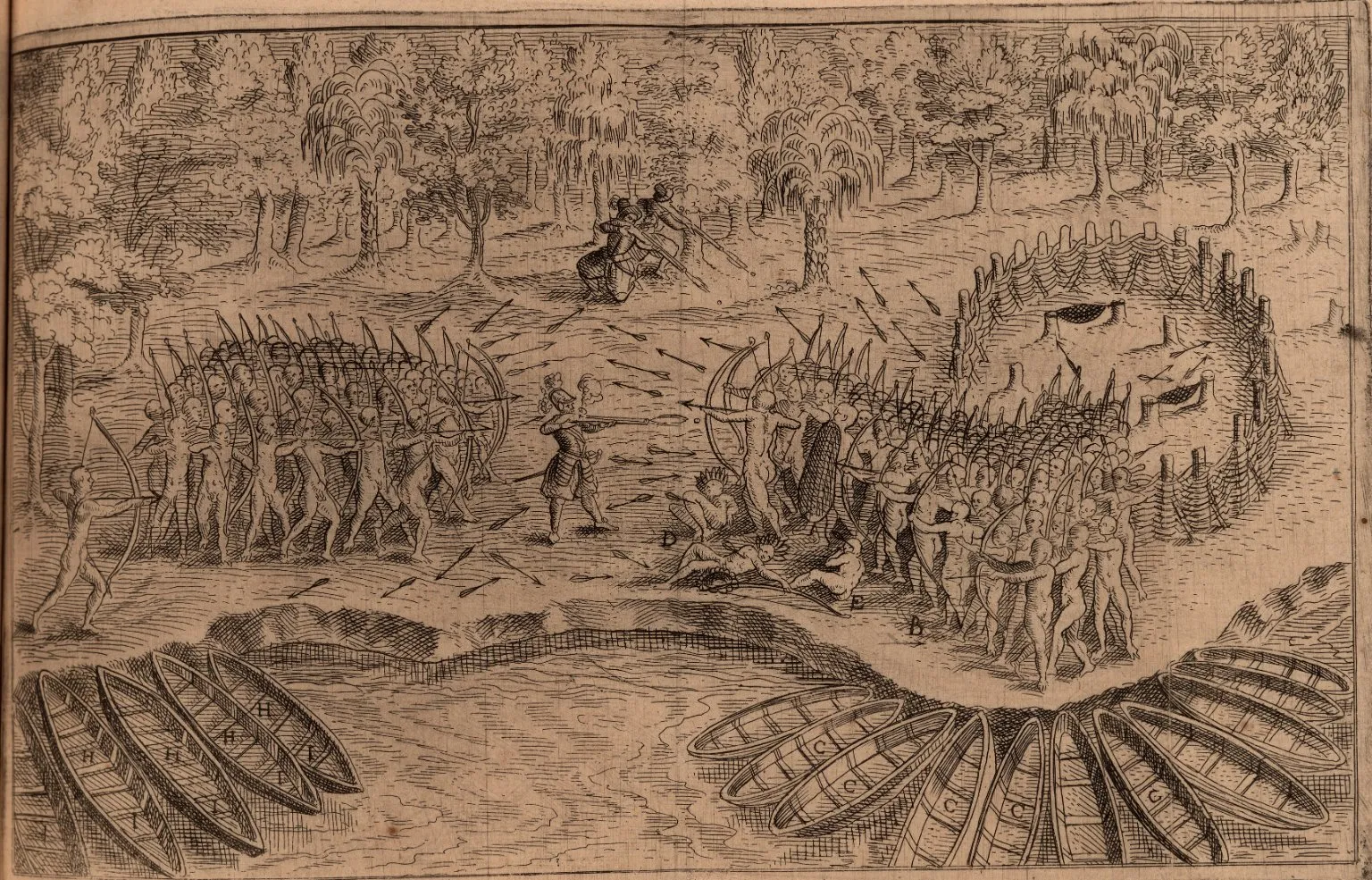
“Deffaite des Yroquois au Lac de Champlain”, the battle plate in Champlain’s Les voyages of 1613, the book that holds the fish passage. Engraving following page 232, from Samuel de Champlain, Les voyages (Paris: Jean Berjon, 1613), cropped. Courtesy of the John Carter Brown Library, E613 C453v [R], CC BY 4.0.
On page 225 he tells what the natives call a chaousarou. The largest, they told him, were 8 to 10 feet long.1 He had seen some of 5 feet:
J’en ay veu qui en contenoyent 5. qui estoient de la grosseur de la cuisse, & auoient la teste grosse comme les deux points [sic: poings], auec vn bec de deux pieds & demy de long, & à double rang de dents fort agues & dangereuses.1
I have seen some of 5 feet, as thick as a thigh, with a head as big as two fists, a snout two and a half feet long, and a double row of very sharp, dangerous teeth.
The page goes on to a body like a pike’s and scales a dagger could not pierce.1 It also gives a trick, on the natives’ word: lying in the reeds with its snout out of the water to pull birds under by the feet.15 Biggar’s footnote to the name reads “Probably the garfish”, and Radford and Nickell call it “almost certainly a gar”.16 We searched the text of the 1613 volume and found no serpent, no barrel and no horse in the lake chapter.2 Our search ran over scanned text, which can miss words, so the claim rests on the two pages we read, 225 and 226, and on Radford and Nickell.2
A letter signed Horse Mackerel
Radford and Nickell write that the earliest of the 224 reports in Zarzynski’s catalogue is from 1819.17 They tracked down the original in the Plattsburgh Republican of Saturday 24 July.18 It is a letter, headed “Cape Ann Serpent on Lake Cham…” (the last word is clipped at the edge of the scan), signed “Horse Mackerel”.19 The writer says that on “Thursday last” Captain Crum, in a scow on Bulwagga Bay, saw a monster rear its head more than fifteen feet out of the water.18 Crum described the animal as about 187 feet long, black, with a flat head and three teeth, the line running on “in shape similar to the sea-horse”, a star on the forehead and a red belt round the neck.18 Its eyes were the colour of a peeled onion.18
The Thursday before Saturday 24 July 1819 was 22 July, by our count.5 Porter gave the sighting as 24 July, the date of the paper.4
The letter ends with Crum’s fear that, before a Captain Rich of Boston arrives, the creature “may be changed to a pickerel”, and with the news that an engraver of the Battle of Plattsburgh is in town, ready to sketch it.19 Radford and Nickell write that its outlandishness suggests someone was pulling the reader’s leg.20
| The story | The record | Verdict |
|---|---|---|
| Champlain saw a serpent, July 1609 | A five-foot fish, 1613 text1 | Unsupported |
| A monster at Port Henry, 24 July 1819 | A letter of that date about 22 July5 | Disputed |
Press reports, 1873 to 1887
The northern New York press took up a serpent in the lake in the summer of 1873, some of it in a joking tone.21 On 23 July the Ogdensburg Journal reprinted an item from the Whitehall Times: a railroad gang at Dresden had seen the head of an enormous serpent, about twenty feet long, come out of the lake.22 Gen. David Barrett of Dresden had lost two calves from his pasture.22 We read only the Journal’s copy. On 8 August the Plattsburgh Sentinel reported that boys were angling for the sea serpent, and copied from the Rutland Herald an item that made fun of the stories.21
Porter’s later entries have no page we could read to check them. She quotes a St. Albans paper of 31 August 1871, which has the serpent seen from the steamer Curlew, going at “railroad speed”.8 For August 1883 she names Captain Mooney and no paper.9 The Plattsburgh Sentinel of 17 August 1883 has only a line saying that a Westport man had seen the sea serpent.23 P. T. Barnum offered rewards for the monster in 1873 and 1887, according to Radford and Nickell.24
What we could not verify
Sources we have not seen
- Robert Bartholomew, The Untold Story of Champ (SUNY Press, 2012). It would show whether he traces the horse-head detail to Porter’s article. The Internet Archive holds it only as a lending copy, and its text file returned an authorization error on 17 October 2026.
- Meurger and Gagnon, Lac Champlain (1988), where Radford and Nickell say the chaousarou passage is quoted. It might show an earlier account of the early reports. We did not find a copy online.
- Zarzynski, Champ: Beyond the Legend (1984), said to catalogue 224 reports. We did not find a copy online.
- Barnum’s offers, said to appear in the Green Mountain Freeman of 27 August 1873. Chronicling America showed a bot check for each request, so the page could not be opened.
Seen only where others quote them
- The Discover article of 1998 and Clark’s 1993 tracing of the line to Porter, both through Radford and Nickell.
- The Burlington newspaper of 1915 and the St. Albans paper of 1871, both through Porter’s article.
- The Whitehall Times item of 1873, through the Ogdensburg Journal’s reprint.
Resting on a single source
- Captain Mooney’s sighting in August 1883: Porter’s article is the only source we read, and it names no paper.
Questions we could not settle
- Whether anyone besides Captain Crum’s letter-writer described that morning on Bulwagga Bay. We read the letter and Radford and Nickell’s summary of it, and no other account.
- Where Porter found the Champlain sentence, and whether it appears in print before the summer of 1970. Her article does not say, and we found no earlier copy.
Read next
TalePine Barrens, New Jersey, 1687 to 1939
The Jersey Devil was first called Leeds’s devil
TaleNew Mexico and Texas, 1629 to 1690
The Lady in Blue had no name in 1630
TaleAdams, Robertson County, Tennessee, 1820 to 2017
Andrew Jackson and the Bell Witch: one letter from 1894
Sources
- Samuel de Champlain, Les Voyages du sieur de Champlain Xaintongeois (1613 edition), digitised copy on the Internet Archive (lesvoyagesdusieu00cham), p. 225, first line "pays Chaousarou, qui est de plusieurs lògueurs" to the end of the page; read from the page image () (primary) transcription
- H. P. Biggar (ed.), The Works of Samuel de Champlain, vol. 2 (Toronto: Champlain Society, 1925), French text with English translation, pp. 91 to 92, English translation of the passage beginning "Amongst others there is one called by the natives Chaousarou"; a footnote to the French text corrects "points" to "poings" ("A lire poings")
- Benjamin Radford and Joe Nickell, Lake Monster Mysteries (Lexington: University Press of Kentucky, 2006), ch. 2 "Lake Champlain", p. 33, block quotation of the chaousarou passage (they quote it from Meurger and Gagnon 1988, pp. 268 to 270; we did not open that book)↑
- Champlain, Les Voyages (1613), pp. 225 to 226 read from the page images (the passage and the page after it); keyword search of the whole OCR text of the volume for "serpent", "baril" and "cheval" finds nothing in the lake chapter (OCR, so a search is not proof for every page) (primary)
- Radford and Nickell, Lake Monster Mysteries (2006), ch. 2, pp. 33 to 34: the "20-foot serpent" quotation "is, alas, bogus"; "Champlain's actual description" is the chaousarou passage, "a native species of large fish"↑
- Marjorie L. Porter, "The Champlain Monster", Vermont Life 24, no. 4 (Summer 1970), pp. 47 to 49, drawings by Robert Candy, p. 47, left column, fourth paragraph ("After all, the early Lake Champlain tourist, Samuel de Champlain"); read from the page image () transcription
- Radford and Nickell, Lake Monster Mysteries (2006), ch. 2, p. 33: the quotation "traceable to an article by the late Marjorie L. Porter in the Summer 1970 issue of Vermont Life", quoting Jerome Clark (1993)↑
- Porter, "The Champlain Monster", Vermont Life (Summer 1970), p. 47, centre column, first paragraph ("but on July 24, 1819 pioneers in the Port Henry area were flabbergasted"); page image↑
- Plattsburgh Republican, 24 July 1819, p. 2, first paragraph of the letter: "On Thursday last"; "about eight o'clock in the morning" (some letters at the column edge are clipped) (primary)
- Radford and Nickell, Lake Monster Mysteries (2006), ch. 2, p. 34: the paper "published on Saturday, July 24"; Crum "had been in a scow on Bulwagga Bay the previous Thursday morning"↑
- Porter, "The Champlain Monster", Vermont Life (Summer 1970), p. 47: the sentence is followed by no citation, quotation marks, document or witness; read on the page image↑
- Porter, "The Champlain Monster", Vermont Life (Summer 1970), p. 47, centre column, paragraph beginning "It happened that a group of Yorkers"; "It is recorded that Alma" with no record named; page image↑
- Porter, "The Champlain Monster", Vermont Life (Summer 1970), p. 47, centre and right columns; we did not see the Temperance Advocate↑
- Porter, "The Champlain Monster", Vermont Life (Summer 1970), p. 47, right column, to p. 48, left column, first lines; she names no newspaper for it↑
- Porter, "The Champlain Monster", Vermont Life (Summer 1970), p. 47, top right, drawing by Robert Candy and its caption; page image↑
- Radford and Nickell, Lake Monster Mysteries (2006), ch. 2, pp. 32 to 33, "According to Discover magazine (Teresi 1998)" and the sentence after the quotation; we did not open Discover or Teresi↑
- Porter, "The Champlain Monster", Vermont Life (Summer 1970), p. 48, centre column, the News story quoted at length; we did not see the 1915 newspaper↑
- Champlain, Les Voyages (1613), p. 218 (scan leaf n259): the chapter heading and first line; read from the page image (primary)
- Biggar (ed.), Works of Samuel de Champlain, vol. 2 (1925), p. 82, chapter IX heading and first sentence ("on the second of July") with the note "Probably July 12. See p. 73 supra"↑
- Radford and Nickell, Lake Monster Mysteries (2006), ch. 2, p. 27, first paragraph of the chapter↑
- Champlain, Les Voyages (1613), p. 225, the sentences from "Ce poisson fait la guerre" to "soubs l'eau"; page image (primary)
- Biggar (ed.), Works of Samuel de Champlain, vol. 2 (1925), p. 92, English translation, sentences from "This fish makes war on all the other fish" to "under the water"↑
- H. P. Biggar (ed.), The Works of Samuel de Champlain, vol. 2 (Toronto: Champlain Society, 1925), p. 91, translator's footnote 1 to "Chaousarou": "Probably the garfish."
- Benjamin Radford and Joe Nickell, Lake Monster Mysteries (2006), ch. 2, p. 34, first paragraph: "It was almost certainly a gar (or garfish)"; p. 36 calls it "clearly a gar"↑
- Radford and Nickell, Lake Monster Mysteries (2006), ch. 2, p. 34: "Zarzynski (1984a, 152-205) cataloged 224 Champ reports ... The earliest is from 1819"; we did not open Zarzynski↑
- Plattsburgh Republican, 24 July 1819, p. 2, letter "Cape Ann Serpent on Lake Champlain" signed "Horse Mackerel" (NYS Historic Newspapers), page 2, last column of the page, under the heading "For the Republican"; read from the page image () (primary) transcription
- Radford and Nickell, Lake Monster Mysteries (2006), ch. 2, p. 34: "I tracked down the original account in the Plattsburgh Republican published on Saturday, July 24" and the paragraph that follows↑
- Plattsburgh Republican, 24 July 1819, p. 2, same column as C7: the heading (italic, last word clipped), the sentence beginning "Capt. Crum informs me", and the signature (primary)↑
- Radford and Nickell, Lake Monster Mysteries (2006), ch. 2, p. 34, last sentence of the paragraph on the 1819 account↑
- The Ogdensburg Journal, 23 July 1873, p. 2 (NYS Historic Newspapers), page 2, column "The Monster Again Turns Up"; OCR text only, the page image was not read at this location (primary)
- The Plattsburgh Sentinel, 8 August 1873, p. 3 (NYS Historic Newspapers), page 3, local column: "Boys are now angling for the great sea serpent in Lake Champlain" and the item headed "THAT SNAKE" copied from the Rutland Herald; OCR text only (primary)↑
- The Ogdensburg Journal, 23 July 1873, p. 2, the item introduced by "The following, from the Whitehall Times, will be read with interest"; OCR text only; we did not see the Whitehall Times (primary)↑
- The Plattsburgh Sentinel, 17 August 1883, p. 1, page 1, "Personal Mention" column, second item; OCR text only (primary)↑
- Radford and Nickell, Lake Monster Mysteries (2006), ch. 2, p. 27, second paragraph of the chapter; we did not see the offers in a newspaper↑
Documents quoted
- “Cape Ann Serpent on Lake Champlain”, Plattsburgh Republican, 24 July 1819 (transcribed from the page image)
- Champlain, Les Voyages (1613): the chaousarou of Lake Champlain (transcribed from the page image)
- Marjorie L. Porter, “The Champlain Monster”, Vermont Life, Summer 1970 (transcribed from the page image)