 Twice Told
The serpent of the Bagradas: Regulus's monster without a witness
Pliny says a 120-foot serpent held off Regulus's army and that its skin hung in a Roman temple. Polybius, who tells the same campaign, never mentions it.
Contents
Published 23 Oct 2026. Sources checked 18 Oct 2026.
Pliny the Elder calls it well known that a Roman army under Regulus took a serpent a hundred and twenty feet long at the river Bagrada in Africa, attacking it with ballistae as if it were a town, and that its skin and jaws stayed in a temple at Rome until the Numantine War.7 Polybius tells the same campaign at length and has no serpent in it.2 None of the texts we read says its writer saw the skin.
The fullest telling is Orosius’s, written about AD 417.89 The writers who tell the story mention two authorities, Tubero and Livy, and Livy’s Book 18, where it would stand, is lost.110
Orosius tells it this way in his Histories.8
Regulus, who had drawn the war with Carthage by lot, was marching with his army when he made camp not far from the river Bagrada. A serpent of marvellous size lived there, and it devoured a great many soldiers as they went down to the river for water.8
Regulus led the army out against it. Javelins and darts did nothing: they slid off the lattice of its scales as off a slanting roof of shields. The serpent mangled men with its bites, trampled them in its charge, and killed even with its poisonous breath, until Regulus ordered ballistae brought up.8
A wall-stone hurled from a ballista struck its spine and broke the frame of its body. Soon, surrounded by missiles, the serpent was easily destroyed.8
Its skin was carried to Rome. They say it measured a hundred and twenty feet, and for some time everyone marvelled at it.8
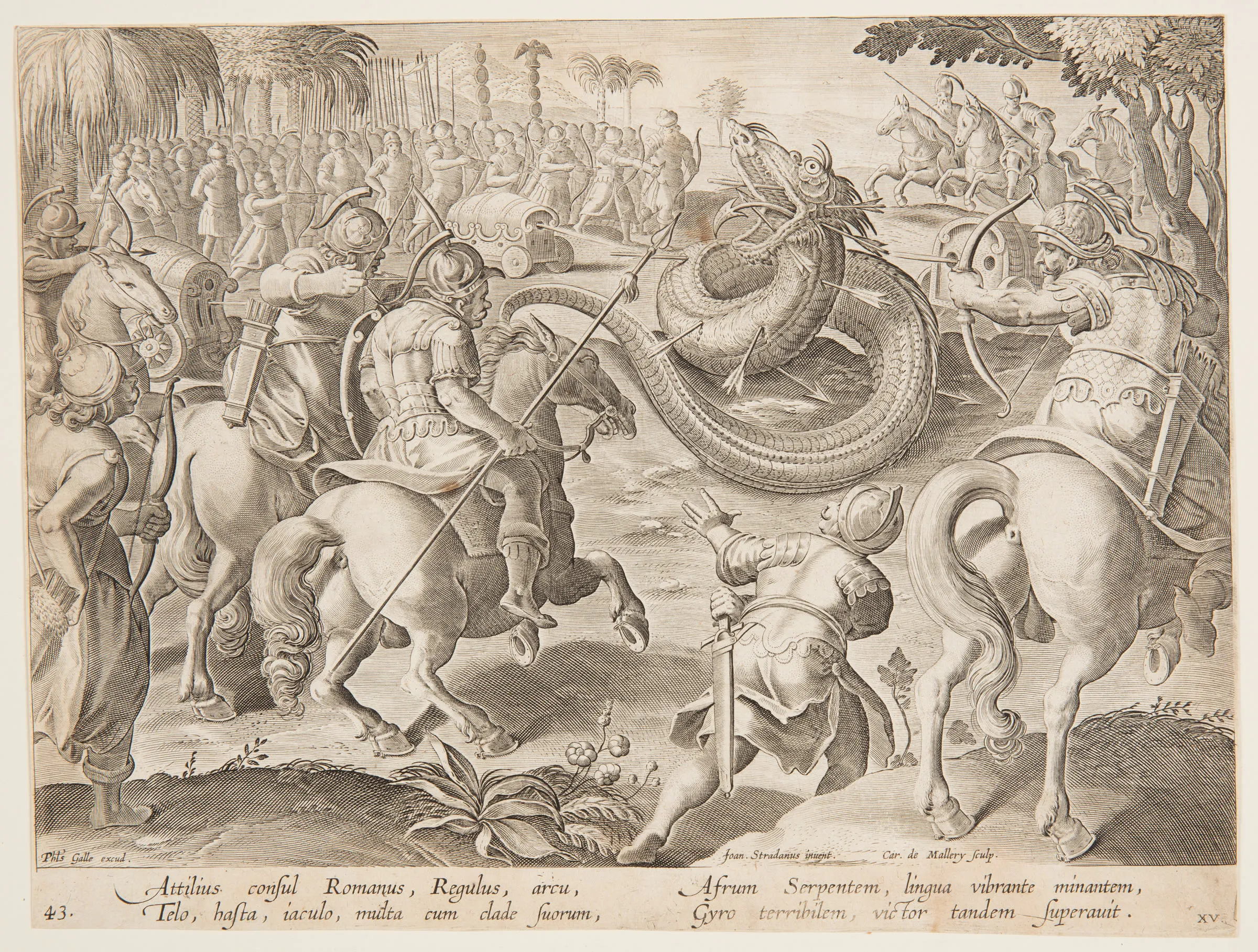
The Roman consul Attilius Regulus fighting a giant African serpent, plate 25 of the Venationes Ferarum series, engraving by Karel van Mallery after Jan van der Straet (Stradanus), published by Philips Galle, 1596 or after. Cooper Hewitt, Smithsonian Design Museum, 1952-37-15, CC0.
A war narrative without a monster
Polybius tells Regulus’s campaign in Book 1 of his Histories: the landing at Aspis, the battle at Adys, the capture of Tunis, the peace talks and the arrival of Xanthippus.2 We searched the whole of Book 1 for “serpent” and “snake” and found neither.2 Diodorus’s fragments on Regulus in Africa and Eutropius’s summary of the war have no serpent either.11
Stothers calls Polybius, who wrote about 150 BC, our main authority for the war.29 That is roughly a century after the landing, which Stothers dates to 256 BC (our arithmetic).12 Stothers adds that Polybius never says the army camped on the Bagradas, and that he blamed other historians for reporting sensational incidents merely to entertain.2 Gsell says Polybius left this marvellous story aside.2
Why he left it aside is not in his text. Either he knew the story and rejected it, or it was not yet told; nothing we read settles which. The order of events also differs: Orosius and Zonaras put the arrival at the Bagrada before the fight at Adys, and Gsell wonders whether the sequence was reversed in them.13
Two lost histories
Stothers notes that none of the many writers who mention the incident lived before the first century AD, and that they cite as their authorities only Tubero and Livy.1 Gsell identifies the first as Q. Aelius Tubero, a contemporary of Caesar.1
Tubero’s version reaches us through Aulus Gellius, who wrote this sentence about it:14
Tubero in historiis scriptum reliquit bello primo Poenico Atilium Regulum consulem in Africa castris apud Bagradam flumen positis proelium grande atque acre fecisse adversus unum serpentem in illis locis stabulantem invisitatae inmanitatis eumque magna totius exercitus conflictione balistis atque catapultis diu oppugnatum, eiusque interfecti corium longum pedes centum et viginti Romam misisse.14
Tubero left written in his histories that in the First Punic War the consul Atilius Regulus, with his camp pitched in Africa by the river Bagrada, fought a great and bitter battle against a single serpent that had its lair in that country, of extraordinary, monstrous size; that the whole army struggled hard against it, and it was attacked for a long time with ballistae and catapults; and that after it was killed he sent its skin, a hundred and twenty feet long, to Rome.
Gellius reports one serpent, one long assault and one skin sent to Rome. His sentence has no dead soldiers, no poison, no jaws and no temple.14
Livy’s account stood in Book 18 of his history, which is lost.10 His summary says that Regulus “killed a serpent of portentous size with great loss of soldiers”.10 Valerius Maximus, who says he is repeating Livy, tells it at more length: the serpent kept the army from the river, seized many soldiers in its jaws and crushed others in its tail coils, and thrown weapons could not pierce it.15 Ballistae and blows from flint stones finally brought it down, and its blood and breath fouled the district so that the Roman camp had to move.15
Fowler and Stothers both take Orosius’s account to come from Livy’s lost Book 18.16
Pliny’s sentence
nota est in Punicis bellis ad flumen Bagradam a Regulo imperatore ballistis tormentisque, ut oppidum aliquod, expugnata serpens CXX pedum longitudinis; pellis eius maxillaeque usque ad bellum Numantinum duravere Romae in templo.7
Well known is the serpent of a hundred and twenty feet that, in the Punic wars at the river Bagrada, was stormed by the general Regulus with ballistae and siege engines, as if it were a town. Its skin and jaws lasted at Rome, in a temple, until the Numantine war.
Pliny names no source for it.7 His verb for the attack is the one used for storming a town, which the Bostock and Riley translation softens to “taken … being besieged, like a fortress”.17 He sets the story beside the boa, which he says grows so large in Italy that a whole child was found in one killed on the Vatican hill under Claudius.18
Pliny gives the 120 feet as the length of the animal. Gellius, Valerius and Orosius give it as the length of the skin.4 The verb for the skin and jaws is in the past tense. They lasted until the Numantine War, which ended in 133 BC, and Stothers dates Pliny’s book to AD 77, so the relics were gone about two centuries before he wrote (our arithmetic).7199 He does not say which temple.6
Details that move
Almost every writer who gives a size says 120 feet.3 Silius Italicus says a hundred ulnae, which Stothers reads as cubits, about 150 feet.20 Seneca and Florus say only that it was huge.2122 The 120 feet stays put while the weapons and the setting change from teller to teller.352223
The killing is told a different way almost every time. In Orosius one stone from a wall breaks the spine.8 Stothers counts seven authors who have it felled by repeated blows from more than one ballista.5 Seneca, in a letter, has arrows and slings fail against it until it was broken by rocks the size of millstones.21 The Dio fragment in Zonaras has Regulus overcome it with a crowd of soldiers and catapults.24 In Silius, Regulus wounds it with a spear from horseback, and ballista fire and a beam finish it.25
So is the place where it struck. Florus says a serpent of wonderful size was born as if to avenge Africa and harassed the camp.22 In John of Damascus’s quotation of Dio it creeps out of the Roman palisade.23 Silius gives it a grove by the river and has a soldier tell the story, with named men among the dead.25
In the same Dio passage the Romans flay it and send the skin to the senate, which has it measured at 120 feet, its thickness in proportion.23 Valerius has it sent to the city, Gellius to Rome.1514
Whether anyone saw the skin
Orosius, the fullest teller, does not claim to have seen it either. He writes that “they say” it measured 120 feet and that for some time it was a marvel to everyone:8
corium autem eius Romam deuectum - quod fuisse centum uiginti pedum spatio ferunt - aliquamdiu cunctis miraculo fuit.8
Its skin was carried to Rome, and they say it measured a hundred and twenty feet; for some time it was a marvel to everyone.
The nearest thing to a witness is the senate in the Dio passage that John of Damascus preserves, which is said to have measured it.23 Stothers’s point about the chain of authorities fits that: the later writers cite Tubero and Livy, not the skin.1
Where it was kept is a guess. Fowler proposes the temple of Aesculapius on the Tiber Island, as the one place where such an offering would fit; Stothers lists the Capitoline temple as another possibility and calls the temple unidentified.6
What the beast was supposed to be
Niebuhr thought the whole tale was invented by the poet Naevius, who wrote a verse history of the First Punic War.26 Fowler thought a real animal lay behind it, possibly the survivor of a water-serpent species then nearly extinct, and would halve the length or more.27 Stothers argues for a python, notes that no snake today passes about 30 feet, and suggests that the 120 may have been a count of ribs misread as feet.2728 Gsell writes that no modern zoologist can accept a length of 120 feet, more than 35 metres.29 Stothers reports that Lazenby and Le Bohec dismiss the story outright and that several others stay noncommittal.30
Vibius Sequester, in his list of rivers, puts it at the Bagrada beside a town called Musti, and the Musti Gsell knows lay far from the river.31 Gsell cannot say whether there was another Musti on the Bagrada.31 The date is not fixed either: Stothers puts the incident in 256 BC, while Lendering’s translation of the periochae brackets the crossing under 256 and the serpent under 255.12
What we could not verify
Sources we have not seen
- Karol Kłodziński, “Bagrada, Africae, iuxta oppidum Musti”, Eirene 60 (2024), on Vibius Sequester and the place of the fight. It would show whether Vibius depends on Livy’s Book 18. The publisher’s page returned an access error for us, and no open copy turned up.
Seen only where others quote them
- Lazenby, The First Punic War (1996), and Le Bohec, Histoire militaire des guerres puniques (1996), known only from Stothers’s summary that both dismiss the story. They would show their reasons; both are in copyright, and a title search on the Internet Archive found neither.
Questions we could not settle
- Which temple held the skin, and whether anyone who wrote about it had seen it.
- Whether Polybius knew the story and chose to leave it out.
- Whether Vibius Sequester took the place from Livy’s Book 18 or from elsewhere.
Read next
TaleUasin Gishu and the Nandi forest, Kenya, 1909 to 1927
The Nandi bear and the devil called Chemosit
TaleLikouala, Republic of the Congo, 1776 to 1997
Mokele-mbembe, report by report, since 1776
CaseTsavo River, Kenya, 1898
The Tsavo man-eaters: 28 counted in 1907, 135 by 1925
Sources
- Richard B. Stothers, "Ancient Scientific Basis of the 'Great Serpent' from Historical Evidence", Isis 95:2 (2004), pp. 220 to 238, p. 223, paragraph beginning "Fortunately, other ancient historians"
- Stéphane Gsell, Histoire ancienne de l'Afrique du Nord, vol. 3, Histoire militaire de Carthage (Paris: Hachette, 3rd ed. 1928), p. 83, n. 1 (Tubero, "contemporain de César", and Livy)↑
- Polybius, Histories Book 1, tr. W. R. Paton (Loeb, vol. 1, 1922), Bill Thayer's LacusCurtius transcription, 1.29 to 1.35 (Regulus remains in Africa with forty ships, 15,000 foot and 500 horse at 1.29.9; Adys 1.30.5; Tunis 1.30.15; talks 1.31; Xanthippus 1.32 and after); we searched the whole Book 1 text for "serpent" and "snake" with no hit (primary)
- Richard B. Stothers, "Ancient Scientific Basis of the 'Great Serpent' from Historical Evidence", Isis 95:2 (2004), pp. 220 to 238, p. 223: "Polybius never mentioned that the Roman expeditionary force ... was encamped by the Bagradas River"; he is "our main authority" and blamed other historians for reporting sensational incidents merely to entertain
- Stéphane Gsell, Histoire ancienne de l'Afrique du Nord, vol. 3, Histoire militaire de Carthage (Paris: Hachette, 3rd ed. 1928), p. 83: "Polybe a laissé de côté cette histoire merveilleuse"↑
- Richard B. Stothers, "Ancient Scientific Basis of the 'Great Serpent' from Historical Evidence", Isis 95:2 (2004), pp. 220 to 238, p. 224, n. 8: eight authors give 120 feet (Valerius, Pliny, Gellius, Vibius Sequester, Orosius, Nepotianus, John of Damascus, Zonaras), Silius 100 cubits, and Seneca, Florus and Arnobius only "huge"
- Pliny the Elder, Naturalis Historia 8, ed. Karl Mayhoff, vol. 2 (Leipzig: Teubner, 1909), pp. 89 to 90, read from the page images; the same text as Perseus's Mayhoff (1906), NH 8.37: "cxx pedum longitudinis" (primary)
- Aulus Gellius, Noctes Atticae 7.3, ed. Carl Hosius, vol. 1 (Leipzig: Teubner, 1903), p. 286, read from the page image, 7.3.1: "corium longum pedes centum et viginti" (primary)
- Valerius Maximus, Facta et dicta memorabilia 1.8 ext. 19, ed. Carl Kempf (Leipzig: Teubner, 1888), pp. 56 to 57, read from the page images, 1.8 ext. 19: "corium centum et uiginti pedum" (primary)
- Orosius, Historiae adversum paganos 4.8.10 to 15, ed. Karl Zangemeister (Leipzig: Teubner, 1889), pp. 113 to 114, read from the page images, 4.8.15: "quod fuisse centum uiginti pedum spatio ferunt" (primary)
- Cassius Dio, Roman History, fragments of Book 11 (Zonaras 8.13 and John of Damascus, De draconibus 1), tr. E. Cary (Loeb, vol. 1, 1914), Bill Thayer's LacusCurtius transcription, Zonaras 8.13.1: "one hundred and twenty feet"; John of Damascus: "one hundred and twenty feet" (primary)
- Vibius Sequester, De fluminibus (Riese 1878), p. 147, line 13: "pedibus centum viginti" (primary)↑
- Aulus Gellius, Noctes Atticae 7.3, ed. Carl Hosius, vol. 1 (Leipzig: Teubner, 1903), p. 286, read from the page image, 7.3.1: the skin of the dead serpent, "eiusque interfecti corium longum pedes centum et viginti" (primary)
- Valerius Maximus, Facta et dicta memorabilia 1.8 ext. 19, ed. Carl Kempf (Leipzig: Teubner, 1888), pp. 56 to 57, read from the page images, 1.8 ext. 19: "beluae corium centum et uiginti pedum" (primary)
- Orosius, Historiae adversum paganos 4.8.10 to 15, ed. Karl Zangemeister (Leipzig: Teubner, 1889), pp. 113 to 114, read from the page images, 4.8.15: "corium autem eius Romam deuectum - quod fuisse centum uiginti pedum spatio ferunt" (primary)
- Pliny the Elder, Naturalis Historia 8, ed. Karl Mayhoff, vol. 2 (Leipzig: Teubner, 1909), pp. 89 to 90, read from the page images; the same text as Perseus's Mayhoff (1906), NH 8.37: "serpens cxx pedum longitudinis" (primary)
- Cassius Dio, Roman History, fragments of Book 11 (Zonaras 8.13 and John of Damascus, De draconibus 1), tr. E. Cary (Loeb, vol. 1, 1914), Bill Thayer's LacusCurtius transcription, Zonaras 8.13.1: the length "is said to have been one hundred and twenty feet (for its slough was carried to Rome for exhibition)" (primary)↑
- Orosius, Historiae adversum paganos 4.8.10 to 15, ed. Karl Zangemeister (Leipzig: Teubner, 1889), pp. 113 to 114, read from the page images, 4.8.11: "ballistas deferri imperauit, per quas murale saxum spinae eius incussum conpagem totius corporis soluit" (primary)
- Richard B. Stothers, "Ancient Scientific Basis of the 'Great Serpent' from Historical Evidence", Isis 95:2 (2004), pp. 220 to 238, p. 224: "Contrary to the testimony of Orosius, seven ancient authors claim that the reptile was felled by numerous blows from more than one ballista"↑
- Pliny the Elder, Naturalis Historia 8, ed. Karl Mayhoff, vol. 2 (Leipzig: Teubner, 1909), pp. 89 to 90, read from the page images; the same text as Perseus's Mayhoff (1906), NH 8.37: "in templo", no god or place named (primary) transcription
- W. Warde Fowler, "The Great Serpent of the River Bagradas", in Roman Essays and Interpretations (Oxford: Clarendon, 1920), p. 180: "I could wish that Pliny had told us what temple was honoured with these remains"; proposes the temple of Aesculapius in the Tiber Island as the only fitting one
- Richard B. Stothers, "Ancient Scientific Basis of the 'Great Serpent' from Historical Evidence", Isis 95:2 (2004), pp. 220 to 238, p. 224, n. 9: "The temple remains unidentified. Fowler suggested ... the temple of Aesculapius on Tiber Island"; another possible site is the Capitoline temple of Jupiter, Juno, and Minerva↑
- Pliny the Elder, Naturalis Historia 8, ed. Karl Mayhoff, vol. 2 (Leipzig: Teubner, 1909), pp. 89 to 90, read from the page images; the same text as Perseus's Mayhoff (1906), NH 8.37 (section 37, p. 90, lines 1 to 4): "nota est in Punicis bellis ad flumen Bagradam a Regulo imperatore ballistis tormentisque, ut oppidum aliquod, expugnata serpens CXX pedum longitudinis; pellis eius maxillaeque usque ad bellum Numantinum duravere Romae in templo" (primary) transcription
- Pliny the Elder, Natural History 8, tr. Bostock and Riley (Bohn, 1855), via Perseus, Book 8, chap. 14 in the Bohn numbering ("Serpents of remarkable size"): "It is a well-known fact, that during the Punic war, at the river Bagrada, a serpent one hundred and twenty feet in length was taken by the Roman army under Regulus" (primary)
- Richard B. Stothers, "Ancient Scientific Basis of the 'Great Serpent' from Historical Evidence", Isis 95:2 (2004), pp. 220 to 238, p. 224: "The jawbones, according to Pliny the Elder (A.D. 77), were also shipped to Rome: along with the skin, they survived in a temple there down to the Numantine War, which ended in 133 B.C."; n. 8 lists Pliny, NH 8.37, among the sources giving 120 feet
- W. Warde Fowler, "The Great Serpent of the River Bagradas", in Roman Essays and Interpretations (Oxford: Clarendon, 1920), pp. 179 to 180: "Pliny ... quite accepts the 120 ft., and adds that the skin and jaws were preserved in a temple at Rome 'usque ad bellum Numantinum' (Nat. Hist. viii. 37)"↑
- Orosius, Historiae adversum paganos 4.8.10 to 15, ed. Karl Zangemeister (Leipzig: Teubner, 1889), pp. 113 to 114, read from the page images, 4.8.10 to 15 (p. 113 line 25 to p. 114 line 16) (primary) transcription
- Richard B. Stothers, "Ancient Scientific Basis of the 'Great Serpent' from Historical Evidence", Isis 95:2 (2004), pp. 220 to 238, pp. 223 to 224: block quotation of Orosius 4.8 (Raymond's translation, lightly changed); "The most detailed account is preserved by Orosius (ca. A.D. 417)"
- W. Warde Fowler, "The Great Serpent of the River Bagradas", in Roman Essays and Interpretations (Oxford: Clarendon, 1920), pp. 179 to 180: quotes the Latin of Orosius, Hist. iv. 8, and summarises the middle of the passage↑
- Richard B. Stothers, "Ancient Scientific Basis of the 'Great Serpent' from Historical Evidence", Isis 95:2 (2004), pp. 220 to 238, p. 223 (Polybius ca. 150 B.C.; Orosius ca. A.D. 417) and p. 224 (Dio ca. A.D. 229; Pliny A.D. 77)↑
- Livy, Periocha 18, Latin text as printed by the Latin Library (edition not named), Periocha 18, first sentence: "Atilius Regulus in Africa serpentem portentosae magnitudinis cum magna clade militum occidit" (primary)
- Livy, Periochae 16 to 20, English translation by Jona Lendering (livius.org), Per. 18.1: "In Africa, [Marcus] Atilius Regulus killed a serpent of portentous dimensions, and suffered great losses among his soldiers" (primary)
- W. Warde Fowler, "The Great Serpent of the River Bagradas", in Roman Essays and Interpretations (Oxford: Clarendon, 1920), pp. 178 to 179: the story "has reached us through the epitomist of Livy's lost books"; quotes the periocha
- Richard B. Stothers, "Ancient Scientific Basis of the 'Great Serpent' from Historical Evidence", Isis 95:2 (2004), pp. 220 to 238, p. 223: Orosius "probably derived it from the now lost Book 18 of Livy's Roman History"↑
- Diodorus Siculus, Library of History, Book 23 fragments, tr. F. R. Walton (Loeb vol. 11, 1957), Bill Thayer's LacusCurtius transcription, fragments 11 to 16 (Regulus's terms, Xanthippus, his fate); we searched the whole Book 23 page for "serpent", "snake" and "Bagrad" with no hit (primary)
- Eutropius, Breviarium 2.21, Latin text as printed by the Latin Library (edition not named), section 21 (consuls Manlius Vulso and Atilius Regulus; the war carried to Africa); we searched the whole of Book 2 for "serpens", "draco" and "Bagrad" with no hit (primary)
- Appian, Roman History, Libyca (Punic Wars) 3, tr. Horace White, vol. 1 (New York: Macmillan, 1899), Libyca 3, the paragraph beginning "About the beginning of the Sicilian war" (Regulus, 200 towns, Xanthippus); we searched the whole volume for "serpent", "snake" and "Bagrad" and the only hits lie in other books (primary)
- De viris illustribus urbis Romae, 40 (Regulus), Latin text as printed by the Latin Library (edition not named), section 40, paragraphs 1 to 4 (the whole entry); the only "serpens" and "draco" in the work are in section 49 on Scipio (primary)↑
- Richard B. Stothers, "Ancient Scientific Basis of the 'Great Serpent' from Historical Evidence", Isis 95:2 (2004), pp. 220 to 238, p. 223: "In the late summer of 256 B.C."; the abstract also gives 256 B.C. for the incident
- Livy, Periochae 16 to 20, English translation by Jona Lendering (livius.org), Per. 17.7 "[256] ... crossed to Africa"; Per. 18.1 bracketed "[255]" (the brackets are Lendering's editorial dating) (primary)↑
- Aulus Gellius, Noctes Atticae 7.3, ed. Carl Hosius, vol. 1 (Leipzig: Teubner, 1903), p. 286, read from the page image, Liber VII (VI in the older numbering), chapter 3, section 1, p. 286 lines 9 to 17 (heading: "Historia sumpta ex libris Tuberonis de serpente invisitatae longitudinis") (primary) transcription
- Richard B. Stothers, "Ancient Scientific Basis of the 'Great Serpent' from Historical Evidence", Isis 95:2 (2004), pp. 220 to 238, p. 224: "Aulus Gellius cited Tubero" for the killing by numerous blows from more than one ballista; n. 8 lists Gellius, Attic Nights 7.3, among the sources giving 120 feet
- Stéphane Gsell, Histoire ancienne de l'Afrique du Nord, vol. 3, Histoire militaire de Carthage (Paris: Hachette, 3rd ed. 1928), p. 83, n. 1: "Cette légende était racontée par Q. Aelius Tubero, contemporain de César, par Tite-Live, etc."↑
- Valerius Maximus, Facta et dicta memorabilia 1.8 ext. 19, ed. Carl Kempf (Leipzig: Teubner, 1888), pp. 56 to 57, read from the page images, 1.8 ext. 19, p. 56 line 14 to p. 57 line 2: "serpentis quoque a T. Liuio curiose pariter ac facunde relatae ... adicit beluae corium centum et uiginti pedum in urbem missum" (primary) transcription
- Richard B. Stothers, "Ancient Scientific Basis of the 'Great Serpent' from Historical Evidence", Isis 95:2 (2004), pp. 220 to 238, pp. 224 to 225: Valerius "cited Livy"; after its death the blood and innards polluted the local air and water; Valerius noted tail coils to identify a snake; n. 8 lists him among the 120-foot sources
- Stéphane Gsell, Histoire ancienne de l'Afrique du Nord, vol. 1 (Paris: Hachette; title page of the archive.org copy: copyright 1930), p. 133, n. 5: Valerius Maximus 1.8 ext. 19 "(d'après Tite-Live : conf. Live, Periocha XVIII)"
- W. Warde Fowler, "The Great Serpent of the River Bagradas", in Roman Essays and Interpretations (Oxford: Clarendon, 1920), p. 179, n. 1: "Valerius Maximus (i. 8. 19) also tells the story from Livy"↑
- W. Warde Fowler, "The Great Serpent of the River Bagradas", in Roman Essays and Interpretations (Oxford: Clarendon, 1920), p. 179: "To get a fair idea of what Livy really wrote about this marvel we must go on some four centuries to Orosius"
- Richard B. Stothers, "Ancient Scientific Basis of the 'Great Serpent' from Historical Evidence", Isis 95:2 (2004), pp. 220 to 238, p. 223: Orosius "probably derived it from the now lost Book 18 of Livy's Roman History"↑
- Pliny the Elder, Naturalis Historia 8, ed. Karl Mayhoff, vol. 2 (Leipzig: Teubner, 1909), pp. 89 to 90, read from the page images; the same text as Perseus's Mayhoff (1906), NH 8.37: "ut oppidum aliquod, expugnata" (primary)
- Pliny the Elder, Natural History 8, tr. Bostock and Riley (Bohn, 1855), via Perseus, Book 8, chap. 14: "was taken by the Roman army under Regulus, being besieged, like a fortress" (primary)↑
- Pliny the Elder, Natural History 8, tr. Bostock and Riley (Bohn, 1855), via Perseus, Book 8, chap. 14: "serpents which in Italy are known by the name of boa ... a child was found entire in the stomach of one of them, which was killed on the Vaticanian Hill during the reign of the Emperor Claudius" (primary)↑
- Richard B. Stothers, "Ancient Scientific Basis of the 'Great Serpent' from Historical Evidence", Isis 95:2 (2004), pp. 220 to 238, p. 224: "the Numantine War, which ended in 133 B.C."
- Stéphane Gsell, Histoire ancienne de l'Afrique du Nord, vol. 3, Histoire militaire de Carthage (Paris: Hachette, 3rd ed. 1928), pp. 82 to 83: the skin "aurait été exposée pendant plus d'un siècle" (would have been displayed for more than a century)↑
- Silius Italicus, Punica 6, Latin text as printed by the Latin Library (edition not named), Punica 6.153: "serpens centum porrectus in ulnas" (primary)
- Richard B. Stothers, "Ancient Scientific Basis of the 'Great Serpent' from Historical Evidence", Isis 95:2 (2004), pp. 220 to 238, p. 224, n. 8: "The rounded number of 100 cubits (about 150 feet) is offered by Silius Italicus, Punica 6.153"; n. 14: 1 cubit taken as 1 1/2 feet↑
- Seneca, Epistulae morales 82.24, Latin text as transcribed on la.wikisource.org (edition not named), Ep. 82, section 24: "Serpentem illam in Africa saevam et Romanis legionibus bello ipso terribiliorem frustra sagittis fundisque petierunt ... molaribus demum fracta saxis est" (text not checked against a named edition) (primary)↑
- Florus, Epitome of Roman War 1.18, Latin text as printed by the Latin Library (edition not named), Epitome 1.18 (section XVIII, Bellum Punicum primum; numbered 2.2 in the older books Bostock used): "cum quasi in vindictam Africae nata mirae magnitudinis serpens posita apud Bagradam castra vexaverit" (primary)
- Richard B. Stothers, "Ancient Scientific Basis of the 'Great Serpent' from Historical Evidence", Isis 95:2 (2004), pp. 220 to 238, p. 224, n. 8: Florus, Epitome 1.18.20, among those who "simply describe the monster as huge"↑
- Cassius Dio, Roman History, fragments of Book 11 (Zonaras 8.13 and John of Damascus, De draconibus 1), tr. E. Cary (Loeb, vol. 1, 1914), Bill Thayer's LacusCurtius transcription, Fragments of Book 11, right-hand column beside Zonaras 8.13: "Ioannes Damascenus, De Draconibus I., p472" (Loeb vol. 1, p. 427) (primary)
- Richard B. Stothers, "Ancient Scientific Basis of the 'Great Serpent' from Historical Evidence", Isis 95:2 (2004), pp. 220 to 238, p. 224: Dio "mentioned that the thickness of the reptile's body was proportionate to its length and added that the flayed skin was measured at the instruction of the senate at Rome"↑
- Cassius Dio, Roman History, fragments of Book 11 (Zonaras 8.13 and John of Damascus, De draconibus 1), tr. E. Cary (Loeb, vol. 1, 1914), Bill Thayer's LacusCurtius transcription, Fragments of Book 11, Zonaras 8.13.1 (Loeb vol. 1, pp. 425 to 427) (primary)
- Richard B. Stothers, "Ancient Scientific Basis of the 'Great Serpent' from Historical Evidence", Isis 95:2 (2004), pp. 220 to 238, p. 224: Cassius Dio (ca. A.D. 229), "quoted by Zonaras and John of Damascus"; n. 8 lists Zonaras, Annals 8.13, among the 120-foot sources↑
- Silius Italicus, Punica 6, Latin text as printed by the Latin Library (edition not named), Punica 6, lines 140 to 293 (serpent first named at 6.153; narrator Marus, speaking to Serranus) (primary)
- Richard B. Stothers, "Ancient Scientific Basis of the 'Great Serpent' from Historical Evidence", Isis 95:2 (2004), pp. 220 to 238, p. 224, n. 8: Silius's "full version of the story is told in 6.140 to 293"; p. 225: Silius "enhanced the snake image by adding a crest and a three-forked tongue, stock Virgilian features"
- W. Warde Fowler, "The Great Serpent of the River Bagradas", in Roman Essays and Interpretations (Oxford: Clarendon, 1920), p. 179, n. 1: "Silius Italicus has an amusingly absurd account of it: vi. 146 ff."↑
- W. Warde Fowler, "The Great Serpent of the River Bagradas", in Roman Essays and Interpretations (Oxford: Clarendon, 1920), p. 178: Niebuhr "fancied that it was an invention of the poet Naevius, who wrote in verse the history of the first Punic War"
- Richard B. Stothers, "Ancient Scientific Basis of the 'Great Serpent' from Historical Evidence", Isis 95:2 (2004), pp. 220 to 238, p. 225: "Niebuhr went so far as to suggest that it was all an invention of Naevius for his epic poem (now lost) about the First Punic War, in which he had served"↑
- W. Warde Fowler, "The Great Serpent of the River Bagradas", in Roman Essays and Interpretations (Oxford: Clarendon, 1920), pp. 179 to 181: "The length of the beast, 120 ft., may be reduced by one-half or more"; not a crocodile; possibly "the survivor of a species even then all but extinct"
- Richard B. Stothers, "Ancient Scientific Basis of the 'Great Serpent' from Historical Evidence", Isis 95:2 (2004), pp. 220 to 238, p. 225: "No python (or other snake) known today has a length exceeding about 30 feet"; apart from the length the reported features are credibly those of a snake such as a python↑
- Richard B. Stothers, "Ancient Scientific Basis of the 'Great Serpent' from Historical Evidence", Isis 95:2 (2004), pp. 220 to 238, p. 226: "Orosius's original source may have recorded the number of ribs, or rib pairs, as 120, a figure that later became misinterpreted as the number of 'feet'"↑
- Stéphane Gsell, Histoire ancienne de l'Afrique du Nord, vol. 1 (Paris: Hachette; title page of the archive.org copy: copyright 1930), p. 133: "Cet animal aurait eu une longueur de cent vingt pieds, c'est-à-dire de plus de trente-cinq mètres : ce qu'aucun zoologiste moderne ne peut admettre"↑
- Richard B. Stothers, "Ancient Scientific Basis of the 'Great Serpent' from Historical Evidence", Isis 95:2 (2004), pp. 220 to 238, p. 225 and n. 13 (secondhand: Lazenby, The First Punic War (1996), p. 100, and Le Bohec, Histoire militaire des guerres puniques (1996), p. 88, are known only through Stothers)↑
- Vibius Sequester, De fluminibus, in Alexander Riese (ed.), Geographi Latini minores (1878), p. 147, lines 12 to 13, read from the page image, entry for B, between Baetis and Barbanna: "Bagrada Africae iuxta oppidum Musti, ubi Regulus serpentem longum pedibus centum viginti exercitu adhibito interfecit" (primary) transcription
- Stéphane Gsell, Histoire ancienne de l'Afrique du Nord, vol. 3, Histoire militaire de Carthage (Paris: Hachette, 3rd ed. 1928), p. 83 and n. 2; vol. 1 p. 133, n. 4: the Musti known from inscriptions (CIL VIII p. 192 and 1501) lay south of the Bagrada, far from it; "Y avait-il une autre Musti, sur le Bagrada? nous l'ignorons"↑
Documents quoted
- Aulus Gellius, Attic Nights 7.3: Tubero on the serpent of the Bagrada (transcribed from the page image)
- Orosius, Histories against the Pagans 4.8.10 to 15: Regulus and the serpent (transcribed from the page image)
- Pliny the Elder, Natural History 8.37, on the serpent of the Bagrada (transcribed from the page image)
- Valerius Maximus 1.8 ext. 19: Livy's serpent at the Bagrada (transcribed from the page image)
- Vibius Sequester, De fluminibus: the entry for the Bagrada (transcribed from the page image)