 Twice Told
The Beast of Gévaudan outlived the king’s wolf
In 1765 the king's gunbearer shot a wolf, and the Gazette declared the Beast of Gévaudan dead. Five months later a new beast was killing in the same hills.
Watch the 68-second version on YouTube
Contents
Published 24 Sept 2026. Updated 25 Sept 2026. Sources checked 24 Sept 2026.
On 25 October 1765 the Gazette de France told its readers that the Gévaudan was safe. Nobody had been attacked since François Antoine, the king’s gunbearer, shot a large wolf on 20 September, and the paper drew the obvious conclusion.6
Depuis la destruction du loup tué le 20 Septembre dernier par le sieur Antoine, Porte-Arquebuse du Roi & Lieutenant de ses Chasses, personne n’a été attaqué par aucune bête carnassière dans le Gevaudan ni dans l’Auvergne ; ce qui fait juger que c’est ce même loup qui a fait les ravages dont ces Provinces ont été affligées.6
Since Monsieur Antoine, the King’s gunbearer and lieutenant of his hunts, killed the wolf on 20 September, no flesh-eating beast has attacked anyone in the Gévaudan or in Auvergne. So this must be the wolf behind the devastation these provinces have suffered.
Five months later, on 24 March 1766, the same paper ran four lines passed on from Avignon: a “nouvelle bête féroce” had appeared in the Gévaudan and had already devoured and wounded several people.7 The killing went on for another fifteen months.
The Courrier d’Avignon had printed a fuller report on 11 March, from letters written in the Gévaudan on 17 February. A beast had reappeared at the end of December and attacked two girls of thirteen or fourteen minding cows at Juillanges, near Le Malzieu. It carried one of them into a wood, and the next day only her arms were found.8 The paper could not say what had happened:
Soit que la Bête féroce qui l’avoit causée ait survécu aux coups sous lesquels on se flattoit qu’elle avoit succombé, & qu’on se soit trompé en prenant pour elle quelqu’une de celles qu’on a fait périr ; soit qu’une autre de même instinct qu’elle l’ait remplacée, la paix du Gévaudan à cet égard n’a été qu’une courte tréve.8
Either the ferocious Beast survived the shots that people liked to think had killed it, and one of the animals that were killed was taken for it, or another with the same instinct has taken its place. Either way, the Gévaudan’s peace was a short truce.
This is the story as Paris read it in the Gazette between 1764 and 1765.
A wild beast came out of the woods around Langogne and the forest of Mercoire, and within two months it had killed some twenty people. Those who finally saw it close up said it was much taller than a wolf, with a reddish coat, a long head ending in a greyhound’s muzzle, and its back striped with black.9 It went for children above all, and especially young girls.2
Dragoons came. Their captain, Duhamel, dressed several of his men as the women who walked the children out to the pastures, hoping the beast would come for them.10 It didn’t. On 7 February 1765 a hunt of about twenty thousand men from a hundred parishes drove it out of a wood; it crossed a river and was gone.11
Then the king sent his own gunbearer. At Les Chazes, in Auvergne, he shot a great wolf, and its body was carried to Versailles and shown to the king.6 The Beast was dead.
That is where the Gazette’s version ends.
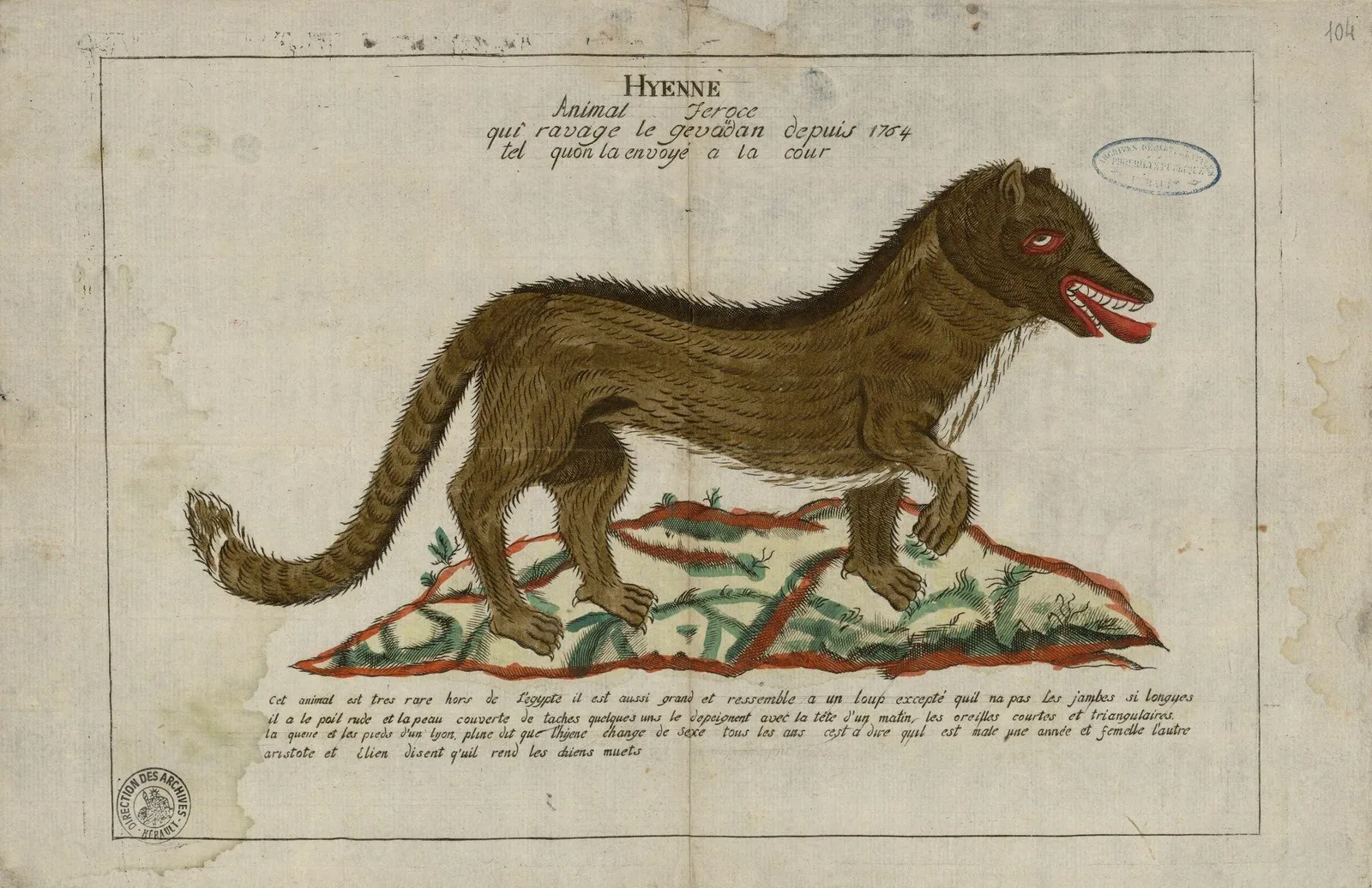
Hyenne, animal féroce qui ravage le Gévaudan depuis 1764, tel qu’on l’a envoyé à la cour (“Hyena, the ferocious animal that has ravaged the Gévaudan since 1764, as it was sent to the court”). Archives départementales de l’Hérault, C 44-2 (archives-pierresvives.herault.fr, file of 10 October 2023), Licence Ouverte.
Three kinds of paper
This article draws on three sorts of document, and they don’t carry the same weight.
The first is the press. The Gazette de France printed letters and reports that reached Paris, like the letter written at Marvejols on 1 November 1764 that gave the description above,9 or the item of March 1766 that came by way of Avignon.7 What it prints is secondhand: the Marvejols letter reports what witnesses said, and the Gazette ran it three weeks after it was written.9 The full Marvejols letter is on its own page, transcribed and translated.
The Courrier d’Avignon was quicker. On 16 November 1764, a week before the Gazette’s letter from Marvejols appeared, it passed on word from lower Languedoc of a beast that had eaten twenty-two people at Langogne and eight more near Mende. It was bigger than a dog, and “bien des gens la croyent une Hiene”, many took it for a hyena.12
The second is the parish registers, where priests recorded burials. The earliest victim historians have found is Jeanne Boulet, killed at the end of June 1764 and buried on 1 July.13 Her burial entry, as Moriceau transcribes it, says she was killed by “la bête féroce”.14 Moriceau built his whole list of victims from registers like hers,14 which makes his count the closest thing to a record of the dead.
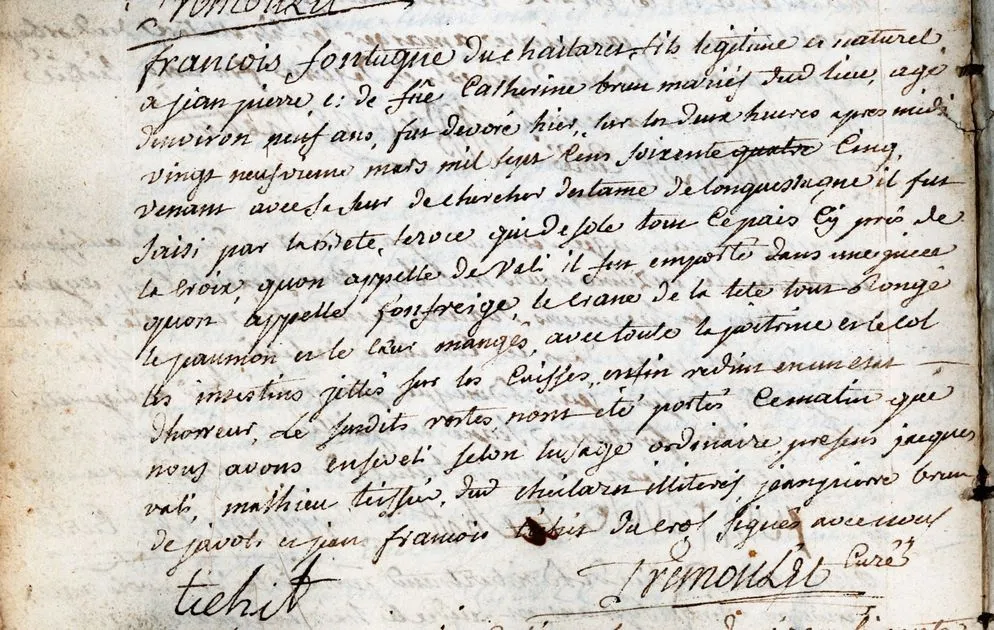
Death of François Fontugne, 29 March 1765, in the parish register of Javols. Archives départementales de la Lozère, EDT 076 GG 6 (archives.lozere.fr, file of 22 October 2012), Licence Ouverte.
The third is pamphlets and letters printed after the event, such as the letter from Auvergne that announced the kill of June 1767.15
This article leans on two historians who worked from these papers: Jean-Marc Moriceau, who compiled the victims from the registers,14 and Jay M. Smith, author of Monsters of the Gévaudan. Smith’s argument is that the province had a heavy wolf problem, and that the single beast was a creation of the press and the officials.4
The great hunt
The Gazette’s report of the hunt of 7 February 1765 is more specific than the legend it fed. Seventy-three parishes of the Gévaudan and thirty from Auvergne and the Rouergue sent men, about twenty thousand in all, led by the subdelegates, consuls and leading inhabitants.11 Hunters from the parish of Prunières started the animal. It crossed the Truyère at a ford where the far bank, which the people of Malzieu were supposed to be guarding, turned out to be empty. The vicar of Prunières and ten of his parishioners went into the river after it, swam part of the way in February, and followed its tracks in the snow until it escaped into a large forest.11
The disguises were real too. The Gazette of 18 February 1765 says Duhamel split his dragoons into squads and had several of them dressed “comme les femmes qui accompagnent les petits enfans lorsqu’ils vont garder les troupeaux”.10 Smith quotes Duhamel himself on the old skirts and women’s wigs.10
A wolf for the king
Antoine’s wolf was, by the Gazette’s own account, a wolf. The report of 4 October 1765 says the most experienced hunters judged it “un véritable loup qui n’avoit rien d’extraordinaire ni pour la taille ni pour la conformation”, a true wolf, nothing out of the ordinary in size or build.6 Its body reached Versailles on 1 October.6
The court had its ending. The Gévaudan did not. Smith counts 24 known deaths between December 1765 and June 1767,7 all of them after the wolf that was supposed to have done the killing.
Counting the dead
| Count | Dead | Based on |
|---|---|---|
| De Beaufort (1987) | 113, plus 49 wounded | his tally, cited in a 2002 Norwegian report3 |
| Moriceau (2008) | under 100 | parish burial registers314 |
| Smith (2011) | 83 | 59 by the end of 1765, 24 after; our sum3 |
The counts differ mostly on which deaths each historian credits to “the beast” rather than to ordinary wolves, so the honest answer is a range: between about 80 and 113 people.3 The letter that announced Chastel’s kill in 1767 claims three hundred. Nobody who has counted the burials comes near that.
The ages are less disputed. Of the 79 dead whose age Moriceau could establish, 51 were between 8 and 15, and 63 were under 20.162 Every victim over 20 was a woman.2 Smith found no adult man among the dead to the end of 1765.2 Most were out minding small flocks when they were attacked.1
Chastel’s shot
The attacks stopped after 19 June 1767, during a hunt led by the Marquis d’Apchier.15 The printed letter from Auvergne names the man who fired:
Dans cet instant, le nommé Jean Chastel, du village de Labessaire, lui tira un coup de fusil, chargé d’une balle & de cinq chevrotines.15
Just then a man named Jean Chastel, from the village of Labessaire, fired at it. His gun was loaded with a ball and five pieces of buckshot.
One detail doesn’t line up, and we can’t yet say why. The letter has d’Apchier’s party entering a wood it calls “la Tournelles”, above the village of Auvers, the night before; Smith places the kill in the wood of La Ténazeyre.15 They may be two names for one wood, or the letter may be vague about where the party ended up. We haven’t found a map or register that settles it.
Legend against record
| The story | The record | Verdict |
|---|---|---|
| One beast | Several wolves: Moriceau, Smith, Pelissier4 | Contradicted |
| Killed by the king’s gunbearer, 1765 | Killing again by March 17667 | Contradicted |
| Far bigger than a wolf | Witnesses said so9; the hunters found an ordinary wolf6 | Disputed |
| A silver bullet | One ball, five buckshot15 | Unsupported |
| Hundreds dead | About 80 to 1133 | Contradicted |
What the animals were
Moriceau concludes that several predatory wolves did the killing, and F.-L. Pelissier, in a 2024 article, that the animals killed in 1765 and 1767 were canids, probably wolves.4
The one live dispute is whether any of them were part dog. A 2002 report of the Norwegian Institute for Nature Research says the animals were “believed to be hybrids” with large shepherd dogs, and in 1961 M. Balmelle published a document describing an animal born of a wolf and a bitch.5
The silver bullet
No document we have read puts a silver ball in Chastel’s gun. The earliest account of the shot is the letter from Auvergne quoted above, dated at Langeac less than three weeks later.15 Its title calls the animal “la vraie Bête féroce”, the true ferocious Beast, which reads like an answer to the court’s wolf of 1765.
What we could not verify
Sources we have not seen
- Abbé Pourcher’s Histoire de la Bête du Gévaudan (1889), over a thousand pages of documents and local tradition, would show where the stories of Chastel’s trip to Versailles and his reward first appear. The BnF holds it on paper and microfilm but has not put it on Gallica, HathiTrust has only a 2006 reprint that it does not show, and no library we checked has digitised the 1889 edition.
- Moriceau’s 2021 book has a chapter on the rewards, which would say whether Chastel was paid. The book is in copyright, and Google Books finds Chastel on only one of its pages, with no preview.
Seen only where others quote them
- De Beaufort’s count of 113 dead and 49 wounded (1987), which we cite through the 2002 Norwegian report. His 1987 booklet Le loup en France leaves man-eating wolves to research then in progress, and his 1988 Rennes thesis has no copy online.
Resting on a single source
- Crouzet (2001) reports that the silver bullet starts with Henri Pourrat’s novel of 1946. We have not checked it.
Questions we could not settle
- The day Antoine’s wolf died: 20 September 1765 in the Gazette, 19 September in some of Antoine’s own papers (wrongly dated in his own hand, Smith says, p. 340), 21 September in de Beaufort’s table of wolf weights (1987, p. 20).
- Where the silver bullet comes from. The earliest one we found is in a novel by Berthet (1862 edition, p. 231), and it isn’t about Chastel.
- What happened to Chastel afterwards. The trip to Versailles and whether he was paid rest on the tradition Pourcher recorded.
Read next
CaseVärend, Småland, Sweden, 1883 to 1889
The lindworm reward in Småland was never claimed
TaleEdam and Haarlem, Holland, Netherlands, 1403 to 1786
Before the Edam mermaid had a tail
TaleVrhnika (Ober-Laybach), Slovenia, 1684 to 1689
Vrhnika's baby dragons: Valvasor's lizard and the olm
Sources
- Smith 2011, p. 1, search "grisly deaths"
- Jean-Marc Moriceau, La Bête du Gévaudan 1764-1767 (Larousse, 2008), p. 252, age table p. 277, search "63 sur 79"↑
- Gazette de France, 23 Nov 1764, view 4 (primary)
- Moriceau 2008, p. 252, search "63 sur 79"
- Smith 2011, p. 80, search "adult male"↑
- Moriceau 2008, p. 248, search "total des tués"
- Smith 2011, p. 240, search "fifty-nine"
- The fear of wolves, NINA Oppdragsmelding 731 (Norwegian Institute for Nature Research, 2002), p. 19↑
- Moriceau 2008, pp. 258, 261, search "plusieurs loups"
- Smith 2011, p. 23, search "multiple wolves"
- F.-L. Pelissier, Scepticisme scientifique 2 (2024), pp. 50-67, abstract↑
- Gazette de France, 4 Oct 1765, view 4 (primary)
- Gazette de France, 25 Oct 1765, view 4: "ce qui fait juger que c'est ce même loup qui a fait les ravages" (primary)
- Smith 2011, p. 228, search "1 October"
- Moriceau 2008, p. 183, search "Versailles"
- Archives départementales de la Lozère, online exhibition "2000 ans d'histoire : 12 dates qui ont fait la Lozère d'aujourd'hui", room "1764-1767 La Bête du Gévaudan : le loup dans les campagnes", text "La chasse au loup": "Antoine de Beauterne abat un gros loup, mais les attaques continuent"↑
- Gazette de France, 24 Mar 1766, view 4: "On écrit d'Avignon qu'il a paru dans le Gevaudan une nouvelle bête féroce qui a déjà dévoré & blessé plusieurs personnes" (primary)
- Smith 2011, p. 240, search "twenty-four known"
- Archives départementales de la Lozère, online exhibition, room "1764-1767 La Bête du Gévaudan", text "La chasse au loup"↑
- Courrier d'Avignon, 11 Mar 1766, p. 83, col. 1 (quote checked on the page image) (primary)↑
- Gazette de France, 23 Nov 1764, view 4, letter from Marvejols: "le dos rayé de noir" (primary) transcription
- Smith 2011, pp. 91, 93, search "year-old bull"
- Figure du monstre qui désole le Gevaudan, BnF Estampes, Hennin 9187, catalogue note transcribing the caption (primary)↑
- Gazette de France, 18 Feb 1765, view 4: "on en a fait habiller plusieurs comme les femmes" (primary)
- Smith 2011, p. 95, search "women's wigs"
- Moriceau 2008, p. 104, search "déguisés en femmes"↑
- Gazette de France, 15 Mar 1765, view 4: "un Corps d'environ vingt mille chasseurs" (primary)
- Jay M. Smith, Monsters of the Gévaudan (Harvard UP, 2011), p. 96, search "approximately 20,000"↑
- Courrier d'Avignon, 16 Nov 1764, p. 372, col. 2 (checked on the page image) (primary)↑
- Jean-Marc Moriceau, La Bête du Gévaudan. Mythes et réalités (Tallandier, 2021), ch. I n. 1, burial entry transcribed from Arch. dép. Ardèche BMS 1757-1780 view 113
- Smith 2011, p. 7, search "Jeanne Boulet"↑
- Moriceau 2021, ch. I n. 1
- Moriceau 2008, p. 272, annex list
- Archives départementales de la Lozère, online exhibition, room "1764-1767 La Bête du Gévaudan", text "La chasse au loup": "Les registres paroissiaux consignant les actes de sépultures, parfois assortis de commentaires"↑
- Lettre écrite d'Auvergne (Langeac, 6 July 1767; Paris, Lottin, 1767), view 2: "une balle & cinq chevrotines" (primary) transcription
- Smith 2011, pp. 240-241, search "Ténazeyre"
- Moriceau 2008, p. 11 (map 6 legend), p. 245, search "19 juin"
- Archives départementales de la Lozère, online exhibition, room "1764-1767 La Bête du Gévaudan", text "La chasse au loup"↑
- Gazette de France, 23 Nov 1764, view 4: "sur-tout des enfans" (primary)
- Moriceau 2008, p. 252, table p. 277↑
Documents quoted
- Gazette de France, 23 November 1764: letter from Marvejols (transcribed from the page image)
- Letter written from Auvergne to the Comte de ***, 1767: the death of the Beast (first page) (transcribed from the page image)