 Twice Told
Kraków's Wawel dragon had no cobbler until 1597
The oldest telling of the Wawel dragon, Kadłubek's, has a crag, no cave and no cobbler. The cobbler Skuba first appears in Bielski's chronicle of 1597.
Contents
Published 24 Oct 2026. Sources checked 18 Oct 2026.
The City of Kraków’s own page on the Dragon’s Den says the first news of the cave came, together with the legend, from Master Wincenty, called Kadłubek, in his chronicle.6 Kadłubek writes of “the hollows of a certain crag”, and the word Wawel is not in the passage.73 The cobbler who advises the dragon’s killer in the telling below is in the 1597 edition and in none of the earlier texts we read.85
The story, as Bielski’s chronicle printed it in 1597, goes like this.8
A man named Krok built a castle on a rocky hill called Wawel and moved the royal seat there from Gniezno, because the place seemed better and easier to defend.8 Under the hill lived a great dragon that ate three head of livestock at a time and stole and devoured people.8 The people had to give it three calves or rams every day.8
Krok had a calf’s skin stuffed with sulphur and laid before the dragon’s den in the morning.8 A certain cobbler, Skuba, had advised it, and Krok afterwards rewarded him and provided for him.8 The dragon came out, took it for a calf and swallowed it whole.8 While it smouldered inside, the dragon drank water for so long that it died.8 Its den is still there under the castle, and people call it the Dragon’s Den.8
The crag in Kadłubek
Kadłubek was a bishop of Kraków and, according to Gapski and Banaszkiewicz, the earliest writer to tell the story.91 Banaszkiewicz places his Chronicle at the end of the twelfth century.10 Kadłubek tells the monster as part of a story about the succession. Poland had grown very prosperous under Graccus, Kadłubek writes, and would have judged his offspring most worthy of the succession, had one of the sons not stained himself with a brother’s blood.11
In the hollows of a certain crag, Kadłubek writes, lived a monster that “some” believe is called an olophagus, a word Gapski glosses as “all-devourer”.71 Every seven days it was owed a fixed number of cattle, or the same number of human heads.7 Graccus, “a gentler son to his country than a father to his sons”, called his sons in secret.12 They told him that command was his and obedience theirs, and that they would use cunning: hides of cattle filled with burning sulphur, set out in the usual place.12 The olophagus swallowed them greedily and was suffocated by the flames inside.12 The plan is the sons’, not the father’s.
The younger son then killed his brother, whom he saw as a rival and not a partner, wept crocodile tears and told his father the monster had done it.13 The father welcomed him as a victor.13 The trick came out soon after, and he was exiled for ever.13 The monster’s death is followed soon by a murder, and the city is built on the monster’s crag.132 Gapski notes that some scholars read the beast’s death, or the brother’s, as a foundation sacrifice for the new city.14
The city comes in a few lines later. A famous city, Kadłubek writes, was founded “on the crag of the olophagus” and called Cracovia from the name of Graccus, so that Graccus would live in memory.2 Some, he adds, derived the name from the croaking of ravens that flocked to a corpse.2 Gapski observes that Kadłubek names the monster’s home only very generally.3 Neither Wawel, nor the Vistula, nor a cobbler is named in the passage.3
The trick has a model in scripture. Daniel 14 in the Vulgate has the prophet kill a dragon by putting lumps of pitch, fat and hair in its mouth, and the dragon bursts.15 Gapski, citing Kürbis and Plezia, reports that some see a direct line from Daniel to Kadłubek, and Banaszkiewicz quotes Kałuża saying that the prophet suggested the manner of the killing.15 Banaszkiewicz adds that Thomas of Cantimpré’s recipe for catching a dragon, a calf filled with quicklime, was already in circulation, and that Wincenty chose sulphur instead.16
From crag to cave
In the texts we read, the crag becomes a cave in a single word. An anonymous Chronica Polonorum, which the title page of its Warsaw printing of 1752 dates to about 1285, tells Kadłubek’s story with a cave in place of the crag: the monster lives in the hollows of a cave, “spelunca”.17 Its founding sentence reads that Cracovia was built “on the crag, that is the cave, of the olophagus”.17 A cobbler does not appear in it.17
The same 1752 volume prints a second chronicle under the name of Bishop Boguphalus II of Poznań.18 It says a man called Crak built a castle named Cracovia where the place had been called Wawel, and it explains the word as a goitre that people living in the mountains get from drinking the water.18 It tells no dragon story in the pages we read.18 The 1752 title page gives about 1285 for the first chronicle, and we did not check modern editions of either.17
Jan Długosz is the first author we read who puts the beast under Wawel by name, and Banaszkiewicz, summing up Kałuża, places him in the fifteenth century.1920 His list of Poland’s mountains says that the hill has several caves in which, “writings and report” say, a dragon and a beast of wondrous size once lived.21 When Grachus built his castle there, a beast with the look of a dragon or olophagus had its lair in the cave.19 It devoured livestock and people, the citizens thought of leaving, and Grachus ordered three animals thrown to it every day.19 When that proved heavier on the prince than on the citizens, he had the bodies filled with sulphur and tinder and sealed with wax and pitch, a reading of an uncertain phrase.19 The beast swallowed them, burned inside and died.19 Długosz has no cobbler and no sons, and the beast does not drink.1922
A bracteate with the legend KASMIR DUX CRA, found in Kraków in 1999, shows a human head above a dragon’s head.23 Banaszkiewicz, following Paszkiewicz, dates it to about the middle of the thirteenth century and ties it to Konrad I.23 He concludes that from about that time there was no doubt about the Wawel monster’s dragon nature, which puts a Kraków dragon well before Długosz.2320
Martin Kromer, in the printing of 1568, names the beast as the one his people call Holophagus and says Cracus killed it by a trick, with bodies stuffed with pitch, sulphur and kindled tinder.24 He adds “I do not know whether this is a fable”, and says the deep cave in the rock can still be seen, called the dragon’s cave, though nature may have made it.24
None of these texts has a cobbler.5
Skuba enters in 1597
The 1554 edition of Marcin Bielski’s world chronicle tells the story as something Polish chroniclers wrote.25 Under the hill Wawel, it says, a great dragon lived in a cave, stole and devoured people and killed with its stinking breath, and was given three head of livestock a day, until Grakus had a hollowed-out calf prepared with sulphur, pitch and saltpetre.25 The dragon ate it, and while it burned the dragon drank water until it burst.16 No cobbler is named in the words we can read; a paper repair hides the first letters of several lines, which in our reading is too little to hold one.255
In Kadłubek, Długosz and Kromer the beast dies of the burning stuffing, with no drinking.22 Banaszkiewicz quotes Thomas of Cantimpré’s recipe, which, he says, was already circulating when Wincenty wrote: the burning dragon goes to water and burns the more the more it drinks.16
The 1597 edition of the Kronika polska is recorded in a library catalogue as newly published by Joachim Bielski, Marcin’s son.26 On the page that tells of Krok, the founder of the city, it rejects the Roman Gracchus as the old writers’ mistake.27 The dragon passage keeps the sulphur and the water, though the dragon now dies where in 1554 it burst, and adds a cobbler named Skuba, on whose advice Krok acted and whom he rewarded.816 The 1554 edition, Długosz and Kromer have none.5
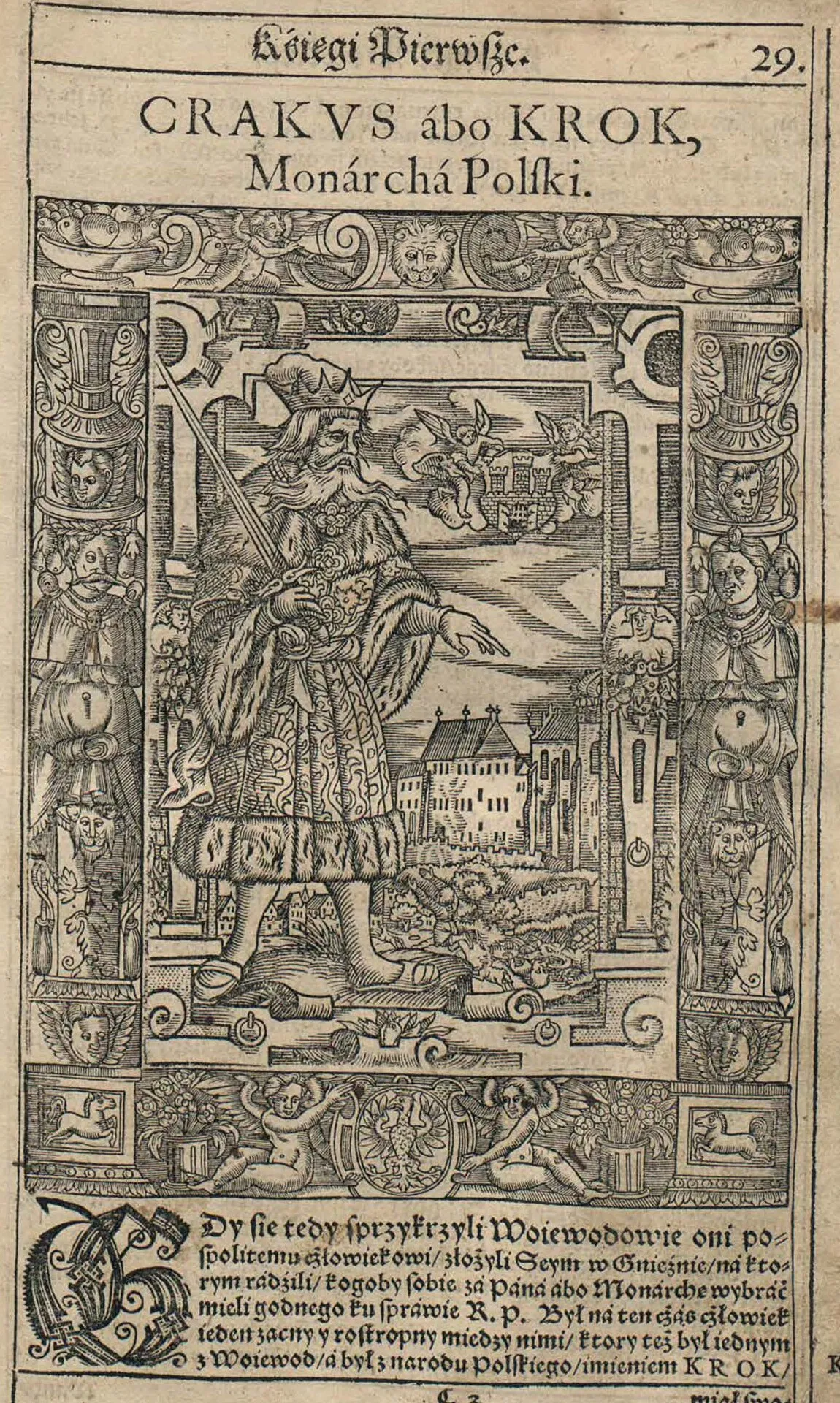
Krok, “monarch of Poland”, with a castle behind him: the woodcut on the other side of the leaf whose page 30 names the cobbler Skuba. Anonymous woodcut, from Joachim Bielski, Kronika polska Marcina Bielskiego (Kraków: Drukarnia Jakoba Siebeneychera, 1597), page 29. Biblioteka Jagiellońska, BJ St. Dr. Cim. 8176, Jagiellonian Digital Library, public domain. Cropped.
Banaszkiewicz offers an explanation: the manner of killing the dragon later gave the plot an impulse that produced the figure of a brave cobbler, finally named Skuba.5 The 1829 editor of the Warsaw reprint reports that Ossoliński held Joachim to have written the Polish chronicle largely himself and credited it to his father.26 We did not find a study that says which of the two wrote the page with the cobbler.
Six texts side by side
| Text | The beast’s home | Who kills it | The stuffing | A cobbler |
|---|---|---|---|---|
| Kadłubek, end of the 12th century by Banaszkiewicz10 | Hollows of a crag7 | Graccus’s sons12 | Sulphur12 | None3 |
| Anonymous chronicle, about 1285 by its print’s title17 | A cave17 | Graccus’s sons17 | Sulphur17 | None17 |
| Długosz, 15th century by Kałuża, via Banaszkiewicz20 | Cave under Wawel19 | Grachus, by decree19 | Sulphur, wax, pitch19 | None5 |
| Bielski, 1554 | Cave under Wawel25 | Grakus25 | Sulphur, pitch, saltpetre25 | None5 |
| Kromer, 1568 | Cave under the castle hill24 | Cracus, by a trick24 | Pitch, sulphur, tinder24 | None5 |
| Bielski, 1597 | Den under Wawel8 | Krok8 | Sulphur8 | Skuba8 |
The feeding changes too: a count of cattle every seven days in Kadłubek, three animals a day in Długosz and in both Bielski texts.719258
In the texts we read, the cobbler is not in the edition of 1554 and is in the one of 1597.58 Bielski’s editions printed in between, and other sixteenth-century chronicles we have not read, could still move his first appearance.
What we could not verify
Sources we have not seen
- Chronica Dzirsvae, edited by Kazimierz Pawłowski (Kraków, 2013). Banaszkiewicz says it adds gypsum, lime and pitch and cites Daniel’s dragon; we could not find it online, so we cannot say what it adds to the story.
- Bielski’s chronicle in the editions printed between 1554 and 1597. The scan on the Internet Archive called “1564” holds only a few pages, so we cannot say which edition first has the cobbler.
- Maciej of Łabiszyn, whom Kałuża names as writing of the Kraków dragon before Długosz. We did not identify his text; it would show whether Długosz was the first to put the beast under Wawel.
Seen only where others quote them
- Kałuża’s article of 2010, through Banaszkiewicz’s quotations. It is the source of the view that the olophagus is a human-shaped monster and that Długosz made it a dragon. The journal’s present site lists only recent issues, and we found no other copy online.
- Thomas of Cantimpré’s recipe for catching a dragon, through Banaszkiewicz’s footnote. It is the nearest model we have for the water.
- Paszkiewicz’s article of 2004 on the bracteate KASMIR DUX CRA, through Banaszkiewicz. It is the evidence for a Kraków dragon around the middle of the thirteenth century.
Questions we could not settle
- Whether Marcin or Joachim Bielski wrote the page with the cobbler, and where either of them found Skuba.
- When the anonymous chronicle and the one printed under Boguphalus II were written. The 1752 print gives about 1285 for the first, and we did not check modern scholarship.
Read next
CaseBasel, Switzerland, 1474 to 1906
Basel's burned rooster
CaseVärend, Småland, Sweden, 1883 to 1889
The lindworm reward in Småland was never claimed
TaleEdam and Haarlem, Holland, Netherlands, 1403 to 1786
Before the Edam mermaid had a tail
Sources
- Marcin H. Gapski, Roczniki Humanistyczne 58:2 (2010), pp. 5 to 11, p. 5, opening: the Chronicle "jako pierwsza przyniosła wiadomości" of the monster later called the Wawel dragon, and Kadłubek named it with a term "niespotykanym przed nim i również unikanym później" (not met before him and avoided later); the term is glossed there as "holophagus – całożerca" (all-devourer); abstract: he "created his own term"
- Jacek Banaszkiewicz, "Smocze obrachunki", Res Historica 59 (2025), pp. 2025 to 2040, p. 2026, paragraph 2: the dragon "o którym jako pierwszy poinformował nas mistrz Wincenty Kadłubek"; p. 2038: "wymyślił mistrz Wincenty olofaga, nazwę oryginalną"↑
- Magistri Vincentii episcopi Cracoviensis Chronica Polonorum, ed. Przezdziecki (Cracow, 1862), p. 11, "Immo in scopulo olophagi fundata est urbs insingnis a nomine gracci dicta Cracovia", and p. 12, first lines, "Quam quidam a crocitacione corvorum, qui eo ad cadaver confluxerant, craccoviam dixerunt" (page images read) (primary) transcription
- Jacek Banaszkiewicz, "Smocze obrachunki. Przeciw olofagowi profesora Zenona Kałuży", Res Historica 59 (2025), pp. 2025 to 2040, p. 2033, footnote 31 (the phrase "in scopulo olophagi" is Kadłubek I, 7, 1 in Plezia's edition); p. 2038 (Banaszkiewicz reads the ravens as flocking to the body of the slain dragon and "croaking Kraków into being")↑
- Magistri Vincentii episcopi Cracoviensis Chronica Polonorum, ed. Przezdziecki (Cracow, 1862), pp. 9 to 12 read through on the page images: the places named are the crag ("scopulus") and, on pp. 11 to 12, Cracovia; the words Wawel, Wisla and a cobbler do not occur (our reading of those pages) (primary)
- Marcin H. Gapski, "Smok smokowi nierówny, czyli rzecz o pochodzeniu istot smoczych w Kronice polskiej mistrza Wincentego zwanego Kadłubkiem", Roczniki Humanistyczne 58:2 (2010), pp. 5 to 11, p. 5, second sentence: Kadłubek "bardzo ogólnie wspomniał o jej miejscu zamieszkania" (mentioned its dwelling only very generally)
- Jacek Banaszkiewicz, "Smocze obrachunki", Res Historica 59 (2025), pp. 2025 to 2040, p. 2026, paragraph 2: reporting Kałuża, "nie ma bowiem nigdzie w Kronice mowy o wawelskim drakonie – jest tylko olophagus i monstrum"↑
- Jacek Banaszkiewicz, "Smocze obrachunki", Res Historica 59 (2025), pp. 2025 to 2040, pp. 2025 to 2026 (abstract and opening); p. 2028, the quotation "zadomowiony pod Wawelem Całożerca był... człekopodobny"; p. 2035, Kałuża's "definitywna metamorfoza potwora-Całożercy w krakowskiego smoka" in Długosz's Annals↑
- Marcin Bielski, Kronika polska (Kraków, 1597), p. 30, "co vczynił za rada Skuba Szewca niakiego" (page image read, leaf n47) (primary)
- Marcin Bielski, Kronika wszytkyego swyata (Kraków, 1554), fol. 234, the paragraph on the dragon: Grakus has the calf prepared; no cobbler or adviser is named in the readable words; the hidden stretches are a few letters at the start of each line, which in our reading is too little to hold one (page image read, leaf n449) (primary)
- Joannis Długossi Historiae Polonicae, tomus 1 (Leipzig, 1711), Liber I, pp. 51 to 52: Grachus acts by "mandato & decreto"; no adviser (page image read, leaf n158) (primary)
- Martin Kromer, De origine et rebus gestis Polonorum (1568 printing), Liber II, p. 21: Cracus acts "astu" (by a trick); no adviser (page image read, leaf n36) (primary)
- Jacek Banaszkiewicz, "Smocze obrachunki", Res Historica 59 (2025), pp. 2025 to 2040, p. 2038, last paragraph before the closing remark: the manner of killing the dragon "dał przecież później fabularny impuls, który doprowadził do powstania postaci dzielnego szewca-pogromcy potwora, nazwanego w końcu Skubą" (later gave the plot impulse that led to the brave cobbler-slayer, named Skuba in the end); footnote 49 cites his essay of 2015↑
- Oficjalny serwis miejski Kraków, "Smocza jama" (Referat Mediów Miejskich; published 2010-07-21, updated 2025-05-12), page text, paragraph after the cave's dimensions: "Pierwszą informację o jaskini podał wraz z legendą o smoku wawelskim mistrz Wincenty zw. Kadłubkiem w Kronice polskiej (XII/XIII w.)"; read 2026-10-18↑
- Magistri Vincentii episcopi Cracoviensis Chronica Polonorum, ed. Alexander Przezdziecki (Cracow, 1862), p. 9, from "Erat enim in cuiusdam scopuli amfractibus monstrum" to "humanis totidem capitibus a monstro plecterentur" (page image read) (primary) transcription↑
- Marcin Bielski, Kronika polska (Kraków, 1597), p. 30, the last third of the page, from "Przytymże Miescie KROK załozył Zamek" to "zowia Smocza iama"; margin notes "Wawel" and "Smok" (page image read, leaf n47) (primary) transcription↑
- Magistri Vincentii episcopi Cracoviensis Chronica Polonorum (Cracow, 1862), catalogue record, Internet Archive record, title field: "Magistri Vincentii episcopi Cracoviensis Chronica Polonorum"; the edition's heading before the text reads the same
- Marcin H. Gapski, Roczniki Humanistyczne 58:2 (2010), pp. 5 to 11, p. 7, "w wywodach uczonego biskupa" (in the scholarly bishop's arguments), said of Kadłubek's Kronika polska↑
- Jacek Banaszkiewicz, "Smocze obrachunki", Res Historica 59 (2025), pp. 2025 to 2040, p. 2025, abstract ("Master Vincent's Chronicle (end of 12th c.)") and p. 2026, Polish summary ("koniec XII w.")↑
- Magistri Vincentii episcopi Cracoviensis Chronica Polonorum, ed. Przezdziecki (Cracow, 1862), p. 9, "Igitur polonia florentissimis per graccum aucta successibus ... nisi alter filiorum eius fratricidii fedasset piaculum" (page image read) (primary) transcription↑
- Magistri Vincentii episcopi Cracoviensis Chronica Polonorum, ed. Przezdziecki (Cracow, 1862), pp. 9 to 10, from "Quam graccus non ferens perniciem" to "exalantibus intro flammis suffocatur"; the sons' reply begins "Ad hec illi" on p. 10 (page images read) (primary) transcription↑
- Magistri Vincentii episcopi Cracoviensis Chronica Polonorum, ed. Przezdziecki (Cracow, 1862), pp. 10 to 11, from "Moxque minor tam victorie quam rengni" to "exilii perpetuitate dampnatus" (page images read) (primary) transcription↑
- Marcin H. Gapski, Roczniki Humanistyczne 58:2 (2010), pp. 5 to 11, p. 6, paragraph 1 ("ofiara zakładzinowa pod budowę nowego miasta"), with footnote 3 citing Kürbis (1976) and Deptuła (2003)↑
- Vulgate, Daniel 14:26, Daniel 14, verse 26: "Tulit ergo Daniel picem, et adipem, et pilos, et coxit pariter: fecitque massas, et dedit in os draconis, et diruptus est draco" (online transcription of the Vulgate with a facing English text; not checked against a printed edition) (primary)
- Marcin H. Gapski, Roczniki Humanistyczne 58:2 (2010), pp. 5 to 11, p. 5, paragraph 2: some see a direct dependence between Kadłubek's myth and the Book of Daniel (Dn 14), citing Kürbis and Plezia in footnote 2
- Jacek Banaszkiewicz, "Smocze obrachunki", Res Historica 59 (2025), pp. 2025 to 2040, p. 2027, paragraph 1: Kałuża holds that "sposób uśmiercenia go podpowiedział Wincentemu prorok Daniel"; p. 2034, footnote 33, on the Chronica Dzirsvae adding gypsum, lime and pitch and citing the example of Daniel (reported, not read by us)↑
- Marcin Bielski, Kronika wszytkyego swyata (Kraków, 1554), fol. 234, the paragraph on the dragon: "gdy w nim tlato pit wode az sye rospukt" (page image read, leaf n449) (primary)
- Jacek Banaszkiewicz, "Smocze obrachunki", Res Historica 59 (2025), pp. 2025 to 2040, p. 2034, footnote 33, quoting Thomas of Cantimpré, Liber de natura rerum, 8, 16: a calf filled with quicklime, the dragon swallows it and "fontem mox petens quanto plus biberit, tanto plus accenditur"; Banaszkiewicz adds that Wincenty "wybiera siarkę" instead and did not content himself with "rozwiązaniem wówczas już kursującym i rozpowszechnianym przez Tomasza", a solution already circulating then (we did not read Thomas)↑
- Boguphali II. Episcopi Posnaniensis Chronicon Poloniae cum Continuatione Baskonis (Warsaw: Collegium Scholarum Piarum, 1752), the premised Chronica Polonorum, title page (leaf n2: "qui praemisit aliud Anonymi Chronicon circa Annum 1285 scriptum"); the passage is on the second spread of the premised text, pages unnumbered in the scan (leaf n5), from "Igitur Graccus Jura instituit" to "Cracoviam dixerunt"; the spelling there is "in cuiusdam spelunc[a]e antractibus" (page image read) (primary)↑
- Boguphali II. Episcopi Posnaniensis Chronicon Poloniae cum Continuatione Baskonis (Warsaw, 1752), p. 7, last lines, "nomine Crak" and "Ifte Crak, qui legitime Corvus dicitur"; p. 8, first lines, "Hic edificavit castrum, quod suo nomine Cracovia est appellatum, quod antea Wawel nomen habebat; Wawel enim quidam tumor dicitur" (page images read, leaves n23 and n24; the dragon's absence is our reading of pp. 1 to 9 of this chronicle, plus an OCR text search for draco, monstrum and olophagus, which is not reliable on this print) (primary)↑
- Joannis Długossi Historiae Polonicae, tomus 1 (Leipzig, 1711), Liber I, p. 52, right column, from "Inter tot tamen suorum primordiorum grata & foecunda auspicia" to "collapsa & extincta est"; the next sentence names the beast "Olophagus" as some writers call it (page image read, leaf n158) (primary) transcription↑
- Jacek Banaszkiewicz, "Smocze obrachunki", Res Historica 59 (2025), pp. 2025 to 2040, p. 2035, paragraph 2: Kałuża "wpuszcza go dopiero na scenę dziejową ... w XV stuleciu ... Jana Długosza" (brings it onto the stage of history only in the fifteenth century, in Jan Długosz)↑
- Joannis Długossi seu Longini Historiae Polonicae libri XII, tomus 1 (Leipzig, 1711), Liber I, p. 33, left column, entry "WAWEL, mons saxeus": "Videntur etiam in diem hanc in monte ipso plures specus, aut cavernae, seu antra latebrosa, in quibus draconem & belluam mirae magnitudinis habitasse, & incolas loci magnis incommodis affecisse, literis & fama vulgatum est" (page image read, leaf n149) (primary)↑
- Magistri Vincentii episcopi Cracoviensis Chronica Polonorum, ed. Przezdziecki (Cracow, 1862), p. 10: "que dum avidissime glutit olophagus, exalantibus intro flammis suffocatur" (suffocated by the flames) (primary)
- Joannis Długossi Historiae Polonicae, tomus 1 (Leipzig, 1711), Liber I, p. 52: "ab igne torrente, & flammis altius diffusis in interiora vrgentibus sensim collapsa & extincta est" (leaf n158) (primary)
- Martin Kromer, De origine et rebus gestis Polonorum (1568 printing), Liber II, p. 21: "ignis conceptus viscera belluae torruisset" (leaf n36) (primary)↑
- Jacek Banaszkiewicz, "Smocze obrachunki", Res Historica 59 (2025), pp. 2025 to 2040, p. 2036, paragraph beginning "Wszakże źródło numizmatyczne" and footnote 42 (Paszkiewicz, 2004)↑
- Martin Kromer, De origine et rebus gestis Polonorum libri XXX (1568 printing), Liber II, p. 21, from "Fertur etiam, immanem belluam, quam Holophagum vocant nostri" to "quod tamen etiam natura sic extitisse potuit" (page image read, leaf n36; the page number is printed small and was checked against pp. 20 and 22) (primary)↑
- Marcin Bielski, Kronika wszytkyego swyata (Kraków, 1554), Third Book, fol. 234 (printed "List 234"), the paragraph beginning "Pisali Kronikarze Polscy, iz pod tha gora Wawel", with the margin note "Smok pod zamkyem"; part of the paragraph's left edge is hidden by a paper repair strip, so the words in square brackets in the document file are our restorations or marked gaps (page image read, leaf n449) (primary) transcription↑
- Marcin Bielski, Kronika polska ... nowo przez Joachima Bielskiego syna jego wydana (Kraków, 1597), library record of the Wrocław copy, Internet Archive record dbc.wroc.pl.BOss_XVI_F.4009, title field: "Kronika Polska Marcina Bielskiego. Nowo Przez Ioach[ima] Bielskiego syná iego wydána", date 1597-08-18
- Kronika polska Marcina Bielskiego (Warsaw: A. Gałęzowski, 1829), editor's preface, Przedmowa, p. IV (leaf n15), the paragraph beginning "Joachim Bielski oycu Kronikę Polską": Starowolski and Okolski call parts Joachim's work and Ossoliński "przekonywa: że Joachim ... sam utworzył kronikę polską i przyznał ią w większey części oycu" (page image read)↑
- Marcin Bielski, Kronika polska (Kraków, 1597), p. 30, "Tento KROK załozył Miasto nad rzeka Wisła" to "z potomstwa Czechowego ieszcze" (page image read, leaf n47) (primary) transcription↑
Documents quoted
- Jan Długosz on Wawel hill and the dragon in its cave (Historiae Polonicae, 1711, Liber I) (transcribed from the page image)
- Marcin Bielski, Kronika polska (1597): Krok, the dragon under Wawel and Skuba the cobbler (transcribed from the page image)
- Marcin Bielski, Kronika wszytkiego swiata (1554): Grakus and the dragon under Wawel (transcribed from the page image)
- Master Vincentius (Kadłubek) on the olophagus and the founding of Cracovia (Przezdziecki's edition, 1862, pp. 9 to 12) (transcribed from the page image)