 Twice Told
Basel's burned rooster
Books say Basel's magistrates sentenced a rooster in 1474. The diary that records the burning names none; the magistrate first appears in a travel book of 1808.
Contents
Published 21 Oct 2026. Sources checked 18 Oct 2026.
Evans’s 1906 book on the punishment of animals says that in 1474 the magistrates of Basel sentenced a cock to be burned for laying an egg.9 The earliest account we found does not mention magistrates. It is a few lines in a chaplain’s Latin diary, and it says only that the bird was handed to the executioner.423
The story, as the books of strange trials tell it, goes like this.
In 1474 the magistrates of Basel sentenced a cock to be burned for the heinous and unnatural crime of laying an egg.9 An egg laid by a cock was feared, because it could hatch a basilisk.10 The burning was held on a height near the city called the Kohlenberg, before a crowd of townsmen and peasants, with as much solemnity as for a heretic.9 The cock was burned together with the egg it had laid.5 When the executioner cut the bird open, he found three more eggs inside.5
The sentence in the books
Evans writes that “the magistrates of Bale sentenced a cock to be burned at the stake” for that crime, and that the burning took place on the Kohlenberg.9 He calls Gross’s three further eggs “of course absurd”.9 We did not find his quoted words in either of the two texts below that tell the story.
His appendix names three sources for the case: a travel book, a memoir of a French learned society and Gross.9 The memoir is Berriat-Saint-Prix’s report of 1829 on animal trials, and the page Evans gives is the page of its table.8 Under 1474 the table has a “Sentence du magistrat de Bâle en Suisse” that condemns a cock to be burned for having laid an egg, and says the egg was burned too.8 Its authority is a newspaper, the Journal du département du Nord of 1 November 1813, which in turn follows a travel book, “Promenades pittoresques dans l’évêché de Bâle”, printed at The Hague in 1808.8 No Basel document is named.8
We found the travel book. Hentzy, in a letter about Basel, turns to the basilisk of the Gerberbrunnen fountain and says that in 1474, on the Thursday before St Lawrence’s day, the magistrate of Basel had the executioner burn a poor cock “accused of having laid a basilisk’s egg all by itself”.7 The magistrate appears in his telling and in no earlier text we read: Knebel and Gross have none, and Hentzy uses no word for sentence or judgment.725 He names no source. His three further eggs and the executioner who opened the bird are in Gross; Knebel has two further eggs.754
Other nineteenth-century writers add their own turns. Georg Friedrich Jäger wrote in 1831 that the Kohlenberg court, which sat on that hill, sentenced to death by fire a cock that was convicted of having laid an egg, and sent his reader to Gross.11 Osenbrüggen answered in 1868 that this sounds historical but is not, that Jäger names no source, and that the burning had nothing to do with that court.12 Osenbrüggen’s own account has the cock burned alive on the Kolenberg because it was convicted of laying an egg, and personified as a heretic.13
Gross’s worm, 150 years on
Johann Gross printed his Kurtze Bassler Chronick at Basel in 1624, a century and a half after the event.14 The cock is on p. 120, under a margin note “Hanen-ey verbrennt”, the cock’s egg burned.15 The passage carries no year.15 The entry before it is dated 1474 in the margin and the entry after it 1475, which is how the burning gets its year from Gross.15
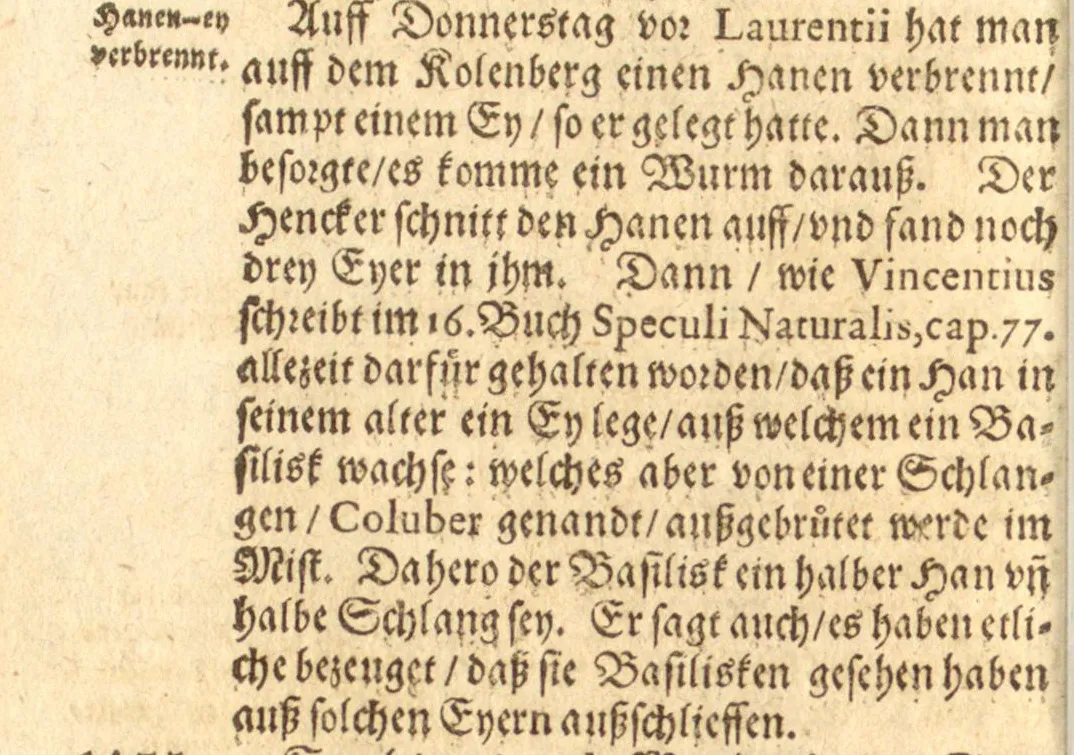
Johannes Gross, Kurtze Bassler Chronick, Basel 1624, p. 120. Universitätsbibliothek Basel, UBH EJ IV 28:2, e-rara.ch, Public Domain Mark, cropped.
Gross says that on the Thursday before St Lawrence’s day a cock was burned on the Kolenberg together with an egg it had laid, because people feared a worm would come out of it.5 The executioner cut the bird open and found three more eggs.5 To explain the fear he cites Vincent in the Speculum naturale: an old cock lays an egg, a serpent hatches it in dung, and the basilisk is said to be half cock and half serpent.5 Gross names no source for the burning itself.5
Gross is the first writer we found who says why anyone burned a bird: they were afraid of what the egg would hatch.5
Wurstisen’s August
We looked for the cock in Christian Wurstisen’s Baszler Chronick of 1580 as well.16 On the page where it reaches August 1474 it reports Burgundian raiders in the Sundgau, a Basel garrison sent to Tattenried and a meeting of the allies at Basel on 18 August.16 There is no rooster on that page.16
What Knebel wrote
Hans Knebel was a chaplain at the Basel cathedral and a notary of the university.3 His diary survives in his own hand, and the first of its two volumes runs from September 1473 to June 1476.3 The editors who printed it, Wilhelm Vischer and Heinrich Boos, compare it to a modern newspaper: whatever its writer saw or heard in the last few days.3 In their edition of 1880 the entry on the cock is seven printed lines long.4
De gallo qui ovavit. Anno domini 1474 die jovis quarta mensis augusti in civitate Basiliensi fuit quidam gallus 11 annorum, qui ovavit et produxit ovum longum. qui quidem gallus traditus fuit lictori cum ovo et amputato capite primo, deinde excentratus, in eo fuerunt reperta alia duo ova, que simul omnia fuerunt combusta prope domum lictoris in monte Carbonum, multis viris et mulieribus presentibus.4
About the cock that laid an egg. In the year of the Lord 1474, on Thursday the fourth of August, there was in the city of Basel a cock eleven years old that laid an egg, a long one. The cock was handed over to the executioner together with the egg. Its head was cut off first, then it was gutted, and two more eggs were found in it. All of these were burned together near the executioner’s house on the Kohlenberg, with many men and women there.
The cock was eleven years old, and the egg was long.4 The bird went to the executioner with its egg and lost its head first, and only then was it gutted, which is the order Osenbrüggen’s “burned alive” leaves out.413 The Latin says that “all together” were burned near the executioner’s house, with many men and women watching.4 Grammatically that points at the eggs; we read it as covering the bird too, as Gross does.45
That is the whole entry. It names no court, no judge and no charge, and it says nothing of a basilisk or a worm.2 Knebel does not call it a trial. The one place where Knebel and Gross cannot both be right is the count of eggs: two more in the diary, three in the chronicle.45
A danger, not a crime
Karl von Amira wrote in 1891 that almost all recent writers took the burning for an especially striking animal execution, and differed only on whether witchcraft or heresy was being punished.6 He thought the matter far simpler. In the popular belief of the Middle Ages and even later, he says, the feared basilisk egg is laid by a cock, so bird and egg had to be got out of the way, and fire does that best.17 On that reading it was a police measure and not a punishment.17 Evans, fifteen years later, rejected Osenbrüggen’s heretic as “far-fetched and wholly fanciful” and held that the bird was feared as an abnormal, inauspicious and so diabolic creature.18
The belief they all work from is old. Gross takes it from Vincent.10 Evans adds that the cockatrice egg was thought to come from a very old cock and to be hatched by a serpent, a toad or the sun, and that a French academician argued against the notion in 1710.10 Amira has the same belief for the Middle Ages and for later centuries.10
Point by point
| The story | The record | Verdict |
|---|---|---|
| A cock that laid an egg was burned at Basel | Knebel and Gross both record it1 | Confirmed |
| It happened in 1474 | Knebel: Thursday 4 August1 | Confirmed |
| The magistrates sentenced it | Knebel names no court; a magistrate in 1808, a “sentence” in 1829278 | Added later (1829) |
| It was burned for fear of a basilisk | Knebel is silent; Gross gives a worm and Vincent’s basilisk25 | Added later (1624) |
| Three more eggs inside | Knebel: two; Gross: three45 | Disputed |
We found no record made in Basel that says who ordered the fire. The 1829 table that Evans relies on cites a travel book, and the travel book names the magistrate without a source.897
What we could not verify
Sources we have not seen
- The Journal du département du Nord of 1 November 1813, the middle link in Berriat-Saint-Prix’s chain, which would show how a joke in a travel book became a “sentence”. Gallica holds the paper only from 1815. The Lille library’s digitised run has issues for February and May 1813 but none for the autumn.
- E. V. Walter’s essay “Nature on Trial: The Case of the Rooster That Laid an Egg” (1984), a study of this very case. Springer’s page for the chapter shows only a preview of subscription content.
- The Staatsarchiv Basel-Stadt’s weekly expenditure book Finanz G 11, which runs from December 1473 to June 1490 and so covers August 1474, and the annual account Finanz H 31 for 1474/75. A payment to the executioner, if there is one, would be there. The archive’s online catalogue lists both but shows no scan, so they can be read only in its reading room. Its entries for the council books stop short of 1474 or are undated, and a search for the cock, the egg and the basilisk finds nothing for that year.
Questions we could not settle
- Where Evans’s phrase “the heinous and unnatural crime of laying an egg” comes from: it is not in Knebel, Gross or Hentzy.
- Whether Jäger had a source beyond Gross for putting the sentence with the Kohlenberg court. Osenbrüggen says he named none.
- Whether Wurstisen mentions the cock on another page. We searched the machine-read text of the whole 1580 volume and looked at the page image only for August 1474; black-letter OCR is poor.
- What Gross used for his entry. He cites only Vincent, and his three eggs against Knebel’s two suggest he did not copy the diary.
Read next
CaseLucerne, Switzerland, 1420 to 2006
The Lucerne dragon stone: a pledge, a charter and a CT scan
TaleWawel hill, Kraków, Poland, the end of the 12th century to 1597
Kraków's Wawel dragon had no cobbler until 1597
CaseVärend, Småland, Sweden, 1883 to 1889
The lindworm reward in Småland was never claimed
Sources
- Hans Knebel, Diarium (Latin), in Basler Chroniken II, ed. W. Vischer and H. Boos, Leipzig 1880, p. 102, lines 11-17, entry "De gallo qui ovavit", dated Thursday 4 August 1474 (primary) transcription
- Johann Gross, Kurtze Bassler Chronick, Basel (J. J. Genath) 1624, p. 120, marginal note "Hanen-ey verbrennt", text from "Auff Donnerstag vor Laurentii" (primary) transcription
- E. P. Evans, The Criminal Prosecution and Capital Punishment of Animals, London 1906, p. 162
- Karl von Amira, "Thierstrafen und Thierprocesse", Mittheilungen des Instituts fuer oesterreichische Geschichtsforschung 12 (1891), p. 558 (offprint p. 14), sentence beginning "Ein sicherheitspolizeilicher Grund"↑
- Hans Knebel, Diarium, in Basler Chroniken II (1880), p. 102, lines 11-17 (primary) transcription↑
- Basler Chroniken II, ed. W. Vischer and H. Boos, Leipzig 1880, Vorrede, pp. iii-iv↑
- Hans Knebel, Diarium, in Basler Chroniken II (1880), p. 102, lines 11-17 (primary) transcription↑
- Johann Gross, Kurtze Bassler Chronick, Basel 1624, p. 120 (primary) transcription↑
- Karl von Amira, "Thierstrafen und Thierprocesse", Mittheilungen des Instituts fuer oesterreichische Geschichtsforschung 12 (1891), p. 558 (offprint p. 14), sentence beginning "Fast alle neueren Schriftsteller"↑
- M. Hentzy, Promenade pittoresque dans l'évêché de Bâle, La Haye (G. Bakhuysen) 1808, first letter, p. 21 (from "puisque l'année 1474") to p. 22, line 3 transcription↑
- E. P. Evans, The Criminal Prosecution and Capital Punishment of Animals, London 1906, p. 162 (quotation and Gross); appendix p. 317 (source list)↑
- Johann Gross, Kurtze Bassler Chronick, Basel 1624, quoting Vincent of Beauvais, p. 120 (primary)
- E. P. Evans, The Criminal Prosecution and Capital Punishment of Animals, London 1906, p. 163
- Karl von Amira, "Thierstrafen und Thierprocesse", Mittheilungen des Instituts fuer oesterreichische Geschichtsforschung 12 (1891), p. 558 (offprint p. 14)↑
- Georg Friedrich Jäger, Schwäbisches Städtewesen des Mittelalters, vol. 1, Stuttgart 1831, pp. 307-308, note 225 (begins on p. 307; the sentence is at the foot of p. 308), read from the page images↑
- Eduard Osenbrüggen, Studien zur deutschen und schweizerischen Rechtsgeschichte, Schaffhausen 1868, pp. 393-394 (Gross's sentence quoted, Kohlenberg as a place of execution) and p. 406↑
- Eduard Osenbrüggen, Studien zur deutschen und schweizerischen Rechtsgeschichte, Schaffhausen 1868, p. 147, paragraph beginning "Zum Ketzer personificirt war der Hahn"↑
- e-rara.ch, Universitaetsbibliothek Basel, shelfmark UBH EJ IV 28:2, catalogue record and PDF header, title "Kurtze Bassler Chronick ... von vierzehenhundert Jahren biss auff das M.DC.XXIV. Jahr", "Getruckt zu Basel, 1624"↑
- Johann Gross, Kurtze Bassler Chronick, Basel 1624, pp. 119-120, our reading of the page images (p. 120 left margin: "Hanen-ey verbrennt"; "1475" beside the meat-tax entry that follows) (primary)↑
- Christian Wurstisen, Baszler Chronick, Basel (Henricpetri) 1580, Sixth book, p. 440 (folio "ccccxl"), Basler Bistumbs Historien; also searched through the OCR of the whole volume for Hahn, Ei, Basilisk and Kolenberg with no relevant hit (primary)↑
Documents quoted
- Hans Knebel's diary, 4 August 1474: the cock that laid an egg (Basler Chroniken II, 1880, p. 102) (transcribed from the page image)
- Hentzy on the Basel cock, Promenade pittoresque dans l'évêché de Bâle (La Haye 1808), pp. 21 to 22 (transcribed from the page image)
- Johann Gross on the cock burned on the Kohlenberg (Kurtze Bassler Chronick, Basel 1624, p. 120) (transcribed from the page image)