 Twice Told
The earliest Nian beast we could find dates from 1933
The Nian, the beast driven off with red paper and firecrackers, is said to be thousands of years old. The oldest text naming it that we found is from 1933.
Contents
- The tellings we could date
- The beggar in the red robe
- Cowherds’ whips in the People’s Daily
- A white beast in Hong Kong, 1949
- A children’s page, 31 December 1939
- The chained dog on the Ziwei scroll
- Searching the older books
- Bamboo in the courtyard fire
- How the Nian might have started
- What would move the date
- What we could not verify
- Sources
Published 24 Sept 2026. Updated 25 Sept 2026. Sources checked 24 Sept 2026.
For Spring Festival 2009 the news portal china.org.cn told its readers that the festival’s origin “can be traced back thousands of years”, and that one of its most famous legends was the monster Nian.8 Encyclopaedia Britannica gives the Nian as a legend of Lunar New Year: a beast that ate people, feared red, noise and fire, and was the reason for red paper on doors, lanterns burning all night and firecrackers.8 The oldest text we could find that gives any creature the name Nian was printed in a Shanghai tabloid on 17 January 1933, and its author was not sure of the name.7
This is the story as china.org.cn told it in January 2009. A book on the festival published in 2003 tells it the same way.
Long ago there was a horned monster called Nian. It lived at the bottom of the sea all year and came ashore only on New Year’s Eve, to eat cattle and kill people. So every New Year’s Eve whole villages fled to the mountains.9
One year, as the people of Peach Blossom village were getting ready to run, an old beggar came in with a stick in his hand and a bag on his arm. Nobody had time for him except a grandmother at the east end of the village, who gave him food and told him to flee. He stroked his silver beard and said that if she let him stay the night, he would drive the monster away. She could not persuade him, so she went up the mountain alone.9
At midnight the Nian burst into the village. The grandmother’s house was lit up, and there was red paper on its doors. The beast howled and charged, and at the door there came a burst of explosions. It stopped, trembling. Then the door flew open and an old man in a red robe stood laughing in the courtyard, and the Nian fled.9
In the morning the villagers came back and found red paper on the doors, bamboo still cracking in the embers and candles still burning. They decided the beggar had been a god sent to drive out the calamity. Ever since, on New Year’s Eve, every family pastes red couplets on its doors, sets off firecrackers and keeps its lights burning through the night, and in the morning goes round to wish its neighbours well.9
That, the page said, is how the Spring Festival customs began.
The tellings we could date
These are the versions we read, by date of the text. The two from the 1990s and 2000s we know only as a journal article quotes them.
| Date | Text | What the Nian is and what stops it |
|---|---|---|
| 1933 | Sun Yusheng, column in Jingangzuan, Shanghai | a dog-like beast chained on Ziwei scrolls; perhaps called Nian7 |
| 1935 | Sun Yusheng, front page of Jingangzuan | lion-like, dog-like, eats people at night6 |
| 1939 | “Shen”, children’s page of Shenbao | four thousand years old; afraid of red10 |
| 1949 | Xuren, “Nianguan kao”, Ta Kung Pao, Hong Kong | white as snow; hunted to extinction11 |
| 1980 | Zhao Cifeng and Kang Xinmin, People’s Daily | whip-cracks, a red garment, lamplight12 |
| 1994 | Xu Jieshun, as quoted by Ge Yun | a beast called Xi; a boy called Nian13 |
| 2003 | Li Yingru, as quoted by Ge Yun | a sea beast; the beggar at Peach Blossom village9 |
| 2009 | china.org.cn | the beggar in a red robe; firecrackers, couplets9 |
The sections below go backwards, from the red robe to the chained dog, then into the older books.
The beggar in the red robe
The 2009 page gives no source for its story.9 Ge Yun, writing in the Minjiang University journal in 2013, quotes the same Peach Blossom tale from a 2003 book, Li Yingru’s Chunjie wenhua, down to the grandmother and the red paper.9 He sets two other versions beside it. In one, from a 2002 book, the Nian stays deep under the sea and families lock themselves in to eat the New Year’s Eve dinner. In the other, from a 1994 book by Xu Jieshun, the beast is called Xi and a small boy named Nian tells the villagers to hang red cloth and throw bamboo on the fire.1314 Zhu Chunxiang and Tao Zhang trace the Xi beast to a children’s story by Guo Mingzhi published in 1981 and made into a paper-cut film in 1984.13
Tao, writing in the Wenhui Bao in 2025, counts many popular books on folk customs in the 1980s that carried much the same Nian story.14
Cowherds’ whips in the People’s Daily
On 16 February 1980 the People’s Daily printed, on page 4, a short piece by Zhao Cifeng and Kang Xinmin, “The legend and customs of passing the year”.12 Their Nian has a huge, bloody mouth and comes out on the thirtieth of the twelfth month to eat its way from house to house. One year it runs from two cowherds racing to crack their whips, then from a red garment drying at a door, then from lamplight glaring through a crack. People learn that it fears noise, red and fire. Firecrackers, the authors say, probably grew out of the cowherds’ whips; the peach charms that became couplets were painted red to drive off evil.12
The piece names no region where the story was told and no source for it.15 It has no sea, no beggar and no red robe. Zhu Chunxiang, who went through the Republican-era papers, calls it the common version and finds its traces in many later folk-tale books; Tao gives it a large part in spreading the story.15 We read it only as database text, since we found no page image, so it is paraphrased here rather than quoted.
A white beast in Hong Kong, 1949
Three decades before that, the Hong Kong edition of the Ta Kung Pao gave the Nian white fur. On 28 January 1949 its supplement page carried a boxed paragraph, “Nianguan kao”, “An inquiry into the year’s pass”, signed Xuren. It opens as “a legend of China”:11
上古時代有一種非常兇猛的野獸,名叫「年」,全身的毛像雪一般白11
In remote antiquity there was a very fierce wild beast called Nian, with fur as white as snow all over.
Every thirtieth of the twelfth month it came out, broke open doors and picked the strongest people to eat, until people joined forces and killed these “Nian beasts” off. Later generations named the thirtieth of the twelfth month nian in memory.11 Then the writer turns, as Sun Yusheng had in 1935, to the year-end debts: a Nian that eats people is no story today but plain fact, and a happy festival turns into its opposite once guan, “pass”, is added to the word.11
A children’s page, 31 December 1939
In 1939 the Nian was already in the Shenbao. On the last day of 1939 the Shenbao ran a children’s weekly on page 13, and in it a short piece signed Shen, “The legend of passing the year”.10
據說,在四千多年前的時候,世界上有一種物,名叫年。這種動物很大,性喜冷,在每一年的終了,與第二年開始的那一夜,他就要出來吃人10
They say that more than four thousand years ago there was a creature in the world called Nian. It was very big and liked the cold, and on the night between the end of one year and the beginning of the next it came out to eat people.
The night became the year’s pass, the piece goes on, and the day after it, having survived, people called the new year. Later they learned to hang up something red, because red was what the Nian feared most.10 There are no firecrackers and no lamps in it yet, and nothing backs the four thousand years. The passage is transcribed and translated.
The chained dog on the Ziwei scroll
Six years before that, in the oldest text we found, the name Nian was a guess. Sun Yusheng, a Shanghai novelist and newspaperman who wrote as Haishang Shushi Sheng, was serialising his memories of old Shanghai customs in the tabloid Jingangzuan, printed with the English name The Diamond.716 On 17 January 1933 he reached the New Year cleaning, when families took down a year’s dust and hung pictures, and some of them hung a scroll of the star god Ziwei:7
畫家每繪一石柱、柱上鎖一似狗非狗之獸、或云是獸即天狗星、或云是獸名年、常欲食人、紫微星故鎖繫之、不令至下界肆惡、而使人不逢年患、故過年時懸此最宜、然腹儉如余、殊不知此典出處、且愧無從考證也7
The painter always draws a stone pillar with a beast chained to it that looks like a dog and yet is not a dog. One account makes the beast the Heavenly Dog star. Another gives its name as Nian and says that it is forever wanting to eat people, and that Ziwei keeps it chained so that it cannot go down to the world below and do harm, and people are spared the calamity of the Nian. That is why this is the best picture to hang at the New Year. But my learning is thin: I do not know where this story comes from, and I am ashamed to say I have no way of checking it.
Prints of this kind existed. A Qing print from Foshan titled Ziwei zhengzhao shows the young god riding a beast, with the pillar it was tied to; the Ziwei theme was also printed in Mianzhu and elsewhere, and Zhu illustrates a print dated 1901.17 The whole 1933 paragraph is transcribed and translated.
On 1 February 1935 Sun came back to the beast on the front page of the same paper, signing himself Shushi.6 This time it is not one guess among two. He remembers hearing the elders say, when he was small, that the Nian was an evil beast, “似獅非獅、似狗非狗”, like a lion and not a lion, like a dog and not a dog, that came out at night to eat people, and that it was the beast chained in the Ziwei pictures.6 He adds that the story “不見經傳、無從考證”: it is not in the classics and cannot be checked. Most of the column is about the lunar year-end, when debts fell due, and the poor who fear it more than any wild animal; someone tells him the Nian is nothing to fear if you never borrow.6 That column is transcribed and translated too.
Sun was born in 1863 or 1864; the Library of Congress record and Zhu give different years.16 If his memory in 1935 is right, the story was being told by the 1870s. That is our reading of a memory set down some sixty years later, and in 1933 the same man had written that he did not know where the story came from.
Searching the older books
We searched the Kanseki Repository, a full-text collection of about nine thousand pre-modern Chinese books, for 年獸. There were nine hits. Every one is an accident of adjacent characters, such as “a thousand years” followed by “beast”; none is a creature called Nian. The phrase “a beast named Nian” gave nothing, and “the Xi beast” gave nothing.
Others looked before us, with the same result. Ge Yun concludes that the Nian is not recorded in the old books and circulates only by word of mouth.1 Zhu read through the Song-dynasty Suishi guangji, the Qing Qingjia lu on the customs of Suzhou, and three Republican-era surveys of New Year customs, and found not a word about it.1
The words themselves point the same way. The Shuowen dictionary defines the character for nian as ripe grain. In the oracle-bone script it combines the signs for grain and for a person, and it came to mean a year from the cycle of the harvest.18 Xu Fengxian, a historian of astronomy at the Chinese Academy of Sciences, makes the same case in an abstract for the Chinese Astronomical Society’s 2018 meeting: nian has no sense of a beast in the oracle bones or the old texts, and the beast is a children’s story written in modern times.19 Ge and Zhu both point out that the chu of chuxi, New Year’s Eve, did not first mean “drive out”, so the eve was not named for driving anything away.20
Bamboo in the courtyard fire
What the old books do have is the noise and the fear. The Jingchu suishi ji, Zong Lin’s record of the year’s customs of the Jingchu region, from the Southern Dynasties, opens with New Year’s morning:2
正月一日是三元之日也春秋謂之端月鷄鳴而起先於庭前爆竹以辟山臊惡鬼2
The first day of the first month is the day of the three beginnings; the Chunqiu calls it the opening month. People rise at cockcrow and, before anything else, set bamboo bursting in the courtyard to ward off the shansao and evil ghosts.
The commentary explains the shansao from a book of marvels, the Shenyi jing: a man-like creature of the western mountains, a foot or so tall with a single foot, unafraid of people, which gave fevers to anyone who crossed it, and which fled in fright when bamboo was thrown on the fire and burst with a bang.21 The firecrackers of that time were real bamboo; gunpowder crackers came in around the Tang and Song, and spread widely under the Ming and Qing as a way to drive out sickness at the year’s end.222
The same book has families paste a painted cockerel on the door, hang reed ropes over it and plant peach-wood charms beside it, “百鬼畏之”, which the hundred ghosts fear.3 Xiao Fang, a folklorist at Beijing Normal University, follows those charms forward: words were written on them from the Tang and Song, and paper door gods and spring couplets took their place in the Ming.3
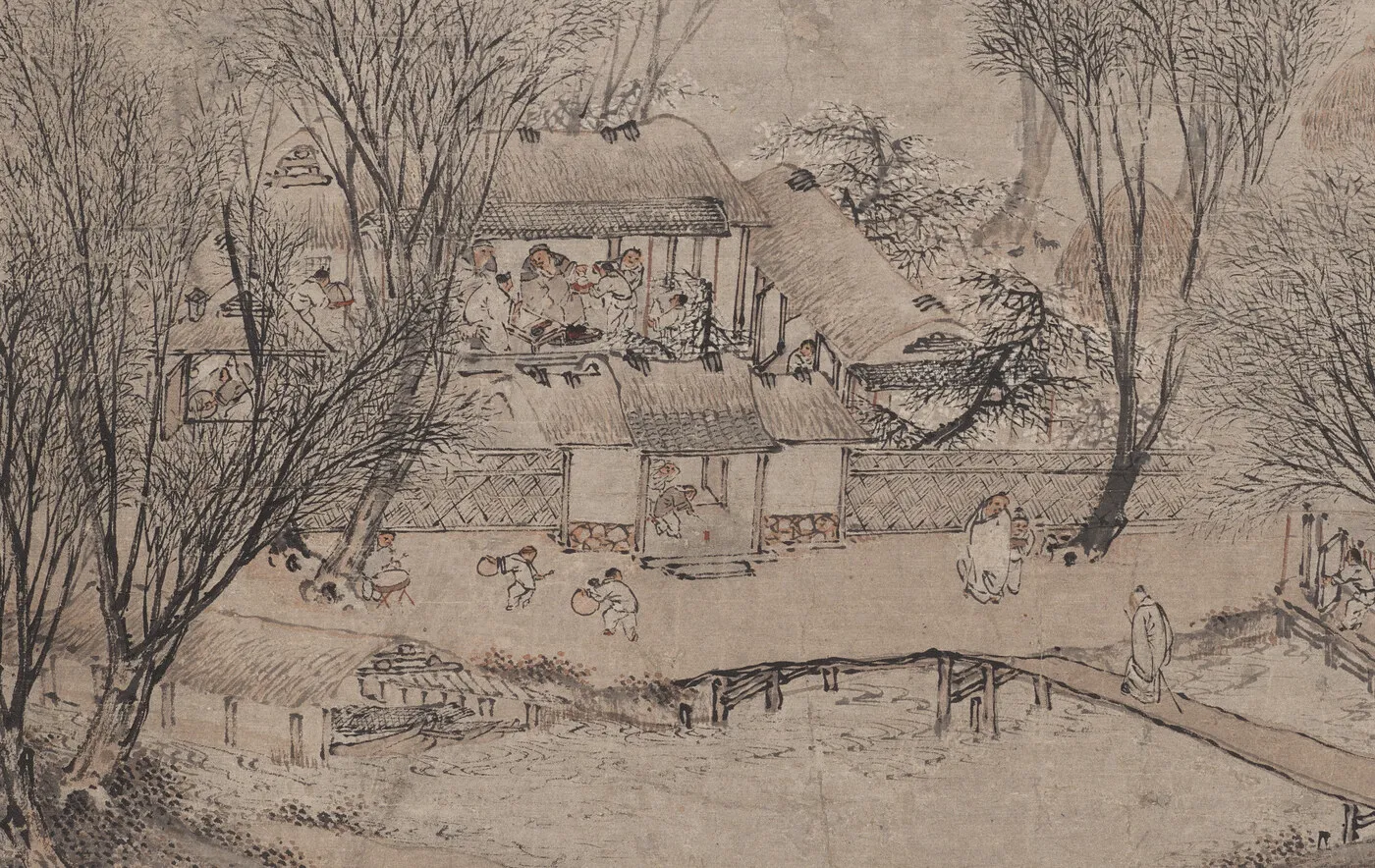
Li Shida, New Year’s Day in a Village at Stone Lake, dated 1609, album leaf (detail). The Cleveland Museum of Art, 1980.178, CC0.
So the thing a Nian story explains was already there. There was a creature to be scared off at the New Year, and a bang to do it with. The creature was a one-footed goblin called the shansao, and nobody in these texts calls it Nian.
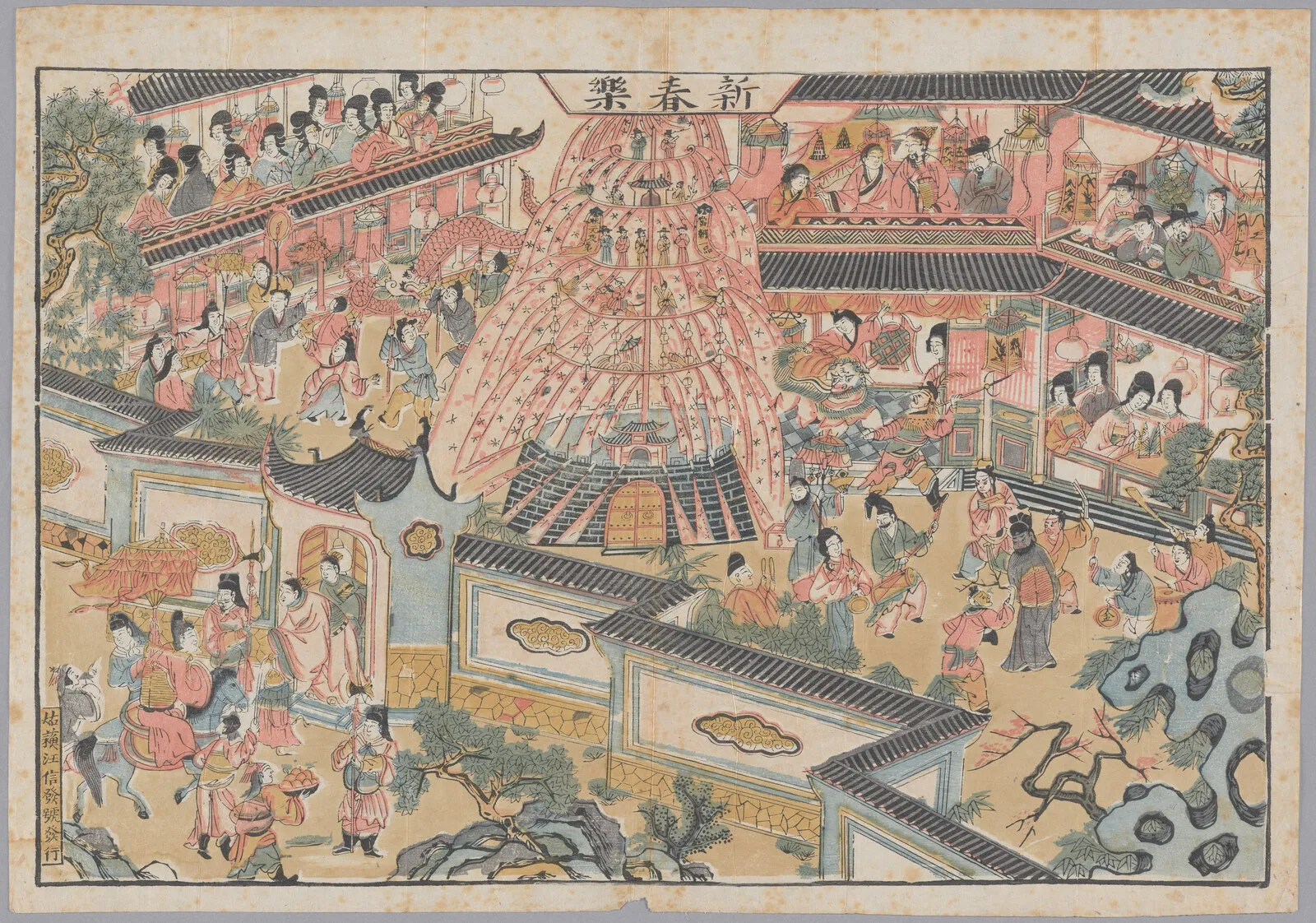
Happy New Year (新春樂), woodblock print, China, Kangxi reign (1662 to 1722). The Cleveland Museum of Art, 2025.93, CC0.
How the Nian might have started
Zhu Chunxiang, in his survey of the Republican texts, published by The Paper in 2019, takes Sun’s 1933 column as the source of everything after it. In his reading the Nian is what happens when the chained beast of the Ziwei prints meets the year’s pass, the season of debts; once woodblock prints faded out of city homes in the 1930s, later writers had no picture to go by and gave the beast any shape they liked.4 Sun’s own 1935 column already joins the two ideas.4
Tao Zhang, in 2025, reads the same evidence differently: the Ziwei beast was probably only one early type among Nian stories told aloud for a long time without any authoritative written record, and he points to how much the beast’s shape varies from one telling to the next.5 Ge Yun makes a related point: the story went round orally, and it came later than the customs it claims to explain, though he thinks the festival probably did begin partly as a way of driving off beasts and evil.523 Xiao Fang documents those rites, from the old year-end exorcisms to firecrackers set off to drive out sickness.23 A page in the Palace Museum’s magazine notices yet another version, in which Ziwei himself comes down to chain the Nian, and compares it with the Guangdong legend of Ziwei and the pixiu beast.17
None of them offers a text older than 1933.7
What would move the date
The earliest text we found is Sun Yusheng’s column on page 2 of Jingangzuan for 17 January 1933, where the Nian turns up in a paragraph about dusting.7 Three kinds of find could move that date back: a Ziwei print, older than 1933, that labels its chained beast Nian; a Qing or early Republican gazetteer or newspaper that tells the story; or an earlier column by Sun himself. We read only three issues of the two Shanghai papers, and their scans are too poor for a text search, so the runs have not been ruled out.
What we could not verify
Sources we have not seen
- Zhu Jiefan, “Questioning the legend that nian is a monster”, Taiwan fengwu 23.1 (March 1973), would show which version a folklorist in Taiwan was doubting by then. The journal’s archive sells each article for prepaid points, and we found no free copy.
- The page image of the People’s Daily for 16 February 1980, which would let us quote the article instead of paraphrasing a database text. The paper’s image archive needs a subscriber login, and the free copy we found is text only.
Seen only where others quote them
- Three versions Zhu Chunxiang quotes would show how the beast’s shape kept changing: the Tiebao of 16 February 1937 (one horn), Li Yi’s “Nian” in the magazine Dajia, 1 April 1947 (it comes on moonless nights), and Wang Yiping’s “The story of Nian” in the Xinmin Wanbao, 15 and 16 February 1959 (two heads). We found no scan of any of them on the Internet Archive or Wikimedia Commons.
- Lou Zikuang’s Suishi mantan (Taipei, 1967), where Zhu finds a sea beast near Tianjin driven off by a beggar in a red robe, the earliest print he gives for the version china.org.cn told. The book is in copyright, and the one scanned copy we found, at HathiTrust, is search-only.
Read next
CaseBeijing, China, 1476 to 1477
Heisheng, Beijing's black creature of 1476, and the Western Depot
TaleChina, 1679 to 1985
Before jiangshi hopped, they ran
TaleLeifeng Pagoda, Hangzhou, China, 975 to 2002
Lady White Snake and the fall of Leifeng Pagoda
Sources
- Ge Yun 2013, section 二.1
- Zhu Chunxiang 2019, paragraphs beginning 揆诸典籍 and 此前,翻阅↑
- 宗懍, 荊楚歲時記, Osaka: 北田清左衛門, 1737, Waseda University Library ヲ07 01123, PDF p. 4, first leaf of text (primary)
- Zhang Bo 张勃, 中华民俗通志·正月志 (draft chapter, China Folklore Society site, 2009), p. 2
- Xiao Fang 萧放, 春节习俗与岁时通过仪式, 北京师范大学学报(社会科学版) 2006 no. 6, PDF p. 4↑
- 荊楚歲時記, 1737 printing, Waseda, PDF p. 6, left page, first column (primary)
- Xiao Fang 2006, PDF p. 6
- Zhu Chunxiang 2019, paragraph beginning 事实上↑
- Zhu Chunxiang 2019, paragraphs beginning 由于给出了新的关键信息 to 孙玉声是新闻界
- 金剛鑽, 1 Feb 1935, p. 1 (primary) transcription↑
- Tao Zhang 2025, paragraph 3
- Ge Yun 2013, section 二.1, last sentences↑
- 金剛鑽, 1 Feb 1935, p. 1 (primary) transcription
- Zhu Chunxiang 2019, paragraph beginning 1935年2月1日《金刚钻》↑
- 金剛鑽, 17 Jan 1933, p. 2 (primary) transcription
- Zhu Chunxiang 2019, paragraph beginning 1933年1月17日《金刚钻》
- Tao Zhang 2025, paragraph 2↑
- china.org.cn, "Origin of Spring Festival", 6 Jan 2009, paragraph 2
- Encyclopaedia Britannica, "Lunar New Year", as excerpted on the Britannica topic page "Nian" (last updated 21 July 2026), excerpt from "Lunar New Year"
- Ge Yun 2013, section 一, first paragraph↑
- china.org.cn (China Internet Information Center), "Origin of Spring Festival", Spring Festival 2009 section, 6 Jan 2009, whole page
- Ge Yun 葛云, 从文字训诂的角度考辨春节起源与年兽传说, 闽江学院学报 34 (2013) no. 3, section 一, version 2 (其二), quoting 李英儒, 春节文化 (2003), p. 4↑
- 申報, 31 Dec 1939, p. 13, 兒童周刊 (primary) transcription
- Zhu Chunxiang 2019, paragraph beginning 1939年12月31日的《申报》
- Tao Zhang 2025, paragraph 5↑
- 大公報 (香港), 28 Jan 1949, 第八版 (masthead "HONGKONG"), page image, leaf n7 (page 8), boxed piece in the middle of the page; transcribed from the page image, see "Where sources disagree" (primary)
- Zhu Chunxiang 2019, paragraph quoting 年關考 (1949年1月28日香港《大公報》)↑
- 人民日报, 16 Feb 1980, p. 4 (database text), article 过年的传说和风俗 (primary)
- Zhu Chunxiang 祝淳翔, 年兽传说探源, The Paper (澎湃新闻, 私家历史), 30 Jan 2019, paragraph beginning 经重新检视↑
- Ge Yun 2013, section 一, version 3 (其三), quoting 徐杰舜, 汉族民间信仰风俗 (1994), p. 89
- Zhu Chunxiang 2019, paragraph beginning 又有人提出
- Tao Zhang 2025, paragraph 6↑
- Ge Yun 2013, notes 1 to 3
- Tao Zhang 2025, paragraph 5↑
- 人民日报, 16 Feb 1980, p. 4 (database text), whole article (primary)
- Zhu Chunxiang 2019, paragraph beginning 经重新检视
- Tao Zhang 陶章, 年兽变形记, Wenhui Bao (文汇报), 9 Feb 2025, reposted by China Writers Network, paragraph 4↑
- Library of Congress Name Authority File, n83192582, record and its notes
- Zhu Chunxiang 2019, paragraph beginning 海上漱石生、漱石↑
- Palace Museum, 紫禁城 magazine, page "广东民俗:舞貔貅" (p. 111; author and issue not shown on the page), whole page
- Zhu Chunxiang 2019, paragraph beginning 年兽概念如何成型的呢 and caption↑
- Xu Shen, Shuowen jiezi, 禾部 (Chinese Text Project), 禾部, entry 秊 (primary)
- Ge Yun 2013, section 二.1
- Xu Fengxian 徐凤先 (Institute for the History of Natural Sciences, CAS), "年"的由来:天文学史研究中的史实与传说问题, 中国天文学会2018年学术年会摘要集 (Kunming, 27 Oct 2018), p. 142, DOI 10.26914/c.cnkihy.2018.008473, abstract on the CNKI record (the one-page text needs a CNKI login)↑
- Ge Yun 2013, section 二.2
- Zhu Chunxiang 2019, paragraph beginning 又有人提出↑
- 荊楚歲時記, 1737 printing, Waseda, PDF p. 4, note to the first entry (primary)
- Ge Yun 2013, section 三, quoting 神異經 (Shanghai guji 1990 ed., p. 7)↑
- Zhang Bo 2009, p. 2
- Xiao Fang 2006, PDF p. 4↑
- Ge Yun 2013, sections 二 (end) and 三
- Xiao Fang 2006, PDF pp. 3 to 4↑
Documents quoted
- Jingangzuan, 1 February 1935: Shushi, 'On passing the year' (transcribed from the page image)
- Jingangzuan, 17 January 1933: Sun Yusheng on the Ziwei scroll (transcribed from the page image)
- Shenbao, 31 December 1939: 'The legend of passing the year', children's weekly (transcribed from the page image)