 Twice Told
Lady White Snake and the fall of Leifeng Pagoda
When Hangzhou's Leifeng Pagoda fell in 1924, Lu Xun took the snake's side. In the oldest full version, from 1624, she is a python her husband helps seal away.
Contents
Published 24 Sept 2026. Updated 6 Oct 2026. Sources checked 24 Sept 2026.
At 1:40 in the afternoon of 25 September 1924, the Leifeng Pagoda on the south shore of West Lake in Hangzhou fell down.67 The North-China Herald’s correspondent in Hangzhou remembered it as “the day of Gen. Sun Chuan-fang’s arrival”.8 Eugene Wang writes that crowds combed the rubble for relics and the police walled the site off. About two weeks later soldiers broke in and took the printed scrolls hidden in the hollow bricks; a larger band of soldiers followed, then the villagers.7
Lu Xun wrote about it in the first issue of the weekly Yusi, on 17 November 1924.9 The essay begins:
聽說,杭州西湖上的雷峰塔倒掉了,聽說而已,我沒有親見。9
I hear that the Leifeng Pagoda on West Lake in Hangzhou has fallen down. I only hear it; I haven’t seen it.
What he knew about the pagoda came first from his grandmother. A man named Xu Xian saved two snakes, one green and one white. The white one became a woman and married him to repay the kindness, and the green one became her maid. The monk Fahai hid Xu behind his seat at the Jinshan temple, the snake flooded the mountain to get her husband back, and in the end she was caught in a tiny alms bowl and buried under the pagoda.10 As a boy, Lu Xun wrote, his one wish was for it to fall. Now it had, and he asked who among the farmers and silkworm women of Wu and Yue did not take Madam White’s side against a meddling monk.11 He guessed that his grandmother’s version came from a ballad called Yiyao zhuan, which he had never read.12
The oldest full version of her story, printed three hundred years before his essay, is much less kind to her.13
This is the story as the Qing stage and storytellers came to tell it, in the outline that Aaron Balivet gives for Qing versions such as Fang Chengpei’s play of 1771.
A white snake took human form as Madam White, called Bai Suzhen, and came to West Lake with her maid, Little Green.14 She met the young Xu Xian on a boat during a storm, and he lent her his umbrella, which gave him a reason to see her again. They married.14
At the Dragon Boat festival Xu pressed her to drink realgar wine, and she turned back into a giant white snake. The sight frightened him to death. She went to Mount Kunlun for the herb of the immortals and brought him back to life.14
The monk Fahai persuaded Xu to come to the monastery on Jinshan, Golden Mountain, and become a monk. Madam White and Little Green led an army of sea creatures against the monastery, but they could not free him, and they met him again at the Broken Bridge.14
Madam White bore a son. Then Fahai came back, subdued her, and shut her under the Leifeng Pagoda. Her son grew up, came first in the palace examinations and made an offering at the pagoda, and his devotion won her release.142
That is the plot the Qing stage settled on.
Eighty-four thousand scrolls
The pagoda was older than any of this. Qian Chu, the last king of Wuyue, had it built on Leifeng, Thunder Peak, a spur running down to the lake. The Database of Religious History dates the building to between 971 and 977; Wang thinks it was most likely finished in 976.15 The scrolls in its bricks carry one firm date. Their printed notice says that Qian Chu, King of Wuyue, made 84,000 copies of the sutra and placed them in the brick pagoda at the West Pass, in the eighth month of the yihai year, 975.16
Qian’s own dedicatory inscription, found at the site, says the pagoda was raised to hold a lock of the Buddha’s hair belonging to someone of the palace. Thirteen storeys were planned; money ran short and seven were built.17
Later writers called it Consort Huang’s Pagoda. Wang argues that no Lady Huang ever existed, and that the name is probably a slip for 王妃, “the king’s consort”. The Database of Religious History reads it as “Pagoda of the Imperial Consort” and links it to Qian Chu’s consort Sun, who died in 977.18
In the middle of the sixteenth century the pagoda burned. Wang dates the fire to 1553, during pirate raids; Wu Jieying gives Jiajing 34, 1555, and names Japanese pirates.19 The fire took the wooden eaves and stairs and left the brick core standing.19
Three stone pagodas in the lake
The snake woman is older than the link to Leifeng. A Tang tale collected in the Taiping guangji tells of a man, Li Huang, whose affair with a white snake in the shape of a beautiful woman ends in his death.20
The first story to put her under a pagoda is “The Three Pagodas of West Lake” (西湖三塔記). The publisher Hong Pian printed it in a collection some time before 1547, according to Wang, or in the mid-sixteenth century, according to Balivet. How old the story itself is, nobody can show. Wang reports that most scholars place it in the Southern Song; Balivet gives the thirteenth or fourteenth century; Whalen Lai calls it an “Ur-myth found in a Song collection”.21
A young man of Lin’an takes a lost girl home and becomes the lover of her mother, a woman in white who kills the men she takes up with. A Daoist, the Perfected Master Xi, has heavenly generals beat the three women until they show what they are:22
只見卯奴變成了烏鷄,婆子是个獺,白衣娘子是條白蛇。22
Maonu turned into a black hen, the old woman was an otter, and the lady in white was a white snake.
He sealed the three in an iron jar, pressed it down with a talisman in the middle of the lake, and raised money to build three stone pagodas over them. The story does not name Leifeng.22
A saying in a guidebook
Leifeng first appears in the tale as hearsay. Tian Rucheng, who passed the palace examination in 1526, wrote a guide to West Lake, the Xihu youlan zhi.23 Its entry on Leifeng, read here in the Siku quanshu copy, says:
吳越王妃於此建塔,始以千尺十三層為率,尋以財力未充,姑建七級。后復以風水家言,止存五級,俗稱王妃塔。以地產黃皮木,遂訛黃皮塔。俗傳湖中有白蛇青魚兩怪,鎮壓塔下。3
The consort of the king of Wuyue built a pagoda here. It was meant to be a thousand feet and thirteen storeys, but money ran short and seven were built for the time being. Later, on the geomancers’ advice, only five were kept. People call it the Consort’s Pagoda, and because yellow-bark trees grow here the name got garbled into Yellow Bark Pagoda. A popular saying goes that two monsters of the lake, a white snake and a green fish, are held down beneath it.
Scholars read this note in different ways. Wu Jieying treats it as the root of the link between the snake and Leifeng, a link she says came from folk legend. Wang, despite the note, thinks the story was not yet tied to one pagoda in the mid-sixteenth century, and credits Feng Menglong with fixing it at Leifeng.4
The saying stuck to the building. Wang quotes the Qiantang county gazetteer of 1609: in the Jiajing reign the pagoda seemed to give off smoke, people said the two monsters were spitting venom, and a closer look found swarms of insects. Wu quotes the Qing writer Lu Ciyun, for whom it was the bodhisattva who set the terms: the snake could come out when the pagoda fell and the lake dried. In the drought of the xinsi year of Chongzhen, 1641, the lakebed cracked, smoke rose from the top of the pagoda, and people told each other the white snake was out.24
Feng Menglong’s python
The oldest full version is Feng Menglong’s story “Madam White Is Kept Forever Under Leifeng Pagoda” (白娘子永鎮雷峰塔), chapter 28 of his collection Jingshi tongyan. The collection’s preface is dated the twelfth month of the jiazi year of Tianqi, the year scholars give as 1624.13
The story is set under the Song emperor Gaozong, in the Shaoxing era. Xu Xuan, twenty-two, works in a relative’s pharmacy in Lin’an, as Hangzhou was then called. At the Qingming festival, caught in the rain, he shares a boat with a widow in white and her maid Qingqing, and lends the widow an umbrella.25 The silver she gives him turns out to have vanished from an official treasury, and later the clothes and fan she dresses him in turn out to be stolen; he is exiled twice. Daoist exorcists try her and fail.26
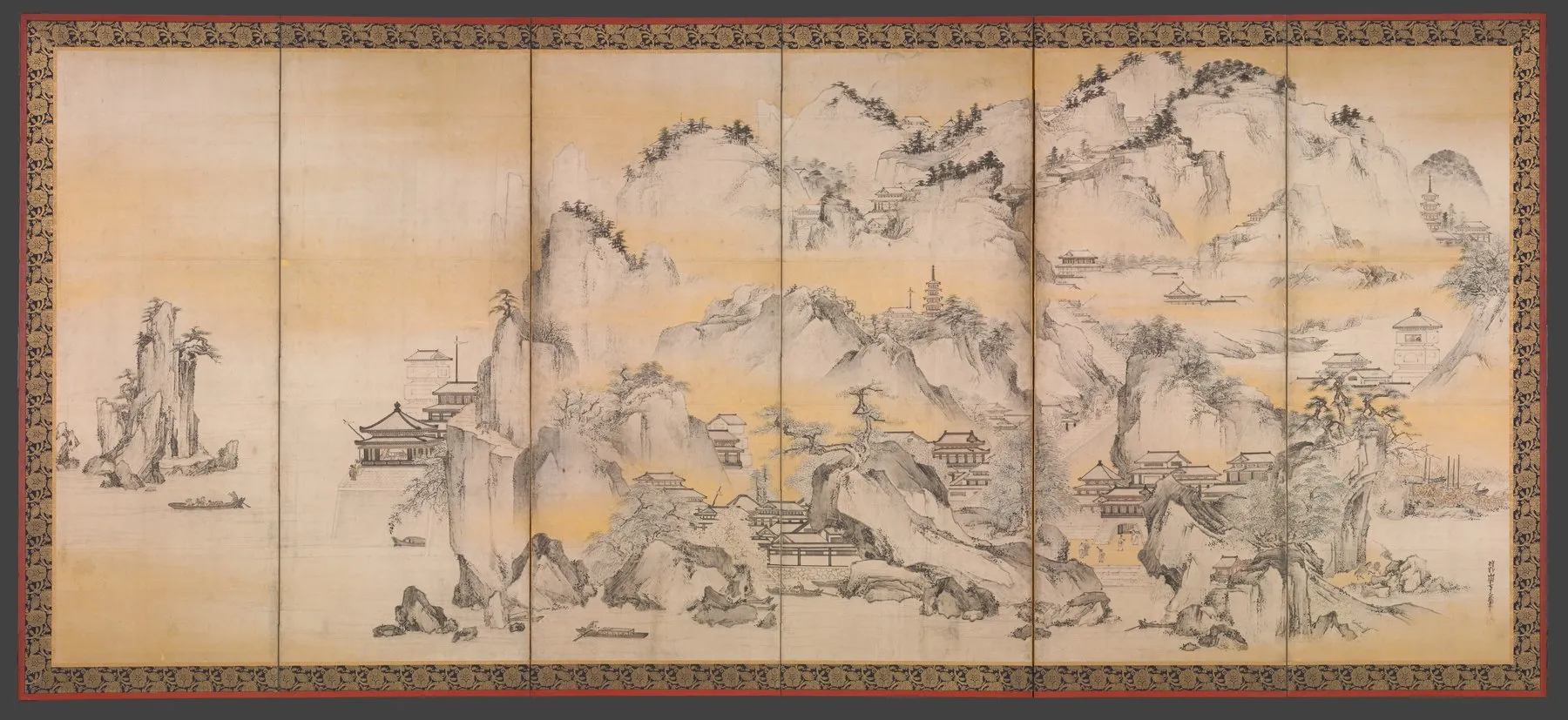
Jinshan, the island temple near Zhenjiang where Feng’s Fahai is abbot, painted by Kano Sanraku in 1630: the right screen of his pair Jinshan Island and West Lake. The Metropolitan Museum of Art, Mary Griggs Burke Collection, Gift of the Mary and Jackson Burke Foundation, 2015, public domain.27
On the seventh day of the seventh month Xu goes to burn incense at the Jinshan temple, near Zhenjiang. The abbot, Fahai, sees the two women arrive by boat through a storm and shouts at them; they overturn the boat and vanish into the river. Fahai tells Xu to look for him at the Jingci temple if they come back.27 They do, and Fahai gives Xu his alms bowl. Xu clamps it over his wife’s head, and the monk questions her:
禪師,我是一條大蟒蛇,因為風雨大作,來到西湖上安身,同青青一處。不想遇著許宣,春心蕩漾,按納不住,一時冒犯天條,却不曾殺生害命。28
Master, I am a great python. A storm drove me to West Lake, and I made my home there with Qingqing. Then I met Xu Xuan, and my heart was stirred beyond holding back. For a moment I broke the law of Heaven, but I never took a life.
Qingqing, she says, is a green fish that spent a thousand years gathering its powers under the third bridge of West Lake.29 Fahai forces both back into their true shapes, puts them in the bowl, seals it with a strip torn from his robe, and has a pagoda of bricks and stones raised over it in front of Leifeng Monastery. Xu Xuan collects alms until the pagoda is seven storeys high.28 Then the monk leaves a verse:
西湖水乾,江湖[?]不起,雷峰塔倒,白蛇出世。30
When West Lake runs dry, when the rivers and lakes [?] no longer rise, when Leifeng Pagoda falls, the white snake will come out into the world.
The second line is blurred in the scan we read. Wu Jieying prints 江湖, as we read it; the verse in the later plays, as Wu quotes them, has 江潮, “the river’s tide”.30 Xu Xuan becomes a monk at the pagoda and dies some years later, sitting in meditation.31 The whole ending is transcribed and translated.
Set this against Lu Xun’s grandmother. Feng’s Qingqing is a fish; the green snake arrives with Fang Chengpei’s play.29 There is no son and no flood at Jinshan.2 The Dragon Boat festival and the realgar wine belong to the eighteenth-century stage.32 And it is Xu Xuan himself who presses the bowl down.
A son for the snake
The oldest play that survives, Huang Tubi’s Leifeng Pagoda, was finished in 1738. It opens in paradise: the Buddha gives Fahai a small pagoda and orders the snake and the fish shut under a seven-storey copy of it. Xu Xuan no longer traps his wife; the monk’s guardian spirits do it. Like Feng’s story, the play ends with her under the pagoda.33
Huang did not like what the actors did next. In a note quoted by A Ying and by Guo Yingde, he complained that meddlers had added a son for the snake who comes first in the examinations, that the new ending was all the rage from Wu and Yue up to Yan and Zhao, and that audiences should have held their noses at a snake’s son among the officials.1 Who added the son is disputed. A Ying credited a script by the actor Chen Jiayan and his daughter. Wu calls it lost; Wang says it survives in later copies; Wang Shih-pe, as Balivet reports, doubts it was theirs at all.34
Fang Chengpei’s version is the one that lasted. His preface is dated the winter of the xinmao year of Qianlong, which scholars give as 1771. He says the play is old and its author unknown, that the salt merchants of the Huai region staged it when the court celebrated an event in the empress dowager’s palace, and that he found its words crude and rewrote it.35 One sentence dates the kindest scenes:
《求草》、《煉塔》、《祭塔》等折,皆點竄終篇,僅存其目。35
In scenes such as “Seeking the Herb”, “Refining the Pagoda” and “Offering at the Pagoda” I rewrote the whole scene and kept only the title.
So the stolen herb and the son’s offering at the pagoda were already being performed; Fang kept their titles and replaced their words. In his thirty-four scenes Qingqing is a green snake, Madam White drinks at the Dragon Boat festival, fetches the herb, fights the battle on the water and meets Xu at the Broken Bridge, and her son comes first in the examinations and visits her at the pagoda. She is set free, and the pagoda is left standing for later generations to look at.232 The preface ends with Fang’s view of the legend itself:
宋禪師鎮壓白蛇事,其有無蓋不足論云。35
As for the Song monk holding down a white snake, whether it happened or not is not worth arguing about.
The preface is transcribed and translated. Storytellers carried the same plot. Balivet cites an edition of 1809 of Chen Yuqian’s ballad Yiyao zhuan, the “Righteous Monster” that Lu Xun thought his grandmother had followed.12
Who changed what
| Text | Date | What it adds |
|---|---|---|
| Li Huang, in the Taiping guangji | Tang tale | a white snake woman; the man dies20 |
| The Three Pagodas of West Lake | printed by the mid-1500s | a woman in white under stone pagodas2221 |
| Tian Rucheng, Xihu youlan zhi | Ming; author a jinshi of 1526 | snake and green fish under Leifeng, as hearsay323 |
| Qiantang county gazetteer | 1609 | smoke from the pagoda, and insects24 |
| Feng Menglong, Jingshi tongyan | 1624 | Xu Xuan, the fish maid, Fahai, the bowl, the verse132830 |
| Huang Tubi, Leifeng Pagoda | 1738 | the Buddha’s model pagoda33 |
| Script attributed to Chen Jiayan | mid-Qianlong | the son, by A Ying’s account34 |
| Fang Chengpei, Leifeng Pagoda | 1771 | green snake, herb, flood, son, release352 |
| Chen Yuqian, Yiyao zhuan | edition of 1809 | the ballad Lu Xun remembered12 |
| Lu Xun, two essays | 1924 and 1925 | the fall as a release; the stolen bricks95 |
Arguments about the source
Balivet warns that no single version can be called the original.36 Chinese scholars argued about origins from the 1920s on: Hu Shiying took the Tang tale of Li Huang for the source, Dai Bufan argued for the Song, Wang Xiang linked the snake to ancient totems and the goddess Nüwa, and Zhao Jingshen thought the story and the Greek Lamia shared a source in India.36 The Lamia comparison goes back at least to Qin Nü and Ling Yun in 1933, according to Wu; Ting Nai-tung (1966) traced it to the Japanese critic Kuriyagawa Hakuson.36 Whalen Lai looks further back still, to ancient myths of men meeting river spirits and to the old custom of marrying a girl to He Bo, the river god.37
Bricks as charms
Lu Xun came back to the pagoda in a second essay, dated 6 February 1925 and printed in Yusi on 23 February. It starts from a letter by Chongxuan in the February literary supplement of the Jingbao newspaper. On a steamer, Chongxuan had overheard two passengers explain why the pagoda fell:5
是因為鄉下人迷信那塔磚放在自己的家中,凡事都必平安,如意,逢凶化吉,于是這個也挖,那個也挖,挖之久久,便倒了。5
Because the country people believed that a brick from the pagoda kept at home would bring peace and good luck in everything and turn misfortune into fortune, so this one dug and that one dug, and after enough digging it fell.
One of the passengers, Chongxuan wrote, kept sighing that the Ten Views of West Lake were now one short.5 So the brick-digging explanation reached Lu Xun’s readers by way of two strangers on a steamer and a letter to a newspaper. Later accounts give other reasons for the digging. Wu Jieying writes that the bricks were known as demon-quelling bricks, kept at home to keep snakes and scorpions out of the silkworm rooms, and that a rumour gave them the power to bring sons. A 2024 article in the Dushi kuaibao gives a third: the hollow “sutra bricks” (藏經磚) were misheard as “gold bricks” (藏金磚).38
Lu Xun cared less about the cause than about what it showed. Wang reads the second essay as treating the stolen bricks as the mark of a society that only leaves ruins.5 Near its end Lu Xun made a prediction:
倘在民康物阜時候,因為十景病的發作,新的雷峯塔也會再造的能。5
In good times, when people are at ease and goods are plentiful, the Ten Views disease will flare up, and a new Leifeng Pagoda may well be built.
Talk of a new pagoda had started before he wrote. On 4 October 1924 the North-China Herald’s correspondent passed on a rumour “that the gentry are going to rebuild the Thunder Peak Pagoda”.39
Archaeologists began digging the site in March 2000 and opened the pagoda’s underground chamber on 11 March 2001; it held fifty-one objects.40 The new Leifeng Pagoda, five storeys high, was completed on 25 October 2002.41
What we could not verify
Sources we have not seen
- The excavation report on the pagoda site (Zhejiang Provincial Institute of Cultural Relics and Archaeology, 2005), which would give the dig’s own dates and the full list of finds. It is in copyright, and Google Books has it without a preview.
Seen only where others quote them
- Wang Shih-pe’s 2018 study of the eighteenth-century scripts, which Balivet says doubts that Chen Jiayan wrote the script with the son and draws on a manuscript of 1780 in the National Library of China. The journal issue, Minsu quyi no. 199, is sold through the Airiti Library database and needs a subscription or payment.
- The Qiantang county gazetteer of 1609 on the smoking pagoda, which we know as Wang quotes it. The one online copy we found, the 1883 reprint on the Chinese Text Project, shows its page images only to registered users, and its machine-read text of this page is garbled.
Resting on a single source
- Wang (2003) cites a libretto of the Leifeng Pagoda with a preface dated 1530. Other scholars treat Huang Tubi’s play of 1738 as the oldest surviving script.
- Wang (2003) says Tian Rucheng listed a Leifeng Pagoda story in the repertoire of Hangzhou’s taozhen singers. The passage is not in the copy of Tian’s guide we read, so it may belong to another edition.
- The historical monk Fahai and the Jinshan temple legends of a monk who drove out a python, found only in reference works and news articles.
Questions we could not settle
- The date of Tian Rucheng’s guide. Reference sites give 1547; one scholarly bibliography gives about 1526; the copy we read carries no date.
Read next
TaleChina, 1679 to 1985
Before jiangshi hopped, they ran
CaseBeijing, China, 1476 to 1477
Heisheng, Beijing's black creature of 1476, and the Western Depot
TaleChina; the earliest texts are from Shanghai, 1933 to 2009
The earliest Nian beast we could find dates from 1933
Sources
- Balivet 2020, pp. 25-26, quoting A Ying 1960 and Guo Yingde 1997
- Wu 2012, p. 200 n. 52, quoting A Ying 1953↑
- Wu 2012, pp. 196-201
- Balivet 2020, p. 33
- Wang 2003, p. 503↑
- 田汝成, 西湖遊覽志, 欽定四庫全書 copy (photographic reprint), vol. 3-6, juan 3, leaf 13 (IA n26-n27) (primary)
- Wu 2012, p. 184
- Wang 2003, pp. 499-500↑
- 魯迅, 再論雷峯塔的倒掉, 語絲 no. 15 (23 Feb 1925), p. 1 (IA n0): "從崇軒先生的通信(二月分京報副刊)裏..."; p. 2 (n1): "新的雷峯塔也會再造的能"; date "一九二五年二月六日" (primary)
- Wang 2003, pp. 526-527↑
- Eugene Y. Wang, "Tope and Topos: The Leifeng Pagoda and the Discourse of the Demonic", in Writing and Materiality in China (Harvard, 2003), p. 517: "At 1:40 P.M. on September 25, 1924"
- Hsueh-Man Shen, "Between One and Many", Proceedings of the British Academy 181 (2012), p. 205: "IN THE EARLY AFTERNOON hours of 25 September 1924"
- Harvard Art Museums, Dharani Sutra ("Leifengta Sutra"), 1984.377, object description
- 潘卓盈, 都市快報, 26 Sep 2024, reprinted by 杭州政協網, "1924年9月25日下午1時40分許"↑
- Wang 2003, p. 517
- Bryce Heatherly, "Leifeng Pagoda (Leifeng ta 雷峰塔)", Database of Religious History (UBC), 2022, pp. 1-2, excavation notes
- Shen 2012, pp. 205, 208↑
- North-China Herald (Shanghai), 4 October 1924, "Hangchow Letter", from our own correspondent, p. 20, col. 1 (IA leaf n19)↑
- 魯迅, 論雷峯塔的倒掉, 語絲 no. 1 (17 Nov 1924), pp. 3-4 (IA images n2-n3): "聽說,杭州西湖上的雷峰塔倒掉了,聽說而已,我沒有親見"; postscript "這篇東西,是一九二四年十月二十八日做的" (primary)
- Aaron Balivet, The Many Transformations of White Snake (PhD diss., University of Wisconsin-Madison, 2020), p. 1 n. 2
- Wang 2003, p. 520↑
- 魯迅, 語絲 no. 1, p. 3 lower band and p. 4 upper band (primary)
- Balivet 2020, pp. 1-2↑
- 魯迅, 語絲 no. 1, p. 4: "那時我惟一的希望,就在這雷峯塔的倒掉"; "可有誰不為白娘娘抱不平,不怪法海太多事的" (primary)
- Balivet 2020, pp. 2-3↑
- Balivet 2020, p. 8 and n. 16
- Wu 2012, p. 178
- 魯迅, 語絲 no. 1, p. 3: "大約是出于一部彈詞叫作義妖傳裏的" (primary)↑
- 馮夢龍 ed., 警世通言 (Peking University Library copy, CADAL scan), vol. 1, preface, last leaf (IA n10): "天啟甲子臘月豫章無礙居士題" (primary)
- Wang 2003, p. 502
- Balivet 2020, p. 7 n. 14
- Wu 2012, pp. 177-178↑
- Balivet 2020, p. 6 n. 13; p. 8
- Wu 2012, pp. 196-202
- Lai 1992, opening section, "The skeleton of an Ur-myth"↑
- Heatherly, DRH 2022, p. 1
- Wang 2003, p. 490 and note 5
- Shen 2012, p. 205↑
- Shen 2012, p. 208, with Chinese text 天下兵馬大元帥吳越國王錢俶造此經八萬四千卷入西關塼塔永充供養乙亥八月日紀
- Wang 2003, p. 491
- Harvard Art Museums, 1984.377, object description↑
- Wang 2003, p. 492
- Heatherly, DRH 2022, pp. 1, 3↑
- Wang 2003, pp. 492-493
- Heatherly, DRH 2022, p. 4↑
- Wang 2003, pp. 500-501
- Wu 2012, pp. 182-183
- Heatherly, DRH 2022, pp. 1-2
- 方成培, 雷峯塔傳奇, 自敘 (1771), preface, IA n4-n5 (primary) transcription↑
- Balivet 2020, p. 5 and n. 10
- Wang 2003, p. 497↑
- Wang 2003, p. 496 and note 25
- Balivet 2020, p. 6 n. 11
- Whalen Lai, "From Folklore to Literate Theater: Unpacking 'Madame White Snake'", Asian Folklore Studies 51.1 (1992), p. 51, first paragraph↑
- 西湖三塔記, 清平山堂話本 (Peking University Library copy, CADAL scan), vol. 1, IA n53-n54: "白衣娘子是條白蛇"; "造成三個石塔鎮住三怪於湖內" (primary)
- Wang 2003, pp. 496-497
- Balivet 2020, pp. 5-6
- Wu 2012, p. 177↑
- Wang 2003, p. 499
- Library of Congress Name Authority File, n81013574, authorized heading↑
- Wang 2003, pp. 501-502
- Wu 2012, p. 184
- 陸次雲, 湖壖雜記 (1683), in 武林掌故叢編 第八集, ctext.org wiki text, section 湖壖雜記, paragraph on 雷峰塔; OCR, unchecked (ctext shows the page images only to registered users) (primary)↑
- 馮夢龍, 白娘子永鎮雷峰塔, 警世通言 卷28 (CADAL scan, vol. 15), IA n32: "話說宋高宗南渡紹興年間杭州臨安府..."; "年方二十二歲"; IA n34-n38 (the boat and the umbrella) (primary)
- Balivet 2020, p. 6↑
- Balivet 2020, p. 7
- 馮夢龍, 警世通言 卷28, IA n44-n46 and following (primary)↑
- 馮夢龍, 警世通言 卷28, IA n87-n89: "法海禪師來了"; "可到湖南淨慈寺裏來尋我" (primary)
- Wu 2012, p. 193↑
- 馮夢龍, 警世通言 卷28, IA n103-n105 (primary) transcription
- Wu 2012, p. 186
- Wang 2003, p. 502↑
- 馮夢龍, 警世通言 卷28, IA n103: "青青是西湖內第三橋下潭內千年成氣的青魚" (primary)
- Wu 2012, p. 196
- Wang 2003, p. 502↑
- 馮夢龍, 警世通言 卷28, IA n105 (primary)
- Wu 2012, p. 187
- Wang 2003, p. 502↑
- 馮夢龍, 警世通言 卷28, IA n105 (primary)
- Wu 2012, p. 186
- Balivet 2020, p. 7↑
- Balivet 2020, p. 8 and n. 15
- Wu 2012, p. 196↑
- Wu 2012, pp. 191-195
- Balivet 2020, pp. 25-26, 31 n. 58
- Wang 2003, pp. 502-503↑
- Balivet 2020, pp. 30-33
- Wang 2003, p. 503
- Wu 2012, p. 191↑
- 方成培, 雷峯塔傳奇, 自敘 (Peking University Library copy, CADAL scan), IA n1-n5 (primary) transcription
- Balivet 2020, pp. 31-32 and n. 60
- Wang 2003, p. 503
- Wu 2012, p. 191↑
- Balivet 2020, p. 4; p. 11 and n. 22
- Wu 2012, p. 178 n. 1
- Ting Nai-tung, "The Holy Man and the Snake-Woman: A Study of a Lamia Story in Asian and European Literature", Fabula 8 (1966), pp. 145 to 191, p. 145 (first page, shown free on the publisher's site; the rest is paywalled)↑
- Lai 1992, section "Early myths of man-god encounters"
- Balivet 2020, p. 17↑
- 吳潔盈, 論明清之際擬話本與戲曲中的雷峰塔, 中國文學研究 34 (2012), p. 185
- 都市快報, 26 Sep 2024, paragraph on the cause↑
- North-China Herald (Shanghai), 11 October 1924, "Hangchow Isolated", from our own correspondent, p. 61, col. 3 (IA leaf n16)↑
- Heatherly, DRH 2022, p. 1
- 都市快報, 26 Sep 2024, "發掘工作從2001年3月11日上午9時開始"
- Shen 2012, p. 205 n. 2↑
- Heatherly, DRH 2022, p. 1
- 都市快報, 26 Sep 2024, closing section↑
Documents quoted
- Fang Chengpei, preface to Leifeng Pagoda (Leifengta chuanqi), winter 1771 (transcribed from the page image)
- Feng Menglong, “Madam White Is Kept Forever Under Leifeng Pagoda” (1624): the ending (transcribed from the page image)