 Twice Told
Heisheng, Beijing's black creature of 1476, and the Western Depot
In June 1477 four ministers told the Chenghua emperor that his new Western Depot alarmed Beijing as a night creature had the summer before.
Contents
Published 6 Oct 2026. Sources checked 6 Oct 2026.
A Veritable Records entry dated 20 June 1477 (Julian) copies a memorial in which four ministers ask the Chenghua emperor to end the Western Depot, the investigating office the eunuch Wang Zhi ran. Near the end they add a sentence that has nothing to do with law. Last year, they write, from the seventh month on, a monster hurt people, and people said at the time that it must foretell something. When the Western Depot was set up, it alarmed people exactly as the monster had.6 The Depot was abolished, and within five weeks it was back.78 Wang Ao and Shen Defu later drew the same line.39
This is the story as the Ming Shi, the official history of the Ming written under the Qing, puts it together from two of its chapters.
In the seventh month of 1476 a creature came into Beijing. It had gold eyes and a long tail and was shaped like a dog or a wildcat. It carried black vapour in through windows and went straight to the innermost rooms, and the people it reached fainted. Men and women slept in the open. The whole city was in uproar, with blades and lamps and gongs and drums, and nobody could catch it. When the emperor held court at Fengtian Gate, the guards saw the creature and shouted. He started to rise, and the eunuch Huai’en held on to his robe until the alarm died down.4
That same year a sorcerer named Li Zilong used talisman magic to befriend a palace eunuch, Wei She, and slipped into the inner palace. When it came out he was executed. The emperor disliked it and wanted to know what went on outside, so he had a eunuch, Wang Zhi, change clothes and go out secretly with one or two officers. The next year the Western Depot was set up with Wang Zhi in command.10
The telling is assembled from two chapters. The treatise on omens gives the creature and the scene at the gate; the biography of Wang Zhi gives the sorcerer and the Depot.410 Wang Ao, a Ming writer, has the scene at the gate in almost the same words, with one difference that matters.3 The Shilu entries on the creature say much less.11
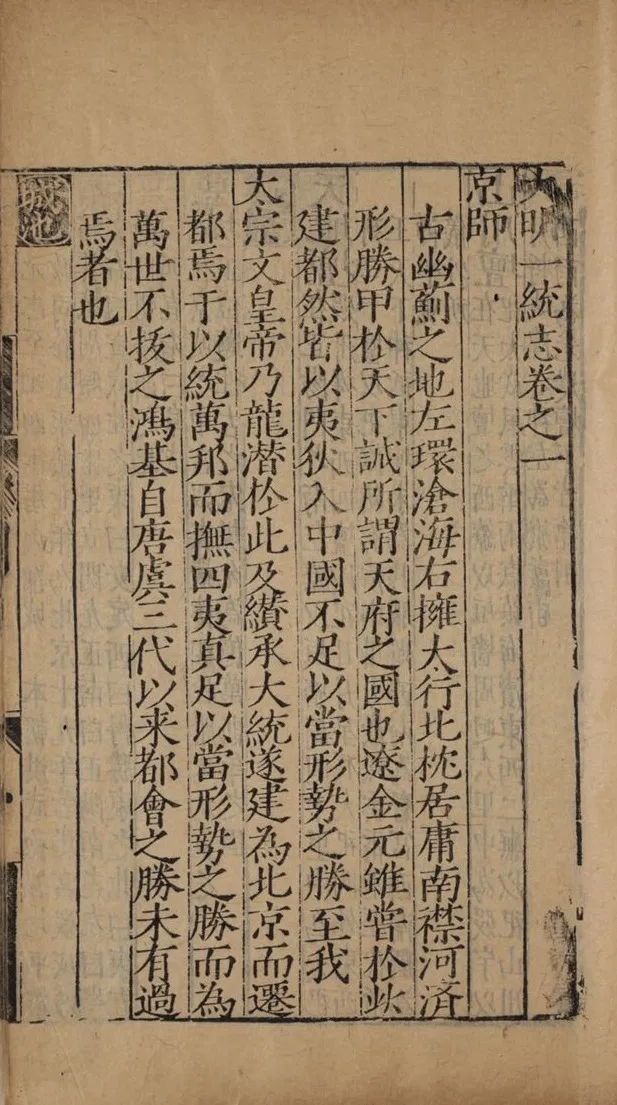
The opening of the chapter on the capital (京師) in the Da Ming yitong zhi, the Great Ming Gazetteer compiled under Li Xian in 1461, in a printing of 1588. Photograph courtesy of the Main Library, Kyoto University, 大明一統志 (5-86/タ/2 貴), from the Kyoto University Rare Materials Digital Archive, cropped.
The court’s days
The Veritable Records (shilu) of the Xianzong reign are the court’s own file. We read them in the text edition of Academia Sinica, and they date the first report of the creature to the 9th day of the 7th month of Chenghua 12. That is 29 July 1476 in the Julian calendar, which we worked out with Academia Sinica’s calendar converter and checked by counting the sixty-day cycle.2 The entry is short. Something came out at night in the west city and injured people. It was black, and people followed its tracks and never caught it. The city’s patrol censors and the city wardens’ offices reported it, and the emperor ordered them to find a way to trap it and to stop people passing on rumours that frightened one another.11
| Date as written | Julian | What the Shilu records |
|---|---|---|
| Chenghua 12, 7th month, day 9 | 29 July 1476 | Black thing in the west city, rumours forbidden11 |
| 7th month, day 19 | 8 August 1476 | Reward for the capital patrol, for catching “sorcerous talk”12 |
| 7th month, day 20 | 9 August 1476 | Message to the City God13 |
| 7th month, day 22 | 11 August 1476 | Shang Lu: Heaven sends monsters as warnings14 |
| 7th month, day 24 | 13 August 1476 | Emperor’s prayer to Heaven and Earth15 |
| 9th month, day 9 | 26 September 1476 | Li Zilong and four others executed16 |
| Chenghua 13, 2nd month, day 8 | 21 February 1477 | Note: Wang Zhi sent out after the creature17 |
| 5th month, day 10 | 20 June 1477 | Memorial against the Depot; Depot abolished7 |
The entries use the word “thing” (wu)11 and later “monster” (yaowu).13 In the Shilu passages we read, the creature is called heisheng, the name the Ming Shi gives it, only in a note on Wang Zhi, where the manuscript has a rare character that a collation note reads as the same word.17
On the 20th the emperor sent Liu Ji, a vice-minister of the Court of Imperial Sacrifices, to the City God of the capital with a message in his own voice. It counts the days: since the ninth, monsters had come out at night and bitten people in every direction, and the soldiers and people of the city were frightened. The emperor says it must be the fault of his government, then tells the god he is not blameless either, since the god takes offerings from the land and people depend on him. He asks the god, in our translation, “Can you alone feel nothing in your heart?”13 The day before, the Shilu rewards the commander of the capital patrol for catching more than 700 robbers and “sorcerous talk” offenders; it does not say they had anything to do with the creature.12
On the 24th the emperor offered sacrifice inside the palace and addressed Heaven and Earth. He asked whether spending without restraint, too many earthworks, loyal words that never reached him, or kindness that never reached the people had caused it.15 The Ming Shi annals keep only the four faults.15 On the 22nd, the grand secretary Shang Lu and others sent in a memorial that put the matter in the language of omens: Heaven sends calamities out of love, and in the worst cases sends monsters to frighten a ruler into reform. They offered eight proposals, from saving money to sending a senior official to govern Yunnan.14 Of the entries we read, only the one of the 9th orders anyone to catch it.11
Yin Zhi’s back room
Yin Zhi (1427 to 1511) was working in Beijing at the time, according to Qiu Zhongmin, then of Academia Sinica’s Institute of History and Philology, whose 2007 paper on Ming night creatures we lean on throughout.18 His notebook, Jianzhai suozhui lu, gives a long description. Early in the seventh month, he says, men and women in the poorer lanes were sleeping outdoors at night, and would see something come in carrying a patch of black vapour. It came through doors and windows; even a shut inner room was not safe. People it reached were stunned and faint. Some had wounds on the hands, feet, head, face, belly or back, with yellow fluid in them, which they only noticed when they came round, and which hardly hurt. Within days the whole city was up at dusk with blades and lamps, beating gongs and drums when black vapour came.19
Yin did not believe it at first. One night at the second watch the small child of Wang Er, who rented the rooms behind his house, began to cry, and Wang Er and his wife shouted for help. Yin got up and called over the wall. “Someone is here,” they answered, and then: “Bring a light, bring a knife.” The next day he sent someone to ask. Something ice-cold had sat on the wife’s chest, she had started up and found the child she held being pulled out of her arms, and she had fought to keep it. Her husband could not find a knife, so he opened the door and borrowed a light from a neighbour, and only then did the creature go.20 In his account Yin heard the commotion through a wall and was told the rest.
He also says where it began: in the northwest of the city, and no one dared mention it until people in every district had been hurt and started complaining to their district warden’s offices. The patrol censors questioned them, found it true, and reported to the throne in a memorial that said only: it is not known what hurt them. Plenty of people had seen it, Yin says, not fewer than twenty or so of them. It was black and small, with gold eyes and a long tail, like a dog or a wildcat. It stopped only after about twenty days.521
A category older than the creature
The description comes in a set phrase, jinjing xiuwei, “gold eyes, long tail”, which the Ming Shi and Yin Zhi both use.21 Qiu finds the same feature in later records, among them Baoding in 1512 and Hengzhou in 1558.22 Wang Ao’s version has it like a wildcat or a dog, moving “like the wind, quick and unpredictable”, coming dozens of times in a night, now in the east of the city and now in the west.3 Qiu quotes Zhu Yunming, a Ming writer, as saying the 1476 creature went chiefly after women.23
Heisheng is not a name the court coined. The dynastic histories keep a heading for it in their treatises on omens, under the element water, and the Ming Shi explains in its introduction that it follows earlier histories in filing “black omens and black signs” there.24 What the Jin shu and the Sui shu file under it is vapour, fog and cloud. The Jin shu lists black vapour that fills the air on every side and a black fog that stained people like ink, and the Sui shu has black vapour like a dragon in a palace hall and black clouds scattering like pigs.25 The Ming Shi’s own list runs through black vapour across the sky, black sand and black rain before it reaches 1476, which is the first entry in it with a creature.26
What the Ming Shi added
The Fengtian Gate scene is Wang Ao’s. He has the emperor holding court there when the guards were suddenly startled and the two ranks of officials grew noisy; the emperor made to rise, and Huai’en pressed him down. After a while it settled.3 He does not say anyone saw the creature. The Ming Shi has the guards see it and shout (jian zhi er hua, 見之而譁), and has Huai’en hold the emperor’s robe.4 Neither the Shilu entries we read nor Yin Zhi has the scene.
| The story | The record | Verdict |
|---|---|---|
| It had gold eyes and a long tail4 | Yin Zhi has the same words; the Shilu entries of the 9th, 20th and 24th give none21111315 | Confirmed |
| It went through windows to inner rooms4 | Yin Zhi says the same19 | Confirmed |
| The guards at Fengtian Gate saw it4 | Wang Ao has them startled, with no sight of it3 | Disputed |
| It appeared in the palace10 | Shilu: the west city; Yin Zhi: it began in the northwest of the city115 | Disputed |
| Wang Zhi was sent out because of it10 | The Shilu’s note of 1477 says so17 | Confirmed |
On the fourth row, the Ming Shi’s treatise says “the capital” and its biography of Wang Zhi says “in the palace”. The Shilu puts it in the west city, and Yin Zhi has it begin in the northwest and spread to every district.410115
From a sorcerer’s trial to the Western Depot
The Shilu enters the sorcerer’s execution under the 9th day of the 9th month, 26 September 1476, and at length.16 He was born Hou Dequan, from Yizhou in Baoding, became a monk, and wandered the north, where fortune-tellers told him he would be eminent and a Daoist gave him a book of prophecy. The book told of a boy named Li Zilong born in Shaanxi after a fourteen-month pregnancy, with red light in the room and a white snake coiled around it. He took the name. A military artisan in Beijing, Yang Daoxian, held forged court papers and seals and passed them to palace attendants, and through them Hou got in and out of the inner palace. The attendants called him Master and bowed to him facing north. Embroidered Uniform Guard officers reported him. As he was led out toward the Censorate, someone called out that a palace attendant, Wei Han, was dead. Five men were put to death, nine others pardoned, and a supervising secretary, Lei Ze, protested that this was too lenient.27
The entry mentions neither a creature nor Wang Zhi.27 The two are joined in 1477, in the Shilu’s note on Wang Zhi: last year in the ninth month, “because of the black creature anomaly and the execution of Hou Dequan,” he was ordered to go out and gather what people were saying. At first he went in plain clothes and a small cap, sometimes on a donkey or a mule.17 Yu Jideng’s Huang Ming dian gu ji wen says the same: after the heisheng, Wang Zhi was ordered out, in a small cap, on a donkey or mule.28 The Ming Shi has him change clothes and slip out with one or two officers.1028
The Western Depot came next. The Ming Shi annals date its setting-up to the 1st month of Chenghua 13, day jisi, which is 13 February 1477. It was a second investigative office run by eunuchs, beside the Eastern Depot of the Yongle years, with Wang Zhi in charge.29 We found no Shilu entry for its founding. The first mention of the Depot that we found there is the note of 21 February, where Wang Zhi is already “the eunuch in charge at the Western Depot”. Our search of the Academia Sinica text finds nothing earlier.30 The memorial copied under 20 June 1477 is where the creature comes back in, in the passage this page opened with:7
去歲七月以後,有妖物傷人,當時人言必有應驗。及立西廠,驚動人心,一如妖物傷人之時。6
Since the seventh month of last year a monster has been hurting people, and people said at the time that it must foretell something. When the Western Depot was set up, it alarmed people exactly as the monster had.
In the same memorial Shang Lu and his colleagues add that Wang Zhi was young and relied on a centurion, Wei Ying, and others to direct him. The emperor was furious at first, then gave way: “Wang Zhi has done harm, and I truly did not know,” he is recorded saying.76 The Ming Shi annals say the Depot was back on the gengxu day of the next month, 24 July 1477.8 They record it abolished in the third month of Chenghua 18, in 1482, and Wang Zhi sent to Nanjing the year after.8
Later writers drew the same line. Wang Ao ends his paragraph on the Depot: “People took it as the answer to the black creature.”3 Shen Defu, in the Wanli yehuo bian, reads the creature as a picture of the Depot itself, “something hurting people in all directions,” and adds a palace eunuch, a monk and a magician, and Wang Yue’s wars, to what brought Heaven’s warning.9 He dates the creature to Chenghua 11, a year too early, and we found no other source that does.9 The 2011 master’s thesis of Tsai Liang-sheng at National Chi Nan University, whose abstract we read, examines the link between the Depot’s founding and fear of heisheng.31
Other years, other cities
Qiu counts heisheng and its cousins in about a quarter of the Ming’s 268 years, across about 180 prefecture-level places.32 He also cites Xu Haomin, who found 52 years with such events between AD 178 and 1892.32 Earlier dynasties have versions of their own. Cai Tao describes a black man-shaped thing that went after children in Luoyang in the Xuanhe years, and says the omen treatise’s heisheng is this.33 Qiu quotes the Wenxian tongkao on a gold-eyed, turtle-shaped creature wrapped in black vapour that haunted the Song palace after 1111.34
Two later entries in the Ming Shi describe the same sort of animal. In the sixth month of 1512 (Zhengde 7), a heisheng came up at Shunde, Hejian and Zhuo, “large ones like dogs, small ones like cats,” then in the capital, and stopped after more than a month.35 Lu Can, in his notebook Gengsi bian, has creatures in the north that year, like dogs or cats, dropping out of the night air.35 In 1638 (Chongzhen 11) the Ming Shi has a heisheng in the capital like a wildcat that entered houses and made trouble for half a year.36
In later outbreaks, Qiu says, magistrates often suspected monks and Daoists who sold charms, and arrested them.37 None of the sources on 1476 that we read mentions such arrests. A former monk was executed that September for another offence, and the Shilu entry on him does not mention the creature.1627
Twenty days
Yin Zhi gives the creature’s length as about twenty days.5 Shen Defu says that after a long time it began to subside, after the City God sacrifice and the prayer.9 The Shilu has no closing entry that we could find, and the ministers of 1477 say only “from the seventh month on.”6 Yin Zhi’s “about twenty days” is the only length any source we read gives.
What we could not verify
Sources we have not seen
- A page image of the Veritable Records for juan 155 and 157, the entries of July and September 1476. We read them in the Academia Sinica text edition and a second online transcription, which agree. The scan of the manuscript edition we used for juan 162 and 166 shows only the heading of juan 155, and HathiTrust’s copy of the printed volume is search-only.
- Tsai Liang-sheng, “Nature and Anomaly: The Belief in Heisheng and its Development during the Ming and Qing Period” (Zaohua zhi yi yu zheng; master’s thesis, National Chi Nan University, 2011). It would show how he argues the Depot and the creature are linked. We read the abstract on the Airiti Library page and found no open full text.
- Xie Yang (Chinese Academy of Social Sciences), “A Rumor of Ghost (heisheng) and its Circulation in Ming and Qing China”, an Oxford China Centre seminar on 17 November 2016. It may bear on how the rumour spread. We saw the abstract in a search result, found no published text, and the Oxford event page now returns “not found”.
- The Xianzhang lu, which Xia Xie quotes in his Ming tongjian as saying almost what the Shilu’s note on Wang Zhi says. It would give an independent line for the link between the creature and Wang Zhi. We found no copy online.
Seen only where others quote them
- Zhu Yunming (1460 to 1526), on the 1476 creature going after women, and the Wenxian tongkao on the Song palace creature: both read only as Qiu Zhongmin quotes them (Qiu 2007, pp. 18 and 2).
- Xu Haomin’s count of 52 years with heisheng between AD 178 and 1892, read only as Qiu gives it.
- The Wenan county gazetteer’s 1476 entry, which Qiu cites for the same blades, lamps and gongs that the Ming Shi has.
Resting on a single source
- That Wei Han killed himself. Xia Xie’s Ming tongjian says so; the Shilu says only that word came he was dead.
Questions we could not settle
- Where the Ming Shi’s Fengtian Gate scene comes from. Wang Ao, a Ming writer, has it without the guards seeing the creature, and the Shilu entries we read do not have it.
- Why Wei Han in the Shilu is Wei She in the Wikisource text of the Ming Shi biography of Wang Zhi, and whether that is a misprint.
- Whether the Shilu has an entry for the founding of the Western Depot. Academia Sinica’s text has none that mentions it before 21 February 1477, and juan 160 was not read.
- How long the panic lasted. Yin Zhi’s “about twenty days” is the only figure.
Read next
TaleChina, 1679 to 1985
Before jiangshi hopped, they ran
TaleLeifeng Pagoda, Hangzhou, China, 975 to 2002
Lady White Snake and the fall of Leifeng Pagoda
TaleChina; the earliest texts are from Shanghai, 1933 to 2009
The earliest Nian beast we could find dates from 1933
Sources
- Ming Xianzong shilu (Veritable Records of Emperor Xianzong), Academia Sinica collated edition, online text, juan 155, 7th month, day 9, printed p. 2825 (primary)
- Ming shi (History of the Ming), juan 28, treatise on the five phases, Heisheng heixiang, entry for Chenghua 12, 7th month, gengxu day transcription↑
- Ming Xianzong shilu (Veritable Records of Emperor Xianzong), Academia Sinica collated edition, online text, juan 155, heading day 9, segment 29885, p. 2825 (primary)
- Ming shi, juan 14, annals of Xianzong, Chenghua 12, 7th month, gengxu
- Academia Sinica, two-thousand-year Chinese-Western calendar converter (Sinocal), Western to Chinese conversion, Julian calendar (cut-over 15 October 1582), run 2026-10-06↑
- Wang Ao, Zhenze changyu zhaichao (abridged), section Xiangwei, section Xiangwei (primary)↑
- Ming shi (History of the Ming), juan 28, treatise on the five phases, Heisheng heixiang, Chenghua 12 entry transcription↑
- Yin Zhi, Jianzhai suozhui lu, juan 4, juan 4 (primary)↑
- Ming Xianzong shilu (Veritable Records of Emperor Xianzong), Academia Sinica collated edition, online text, juan 166, 5th month, day 10, printed pp. 3007 to 3008 (primary) transcription↑
- Ming Xianzong shilu (Veritable Records of Emperor Xianzong), Academia Sinica collated edition, online text, juan 166, 5th month, day 10, segment 30154, pp. 3002 to 3011 (primary) transcription
- Ming shi, juan 14, annals of Xianzong, Chenghua 13, 5th month, bingzi↑
- Ming shi, juan 14, annals of Xianzong, Chenghua 13, 6th month, gengxu; Chenghua 18, 3rd month, renshen; Chenghua 19, 6th month yihai and 8th month renshen↑
- Shen Defu, Wanli yehuo bian, juan 29, juan 29, section Chao can e chuan (primary)↑
- Ming shi, juan 304, biography of Wang Zhi, Wang Zhi biography, opening paragraph↑
- Ming Xianzong shilu (Veritable Records of Emperor Xianzong), Academia Sinica collated edition, online text, juan 155, 7th month, day 9, p. 2825 (primary)↑
- Ming Xianzong shilu, Shidian Guji transcription, juan 155, 7th month, gengshen (day 19); Shidian Guji text only (primary)↑
- Ming Xianzong shilu (Veritable Records of Emperor Xianzong), Academia Sinica collated edition, online text, juan 155, 7th month, day 20, segment 29894, p. 2829 (primary)↑
- Ming Xianzong shilu, Shidian Guji transcription, juan 155, 7th month, guihai (day 22); read in the Shidian Guji text only, not in the Academia Sinica database (primary)↑
- Ming Xianzong shilu (Veritable Records of Emperor Xianzong), Academia Sinica collated edition, online text, juan 155, 7th month, day 24, segment 29898, p. 2838 (primary)
- Ming shi, juan 14, annals of Xianzong, Chenghua 12, 7th month, yichou↑
- Ming Xianzong shilu (Veritable Records of Emperor Xianzong), Academia Sinica collated edition, online text, juan 157, 9th month, day 9, segment 29931, pp. 2867 to 2869 (primary)
- Ming shi, juan 304, biography of Wang Zhi, Wang Zhi biography
- Xia Xie, Ming tongjian, juan 37, Chenghua 12, 9th month, first entry↑
- Ming Xianzong shilu (Veritable Records of Emperor Xianzong), Academia Sinica collated edition, online text, juan 162, 2nd month, day 8, segment 30065, p. 2958 (primary) transcription↑
- Yin Zhi, Jianzhai suozhui lu, juan 4, juan 4 (primary)↑
- Yin Zhi, Jianzhai suozhui lu, juan 4, juan 4 (primary)↑
- Yin Zhi, Jianzhai suozhui lu, juan 4, juan 4 (primary)
- Ming shi (History of the Ming), juan 28, treatise on the five phases, Heisheng heixiang, Chenghua 12 entry transcription↑
- Ming shi (History of the Ming), juan 28, treatise on the five phases, opening paragraph of the section Heisheng heixiang↑
- Jin shu, juan 29, treatise on the five phases, Heisheng heixiang section, Yongjia 5, Jianxing 2 and Yongchang 1 entries
- Sui shu, juan 23, treatise on the five phases, Heisheng heixiang section, Chengsheng 3 and Taijian 5 entries↑
- Ming shi (History of the Ming), juan 28, treatise on the five phases, Heisheng heixiang, Hongwu 10 to Chenghua 12↑
- Ming Xianzong shilu (Veritable Records of Emperor Xianzong), Academia Sinica collated edition, online text, juan 157, 9th month, day 9, pp. 2867 to 2869 (primary)↑
- Ming Xianzong shilu (Veritable Records of Emperor Xianzong), Academia Sinica collated edition, online text, juan 162, 2nd month, day 8, p. 2958 (primary) transcription
- Yu Jideng, Huang Ming dian gu ji wen, juan 15, juan 15 (primary)
- Ming shi, juan 304, biography of Wang Zhi, Wang Zhi biography↑
- Ming shi, juan 14, annals of Xianzong, Chenghua 13, 1st month, jisi notes
- Xia Xie, Ming tongjian, juan 37, Chenghua 13, 1st month, jisi
- Academia Sinica, two-thousand-year Chinese-Western calendar converter (Sinocal), Western to Chinese conversion, run 2026-10-06↑
- Ming Xianzong shilu (Veritable Records of Emperor Xianzong), Academia Sinica collated edition, online text, juan 162, 2nd month, day 8, p. 2958; database search of 2026-10-06 (94 hit chapters in all three reigns, first for Xianzong at juan 162) (primary)↑
- Tsai Liang-sheng, Zaohua zhi yi yu zheng: Ming Qing wuguai heisheng xinyang yanbian (master's thesis, National Chi Nan University, 2011), abstract, abstract on the Airiti Library page, DOI 10.6837/NCNU.2011.00290↑
- Cai Tao, Tieweishan congtan, juan 3, juan 3 (primary)↑
- Ming shi (History of the Ming), juan 28, treatise on the five phases, Heisheng heixiang, Zhengde 7, 6th month, renxu transcription
- Lu Can, Gengsi bian, juan 3, section Heisheng (primary)↑
Documents quoted
- Ming Shi, juan 28 (treatise on the five phases): the black creature entries of 1476, 1512 and 1638 (OCR, checked against the page image)
- Veritable Records of Emperor Xianzong, juan 162, Chenghua 13, 2nd month, 8th day: a note on Wang Zhi (OCR, checked against the page image)
- Veritable Records of Emperor Xianzong, juan 166, Chenghua 13, 5th month, 10th day: the memorial that ended the Western Depot (OCR, checked against the page image)