 Twice Told
Before jiangshi hopped, they ran
In the Qing stories behind the jiangshi, corpses run, grab and cling to trees. Only one of Yuan Mei's comes leaping, and the escorted dead of 1909 walked.
Contents
Published 24 Sept 2026. Updated 6 Oct 2026. Sources checked 24 Sept 2026.
In the opening scene of Mr. Vampire, a line of corpses stands in a funeral home, kept quiet by paper talismans stuck to their foreheads. An oil lamp goes over in a scuffle, the talismans flutter loose, and the corpses begin to hop.3 The Hong Kong Film Archive files these films as jiangshi, “(hopping vampire) films”, and the paper spells as one of the genre’s staples.3 The hop gives the creature its English name. The Qing books that tell jiangshi stories say very little about it.7
This is the story as Mr. Vampire told it in 1985, the version most people know today.
Master Kau was a Daoist priest of the Maoshan school. A rich man, Mr Yam, hired him to dig up his father’s coffin and rebury it in a better spot. When they opened the coffin, the body had not decayed at all.8 Soon it rose as a jiangshi and killed Mr Yam.8
The dead hopped, and a paper talisman stuck to the forehead held them still. Kau and his two apprentices fought the corpse with glutinous rice, talismans, the carpenter’s inked line and swords of peach wood.38
That is the story as the film tells it.
Golden Harvest, 1985
Mr. Vampire (殭屍先生) was made by Golden Harvest in 1985, directed by Lau Koon-wai (Ricky Lau) and produced by Sammo Hung, with Lam Ching-ying as the priest.1 It was nominated for best film and best director at the fifth Hong Kong Film Awards and won for its score.1 The Film Archive credits it with setting off the jiangshi craze of the 1980s.2 Its own notes differ on how big a hit it was: seventh at the 1985 box office in a note of 2017, “among the five highest-grossing films of 1985” in the English note of 2026, which the Chinese version puts at over HK$20 million, after an unexpected success in Taiwan.9
The Archive says the film took the western Hunan legend of corpse-driving (湘西趕屍) and blended it with Western vampires and zombies.4 Katarzyna Ancuta, writing on jiangshi in The Palgrave Handbook of the Vampire (2024), describes the screen jiangshi being reshaped over the years “to align it with Western vampires”.4 Both point back to older Chinese material. The table below lists what that material makes the dead do, oldest text first.
What the corpse does, text by text
| Text | Date | The corpse |
|---|---|---|
| Pu Songling, Liaozhai zhiyi, “Shibian” | preface 1679, printed 176610 | runs; arms out round a tree11 |
| Yuan Mei, Zibuyu, “Slapping a jiangshi’s cheek” | printed 178812 | comes leaping out of a wood13 |
| Yuan Mei, sequel, “The hou” | after 178812 | legs too stiff for a ladder; three leaps14 |
| Ji Yun, Rushi wowen, juan 7 | 179115 | leaps round a tree till dawn16 |
| Ji Yun, Rushi wowen, juan 10 | 179115 | new dead “leap up” and seize17 |
| Xu Ke, Qingbai leichao, “Sending corpses” | 1918 printing; seen 1909518 | walks behind two men56 |
| Mr. Vampire | 19851 | hops; charm on the forehead3 |
Pu Songling’s runner
The oldest of these is a story Pu Songling (1640 to 1715) called “Shibian” (尸變), “The corpse that changed”. His collection of strange tales has a preface dated 1679 and circulated in copies until 1766, when the Qingketing edition was printed in sixteen juan.10 In the Shanghai Library’s Qingketing copy, “Shibian” is in juan 13.10
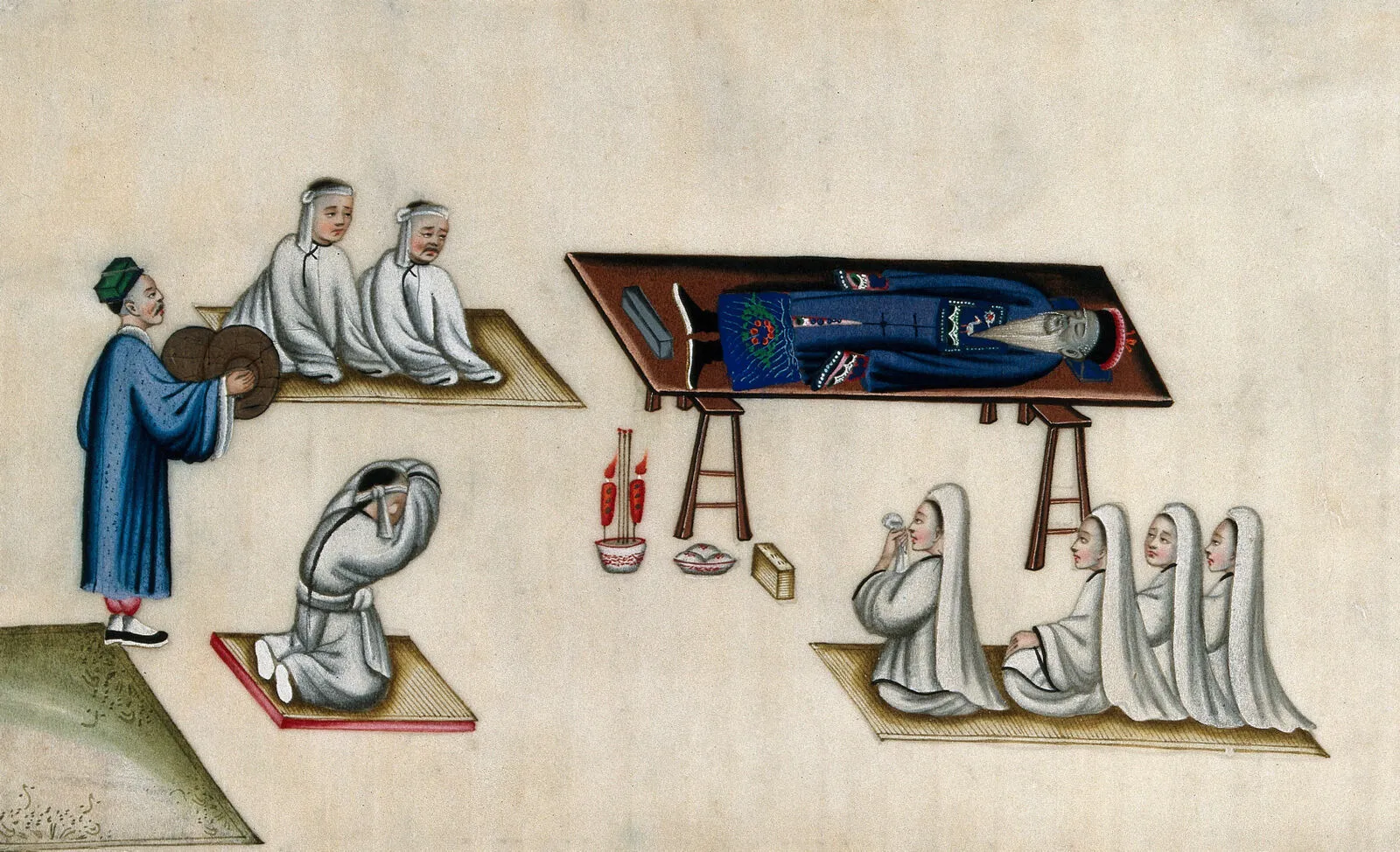
A body laid out before coffining, with mourners and a cymbal player, the stage at which “Shibian” begins. Chinese funeral customs, watercolour by a Chinese artist, about 1800. Wellcome Collection, 572389i. Public domain.
Four carters, finding the inn full, are put up in the room where the innkeeper’s daughter-in-law lies dead. One of them, still awake, watches her sit up, come to the beds and blow on each sleeper. Her face is a pale gold and her forehead is bound with raw silk. He runs for it barefoot, and she runs after him all the way to a temple outside the town, where he dodges her round a poplar.11 Then:
尸暴起,伸兩臂隔樹探撲之。客驚仆。尸捉之不得,抱樹而僵。11
Suddenly the corpse lunged, stretching both arms round the tree to seize him. He fell in a faint. The corpse, missing him, clung to the tree and went stiff.
At dawn the magistrate’s men find her fingers curled like hooks and sunk into the wood up to the nails; the holes look chiselled.11 The whole story is transcribed and translated. The verb for her pursuit is 馳, to race. The outstretched arms are there, once, to reach round a tree. The band across her forehead is silk, part of the laid-out body, and not a charm.
Pu did not invent the rising corpse. Feng Yichao, in a 2007 study of the jiangshi stories of Zibuyu, finds records before and during the Tang and Song few and scattered, and many from the Ming on, above all in the Qing.19 Wang Shengyu, in T’oung Pao (2022), places “Shibian” in a group of “House of Death” accounts and argues that Pu also borrowed from a “Temple of Horror” tale of the same kind.19 The magazine ArtReview, writing on Mr. Vampire in 2020, gives Pu’s book the date 1740, which matches neither the preface nor the first printing.1020
A slap outside Yifeng Gate
Yuan Mei (1716 to 1797) called his collection Zibuyu, “What the Master would not discuss”, then renamed it Xin Qi Xie; it runs to twenty-four juan with a sequel of ten.12 Feng Yichao works from an edition based on the Suiyuan print of the fifty-third year of Qianlong, 1788. Matsumura (松村昂), in the Heibonsha encyclopedia, notes that the newest story in it dates from 1791, so the book kept growing after that first print.12
Feng counts thirty-four jiangshi stories in the two books.7 Nakano Kiyoshi, who went through the same stories in a series of articles ending in 2014, puts the number at about thirty.21 His finding on how they move is plain: a corpse that travels by leaping turns up in only one of them. Chasing and running are what the stories mostly show, and the corpses’ stiff joints keep them from climbing walls, trees or ladders, or crossing water, which is how the living escape them.7
The one leaping corpse belongs to a man named Qian, from Tongcheng, who lived outside Yifeng Gate.1322 Riding home drunk at the second watch, past a stretch of dense graves, he saw something come out of the trees:
見樹林內有人跳躍而來,披髮跣足,面如粉墻。13
He saw someone come leaping and jumping out of the wood, hair loose, feet bare, the face like a whitewashed wall.
Qian slapped it. Its head swung round with the blow and came back, “like a puppet on strings”, and it retreated into the trees when other travellers came up. His hand stayed black for three or four years. The locals told him it was a jiangshi just starting out, “not yet fully made”.13 Nakano Kiyoshi (2011) singles out the swinging head: a jiangshi is supposed to be stiff, and this one gives under the hand like a hanging puppet, which he finds oddly true to life.23
In the sequel, a corpse that goes out at night comes home to find its coffin filled with tiles and sees the man who did it up in a loft. Its legs are “hard as dry wood” (腿硬如枯木) and it cannot climb the ladder. When he escapes across a river, it paces the bank, howls, “leaps three times and jumps three times” (三躍三跳), and goes off in the form of a beast.14 The storyteller explains that a jiangshi first becomes a drought demon and then a hou, the beast the Buddha rides.1424 Here the stiffness and the leaps sit in one story, but the stiffness is what stops the corpse, and the leaps come as it changes into something else.
Ji Yun’s leaping dead
Ji Yun (1724 to 1805) wrote the five parts of his Yuewei caotang biji between 1789 and 1798; his pupil Sheng Shiyan printed them together in 1800.15 The part called Rushi wowen opens with Ji Yun’s note dated the twenty-first day of the seventh month of the xinhai year, 1791.15
Its first juan has the story of Hu Gongshan, a physician Ji Yun met as a boy of six or seven, when Hu was past eighty. Hu said that as a young man he had met a jiangshi:16
揮拳擊之,如中木石,幾爲所搏。幸躍上高樹之頂,尸繞樹踴距,至曉乃抱木不動。16
He punched it, and it was like hitting wood or stone; it nearly caught him. Luckily he leapt to the top of a tall tree. The corpse leapt about round the tree until dawn, when it clung to the trunk and stopped moving.
Only when a pack train came by with its bells did Hu dare to look down: white hair all over, eyes red as cinnabar, fingers like hooks, teeth sticking out of the lips like blades.16 The tree, the dawn and the clinging all match Pu’s “Shibian”, written more than a century earlier; that is our observation. The 1925 Shanghai lithograph of the book prints 抱本 for 抱木, which we read as a misprint.16
In the fourth juan of Rushi wowen Ji Yun sets out a theory.17
其爲祟者曰僵尸。僵尸有二:其一新死未斂者,忽躍起搏人;其一久葬不腐者,變形如魑魅,夜或出遊,逢人即攫。17
The ones that do harm are called jiangshi. There are two kinds. One is the newly dead who has not yet been put in the coffin, who suddenly leaps up and seizes people. The other is the long-buried corpse that does not rot, changes its shape into something like a mountain demon, sometimes goes out roaming at night, and snatches anyone it meets.
He records a view that the drought demon is this second kind (或曰旱魃即此) and adds that no one can say for certain.17 Elsewhere in the same part he writes that “the drought demons people talk of nowadays are all jiangshi; they dig them up and burn them, and often rain follows” (近世所云旱魃則皆僵尸,掘而焚之,亦往往致雨), and asks how one corpse’s breath could block heaven and earth.24 Feng finds the same belief, that burning a drought demon brings rain, in Yuan Mei’s stories.24 Nakano Kiyoshi (2012) takes Ji Yun’s “nowadays” at its word: he finds no story tying drought demons to jiangshi from before the Qianlong fifties, 1785 to 1794.25
Ji Yun does not believe the dead know what they do. A corpse that grabs its own parents and children, he argues, cannot be the person it was; “some other evil thing possesses it”. He then quotes Yuan Mei’s Xin Qi Xie, the story of a Nanchang scholar whose walking corpse visits a friend, and its theory that the good hun soul leaves while the dull po soul stays behind.1726 He finds the reasoning sound but suspects another cause.26 The full passage is transcribed and translated. Neither man explains the corpse’s movements by stiffness; the words for how it moves are 躍起, “leaps up”, and 踴躍, “leaps about”. The popular claim that jiangshi hop because rigor mortis locks their joints does not appear in any Qing text we read.
Timber rafts to Changde
The practice the Film Archive names, sending the dead home on foot, appears in the Qingbai leichao, a compilation of Qing anecdotes by Xu Ke published by the Commercial Press; we read its 1918 printing.18 Its entry 送尸術, “the art of sending corpses”, is set among timber merchants of Guizhou who rafted logs down to Changde in Hunan each spring and walked home.5 When one died, two companions brought him back:
一人導於前,一人以手持碗水隨於後。水不傾潑,尸不倒也。尸與生人無異,但不能言,其行步與生人亦微異。蓋人行則行,人止則止。5
One walks in front; the other follows holding a bowl of water. As long as the water does not spill, the corpse does not fall. The corpse is like a living man except that it cannot speak, and its gait is a little different from a living man’s: it walks when they walk and stops when they stop.
The water in the bowl had to be charged with a charm and spell. Inns kept a room for such parties, and the corpse stood by the door all night, hence the Hunan saying “three stay at the inn, two eat”. At home the water was poured out and the corpse dropped. A man named Yang Kuanfu, the entry says, saw one outside Changsha in the autumn of the jiyou year of Xuantong, 1909.5 The next entry has the general Huang Zhonghao, camped on the Sichuan border, watch a man with a cloth banner lead a corpse that “stood upright and followed him, stepping along in a daze” (一尸直立,隨其人,惘惘而步). Hundreds of soldiers came out to look.6 Both entries are transcribed and translated.
The corpses in these accounts walk. The charm is on the water, not on the dead man’s face. And neither account is set in western Hunan: the first runs from Guizhou to Changde and Changsha, the second is on the Sichuan border. Feng, pointing to Zhan Yinxin’s quotation of this entry, puts the art between Guizhou and Hunan, “not only western Hunan”.5
Coffins left above ground
The Qing stories keep putting jiangshi near coffins that were never buried. Joohee Suh, in a 2019 dissertation on unburied bodies in Qing China, describes how delayed burial (停葬) left coffins above ground across Jiangnan in the eighteenth and nineteenth centuries, and how popular tales of the time turned these bodies into man-hunting jiangshi.27 Feng reaches the same link from the other side: in one of Yuan Mei’s stories, jiangshi seize people in Henan because coffins there were so often left in the open (棺多野厝), which he reads as tying the jiangshi to the unburied body.27
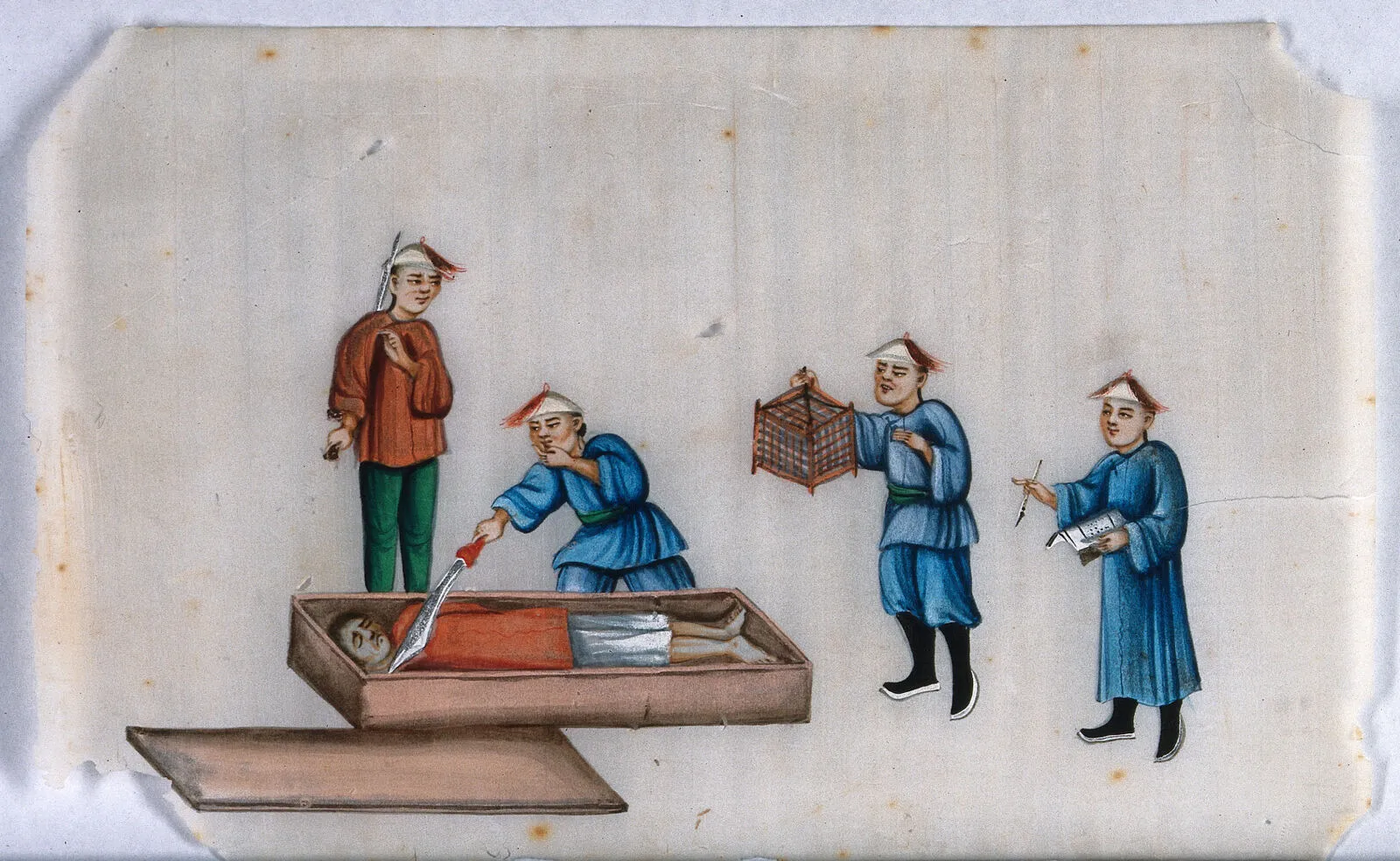
Men in official hats inspect a body in an open coffin. Gouache on rice paper by a Chinese artist, about 1850. Wellcome Collection, 582385i. Public domain.
Feng also warns against the idea that jiangshi belong to Hunan. The corpse-driving legend makes people think of Hunan first, but Yuan Mei sets his stories all over China, most of them in Jiangsu and Zhejiang, eight each.22 The man who slapped the leaping corpse lived outside Yifeng Gate; the hou was told by a magistrate from Changzhou.22
Where the hop is missing
Put the texts side by side and the parts of the film come from different places. The undecayed corpse that rises and kills is in Ji Yun’s second kind.17 Arms that reach out and fingers that sink into wood are in Pu Songling.11 The escorted dead who stop when their guide stops, and stand by the door at the inn, are in the Qingbai leichao, and so is the charm, on a bowl of water.5 The glutinous rice, the inked line and the peach-wood sword we did not find in any of these texts; the Film Archive credits the film with setting them.3
The hop is the gap. Yuan Mei has one corpse that comes leaping out of a wood and another that leaps three times as it turns into a beast.1314 Ji Yun’s dead leap up to seize and leap round a tree.1617 The escorted dead of 1909 walk.5 We could not find a text, before the films, in which the corpse-driver’s charges hop in file along a road, and we could not find the first text that sticks the charm to the corpse’s forehead.35
What we could not verify
Sources we have not seen
- Shen Congwen’s essay 〈沅陵的人〉, in his collection 湘西, is said to describe corpse-driving in western Hunan; it would show what a Hunan writer reported before the films. The book is in copyright, and the Hong Kong Ta Kung Pao issues that first printed this part, 20 to 31 August 1938, are missing from the Hong Kong Public Libraries’ scans.
- 陸群, 湘西趕屍 (民族出版社, 2006), the only monograph on corpse-driving we know of, is said to rest on oral testimony and to report a 1980s magazine’s claim that the dead were carried on bamboo poles, which would explain the hop. It is in copyright, and Google Books shows no preview.
- Wang Shengyu’s T’oung Pao article (2022) and his translation with Paulo Brito of five late-Ming and early-Qing analogues of “Shibian” (Renditions 98, 2022) would show how the corpses move in the chase stories before Pu. The article is behind Brill’s paywall and the Renditions issue is sold in print, so we have read only the abstract.
Resting on a single source
- ArtReview (2020) says the film’s corpses wear the robes of Qing officials.
Questions we could not settle
- The bamboo-pole explanation of the hop. No source we read supports it.
- Whether “Shibian” survives in Pu Songling’s own manuscript. A facsimile of the surviving half, posted to the Internet Archive by a private user, has it in the first volume with the chase in the same words, but the upload does not say what it copies, and we found no library’s own scan.
Read next
TaleLeifeng Pagoda, Hangzhou, China, 975 to 2002
Lady White Snake and the fall of Leifeng Pagoda
CaseBeijing, China, 1476 to 1477
Heisheng, Beijing's black creature of 1476, and the Western Depot
TaleChina; the earliest texts are from Shanghai, 1933 to 2009
The earliest Nian beast we could find dates from 1933
Sources
- Hong Kong Film Archive, programme note 殭屍先生, 靈幻經典 series, 2026, credits: "導演:劉觀偉 … 監製:洪金寶 … 出品:嘉禾"; "1985 | 彩色 | DCP |粵語 … 98分鐘"; "茅山師傅九叔(林正英)"
- Hong Kong Film Awards Association, 第5屆得獎名單, rows 最佳電影, 最佳導演 "劉觀偉 (殭屍先生)", 最佳男配角 "林正英 (殭屍先生)", 最佳電影配樂 "Melody Bank (殭屍先生)"
- Fi Churchman, "'Mr. Vampire': Fear and Laughter in Hong Kong", ArtReview Asia, 1 July 2020, opening paragraphs
- Katarzyna Ancuta, "Scared Stiff: Jiangshi and Chinese Vampires", in Simon Bacon (ed.), The Palgrave Handbook of the Vampire (Palgrave Macmillan, 2024), reference list (abstract and references seen; chapter not read)↑
- Hong Kong Film Archive, 殭屍先生, 2026, "從此掀起八十年代風靡一時的殭屍片熱潮"
- Hong Kong Film Archive, 殭屍先生, programme note, 2017, "公映後引起港產殭屍片拍攝熱潮"
- Kwan Wai Eric Yu, "Professionalism and the body in Hong Kong jiangshi films: From Mr. Vampire to Tsui Hark's vampire hunters", conference paper, Envisioning Chinese Cinemas in the 21st Century, National Chiao Tung University, 2013, abstract (paper not read)
- ArtReview, Churchman 2020, second paragraph↑
- ArtReview, Churchman 2020, opening-scene paragraphs
- Hong Kong Film Archive, Vampire Cleanup Department, English programme note, 2021, whole note
- Hong Kong Film Archive, 殭屍先生, 2026, "並設定糯米、靈符、墨斗線、桃木劍等治殭屍的獨特方法"
- Yu 2013, abstract↑
- Hong Kong Film Archive, 殭屍先生, 2026, "電影將湘西趕屍的民間傳說,糅合西方吸血鬼、喪屍的特色,塑造出別樹一格的殭屍形象"
- Hong Kong Film Archive, English programme note, 2026, first paragraph
- Ancuta 2024, abstract↑
- Xu Ke 徐珂, Qingbai leichao 清稗類鈔, vol. 33, 方伎類, 送尸術, Commercial Press, 1918 printing, pp. 52-53 (PDF pp. 54-55) (primary) transcription
- Feng 2007, p. 191, n. 10↑
- Qingbai leichao, vol. 33, 方伎類, 1918 printing, p. 54 (PDF p. 56): "一尸直立隨其人惘惘而步" (primary)
- Hong Kong Film Archive, English programme note, 2026, first paragraph↑
- Feng 2007, pp. 190-191, 205-206: "跳躍而行的僵屍也只在〈批僵屍頰〉故事中看到"; "僵屍跳躍行進的情形也不多見,反而追逐、奔跑的畫面卻經常出現"
- Xin Qi Xie, juan 8, PKU copy, leaf 10a: "見樹林內有人跳躍而來" (primary)↑
- Hong Kong Film Archive, 殭屍先生, 2026, "受任老爺(黃蝦)所託,為其父起棺遷葬,赫然發現屍體毫無腐化跡象,其後更化為殭屍,殺掉任老爺"
- ArtReview, Churchman 2020, plot paragraph
- Hong Kong Film Archive, English programme note, 2026, second paragraph↑
- Hong Kong Film Archive, 殭屍先生, 2017, "本片票房當年排名第七"
- Hong Kong Film Archive, Mr. Vampire, English programme note, 2026, first paragraph
- Hong Kong Film Archive, 殭屍先生, Chinese programme note, 2026, "在台灣公映後意外成功,回港正式上映,票房大收超過兩千萬元"↑
- 日本大百科全書 (Nipponica), 聊斎志異 and 蒲松齢 (Kotobank), "死後51年を経た1766年に最初の刊本青柯亭本が刊行された"; "自序の書かれた1679年"
- ブリタニカ国際大百科事典 小項目事典, 聊斎志異 (Kotobank), "康煕 18 (1679) 年頃成立。著者の死後の乾隆 31 (1766) 年刊"
- Pu Songling, Liaozhai zhiyi, 16 juan, Qingketing edition, Shanghai Library copy, PDF p. 1 (title page), p. 29-30 (contents), p. 831 (juan 13 head) (primary)↑
- Liaozhai zhiyi, Qingketing edition, Shanghai Library copy, juan 13, 尸變, PDF pp. 840-842, leaves 11-12 (primary) transcription
- Shengyu Wang, "Pu Songling's 'Shibian' 尸變 and Vampiric Chases in the Chinese Tradition of Strange Narratives", T'oung Pao 108 (2022): 738-777, abstract (article not read)
- Feng Yichao 馮藝超, 〈《子不語》正、續二書中僵屍故事初探〉, 東華漢學 6 (2007): 189-222, p. 190 and n. 4↑
- ブリタニカ国際大百科事典 小項目事典, 子不語 (Kotobank), "正 24巻,続 10巻。正編は乾隆 53 (1788) 年頃,続編は同 57年頃成立"; "『新斉諧』と改名した"
- 松村昂, 改訂新版 世界大百科事典, 子不語 (Kotobank), "最も新しい話は1791年"; "のちに《新斉諧》と改名"
- Feng 2007, p. 191, n. 6: "以乾隆53年隨園刻本為底本"↑
- Yuan Mei, Xin Qi Xie (Zibuyu), juan 8, 批僵尸頰, Peking University Library copy scanned by CADAL (新齊諧(五)), juan 8, leaves 10a-10b; Commons pages 20-21 (primary)
- Feng 2007, p. 205
- Nakano Kiyoshi 中野清, 〈『子不語』僵尸説話の加工〉, 中國詩文論叢 30 (2011): 140-154, p. 149 (discussion) and n. 13, p. 154 (text quoted: "見樹林內有人跳躍而來。披髮跣足、面如粉牆")↑
- Yuan Mei, Xu Xin Qi Xie (sequel), juan 3, 犼, PKU copy scanned by CADAL (續新齊諧(二)), juan 3, leaf 1; Commons pages 2-3 (primary)
- Feng 2007, pp. 199, 203, 207↑
- ブリタニカ国際大百科事典 小項目事典, 閲微草堂筆記 (Kotobank), "嘉慶 5 (1800) 年刊"; "乾隆 54 (1789) 年から嘉慶3 (98) 年にかけて書かれたものを,門人の盛時彦が合刊"
- 日本大百科全書 (Nipponica), 閲微草堂筆記 (Kotobank), "「如是我聞」4巻(1791)"
- Ji Yun, Yuewei caotang biji, 24 juan, 1816 Beiping Sheng reprint, NCPSSD copy, vol. 3, juan 7, leaf 1a (PDF p. 4) (primary)↑
- Yuewei caotang biji, 1816 reprint, NCPSSD copy, vol. 3, juan 7 (Rushi wowen 1), leaves 9a-9b, PDF pp. 12-13 (primary)
- 繪圖閱微草堂筆記, Shanghai: 沈鶴記書局, 1925, National Taiwan University Library copy, v. 1, 卷三 (如是我聞一), PDF pp. 120-121 of part 1 (primary)↑
- Yuewei caotang biji, 1816 reprint, NCPSSD copy, vol. 4, juan 10 (Rushi wowen 4), PDF pp. 71-72 (primary) transcription
- Feng 2007, p. 190, n. 5; p. 198↑
- National Library of China, 民國文獻 record 清稗類鈔. 第三十三冊 (Liaoning Provincial Library copy), record fields 責任者=徐珂, 出版者=商務印書館, 出版時間=民國9[1920]
- Qingbai leichao, vol. 33, 1918 printing, cover, PDF p. 1 (primary)↑
- ArtReview, Churchman 2020, paragraph on geongsi↑
- Feng 2007, pp. 190-191
- Nakano Kiyoshi 中野清, 〈『子不語』の僵尸説話 補遺及び結語〉, 中國詩文論叢 33 (2014): 269-282, p. 279: "約三十則ほどの「僵尸説話」を検討してきた"↑
- Feng 2007, p. 191
- Xin Qi Xie juan 8, sequel juan 3, PKU copy, juan 8 leaf 10a; sequel juan 3 leaf 1a (primary)↑
- Nakano Kiyoshi 中野清, 〈『子不語』僵尸説話の加工〉, 中國詩文論叢 30 (2011): 140-154, p. 149: "僵尸の一般的なイメージは「硬く強張っている」ものであるはずだ"; "實は硬く強張ってはいない、という所が妙なリアリティーをもつ"↑
- Yuewei caotang biji, 1816 reprint, vol. 3, juan 7, leaf 2b, PDF p. 6: "近世所云旱魃則皆僵尸掘而焚之亦往往致雨" (primary)
- Feng 2007, pp. 202-203: "旱魃出現時則天大旱,焚之則致雨"; "其由僵屍先變為旱魃,再變為犼"
- Nakano Kiyoshi 中野清, 〈『子不語』の僵尸說話: 旱魃との關聯について〉, 中國詩文論叢 31 (2012): 105-113, p. 108: "近世云ふ所の旱魃は則ち皆な僵尸にして、掘りてこれを焚けば、亦た往往にして雨を致す"↑
- Nakano Kiyoshi 中野清, 〈『子不語』の僵尸說話: 旱魃との關聯について〉, 中國詩文論叢 31 (2012): 105-113, p. 108: "紀昀も「近世」と言っているように、「旱魃」と「僵尸」を結びつけた話は、この時代(乾隆五十年代)以前のものには全くないのである"↑
- Yuewei caotang biji, 1816 reprint, vol. 4, juan 10, PDF p. 72: "袁子才前輩新齊諧載南昌士人行尸夜見其友事" (primary)
- Feng 2007, pp. 198, 205-206, 218↑
- Joohee Suh, The Afterlife of Corpses: A Social History of Unburied Dead Bodies in Qing China (1644-1911), PhD dissertation, Washington University in St. Louis, 2019, abstract (dissertation not read)
- Feng 2007, pp. 198-199, 216: "其地棺多野厝"; "明確指出僵屍與屍體未入土有相當關係"↑
Documents quoted
- Ji Yun on the two kinds of jiangshi, Yuewei caotang biji, juan 10 (1791) (transcribed from the page image)
- Pu Songling, “Shibian” (The corpse that changed), Liaozhai zhiyi, Qingketing edition (transcribed from the page image)
- Xu Ke, “The art of sending corpses home” (送尸術), Qingbai leichao (transcribed from the page image)