 Twice Told
How the dog of Bretten got its siege
Bretten's tailless dog is said to have ended a siege in 1504. The oldest telling, printed in 1805, gives no year, and the real siege ended in a truce.
Contents
Published 1 Oct 2026. Sources checked 10 Oct 2026.
Bretten’s own tourism page tells how a fattened dog saved the town from a siege.6 The same page ends with a correction from Peter Bahn, the former head of the town museum: not one of the sieges Bretten went through, he writes, was averted by a dog.7
A local weekly went further in 2024 and said that no record of a siege “at this time” survives.8 That is wrong. Duke Ulrich of Württemberg’s army arrived before the town on Tuesday 11 June 1504 and lay there for 23 days.910 What none of the accounts we read has is a dog sent out of the town.111213
The story, as the town’s own tourism page tells it, goes like this.6
Bretten was besieged by a large enemy army and cut off from all supplies.6 Food ran low, and surrender had to be considered in earnest.6 Then one of the councillors, or in some versions the mayor himself, had an idea.6 They would gather the last scraps of provisions, fatten a small dog on them, and send it toward the enemy once it was round and fat.6 Seeing it, the enemy would think the town still had food in plenty and give up hope of starving it out.6 The people of Bretten pooled their last stores, and for some days the little dog lived on the best of them.6 When it was properly round it was sent out of the town into the enemy camp.6
The besiegers saw the fat dog, decided the siege could last for ages, and marched off with nothing done.6 In their annoyance they chopped off the poor dog’s tail and chased it back into the town, though some say they did it so that the army would at least have something to show.6 The citizens, so the story goes, later put up a stone monument to the little dog that had saved them.6
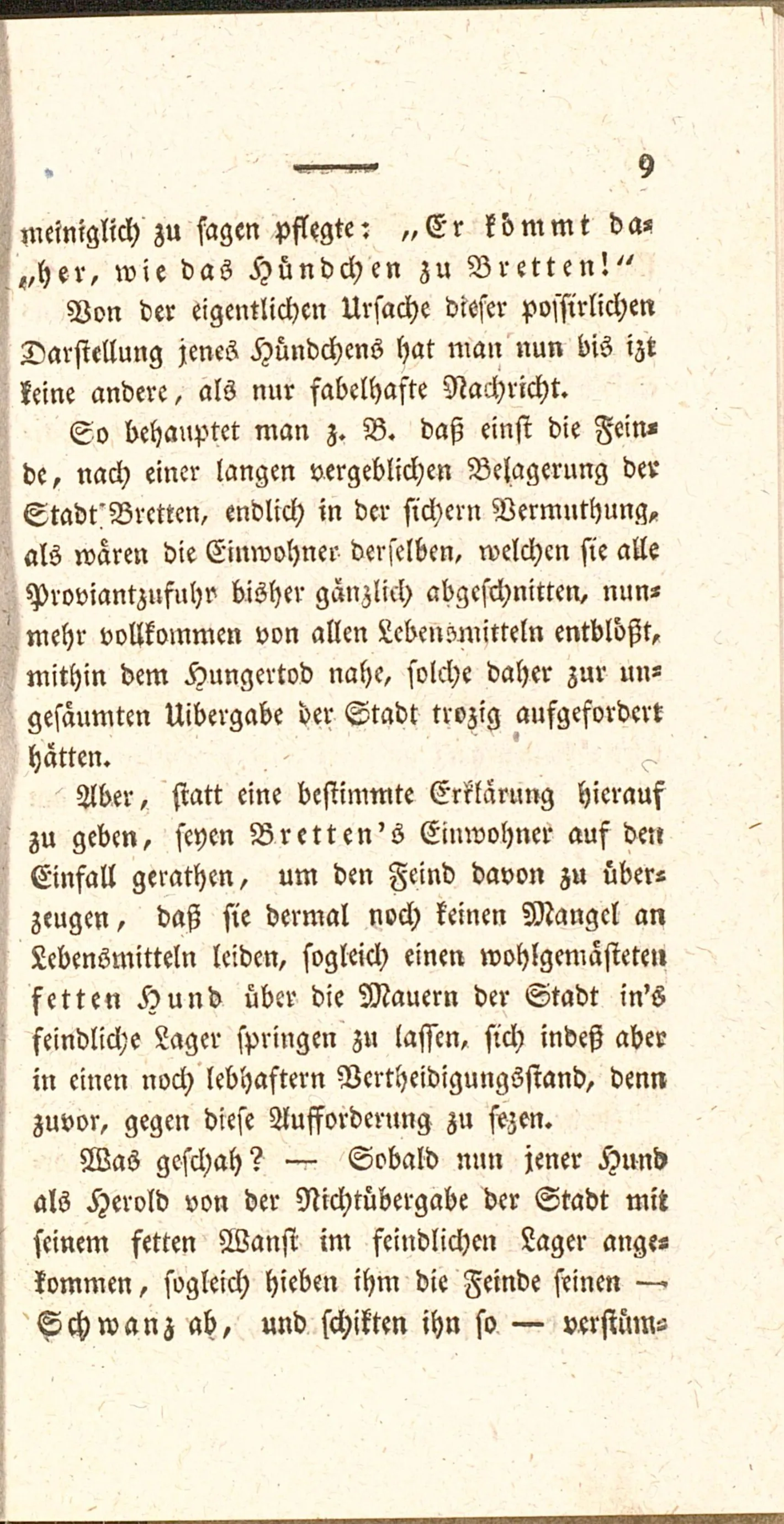
Page 9 of Siegmund Friedrich Gehres, Bretten’s Kleine Chronik, Esslingen 1805. It ends the proverb “Er kömmt daher, wie das Hündchen zu Bretten!” and begins the oldest siege story about the dog that we could read. Badische Landesbibliothek Karlsruhe, O 50 A 379, Public Domain Mark, cropped.
The siege without a dog
The siege is better documented than the dog.10 Georg Schwarzerdt, the younger brother of Philipp Melanchthon and later the town’s Schultheiss, wrote what Peter Bahn calls the most important surviving contemporary source for the siege.14 He was about four years old in 1504, so he wrote from what people who had been there told him, and no manuscript in his own hand is known.1415
His account has the town well provided for. Elector Philip had supplied it with guns, powder, lead and provisions, so that it lacked nothing, and had a common kitchen set up in the Steinhaus where anyone could fetch food.16 When the Landsknechte mutinied, their captain told them their pay was on the way and that they lacked neither food, drink, powder, lead nor water.17 That was a speech to angry men, and it shows what he said, not what every household had.
The want Schwarzerdt does record is water: the besiegers threw three fire-balls into the town, and the citizens were badly frightened because it was a hot season and there was little water.18
The siege did not end with a trick. Schwarzerdt writes that just when the war was at its hardest, it began to come to an end:
Also da der krieg am hertisten war, gewan er ein loch, wie gemeinlich beschicht, dan uff unser frawen heimsuchung tag wart ein fried geschriehen19
Just when the war was at its hardest it began to come to an end, as often happens, for on Our Lady’s Visitation day a peace was proclaimed
Duke Ludwig, the elector’s son, then came to Ulrich’s camp, and Ulrich left with his army.19 Peter Bahn dates the truce to 2 July 1504 and says it was signed at Knittlingen the same day.19
In the whole narrative the only dog we found is a simile. The citizens and soldiers grow bold and keen “wie ein jaghundt, der ob dem wilprecht gebaißt”, like a hunting hound that has bitten into game.11 Gehres tells the same siege in a chapter of its own, later in the book that holds the dog, and there too there is no dog and no hunger: Ulrich comes with 20,000 foot and about 400 horse, the citizens make a night sortie, and the siege is lifted when Duke Ludwig arrives and brings about a settlement.12
A real dog does turn up in Schwarzerdt’s other account, of the Peasants’ War of 1525. Michael Klebon quotes it: the town tied the shepherd’s dog round the town every night.20 He calls this a thoroughly unlegendary report of what the “Brettener Hundle” was worth.20
The first siege story
The oldest siege story we could read is in a town chronicle printed in 1805.3 Siegmund Friedrich Gehres opens his chapter on the “so-called Wahrzeichen of the town of Bretten” with a little dog carved in stone outside the choir of the St. Laurentius church, without a tail.21 It had supplied the first material, he says, for a proverb about someone who lost his lawsuit or came off worst in a critical matter: “He turns up like the little dog of Bretten!”21
Von der eigentlichen Ursache dieser possirlichen Darstellung jenes Hündchens hat man nun bis izt keine andere, als nur fabelhafte Nachricht.21
Of the real reason for this comical figure of the little dog, nothing has been known until now except fabulous reports.
The first of those reports is the siege, and it is not the town’s telling of today.36 Gehres’s dog is already fat and goes over the wall as a herald; nobody fattens it.3 The starvation is the enemy’s guess, not the town’s.3 The tail comes off as a threat that the besiegers will spare no one if they take the town, and the siege is lifted soon after, where the town now has the tail cut off in spite as the army leaves.36 Gehres names no year, no duke and no enemy.3
Gehres prefers other explanations. Two follow: the man who commissioned the church had a dog in his coat of arms, or, which Gehres finds more credible, the Freiherren von Hundheim, who carried a dog in their arms and gave much to the building, were thanked with the carving.5 He ends by saying the reports contradict one another and that nobody has found a true trace of how the dog lost its tail.5
A butcher on a Friday
Eleven years later the Brothers Grimm printed the dog without a siege.4 Their no. 95 is marked “Mündlich”, told by word of mouth, and opens with a saying: in the Palatinate, especially the Kraichgau, people say “it will happen to you as it did to the little dog at Bretten” when they speak of loyalty badly repaid.22
In the story a man’s trained little dog fetches meat and sausage from the butcher, with a basket in its mouth holding a note and the money.4 One Friday its master, a Protestant, sends it to a butcher who is a Catholic and keeps the fast strictly.4 Finding a sausage on the note, the butcher holds the dog, chops off its tail, puts the tail in the basket and says “There, have your meat!”4 The dog carries the basket home and dies, the whole town mourns, and a tailless dog is carved in stone and set above the town gate.4 Others tell it differently, Grimm adds: the dog stole meat for its poor master until a butcher caught it and took its tail.23
In Grimm’s telling the dog is a victim, or a thief, not a rescuer.423 The saying sits oddly with a rescuer. Grimm glosses it as loyalty badly repaid, and Gehres as coming off worst.2221 On our reading it is a saying about a loser, and a dog that saved a town is an odd loser.
Fischart’s dog
Grimm wrote that the legend “must be old already”, and that Fischart alludes to it in two different places.22 We found both in Scheible’s 1847 edition of Fischart, the first in the Geschichtklitterung and the second in the text printed after it.12 The dog is no hero in either.
In summa, er ließ nie kein Nieren, noch anders, wie das Hündlein von Bretta dahinden, von frembdes genäsch wegen1
In short, he never left behind a kidney (probably “testicle”) or anything else, like the little dog of Bretta behind, for the sake of other people’s treats
The sense of the line is not clear to us. In the second, a joke about “red peasant dogs”, they lately chased the little dog of Bretta so that it left its weak tool at the fence.2 Neither says why the dog has no tail, and neither mentions a siege, a butcher or a monument.
Fischart’s book came out in 1575 and was reworked in 1582 and 1590. Alsleben’s edition prints the 1590 text with the earlier versions’ variants in its notes, and on the page with the first line his footnotes give variants from the earlier two for other lines but none for this one.1 On our reading the dog of Bretta was a joke in print by 1590 and probably by 1575; we did not check the 1575 print itself.
One stone dog, several places
Gehres puts the stone dog outside the choir of the St. Laurentius church.21 Grimm has it above the town gate.4 A view of the town drawn after 1879 shows the Hundle on the south side of the Stiftskirche, below the bell tower.24 We cannot say whether these are one carving seen three ways or more than one.
In 1786 Widder wrote that the town’s seal and arms show nothing but 21 blue and white Bavarian lozenges, and his chapter on Bretten does not mention a dog.2513 A council decision of 1890, quoted by Wolfgang Martin, still speaks of the “Traubenbrunnen”, which he glosses as today’s Hundlesbrunnen.26 We could not date the dog on the Hundlesbrunnen.
The story against the record
| The story | The record | Verdict |
|---|---|---|
| Bretten was besieged | Ulrich’s army from 11 June 15049 | Confirmed |
| The town was starving | Stocked, with a common kitchen16 | Unsupported |
| A fattened dog was sent out | No dog sent out in Schwarzerdt, Widder or Gehres’s siege chapter111312 | Unsupported |
| The dog’s sight ended the siege | A truce, after Duke Ludwig came to the camp19 | Contradicted |
| The besiegers cut off its tail | Gehres says so; Grimm has a butcher34 | Disputed |
| A monument was raised in thanks | Three reasons in Gehres, a butcher in Grimm54 | Disputed |
The town’s own chronology of 1967 lists the siege of “11.-22. Juni” under 1504, ending it earlier than Bahn’s truce, and, as a separate line, the “Sage vom Brettener Hundle”.2719 Between Gehres in 1805 and that chronology we found no text that puts the dog before Duke Ulrich’s army, so we cannot say who first did.
What we could not verify
Sources we have not seen
- Johann Heinrich Andreae, Bretta Creichgoviae illustrata (1769), which Gehres cites for the siege. It would show whether the dog was tied to a siege before 1805. We found no scan on archive.org or Google Books on 10 October 2026.
- Karl Withum, Erinnerungsblätter aus 2000 Jahren (1904), a town history that the 1967 Jahrbuch lists. It might hold an earlier telling or a date for the stone dog. No scan turned up in the same search.
- The 1913 Kunstdenkmäler of the district of Bretten, which would describe the stone dog and the fountain. Heidelberg University Library’s copy answered with a bot check on 10 October 2026, and we did not try to pass it.
- Alfons Schäfer’s Brettener Quellenbuch (1967), which prints the town’s sources up to the early nineteenth century. It is in print only; we found no online copy.
Seen only where others quote them
- Schwarzerdt’s account of the Peasants’ War, in Würdinger’s edition (p. 20), which Klebon quotes for the shepherd’s dog. We read only Klebon’s quotation and found no scan of the edition.
Questions we could not settle
- When a siege, and then Duke Ulrich’s of 1504, was first attached to the dog.
- When the stone dog was carved, and when a dog first stood on the Hundlesbrunnen.
- Whether the line on the dog of Bretta stands in Fischart’s 1575 print.
Read next
CaseBedburg, near Cologne, Germany, 1589 to 1590
The werewolf of Bedburg in the Cologne papers of 1589
TaleWawel hill, Kraków, Poland, the end of the 12th century to 1597
Kraków's Wawel dragon had no cobbler until 1597
CaseBasel, Switzerland, 1474 to 1906
Basel's burned rooster
Sources
- Alsleben (ed.), Fischart, Geschichtklitterung (1891), p. 90, first lines, chapter 5 () (primary) transcription↑
- Scheible (ed.), Fischart (1847), reprinting a text with a Strasbourg title of 1617, pp. 102 and 565 () (primary) transcription↑
- Gehres, Bretten's Kleine Chronik (1805), ch. 3, pp. 9 to 10 () (primary) transcription↑
- Grimm, Deutsche Sagen, vol. 1 (1816), p. 155, first paragraph () transcription↑
- Gehres, Bretten's Kleine Chronik (1805), ch. 3, pp. 10 to 11 () (primary) transcription↑
- erlebe-bretten.de, "Brettener Hundle", signed Peter Bahn, the section "Das Hundle, wie es jeder kennt"↑
- erlebe-bretten.de, "Brettener Hundle", signed Peter Bahn, the paragraph beginning "Naturlich war alles ganz anders"↑
- Nussbaum, "Das Brettener Hundle: Vierbeiner als Wahrzeichen" (2024), the paragraph on the origin of the legend↑
- Schwarzerdt, "Erzelung der belegerung" (Mone ed. 1854), p. 6, section 10 "Anzug der Wirtenberger" (primary)
- Bahn, "Landsknechte in Bretten" (2003), p. 63, section "Die Meuterei", first sentence↑
- Schwarzerdt, "Erzelung der belegerung" (Mone ed. 1854), p. 15, section 38 ("drey und zwentzig tag darvor gelegen"; eighteen of them shooting) (primary)
- Widder, Beschreibung der Kurpfalz, part 2 (1786), p. 192, last paragraph on the page↑
- Schwarzerdt, "Erzelung der belegerung" (Mone ed. 1854), pp. 14 to 15, end of section 37 () (primary) transcription↑
- Gehres, Bretten's Kleine Chronik (1805), ch. 11, pp. 38 to 41 (primary)↑
- Widder, Beschreibung der Kurpfalz, part 2 (1786), pp. 183 to 199 (OCR search); pp. 192 and 198 read as images↑
- Mone, introduction to the edition of Schwarzerdt (1854), pp. 1 to 2 ("er war zur Zeit der Belagerung erst vier Jahr alt")
- Klebon, "Wie es deßmahls zu Bretheim" (Brettener Jahrbuch 12), p. 51, opening paragraph and notes 4 and 5
- Bahn, "Landsknechte in Bretten" (2003), p. 59, first paragraph↑
- Mone, introduction (1854), p. 1
- Klebon, Brettener Jahrbuch 12, p. 51 and note 7↑
- Schwarzerdt, "Erzelung der belegerung" (Mone ed. 1854), p. 6, section 11 "Rustung der Stadt Bretten" (primary)↑
- Schwarzerdt, "Erzelung der belegerung" (Mone ed. 1854), p. 10, section 21 "Meuterei der Landsknechte" (primary)↑
- Schwarzerdt, "Erzelung der belegerung" (Mone ed. 1854), p. 15, end of section 37 (primary)↑
- Schwarzerdt, "Erzelung der belegerung" (Mone ed. 1854), p. 15, sections 38 to 39 (the date is "uff unser frawen heimsuchung tag") (primary)
- Bahn, "Bretten und der Landshuter Erbfolgekrieg" (2003), p. 52, section "Ergebnisse und Langzeitwirkung"↑
- Klebon, Brettener Jahrbuch 12, p. 56 and note 33↑
- Gehres, Bretten's Kleine Chronik (1805), ch. 3, pp. 8 to 9 () (primary) transcription↑
- Grimm, Deutsche Sagen, vol. 1 (1816), p. 154, the lines under the title () transcription↑
- Grimm, Deutsche Sagen, vol. 1 (1816), p. 155, second paragraph () transcription↑
- Bickel, "Historische Stadtbilder von Bretten", Brettener Jahrbuch 1967, p. 152, the captions and the paragraph after the list of drawings↑
- Widder, Beschreibung der Kurpfalz, part 2 (1786), p. 198, third paragraph↑
- Martin, "Brettheim Nordseite", Brettener Jahrbuch N.F. 1 (1999), pp. 36 to 37, section 3.1 "Poststrasse"↑
- Beuttenmuller, "Zeittafel zur Geschichte Brettens", Brettener Jahrbuch 1967, pp. 15 to 18, entry for 1504↑


Documents quoted
- Brothers Grimm, Deutsche Sagen, 1816: Das Hündlein von Bretta (no. 95) (transcribed from the page image)
- Fischart, Geschichtklitterung: the Hündlein von Bretta (Alsleben 1891, p. 89 to 90; Scheible 1847, pp. 102 and 565) (transcribed from the page image)
- Gehres, Bretten's Kleine Chronik, 1805: the so-called Wahrzeichen of Bretten (transcribed from the page image)
- Georg Schwarzerdt, Erzelung der belegerung der statt Bretten, 1504 (Mone 1854): provisions, water and the end of the siege (transcribed from the page image)