 Twice Told
Amabie, from a single news sheet of 1846
In 1846 a news sheet drew a long-haired sea creature from Higo and named it Amabie. Every other known paper about the creature calls it amabiko.
Contents
Published 24 Sept 2026. Updated 25 Sept 2026. Sources checked 24 Sept 2026.
In April 2020 Japan’s Ministry of Health, Labour and Welfare put Amabie on an icon asking young people to help stop the spread of Covid-19, calling it the yōkai “said to protect people from epidemics”.6 The name on that icon comes from one cheap print of 1846, and from nothing else.7 Yumoto Kōichi, a collector and historian of yōkai, thought the name was a mistake made by whoever copied the text.2
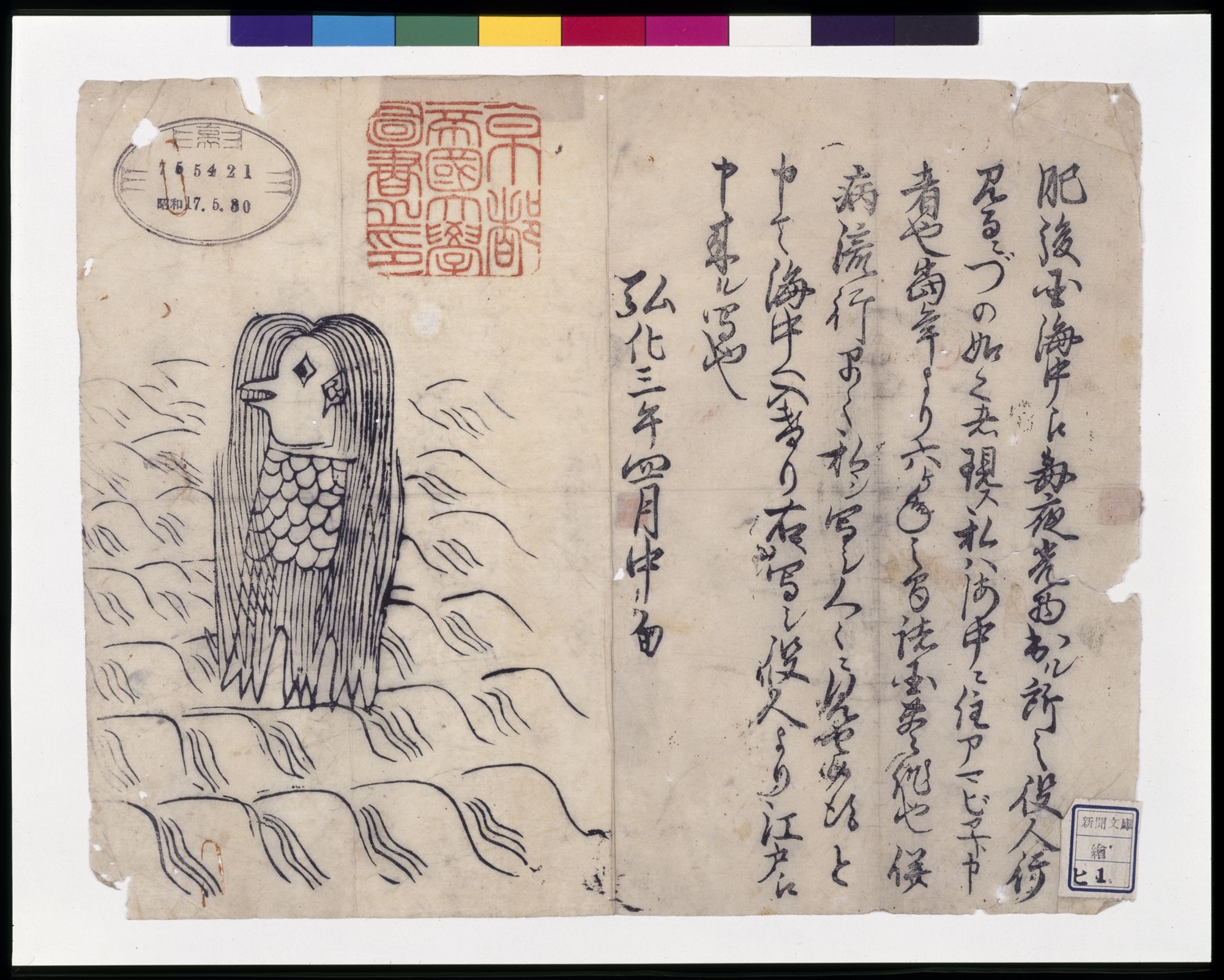
The print is a kawaraban, a single sheet sold on city streets, and the Fukui Prefectural Archives judge its cutting, text and picture alike, crude.8 On the left half a creature with very long hair, a pointed beak and a scaly body stands in waves, with three leg-like shapes below; on the right are seven columns of brush-written text and a date.9 It survives in the newspaper collection of Kyoto University’s Main Library as Higo no kuni kaichū no kai, “a marvel from the sea of Higo”.10 The library says it came with newspapers bought in 1941 and 1942 from Nakagami Toshito, a former Osaka Shimbun reporter, and an oval stamp on the sheet dates its accession to 30 May 1942.1110
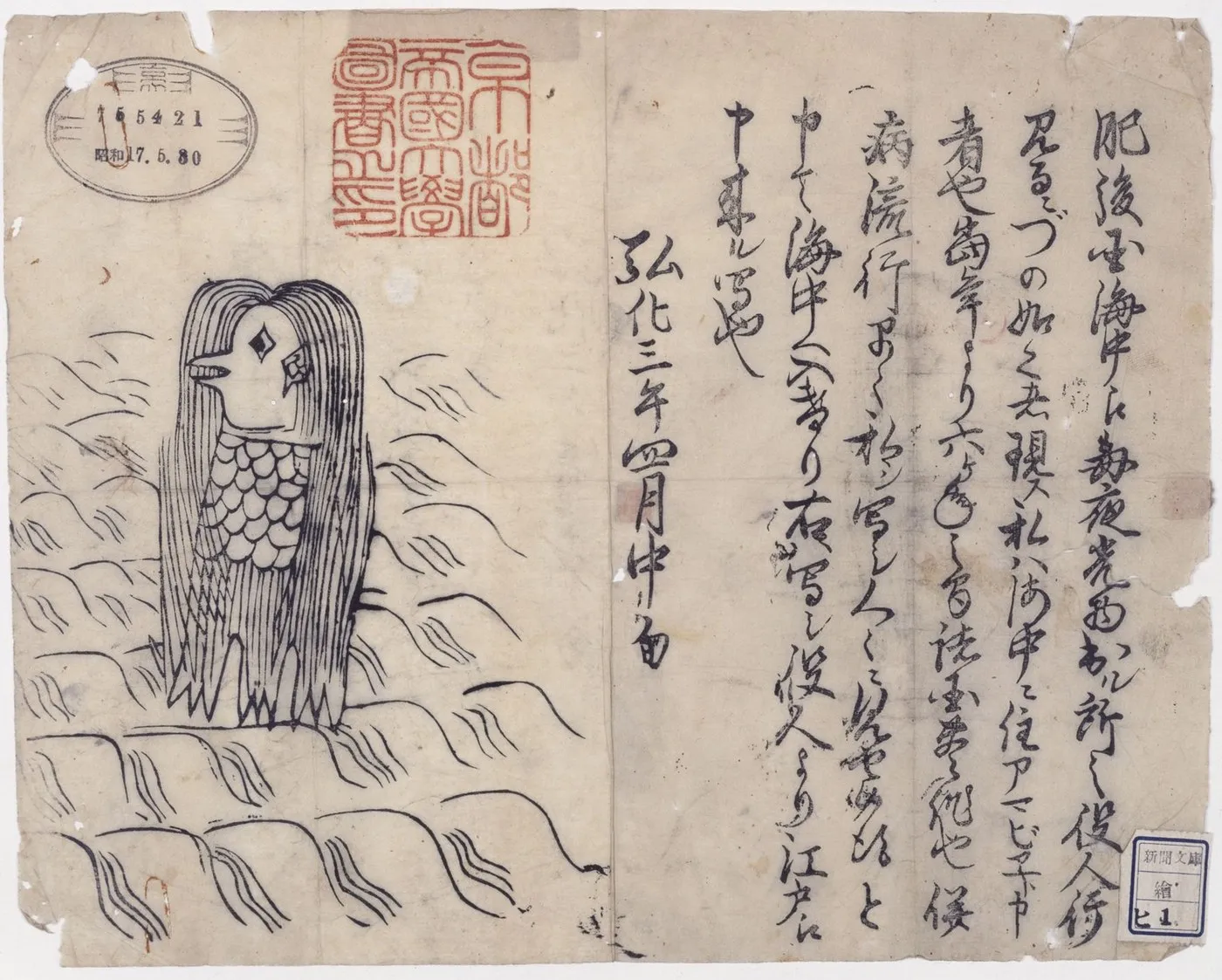
『肥後国海中の怪(アマビエの図)』(京都大学附属図書館所蔵), Kōka 3 (1846), cropped. Photograph courtesy of the Main Library, Kyoto University, from the Kyoto University Rare Materials Digital Archive.10
This is the story as the sheet tells it. No other old paper tells it under this name.
Night after night, something shining appeared in the sea off Higo. An official went to see what it was, and a creature appeared. It said it lived in the sea and that its name was Amabie. For six years from that year, it said, every province would have good harvests. But illness would spread, and he should quickly copy its likeness and show it to people. Then it went back into the sea.3
The official, the sheet says, sent a copy to Edo.
Seven columns, read in order
The whole text is transcribed and translated. It opens:
肥後国海中江毎夜光物出ル所之役人行見るニ3
In the sea of Higo a shining thing came out every night. When the local official went to look…
That is all the setting there is: a province, “the sea”, no village, no date for the sighting, no name for the official.4 Other amabiko texts name a district called Shinji and a witness named Shibata; Nagano Eishun found the district names in no place-name dictionary, and reads the bareness of the oldest texts as a sign of their age.12 One text dated 1843, three years before the sheet, already has both.13
づの如之者現ス14
A creature like the one in the picture appeared.
づ stands for 図, “the picture”.14 The text describes the creature no further than “a shining thing”; the hair, the beak and the scales exist only in the woodcut.149
私ハ海中ニ住アマビヱト申者也3
I live in the sea, and I am called Amabie.
The last kana of the name is ヱ, an older letter for the sound e, not the modern エ.3 Both published transcriptions, the library’s and Nagano’s, read it that way.3
當年より六ヶ年之間諸国豊作也併病流行3
From this year there will be good harvests in every province for six years. But illness will spread.
The sheet predicts the illness outright.3 Modern reference books soften it: the Digital Daijisen Plus has Amabie tell people to copy its picture if illness spreads, and Murakami Kenji’s Yōkai jiten (2000), as Nagano quotes it, gives six months of good harvests, not six years.15 Six years is the usual span: Nagano counts five amabiko texts that promise six years of plenty before an epidemic.16
早々私ヲ写シ人々ニ見セ候得と申て海中へ入けり3
“Copy my likeness quickly and show it to people,” it said, and went back into the sea.
It does not say what the copy will do.17 The older amabiko texts do: whoever sees the picture escapes death or disease.1819
右ハ写シ役人より江戸江申来ル写也3
The above is a copy of what the official sent to Edo.
The date follows: 弘化三年四月中旬, the middle ten days of the fourth month of Kōka 3, which is 6 to 15 May 1846 by our conversion.20 It dates the sheet, not the sighting.20 Nagano thinks the report to Edo is a device to make the news look official, and that no such report existed.5
Amabiko on paper, 1843 to 1882
| Text | Date | Name | What it adds |
|---|---|---|---|
| Seisō kibun, Mizuno Masanobu’s Owari record | 1843 | amabiko | the oldest known entry1 |
| A copy of a Nagasaki letter, printed in the Kōbunko (1916) | eighth month, 1843 | アマビコ | Shinji in Higo; Shibata Gorōzaemon; a monkey’s voice13 |
| Tsubokawa family copy, Echizen | spring 1844 | 海彦 | Echigo coast; seven-tenths of Japan to die18 |
| Zasshodome, Kanamori family, Echizen | 1844 | あま彦 | Shinji district, Higo; the samurai Shibata Chūta19 |
| The Kyoto sheet | 1846 | アマビヱ | the only use of the name Amabie7 |
| A cholera-year print sold in Edo | 1858 | あま彦 | a monkey’s voice; a charm against cholera21 |
| Tōkyō nichinichi shinbun | 14 August 1875 | 天日子尊 | rice fields in Echigo; seven bad harvests22 |
| Tōkyō akebono shinbun | 20 October 1881 | 天彦 | the end of the world; five sen a copy23 |
| Yūbin hōchi shinbun | 10 July 1882 | あま彦 | a widow handing out cholera charms24 |
None of the five records from 1843 and 1844 is a print.1 They are entries in the records that domain retainers kept for their lords, in essay collections and in a farming family’s manuscript, and Castiglioni reads them as copies of kawaraban that are now mostly lost.118 He finds the name written あま彦 in kana, 海彦 with the character for sea, and 雨彦 with the character for rain.25
The encyclopedia Kōbunko, published in 1916, prints a text of 1843 under the heading “strange bird”, with a small drawing of a hairy creature with a beak. Its source is a copy of a letter about strange events in Nagasaki, taken from a collection the Kōbunko calls 昔日叢書, and dated the eighth month of Tenpō 14 (1843).13 At a place called Shinji in the Kumamoto domain of Higo, a shining thing came out night after night and called to people in a voice like a monkey’s. A retainer named Shibata Gorōzaemon went to look, and it told him it lived in the sea and was called アマビコ. There would be six years of good harvests, it said, but much illness in every province, and six-tenths of the people would die; those who saw a drawing of it would escape the illness, and he should spread the word to every province quickly. Then it vanished.13
The Tsubokawa copy, a single leaf now in the Fukui Prefectural Library, was made by a farming family of Taneike village; it is dated Tenpō 15, the dragon year 1844, but nobody knows when it was copied.18 Its creature has a shaven head, round eyes, short hair all over and three long legs, and Nagano, who published it in 2005, transcribes its words as:
越後国浦辺ニ而海中ゟ出候而、當辰年日本之人七歩通り可死、我が形の繪圖を見たる人ハ死をのかるゝとなん申しき18
It came out of the sea on the coast of Echigo and said that in this dragon year seven-tenths of the people of Japan would die, but that anyone who saw a picture of its form would escape death.
The name is written 海彦, with ruby giving the reading amahiko.18 It foretells no harvests and no epidemic, only the deaths.16
The Kanamori family’s record, the Zasshodome, turned out in 2020 to have an amabiko entry.19 In Castiglioni’s translation the creature calls out at night with a voice like a kite’s, promises six years of good harvests and then a disease that will kill more than half the people, and says that those who look at its shape will escape.19 The copyist noted beside the drawing that the mouth was red and the fur black.19
By the Meiji period the name was being written with 天 (heaven) or 尼 (nun).25 In 1875 the Tōkyō nichinichi shinbun found houses in the post town of Yuzawa with the creature’s picture pasted by the door, and its reporter guessed that a monk or a yamabushi had started it.22
Borrowed parts
Some researchers call creatures like this yogenjū, prophecy beasts, which appear, foretell a harvest or an epidemic, and say how to escape it.26 Amabiko was not the first. Nagano lists a jinja-hime, a fish with a human face, recorded in 1819, and several kudabe between 1827 and 1829.26 Yumoto, as Nagano reports him, traces the three legs of the Kyoto picture to the jinja-hime, which has long hair, scales and three sword-like tail fins.26
Looking at a picture as a remedy was older too. Nagano points to handbills for animal shows, such as a camel shown in Edo in 1824, which promised that a child who looked at the picture would get through smallpox and measles lightly.27 Castiglioni calls this “ocular luck”, ganpuku.27
Both scholars see an ape. Nagano notes that several amabiko cry with a monkey’s voice, and suggests that a rumour of 1814, three talking monkeys foretelling that seven-tenths of the people would die, may have shaped the earliest ones.28 Castiglioni calls the amabiko “an oceanic ape” and looks back to the monkey god Sarutahiko.28
A misread letter
Yumoto’s argument is that whoever copied an amabiko text onto the Kyoto sheet wrote エ where the original had コ.2 Castiglioni repeats it, the Digital Daijisen describes Amabie as a changed form of amabiko, and the Yumoto Kōichi Memorial Japan Yōkai Museum in Miyoshi calls it the leading theory.2
Nagano accepts it and draws the consequence: if the carver misread a katakana コ, an earlier sheet must have given the name in katakana, since nobody could turn 尼彦 into Amabie.5 The 1843 text in the Kōbunko does write the name in katakana, アマビコ.13 That fits his argument, though we have the text only in the encyclopedia’s printing of 1916; the link is our reading. In a 2023 essay he goes further. He thinks prophecy beasts were news made up by kawaraban writers in the cities, and notes that no tradition of Amabie was ever recorded in Higo itself.5
Castiglioni and the Miyoshi museum both write the slip as コ read as エ, but the sheet has ヱ, and we found no scholar who discusses the difference.23
What ama means is disputed.29 Nagano thinks 海, sea, is the original character, since almost every amabiko comes out of the sea, and that 天 and 尼 were added later to lend authority or for ornament; he reads Yumoto as treating 天, heaven, as the creature’s essence.29 Castiglioni reads the variants together, sea and heaven both, as the water element.29
The widow of Honjo
On 10 July 1882 the Yūbin hōchi shinbun reported that for three or four days a widow named Izawa Masa, of Honjo Sotodechō, had been going from door to door handing out a charm against cholera.24 Its lower half showed a three-legged beast like a monkey; the text above told the Shinji story again, with a man named Shibata Gorōemon going to look.24 “We are amabiko, who live in the sea,” it said, and it promised six years of good harvests, then illness everywhere and six-tenths of the people dead, and safety for anyone who drew its likeness.24
The paper said the text matched, word for word, a picture cried through the streets of Edo at a good profit in 1858, when the disease it called korori first struck the city.21 It guessed that the old woman had found one in an old purse and reprinted it to help people and earn merit for the next life.24 It closed:
今時ハ此様な事にて安心する人ハござらぬ24
These days nobody takes comfort in that sort of thing.
What we could not verify
Seen only where others quote them
- Nagano Eishun’s second study, “Yogenjū amabiko saikō” (2009), which identifies the 1843 entry in Mizuno Masanobu’s Seisō kibun, read through Castiglioni. It appeared in a 2009 essay collection that is in copyright and that the National Diet Library has not digitised.
- Yumoto Kōichi’s own writing on the misreading, among them “Yogen suru genjū” (2003) and Nihon no genjū zufu (2016), which we know through Nagano and Castiglioni. Both books are in copyright, and the National Diet Library has no scan of either.
- Murakami Kenji’s Yōkai jiten (2000), which Nagano quotes as giving six months of good harvests. The National Diet Library’s scan can be read only inside the library.
- The newspapers of 1875, 1881 and 1882, read in Nagano’s transcriptions and Castiglioni’s translations. The Tōkyō nichinichi of 1875 is in Mainichi’s paid archive; the National Diet Library has digitised none of the three.
Questions we could not settle
- The widow’s address: Nagano gives number 42, Castiglioni number twenty.
Read next
TaleMiyoshi, Hiroshima, Japan, 1749 to 1859
The Inō mononoke roku: where the demon king's mallet came from
CaseShimoda, Izu, Japan, 1884 to 1891
Kokkuri-san came ashore at Shimoda, or so Inoue Enryō heard
TaleHanyū, Shimōsa (now Jōsō, Ibaraki), Japan, 1672 to 1859
Kasane's spirit left Hanyū village twice
Sources
- Castiglioni 2023, §1 (citing Nagano 2009: 136-142); §3: "the five oldest written sources…are not tile prints but rather single entries"
- Fukui Prefectural Archives, August 2020 exhibit, panel 百科事典に載る"最古のアマビコ"
- 長野栄俊 2005, p. 9: "「海彦」は「アマビエ」を二年遡り"↑
- 長野栄俊 2005, p. 4 (quoting 村上健司 2000 summarising Yumoto); p. 16: "湯本氏は…「コ」を「エ」と誤ったもの、と推断"; n. 29
- Castiglioni 2023, §2 (citing Yumoto 2016: 42)
- 湯本豪一記念日本妖怪博物館, 吉川奈緒子 2021, "アマビコの「コ」が「エ」に変化して、アマビエになった、という説が有力です"
- デジタル大辞泉 (Shōgakukan), あまびえ (Kotobank), "あまびこが変化して伝わったものとみられている"↑
- 肥後国海中の怪 (the sheet), all seven columns (primary) transcription
- 長野栄俊 2005, p. 24, 史料2 (checked on the page image)
- Kyoto University Library Network, 画像『肥後国海中の怪(アマビエの図)』のご利用について, 翻刻(例)
- Fukui Prefectural Archives, August 2020 exhibit 「アマビヱよ、君はいったい何者だ?」, panel かわら版に登場した"アマビヱ": "諸国豊作と病気流行を予言し、自身の姿を書き写せ、と述べています"↑
- 肥後国海中の怪 (the sheet), whole sheet (primary) transcription
- 長野栄俊 2005, p. 8: "古い二例が共に、出現地に特定地名を記していない"; "具体的地名と人物名を記していない" (checked on the page image)↑
- 長野栄俊 2005, p. 16
- 長野栄俊, 自著解説『予言獣大図鑑』(文学通信, 2023), ALL REVIEWS, "肥後でアマビエが出現したとされることは、同地の人々の間では伝承されてこなかった"; "出現のニュースをでっち上げ"↑
- Ministry of Health, Labour and Welfare, 新型コロナウイルス感染症について (Wayback capture, 8 Apr 2020), section 若者の皆様へ: "疫病から人々を守るとされる妖怪「アマビエ」をモチーフに、若い方を対象とした啓発アイコンを作成しました"
- Castiglioni 2023, n. 1↑
- Castiglioni 2023, §2: "all of the other extant written sources…call the creature amabiko"; "in contemporary Japan, amabiko is usually referred to as amabie because the oldest and most famous kawaraban…reports this version"
- Fukui Prefectural Archives, August 2020 exhibit, panel かわら版に登場した"アマビヱ"
- 湯本豪一記念日本妖怪博物館 (三次もののけミュージアム), 吉川奈緒子, 「妖怪コレクション1 予言獣「アマビコ」」, 2 Sep 2021, "「アマビコ」の方が記録が古く、また資料も多く残されている"; "京都大学附属図書館が所蔵する「アマビエ」のブーム"
- 長野栄俊 2005, p. 7, list of names; p. 5: "全九例"↑
- Fukui Prefectural Archives, August 2020 exhibit, "字・図とも彫りは稚拙で、都市部で販売された「かわら版」の特徴を備えています"
- Castiglioni 2023, §1, figure 1 caption
- 長野栄俊 2005, p. 5: "弘化三年四月中旬の摺物「肥後国海中の怪」"↑
- 長野栄俊 2005, p. 5: "頭髪は非常に長いが、顔には毛が無い…口が尖って…胴体は鱗(または羽毛)で覆われており…三本生えている"
- 肥後国海中の怪 (the sheet), image 85, left half (primary)
- Castiglioni 2023, §2↑
- Kyoto University Rare Materials Digital Archive, record RB00000122 (新聞文庫・絵), record page: "合綴: 肥後国海中の怪(アマビエの図)"; 所蔵 "京都大学附属図書館"; コレクション "新聞文庫"
- Kyoto University Library Network, 画像『肥後国海中の怪(アマビエの図)』のご利用について, section 原資料について: "受入日は昭和17(1942)年5月30日"
- 肥後国海中の怪 (the sheet), Kyoto University Main Library, image 85, upper left and lower right (primary) transcription
- 長野栄俊, 「予言獣アマビコ考 「海彦」をてがかりに」, 若越郷土研究 49-2 (2005), p. 24, 史料2: "原本 京都大学附属図書館新聞文庫蔵"↑
- Kyoto University Library Network, 画像『肥後国海中の怪(アマビエの図)』のご利用について, section 原資料について: "昭和16年から17年にかけて、元大阪新聞社記者の中神利人氏から購入した新聞とその類縁資料のうちの1点です" (re-read 2026-09-25)↑
- 長野栄俊 2005, p. 8: "肥後国の青沼郡・眞字郡はいずれも実在しない架空の地名"; "古い二例が共に、出現地に特定地名を記していない"
- Castiglioni 2023, §1; §4↑
- 物集高見, 広文庫 第1冊 (広文庫刊行会, 1916), frame 606 of 689 (left page, first あまびこ entry); read on the page image in the NDL viewer, 2026-09-25 (primary)
- Fukui Prefectural Archives, August 2020 exhibit, panel 百科事典に載る"最古のアマビコ"↑
- 肥後国海中の怪 (the sheet), columns 1-2: "光物", "づの如之者現ス" (primary) transcription
- 長野栄俊 2005, p. 5: "文章には「光物」という描写以外、形態に関する記述は見られない"↑
- デジタル大辞泉プラス (Shōgakukan), アマビエ (Kotobank), "病気が流行したら自分の姿を写して人々に見せるようにと伝えて消えた"
- 長野栄俊 2005, p. 4 (quotation of 村上健司『妖怪事典』, 2000; checked on the page image)↑
- 長野栄俊 2005, pp. 10-11; table 1 (p. 22)
- Castiglioni 2023, §3; §5↑
- 肥後国海中の怪 (the sheet), columns 4-5: "早々私ヲ写シ人々ニ見セ候得と申て海中へ入けり" (primary) transcription
- Fukui Prefectural Archives, August 2020 exhibit, panel かわら版に登場した"アマビヱ"↑
- 長野栄俊 2005, pp. 1-4; transcription p. 3 (checked on the page image)
- Fukui Prefectural Archives, August 2020 exhibit, panel 越前に書き伝えられた"アマビコ"↑
- Castiglioni 2023, §1; §3 (translation and figure 3)
- Echizen City, 緊急企画展「アマビコとはやり病」 (page of 21 Jul 2020, Wayback capture), "今回発見された『雑書留』記載のあまびこの絵姿"; "令和2年6月23日…から令和2年8月23日"
- Chunichi Shimbun, 24 and 25 June 2020, article 77370; article 78168↑
- 肥後国海中の怪 (the sheet), last column (primary) transcription
- Kyoto University Library Network, 画像『肥後国海中の怪(アマビエの図)』のご利用について, 翻刻(例), last line
- 長野栄俊 2005, p. 24 (史料2, date line); p. 9: "出現年は不明だが、弘化三年四月の摺物であるため"
- Andrea Castiglioni, "Amabiko: The Oceanic Ape and Its Rhizomatic Body", Journal of Religion in Japan 12:2-3 (2023), 187-215, §1, figure 1 caption; §2↑
- 長野栄俊 2005, p. 24, 史料3: "安政五年初めて江戸にコロリと稱する悪疫流行の際何者かゞ此畫像を印刷して高聲に市街を呼び歩き多くの利を得しと同様の物にて文言の一字も相違せぬ"; p. 9
- Castiglioni 2023, §5, translation of the Yūbin hōchi article↑
- 長野栄俊 2005, pp. 24-25, 史料5 (checked on the page image)
- Castiglioni 2023, §2 and §4↑
- 長野栄俊 2005, p. 25, 史料7; p. 10
- Castiglioni 2023, §5↑
- 長野栄俊 2005, p. 24, 史料3 (checked on the page image)
- Castiglioni 2023, §5↑
- Castiglioni 2023, §2
- 長野栄俊 2005, p. 7
- 湯本豪一記念日本妖怪博物館, 吉川奈緒子 2021, items その1 to その3↑
- デジタル大辞泉, 予言獣 (Kotobank), entry 予言獣
- 長野栄俊 2005, p. 5; p. 12; table 2 (p. 23)
- Castiglioni 2023, §2↑
- 長野栄俊 2005, p. 17
- Castiglioni 2023, abstract; §4↑
- 長野栄俊 2005, pp. 12-14
- Castiglioni 2023, abstract; §2↑
- 長野栄俊 2005, pp. 7-8: "湯本氏は「天」をアマビコの本質と捉えているようだが"
- Castiglioni 2023, §2↑
Documents quoted
- The Amabie sheet: Higo no kuni kaichū no kai, Kōka 3 (1846) (transcribed from the page image)