 Twice Told
Si Jagur, the cannon with a fist on its breech
A clenched fist is cast on the breech of Batavia's holy cannon. One scholar read it as a charm, another as an insult, and no document names the founder.
Contents
Published 15 Oct 2026. Sources checked 10 Oct 2026.
A cannon lay on the ground at Kota Inten, in the lower town of Batavia, and its breech ends in a cast fist with the thumb pushed between two fingers.67 The Preanger-bode of 19 August 1898 calls it the place where childless mothers go to offer.8 The gesture is the one Italians call mano in fica and the Portuguese figa, and writers have read it as a protection, as a luck charm, as scorn for the Dutch and as a plain obscenity.69
Two scholars of the 1930s, Crucq and Neijens, argued over the fist and over what the Latin on the breech says about the casting.3910
The story, as the Dutch newspapers told it between 1898 and 1930, with the Solo tradition printed in De Nieuwe Vorstenlanden in 1926, goes like this.
Si Djagoer lay in the shade of the Amsterdam Gate at Kota Inten, a gun the people of Batavia held holy, and its guard sold paper offerings from a stall beside it.711 Women who wanted a child came to offer flowers and sat on it.81213 Others came for a husband, for money or for a wish.12 The guard got his tips on Fridays and Sundays.11 Believers said that on the day the cannon met its like, at Banten or at Solo, Dutch rule over Java would be over.5
It had a wife. Njai Setomi lay in the Bangsal Witono at Solo.14 The ruler of Pajajaran had once asked his minister Setomo for a holy cannon.14 The minister went to a lonely place with his wife Njai Setomi, and many years passed.14 The ruler’s messengers found no couple at the place, only two cannons, and carried both to the palace.14 One of them gave a loud bang.14 The startled ruler had it laid on the beach at Batavia, and the other went into the Bangsal Witono.14
That one is Kiai Setomo. It lies at Batavia, and it is called Kiai Jagur after the heavy bang.14
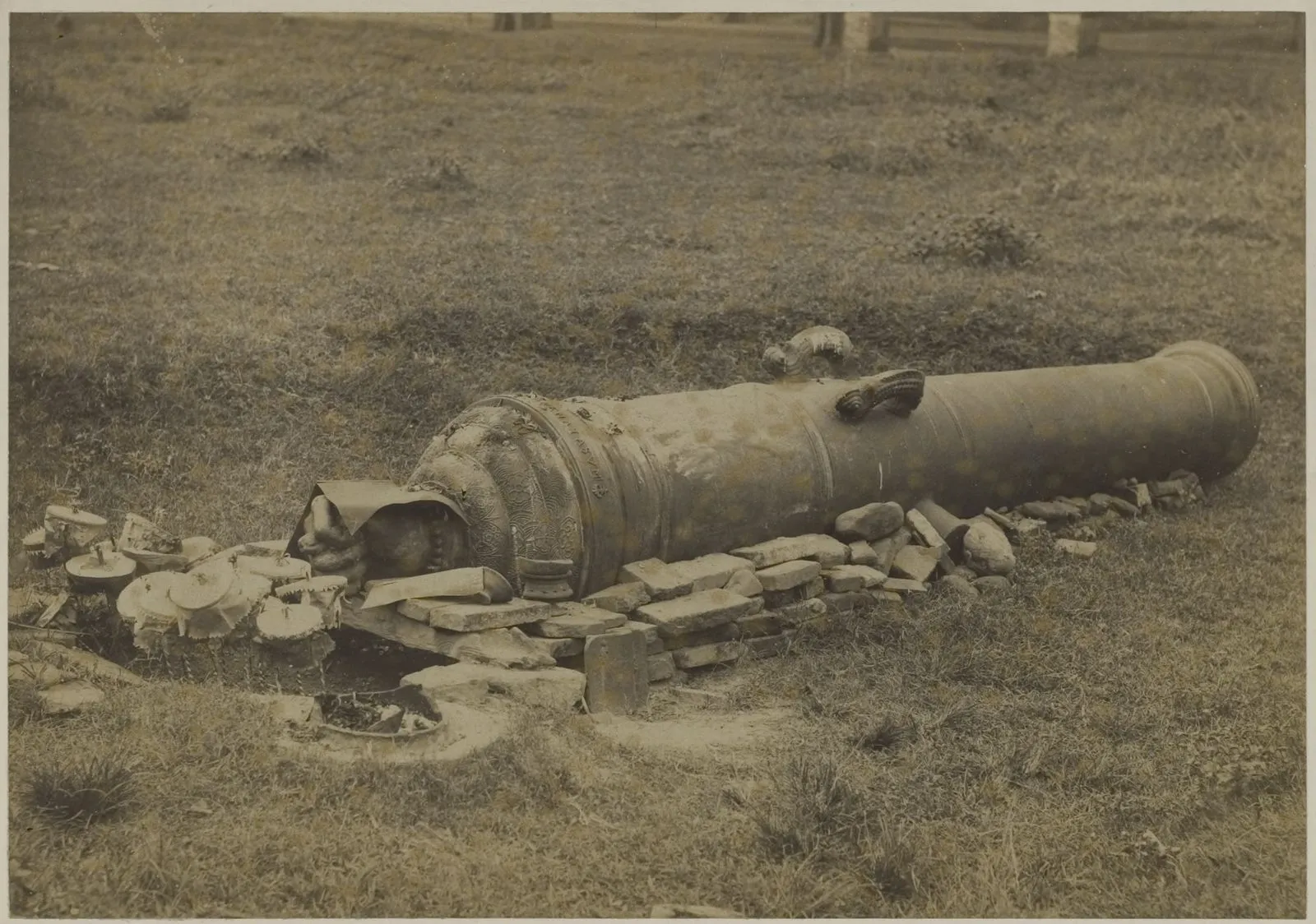
“Heilig kanon Si Djagoer bij de Amsterdamse Poort te Batavia”, photograph catalogued as made about 1880, photographer not recorded. Leiden University Libraries, KITLV 7594, Public Domain Mark.
What is on the breech
The gun is about 3.8 m long and weighs about 3.5 tonnes.15 Crucq, who traced it through the Company’s artillery lists, says it is iron, with the inscription on a bronze band around the breech.16 The inscription reads EX ME IPSA RENATA SUM, “from myself I am reborn”.3
Crucq in 1930, Neijens in 1938 and the image catalogue Arquipelagos all take that to mean the gun was recast from an older piece.4 Neijens needs one line for it:
dat het bewuste stuk hergoten is, behoeft geen bewijs; het opschrift zelf zegt zulks duidelijk genoeg4
that the piece in question was recast needs no proof; the inscription itself says so clearly enough
The fist at the breech is cast with the thumb between the first two fingers.6 Crucq says it is a woman’s hand, because it comes out of an embroidered puffed sleeve and wears a pearl bracelet.17 He also gives the native name Jagur a meaning: djagoer, he writes, is the back of the clenched fist.18
What the gesture was meant to do is argued four ways.9 Crucq reads it as a protection against the evil eye.9 The Arquipelagos catalogue reads it as a luck charm added after the recasting.9 Neijens answers that the gesture is one of mockery and contempt, aimed at the Dutch.9 Gunn, writing in 2024, calls it an obscene gesture used to insult enemies, and cites the museum’s text for it.9
One gun, three dates for the casting
The museum in Jakarta says Manuel Tavares Bocarro cast it at Macau in 1625.1920 Neijens reached Bocarro by a different route, a Lisbon gun dated 1640 and signed by him that has the same form and decoration.19 No document we found names the Batavia gun at Macau, and the Arquipelagos catalogue says it has been attributed to Bocarro but also contested, without special reasons.19
| The story | The record | Verdict |
|---|---|---|
| Cast in 1625 | Museum 1625; Crucq 1606; catalogue c. 164020 | Disputed |
| Cast by Bocarro at Macau | Attributed from a likeness to a Lisbon gun of 1640, and contested; no document names it19 | Disputed |
| Bronze | Catalogue: bronze21; Crucq: iron body, bronze band16 | Disputed |
Crucq reached 1606 by reading the letters of the inscription as a date and, in 1938, called it a conjecture he would not defend.20 Bocarro’s own years at Macau are given differently too.20 Gunn gives the foundry’s years as about 1627 to 1650, which leaves out 1625.20 Neijens gives Bocarro’s time at Macau as 1626 to 1631.20 The catalogue gives 1625 to 1652.20
Neijens had a theory with a Dutch target.10 On 22 June 1622 the Dutch attacked Macau and left a big gun on the beach at Cacilhas, and he held that Bocarro recast it, then made it “far figas” at the Dutch.10 Crucq answered that the Dutch gun was bronze, Coen’s letter of 20 June 1623 speaks of “metale stucken”, and an iron gun cannot be recast from bronze.10
From Malacca to the magazine
The Dutch took Malacca on 14 January 1641.22 Crucq argues from the inventories that four large guns went from there to Batavia, and that the only iron one among them is the holy cannon, though no document names it at Malacca.1
From there the lists are Crucq’s, and we read them only through him.2 He says a large iron piece appears at Batavia from 1668 and that by 1760 it stood in the battery beside the castle’s Pearl bastion.2 Its weight, 7000 pounds, was cut into it in 1692.2 In 1796 it came off the battery.23 When Daendels moved the artillery to Weltevreden in 1810, he writes, it was left behind.23
Crucq then pictures what he cannot document:
Kort daarop moet het „heilig” geworden zijn, hetgeen ik mij zoo voorstel dat, toen eenmaal het kanon proefondervindelijk bewezen had „magisch geladen” te zijn, een handig man zich heeft opgeworpen tot regelaar dier magische krachten24
Soon afterwards it must have become “holy”. I picture it this way: once the cannon had been proved by experience to be “magically charged”, a clever man set himself up as the regulator of those magical powers
That is his supposition.24
De Haan had written in Oud-Batavia that no description of Batavia names the holy cannon before about 1835.25 Crucq cites Van Doren’s travel book of 1822 as naming it already, and a journal of 1845 at the same place.26 We have read neither.26 The earliest text we have opened is the Preanger-bode of 19 August 1898.8
What people asked of it
Two photographs in Leiden, catalogued as made about 1880 and between 1895 and 1905, show the cannon on the ground with offerings at its breech.27 The 1898 reports describe vows and offerings at the gun on the day of a public feast.8
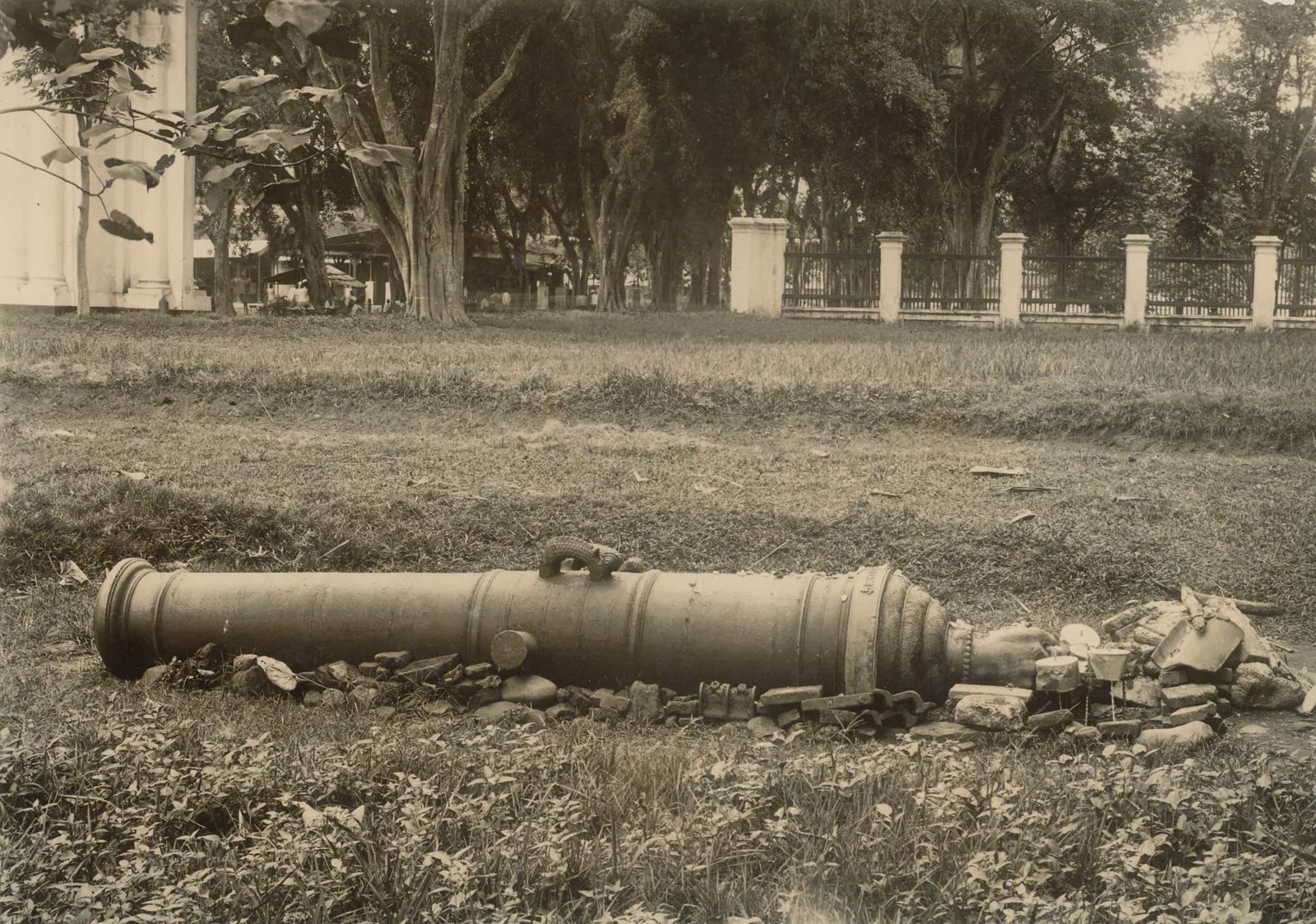
“Heilig kanon Si Djagoer bij de Amsterdamse Poort te Batavia”, photograph catalogued as made between 1895 and 1905, photographer not recorded. Leiden University Libraries, KITLV 81306, Public Domain Mark.
The reports we read name children first.138 The Westlandsche courant of 1903 says women had only to offer and sit on the cannon for a moment to be expecting soon.13 In 1900 the Preanger-bode told of three unmarried girls who burned incense there and each asked for a husband.12 A reporter in 1930 adds that wishes spoken while offering stood every chance of being granted.12 In 1953 the Tubantia lists couples wanting children, lovers, the merchant who wanted good business and the sick who wanted to recover.12 It also says a wife who touched the cannon could be sure the marriage would not stay childless.13
Gunn writes that the cannon became a talisman for locals in Java, barren women especially.13
The guard made a living from it.11 In 1930 the Algemeen Handelsblad names him as Si Omong and says the tourist ships were an important source of income for him.11 In 1932 the Indische courant describes him selling paper offerings from a small stall, and holding a letter of appointment that entitled him to collect what was left at the cannon, which he kept folded in an old spectacle case.11
The twin at Solo
In the stories the cannon had a twin.5 The Westlandsche courant in 1903 gives the prophecy with a twin at Banten, and the Algemeen Handelsblad in 1930 says Banten, or Solo according to others: when the Batavia cannon met its like, Dutch rule would be over.5 Crucq, in 1930, records the legend for Banten and says the same is told of Batavia and Solo.5
The prophecy turns up again in December 1913.28 The Bataviaasch nieuwsblad of 27 December that year printed what it called a secret oath of the Sarekat Islam in Rembang, said to speak of the return of the heirloom cannon Kiahi Setomi.28 The paper explained that the cannon’s return to Solo would be the sign of Java’s freedom, and called the idea nonsense.28
Crucq tried to look at the Solo twin.29 He worked from lead casts of wax impressions and saw the Portuguese arms and an astrolabe on it.29 He concluded that the Solo gun is certainly Portuguese, the Banten gun of Muslim make and the Batavia gun European and perhaps Portuguese.30 A set of three, as the legend says, has no basis in what the guns are.30
Crucq also reports a Javanese tale from the Serat Cabolang in which Kjai Setama and Njai Setomi are gifts from the Portuguese to the prince of Jakarta, and in which Kjai Setama roared on certain evenings and was sent back from Mataram.31 We have not read the Serat Cabolang.31
Lifted off the grass
Until 1936 the cannon lay on the ground, according to Crucq.32 That year the army engineers set it on a concrete block at the request of the Archaeological Service.32
The Jakarta History Museum says the gun was moved to the museum in 1974, and the Arquipelagos catalogue places it at Fatahillah Square today.33 It had been moved before that.34 In March 1953 the Java-bode reported that Jakarta’s municipality had decided the cannon could not stay at Kota Inten and had rented it to the museum for 250 rupiah a month, as study material.34 Its weight had been underestimated, and the first crane sent for the job was too light.35 The same Java-bode piece credits Neijens with the reading of the date as 1606 or 1604, which in the journal is Crucq’s.36 And the cannon, as the Java-bode tells it, braced itself at the museum’s back entrance and refused to be carried in.37
What we could not verify
Sources we have not seen
- Van Doren, Reis naar Nederlandsch Oost-Indie, part II (1822), pp. 55 to 56, and the Tijdschrift voor Nederlandsch-Indie of 1845, part I, p. 236. They would settle whether the cannon was called holy before 1898. We searched archive.org and Delpher’s newspaper index on 10 October 2026 and found no scan.
- De Haan, Oud-Batavia (1922), pp. 142 to 143, where he says no description names the cannon before about 1835. We found no open scan of the book.
- Casquilho’s paper on Bocarro’s cannons in Indonesia (a preprint on ResearchGate). It may give the founder’s reading of the inscription and the date. The page returned a login error.
Seen only where others quote them
- The Company’s artillery lists for Malacca and Batavia (Schouten’s report of 1641, the 1678 Malacca list, the Batavia inventories of 1668 to 1797), which we know only as Crucq summarises them.
- The Serat Cabolang, canto 173, verses 7 to 11, known to us only through Crucq.
Resting on a single source
- The 1625 casting date, given by the Jakarta museum’s text and repeated by Gunn without an earlier source.
Questions we could not settle
- Who cast the gun, where and when, and where it stood between the casting and 1641.
- How the cannon came to be held holy, and who first said so.
- Whether the iron body Crucq describes can be reconciled with the catalogue’s “bronze”.
Read next
TaleSantash pass, Tüp valley, Kyrgyzstan, 1537 to 1857
San-Tash and the legend of Timur's counted stones
TaleŌtemachi, Tokyo, 940 to 2020
Masakado's head mound in Ōtemachi: a curse in print by 1926
TaleMoscow, Russia, 1709 to 1934
The Sukharev Tower warlock: what Jacob Bruce left on paper
Sources
- Crucq, TBG 77 (1937), pp. 107 to 115, conclusion on p. 115 ("mogen en moeten we wel aannemen ... de groote ijzeren wijdmonder is dan het Heilig Kanon") and p. 128↑
- Crucq, TBG 77 (1937), pp. 115 to 123 (1668 on p. 115; the number 7000 on p. 116 to 117; 1760 on p. 121; the 1767 inventory on p. 123)↑
- Crucq, TBG 70 (1930), p. 196 note *, with the translation "uit mijzelve ben ik herboren" (page image read) transcription
- Neijens, TBG 78 (1938), p. 278, the inscription set in capitals EXMEIPSARENATASVM with "Uit mij zelve ben ik herboren" () transcription
- Arquipelagos catalogue entry (2021), inscription field: "EX ME IPSA RENATA SUM", rendered "Eu renasci de mim própria" ("I was reborn from myself"); the reading is credited to Prof. Telmo Corujo dos Reis (UMa)
- De Indische courant, 18 June 1932, "Bataviasche causerieën", column on the Amsterdamse Poort, after the paragraph on "Kjai Setomi ... Si Djagoer"; the OCR spells the letters apart ("E x m e ip s a ... r e n a t a s u m") and gives "uit mij zelve ben ik herboren" (primary)↑
- Crucq, TBG 70 (1930), p. 197 ("Ik vermoed dat de inscriptie ... eenvoudig vermeldt, dat het kanon gegoten is uit het metaal van een ander, door ouderdom of beschadiging onbruikbaar geworden stuk")
- Neijens, TBG 78 (1938), p. 278 ("dat het bewuste stuk hergoten is, behoeft geen bewijs; het opschrift zelf zegt zulks duidelijk genoeg") (page image read)
- Arquipelagos catalogue entry (2021), inscription note: "Dá a entender que houve um primeiro canhão que, inutilizado por qualquer razão, foi tornado a fundir num segundo canhão" (it suggests an earlier cannon, unusable for some reason, was recast into a second)↑
- Crucq, TBG 70 (1930), p. 202: the legend that when the Banten and Batavia guns meet "een groot rijk zal worden gesticht", the Dutch driven from Java; "hetzelfde wordt verteld" of Batavia and Solo
- Westlandsche courant, 26 September 1903, "wanneer dit kanon met een dergelijk, dat in Bantam ... ligt, samenkomt, dat het dan met de opperheerschappij der Nederlanders gedaan zal wezen" (primary)
- Algemeen Handelsblad, 8 April 1930, "sommige inlanders gelooven" the Dutch will be finished once it meets its like at Banten, "Of te Solo volgens anderen" (primary)↑
- Crucq, TBG 70 (1930), pp. 197 to 198: the knob is "gevormd als een vuist met den duim tusschen wijsvinger en middelvinger"; p. 198 "mano in fica" (page image read)
- Neijens, TBG 78 (1938), p. 278 (the "handgebaar" seen on Crucq's photograph) and p. 279 ("dar figas", "faire la figue") (page images read)
- Gunn, Revista de Cultura 75 (2024), p. 50: "the breech end of the cannon features a finely crafted thumb wedged between two fingers"
- Leiden University Libraries, KITLV 7594 and KITLV 81306 (photographs), both photographs show the fist at the breech end↑
- Algemeen Handelsblad, 8 April 1930, the holy cannon "in de schaduw der poort" (the Amsterdamsche Poort, in the "benedenstad") at Kota Inten (primary)
- Crucq, TBG 77 (1937), p. 127: the cannon was moved a little northwest when the railway embankment was built "achter de Amsterdamsche Poort"
- Twentsch dagblad Tubantia, 4 April 1953, the cannon stood "in Djakarta's benedenstad, in Kota Inten" and the "Amsterdamse Poort" has gone (primary)↑
- De Preanger-bode, 19 August 1898, "Nederlandsch-Indië", the item on the sedekah-boemi at Kotta Intan "ter hoogte van de mariam sidjagoer, het heilige kanon te Batavia waar onvruchtbare moeders, die naar den kinderzegen snakken, komen offeren" (primary)
- Bataviaasch nieuwsblad, 5 September 1898, p. 1, "De Groote Sederah te Kota-Inten", report of the feast: by the cannon "Si Djagoer" people "hun geloften kwamen doen en hun gaven kwamen offeren"; a buffalo head was buried by it (primary)↑
- Crucq, TBG 77 (1937), p. 128: the gesture "is het bekende afweermiddel tegen het booze oog, zwarte magie en hekserij" (); also TBG 70 (1930), p. 198 (page image read) transcription
- Neijens, TBG 78 (1938), p. 279: the gesture "is een gebaar van spot, verachting", meant "tegen den vijand ... o Olandese" () transcription
- Gunn, Revista de Cultura 75 (2024), p. 50: "an obscene gesture used to insult enemies", with footnote 78 (p. 52) citing the Jakarta History Museum text
- Arquipelagos catalogue entry (2021), inscription note: after the gun was recast "fizeram-lhe uma figa" so that the bad luck would not repeat and it would have better luck this time↑
- Neijens, TBG 78 (1938), pp. 280 to 282: the Dutch attack on Macao of 22 June 1622, the "canon gruesso" left behind, and Bocarro's "Portugees herboren" gun making "far figas" at the Dutch
- Crucq, "Naschrift", TBG 78 (1938), pp. 282 to 283: "beslist onjuist"; Coen's letter of 20 June 1623 (Colenbrander I, p. 763) speaks of "Twee metale stucken", one left ashore↑
- De Indische courant, 18 June 1932, "Bataviasche causerieën", the "bewaker, de hoogepriester, en impresario" with a stall of paper offerings; the "aanstellingsbrief" kept folded in an old spectacle case (primary)
- Algemeen Handelsblad, 8 April 1930, "Si Djagoer's djaga Si Omong" gets tips ("douceurtje") on Fridays and Sundays; the tourist ships "vormen een voorname bron van inkomsten" for him (primary)↑
- De Preanger-bode, 18 August 1900, "Nederlandsch-Indië", item on three unmarried girls who burned incense at "meriam si Djagoer" and asked for a husband each (primary)
- Algemeen Handelsblad, 8 April 1930, p. 13, "Kiai Setomi of Si Djagoer, het wonderkanon", women who want to be mothers; wishes spoken while offering "alle kansen op vervulling"; offerings of flowers and small parasols (primary)
- Twentsch dagblad Tubantia, 4 April 1953, p. 5, "Het heilig kanon van Djakarta", a place of pilgrimage for married couples wanting children, lovers, the merchant "zekerheid van goede zaken", the sick recovery (primary)↑
- Westlandsche courant, 26 September 1903, "Indische Penkrassen XXIX", "slechts aan dit kanon hebben te offeren en 't 'n oogenblik als zetel moeten gebruiken, om weldra in de blijde verwachting te komen" (primary)
- Twentsch dagblad Tubantia, 4 April 1953, "als de echtgenote het kanon had aangeraakt, kon zij er zeker van zijn, dat het huwelijk niet kinderloos zou blijven" (primary)
- Gunn, Revista de Cultura 75 (2024), p. 50: it "became a talisman for locals in Java -- barren women especially -- seeking its blessing"↑
- De Nieuwe Vorstenlanden, 23 March 1926, p. 2, "Bangsal Witono", the paragraph "De overlevering verhaalt ons het volgende"; the other cannon, Njai Setomi, lies in the Bangsal Witono on the Sitinggil (primary)↑
- Crucq, "De geschiedenis van het heilig kanon te Batavia", TBG 77 (1937), p. 104 (length 3.81 m with the fist knob, bore 25 cm); p. 105 (weight 7000 pounds, the figure chiselled before the touch-hole)
- Arquipelagos, "Sagrado canhão português, Si Jagur" (catalogue entry, 2021), description line: "Bronze, 384 cm.; cal. 39 cm.; peso: 3500 kgs."
- Jakarta History Museum, "Si Jagur cannon", Tetangga Exhibition (2022), text on the cannon: "3.5 tons"↑
- Crucq, TBG 77 (1937), p. 105 (the artillery reports call it "een groote ijzeren wijdmonder", "een ijzeren steenstuk" and "een ijzeren kamerstuk"); also Crucq, TBG 70 (1930), p. 196 note *: "het kanon zelf is van ijzer"↑
- Crucq, TBG 77 (1937), p. 128: "De druif stelt een vrouwenhand voor, blijkens den parelarmband om den pols" () transcription↑
- Crucq, TBG 70 (1930), p. 198: "djagoer = achterzijde van de gebalde vuist" (page image read)↑
- Neijens, TBG 78 (1938), p. 278 note 1 (a gun in the Lisbon artillery museum with the same form, dated 1640 and signed "POR Mel TAVARES BOCARRO"); pp. 281 to 282 (Bocarro as "fundidor" at Macao 1626 to 1631, casting the gun there)
- Crucq, TBG 77 (1937), p. 128: "Van den tijd dat het nog te Malakka was, en van zijn vervaardiging is natuurlijk niets met zekerheid te zeggen"
- Arquipelagos catalogue entry (2021), title "Manuel Tavares Bocarro (atr.)"; the text says the gun "tem sido atribuída, mas também contestada, embora sem especiais razões" to him, and compares its decoration with guns in the Lisbon Military Museum and the "Miracle cannon" in South Africa↑
- Crucq, TBG 77 (1937), p. 128: the year 1606 reconstructed from the letters of the inscription, offered as a conjecture ("niet onwaarschijnlijke conjectuur", p. 127)
- Neijens, TBG 78 (1938), p. 281 note 3: Bocarro came to Macao as "fundidor de artilharia" in 1626 and stayed until 1631
- Gunn, Revista de Cultura 75 (2024), abstract (p. 36): the foundry ran at Macao "c. 1627 to 1650"; p. 50: "Made in 1625 by Bocarro in Macao, as described by a Jakarta History Museum website"
- Jakarta History Museum, Tetangga Exhibition (2022), "Built in 1625 by Portuguese-born engineer Manuel Tavares Bocarro in Macau"
- Arquipelagos catalogue entry (2021), date "1640 (c.)"; Bocarro "(Act. 1625 a 1652)"↑
- Arquipelagos catalogue entry (2021), description line: "Bronze, 384 cm.; cal. 39 cm.; peso: 3500 kgs."↑
- Crucq, TBG 77 (1937), p. 107, drawing on Leupe's "Stukken betreffende het beleg en de verovering van Malakka" (1640 to 1641)
- Jakarta History Museum, Tetangga Exhibition (2022), "The Dutch captured Melaka in 1641"↑
- Crucq, TBG 77 (1937), pp. 126 to 127 (1796 on p. 126; 1810 on p. 127; page image of p. 127 read)↑
- Crucq, TBG 77 (1937), p. 127 ("hetgeen ik mij zoo voorstel dat ...",) transcription↑
- Crucq, TBG 70 (1930), quoting De Haan, Oud-Batavia, pp. 142 to 143, p. 196 (quotation; De Haan's own book was not read by us) transcription↑
- Crucq, TBG 77 (1937), p. 127 (Van Doren, Reis naar N.O.I., deel II, pp. 55 to 56; Tijdschrift voor N.I., deel I, p. 236); Van Doren and the 1845 volume were not read by us () transcription↑
- Leiden University Libraries, KITLV 7594, "Heilig kanon Si Djagoer bij de Amsterdamse Poort te Batavia", record: "[Circa 1880]", rights status public domain (Public Domain Mark 1.0)
- Leiden University Libraries, KITLV 81306, record: "[Between 1895 and 1905]"; the photograph shows the cannon on the ground with offerings at the breech↑
- Bataviaasch nieuwsblad, 27 December 1913, p. 2, "De Toebansche Rechtszaak", the section "De geheime eed", sourced to "een betrouwbare bron" that did not give the wording; the paper's own explanation of the cannon story follows (primary)↑
- Crucq, TBG 70 (1930), pp. 198 to 201↑
- Crucq, TBG 70 (1930), p. 204 (the closing paragraph)↑
- Crucq, TBG 77 (1937), pp. 103 to 104 (the Serat Cabolang itself was not read by us)↑
- Crucq, TBG 77 (1937), p. 127 () transcription↑
- Jakarta History Museum, Tetangga Exhibition (2022), "In 1974 ... transferred to the Jakarta History Museum, where it now sits in the square in front of the museum"
- Arquipelagos catalogue entry (2021), "Museu Nacional da Indonésia, Fatahillah Square, Jakarta"; photograph dated 2 February 2015↑
- Java-bode, 28 March 1953, p. 1, "Verhuurd aan Museum!", the paragraph "Thans is er een leemte ontstaan in Kota Inten" (primary)↑
- Java-bode, 28 March 1953, p. 1, "Verhuurd aan Museum!", the paragraph on loading the cannon at Kota ("onderschatte men het gewicht, zodat vele moeilijkheden bij het werk werden ondervonden") (primary)
- Twentsch dagblad Tubantia, 4 April 1953, p. 5, "Het heilig kanon van Djakarta", "Het transport van het kanon is niet zonder wederwaardigheden verlopen": the first crane sent for the job was too light and tipped up, "Wat niet zo vreemd is als men weet dat het kanon zeven ton weegt" (primary)↑
- Java-bode, 28 March 1953, the sidebar says that, according to Dr. Neyens, the gun was recast and the year reconstructed as "1606 (of 1604?)" (primary)
- Neijens, TBG 78 (1938), p. 278: "zijne reconstructie van het jaartal 1606 (of 1604?)" is attributed to Crucq; Crucq's postscript, p. 282, calls it his "schuchtere hypothese" (page image of p. 278 read)↑
- Java-bode, 28 March 1953, p. 1, "Verhuurd aan Museum!", the sentence "Later zette hij zich bij de achteringang van het Museum schrap en weigerde naar binnen gedragen te worden" (primary)↑
Documents quoted
- Crucq, De drie Heilige Kanonnen, 1930: De Haan on the holy cannon, and the inscription (transcribed from the page image)
- Crucq, De geschiedenis van het heilig kanon te Batavia, 1937: after 1810, and the inscription and fist (transcribed from the page image)
- Neijens, Het Heilig Kanon van Batavia, voorheen ... een Spotkanon?, 1938: the opening and the fist (transcribed from the page image)