 Twice Told
San-Tash and the legend of Timur's counted stones
In 1856 Chokan Valikhanov wrote down the tale of Timur's counted stones, then added that history contradicts it. A Kazakh account names a different builder.
Contents
Published 13 Oct 2026. Sources checked 15 Oct 2026.
Chokan Valikhanov, a member of Colonel Khomentovsky’s expedition to Lake Issyk-Kul, camped on the Tüp river at the Santash pass on the night of 25 May 1856.78 His diary entry for that date gives the pass’s legend: Timur, stones, a count of the dead.1 The next lines of the same entry say that the historical accounts flatly contradict it.2
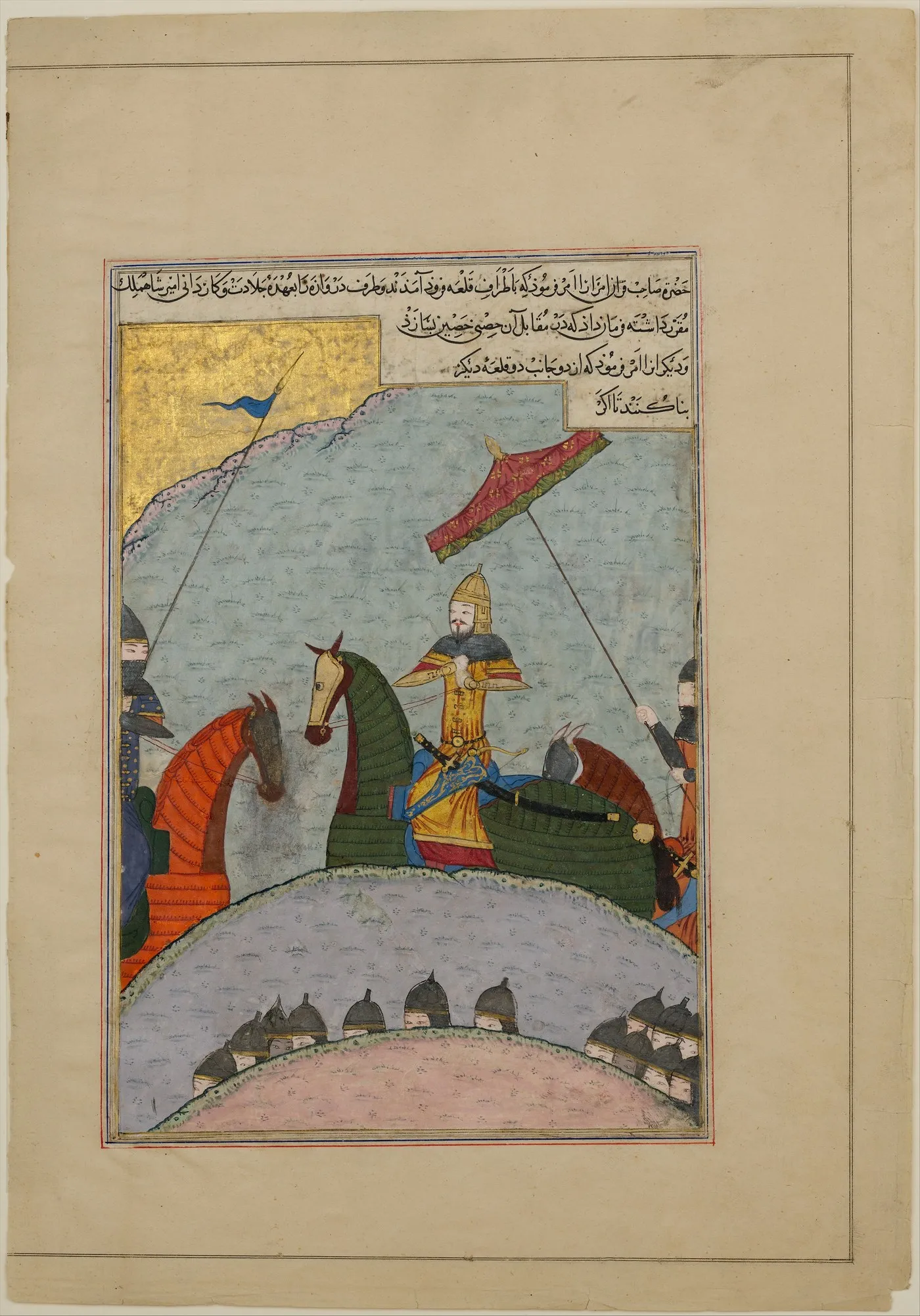
“Timur before Battle”, folio from a copy of Sharaf al-din ‘Ali Yazdi’s Zafarnama (Book of Victories), Iran, 1436. The Metropolitan Museum of Art, Rogers Fund, 1955, 55.121.16, public domain (CC0).
The story, as Semenov printed it, goes like this.4
When Timur set out from Samarkand for the lands of the east, he led a vast army.4 At the Santash pass, where the road crosses from the Issyk-Kul basin into the Ili basin, he ordered each soldier to carry a stone and lay it in one heap on the shore of a small lake.49 The size of the heap was the size of the army.4
Timur beat his enemies in many battles and conquered wide lands in the east, and came back by the same road.4 At the pass he ordered each soldier to take one stone from the heap.4 The heap shrank enormously.4 The stones left in it counted the soldiers who had died on the campaign, and the heap stayed as their monument, raised in a foreign land by their own hands.4
Written down, then doubted
Valikhanov’s diary of the 1856 trip stayed in manuscript for a century.10 The editors of the 1984 collected works say the autograph is in the Academy of Sciences archive and that the diary first appeared in print in 1959.10 Valikhanov wrote of the expedition that it spent two months among the wild-stone Kyrgyz, collecting information mainly by studying their traditions and language.7
His entry for 25 May glosses the name as “counting stone” and says the pass takes it from a heap of stones piled into one mound, about three sazhen high and thirty-five around.311 A sazhen is the Russian fathom. His version of the story has Timur, whom he calls the emir Temir-Kurkan, setting out for China to take the Chinese emperor’s daughter into his harem.1 Each soldier put a stone in one place on the way out.1 On the way back each took one and put it in another place, and Timur judged his losses from the stones left unlifted.1 The diary then turns on the story it has just told.
Исторические известия совершенно противоречат этой легенде.2
The historical accounts flatly contradict this legend.
Timur did march on China, Valikhanov goes on, but he died at Otrar at the very start of the journey from Samarkand.12 Le Strange, who annotated the English translation of Clavijo’s embassy, dates that death to the middle of February 1405, after Timur had crossed the Jaxartes.12 Valikhanov adds that in all the Central Asian legends Timur plays the lead, as Charlemagne does in the medieval poems and Vladimir the Red Sun in Russian fairy tales.2
He did not dismiss the mound itself. Building it, he wrote, took many people and a great deal of labour, and it must commemorate some notable event in the life of some earlier people.2
One pass, two tellings
A year later Semenov-Tian-Shansky crossed the same pass.13 His memoir puts the crossing on 9 June 1857, and the legend above is his.134 It differs from Valikhanov’s at several points.
| Valikhanov, diary of 1856 | Semenov, memoir (printed 1946) | |
|---|---|---|
| The name means | Counting stone3 | A thousand stones3 |
| Timur’s errand | The emperor of China’s daughter1 | A campaign in the east, army counted at the pass4 |
| Stones laid | One place going out, another coming back1 | One heap on a lake shore4 |
| Stones left | Timur’s losses1 | The dead, and their monument4 |
Semenov’s account puts Timur’s march in the last quarter of the fifteenth century,13 and Timur died in 1405.12 Valikhanov names no teller; Semenov says only that the Kara-Kyrgyz keep the tradition.14 Neither entry says where the story came from before them. In his report on the 1858-59 journey to Kashgar, Valikhanov describes the pass as a level plateau “famous for a tradition about Tamerlane” and does not tell the tradition.14
Both men do agree on the pass. It lies on the divide between the Ili and Issyk-Kul basins, and caravans use it; Valikhanov calls it the most important and most convenient of the crossings of the Kungei Alatau.9
A khan in the postscript
Under the legend and its rebuttal, Valikhanov added a postscript. The wild-stone Kyrgyz, he says, ascribe the mound to a Kyrgyz khan called Ishim, as a monument to a victory over the Kalmyk Dzungars.5 He finds that more likely than Timur.5
A Kazakh book of 2010 also gives the mound a khan, after a defeat rather than a victory. Bektursyn’s list of the Kazakh people’s major battles says that after the battle of San-Tash the Kazakh khan Esim held a memorial feast there for the Kazakhs and Kyrgyz who had died, and built a stone burial mound.6
The battle itself has a date. Atygaev, in a 2023 history of the Kazakh khanate that draws on Zayn ad-Din Vasifi, says Uzbek and Moghul armies fought a Kazakh-Kyrgyz army at a place called San-Tash on 27 July 1537 and won.15 Bektursyn says the Kazakh-Kyrgyz army was destroyed there.15 They disagree on where: Atygaev puts it west of Issyk-Kul, Bektursyn on the east shore.15 Neither says the battlefield is the pass on the Tüp. Bektursyn puts the feast “afterwards” without a year, and the sources we read show Esim active around 1600, some sixty years after the battle.616
That leaves two khans’ monuments for two different events: Valikhanov’s Ishim celebrating a victory over the Dzungars, and Bektursyn’s Esim mourning a defeat by Uzbek and Moghul armies.5615 Ishim and Esim look like one name spelled two ways, but that is our guess; no source we read says so.
What the mound is
Whether the cairn covers a grave, older than Timur or younger, is something we could not settle: we found no excavation report. The 1856 diary describes a heap and calls it a kurgan, a mound.311 Valikhanov’s own reasoning from the labour involved is the closest thing to a verdict in the record we read, and he left it open.2
What we could not verify
Questions we could not settle
- Whether anyone has excavated the cairn. Travel pages describe Saka-period burial mounds around San-Tash and a resemblance to the Pazyryk kurgan; we found no excavation report, excavator or year, and none says a chamber lies under the main heap.
- Whether the 1537 battle was fought at this pass. Atygaev and Bektursyn name the place San-Tash and disagree on which side of Issyk-Kul it lies.
- Whether Valikhanov’s Ishim and Bektursyn’s Esim are one man.
Read next
CaseBatavia (Jakarta), Indonesia, 1641 to 1974
Si Jagur, the cannon with a fist on its breech
TaleŌtemachi, Tokyo, 940 to 2020
Masakado's head mound in Ōtemachi: a curse in print by 1926
TaleMoscow, Russia, 1709 to 1934
The Sukharev Tower warlock: what Jacob Bruce left on paper
Sources
- Chokan Valikhanov, Diary of a journey to Issyk-Kul (1856), Sobranie sochinenii, vol. 1, 1984, pp. 325-326, entry under 25 May (primary) transcription↑
- Chokan Valikhanov, Diary of a journey to Issyk-Kul (1856), Sobranie sochinenii, vol. 1, 1984, p. 326: "Исторические известия совершенно противоречат этой легенде" and the next lines (primary) transcription↑
- Chokan Valikhanov, Diary of a journey to Issyk-Kul (1856), in Sobranie sochinenii v 5 tomakh, vol. 1, Alma-Ata, 1984, p. 325: "Санташ — счетный камень. Проход этот получил свое название от груды камней" (primary) transcription
- P. P. Semenov-Tian-Shansky, Memuary vol. 2 (Puteshestvie v Tian-Shan v 1856-1857 gg.), Moscow, 1946, p. 164: "получил своё название от груды камней («Санташ» значит тысяча камней)" (primary) transcription↑
- P. P. Semenov-Tian-Shansky, Memuary vol. 2, Moscow, 1946, pp. 164-165 (primary) transcription↑
- Chokan Valikhanov, Diary of a journey to Issyk-Kul (1856), Sobranie sochinenii, vol. 1, 1984, p. 326, "P. S.": "Дикокаменные киргизы насыпь Санташа приписывают киргизскому хану Ишиму ... Это имеет более вероятия" (primary) transcription↑
- M. S. Bektursyn, Velikie lyudi velikoi stepi: biograficheskii sbornik, Karaganda: Kazakhstano-Russkii universitet, 2010 (bilingual; Russian text), p. 236, section "Значимые военные сражения казахского народа", item 2 "Сан-Таштинская битва": "Впоследствии казахский хан Есим устроил в урочище Сан-Таш поминальный ас (тризну) ... соорудил каменный могильник-курган"↑
- Sobranie sochinenii, vol. 1, 1984, editors' introduction quoting Valikhanov (the editors cite the 1961 edition, p. 304), p. 37: "находясь два месяца среди дикокаменных киргизов, успели собрать разные положительные сведения, преимущественно изучая их предания и язык"↑
- Chokan Valikhanov, Diary of a journey to Issyk-Kul (1856), Sobranie sochinenii, vol. 1, 1984, p. 324, entry "25 [мая]. Ночлег на реке Туп ... при проходе Санташ" (the editors correct Туп to Тюп); p. 326, entry "28 [мая]. Ночлег на реке Тупе, на южном конце прохода Санташ" (primary) transcription↑
- P. P. Semenov-Tian-Shansky, Memuary vol. 2, Moscow, 1946, p. 164: "горный перевал Санташ через горный водораздел между илийским и иссыккульским бассейнами" (primary)
- Chokan Valikhanov, Diary of a journey to Issyk-Kul (1856), Sobranie sochinenii, vol. 1, 1984, with editors' note 21, p. 343, July 1856 entry: "Через хребет Кунгей-Алатау ... существует много проходов. Самый важный и удобный для езды всякого рода — это Санташ. По нему проходят караваны"; p. 406, editors' note 21 (pass at the eastern end of the Kungei Alatau) (primary)↑
- Sobranie sochinenii, vol. 1, 1984, editors' commentary, p. 403, headnote to "Дневник поездки на Иссык-Куль"↑
- Chokan Valikhanov, Diary of a journey to Issyk-Kul (1856), Sobranie sochinenii, vol. 1, 1984, p. 325: "Высота кургана сажени в 3, окружность саженей 35" (primary) transcription↑
- Guy Le Strange, introduction and notes to Clavijo, Embassy to Tamerlane 1403-1406, London: Routledge, 1928, p. 15: "after crossing the Jaxartes he died at Otrar in the middle of February" and the campaign "to effect the conquest of China"; p. 358 note ("death overtook him at Otrar at the crossing of the Jaxartes"); p. 362 note (expired on the 17th of February); the year 1405 is on p. 15 and p. 357
- Chokan Valikhanov, Diary of a journey to Issyk-Kul (1856), Sobranie sochinenii, vol. 1, 1984, p. 326: "Тамерлан действительно шел на Китай но при самом выезде из Самарканда умер в городе Отраре" (gives no year) (primary) transcription↑
- P. P. Semenov-Tian-Shansky, Memuary vol. 2, Moscow, 1946, p. 164 ("Девятого июня я ... выступил") and p. 165 ("(9 июня)"); p. 164-165 "в последней четверти XV века" (primary) transcription↑
- Chokan Valikhanov, "O sostoyanii Altyshara ..." (read to the Russian Geographical Society, printed 1861), in Sochineniya Chokana Chingisovicha Valikhanova, Zapiski IRGO vol. 29, ed. N. I. Veselovsky, St Petersburg, 1904, p. 76: "горный проход Сенъ-ташъ, представляющий ровное плоскогорие и знаменитый преданием о Тамерлане" (printed "Сен-ташь"); reprinted in Sobranie sochinenii vol. 3 (1985), not independent (primary)↑
- Nurlan Atygaev, Kazakhskoe khanstvo: ocherki vneshnepoliticheskoi istorii XV-XVII vekov, Almaty: Eurasian Research Institute, 2023, pp. 75-76 ("18 safara / 27 iyulya sostoyalos srazhenie"; "V rezultate San-Tashskogo srazheniya mogulyi i uzbeki dobilis znachitelnykh uspekhov"); builds on Zayn ad-Din Vasifi, whom we did not read
- M. S. Bektursyn, Velikie lyudi velikoi stepi, Karaganda, 2010, p. 236, item 2: "Произошла 27 июля 1537 г. в местности Сан-Таш ... В ней казахско-кыргызское войско было полностью уничтожено" (Bektursyn does not say which side won in those words, but says the Kazakh-Kyrgyz army was destroyed)↑
- M. S. Bektursyn, Velikie lyudi velikoi stepi, Karaganda, 2010, p. 236, item 4 "Каракамыское сражение" (1605: "войск казахских ханов Есима и Батыра")
- Nurlan Atygaev, Kazakhskoe khanstvo, Almaty, 2023, pp. 48 and 50 (Esim in the wars of Tauekel and after Baki-Muhammad's death), p. 53 (about 1028/1618-1619, per T. I. Sultanov), p. 54 (Abulgazi's three months with Esim in Turkestan in 1625)↑
Documents quoted
- Chokan Valikhanov, Diary of a journey to Issyk-Kul, 1856: the entry on Santash (25 May, with a postscript) (transcribed from the page image)
- Petr Semenov-Tian-Shansky, Memoirs vol. 2, the journey into the Tian Shan, 1857: the Santash pass and its stones (transcribed from the page image)