 Twice Told
The Sukharev Tower warlock: what Jacob Bruce left on paper
The calendar that carries Jacob Bruce's name says on its first sheet that a librarian, Vasily Kipriyanov, did the work and Bruce only supervised.
Contents
Published 11 Oct 2026. Sources checked 15 Oct 2026.
The Sukharev Tower came down in 1934, between April and June.45 Moscow’s later legend says Stalin had it taken apart brick by brick to find the black book of Jacob Bruce, the warlock supposed to have lived there.6 The papers we could read are plainer: Stalin and Voroshilov wrote to Kaganovich that the tower must be demolished and traffic widened.78
Jacob Bruce was a general and associate of Peter the Great, and died at his estate at Glinki, near Moscow, in 1735.9 Three things tie the warlock to the man: a tower, a library and a calendar.
The story, pieced together from a yard keeper’s telling of 1923, Gilyarovsky’s sketch of 1926 and a Moscow magazine of 2018, goes like this.
Bruce was the cleverest man there was, and you could walk the whole world without finding a cleverer.10 He knew magic and had gone through every science.10 He made calendars, and powders, and compounds of all kinds.10 He could turn himself into a bird.10 He lived in the Sukharev Tower, where books, papers and vials stood about in great numbers.10
He had come to the tower on a flying ship.6 In an alchemical laboratory there he made gold by magic, and out of flowers he made a maid.6 When he went out to amuse himself he frightened the traders round the tower with sessions of mass hypnosis.6 A black book written by the devil lay in the tower’s hiding places.3
The tower came down for traffic
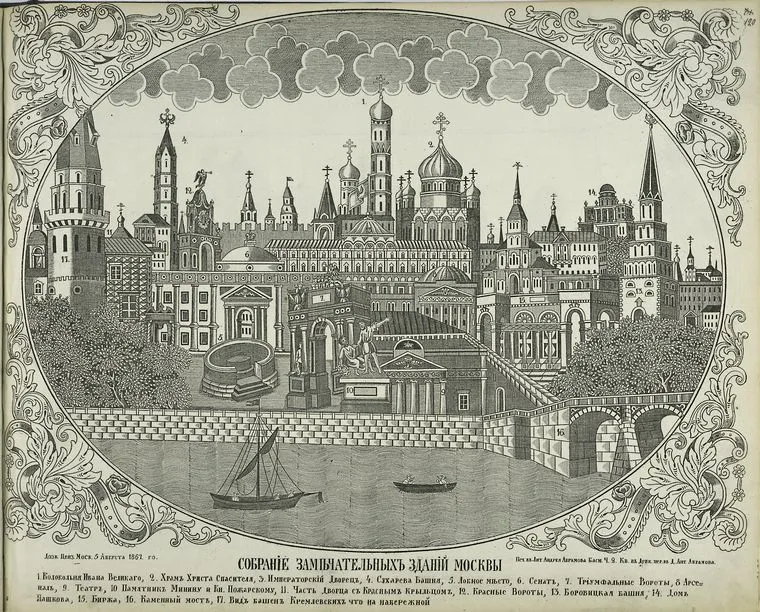
Sobranie zamechatel’nykh zdanii Moskvy (A collection of Moscow’s remarkable buildings), lithograph printed at Andrei Abramov’s press, Moscow, 1867. The Sukharev Tower is number 4. The New York Public Library, Wallach Division, image 479625, public domain.
The tower was built between 1695 and 1701 on Peter’s orders.11 Gilyarovsky wrote that Peter named it for Sukharev, a streltsy colonel who stayed loyal to him.11 From 1925 until 1934 it housed the Moscow Communal Museum, whose first director, Petr Sytin, studied the tower’s history and the legends about it.12
Konstantin Mikhailov, in Kommersant, writes that a note signed by Stalin and Voroshilov reached Kaganovich on 18 September 1933; it says the tower must be demolished and traffic widened.7 RBC prints the same note without a date and shows it as a page of the journal Izvestiya TsK KPSS.8 A Moscow Soviet inspector wrote in Izvestiya in the spring of 1934 that the square had earned the name “historical meat grinder”.13 The Moscow city website gives the same reason: the tower was razed because it hindered a transport route.13
Protests went to Stalin and Kaganovich in 1933 and 1934 from the painter and art historian Igor Grabar, the architects Ivan Fomin, Ivan Zholtovsky and Aleksei Shchusev, the art historian Abram Efros and the painter Konstantin Yuon.14 The Museum of Moscow says letters to the leadership and to Stalin himself survive.14 They failed.13 Mikhailov writes that the Central Committee agreed on 16 March 1934 to the Moscow party committee’s proposal.15 RBC, written with the Shchusev Museum, which supplied the archival documents, puts the start in the night of 13 to 14 April 1934.4 Kommersant says the night of 14 April.16 By the end of June, Rodina writes, nothing was left of the tower.5
RBC brings up Bruce to say that some people wrongly think the tower was built as the house of the sorcerer and black magician Bruce.17 It calls that a legend, says he lived nearby and did visit the tower, and says he had nothing to do with building it.17 Fedorov, in Vokrug sveta, says Bruce did not live in the tower at all and was in Moscow only on visits.18
None of the demolition accounts we read mentions a book.
Five tellings, in the order they were written
The oldest telling we found has no tower in it at all. Here is each text we could read, by date.
| Text | Bruce |
|---|---|
| Pekarsky, 1862 | Leaves Peter a flask of living and dead water2 |
| Russian Biographical Dictionary, 1908 | Belongs to a Neptune society that met on top of the tower19 |
| A yard keeper to Baranov, 1923 | Knows magic, turns into a bird, lives in the tower10 |
| Gilyarovsky, 1926 | Makes gold from lead; the devil’s black book is in the tower3 |
| Vokrug sveta, 2018 | Arrives on a flying ship; Stalin looks for his book6 |
Pekarsky tells it this way. Dying, Bruce hands Peter a flask of living and dead water and says to sprinkle it on his corpse if the tsar wants him alive.2 Years later Peter remembers, has the grave opened and finds the dead man lying as if alive, the hair on his head and in his beard grown long, and nails on his hands.2 The tsar is so struck that he has the grave filled in quickly and smashes the flask.2 Pekarsky adds that Bruce in fact died ten years after the tsar.2
The Russian Biographical Dictionary, in 1908, says Bruce belonged to the merry society of the Neptunes, which met in secret on top of the Sukharev Tower, “where by tradition they practised black magic”.19 The signed entry by P. M. Maikov does not say whose tradition.
Gilyarovsky wrote in 1926 that many legends went around about the tower: the “sorcerer Bruce” made gold from lead there, and a black book written by the devil was kept in its hiding places.3 He calls them “hundreds of legends, one more absurd than the other”.3 We found no earlier text that puts a black book in the tower.
The flask did not die out. The 2018 magazine piece reports a version in which Bruce makes living water, tells his pupil to kill him and revive him younger, and his unfaithful wife smashes the vessel.20
Who first called him a warlock
Pekarsky wrote that Bruce’s reputation in eighteenth-century Russia as a black magician and an astrologer was well known.21 He heard stories of it himself as a child in a remote province.22 He found nothing in Bruce’s life to justify it:
Между-тѣмъ въ жизни Брюса не было ничего, чтобы могло хоть нѣсколько заподозрить его въ чернокнижествѣ: онъ былъ только просвѣщеннѣе многихъ изъ своихъ знатныхъ современниковъ.22
Yet there was nothing in Bruce’s life that could give even slight grounds to suspect him of black magic: he was merely better educated than many of his noble contemporaries.
His own guess was that the tale began with Peter buying a secret embalming method from the famous Ruysch, and with Bruce’s astronomical observations and talks with the tsar.22
The Russian Biographical Dictionary says that once Bruce had settled at Glinki, studying the sciences and writing to Leibniz, he “got the name of a sorcerer”.21 Natalia Kopaneva of the Kunstkamera ties the reputation to his astronomy.21
The Moscow city website says folktales made Bruce a sorcerer, an astrologer and the master of the tower, with an iron bird with a human head that carried him to the tsar and a mute girl who served the tsar’s guests and fell apart into flower buds.23 It dates those legends to the early eighteenth century and draws on Sytin’s book of 1926, without a page reference.23 We have not seen the book.
The dating is where the sources part. Fedorov reports that the historian Aleksandr Filimon puts the black-magician legends no earlier than the 1810s or 1820s.24 He quotes Andrei Nartov, who knew Peter’s circle, as writing that Bruce was a learned man who “did not believe in the supernatural”, and adds that no source of Peter’s time reports a sorcerer’s repute.25 Pekarsky’s book is the earliest print we found, and we do not know whether Filimon knew it. We have not read Filimon.
What the Academy took from Glinki
The books that went from Bruce’s house to the Academy were mostly mathematics and the sciences, with a handful on astrology and magic among them.2627 Kopaneva reads the collection, from the inventories, as less a collector’s than a working scientist’s cabinet.28
Bruce died in April 1735.9 On 30 May the Academy’s head, Korff, asked the Cabinet for his books, instruments, antiquities, rare coins and stones.29 The whole book collection reached St Petersburg in December 1735 and went into the Academy’s library; the curiosities went to the Kunstkamera.30 The Russian Biographical Dictionary says instead that Bruce bequeathed his cabinet, library and collections to his nephew and also to the Academy “for public benefit”.31
The register of the library is printed in the Academy’s own papers, edited by Sukhomlinov in 1889, under 1 June 1742.32 It is headed “Vedomost”, a statement of what turned up in the house of the late field marshal, “in the library of books, German of various dialects and Russian”.29 Its numbered entries run to 1,432, and an entry can bundle several works.32 Chekmarev writes that Bruce’s library passed 1,600 volumes by 1725 and was fully open to the tsar.33
Nine entries that we picked out of the register by title, as astrology, geomancy or magic on our reading, are listed here as the register prints them.27
| No. | As listed |
|---|---|
| 772 | Hildebrand, Natural Magic, in Latin27 |
| 777 | Geomantic tables, in Latin27 |
| 780 | Christian Thomasius, The Magic Science, in German27 |
| 795 | Balthasar Bekker, The Enchanted World, in German, Amsterdam, 169327 |
| 811 | A Key to Astrology, in Latin, London, 167627 |
| 974 | An astrological calendar, in German27 |
| 1318 | Philosophical secrets, in Latin, London, 169727 |
| 1320 | An introduction to astrology, in English, London, 169427 |
| 1326 | Complete geomancy, in German, Freystadt, 170427 |
The register does not say which of these Bruce read, and no entry we found is called a black book. We read the register’s pages for these entries as images and the rest only in the text layer, so the nine are a floor and not a count.
By the count of S. P. Luppov, as Kopaneva reports it, most of the books were on mathematics, astronomy, physics, mechanics, optics and mineralogy; among the humanities, most books were on history, numismatics and politics, with travel, religion and art beside them.26 Chekmarev adds that the library held works on painting, drawing, goldwork and lacquer.26
The cabinet held minerals, instruments, coins and medals, paintings, intaglios and Chinese objects.34 Pekarsky says Bruce collected Chinese curiosities.34 The register of instruments opens with a celestial globe of the Tychonic system by Willem Blaeu, an arshin and a half across, then a terrestrial globe of the same size.35 Kopaneva says Bruce made lenses, telescopes and burning glasses himself, and lists 147 burning glasses of different sizes handed to Delisle for the observatory and a concave mirror of 1733, now in the Hermitage.28 She notes that his translation of Huygens’s Cosmotheoros, which sets out the Copernican system, came out in 1717.36
The calendar’s own imprint
The calendar that carries Bruce’s name was put together and engraved by a librarian.137 Pekarsky transcribes the lettering of the first sheet:
подъ надзрѣніемъ его превосходительства, господина генерала лейтенанта Якова Вилимовича Брюса, тщаніемъ библіотек. Васи. Кипріа: мая 2, 17091
under the supervision of His Excellency Lieutenant General Jacob Vilimovich Bruce, through the diligence of the librarian Vasily Kipria[nov]: 2 May 1709
Pekarsky writes that the name “Bruce’s calendar” is not quite fair, since the calendar itself says it was compiled and published by the librarian Kipriyanov, and Bruce only supervised.1 He says that supervision was marked on all books from the Moscow civil press.38 The Russian Biographical Dictionary agrees that Kipriyanov composed and first printed it in Moscow in 1709, and that Bruce’s name stuck because of the supervision line.1 The Russian National Library catalogues a sheet with Vasily Onufrievich Kipriyanov as its author.1
The engraving was Kipriyanov’s too.37 A line at the foot of sheet 1 reads, in Pekarsky’s transcription, that he engraved it with his pupil Aleksei Rostovtsev.37 The Presidential Library says the first edition was engraved on copper by Kipriyanov and printed on six large sheets.37
Bruce’s own part was the press.38 The Russian Biographical Dictionary has him in charge of Russian book printing from 1706, and Chekmarev has him supervising the Moscow civil printing house from 1705.38 Chekmarev adds that he edited and translated publications prepared for printing there.38
Whether he chose the calendar’s forecasts or read its proofs, no source we read says.
Sources differ on when the calendar was printed.39 Pekarsky separates a quarto calendar of 28 December 1708 from the engraved wall calendar of 1709.39 He reads the sheets’ imprints as May 1709, November 1709 and 1710.39 The Presidential Library puts the printing of the six-sheet first edition at the end of December 1708, or early January 1709 in the new style.39
The name outlived the sheet.40 Pekarsky says the calendar sold in many editions, partly for its everlasting Easter table and the hours of sunrise and sunset.40 The Presidential Library says later editions differed from the first and grew to 47 sheets, and Fedorov says other presses kept issuing versions under the Bruce name into the early twentieth century.40
What we could not verify
Sources we have not seen
- Pyotr Sytin’s book “Sukhareva bashnya (1692 to 1926)” with its section of folk legends, cited by RBC and by the Moscow city website. It was written in the tower, so it may carry the earliest collected tellings of the black book. We searched the Internet Archive and the open web and found no scan or text.
- Savelyeva’s catalogue “Biblioteka Ya. V. Bryusa” (1989) and Luppov’s studies of the library (1973). They would give the surviving volumes and the subject counts; we read them only through Kopaneva and Chekmarev. Both are print books, in copyright, and we found no online copy.
- The archive files behind the 1742 register and the 1735 inventory: RGADA f. 17, op. 1, d. 3 and d. 10, and the St Petersburg branch of the Academy archive, f. 3, op. 1, d. 16 and R. III, op. 1, d. 138. They would show the Moscow valuation entry by entry and settle whether the printed register repeats the 1735 list. They are held in the archives, and we found no digitised copy.
- The engraved sheets themselves, held at the Hermitage, the Pushkin Museum and the library of the Academy of Sciences according to the Presidential Library. They are museum objects; we read the imprint of sheet 1 only as Pekarsky transcribes it.
Seen only where others quote them
- Filimon’s dating of the legends to the 1810s or 1820s, and the Baranov text of 1923: both through Fedorov’s magazine article. Filimon’s own work and Baranov’s publication would show on what evidence the dates and the wording rest. We could not find either online.
- Nartov’s remark that Bruce “did not believe in the supernatural”, also through Fedorov. Nartov’s text would show whether the words are his and what they refer to; we did not find it.
Resting on a single source
- That the black book was walled up in the tower or in its foundations. We read nothing that says so; Gilyarovsky puts the book in the tower’s “hiding places”, and no demolition account mentions it.
- That Bruce flew over Moscow at night. We found a flying ship and a bird, not a night flight.
Questions we could not settle
- Where the sorcerer legend was first written down. Pekarsky’s flask story of 1862 is the earliest we found, and the earliest black-book text is Gilyarovsky’s of 1926; whether Snegirev’s 1862 pamphlet on the tower, his note of 1842 or Lazhechnikov’s unfinished novel “The Sorcerer on the Sukharev Tower” of 1840 carried earlier tellings, we could not tell, since none was readable.
- What Bruce himself did for the calendar, apart from lending his name and his supervision.
- How many volumes the 1735 inventory counted: the register’s 1,432 entries are not a count of volumes, and the figure of 1,600 is Chekmarev’s, for 1725.
Read next
CaseLucerne, Switzerland, 1420 to 2006
The Lucerne dragon stone: a pledge, a charter and a CT scan
TaleWawel hill, Kraków, Poland, the end of the 12th century to 1597
Kraków's Wawel dragon had no cobbler until 1597
CaseBasel, Switzerland, 1474 to 1906
Basel's burned rooster
Sources
- Pekarsky, Nauka i literatura, vol. 1 (1862), p. 289 («въ самомъ календарѣ положительно сказано, что онъ собранъ и изданъ тщаніемъ библіотекаря Василья Киприанова; Брюсъ же надзиралъ только за изданіемъ»); p. 304, the imprint of sheet 1 as transcribed by him and transcription transcription
- Russkii biograficheskii slovar, vol. 3 (1908), Maikov, the paragraph on the printing house: «календаря Брюсова, который составлен и напечатан в первый раз в Москве, в 1709 г. Киприяновым»
- Russian National Library, catalogue record (Knizhnye pamyatniki), record header: Avtor/y, Zaglavie ("ot bibliotekarya V: K:"), Data izdaniya [1715], Shifr khraneniya
- Presidential Library, "V Moskve izdan pervyi grazhdanskii kalendar", second paragraph of the entry↑
- Pekarsky, Nauka i literatura, vol. 1 (1862), pp. 289 to 290 transcription↑
- Gilyarovsky, Moskva i moskvichi (1926), chapter "Sukharevka", the paragraph «Много легенд ходило о Сухаревой башне: и «колдун Брюс» делал там золото из свинца, и черная книга, написанная дьяволом, хранилась в ее тайниках», which follows «Высоко стояла вековая Сухарева башня с ее огромными часами» and comes before the Sunday market (primary)↑
- RBC Realty with the Shchusev Museum, «Снос Сухаревой башни начался в ночь с 13 на 14 апреля 1934 года»; the closing paragraph says the tower stood for almost two and a half centuries↑
- Lokalov, Rodina, 28 June 2024, next to last paragraph: «К концу июня 1934-го от Сухаревой башни не осталось следа»↑
- Fedorov, Vokrug sveta (2018, updated 2025), section «Башня», second paragraph («Рассказывали, будто явился волшебник в эту башню на летучем корабле …»)↑
- Mikhailov, Kommersant, 18 Aug 2014, p. 38; «Но 18 сентября 1933 года Каганович получил записку, подписанную Сталиным и Ворошиловым»↑
- RBC Realty with the Shchusev Museum, the paragraph «Снос Сухаревой башни начался в ночь с 13 на 14 апреля 1934 года», which quotes the note («ее надо обязательно снести. Предлагаем снести Сухареву башню и расширить движение»)↑
- Kopaneva, Kunstkamera 2020, opening paragraphs of the text after the abstract: «скончался 19 (30) апреля 1735 г. в своей подмосковной усадьбе Глинки»
- Russkii biograficheskii slovar, vol. 3 (1908), Maikov, pp. 416 to 419; «ум. 19 апреля 1735 г.»; the paragraph on 1726 («Он поселился в деревне Глинках»)↑
- Fedorov, Vokrug sveta (2018, updated 2025), section «Башня», the epigraph; «Рассказано в 1923 году собирателю городского фольклора Евгению Баранову московским дворником Филиппом Болякиным»↑
- Museum of Moscow, exhibition page "Sukhareva bashnya", second paragraph: «возведенной в 1695–1701 годах по приказу Петра I»
- Gilyarovsky, Moskva i moskvichi (1926), chapter "Sukharevka", the paragraph «Сухарева башня названа Петром I в честь Сухарева, стрелецкого полковника» (primary)↑
- Museum of Moscow, exhibition page "Sukhareva bashnya", third paragraph↑
- Mikhailov, Kommersant, 18 Aug 2014, p. 38; «под предлогом того, что она мешает уличному движению»
- Lokalov, Rodina, 28 June 2024, the paragraph quoting Khoroshilkin of the Mossovet inspection
- Moscow city website, news item "A bird with a human head and other horror stories: Moscow legends about the Sukharev Tower", the last paragraph of the item↑
- Mikhailov, Kommersant, 18 Aug 2014, p. 38; the paragraphs «После сообщений о сносе Сухаревой башни Сталин получил письмо корифеев» and «Сталин получал последние отчаянные письма»
- RBC Realty with the Shchusev Museum, the paragraph «Снос стал неожиданностью» (Shchusev, Efros, Yuon wrote to Stalin) and the next paragraphs (Fomin, Zholtovsky and others proposed alternatives)
- Museum of Moscow, exhibition page "Sukhareva bashnya", fourth paragraph («о чем свидетельствуют сохранившиеся письма руководству страны и лично Иосифу Сталину»)↑
- Mikhailov, Kommersant, 18 Aug 2014, p. 38; «16 марта 1934 года ЦК ВКП (б) согласился с предложением московского горкома партии о сносе Сухаревой башни»↑
- Mikhailov, Kommersant, 18 Aug 2014, p. 38; «В ночь на 14 апреля снос начался»; the diary entry of 17 April↑
- RBC Realty with the Shchusev Museum, the paragraph before the captioned photo of the tower: «Некоторые ошибочно считают, что Сухарева башня была построена как дом колдуна и чернокнижника Якова Брюса. Но это лишь легенды.»↑
- Fedorov, Vokrug sveta (2018, updated 2025), section «Башня», paragraphs beginning «Разместили ее в Сухаревой башне» and «В Москве Брюс вообще бывал наездами»↑
- Russkii biograficheskii slovar, vol. 3 (1908), Maikov, pp. 416 to 419; the paragraph on Bruce's life around 1697: «членом веселого общества Нептунов, под председательством Лефорта собиравшегося таинственно на верху Сухаревой башни в Москве, где занимались, по преданию, чернокнижием»↑
- Fedorov, Vokrug sveta (2018, updated 2025), section «Особняк», the paragraph beginning «По одной из легенд, Брюс создал живую воду»↑
- Kopaneva, Kunstkamera 2020, the paragraph on the instrument collection: «Интерес Брюса к астрономии привел к тому, что он приобрел репутацию «чернокнижника» и астролога»
- Russkii biograficheskii slovar, vol. 3 (1908), Maikov, the paragraph on his retirement at Glinki: «занимался науками, вел переписку с Лейбницем, прослыл колдуном и умер, не оставив потомства»
- Pekarsky, Nauka i literatura, vol. 1 (1862), p. 289, lower part: «Извѣстна репутація Брюса въ Россіи XVIII столѣтія, какъ черно-книжника и астролога» transcription↑
- Pekarsky, Nauka i literatura, vol. 1 (1862), pp. 289 to 290 transcription↑
- Moscow city website, news item "A bird with a human head and other horror stories: Moscow legends about the Sukharev Tower", paragraphs 5 and 6 of the item (the page is an English text; it names Sytin's 1926 book but cites no page)↑
- Fedorov, Vokrug sveta (2018, updated 2025), text after the Mansion and Estate sections, paragraph beginning «Однако ни один современник Петра и Брюса»: «легенды о Брюсе-чернокнижнике появились не ранее 1810–1820-х годов»↑
- Fedorov, Vokrug sveta (2018, updated 2025), same paragraph as C14↑
- Kopaneva, Kunstkamera 2020, the paragraph «При сопоставлении состава библиотеки Я. В. Брюса и коллекций предметов» (counting by S. P. Luppov, 1973, pp. 261 to 262, cited there)
- Chekmarev, VVIA 21 (2023), p. 18, under "Knizhnoe sobranie Ya. V. Bryusa"↑
- Materialy dlya istorii Imperatorskoi Akademii nauk, vol. 5 (1742 to 1743), ed. M. I. Sukhomlinov (St Petersburg, 1889), pp. 193 to 195 (nos. 772, 777, 780, 795, 811), p. 203 (no. 974), p. 220 (nos. 1318, 1320, 1326); the pages were read as images (primary) transcription↑
- Kopaneva, Kunstkamera 2020, the English abstract; the paragraph on the instruments (St Petersburg branch of the Academy archive, R. III, op. 1, d. 138, l. 118 ob.)↑
- Kopaneva, Kunstkamera 2020, the paragraphs from «30 мая того же года главный командир Академии наук И. А. Корф направил в Кабинет императрицы Анны Иоанновны доношение» to «Ведомость что по описи явилось в доме покойного господина генерала фельтмаршала и кавалера Якова Виллемовича Брюса в Библиотеке инструментов разных и прочих вещей» (St Petersburg branch of the Academy archive, f. 3, op. 1, d. 16)
- Chekmarev, VVIA 21 (2023), p. 18, second paragraph under "Knizhnoe sobranie Ya. V. Bryusa"
- Materialy dlya istorii Imperatorskoi Akademii nauk, vol. 5 (1889), ed. Sukhomlinov, p. 152, the heading under report no. 178: «Вѣдомость, что по описи явилось въ домѣ покойнаго господина генерала фельдмаршала и кавалера Якова Вилемовича Брюса въ библіотекѣ книгъ нѣмецкихъ разныхъ діалектовъ и россійскихъ, а именно» (primary)↑
- Kopaneva, Kunstkamera 2020, abstract, and the paragraph on the order of 16 June 1735 and «в декабре «Брюсовы пожитки» оказались в Академии наук»
- Chekmarev, VVIA 21 (2023), p. 18, first paragraph under "Knizhnoe sobranie Ya. V. Bryusa": «Вскоре после кончины Я.В. Брюса все его книжное собрание в декабре 1735 г. было перевезено из Глинок в Петербург»↑
- Russkii biograficheskii slovar, vol. 3 (1908), Maikov, the last paragraph of the entry: «Ему же, а также академии наук «на пользу общественную» он завещал богатый свой кабинет»↑
- Materialy dlya istorii Imperatorskoi Akademii nauk, vol. 5 (1742 to 1743), ed. M. I. Sukhomlinov (St Petersburg, 1889), p. 152 (heading, after the Ahlbom report no. 178); p. 180 (the list ends with entry 735, seen through the page); p. 192 (heading «Прибавленіе къ книгамъ ...», entry 736); p. 225 (entries 1429 to 1432, then «При семъ еще въ переплетѣ и безъ переплета, также и рукописныя книги, находятся слѣдующія») (primary) transcription↑
- Chekmarev, VVIA 21 (2023), p. 17, abstract («в 1725 г. … библиотечное собрание Я.В. Брюса, абсолютно доступное царю, превышало 1600 томов»)↑
- Kopaneva, Kunstkamera 2020, the paragraphs on the instruments, the mineral collection and the numismatic collection, from «особый интерес представляет собрание научных инструментов и приборов» to the paragraph on the portraits cut in jasper by Dorsch
- Russkii biograficheskii slovar, vol. 3 (1908), Maikov, the last paragraph of the entry: «богатый свой кабинет, состоявший из разных физических и астрономических инструментов … а также свою библиотеку и собрание монет, медалей»
- Pekarsky, Nauka i literatura, vol. 1 (1862), p. 303, middle: «У Брюса было собраніе китайскихъ рѣдкостей»↑
- Materialy dlya istorii Imperatorskoi Akademii nauk, vol. 5 (1742 to 1743), ed. M. I. Sukhomlinov (St Petersburg, 1889), p. 180, entries 1 to 4 and the table under no. 4 (primary)↑
- Kopaneva, Kunstkamera 2020, the paragraph on the instrument collection: «В 1717 г. в переводе Брюса была издана книга голландца Хр. Гюйгенса «Космотеорос»»↑
- Pekarsky, Nauka i literatura, vol. 1 (1862), p. 304 («гравированъ на мѣди на шести отдѣльныхъ листахъ»); p. 305, the line at the foot of sheet 1 («Грыдоваль Василій Кіприановъ со ученикомъ своимъ Алексѣемъ Ростовцовымъ»)
- Presidential Library, "V Moskve izdan pervyi grazhdanskii kalendar", second and third paragraphs of the entry↑
- Russkii biograficheskii slovar, vol. 3 (1908), Maikov, the paragraph on the printing house: «Брюс с 1706 г. имел в своем заведовании русское книгопечатное дело и находился в переписке по этому предмету с директором московской типографии Киприяновым»
- Chekmarev, VVIA 21 (2023), p. 17, abstract (English version: "it was on behalf of Peter I that Bruce from 1705 supervised for some time the Moscow printing house of V. Kuprianov")
- Pekarsky, Nauka i literatura, vol. 1 (1862), p. 289, «Брюсъ же надзиралъ только за изданіемъ, что обозначалось не только на календарѣ, но и на всѣхъ изданіяхъ, выходившихъ изъ московской гражданской типографіи»↑
- Pekarsky, Nauka i literatura, vol. 1 (1862), p. 289 (quarto calendar of 28 Dec 1708; «Въ 1709 году, вышелъ гравированный на мѣди, стѣнной календарь»); p. 304 (sheet 1, «мая 2, 1709»); p. 306 (the imprints of sheets 2 and 3, «1 ноября», «1710»), p. 306 read in the OCR text only
- Presidential Library, "V Moskve izdan pervyi grazhdanskii kalendar", the date heading "8 yanvarya 1709" and the first paragraph («28 декабря 1708 г. (8 января 1709 г.) по инициативе Петра I в Москве был напечатан первый гражданский календарь, известный как «Брюсов»»)↑
- Pekarsky, Nauka i literatura, vol. 1 (1862), p. 304, first paragraph: the calendar «пользовался уваженіемъ и расходился во множествѣ изданій» because it held an everlasting Easter table and the times of sunrise and sunset as well as astrological forecasts
- Presidential Library, "V Moskve izdan pervyi grazhdanskii kalendar", fifth and last paragraphs of the entry («Впоследствии объём «Брюсова календаря» достиг 47 листов»; «поздние его издания существенно отличались от первого»)
- Fedorov, Vokrug sveta (2018, updated 2025), the section after "* * *": «Уже другие типографии продолжали выпускать разные версии календаря под «брендовой» фамилией вплоть до начала XX века»↑
Documents quoted
- Materialy dlya istorii Imperatorskoi Akademii nauk, vol. 5 (1889): the 1742 report on Bruce's goods and extracts from the register of his books and instruments (transcribed from the page image)
- Pekarsky, Nauka i literatura v Rossii pri Petre Velikom, vol. 1 (1862), pp. 289 to 290: the calendar called Bruce's, and the flask of living and dead water (transcribed from the page image)
- Pekarsky, Nauka i literatura v Rossii pri Petre Velikom, vol. 1 (1862), pp. 304 to 305: the imprint of sheet 1 of the engraved calendar, 2 May 1709 (transcribed from the page image)