 Twice Told
Yao Bikuni, the nun shown in Kyoto in 1449
In 1449 three Kyoto diaries recorded a nun from Wakasa shown for a fee. They disagree on her age and never mention a mermaid, which comes 150 years later.
Contents
Published 25 Oct 2026. Sources checked 18 Oct 2026.
In 1449 diarists in Kyoto wrote down reports of a nun from Wakasa shown to paying visitors, and they did not agree on her age.1235 The court clerk Nakahara Yasutomi heard she was over 200; the noble Hirohashi Tsunamitsu and the Zen monk Zuikei Shūhō wrote 800.5 None of them says why she lived so long, and none mentions a mermaid.4
Obama, the Wakasa town of today’s story, enters the record much later. Togashi Akira argues that two of its temples tended her cave and wrote new origin texts between the late 1600s and the mid-1700s.7
This is the Sado telling, as the Nihon daihyakka zensho summarises it.8
A man at a kōshin-kō gathering invites the others to the next one.8 Looking into the kitchen he sees a mermaid being cooked.8 Nobody touches it. One person forgets to throw it away and takes it home, and the daughter of that house eats it.8 She does not grow old, and her own state saddens her.8 She leaves the place where she was born and goes from province to province.8 At eight hundred she enters her final rest in Wakasa.8
Shown for a fee at the Great Jizō Hall
In the fifth month of 1449 Yasutomi heard that a nun from Wakasa was being shown for money in a Kyoto hall.2 Yasutomi’s diary has the entry, dated the 26th.2 The era name changed from Bun’an to Hōtoku on the 28th day of the seventh month, so entries from the fifth to the seventh month belong to Bun’an 6, though reference works give the year as Hōtoku 1.9 Days are given here as the diaries write them.
Yasutomi writes at second hand: someone says that around the 20th a nun called the white nun, more than 200 years old, has come up from Wakasa.2 Everyone found it extraordinary.2 At the Great Jizō Hall on Nijō Higashi-no-tōin a low “mouse door” was set up, and she was shown, a fee taken from each person.2 An official called the Kanmu went to look.2 After talk in the streets that it was not right, or could not be so (the phrase reads both ways), she went back down to Wakasa that day.2
古老云、往年所聞之白比丘尼也2
An old man says: this is the white nun we heard of in years past.
The old man’s remark matters more than it looks. It says a nun of that name was already known in Kyoto before 1449, which is how Togashi reads it too, and he takes the fee to be a kind of fundraising.10 The next day Yasutomi notes a second nun, from the eastern provinces, about fifty, with some twenty companions, lecturing on the Lotus Sutra at another Jizō hall.11 Togashi counts both among the travelling groups of religious women who drew crowds in Kyoto with marvels.12
Eight hundred, in two other hands
Two other diarists wrote down 800.133 Hirohashi Tsunamitsu, a court noble, records on the 8th day of the sixth month that the white nun is said to come to the palace.113
年八百歳之由申、怪異此事也13
She says she is eight hundred years old. This is a strange business.
He goes on that she goes home today, wonders whether she is a creature in disguise (our reading of an uncertain word) or an ill omen, and closes with “say no more”.13 The next day he writes that she did not come to the palace after all.13 Earth tremors ran through that spring and summer.14 He notes a great quake at the dawn bell on the 4th of the sixth month and, on the first of the seventh, that the shaking had lasted more than 75 days.14 Togashi reads his “strange” and “ill omen” against that unrest, while the townspeople crowded to see her anyway.14
On the 26th of the seventh month Zuikei Shūhō visited a hermitage near Kiyomizu, where the master told him an old nun of 800 had lately come into the capital from Wakasa.3 She kept her gate shut, so the high-born paid a hundred coins to be let in and the low ten.3 Sōgen, a monk there, answered with a monk of 700 who used to beg in the city from beside Seigan-ji.3
貴者出百錢、賤者出十錢3
The high-born pay a hundred coins, the low ten.
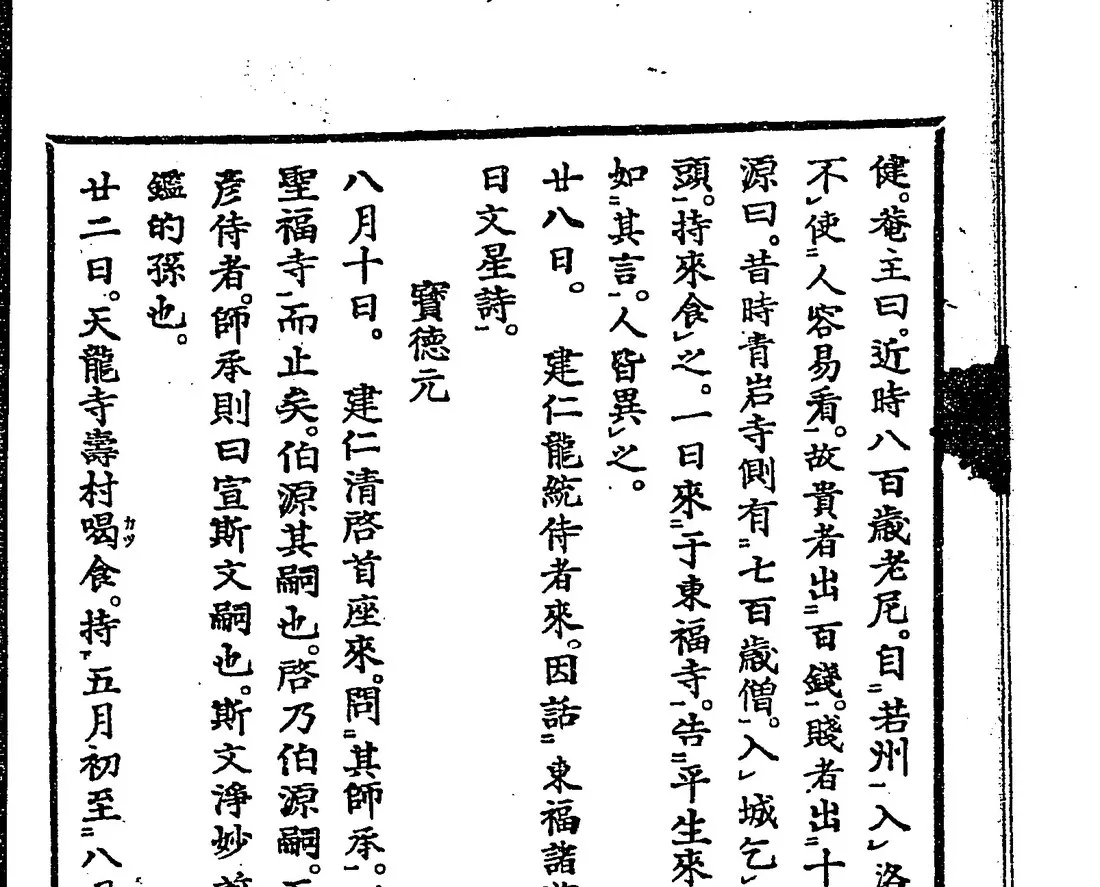
The nun’s entry, continued at the top of p. 42 of 臥雲日件録抜尤 (Gaun nikkenroku batsuyū), in 史籍集覧 (Shiseki shūran) vol. 11, 1893, cropped. National Diet Library Digital Collections, call number 69-50, public domain (PDM).
| Diary | Day | Her age | In the entry |
|---|---|---|---|
| Yasutomi-ki | 5th month, 26th | Over 2002 | Shown for a fee; left that day2 |
| Tsunamitsu-ko ki | 6th month, 8th | 800, her own word13 | Said to come to the palace; did not13 |
| Gaun nikkenroku | 7th month, 26th | 8003 | Gate shut; a hundred coins or ten3 |
The diaries do not settle which age is right.5 They also leave open whether one group stayed in Kyoto for two months or several took turns.2133 Yanagita Kunio held that one group stayed, and Togashi, who weighs both, thinks that more likely.15
A herb, then a mermaid
A tale of 1480, Fudeyui no monogatari by Ishii Yasunaga, sends a party of raccoon-dogs from Tamba to Kyoto to meet the white nun of Wakasa.16 Togashi reads it as built on the 1449 visit.16 She tells them her long life comes from a herb, kuko (wolfberry), that her mother took every day.16 She puts her age at about 900, calls herself the white nun of Wakasa, and adds that some people have lately begun to call her Yao Bikuni.16
The mermaid is in Hayashi Razan’s Honchō jinja kō, a book of shrines that Togashi dates to between 1638 and 1645.17 Razan says his late father told him the story and that he heard it as a child; Togashi puts that around 1590.181917 In the Tohoku University copy of the book, the white nun’s father meets a stranger in the mountains and is taken to a place that is almost another world.18 The stranger gives him a mermaid and says that eating it lengthens life and stops ageing.18 The father carries it home, and his daughter finds it in his sleeve and eats it.18
是人魚也。食之延年不老18
This is a mermaid. If you eat it, your years will be lengthened and you will not grow old.
In Razan’s text the nun lives to “more than four hundred years”, not 800.19 The Wakasa kokuden-ki, a gazetteer Togashi dates to the Kanbun years (1661 to 1673), quotes the passage with “four hundred years”.182021 Togashi says that after the diaries the records of the legend stop for about 150 years, until Razan, and that how the story took shape in those years remains to be studied.6
The same gazetteer tells a second story. Several people of Obama, blown off course in a storm, land on an island with a golden-towered gate and are fed a dish that looks like human flesh.20 A girl eats the meat and lives to 800, and people think the island was Hōrai and the meat a mermaid’s.20 The Wakan sansai zue, dated 1712 by Togashi, has an entry on Kūin-ji that gives the nun 800 years and the looks of a girl of fifteen or sixteen.22 It then says that some claim she ate a mermaid and that this is not so.23
或謂食人魚、然者非也23
One account has her eating a mermaid. That is not so.
| Text | Date | Why she lives long | Her age |
|---|---|---|---|
| The three diaries | 1449 | Not said4 | Over 200, or 8005 |
| Fudeyui no monogatari | 1480 | A herb her mother took16 | About 900, in her own words16 |
| Honchō jinja kō | Written 1638 to 164517 | A mermaid, eaten by the daughter18 | Over 40019 |
| Wakasa kokuden-ki | 1661 to 1673, Togashi’s estimate20 | A dish from an island, said to be a mermaid’s20 | 80020 |
| Kaibara Ekiken, Kikō | 1689 | A mermaid, eaten in secret24 | 80024 |
| Wakan sansai zue | 171223 | Some say a mermaid; the author says no23 | 800, looking 15 or 1622 |
What Obama built around her
The Sekai daihyakka jiten gives her an address, a cave at Kūin-ji in Obama, and says she looked fifteen or sixteen.22 The Edo texts that give the cave are late, and they are not sure what it is.202526
The Wakasa kokuden-ki lists a Yao Bikuni cave in the grounds of Kūin-ji and says her place of death is unknown.20 The Wakasa gunken-shi of 1693 gives the cave as the rock where, tradition says, she hid.25 Kinoshita Gaisō’s Shūi zatsuwa, finished in 1764, says her grave was moved into the cave in the Kanbun years, after visitors had taken the grave for a couple’s, and says the grave in the cave is not an old thing.26 We read the first two on page images; the third only as Togashi quotes it.
The Sakai family, lords of the Obama domain, are the other part of the story. Kūin-ji is their family temple and took its name in 1662 from the sobriquet of Sakai Tadakatsu.27 Togashi reports from the Shūi zatsuwa that the Shinmei shrine in the same town made a new statue bearing the Sakai crest, with its first origin text, in 1740, and showed it in Kyoto in 1759.28 A third strand is a small shrine west of town, built in 1619 after a nun’s shape was seen dancing and vanishing when it met people; Togashi reports from an eighteenth-century gazetteer of unknown authorship that people there pray against toothache.29
Togashi’s argument is that the domain’s finances began to run short under its second lord, and that the two temples, which needed money to keep the standing the Sakai gave them, used the nun to raise it.7 He gives the temples’ origin texts as evidence that they disagree on her birth and death, and that each gives the cave as her place of death.30 The argument is his inference, and we found no second scholar who tests it. Our reading is narrower. The diaries already give her 800 years, and Razan already gives her a mermaid, so what Obama adds is a place to visit: a cave, a grave, a statue.4182628
How the diaries got into the story
Togashi points out that the diaries were private, and that their entries became widely known only when Edo-period gazetteers of Wakasa copied them.31 Chika Genemon’s Mukō jaku-roku of 1671 says he read Nakahara Yasutomi’s family diary, and gives the white nun and the eastern nun as having met and talked.31 The two entries we read do not say they met.211 The Wakasa kokushi of 1749 quotes the Yasutomi-ki and the Gaun nikkenroku.31
Traditions of the nun now run far beyond Wakasa. Togashi collected 164 cases between Iwate and Saga, and Takahashi Harumi, counting another way, found 166 traditions in 1982.32 Nomura Jun’ichi guesses that groups of women who called themselves Yao Bikuni carried it, as the Kumano bikuni carried theirs by picture-telling.33 Togashi adds that origin texts sold by the Obama temples reached temples in Niigata and Gunma, which gave her local families as descendants.30
Togashi names the stretch between the diaries and Razan, about 150 years, as the one still to be explained.6 The one text we know from it, the 1480 tale, still gives her a herb.16
What we could not verify
Sources we have not seen
- Fudeyui no monogatari (1480). It would show whether the nun’s own speech about the herb and the name Yao Bikuni reads as Togashi reports. It survives in one manuscript, in the Sonkeikaku Bunko. The NDL catalogue lists no digitised copy under that title, the Kokusho database would not return a result to our requests, and the modern transcription is in a 2014 book by Sawai Taizō that is in copyright and not online.
- Kinoshita Gaisō’s Shūi zatsuwa (1764), the Obama temples’ origin texts and Kaibara Ekiken’s Kikō (1689). They would show how the originals differ from Togashi’s and Aoyagi’s summaries. The NDL holds the Shūi zatsuwa and Ekiken’s collected works, but only for registered readers: no page images are public. We found no scan of the temples’ origin texts. The Fukui prefectural library’s digital archive was not reachable to us, so its holdings are unchecked.
Seen only where others quote them
- Kaibara Ekiken’s Kikō (1689), which we read in Aoyagi Shūichi’s quotation of the Shin Nihon koten bungaku taikei text and in Togashi’s table.
- Yanagita Kunio’s reading that one group stayed in Kyoto, which we read as Togashi reports it.
Questions we could not settle
- Whether the nun of 1449 came from Obama. The three diaries say Wakasa only.
- How the story went from a herb to a mermaid between 1480 and Razan’s book.
Read next
TaleHitachi (now Ibaraki), Japan, 1803 to 2026
Where the Utsuro-bune landed depends on the text
TaleKumano and Saga, Japan, 219 BCE to 1826
How Xu Fu got to Japan
TaleMusashi (now Tokyo), Japan, 1685 to 1993
Yuki-onna, the snow woman of Kwaidan, 1904
Sources
- Togashi Akira 冨樫晃, Togashi 2024, p. 169 (Introduction) and p. 170: 文安六年(一四四九)における『康富記』、『綱光公記』、『臥雲日件録』という同時期に書かれた三種の日記類; p. 172 for the authors
- Togashi 2020, table 2 nos. 1 to 3, p. 111: nos. 1 to 3, 宝徳元年 (1449), 康富記 5月26日, 綱光卿記 6月8日, 臥雲日件録抜尤 7月26日 (the table calls the second 唐橋綱光卿記; Togashi 2024 p. 173 corrects it to Hirohashi Tsunamitsu)
- Miyata Noboru, entry 八百比丘尼, Sekai daihyakka jiten, as reproduced at Kotobank, paragraph on 1449: 1449年(宝徳1)の5月に実在の八百比丘尼(白比丘尼)が若狭国から上洛し京に出現したという記事が、《康富記》や《臥雲日件録》に見られる (names two of the three diaries)↑
- Nakahara Yasutomi, Yasutomi-ki 康富記, Shiryo taisei vol. 3 (typeset edition), NDL Digital Collections pid 1207179, frame 15; documents/yasutomi-ki-1449-05-26.md, printed p. 112 (frame 15, right-hand page, lower columns), entry 廿六日乙巳: 或云、此廿日比、自若狭國、白比丘尼トテ、二百餘歳ノ比丘尼令上洛、諸人成奇異之思、仍守護召上歟、於二條東洞院北頰大地藏堂、結鼠戸、人別取料足被一見云々、古老云、往年所聞之白比丘尼也云々、白髪之間白比丘尼ト號歟云々、官務行向見之云々、而不可然之由有巷說之間、今日下向若狭國云々 () (primary) transcription
- Togashi 2024, p. 172: the entry quoted in full (五月二六日の条) and discussed on p. 174 (伝聞 because it opens 或説云; 古老 shows the name was known earlier)
- Togashi 2020, table 2 no. 1, p. 111, table 2 no. 1: the same entry quoted in Japanese with Togashi's remark that its figure (200 and more) differs from nos. 2 and 3 (800)↑
- Zuikei Shuho 瑞渓周鳳, Gaun nikkenroku 臥雲日件録 (abridgement, Gaun nikkenroku batsuyu), in Shiseki shuran vol. 11 (Kondo Heijo ed., 1893), NDL pid 769659, pp. 41 to 42 (frames 23 and 24); documents/gaun-nikkenroku-1449-07-26.md, entry 廿六日, from the last lines of p. 41 (赴清水定水菴) to p. 42, first columns: 菴主曰、近時八百歳老尼、自若州入洛、洛中爭覩、堅閉所居門戸、不使人容易看、故貴者出百錢、賤者出十錢、不然則不得入門也。曹源曰、昔時青岩寺側有七百歳僧 ... The month heading is on an earlier page; the next heading on p. 42 is 寶德元 八月十日 (). (primary) transcription
- Togashi 2024, p. 173: 七月二六日の条 quoted; p. 174 on Zuikei Shuho and the talk of a 700-year-old monk
- Togashi 2020, table 2 no. 3, p. 111, table 2 no. 3 (臥雲日件録抜尤 七月二十六日の条), text quoted; Togashi's remark: from no. 3 one sees that several people claimed long life like the white nun↑
- Yasutomi-ki, Tsunamitsu-ko ki and Gaun nikkenroku, as above, the passages in C8, C10 and C11 are complete as quoted and carry no word for food, fish or a cause of age; 白比丘尼 in Yasutomi-ki and Tsunamitsu-ko ki, 八百歳老尼 in Gaun nikkenroku (our reading of the three page images) (primary)
- Togashi 2024, p. 180: 「八百比丘尼」という名称が文献に初めて現れた ... 文安六年の同時期日記にも八百比丘尼の語源となる自称八百歳の比丘尼の記録はあるが、八百比丘尼の呼称は使われておらず、もっぱら白比丘尼という呼称が使われている; p. 188: no tale of a visit to another world and no mermaid flesh in this period↑
- Yasutomi-ki (C8), Tsunamitsu-ko ki (C10) and Gaun nikkenroku (C11), as above, Yasutomi-ki 二百餘歳; Tsunamitsu-ko ki 年八百歳; Gaun nikkenroku 八百歳老尼 (page images; see C8, C10, C11) (primary)
- Togashi 2020, table 2, p. 111, remark on nos. 1 to 3: No. 1 gives 200 and more, nos. 2 and 3 give 800 (宝徳元年(1449)夏の同時期に書かれた日記。比丘尼の年齢はNo.1が200余歳とするのに対し、No.2、3が800歳とする)↑
- Togashi 2024, p. 188, まとめ: この同時期の日記類以降、八百比丘尼伝説に関わる文献記録はしばらく途絶えており、次の記録は、およそ一五〇年後の林羅山『本朝神社考』となる ... 異郷訪問のモチーフと人魚の肉という、その後の八百比丘尼伝説の定番となるストーリーが始めて述べられている; he adds that how the story was formed in those 150 years remains to be studied↑
- Togashi Akira 冨樫晃, Togashi 2020, p. 99 (section 4, quoting the Fukui-ken shi on the domain's debt: 二代藩主忠直の時期 ... 八代の忠貫の明和七年(一七七〇)には借財が一一万両に達し) and p. 104 (6, まとめ): 一六〇〇年代後半から一七〇〇年代半ばに作成した; wording throughout is 考えられる (it is thought), his inference↑
- Nomura Junichi, entry 八百比丘尼, Nihon daihyakka zensho (Nipponica), as reproduced at Kotobank, entry: 新潟県佐渡市南部の旧羽茂町地域 ... 庚申講に加わった男が次の講に人々を招く。台所をのぞくと人魚を料理している ... 八百歳で若狭の地で入定したという↑
- Togashi 2024, note 1, p. 189: 文安六年(一四四九)七月二八日に宝徳に改元されたため、日記に記述された白比丘尼上洛時は文安六年となる
- Zuikei Shuho, Gaun nikkenroku, Shiseki shuran vol. 11, NDL pid 769659, p. 42 (frame 24), the heading 寶德元 stands before the entry 八月十日 on the same page that carries the 26th and 28th of the month before; Tsunamitsu-ko ki, printed p. 111, 七月一日 entry (start of the lower register): 今月有改元間 (primary)↑
- Togashi 2020, table 2 nos. 1 to 3, remark, p. 111, remark: 見料を取っていたことから、一種の勧進活動であったろう。No.1の古老の話から、この日記以前から白比丘尼と称する長寿の比丘尼の噂があったものと考えられる↑
- Nakahara Yasutomi, Yasutomi-ki, Shiryo taisei vol. 3, NDL pid 1207179, frame 15; documents/yasutomi-ki-1449-05-26.md, printed p. 113 (frame 15, left-hand page, top), entry 廿七日丙午: 或說云、自東國比丘尼上洛、此間一條西洞院北頰地藏堂、致法花經之談義云々、五十バカリノ比丘尼也、同宿比丘尼二十人許在之云々 (primary)
- Togashi 2024, p. 172 (the 五月二七日の条 quoted), p. 186 (Togashi takes it for a separate group and cites Nei Jo on how many nuns travelled in bands)↑
- Togashi 2024, pp. 186 to 187, sections 五 (一) and 五 二, quoting Nei Jo on travelling bikuni bands; "多くの勧進を目的とした宗教者集団が京都に集まる中で、「名取の老女」や「八百歳の長寿者」といった奇瑞譚を持って自らをアピールする集団が京都の民衆の耳目を集め" (p. 187)↑
- Hirohashi Tsunamitsu 広橋綱光, Tsunamitsu-ko ki, Bun'an 6 (Hotoku 1) April to August, ed. Endo Tamaki, Suda Makiko, Tanaka Naho and Momosaki Yuichiro, Tokyo Daigaku Shiryo Hensanjo kenkyu kiyo 27 (2017); documents/tsunamitsu-ko-ki-1449-06-08.md, printed p. 111 (PDF p. 6), upper register, entries 六月八日 and 九日: 白比丘尼参御所云々、年八百歳之由申、怪異此事也、今日帰国云々、定篇解物歟、不吉事歟、不審沙汰有条々者也、莫言〳〵; next day 白比丘尼御所参由、昨日有御聞き、雖然不参云々、尤以珍重〳〵、猶々希代事也 () (primary) transcription
- Togashi 2024, p. 173: 六月八日の条 and 九日の条 quoted; p. 174 reads 怪異此事也 and 不吉事歟 as the diarist's unease↑
- Hirohashi Tsunamitsu, Tsunamitsu-ko ki, as in C10, printed p. 111 (PDF p. 6): upper register 六月四日 晴、地震、暁鐘程大地震、驚無極也; 七月一日 entry, which runs on into the start of the lower register: 到今日猶地震、已七十五日余也、可驚〳〵 (primary)
- Togashi 2024, pp. 173 to 174: the Tsunamitsu-ko ki's quake entries for 4月10日 to 7月19日 quoted, with Togashi's reading that Tsunamitsu tied the nun to the unrest (怪異此事也、不吉事歟) while the townspeople crowded to see her↑
- Togashi 2024, p. 186, section 五 (一): 柳田の言うとおり、長期間滞在している同一の集団であると考えられるのではないか; he weighs the Yasutomi-ki's one-week plan against the viewing for money in both the Yasutomi-ki and the Gaun nikkenroku (he labels the second quotation 綱光公記 七月, a slip: the words are the Gaun nikkenroku's)↑
- Togashi 2024, pp. 170 to 171 (summary of the tale and of its single manuscript at the Sonkeikaku Bunko); pp. 178 to 180 (the nun's speech quoted from Sawai Taizo's transcription: 枸杞といふ草ヲ、毎日ふくし給ふ ... 既に九百年におよふよわい ... 若狭の白比丘尼といふなり。近比より、八百比丘尼とよふ人も侍り). The tale itself not opened↑
- Togashi 2024, note 26, p. 190: 『本朝神社考』寛永十五年(一六三八)から正保二年(一六四五)の間に書かれたとみられる。巻六都良香の条に林羅山が一五九〇年頃の幼少期に聞いた話としている↑
- Hayashi Razan 林羅山, Honcho jinja ko 本朝神社考, vol. 6, entry 都良香, Tohoku University Library copy (undated Kyoto print), image 273 of 279, image 273, right-hand page, columns 3 to 7: 傳聞若狹國有号白比丘尼者、其父一旦入山、遇異人、與俱到一處、殆一天地而別世界也。其人與一物曰、是人魚也。食之延年不老。父携歸家。其女子迎歡而取衣帯、因得人魚于袖裏、乃食之 () (primary) transcription
- Sakurai Kyokuzen, Wakasa kokuden-ki 若狭国伝記 (NDL pid 994428, print of 1871), entry 八百比丘尼窟, quoting the Honcho jinja ko, frame 19, left-hand page, first columns: 神社考云、余先考嘗語云、傳聞若狹國 [有]号白比丘尼者、其父一旦入山、遇異人、與俱到一處、殆一天地而別世界也。其人與一物曰、是人魚也。食...; the middle lines were not transcribed () (primary) transcription
- Togashi Akira 冨樫晃, Togashi 2020, table 2 no. 4, p. 111, table 2 no. 4, Honcho jinja ko vol. 6, entry 都良香, the same passage quoted
- Togashi Akira 冨樫晃, Togashi 2024, p. 188 (まとめ), the same passage quoted
- Miyata Noboru, entry 八百比丘尼, Sekai daihyakka jiten, as reproduced at Kotobank, paragraph on 1449: 《本朝神社考》でも、この比丘尼の父親が山中で異人にあい、招かれて人魚の肉をすすめられたが、食べずに帰ったのを娘が食べて長寿になったと記している↑
- Hayashi Razan, Honcho jinja ko, vol. 6, Tohoku University Library copy, image 273, image 273, right-hand page, columns 7 and 8: 女子寿四百餘歳。謂所白比丘尼是也。余幼齢嘗聞此事而不忘 () (primary) transcription
- Togashi Akira, Togashi 2024, p. 188, the quoted passage: 女子寿四百余歳、所謂白比丘尼是也。余幼齢にしてこの事を聞いて忘れず↑
- Sakurai Kyokuzen, Wakasa kokuden-ki 若狭国伝記, NDL pid 994428 (print of 1871), entry 八百比丘尼窟, frame 18 (left-hand page, last columns) and frame 19 (right-hand page): 八百比丘尼ノ窟ハ後瀬山南麓空印寺ノ裡ニアリ ... 小濱ノ人數輩 ... 一嶋ニ着ク ... 金樓門 ... 其女取食之而及八百歳ニ ... 衆皆以為其嶋ハ蓬莱、肉ハ人魚ナラン ... 死所不詳 () (primary) transcription
- Togashi Akira, Togashi 2020, table 2 no. 5, p. 112, table 2 no. 5: 八百比丘尼ノ窩「此窩空印寺ニアリ、...保八百歳、故時人号八百比丘尼 ... 死所不詳」; Togashi dates the gazetteer to the Kanbun years and reads it as the first document to use the name for an 800-year nun (he gives about ten men; the 1871 print says 數輩, several)↑
- Sakurai Kyokuzen, Wakasa kokuden-ki 若狭国伝記, NDL pid 994428, entry 八百比丘尼窟, frame 19, left-hand page, lower of the quotation's columns: 女子壽四百歳。所謂白比丘尼是也 () (primary) transcription↑
- Terajima Ryoan, Wakan sansai zue, vol. 71 (Wakasa), entry 空印寺, NDL pid 898185 (1901 reprint); documents/wakan-sansai-zue-kuinji.md, frame 200, printed p. 1154, right-hand page: 八百比丘尼木像窟 ... 昔有女僧住于此、其齡八百歳而容貌壯美、可十五六歳、仍稱八百比丘尼 () (primary) transcription
- Miyata Noboru, entry 八百比丘尼, Sekai daihyakka jiten, as reproduced at Kotobank, first paragraph: 福井県小浜市の空印寺の洞穴に住み、その容貌は美しく、15, 16歳のように見えた↑
- Terajima Ryoan, Wakan sansai zue, vol. 71 (Wakasa), entry 空印寺, NDL pid 898185, frame 200, printed p. 1154, right-hand page, last lines: △按 ... 或謂食人魚、然者非也 (). Togashi 2020 table 2 no. 8 paraphrases the entry as 'これ人魚を食いしに因る', which the page does not say (primary) transcription↑
- Togashi 2020, table 2 no. 6, p. 112, table 2 no. 6: 貝原益軒『己巳紀行』元禄2年 (1689), quoted: 八百比丘尼の事。世俗の語り伝へに云く。古へ此辺に六人の福徳長者あり ... 人魚は薬なる由を聞て。窃かに取て食しける。是より長命にて。八百年生きて、此所に住し. Togashi: a story Ekiken heard while staying in Obama. The Kiko itself not opened
- Aoyagi 2015 (Fukui-ken Monjokan kenkyu kiyo 12), quoting Shin Nihon koten bungaku taikei 98, pp. 9 to 10: the Kiko passage quoted (小浜は当国の主、酒井氏の居城也 ... 脇社に、白比丘尼又号八百比丘尼十八歳の影有 ... 八百年、此所に住スとかや) and summarised↑
- Makita Chuzaemon Chikatoshi 牧田忠左衛門近俊, Wakasa gunken-shi 若狭郡県志, vol. 3 (古跡部, 遠敷郡), in Shokoku sosho: Hokuriku 1 (Ashida Koreto ed., 1917), NDL pid 952773, frame 17, left-hand page, printed p. 23: 八百比丘尼洞 在後瀬山下空印寺之境、傳言八百比丘尼隱此巖洞矣 (primary)
- Togashi Akira, Togashi 2020, table 2 no. 7, p. 112, table 2 no. 7 (『若狭郡県志』元禄6年, 1693): 八百比丘尼洞 ... 八百比丘尼隠此巌洞矣; Togashi: the first description to call it 八百比丘尼洞 and her hiding place (死所)↑
- Togashi 2020, table 2 no. 11, p. 113, table 2 no. 11 (『拾椎雑話』明和元年): 「岩窟」の項 ... 此故に比丘尼の墓を岩窟へ引て今の如しと云。此墓寛文年中の事にして古跡にあらず; remark: 八百比丘尼の岩窟を墓とするのは古いことではない. Shui zatsuwa itself not opened↑
- Togashi 2020, p. 96, section 2 (1): この空印寺は小浜藩主酒井家の菩提寺で ... 父忠勝(号 空印)...; p. 112, table 2 no. 5 remark: 1662年 小浜藩主酒井忠勝の号にちなみ「空印寺」と寺号を改める↑
- Togashi 2022, p. 177 (section 3 (3)), quoting 『拾椎雑話』「寺社」の項 (寛文の頃より比丘尼の像を山上に仮殿をしつらひ収め置 ... 元文五年に改め作るは壱尺四寸也。此時初て縁起を作る。宝暦九年京都にて開帳あり) and the Sakai crest on the statue↑
- Togashi 2020, table 2 no. 9, p. 112, table 2 no. 9 (『若狭国守護代記』, first half of the 1700s), vol. 5: 元和五年 ... 是れ即ち同所神明の神主菊地某が計ひなり ... 八百比丘尼の宮と名付く ... 今は歯瘡の宮と世人申して、歯の痛むに願を掛れば、癒と云々; the gazetteer's author unknown. Not opened itself↑
- Togashi 2022, pp. 176 to 181 (sections 2 to 5, まとめ on p. 181): the engi differ on her father and birthplace (Shinmei-gu: Doman, Wakasa; Kuin-ji: a Takahashi of Obama) and each temple's engi gives the cave as her death place; wording is Togashi's inference (考えられる)↑
- Togashi 2024, p. 176 and notes 8 and 9, p. 189: 『若耶群談』、『向若録』や『若狭国志』等の近世若狭国地誌に日記類の記事が採録された以降; 向若録 (寛文11年, 1671): 余往歳在国史編輯之席、閲中原康富家記 ...; 若狭国志 (寛延2年, 1749): 或云中原康富記曰 ... 又日件録曰 ... 八百歳老尼↑
- Togashi 2020, p. 95, Introduction: 北は岩手県から南は佐賀県まで百六十四事例を収集した中で、伝承の濃密な地域として、群馬、埼玉などの北関東地域、新潟、富山、石川、福井などの北陸地域、岐阜、愛知などの中部地域、鳥取、島根の山陰地域
- Aoyagi Shuichi 青柳周一, "Edo jidai no Echizen, Wakasa o tabishita hitobito", Fukui-ken Monjokan kenkyu kiyo 12 (2015), pp. 1 to 13 (lecture text), citing Takahashi Harumi, Toyo Daigaku Tanki Daigaku ronshu, Nihon bungaku hen 18 (1982), p. 10: 28都県89区市町村121ヶ所にわたって分布 ... 伝承数は166 ... 石川・福井・埼玉・岐阜・愛知に多い。埼玉・岐阜といった海のないところも含まれています. Takahashi's paper itself not opened↑
- Nomura Junichi, entry 八百比丘尼, Nihon daihyakka zensho, as reproduced at Kotobank, entry, near the end: 中世に熊野比丘尼が絵解きをしながら各地を巡遊したように八百比丘尼を名のる集団があって、この伝説を広めたと推測される↑
Documents quoted
- Gaun nikkenroku, 1449, 7th month, 26th day (transcribed from the page image)
- Honcho jinja ko, vol. 6, the white nun of Wakasa (Hayashi Razan) (transcribed from the page image)
- Tsunamitsu-ko ki, Bun'an 6 (1449), 6th month, 8th and 9th days (transcribed from the page image)
- Wakan sansai zue, vol. 71 (Wakasa): Kuin-ji and the 800-year nun (transcribed from the page image)
- Wakasa kokuden-ki, the Yao Bikuni cave at Kuin-ji (Sakurai Kyokuzen) (transcribed from the page image)
- Yasutomi-ki, Bun'an 6 (1449), 5th month, 26th and 27th days (transcribed from the page image)