 Twice Told
Where the Utsuro-bune landed depends on the text
Fourteen old texts tell of a round vessel and a woman with a box on a Hitachi beach in 1803. The beach named in the Toen-kai text appears in no Edo record.
Contents
Published 15 Oct 2026. Sources checked 10 Oct 2026.
The Toen-kai account of the hollow ship names the beach where it came ashore: Harayadori, in Hitachi province. No Edo-period record has turned up with a place of that name, and it was taken for an invention.9 In 2014 Tanaka Kazuo, a Gifu University professor emeritus,10 found the beach written another way in a document from a ninja family’s papers: Hitachihara Sharihama, a name that appears on Inō Tadataka’s map of the coast.1112 If he is right, the beach is real. It is also a stretch of dunes where, the Kamisu city newsletter says, nobody lived until 1872.13
This is the story as the Toen-kai text tells it, in the copy kept at Japan’s National Archives.14
In the spring of 1803, on the 22nd day of the second month, around noon, people on a beach in Hitachi called Harayadori saw something like a boat out at sea.141516 The people of the shore rowed out in small boats and drew it up onto the beach. No one could talk to the woman who was aboard, so no one could learn where she came from.16
The vessel was shaped like an incense box and about three ken long, with glass screens on top and iron plates along the bottom.17 Inside were water, food and the woman.18 Her eyebrows and hair were reddish and her face was pink.19 She held a box two shaku square.18
An old man of the place said she was the daughter of a foreign king, whose lover had been put to death, and that the box probably held the lover’s head.20 Reporting it would have cost the village a great deal, so they put her back in the vessel and drew it out to sea.21
One story, fourteen texts
The Archives file the copy under the Hirokata zuihitsu, “Hirokata’s essays”, call number 特095-0004.14 Minakami Ryūtarō traces the text to 1825 and the Toen-kai, a monthly gathering in Edo where twelve collectors of curiosities brought each other strange stories, and names Bakin and his son Sōhaku as its authors.22 It was later bound as the Toen shōsetsu and travelled in hand copies.22 A coloured copy at Tenri University’s Central Library has the vessel, the woman and four strange signs.23
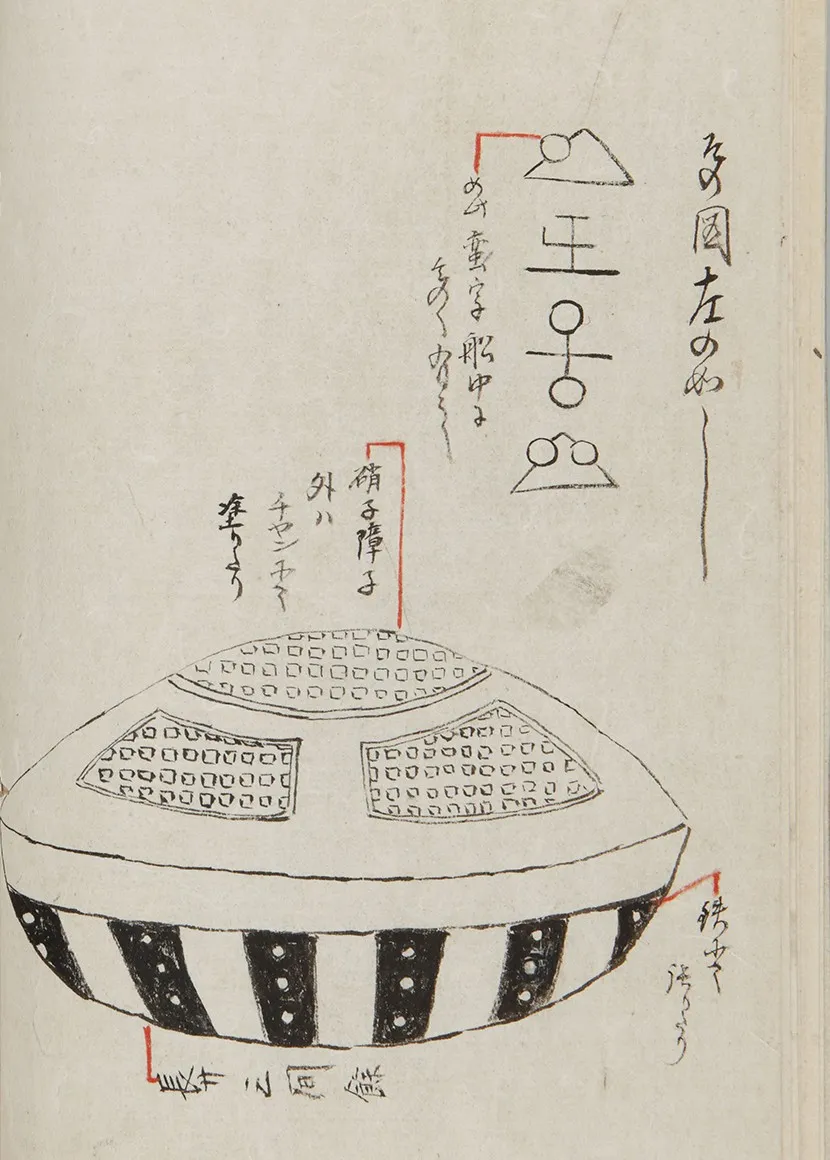
The vessel and its four signs, from the Hirokata zuihitsu, 「うつろ舟の蛮女」, copy of the Toen-kai text. 国立公文書館所蔵, 弘賢随筆 特095-0004, from the Archives’ exhibition 漂流ものがたり, cropped.17
The Ōshuku zakki draws a different vessel. It is a round one with a flat rim and a single window, labelled ウツロ舟図 (“hollow ship drawing”), and a woman with long loose hair stands beneath it.24
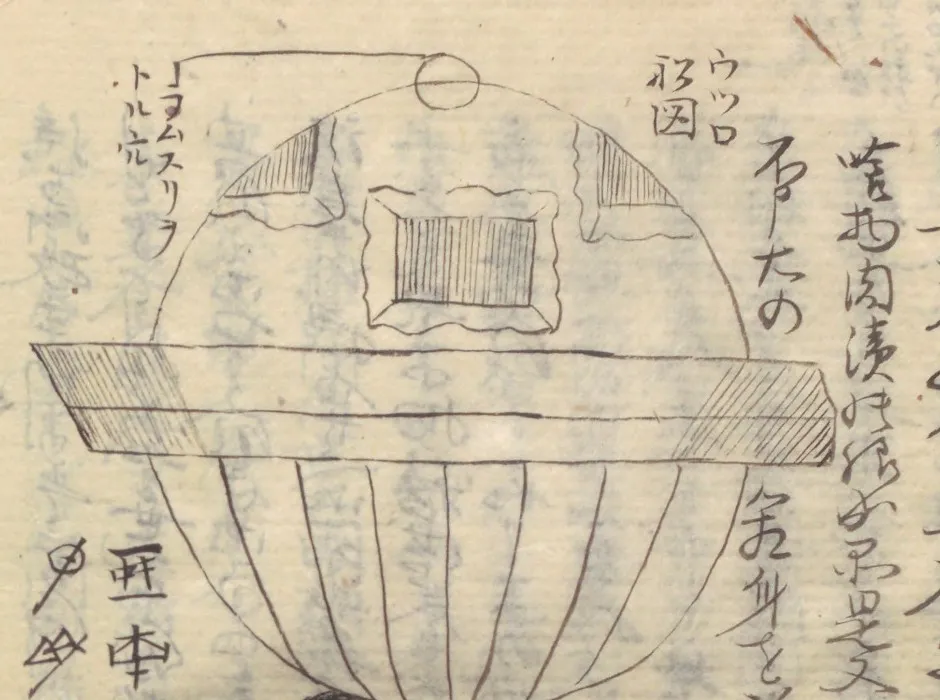
The vessel labelled ウツロ舟図 in the Ōshuku zakki, vols. 13 to 14, a manuscript copy of Komai Norimura’s notes. 「鶯宿雑記」巻13-14 (駒井乗邨), National Diet Library Digital Collections, call number 238-1, pid 10301138, cropped.24
Tanaka counts fourteen texts of thirteen kinds, and every one has a picture.1 He sorts them into three groups. The Toen shōsetsu and nine other kinds are the first. The Ōshuku zakki and a paper from Mito form the second, which tells the same event from another source. The third is a single paper that puts the landing at a harbour in Bōshū.25
Three of them he calls the oldest and closest to the original: the Banke document, the Shinko zakki and the Ibun zassho. They share a plot, were written soon after 1803, name no lord, and draw the vessel as a bowl with a straight base.2 The Ibun zassho, in the Sakakibara family papers, is a private notebook compiled by Suzuki Kanrai, who died in 1812; its entries run to 1806.26 The table follows Tanaka’s date for each text.
| Text | Dated by Tanaka | Arrival | Beach |
|---|---|---|---|
| Ibun zassho | 18036 | 26th, 3rd month4 | 原舎ノ濱6 |
| Shinko zakki | 18036 | 26th, 3rd month4 | 厚舎ヶ濱6 |
| Banke document | 18036 | 26th, 2nd month4 | 原舎り濱6 |
| Ōshuku zakki | about 18156 | 8th month, 2nd day5 | 阿久津浦6 |
| Toen shōsetsu (Hirokata copy) | 18256 | 22nd, 2nd month14 | はらやどり15 |
| Mito document | undated6 | 8th month5 | 外濱6 |
Three months
The oldest three agree on the day and differ on the month. Tanaka takes the Banke document’s second month for a copyist’s slip, which would put all three on the 26th of the third month.4 The Toen-kai text has the 22nd of the second month, and spring.14 The Mito document and the Ōshuku zakki entry say the eighth month.5
The calendar database of Japan’s National Astronomical Observatory shows that 1803 had a leap first month.27 By it, the Toen-kai date falls on 13 April and Tanaka’s date for the oldest three on 17 May.27 The eighth month began in mid-September.27 So the texts put the landing in spring or in autumn.
A beach with many spellings
Several of the texts write the beach with the characters 原舎 and small changes of ending, which Tanaka reads as Harayadori.6 A printed broadside has 京舎ヶ濱 in Kashima district, the Ōshuku zakki 阿久津浦, the Mito document 外濱.628
Most also say the beach lay in the fief of Ogasawara Etchū no kami, and that is the first thing that fails. Tanaka and Minakami both find no such fief on that stretch of coast.29 Tanaka puts the fishing rights at Sharihama in the hands of a different bannerman, Matsushita Kawachi no kami.30 He reads the Ogasawara line, which says the account was copied from a report by that lord’s fief, as the story’s source rather than its landing place.31
Sharihama is the best candidate so far. The Banke document, which Tanaka found in 2014, writes the name as 常陸原舎り濱, and he says the same name is on Inō’s map and is the Sharihama of today’s Hasaki, in Kamisu city.11 The National Archives are more careful, saying only that Harayadori is “said to be” perhaps Sharihama.32 Minakami, whose paper of 2014 called Harayadori invented, was writing before the Banke document came to light.9
The Mito document has its own beach. Tanaka found the name 外濱 in the Yanagawa district of Kamisu, about 10 km from Sharihama, and reads the paper as an advertisement for Seifuku-ji temple’s silkworm faith, not a travel report.33
The woman in the vessel
All ten kinds in Tanaka’s first group have a woman with a box.18 Little else about her stays put. The three oldest give a pale blue-white face, dark red eyebrows and hair, and white teeth.34 The Toen-kai text has reddish brows and hair and a pink face.1934 The Ume no chiri of 1844 has skin white as snow and glossy black hair, and Tanaka reads the later wording as simplified over time.34
A hollow ship with a woman aboard was not new in 1803. The National Archives list one that came ashore at Yoshida-ura in Mikawa in 1698, with a man’s head at the bow and a woman nobody could understand.35 A diary of 1699 reports another at Atsuta, with a palace woman and a monk’s head on a spike, and the diarist writes it off as a false tale.36
A guess that ends in a shrug
The Hirokata copy ends by guessing at her country. It says the signs inside the vessel resemble those on an English ship that came to Uraga, and that she might be English or a king’s daughter from the Netherlands or America.37
これも亦知るべからず37
This too cannot be known.
Minakami, quoting Yanagita Kunio’s essay of 1926, gives the same words as Bakin’s note.37 Yanagita himself called the whole story a tall tale, because the four signs in the vessel were nonsense.38 The one early text that doubts it, the Ibun zassho, ends 「此事偽と聞たり」, “this matter was heard to be false”.3 Tanaka cannot tell whether “false” means the report to the authorities or the story, and he finds no official record of a landing.3
Minakami thinks the event probably never happened.7 Tanaka says in an interview that he feels it was probably based on something real.8
How it became a flying saucer
In 1926 Yanagita could treat letters nobody could read as proof of a tall tale. Minakami argues that after the Kenneth Arnold sighting of 24 June 1947 “letters not of this world” no longer meant that, and could mean the writing of visitors.39 Tanaka began studying the story around 1998.10 Skeptical Inquirer printed his paper in July/August 2000 under the title “Did a Close Encounter of the Third Kind Occur on a Japanese Beach in 1803?”40 We found no earlier publication that sets the vessel beside a saucer, but we could not read Tanaka’s paper or his book, so that is a gap in our search and not a finding.
Two of the explanations for the signs and the shape are on the record. Minakami reads the triangle-and-circle signs as an upside-down VOC monogram of the Dutch East India Company, the mark of a Nagasaki ship-owner’s flag; Tanaka reports the idea and doubts that Dutch letter frames were in use in Hitachi in 1803.41 Tanaka’s own reading is that the early texts describe a silkworm in its stages, pale larva to white cocoon, and that the Mito document’s woman was drawn from the Kinjiki-hime statue at Seifuku-ji. He still calls the origin of the saucer shape unexplained.42
A copy from Akita
On 23 July 2026 the Sakigake newspaper reported that Akita Prefectural Library holds a copy, made in 1867 by Ogasawara Tameji of Asō in present-day Noshiro, of a record titled 「聞書覚及俳諧」. It puts the arrival on the Hitachi coast in February 1803, as the paper gives it. We could read only the free opening of the article, and it does not say whether that is the lunar second month. Experts told the paper it is plain and lacks the sensational parts of the other texts, and one called it possibly a real drift report.43 We have not seen it.
What we could not verify
Sources we have not seen
- The Toen shōsetsu itself, which would show everything Bakin wrote on the story. The only open copy we found is the Hirokata copy above; the National Diet Library’s edition (Nihon zuihitsu taisei, 1928) is restricted to registered readers, and its image service refused the request when we tried on 10 October 2026.
- Tanaka’s Skeptical Inquirer paper of 2000, which would show how the saucer comparison was first argued. The magazine’s archive is for subscribers only.
Seen only where others quote them
- The Banke document, the Shinko zakki, the Ibun zassho and the Mito document, read only in Tanaka’s tables and printed transcriptions; the Banke and Mito papers are in private hands.
- The Ume no chiri (1844), read only in Tanaka’s quotations.
- Asahi Bunzaemon’s diary of 1699 and Yanagita’s essay of 1926, read only where Minakami quotes them.
Questions we could not settle
- Which beach it was, and in which month.
- Whether anything came ashore at all.
- What Bakin wrote about the story beyond the note Yanagita quotes.
- Who first compared the vessel to a flying saucer.
Read next
TaleKyoto and Obama (Wakasa), Japan, 1449 to 1764
Yao Bikuni, the nun shown in Kyoto in 1449
TaleKumano and Saga, Japan, 219 BCE to 1826
How Xu Fu got to Japan
TaleMusashi (now Tokyo), Japan, 1685 to 1993
Yuki-onna, the snow woman of Kwaidan, 1904
Sources
- Tanaka Kazuo 2023, p. 108, introduction: 「14編13種類の文書が見つかった…すべての文書に絵があり、絵のない文書は見つかっていない」↑
- Tanaka Kazuo 2023, p. 104, section 5 (初期3文書・最もオリジナルに近い伝説) with its list of six shared features; p. 103 for the shared items↑
- Tanaka Kazuo 2023, pp. 105 to 104: final lines of section 4, quoting 「此事偽と聞たり」 and 「右之段公儀へ御訴申上候」; the same lines in the appendix text of ⑭ on p. 94↑
- Tanaka Kazuo 2023, p. 107 (Banke: 「亥年 二月廿六日」, "slip" argument); p. 103 (all items common among the three; 「「三月二十六日」の写し間違い」); appendix pp. 96 to 95 (⑪ 「亥年 二月廿六日」, ⑬ 「當亥三月廿六日」, ⑭ 「當亥三月廿六日」)↑
- 鶯宿雑記, Komai Norimura, NDL 238-1, image 115, left page, first entry, lines 1 to 2: 「享和三年亥八月二日 常陸国鹿嶋郡阿久津浦 小笠原越中守知行所」 (reading ours; 八 and the day number are the clearest cursive on the line); continued on image 116 right page (primary)
- Tanaka Kazuo 2023, p. 94, appendix text of ⑧ 水戸文書: 「享和三亥八月常陸国鹿嶋郡外濱 小笠原越中守様御知行所」↑
- Tanaka Kazuo 2023, p. 107, Tables 1 and 2, columns 年 and 漂着現場の地名; p. 106 for the reading はらやどり; p. 100 for the Ume no chiri published in 1844↑
- Minakami Ryūtarō 2014, p. 89: 「事件は、実在しなかった可能性が高い」↑
- nippon.com, interview with Tanaka Kazuo, 2020, section on Yanagita's view: "I feel it was probably based on something that really happened"↑
- Tanaka Kazuo 2023, p. 106, section 2, near the top: 「「常陸」「原」「舎」を含む地名が江戸時代の記録に見つからず、架空の地名とされて来た」
- Minakami Ryūtarō 2014, p. 89: 「「はらやどり」という地名も存在していなかった。つまり、架空の地名であったことが、田中名誉教授の調査によって明らかにされている」 (written before the Banke find)↑
- 広報かみす no. 409, 1 March 2024, p. 3, paragraph 「田中さんがうつろ舟奇談の研究を始めたのは1998年ごろ…2009年には『江戸うつろ舟ミステリー』を出版しました」↑
- Tanaka Kazuo 2023, p. 106, section 2, paragraph 2: 「2014年、筆者の調査により「⑪伴家文書」には漂着地名として「常陸原舎り濱」と書かれていることが判明した…一八〇一年の測量から作成した地図「伊能図」にあり…(現在の茨城県神栖市波崎舎利浜)」↑
- Tanaka Kazuo 2023, p. 107, section 2 (「⑪伴家文書」と“常陸原舎り浜”), first paragraphs; Kawakami's opinion as relayed there↑
- 広報かみす no. 409, 1 March 2024, p. 4, section 「漂着地が舎利浜と判明!」, the paragraph after the Inō-map sentence: 「波崎町史によると、舎利浜に人が定住するようになったのは…1872年(明治5年)…江戸時代には住む人はなく砂丘が広がっていた」↑
- 弘賢随筆, item うつろ舟の蛮女, National Archives of Japan, 特095-0004, image 23-1, left page, title and first two lines: 「享和三年癸亥の春二月廿二日の午の時ばかりに」 (primary) transcription
- National Archives of Japan, exhibition 漂流ものがたり, item 23, page 12.html, section heading 「享和3年(1803)2月22日、常陸国への漂着」 and item "23 うつろ舟の蛮女(弘賢随筆所収) 請求番号特095-0004"
- National Archives of Japan, Digital Archive record うつろ舟の蛮女 (within 弘賢随筆), catalogue record, item 0721 of 821: call number 特095-0004, event date 享和3年(1803)2月22日, access class 公開↑
- 弘賢随筆, item うつろ舟の蛮女, National Archives of Japan, image 23-1, left page, lines 2 to 3: 「小笠原越中守 高五千石 知行所 常陸国 [?]やどりと云(ふ)浜」; the first two kana of the name are cursive and read as はら with the Archives' own reading below (primary)
- National Archives of Japan, exhibition 漂流ものがたり, item 23, page 12.html, item 23 text: 「舟が漂着した「はらやどり」という浜」
- Tanaka Kazuo 2023, 文化科学研究 34, p. 107, Table 1 (表1 グループ1), rows ① 兎園小説 (年 1825, 領主 小笠原越中守知行所, 地名 常陸國はらやどり濱) and ② 弘賢随筆 (「同右」)↑
- 弘賢随筆, item うつろ舟の蛮女, National Archives of Japan, image 23-1, left page, lines 4 to 5 (「浦人あまた小舟…漕ぎ出して、遂に浜に…つけて見るに」); image 23-2, right page, third line (「言語の通ぜざれば」); cursive, [?] marks in the document file (primary)↑
- 弘賢随筆, item うつろ舟の蛮女, National Archives of Japan, image 23-1, left page, lines 4 to 7: 「香盒のごとくして」 (ハコ), 「硝子障子」 sealed with pine resin (松脂), a bottom of iron plate (鉄の板) laid in bands (ダンダラ); the length figure is cursive and is taken from the Archives' text (primary)
- National Archives of Japan, exhibition 漂流ものがたり, item 23, page 12.html, item 23: 「香盒のような形で、長さが3間(約5.5メートル)あり、上はガラス障子で、底は鉄板がはめられていた」↑
- 弘賢随筆, item うつろ舟の蛮女, National Archives of Japan, image 23-2, right page: 「二尺四方」 box held by the woman, a small bottle of about two sho of water, sweets and a kneaded meat-like food (primary)
- National Archives of Japan, exhibition 漂流ものがたり, item 23, page 12.html, item 23: 「中には水と食糧、そして一人の女性が乗っており、二尺四方(60センチ四方)の箱を持っていました」
- Tanaka Kazuo 2023, p. 100, Table 4 (表4), item 6 「女性は箱を持つ」: marked as described in every one of the ten group 1 documents↑
- 弘賢随筆, item うつろ舟の蛮女, National Archives of Japan, image 23-2, right page, first columns: 「眉と髪の毛の赤[かるに?]…顔も桃色にて」; cursive, partly [?] (primary)
- Tanaka Kazuo 2023, p. 100, section 8: 「①兎園小説」 「眉と髪の毛赤かるにその顔も桃色にて」↑
- 弘賢随筆, item うつろ舟の蛮女, National Archives of Japan, image 23-2, left page, first columns: 「故老の云ふ、蛮国の王この女(ムスメ)を他へ嫁(めあは)せしが、密夫あり…密夫の首にやあらん」; reading ours, see the document file (primary)
- National Archives of Japan, exhibition 漂流ものがたり, item 23, page 12.html, item 23: 「地元の古老の話では、これは蛮国の王の娘で箱の中はおそらくは密通した男の首だろう」↑
- 弘賢随筆, item うつろ舟の蛮女, National Archives of Japan, image 23-2, left page, last columns: a remark that reporting to the authorities would bring heavy expenses (「雑費も大」), then the vessel is towed out; cursive, partly [?] in the document file (primary)
- National Archives of Japan, exhibition 漂流ものがたり, item 23, page 12.html, item 23: 「幕府や領主へこの事を申し上げれば、長崎への輸送など諸費用がとてもかかるため、再び女を舟に乗せて沖へ引き出した」↑
- Minakami Ryūtarō 2014, 文化科学研究 25, p. 90, second paragraph: 「文政八(一八二五)年に江戸で開かれていた「兎園会」…十二人が月に一回互いの家へと集まり…書き写される形で次第に世に知られるようになった」↑
- Tanaka Kazuo 2023, p. 108, figure 1 caption: 「「①兎園小説:うつろ舟の蛮女」の絵 (原画はカラー)…(天理大学中央図書館蔵)」
- Minakami Ryūtarō 2014, p. 90: 「天理大学図書館に残る『兎園小説』の原本にある色付きのイラスト」↑
- 鶯宿雑記, Komai Norimura, NDL 238-1, image 116, right page, the drawing, the label 「ウツロ舟図」 and the entry text; image 115 left page for the place line (primary)
- Tanaka Kazuo 2023, p. 107, Table 2, row ⑤ 鶯宿雑記 (年 1815; 領主 小笠原越中守様知行所; 地名 常陸國鹿嶋郡阿久津浦)↑
- Tanaka Kazuo 2023, pp. 107 and 103, Tables 1 to 3 and section 5 intro; group 2 is ⑤ 鶯宿雑記 and ⑧ 水戸文書, group 3 is ⑩ やじきた文書 whose landing place is a harbour in Bōshū↑
- Tanaka Kazuo 2023, p. 105, section 4 (⑭ 異聞雑著): cover 「享和元年(一八〇一年)九月廿九日」, items up to Bunka 3 (1806)↑
- National Astronomical Observatory of Japan, 日本の暦日データベース (Japanese calendar database), Query 和暦から西暦へ変換 for 享和3年2月22日 (result 1803/04/13), 3月26日 (1803/05/17), 8月2日 (1803/09/17), 閏1月1日 (1803/02/22); queried 2026-10-10↑
- 広報かみす no. 409, 1 March 2024, pp. 1 and 3, picture captions↑
- Tanaka Kazuo 2023, p. 105, end of section 3: 「小笠原越中守の領地は鹿島郡を含む常陸国の太平洋沿岸に見つかっていない」
- Minakami Ryūtarō 2014, p. 89: 「当時の常陸国の海岸線沿いには小笠原越中守の知行地などなく」, citing Tanaka's survey↑
- Tanaka Kazuo 2023, p. 106, section 2: 「江戸時代“舎り濱”の漁業権を持つ「東下村舎利」は旗本松下河内守の領地で小笠原越中守の領地ではない」↑
- Tanaka Kazuo 2023, p. 105, section 3 (⑬ 新古雑記), the red-ink note of the Shinko zakki and the paragraph that follows it↑
- National Archives of Japan, exhibition 漂流ものがたり, item 23, page 12.html, item 23: 「現在の茨城県神栖市波崎舎利浜ではないかと言われています」↑
- Tanaka Kazuo 2023, pp. 101 to 102, sections 6 and 7 (⑨→⑧ 水戸文書, 外濱, stele of 1867 in Yanagawa, map fig. 7; 「グループ1の漂着地“舎利浜”とは10km程しか離れてない」)↑
- Tanaka Kazuo 2023, p. 100, section 8 and Table 4↑
- National Archives of Japan, exhibition 漂流ものがたり, item 22 改正甘露草 (150-0121), page 12.html, item 22↑
- Minakami Ryūtarō 2014, pp. 89 to 88, passage quoting 『鸚鵡籠中記』 元禄十二年六月五日↑
- 弘賢随筆, item うつろ舟の蛮女, National Archives of Japan, image 23-3, right page: the figures of the four signs, then 「イギリス」, 「ベンガラ」/「アメリカ」, 「蛮王の女」, 「これも亦知るべからず」; cursive, partly [?] (primary)
- National Archives of Japan, exhibition 漂流ものがたり, item 23, page 12.html, item 23: 「舟に書かれた記号は、浦賀に来航したイギリス船にも書かれていたようで、この作者は蛮女はイギリスかオランダ、アメリカ等の王の娘ではないかと記しています」
- Minakami Ryūtarō 2014, 文化科学研究 25, p. 88: quotes Yanagita Kunio's 「うつぼ舟の話」 (Chūō kōron, 1926; 定本柳田國男集 vol. 9) quoting Bakin's note: 「最近浦賀の沖に繋つたイギリス船にも此等の蛮字があつた…是も亦知るべからず、尋ねまほしきことなりかし」; read by us as Bakin's annotation on the story↑
- Minakami Ryūtarō 2014, 文化科学研究 25, p. 88: Yanagita 「今では最も明白に此話の駄法螺なることを證明する」 as quoted by Minakami
- nippon.com, interview with Tanaka Kazuo, 2020, section on Tanaka's view: "Yanagita Kunio considered all utsurobune legends groundless fiction"; Tanaka disagrees for the Hitachi case↑
- Minakami Ryūtarō 2014, p. 88, the paragraph from 「だが、戦後になるとこの解釈だけでは押しきれなくなった」↑
- Skeptical Inquirer, catalogue page, catalogue page: title, author (Gifu University, Department of Electronics and Computer Engineering), volume and issue; text for subscribers only↑
- Minakami Ryūtarō 2014, pp. 87 to 86: the triangle-and-circle signs compared with the Nagasaki Kunchi flag and the VOC mark
- Tanaka Kazuo 2023, p. 97, section 10, last paragraph: 「皆神龍太郎氏が一八一〇年頃の浮世絵やオランダ東インド会社のロゴとの類似を指摘している。しかし…享和三(一八〇三)年頃に常陸国で流通していたかは、はっきりしない」↑
- Tanaka Kazuo 2023, pp. 99 to 97, sections 9 and 10; pp. 103 to 102 for the statue and bow; p. 97 for the unsolved origin of the vessel↑
- 秋田魁新報, 23 July 2026, the free opening paragraphs of the article 「「うつろ船」伝説、秋田県立図書館で記録発見」↑