 Twice Told
Yuki-onna, the snow woman of Kwaidan, 1904
Hearn said a farmer of Chōfu told him the tale of the snow woman who marries. Tōda traces the Japanese folktale versions back to Hearn's English.
Contents
Published 15 Oct 2026. Sources checked 15 Oct 2026.
In the introduction to Kwaidan, dated Tōkyō, 20 January 1904, Lafcadio Hearn says that “Yuki-Onna” was told to him by a farmer of Chōfu, in Nishitama district, Musashi province, as a legend of his native village.109 He adds that he does not know whether it was ever written down in Japanese.9 Komatsu Kazuhiko writes that the snow woman who takes up with a man first appears in Hearn’s book.11
Tōda Masaru argues that Aoki Junji’s book of 1930, and the folktale versions after it, come from Hearn.45 Makino Yōko, who wrote on the story in 1989, accepts that conclusion and objects to how Tōda presented it.67
This is the story as Hearn printed it in Kwaidan in 1904.10
In a village of Musashi Province there lived two woodcutters, Mosaku and Minokichi.1 Mosaku was old, and Minokichi, his apprentice, was eighteen.1 One cold evening a snowstorm caught them on the way home from the forest, and since the ferryman had gone, they shut themselves into his hut, a two-mat room with one door and no window.1
Minokichi woke with snow on his face. The door had been forced open, and by the snow-light he saw a woman all in white, bending over Mosaku and blowing her breath on him.1 She turned to Minokichi and bent until her face almost touched his. She was very beautiful, though her eyes made him afraid.1 She whispered that she had meant to treat him like the other man, but she pitied him because he was young. If he ever told anyone what he had seen, even his mother, she would know, and she would kill him.1 When he could move again, he found Mosaku frozen dead.1
The next winter, on the road home, he overtook a girl called O-Yuki, whose parents had died and who was on her way to Yedo to find a place as a servant.1 He brought her to his house, his mother took to her, and she never went to Yedo.1 She became his wife and bore him ten children, and she looked as young after the tenth as on the day she came.1
One night, as she sewed by the paper lamp, Minokichi told her that her face in the light reminded him of a woman he had seen as a boy, and he told her about the hut.1 O-Yuki flung down her sewing and shrieked that it was she, and that she would kill him now if it were not for the children asleep there.1 Her voice thinned like the wind, and she melted into a white mist that went up to the roof-beams and out through the smoke-hole.1 Never again was she seen.1
Hearn’s names, in other people’s books
Makino reports that Tōda identifies the first of these books as Aoki Junji’s Yama no densetsu of 1930, which prints the story as a Japanese tale without crediting Hearn.4 A newspaper column on Tōda’s 2023 book puts it the same way: a regional collection of legends from 1930 printed “Yuki-onna” without saying it was Hearn’s work, and the belief that it was an old local tale grew from there.12 The publisher describes the book as showing that Hearn wrote the story in English as a modern short story, and that translations and adaptations carried it into the provinces as a local legend, an oral tale and a folktale.13
Tōda counts eight descendants of Hearn’s text, from Aoki’s book of 1930 through Matsutani Miyoko’s Shinano no minwa of 1957 to the Tōno storyteller Suzuki Satsu’s telling of 1993.5 Makino adds that Iwaya Sazanami’s Daigoen of 1935 gathers tales from written sources and names them, and that its snow-woman entry cites Aoki.14 The folklorist Konno Enpo, in his book of 1981, noted that at least three local legend and folktale books by local writers printed Hearn’s tale with Mosaku, Minokichi and O-Yuki.1516
Makino does not dispute Tōda’s conclusion that Hearn’s text lies behind Matsutani’s folktales, and says she had already treated the Shinano tales as later than Hearn in her 1989 article.6 What she objects to is the framing. Tōda’s book presents the origin of Hearn’s tale as a dispute among Hearn scholars, and to her knowledge only Muramatsu Shin’ichi, in a short piece in a small society magazine in 1998, held that it came from a local legend.7 She notes that Kwaidan was a common English-class text in the old middle schools.17
Her doubt about the last link is specific. Tōda traces Suzuki Satsu’s telling to a Tōno doctor who taught her the story, probably out of Matsutani’s book; Makino asks why a doctor could not have read Hearn directly.18
What the collectors wrote down
Folklorists who gathered snow-woman stories report a different figure. In Yanagita Kunio’s Tōno monogatari of 1910, section 103 says the snow woman comes out to play on the night of the small New Year, or on any winter full-moon night, and brings many children with her.19 Village children are told to come home early on those nights, and few people say they have seen her.19 The section says nothing of killing or marriage.
Konno Enpo lists her names as yuki-musume, yuki-jorō, yuki-baba, yuki-furi-baba and Shikkenken, according to Makino.16 He sorts the stories into three kinds: a snow spirit seen from afar, the ghost of someone who died in a blizzard, and a joke tale in which she melts.16
The farmer of Chōfu
The legend the farmer told survives in no printed form, Makino wrote in 1989.9 Ōsawa Takayuki, as Makino quotes him, points out that Hearn’s introduction is part of the work, so the farmer of Chōfu may be fiction.20
A bulletin of the Edo-Tokyo Museum, recording a literary walk through Ōme in November 2010, says otherwise. It says the story is based on a tale from Ōme, and that the farmer was Sōhachi, a carpenter from Chōfu village whose daughter Hana worked in the Koizumi household and who told the story to Hearn’s wife Setsu, who passed it on.21 For this the bulletin cites a 2002 book on the snow woman, which we have not seen.21 It adds that Chōfu village was formed in 1889 from four villages that lie in today’s Ōme, and that a monument to the story’s connection was put up in 2002 at the foot of Chōfu bridge, because the setting is inferred to be Chōfu village.22
Hearn’s introduction does not name the farmer.9
Kinjuro’s white face
Hearn had met a snow woman before the farmer. In Glimpses of Unfamiliar Japan, published in 1894, his gardener Kinjuro in Matsue tells him about the Yuki-Onna in the snow.23 She is “the White One that makes the Faces in the snow”, does no harm and only makes people afraid, and her face is enormous, white and lonesome.23
The same chapter carries a note: in other parts of Japan, Hearn writes, he has heard her described as a very beautiful phantom who lures young men to lonesome places to suck their blood.24 Makino quotes a letter to Basil Hall Chamberlain from February 1893 in which Hearn says the Japanese have “Snow-women” who do no harm and do not speak, and that sometimes while he sleeps the Yuki-onna slips her white arm through the shutters and touches his chest.25 A notebook found after his death holds several Japanese comic verses about her, with English translations, and a pencil sketch of the snow woman he imagined, Makino says.26
Sōgi in Echigo
In the oldest snow-woman text we read, she only appears. Sōgi shokoku monogatari is a five-volume book printed in Kyoto in 1685, with the renga poet Sōgi, who lived from 1421 to 1502, as its narrator.2 A tale in volume 5 has him see a woman in white outside at dawn in Echigo, and when he mentions it to people next morning they name her the snow spirit, yuki-onna.27
明て此事を人に語りければ27
When day broke, he told people about this.
Makino’s summary has the woman stand at the edge of a bamboo thicket, walk quietly and vanish, with Sōgi told that the snow spirit rarely appears in a great snow.3 She places the passage in the book’s preface; in the Waseda University Library copy we read, it is the tale headed 化女苦朧夜雪 in volume 5.327 We read only some lines of it closely.
The name and a picture of a snow woman also reached Edo picture books. In the National Diet Library’s printing of Toriyama Sekien’s Hyakki yagyō, dated 1805, one plate is labelled 雪女 and shows a long-haired woman in a long robe among snowy bamboo, her face turned down.28 We did not establish when the plate first appeared.
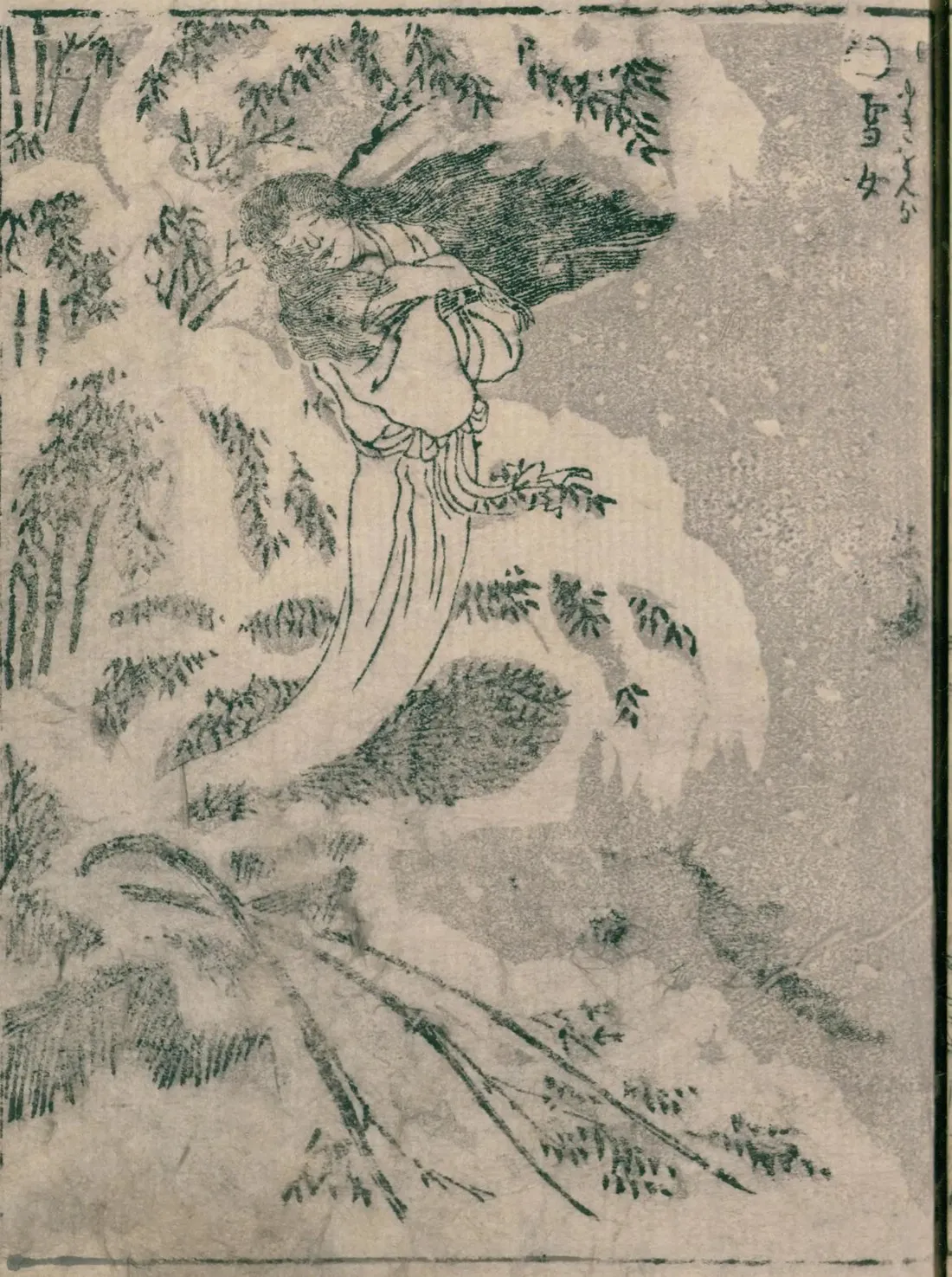
The plate 雪女 in Toriyama Sekien, 百鬼夜行 (Hyakki yagyō), printing of 1805, cropped. National Diet Library Digital Collections, call number 辰-23, public domain (PDM).
Makino reports that no text like Hearn’s has turned up from before his time.8
What we could not verify
Sources we have not seen
- Aoki Junji, Yama no densetsu (1930), the book Tōda and Makino name as the first to print Hearn’s story as a Japanese tale. It would show whether Aoki gave any source. The National Diet Library’s copy cannot be viewed online.
- The 2002 book on the snow woman that the Edo-Tokyo Museum bulletin cites for the farmer Sōhachi. It would show what the claim rests on. We found no online copy.
Seen only where others quote them
- Tōda’s book of 2011, and the 2023 book described by its publisher and a newspaper column. We read them only as Makino quotes them and as the blurb and column describe them. Both are in copyright and we found no open copy; Tōda’s articles on the subject in the journal Kindai have no open text we could find.
- Hearn’s letter to Chamberlain of 1893 and the notebook with the snow-woman verses, known only through Makino 1989. They would show his own words and what he sketched. We found no open scan.
- Konno Enpo (1981), Komatsu Kazuhiko (2009) and Ōsawa Takayuki (2005), as Makino quotes them. Each is in copyright and we found no open copy.
Questions we could not settle
- Whether any text before Kwaidan carries Hearn’s plot, and who the Chōfu farmer was.
- Whether the Sekien plate is in the first printing of the Hyakki yagyō, and where the 1685 tale in volume 5 differs from Makino’s summary.
Read next
TaleYotsuya, Edo (now Shinjuku, Tokyo), Japan, 1727 to 1952
Oiwa of Yotsuya was divorced in the old text and drugged on the stage
TaleMiyoshi, Hiroshima, Japan, 1749 to 1859
The Inō mononoke roku: where the demon king's mallet came from
CaseShimoda, Izu, Japan, 1884 to 1891
Kokkuri-san came ashore at Shimoda, or so Inoue Enryō heard
Sources
- Hearn, Kwaidan (1904), Project Gutenberg #1210, "Yuki-Onna": the woman in the hut ("I intended to treat you like the other man"), O-Yuki on the road, the ten children, and the reveal ("It was I—I—I! Yuki it was!") to "Never again was she seen" (primary)
- 行吉正一, 田中実穂, 東京都江戸東京博物館紀要 8 (2018), pp. 4 to 5, section 2(1)(イ): plot summary of 「雪おんな」 from the woodcutters to the disappearance through the smoke-hole↑
- Waseda University Library, Kotenseki sōgō database, 宗祇諸國物語 (call number ヘ13 01653), Catalogue record: 巻之1-5, 八幡町通 (京師) 坂上勝兵衛, 貞享2 [1685], 仮名草子
- Makino 2013, note 1 (p. 96, PDF p. 23): 宗祇法師 (一四二一―一五〇二) の『宗祇諸国物語』(一六八五)↑
- Makino 2013, note 1 (p. 96, PDF p. 23)↑
- Makino 2013, pp. 108 to 107 (PDF pp. 11 to 12), citing Tōda, 『〈転生〉する物語』(新曜社, 2011), pp. 22 and 28↑
- Makino 2013, p. 107 (PDF p. 12) and pp. 105 to 104 (PDF pp. 14 to 15)↑
- Makino 2013, p. 114 (PDF p. 5): ハーンの作品が元になって、松谷みよ子らの民話になった、という結論に異論があるのではない; p. 115 (PDF p. 4) on her earlier article↑
- Makino 2013, pp. 113 to 109 (PDF pp. 6 to 10)↑
- Makino 2013, p. 116 (PDF p. 3): ハーンの時代以前まで遡ろうとすると、それらしき話はみつからない ... 『北越雪譜』などに雪女伝説の言及は見当たらない↑
- Hearn, Kwaidan (1904), Project Gutenberg #1210, Introduction, paragraph beginning "Most of the following Kwaidan": "One queer tale, 'Yuki-Onna,' was told me by a farmer of Chōfu, Nishitama-gōri, in Musashi province, as a legend of his native village. Whether it has ever been written in Japanese I do not know" (primary)
- Makino Yōko (牧野陽子), 「ラフカディオ・ハーン『雪女』について」, 成城大學經濟研究 105 (1989), p. 96 (PDF p. 8): the introduction's sentence quoted in Japanese, and the remark that the legend the farmer told survives in no printed form
- Makino Yōko (牧野陽子), 「「雪女」の“伝承”をめぐって:口碑と文学作品」, 成城大學經濟研究 201 (2013), p. 116 (PDF p. 3): Hearn writes in the preface to Kwaidan that he heard the snow-woman legend from a farmer who came and went at his house↑
- Hearn, Kwaidan: Stories and Studies of Strange Things (Boston and New York, Houghton, Mifflin, 1904), Project Gutenberg #1210, Introduction, last lines, signed "L. H.": "TŌKYŌ, JAPAN, January 20th, 1904" (primary)
- 行吉正一, 田中実穂, 「えどはくカルチャー「多摩文学歴史散歩(全3回)」の記録」, 東京都江戸東京博物館紀要 8 (2018), p. 4, section 2(1)(イ): Kwaidan published by Houghton Mifflin, Boston and New York, 1904, about half a year before Hearn's death↑
- Makino 2013, p. 105 (PDF p. 14), citing 小松和彦編『図解雑学 日本の妖怪』(ナツメ社, 2009), p. 114↑
- Akita Sakigake Shimpō, column 北斗星, 29 January 2026, paragraph 3↑
- Genkishobō, book page for 遠田勝『「雪女」、百年の伝承』, blurb, quoting the book (本文より)↑
- Makino 2013, pp. 109 to 108 (PDF pp. 10 to 11)↑
- Makino 2013, p. 102 (PDF p. 17)↑
- Makino 2013, p. 116 (PDF p. 3), citing 今野圓輔『日本怪談集(妖怪編)』(社会思想社, 1981)↑
- Makino 2013, p. 114 (PDF p. 5)↑
- Makino 2013, pp. 94 to 93 (PDF pp. 25 to 26)↑
- Yanagita Kunio, 遠野物語, Aozora Bunko transcription of the Kadokawa bunko edition (1955), §103 (一〇三): 小正月の夜、または小正月ならずとも冬の満月の夜は、雪女が出でて遊ぶともいふ ... 雪女を見たりといふ者は少なし (primary)
- Makino 2013, p. 116 (PDF p. 3) and note 1 (p. 96): the Tōno monogatari snow woman tells children to go home on winter full-moon nights; p. 115 (PDF p. 4): the book was published after Hearn's death↑
- Makino 2013, p. 110 (PDF p. 9) and note 11 (p. 95): 序は作品の一部であるので、フィクションの可能性がないとは言えない↑
- 行吉正一, 田中実穂, 東京都江戸東京博物館紀要 8 (2018), p. 2 (lecture 5 November 2010, walk 12 November 2010); p. 5, section 2(1)(ウ), with note 4 on p. 44: 昭和レトロ商品博物館編著『雪おんな』(クレイン, 2002)↑
- 行吉正一, 田中実穂, 東京都江戸東京博物館紀要 8 (2018), p. 5, section 2(1)(ウ) and p. 10, section 2(1)(③) d: the monument 「雪おんな縁の地」 at Chōfu bridge, Chigase-chō 5-chōme↑
- Hearn, Glimpses of Unfamiliar Japan: Second Series, Project Gutenberg #8133, Chapter Ten, "Of Ghosts and Goblins", Sec. 1: the exchange from "'O Kinjuro, is there a God of Snow?'" to "It is a lonesome face" (primary)
- Makino 1989, pp. 97 to 98 (PDF pp. 9 to 10): Hearn first heard of the snow woman in Matsue from Kinjuro, in "Of Ghosts and Goblins"; this Yuki-onna is only snow made into a figure, with no story
- 行吉正一, 田中実穂, 東京都江戸東京博物館紀要 8 (2018), p. 4, section 2(1)(ア): 『知られざる日本の面影』(Glimpses of Unfamiliar Japan, 1894)↑
- Hearn, Glimpses of Unfamiliar Japan: Second Series, Project Gutenberg #8133, Notes for Chapter Ten, note 1 (primary)↑
- Makino 1989, pp. 98 to 99 (PDF pp. 10 to 11), quoting the letter in Japanese translation; we did not see the letter itself↑
- Makino 1989, p. 99 (PDF p. 11)↑
- 宗祇諸國物語 vol. 5, Waseda University Library copy ヘ13 01653 (our reading of the page images), PDF spreads 89 to 90: (heading, 明て此事を人に語りければ, the word 雪女, 深雪の時にこそ出べけれ); partial reading (primary) transcription
- Makino 2013, note 1 (p. 96, PDF p. 23): Sōgi in Echigo sees a pale woman in a white single robe at dawn and is told afterwards that she is a snow spirit, commonly called 雪女↑
- National Diet Library, Digital Collections, 百鬼夜行 3巻拾遺3巻 [1] (鳥山石燕 画, 長野屋勘吉, 文化2 [1805]), call number 辰-23, Record: Access Restrictions PDM; frame 25 (R0000025)
- Same copy, page image (our reading), frame 25, left page: label ゆきおんな, 雪女 (primary)↑
Documents quoted
- Sōgi shokoku monogatari, vol. 5 (1685): the snow-woman tale, heading and three lines (transcribed from the page image)