 Twice Told
Oiwa of Yotsuya was divorced in the old text and drugged on the stage
Shinjuku City says the real Oiwa and her husband got on well. The old Yotsuya text has him divorce her, and Nanboku's 1825 play has a drug ruin her face.
Contents
Published 15 Oct 2026. Sources checked 15 Oct 2026.
Shinjuku City’s page for the Tamiya shrine says that the real Oiwa and her husband were a contented couple, and that the play about her came two hundred years later.3 That is not the Oiwa of the stage. The play, Tsuruya Nanboku IV’s Tōkaidō Yotsuya kaidan, opened at the Nakamuraza in 1825, and Saitō Takashi says Nanboku made it by adapting an older documentary novel, the Yotsuya zōdan.67 In the novel it is the husband who arranges to be rid of her.1
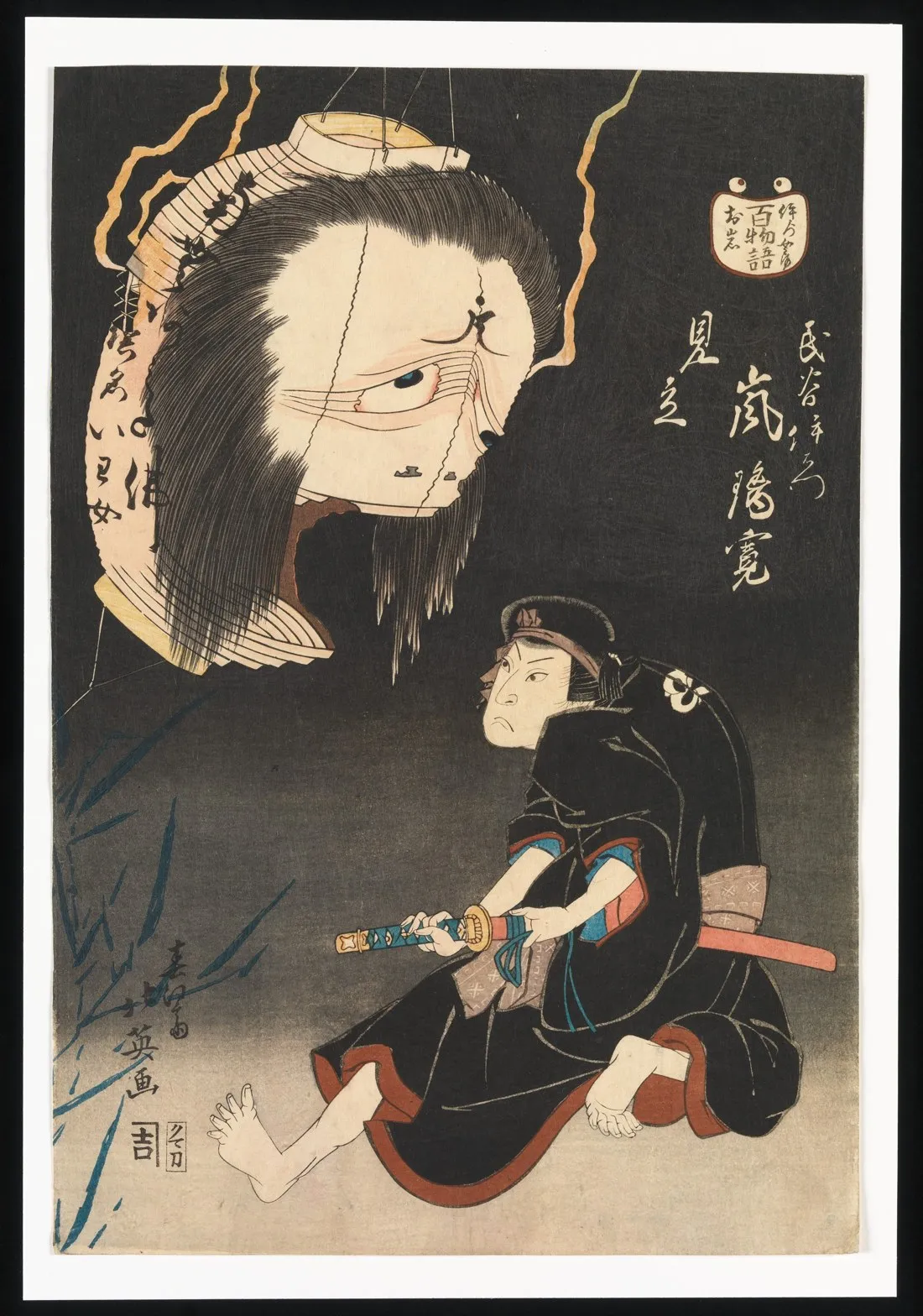
Shunbaisai Hokuei, the actor Arashi Rikan II as Iemon facing Oiwa’s face on a broken lantern, colour woodblock print, 1832. The Metropolitan Museum of Art, Purchase, Friends of Asian Art Gifts, in honor of James C. Y. Watt, 2011, 2011.135, public domain (CC0).
This is the story as the play tells it in a printed text of 1922, with the rest of the plot filled in from Japanese summaries of it today.89
Tamiya Iemon is a masterless samurai, married to Oiwa.9 He is unfaithful to her.9 Itō Kihei offers him his daughter Oume, with his stipend.10
Iemon says that by family and looks he would accept at once, but he cannot leave Oiwa until he has avenged her father, Yotsuya Samon, who was killed by someone nobody can name.108 Kihei answers that the medicine he sent Oiwa, which he called a remedy for women’s complaints, was a lie.2 It was a drug that deforms a person within a day, and Oiwa’s face has changed; he gave it to grant his daughter’s wish.2 Iemon consents, and Oume is pushed to sit beside him.810
Oiwa, as she was before, puts her child to sleep and drinks the medicine; a bell tolls.11 She is poisoned, or goes mad and is gone, and the people around Iemon begin to die.9
The old text’s bride nobody wanted
The text we could read is a printing in the Waseda series Kinsei jitsuroku zensho. Saitō counts it among the editions of the Yotsuya zōdan, which he says was published underground, most likely first in 1727, and he reports a surviving manuscript with a colophon of Kyōhō 12 (1727).1213 We have not seen a manuscript, so what follows is what the printing says, not what the 1727 text says.
It opens by naming three men of Yotsuya, the yoriki Itō Kihei and the dōshin Tamiya Iemon and Akiyama Chōemon.14 Saitō says the story came out of a scandal that ended those three real households.13
人の報いに依て其家永く絶えたる譚話あり14
“a tale of how their houses ended for good through what others did to them”
Oiwa is the only daughter of the dōshin Tamiya Matazaemon. Nobody will marry her because of her temper, and at 21 smallpox leaves her face drawn tight, her hair white and her back bent.15 A matchmaker called Matai’chi finds a rōnin from Settsu, and the wedding is arranged before the couple have met.16 Iemon falls for Hana, the elder of Kihei’s two concubines.17 Saitō’s summary of the 1884 edition adds the plan that follows: Iemon plays the gambler and the debauchee, beats Oiwa and sells her things, so that she herself asks to end the marriage and goes into service elsewhere.1 The Waseda printing agrees that a letter of release is taken and her clothes are returned, and it has Iemon become Kihei’s son-in-law by marrying Hana.1
In this version Oiwa never clearly dies. Saitō says that on learning of the plot she rages, vows revenge and disappears.18 He lists the victims of her curse as seven on Iemon’s side, three on Kihei’s and five on Chōemon’s, which we sum to 15.19
What the stage changed
The play keeps the cast and changes the reasons. The table sets the two texts side by side; the play column comes from Act 2 only, which is all of the play we read.
| Yotsuya text | Play, Act 2 | |
|---|---|---|
| Family name | 田宮20 | 民谷20 |
| The other woman | Hana, Kihei’s concubine17 | Oume, Kihei’s daughter2 |
| Iemon’s line | Plays the wastrel to drive her out1 | Her father must be avenged first8 |
| What ruins her | Smallpox, before the wedding15 | A drug from Kihei2 |
| What happens to her | Goes into service1 | Drinks the medicine11 |
The new villain is the drug, and Kihei confesses it in his own words.
血の道の薬とは嘘言、誠は一日のうちに異形の姿と變る秘薬でござる2
“The medicine for women’s complaints was a lie; in truth it is a secret drug that turns a person into a deformed shape within a day.”
The Edo-Tokyo Museum’s record of a reproduced Nakamuraza programme names Kanadehon Chūshingura and Tōkaidō Yotsuya kaidan together in its title, but does not say they were played on one bill.21
Ryūō’s chaste wife
By 1896 the storyteller Shunkintei Ryūō had made Oiwa the opposite of the old text’s bride nobody would marry. In his book she is plain but a model of chastity, who endures Iemon’s beatings and sells her own clothes for him.22 The postscript, by Tada Seiken, calls her a wise woman of chastity and loyalty, and says that people who wrote about the Yotsuya Inari had met its divine anger.23 We know this book only through Saitō, who quotes it.
The report of 1827
In the tenth month of 1827 two men of Yotsuya Tenma-chō, Magoemon and Mohachirō, signed a report on the origin of the Oiwa Inari. It sits as an appendix in the National Diet Library’s manuscript copy of the Yotsuya ward reports.24 We read its title, its close and a handful of lines; the middle is a running hand that we could follow only in names, dates and a few words.
The report sets the Tamiya household in the Jōkyō years, 1684 to 1688, and names the year 1687.5 The words for divorce, 離別 and 離縁状, occur in its account of the house.25 It says that after memorial rites at the temple the curses and the strange events stopped of themselves, and that in the eighth month of 1825, the month after the play’s first performance, a Buddhist name was arranged through Myōgyōji: Tokushōin Myōnen Nisshō daishi.266 A later entry in the same report records a lane the locals call Oni-yokochō, “demon lane”, because Oiwa, turned into a demon-woman, ran along it.27
That is as far as we can set the report beside the account the city and the ward give for the shrine. They both say that Oiwa and her adopted husband rebuilt the Tamiya house together.28 We could not read the sentences that join the report’s divorce words to its story, so we cannot say what the report claims happened between them.
Two shrines, one grave
Two places in Samon-chō are called Oiwa Inari: the Tamiya shrine at number 17 and the Nichiren temple Yōunji at number 18.29 The city says the Inari was a household shrine in the compound of a Sakite-gumi dōshin family, worshipped by Oiwa, daughter of the first Tamiya Matazaemon; the city gives her death as 1636.28 The shrine’s Yotsuya buildings burned in 1879, it moved to what is now Shinkawa in Chuo ward, and a shrine went up again at Yotsuya in 1952.30
Actors went to the Shinkawa shrine. Chuo City quotes a guide of 1900 saying actors and geisha visited in large numbers, and says the actor Ichikawa Udanji IV gave the Shinkawa shrine a stone for the hundred-fold prayer in 1914, to mark his Osaka run of the play.3132
Yōunji tells its own story. It says it was founded in the early Showa years by Nichiken and keeps a wooden statue of Oiwa, and that people connected with kabuki always come to pray there when a run opens.33 Its head priest says the temple’s records give her death as the 22nd of the second month of Kan’ei 13, at 36, and that she worked to rebuild the failing Tamiya house and served her husband.4
Her grave is at Myōgyōji, a temple of the Hokke sect that once stood in Yotsuya and now stands at Nishi-Sugamo.34 Saitō reports that it moved in 1909, and that Ryūō says he rebuilt the grave in 1868.35
What we could not verify
Sources we have not seen
- The manuscripts of the Yotsuya zōdanshū, including the one said to carry the 1727 colophon, would show whether the Waseda printing keeps the old text; we found no digitised copy in the NDL, Waseda or Kokubunken catalogues on 15 October 2026.
- The Tamiya shrine’s own booklet, 田宮神社由来記, is quoted in Shinjuku’s 1992 folklore volume, which the NDL lets only registered users read online.
Seen only where others quote them
- The 1884 edition of the Yotsuya zōdan and Ryūō’s 1896 book are known to us only through Saitō’s summaries and quotations.
Questions we could not settle
- Which years the Tamiya story describes: 1636 in Yōunji’s records, the 1680s in the 1827 report, 1727 for the oldest manuscript.
- What the middle of the 1827 report says about Oiwa, the other houses and the shrine’s land.
- What the Tamiya family itself publishes about her; we found only what the city, the ward and the temples say for it.
Read next
TaleMusashi (now Tokyo), Japan, 1685 to 1993
Yuki-onna, the snow woman of Kwaidan, 1904
TaleMiyoshi, Hiroshima, Japan, 1749 to 1859
The Inō mononoke roku: where the demon king's mallet came from
CaseShimoda, Izu, Japan, 1884 to 1891
Kokkuri-san came ashore at Shimoda, or so Inoue Enryō heard
Sources
- 近世実録全書 第4巻 (1918), 四谷怪談, printed p. 16 (NDL frame 136 right) to p. 17 (left): the plan to have a letter of release taken; 女房に暇の状を取らせ衣類夜の物残らず返しけり; the guarantor 紙賣又兵衞; the heading 喜兵衛伊右衛門を聟にする事 并 秋山長右衛門を媒人に頼む事 (primary) transcription
- Saitō 2019, 研究所報 29, pp. 23 to 24: Iemon's circle plans to drive Oiwa out; p. 24, 伊右衛門は博奕と女に狂った振りをしてお岩を散々に打擲し衣類その他一切を持ち出して売り払ったため、計画通りお岩の方から縁切りを申し出て他家に奉公に出た; Iemon then marries Hana↑
- 脚本集 下 (1922), いろは仮名四谷怪談, printed p. 222 (NDL frame 116, right page; the next lines of Kihei's speech: お岩様、顔が變つた上からは; p. 223, frame 116 left page: お梅「父様母さんお許しなされませ」): 最前持て遣はしたは、血の道の薬とは嘘言、誠は一日のうちに異形の姿と變る秘薬でござる; the line 娘が願ひを叶へんと、罪なき人に秘薬を盛り (primary) transcription↑
- Shinjuku City, 温故知しん!じゅく散歩, 於岩稲荷田宮神社, 概要: 戯曲は実在の人物からは200年後の作品で、お岩夫妻も怪談話とは大きく異なり円満であった↑
- Nichiren Shu, 日蓮聖人降誕800年 特設ウェブサイト, 歌舞伎と日蓮宗 ~東海道四谷怪談~, Section 〇お岩さまや歌舞伎、怪談の裏話: 寺の記録にはお岩様は ... 寛永十三年二月二十二日 三十六歳でこの世を去っています; 実際には、つぶれかけていた田宮家を苦労して復興させ、夫に尽くした心優しい女性だったと伝えられています↑
- 町方書上 [66] 四谷町方書上 附録 全, NDL, frame 40 right page, third column: 榊原采女様御組ニ罷成 ... 貞享年中 同組同心田宮又左衛門; frame 44 right page, second column: 貞享四丁 (卯); readings partly uncertain, see (primary) transcription↑
- Kabuki-za, 歌舞伎美人, 今日のことば 「東海道四谷怪談」, Entry text, second paragraph: 『東海道四谷怪談』(初演は同じく文政8年7月中村座)
- Edo-Tokyo Museum Digital Archives, collection ID 14000938, Title: 中村座絵本番付(複製)仮名手本忠臣蔵・東海道四谷怪談-文政8年7月
- Yōunji (陽運寺), 陽運寺について, 由来の事, 江戸時代、文政八年七月、歌舞伎作者 四世鶴屋南北作「東海道四谷怪談」が世に広まり
- Saitō 2018, Bulletin 42, p. 25: Nanboku's Tōkaidō Yotsuya kaidan premiered in 1825↑
- Saitō Takashi, O-Iwa's Curse, Bulletin 42 (2018), author named on the first page as Saitō Takashi, Nanzan Institute for Religion and Culture, p. 26, second paragraph: "About one hundred years later, Tsuruya Nanboku IV ... created a theatrical performance in adapting the documentary novel for the kabuki stage"↑
- 脚本集 下 (1922), いろは仮名四谷怪談, printed p. 221 (NDL frame 115, left page), columns 1 to 3: お岩が舅四谷左門、先達て何者とも知れず手にかけたる故 ... この敵を討つ迄は、お岩と不縁にはなり難し; p. 223 (frame 116, left page): 民谷伊右衛門承知致した (primary) transcription↑
- Nichiren Shu, 日蓮聖人降誕800年 特設ウェブサイト, 歌舞伎と日蓮宗, Section 大まかなあらすじ: 田宮家に婿養子に来た伊右衛門が、別の女性とも関係を持ち ... お岩が発狂し失踪、又は殺された後、様々な怪奇現象が起こり、伊右衛門の関係者が次々と非業の最後をむかえてしまう
- Shinjuku Tourism Promotion Association, 田宮稲荷神社跡 四谷怪談の旧地, Paragraph 2: 浪人・伊右衛門が不義をしたうえにお岩を毒殺し、その亡霊に報復されるという話↑
- 脚本集 下 (1922), いろは仮名四谷怪談, p. 221 (NDL frame 115, left page): 伊右「...そりや隨分家柄とこひ娘御の御器量、直に承引致す所なれども」, 喜兵衛「...拙者が知行を譲り」; p. 223 (frame 116, left page): ト娘を無理に伊右衛門の傍へ推遣る (primary) transcription↑
- 脚本集 下 (1922), いろは仮名四谷怪談, printed p. 223 (NDL frame 116, left page), last columns: お岩以前の形にて子を寐さして薬を呑んでゐる見得、時の鐘、凄き合方にて道具とまる (primary) transcription↑
- Saitō 2018, Bulletin 42, p. 25, section "Three Literary Forms of the Yotsuya kaidan", second paragraph↑
- Saitō 2019, 研究所報 29, p. 21, left column, the paragraph beginning 実在する田宮・伊藤・秋山の三家が and note 6↑
- 近世実録全書 第4巻 (1918), 四谷怪談, printed p. 1 (NDL frame 128), first column: 爰に御先手組與力伊藤喜兵衞、同心田宮伊右衞門、秋山長右衞門等三人の者ども、人の報いに依て其家永く絶えたる譚話あり (primary) transcription
- Saitō 2019, 研究所報 29, p. 23, right column: the 1884 edition's opening says the story concerns the extinction of the three households Tamiya, Itō and Akiyama of the yoriki and dōshin of Yotsuya Samon-chō↑
- 近世実録全書 第4巻 (1918), 四谷怪談, printed p. 1 (NDL frame 128), columns 2 to 9 (primary) transcription
- Saitō 2019, 研究所報 29, p. 23, right column: the only daughter of the dōshin Tamiya had neither looks nor character and no man came to marry her↑
- 近世実録全書 第4巻 (1918), 四谷怪談, printed p. 4 (NDL frame 130, right page): 伊右衛門生國は攝州にて年三十一なる華車男なり ... 八月十四日は吉日なればとて聟入りに極まりぬ; p. 4 last columns: Iemon first sees her on the wedding evening (primary)
- Saitō 2019, 研究所報 29, p. 23, right column: 又市という男に婿探しをさせ ... お岩に会わせないまま婚礼の手はずを整え↑
- 近世実録全書 第4巻 (1918), 四谷怪談, printed p. 5 (NDL frame 130, left page): the heading 伊藤喜兵衛庭前の花見の會の事 并 喜兵衛が妾を伊右衛門思ひ初る事, then the two concubines Ume (18) and Hana (20) and Iemon's love for Hana (primary)
- Saitō 2019, 研究所報 29, pp. 23 to 24: Iemon, favoured by the yoriki Itō Kihei, comes to love his concubine Hana↑
- Saitō 2019, 研究所報 29, p. 23, left column: 彼女は怒り狂い、復讐を誓って失踪するのみである ... お岩の死は明確に語られているわけではない↑
- Saitō 2019, 研究所報 29, pp. 24 to 25: the three lists headed 伊右衛門方(七人), 喜兵衛方(三人), 長右衛門方(五人)↑
- 脚本集 下 (1922), いろは仮名四谷怪談, printed p. 223 (NDL frame 116, left page): 民谷伊右衛門承知致した (primary)
- 近世実録全書 第4巻 (1918), 四谷怪談, printed p. 1 (NDL frame 128): 同心田宮伊右衞門 (primary)↑
- Edo-Tokyo Museum Digital Archives, collection ID 14000938, Title and English title; creation date 昭和32年 1957 (reproduction, 原資料 沢村屋利兵衛 版)↑
- Saitō 2019, 研究所報 29, p. 25, right column, section 柳桜口演における崇りの発動: 口演速記『四谷怪談』のお岩は器量は良くないが貞女の鑑として設定されており↑
- Saitō 2019, 研究所報 29, pp. 21 to 22: the block quotation of the postscript (note 8: 省軒「四谷怪談」『四谷怪談』1896, 1 (173)) and the paragraph after it↑
- 町方書上 [66] 四谷町方書上 附録 全, NDL (call number 803-1 on the shelf label), pid 2571547, frame 36 (title leaf 於岩稲荷來由書上), frame 48 left page (文政十丁亥年十月 and the two signatures) (primary) transcription↑
- 町方書上 [66] 四谷町方書上 附録 全, NDL, frames 42 to 44: 離別可致与追々勧メ (42 right), 離縁 (43 right), 離縁状 (43 left); the connecting sentences were not read (primary)↑
- 町方書上 [66] 四谷町方書上 附録 全, NDL, frame 47 right page, columns 1 to 2: 同寺ニおゐて追善仏事懇ニ経営致し、其後自然ト祟り [?] 奇怪も相止; frame 47 left page, columns 3 to 5: 文政八乙酉年八月中 ... 妙行寺へ相頼 ... 得證院妙念日正大姉ト称シ; the first line of frame 48 reads 同寺過去帳ニ記…; readings partly uncertain, see (primary) transcription↑
- 町方書上 [66] 四谷町方書上 附録 全, NDL, frame 48 right page: 一 里俗鬼横町 ... 右者お岩鬼女の如くなりて此横町を走り ... 里俗唱来り候 (primary)↑
- Shinjuku City, 温故知しん!じゅく散歩, 於岩稲荷田宮神社, 概要: 初代田宮又左衛門の娘お岩(寛永13年没)が信仰し、養子伊右衛門とともに家勢を再興したことから「お岩さんの稲荷」として次第に人々の信仰を集めた
- Chuo City, 於岩稲荷田宮神社の鳥居, Fourth paragraph: 婿養子の伊右衛門とともに家勢を再興したお岩の徳を称えた稲荷社として古くから信仰を集めてきました
- Shinjuku Tourism Promotion Association, 田宮稲荷神社跡 四谷怪談の旧地, Paragraph 2: 幕府の御家人・田宮又左衛門の娘お岩は、養子伊左衛門の貞淑な妻で、代々家に伝わる稲荷を信仰していました↑
- Shinjuku City, 温故知しん!じゅく散歩, 於岩稲荷田宮神社, 所在地: 新宿区左門町17番地
- Yōunji, 陽運寺について, Footer: 〒160-0017 新宿区左門町18番地; 当寺は ... 「於岩稲荷(おいわいなり)」とも呼ばれています
- Saitō 2019, 研究所報 29, p. 23, note 11: ①四谷於岩稲荷田宮神社 (新宿区左門町17) and ②於岩稲荷陽運寺 (新宿区左門町18), a Nichiren temple founded in early Showa↑
- Shinjuku City, 温故知しん!じゅく散歩, 於岩稲荷田宮神社, 概要: 稲荷社は明治12年(1879)に火事で焼失し ... 現在の中央区新川に移転 ... 昭和27年(1952)に四谷の旧地にも神社を再建
- Chuo City, 於岩稲荷田宮神社の鳥居, Fourth paragraph: 明治12年(1879)の火災で焼失したことを契機に京橋区越前堀一丁目(現在地)へと遷座しました(戦後〈昭和27年〉、四谷の旧地にも再建)↑
- Chuo City, 於岩稲荷田宮神社の鳥居, Fifth paragraph, quoting 『新撰東京名所図会』: 俳優、芸妓の参詣夥多敷↑
- Chuo City, 於岩稲荷田宮神社の百度石, Paragraphs 3 to 5: 大正3年(1914)10月に奉納 ... 大阪浪花座興行記念 四代目市川右団次↑
- Yōunji, 陽運寺について, 陽運寺の縁起 (founding), 陽運寺とお岩様: 本堂にはお岩様の木像が安置されており ... 歌舞伎興行の際には安全と成功を願って役者等関係者が必ず参拝に訪れます↑
- Saitō 2019, 研究所報 29, p. 23, note 11: ④妙行寺 (豊島区西巣鴨 4-8-28), 法華宗陣門流, with a stone in front reading お岩様之寺妙行寺 and the grave inside; moved from Yotsuya
- Nichiren Shu, 日蓮聖人降誕800年 特設ウェブサイト, 歌舞伎と日蓮宗, Section 〇現在のお岩様: お岩様のお墓は巣鴨の妙行寺という法華宗のお寺にあります。妙行寺は当時、四谷にありましたが、後に巣鴨に移転されました↑
- Saitō 2019, 研究所報 29, p. 23, note 11, last sentences: 慶応4年(1868年)に建てたと柳桜本人が言っているが、四谷鮫ヶ橋南町から明治42年(1909年)に移転したとされる↑
Documents quoted
- Iroha-gana Yotsuya kaidan in Kyakuhon kessakushū, second volume (1922): Act 2, Iemon's house (transcribed from the page image)
- Oiwa Inari raiyu kakiage (1827), in Machikata kakiage, Yotsuya appendix: the title, the date of the rite, the lane and the signatures (transcribed from the page image)
- Yotsuya kaidan in Kinsei jitsuroku zensho vol. 4 (1918): the opening, the matchmaker and the letter of release (transcribed from the page image)