 Twice Told
How Xu Fu got to Japan
The Shiji sends Xu Fu to sea for the First Emperor and names no landing. The first text we found that puts him in Japan is a monk's book of the 950s.
Contents
Published 16 Oct 2026. Sources checked 15 Oct 2026.
A tomb of Xu Fu stands at Shingu, on the Kumano coast, under a marker that reads 秦徐福之墓, “tomb of Xu Fu of Qin”.7 The marker is dated 1736.7 Its inscription is credited to the Confucian Yi Maegye, who lived from 1617 to 1682, at the order of Tokugawa Yorinobu, the first lord of Kishu, who died in 1671.7 By our count, both men had been dead for more than fifty years when the stone was dated.7 The Shiji sends Xu Fu over the sea and does not say where he went.81
This is the Kumano telling as Edo writers set it down: Takizawa Bakin in 1820 and Satō Narihiro in 1826, with a detail from Momoi Tōu.91011
Xu Fu came looking for the medicine of immortality and settled at Kumano.9 A shrine of his stood on Hōrai hill, southeast of Shingu.9 His grave lay at Shingu, under a stone cut with the words “tomb of Xu Fu of Qin”.10 At Kumano he taught paper-making.11 Every April the villagers planted rice in the fields around the grave and sang the Xu Fu song.10 People came from far and near to bow at the grave, and their malaria cleared.10
Twenty places claimed him
By the Edo period more than twenty places along the coasts of Honshu, Kyushu and Shikoku claimed a Xu Fu site.3 Wu Weiming, who has surveyed the writing of the Tokugawa age, says the Kumano telling stayed the most widely told of them, and that the relics piled up there: a tomb of seven retainers, Xu Fu paper, a Xu Fu dance, a saddle and an old stone wall.12
Xu Fu paper has a story attached. A monk of the Enshin temple at Nachi-Katsuura told Momoi Tōu that Xu Fu had lived at Kumano and taught paper-making, and that a village or two nearby still made it.11 Wu notes that paper appeared only under the Eastern Han, long after Xu Fu’s time.11
At Saga the claim rests on a picture of the origin of the Kinryū shrine, dated 1648, which shows his landing.13 The shrine’s account makes Xu Fu the First Emperor’s third son.14 The Hizen koseki engi of 1665 calls him taishi, “prince”, and has him set a cup afloat at the landing place, which gave the place its name, Bubai, “floating cup”.15 Hua Xuemei, who traced Saga’s place names, objects and records, concludes that the telling spread among ordinary people in the Edo period.16
The official histories of the age took him in. The Honchō tsūgan of Hayashi Razan and his son Gahō says under Emperor Kōrei, “in the seventy-second year, Xu Fu of Qin came”, and the Mito Dai Nihonshi has the First Emperor sending the books of the Five Emperors and Three Kings to the Japanese emperor.17 Not everyone agreed. Arai Hakuseki wrote in 1716 that Yizhou did not mean Japan and that Xu Fu was not the first immigrant from China.18 Takizawa Bakin, in 1820, said the standard histories do not record Xu Fu at Kumano, but that the story comes from old custom and cannot be denied, and he guessed that the herb Xu Fu sought was Kumano’s wild ginseng.9
The stone at Shingu has its own puzzle. The city’s page dates the marker to 1736, and the Kumano tourism page says Yorinobu planned the tomb and that it was put up at its present site about a hundred years later.7 Shimada Masao placed the founding of the tomb in the late Muromachi period.19 No source we read says whether the stone of 1736 replaced an older one carrying the same words.
Later claims went further. The Miyashita documents of Fujiyoshida, made public in 1883 and tied to Xu Fu, are held by most scholars to be a forgery.20 In 1950 Wei Tingsheng argued that Emperor Jimmu was Xu Fu himself, and Japanese scholars led by Ienaga Saburō questioned it.21
A chronicle that leaves him out
The earliest Japanese-written text we could open that names Xu Fu is a poem, and it was written in China.22 In 1376 the Zen monk Zekkai Chūshin was received by the Hongwu emperor of the Ming, and on the emperor’s order wrote a poem on the “three mountains” that opens with a Xu Fu shrine in front of the peak at Kumano.22 Wu reports older Kumano poems, by the monk Mugaku Sogen and the Yuan poet Wu Lai, and dates a first mention of a Xu Fu shrine at Kumano to a text of 1075.2324 We have seen none of them.
The other early Japanese text is a chronicle, the Jinnō shōtōki, written in 1339 by Kitabatake Chikafusa.25 Its passage under Emperor Kōrei brings in the First Emperor of Qin and does not name Xu Fu.26
この始皇、仙方を好みて、長生不死の藥を日本に求む。日本より五帝三王の遺書をかの國に求めしに、始皇悉くこれを送る。26
This First Emperor loved the arts of the immortals and sought an elixir of long life and immortality from Japan. Japan asked that country for the surviving books of the Five Emperors and the Three Kings, and the First Emperor sent every one of them.
Thirty-five years later, the chronicle says, China burned its books and buried its Confucians, so Confucius’s complete classics stayed in Japan.26 Chikafusa adds that this is recorded in the books of a foreign court, and admits that nobody has heard of writing in Japan as early as Kōrei’s time, though high antiquity may simply not have been recorded with care.27 There is no Xu Fu in any of it.26
A poem about a sword
A Song poem on a Japanese sword makes Xu Fu the ancestor of the Japanese.28 It says Japan lies on a large island, that Xu Fu deceived the Qin people, went to gather herbs and lingered until the boys he took grew old, that craftsmen and the five grains came with him so that Japan’s craftwork is still fine, and that he left before the books were burned, so that lost books survive there.28 Jin, following Zhu Dongrun, says it was probably composed in 1058.29
Whose poem it is has been disputed for centuries. It stands in the supplementary collection of Ouyang Xiu and in the collected writings of Sima Guang.30 Jin Chengyu argues for Sima Guang. The poem is in the collection Sima Guang compiled himself, while Ouyang’s supplementary collection was compiled by later hands, and scholars have long said it contains forgeries.31 Jin says the first to state it clearly was a Japanese scholar, Kusaka Hiroshi, in an essay of 1883, and that Yang Shoujing, who was in Japan collecting books at the time, took the view over.32 A Northern Song anecdote already has a courtier quoting the lines as Ouyang’s, to answer a minister who asked whether Korea held a hundred chapters of the Shangshu.33
The lines about the books outlived any proof of them. A Joseon envoy asked Hayashi Razan to let him see the pre-Qin books Xu Fu was said to have taken; Jin says it is not known how Razan answered.34 In 1711 Arai Hakuseki told another envoy that lost books survived at Atsuta and Izumo.35 When the envoy asked to borrow them, Hakuseki declined because sacred books could not be shown, and Wu, following Iki Ichirō, says they had probably burned in a fire and were likely forgeries.35 Amenomori Hōshū, in a conversation the Joseon envoy Sin Yu-han reported from his journey of 1719, called Ouyang Xiu’s claim completely unreasonable.36 Hayashi Kō named a collection of rare surviving books, the Isson sōsho of 1799, after the poem, while writing in its preface that he did not know the evidence for the hundred chapters.37
The poem has Xu Fu carry the books to Japan. The chronicle of 1339 has the First Emperor send them to Japan on request.2826 Jin says nothing confirms a direct link between the two, though by Chikafusa’s time Japanese writers already believed the classics were kept in Japan.38
A monk’s book of the 950s
The Yichu liutie is a Buddhist reference book compiled by the monk Yichu, begun in 945 and finished in 954, according to Sano Seiko.39 Hua Xuemei calls Yichu the first to say that Xu Fu’s party went to Japan, though a Tang poem, below, comes close.406 The entry on Japan opens like this.
日本國亦名倭國,東海中。秦時徐福將五百童男五百童女止此國也。今人物一如長安。41
Japan, also called Wo. It lies in the eastern sea. In the time of Qin, Xu Fu led five hundred boys and five hundred girls to this country and stayed. The people and things here are now just like Chang’an.
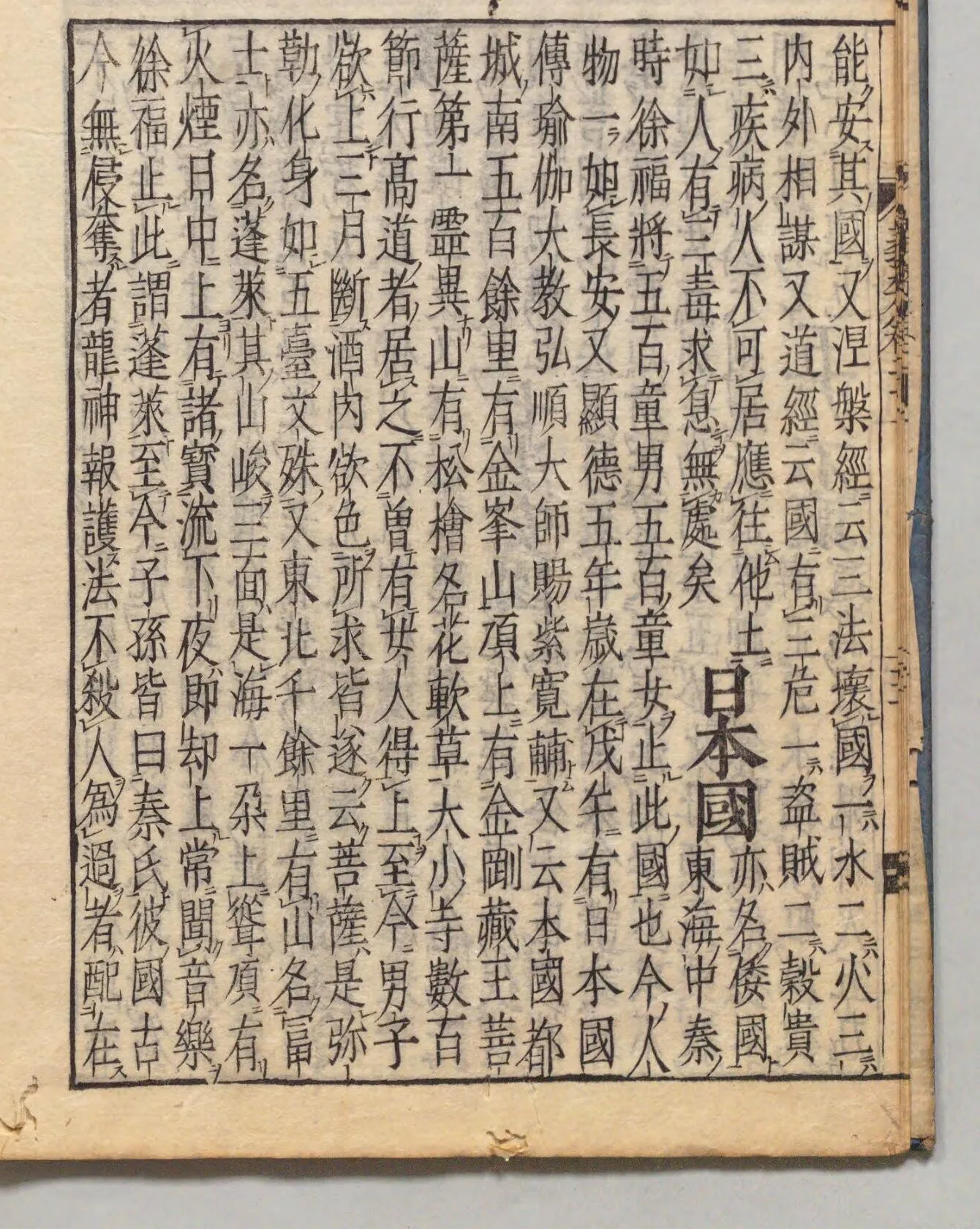
The entry 日本國 in 義楚六帖 (Yichu liutie), vol. 21, Japanese print of Kanbun 9 (1669), cropped. 国立公文書館所蔵, Naikaku Bunko 310-0158, item 3672704.
Further down the entry a mountain more than a thousand li to the northeast is named Fuji, and also Penglai.4 It says Xu Fu “stopped here” and called it Penglai, and that his descendants all bear the name Qin, as the entry puts it.4 Yichu puts Xu Fu at Fuji, not at Kumano.4
The Fuji lines come after a report from a Japanese monk, the Great Master Hongshun, in a passage the entry dates to the fifth year of Xiande, which is 958 by our conversion.42 Sano gives 954 as the year the book was finished.39 The entry as printed therefore mentions an event four years later than that, and nothing we read says whether the sentence was added afterwards. Wu gives 955 for the book.43
Islands beyond Kuaiji
Before Yichu, the Chinese histories that tell the story put Xu Fu on an island, and the island is not called Japan.444546
The Sanguo zhi, by Chen Shou, who died in 297, says that in the second year of Huanglong, which is 230 by our conversion, Sun Quan of Wu sent the generals Wei Wen and Zhuge Zhi with 10,000 men to look for Yizhou and Danzhou.4447 The text says elders passed on a report that Xu Fu had stopped on Danzhou and never come back, and that tens of thousands of households lived there now.44 The fleet brought back several thousand people from Yizhou and never reached Danzhou.44
The Hou Han shu, by Fan Ye, passes the story on as hearsay (傳言) at the very end of its section on Wo, a name for Japan.4541 Xu Fu, afraid of punishment, stayed on the island, the paragraph reports, and its people sometimes come to the market at Kuaiji.45 The paragraph is about islands beyond Kuaiji, not about Wo itself.45 Wu and Hua both read these histories as stopping short of saying Xu Fu reached Japan.46
A commentary on the Shiji quotes an older geography, the Kuodi zhi, on Danzhou: it lies in the East Sea, Xu Fu stopped there, and people from the island sometimes trade at Kuaiji.48 The commentary adds a Wu-era map book that puts Danzhou 10,000 li from Langya.48 A Song gazetteer of the Taizhou area quotes a note that puts Yizhou, and Xu Fu with it, thirty li from the prefecture; we read that only in a transcription not proofread against the scan.49
One Tang poem comes closer to Japan. Pi Rixiu wrote two poems to send the monk Yuanzai home to Japan, and the second has a line asking how many of the regions there are Danzhou.6 A note on the line says the island lies beyond Kuaiji and is said to hold Xu Fu’s descendants.6 The copy we read, an unproofed transcription of the Siku Quan Tang shi, does not say who wrote the note.6 It is not a statement that Xu Fu reached Japan, but it puts his island among Japan’s lands in a poem addressed to a Japanese.6
The marshes in the Shiji
The Shiji tells of Xu Fu in the Basic Annals of the First Emperor and in the Huainan biography.82 In the 28th year of the First Emperor, Xu Fu, whose name is written 徐巿 there, a man of Qi, wrote that the sea held three spirit mountains, Penglai, Fangzhang and Yingzhou, where immortals lived.8 He asked leave to seek them with boys and girls, and the emperor sent him with several thousand.8 By the 35th year the emperor was complaining that Xu Fu and others had spent sums counted in the billions without finding the drug.50
In the 37th year, on the coast near Langya, the Shiji says that Xu Fu and others had spent years at sea and large sums, and feared a rebuke, so he claimed a huge shark blocked the way to Penglai.51 The emperor dreamed of fighting a sea god, and at Zhifu he shot a large fish.51 The emperor died that year, in 210 BCE.52 The Basic Annals do not follow Xu Fu any further.51
The Huainan biography, which writes the name 徐福, has him in a speech. A courtier named Wu Bei tells the King of Huainan that Xu Fu came back with a false report of a sea god.2 The emperor then sent 3,000 boys and girls with grain seeds and craftsmen, and Xu Fu found 平原廣澤, “plain and wide marshes”, stopped there and did not come back.2 The craftsmen and grain that the Song poem credits to Xu Fu are in this speech, not in the Basic Annals.2828 The Shiji’s treatise on the Feng and Shan sacrifices describes voyages to the same mountains and does not name him.53
None of these passages names a country, and the one place word, 平原廣澤, is the marshes.1 Hua says scholars still argue where they were.1 No text we read before the 950s says outright that Xu Fu reached Japan.46405
What we could not verify
Sources we have not seen
- The Southern Song print of the Yichu liutie at Tōfukuji, the oldest surviving copy according to Sano, would let a reader compare the sentence dated 958 and the Xu Fu lines with the oldest text. We found no scan of it and read the entry only in the Japanese print of 1669.
- A 2024 paper by Lin Man-houng and Huang Yi-chen on where Yizhou and Liuqiu were would bear on the islands in the Sanguo zhi; its server returned an access-denied error when we tried it.
Seen only where others quote them
- The 1075 Kumano record, Mugaku Sogen’s verses and Wu Lai’s poem are known to us only as Wu Weiming quotes them.2324
- Zekkai’s poem is known to us as Makita, Ullmann and Wu quote it. We found no digitised text of his collection, the Shōkenkō.22
- Takizawa Bakin, Satō Narihiro, Momoi Tōu, Arai Hakuseki and Hayashi Razan are read only through Wu and Jin. Their books are in twentieth-century reprints, and we found only library catalogue records for them, no online copy.9101118
Resting on a single source
Questions we could not settle
- Whether the Japan entry in the Yichu liutie, with its date of 958, is as Yichu left it.
- Whether the marker at Shingu replaced an older stone, and who first cut Xu Fu’s name there.
- Where the plain and wide marshes of the Shiji, and Danzhou and Yizhou, were.
- Whether any Chinese text earlier than Yichu puts Xu Fu in Japan outright. The Sui and Tang histories do not,5 Hua and Wu name none, and the one nearby Tang text is Pi Rixiu’s note on Danzhou, whose author the copy does not give.6
Read next
TaleKyoto and Obama (Wakasa), Japan, 1449 to 1764
Yao Bikuni, the nun shown in Kyoto in 1449
TaleMusashi (now Tokyo), Japan, 1685 to 1993
Yuki-onna, the snow woman of Kwaidan, 1904
TaleYotsuya, Edo (now Shinjuku, Tokyo), Japan, 1727 to 1952
Oiwa of Yotsuya was divorced in the old text and drugged on the stage
Sources
- Shiji 史記 6, Qin Shi Huang benji, Sima Qian, the three paragraphs cited under C1 to C3 (28th, 35th and 37th years); none names a land beyond the sea (primary)
- Shiji 史記 118, Huainan Hengshan liezhuan, Sima Qian, Wu Bei's speech, paragraph [19]; the place word is 平原廣澤 (primary)
- Hua Xuemei, 佐賀県佐賀市における徐福ゆかりの地とその伝説, 非文字資料研究 18 (2019), pp. 149-175, p. 150, はじめに: the Shiji gives 平原広沢 and scholars dispute where it is↑
- Shiji 史記 118, Huainan Hengshan liezhuan, Sima Qian, Wu Bei's speech to Liu An, the passage 又使徐福入海求神異物 (ctext paragraph [19]) (primary)↑
- Wu Weiming 吳偉明, Journal of Chinese Studies 58 (2014), p. 167 (citing Iki Ichiro 1996, pp. 82, 126-28)
- Hua Xuemei, 非文字資料研究 18 (2019), p. 151: more than twenty places, from Hokkaido to Kagoshima↑
- Yichu liutie 義楚六帖, Kanbun 9 print, Naikaku Bunko 310-0158, vol. 21, entry 日本國, viewer image 7, right-hand leaf lower columns and left-hand leaf first columns: 又東北千餘里有山名富士 to 至今子孫皆曰秦氏 () (primary) transcription
- Wu Weiming 吳偉明, Journal of Chinese Studies 58 (2014), p. 162, the quoted passage of 義楚六帖 and the sentence introducing it↑
- Sui shu 隋書 81, Dongyi zhuan (Wo), text at zh.wikisource.org, whole chapter, text searched for 徐福, 徐市 and 徐巿 on 2026-10-15: no hit (primary)
- Jiu Tang shu 舊唐書 199 shang, Dongyi (Wo, Riben), text at zh.wikisource.org, whole chapter, same search, no hit (primary)
- Xin Tang shu 新唐書 220, Dongyi (Riben), text at zh.wikisource.org, whole chapter, same search, no hit (primary)↑
- 御定全唐詩 (Quan Tang shi), Siku quanshu copy, juan 614, Pi Rixiu, as transcribed at zh.wikisource.org (not proofread there against the scan), juan 614, the poem 重送 after 送圓載上人歸日本國 (primary)↑
- Shingu city, page on the Xu Fu legend (新宮市ホームページ, 徐福), the paragraph on the tomb marker (墓碑): 元文元年(1736)建立, inscription written by 李梅溪 at Yorinobu's order
- Wu Weiming 吳偉明, Journal of Chinese Studies 58 (2014), p. 166: Yorinobu built the tomb at Shingu and Yi Maegye (1617-1682) wrote 秦徐福之墓 in clerical script; Yorinobu's dates 1602-1671
- Kumano tourism page on Jofuku Park (mikumano.net), the tomb paragraph: planned by Yorinobu and put up at the present site "about 100 years later, in 1736"↑
- Shiji 史記 6, Qin Shi Huang benji (Basic Annals of the First Emperor), Sima Qian, 28th year, the paragraph after the Langya stone inscription, opening 既已,齊人徐巿等上書 (ctext paragraph [25]) (primary)↑
- Wu Weiming 吳偉明, Journal of Chinese Studies 58 (2014), p. 166, quoting 玄同放言 (1820), citing Nihon zuihitsu taisei ser. 1 vol. 5, p. 94↑
- Wu Weiming 吳偉明, Journal of Chinese Studies 58 (2014), p. 171, quoting 中陵漫錄 (1826), Nihon zuihitsu taisei ser. 3 vol. 3, p. 138↑
- Wu Weiming 吳偉明, Journal of Chinese Studies 58 (2014), pp. 170-171, quoting 笈埃隨筆 (pp. 98-99)↑
- Wu Weiming 吳偉明, Journal of Chinese Studies 58 (2014), p. 165, the paragraph beginning 熊野說在德川時代依然是流傳最廣的徐福傳說↑
- Wu Weiming 吳偉明, Journal of Chinese Studies 58 (2014), p. 167, paragraph on Saga
- Hua Xuemei, 非文字資料研究 18 (2019), p. 164 and p. 169, section on the 金立神社縁起図 (dated 正保5, 1648; Saga Prefectural Museum)↑
- Wu Weiming 吳偉明, Journal of Chinese Studies 58 (2014), p. 167: 〈金立神社畫圖緣起〉 makes Xu Fu the third prince of the First Emperor
- Hua Xuemei, 非文字資料研究 18 (2019), p. 152, quoting 『金立山物語』 via Muraoka 2002, p. 13: "秦始皇帝の第三皇子の徐福"↑
- Hua Xuemei, 非文字資料研究 18 (2019), p. 155, quoting 肥前古跡縁起 (1665) via Hizen shidankai 1973, p. 388
- Wu Weiming 吳偉明, Journal of Chinese Studies 58 (2014), p. 167: Oki Soemon's 肥前古跡緣起 (1665) has Xu Fu land at Morodomi with over seven hundred people↑
- Hua Xuemei, 非文字資料研究 18 (2019), p. 169 and pp. 172-173 (conclusion)↑
- Wu Weiming 吳偉明, Journal of Chinese Studies 58 (2014), p. 168 (Honcho tsugan, vol. 1, p. 5) and p. 170 (Dai Nihonshi, Korei)↑
- Wu Weiming 吳偉明, Journal of Chinese Studies 58 (2014), p. 169, note 43 (Arai 1969 ed., p. 292)↑
- Wu Weiming 吳偉明, Journal of Chinese Studies 58 (2014), p. 165, note 21 (Shimada 1957)↑
- Wu Weiming 吳偉明, Journal of Chinese Studies 58 (2014), p. 164, note 13↑
- Wu Weiming 吳偉明, Journal of Chinese Studies 58 (2014), p. 161, note 1↑
- Makita Tairyo 牧田諦亮, 絶海中津と明僧との交渉, 禪學研究 57 (1969), pp. 165-180, p. 174 (printed 一七四), the paragraph opening 中津が洪武九年(一三七六)、宮中の英武楼で太祖に拝謁し
- Vito Ullmann ヴィート・ウルマン, 五山文学に見られるグローバル化の始まり, 比較日本学教育研究センター研究年報 11 (2015), pp. 177-180, pp. 177-178, section 3: the poem 應制賦三山 (熊野峰前徐福祠) written before his return to Japan for the Hongwu emperor
- Wu Weiming 吳偉明, Journal of Chinese Studies 58 (2014), p. 163, the poem quoted and Zekkai's account to the Ming founder (citing Fogel 1996, p. 31)↑
- Wu Weiming 吳偉明, Journal of Chinese Studies 58 (2014), pp. 162-163, quoting 淵穎集 8, p. 234 (1985 reprint) and a poem cited from Hada Takee (1993)↑
- Wu Weiming 吳偉明, Journal of Chinese Studies 58 (2014), p. 162, the paragraph beginning 熊野說亦出現於平安末年 (no note gives a source for the 1075 text)↑
- Wu Weiming 吳偉明, Journal of Chinese Studies 58 (2014), p. 168, note 35
- Jin Chengyu, Journal of Chinese Humanities 9 (2023), p. 396, section 3, "In 1339 ... Kitabatake Chikafusa (1293-1354) stated in the Jinno shoto ki"↑
- 神皇正統記評釈 (Jinno shotoki hyoshaku), ed. Omachi Yoshie (Keigetsu), Meiji Shoin, 1925, National Diet Library, NDL pid 943298, call number 323-589, viewer image 39, pp. 62-63, the Korei paragraph from 四十五年乙卯、秦の始皇即位 () (primary) transcription
- Wu Weiming 吳偉明, Journal of Chinese Studies 58 (2014), p. 168, note 35, quoting the Korei passage from the Iwasa and Tokieda edition (Iwanami, 1965), p. 71; the quotation has no Xu Fu
- Jin Chengyu, Journal of Chinese Humanities 9 (2023), pp. 396-397, English translation of the same passage, no Xu Fu↑
- 神皇正統記評釈, Omachi Yoshie, 1925, NDL, pid 943298, viewer image 39, p. 63, columns 3 to 6 from the right (primary)↑
- 日本刀歌, as transcribed at zh.wikisource.org from the Ouyang Xiu collection, the poem's lines 其先徐福詐秦民,採藥淹留丱童老 and 徐福行時書未焚,逸書百篇今尚存 (primary)
- Jin Chengyu 金程宇, The "Riben dao ge" and the Sinosphere, Journal of Chinese Humanities 9 (2023), pp. 387-409, pp. 388-389, the poem in Chinese and English; cites Ouyang Xiu quanji, ed. Li Yi'an (2001), p. 766↑
- Jin Chengyu, Journal of Chinese Humanities 9 (2023), p. 390, paragraph beginning "Contemporaneous with Sima Guang, Mei Yaochen"↑
- Jin Chengyu, Journal of Chinese Humanities 9 (2023), p. 389 (Ming editors found it in Sima Guang's collected works; Qing doubts) and pp. 393-396 (Wang Shuizhao, Yang Shoujing, Kusaka Hiroshi)
- Watanabe Hiroaki 渡辺宏明, 「日本刀歌」小考, 法政大学教養部紀要 人文科学編 100 (1997), pp. 1-13, p. 1 (the song of the Song man Ouyang Xiu, "or said to be Sima Guang's") and p. 8 ("said to be Ouyang Xiu's")↑
- Jin Chengyu, Journal of Chinese Humanities 9 (2023), pp. 393-394, section 2, the paragraph on Wang Shuizhao's three reasons↑
- Jin Chengyu, Journal of Chinese Humanities 9 (2023), pp. 394-396, section 2↑
- Jin Chengyu, Journal of Chinese Humanities 9 (2023), pp. 390-391↑
- Jin Chengyu, Journal of Chinese Humanities 9 (2023), p. 401, section 4↑
- Wu Weiming 吳偉明, Journal of Chinese Studies 58 (2014), pp. 169-170, text and note 45↑
- Jin Chengyu, Journal of Chinese Humanities 9 (2023), pp. 401-402↑
- Jin Chengyu, Journal of Chinese Humanities 9 (2023), p. 397, first paragraph↑
- Sano Seiko 佐野誠子, 『義楚六帖』所引志怪資料について, 和光大学表現学部紀要 15 (2015), pp. 55-70, p. 55 (printed 055), section 1, the paragraph on the author's preface: begun in Kaiyun 2 (945), completed in Xiande 1 (954) and presented to the court
- Hua Xuemei, 非文字資料研究 18 (2019), pp. 150-151: 義楚六帖 (954; also called 釈氏六帖)↑
- Hua Xuemei, 佐賀県佐賀市における徐福ゆかりの地とその伝説, 非文字資料研究 18 (2019), pp. 150-151, はじめに, the sentence beginning 徐福一行の渡海先を具体的に日本であると最初に述べたのは↑
- Yichu liutie 義楚六帖, 24-volume print of Kanbun 9 (1669), Naikaku Bunko copy 310-0158, National Archives of Japan, vol. 21 (juan 21, 國城州市部 no. 43), entry 日本國, viewer image 7, right-hand leaf, first columns after the heading () (primary) transcription
- Wu Weiming 吳偉明, Journal of Chinese Studies 58 (2014), p. 162, quoting 義楚六帖 vol. 21, 國城州市部 no. 43, p. 459 of the 1979 Kyoto reprint↑
- Yichu liutie 義楚六帖, Kanbun 9 print, Naikaku Bunko 310-0158, vol. 21, entry 日本國, viewer image 7, the columns beginning 又顯德五年歲在戊午 () (primary) transcription
- Wu Weiming 吳偉明, Journal of Chinese Studies 58 (2014), p. 162: Yichu learned of the Fuji legend from the Japanese Shingon monk Hongshun (弘順)↑
- Wu Weiming 吳偉明, Journal of Chinese Studies 58 (2014), p. 162, the paragraph on the Fuji legend: 《義楚六帖》(955年)↑
- Sanguo zhi 三國志 47, Wu zhu zhuan, Chen Shou, the entry for the second year of Huanglong, after 二年春正月,魏作合肥新城 (ctext paragraph [30]) (primary)
- Hua Xuemei, 佐賀県佐賀市における徐福ゆかりの地とその伝説, 非文字資料研究 18 (2019), p. 150: the Sanguo zhi, composed in the 3rd century, gives Danzhou
- Wu Weiming 吳偉明, 徐福東渡傳說在德川思想史的意義, Journal of Chinese Studies 58 (2014), pp. 161-176, pp. 161-162: the Xu Fu story appears in Chen Shou's Sanguo zhi without clearly saying he reached Japan↑
- Hou Han shu 後漢書 85, Dongyi liezhuan, Fan Ye, the paragraph after the Wo section's list of countries, opening 會稽海外有東鯷人 (ctext paragraph [32]) (primary)
- Hua Xuemei, 佐賀県佐賀市における徐福ゆかりの地とその伝説, 非文字資料研究 18 (2019), p. 150: the Hou Han shu's 東夷列傳・倭傳 records Xu Fu's party on Danzhou with "tens of thousands of households"; Hua says this is no explicit record that they reached Japan↑
- Wu Weiming 吳偉明, Journal of Chinese Studies 58 (2014), p. 162, opening paragraph: these histories enlarge the story "but did not clearly say he reached Japan" (並沒有明確指出他到達日本)
- Hua Xuemei, 非文字資料研究 18 (2019), p. 150: the Hou Han shu passage is "not an explicit record" that Xu Fu reached Japan; p. 150: the first to name Japan was the monk Yichu↑
- Wu Weiming 吳偉明, Journal of Chinese Studies 58 (2014), pp. 161-162, the opening paragraphs of 德川以前的徐福東渡傳說 and the introduction↑
- Shiji sanjia zhu 史記三家註 6, Zhengyi note quoting the Kuodi zhi 括地志, note after 於是遣徐巿發童男女數千人,入海求僊人 (Qin Shi Huang benji, 28th year); the quoted text begins 亶洲在東海中 (primary)↑
- Chicheng zhi 赤城志 39, Chen Qiqing, Siku quanshu copy as transcribed at zh.wikisource.org (not proofread there against the scan), juan 39, the entry 夷洲 quoting the Linhai ji (primary)↑
- Shiji 史記 6, Qin Shi Huang benji, Sima Qian, 35th year, the paragraph of Hou Sheng and Lu Sheng's talk, the emperor's anger beginning 吾前收天下書不中用者盡去之 (ctext paragraph [41]) (primary)↑
- Shiji 史記 6, Qin Shi Huang benji, Sima Qian, 37th year, paragraph opening 并海上,北至瑯邪。方士徐巿等入海求神藥 (ctext paragraph [45]) (primary)↑
- Shiji 史記 6, Qin Shi Huang benji, Sima Qian, 37th year, 七月丙寅,始皇崩於沙丘平臺 (ctext, the paragraph after the one cited under C3) (primary)
- Jin Chengyu, Journal of Chinese Humanities 9 (2023), p. 390: Qin Shi Huang r. 221-210 BCE↑
- Shiji 史記 28, Fengshan shu, Sima Qian, the paragraph opening 自威、宣、燕昭使人入海求蓬萊、方丈、瀛洲 (primary)↑
Documents quoted
- Jinnō shōtōki (1339): the passage on Emperor Kōrei and the First Emperor of Qin (transcribed from the page image)
- Yichu liutie, juan 21: the entry on Japan (日本國) (transcribed from the page image)