 Twice Told
Plogojowitz and Paole: the vampire reports of 1725 and 1732
In January 1732 Habsburg army surgeons had graves opened at Medveđa, cut the bodies open, and signed a report saying which dead were in a "vampire state".
Contents
Published 24 Sept 2026. Updated 6 Oct 2026. Sources checked 24 Sept 2026.
On 21 July 1725 the Wienerisches Diarium, a Vienna newspaper, printed on its eleventh page a “Copia eines Schreibens aus dem Gradisker District in Ungarn”, a copy of a letter from the Gradiska district in Hungary.7 The writer signs only as the district’s imperial provisor, and the paper prints no date for the letter.8 Ten weeks earlier, he writes, a man named Peter Plogojoviz had died in the village of Kisolova. Within eight days nine people, old and young, died after an illness of twenty-four hours, and on their deathbeds they said that Plogojoviz had come to them in their sleep, lain on them and throttled them.9 The villagers had a name for dead men like him.
sintemalen aber bey dergleichen Personen (so sie Vampyri nennen) verschiedene Zeichen / als dessen Cörper unverwesen / Haut / Haar / Bart und Nägel an ihme wachsen zu sehen seyn müsten10
but with such persons, whom they call vampyri, certain signs are supposed to be visible: the body undecayed, and skin, hair, beard and nails growing on it
Seven years later three army surgeons and two officers signed a much longer report from another Serbian village, Medveđa.11 Printers in Nuremberg and Leipzig published it the same year, and it set off a learned argument: Ádám Mézes counts over forty treatises and 150 journal articles on it between the 1730s and the 1760s.1213
This is the story as Vienna’s newsletters told it in the first months of 1732, and as the pamphlets reprinted it.
In Serbia, on the Turkish border, the dead did not stay in their graves. A man long dead and buried came by night to his living relatives and sucked their blood until they died, and everyone he killed became a bloodsucker in turn.14 At Medveđa it began with a haiduk, a frontier soldier, named Arnod Paole. Years before, a vampire had tormented him in Turkish Serbia, so he ate earth from its grave and smeared himself with its blood. Then he broke his neck falling from a hay wagon. Within a month people said he was coming for them, and four of them died.1
After forty days the villagers dug him up. He lay whole and fresh, blood running from his eyes, nose, mouth and ears, with new nails on his hands and feet. When they drove a stake through his heart he let out a loud cry.13 But he had fed on the cattle as well, and those who ate the meat died after him, seventeen people in three months.2 The army came and opened the graves, and found the dead full of fresh blood. The executioner drove stakes through their hearts, and the bloodsuckers were burned.146
That is where the newsletters leave it.
Five papers from two villages
Only a handful of documents carry this story, and they were written at different distances from the graves.
| Document | Written | In print | By |
|---|---|---|---|
| Report on Kisolova | 17258 | Wienerisches Diarium, 21 July 17257 | the Gradiska provisor, unnamed8 |
| Glaser’s report on Medveđa | December 173115 | not in 173212 | Glaser, physician at Paraćin16 |
| Visum et Repertum | Medveđa, 7 January 173211 | Nuremberg and Leipzig pamphlets, 173212 | three surgeons, two officers11 |
| Letter of Glaser’s father | Vienna, 13 February 173216 | Commercium litterarium, 12 March 173216 | Johann Friedrich Glaser16 |
| Latin summary of the Visum et Repertum | 173217 | Commercium litterarium, 19 March 173217 | the journal17 |
Two of the writers stood at the open graves and wrote about what they saw: the provisor in 1725 and the surgeons in 1732. Glaser did too, but his report stayed in the Vienna archives, and the public of 1732 never read it.12 The others are relays. The father’s letter repeats a note his son wrote in haste,16 and the Vienna newsletters sum up reports that had reached the capital.14 The pamphlets reprint the surgeons’ report, and three of them reprint the 1725 report from Kisolova beside it.87
Two modern studies do most of the work of reading these papers. Paul Barber’s Vampires, Burial, and Death (1988) translates both reports and reads them against forensic medicine.918 Ádám Mézes (2021) went back to the commission files in the Austrian State Archives, including Glaser’s report.12
Kisolova, 1725
Serbia was Habsburg territory from 1718 to 1739, taken from the Ottoman Empire and lost to it again, and its villages answered to imperial officials.19 Thomas Bohn identifies Kisolova with Kisiljevo, a village in eastern Serbia.20
The provisor did not go looking for a vampire. The villagers came to him and to the local priest and asked them to attend the opening of Plogojoviz’s grave. He told them the Administration in Belgrade had to be informed first. They answered that he could do as he liked, but if they could not deal with the body in their own way they would leave house and home, since by the time Belgrade replied the whole village might be destroyed, as had happened, they said, in Turkish times.21 So he went, with the priest of Gradiska, and looked at a body the villagers had already dug up.22
He found no smell of death. The body was fresh except for the nose. Hair, beard and nails had grown, and the old, whitish skin had peeled away to show new skin beneath.22 Then:
in seinem Mund hab nicht ohne Erstaunung einiges frisches Blut erblicket / welches der gemeinen Aussag nach er von denen / durch ihme Umgebrachte / gesogen22
in his mouth, not without astonishment, I saw some fresh blood, which, as the common people say, he had sucked from those he had killed
He saw the blood. That it was his victims’ blood is, in his own words, what the common people say. The villagers then sharpened a stake, which the print calls a “Pfeil”, and drove it into the heart. Fresh blood ran from the ears and mouth, and “andere wilde Zeichen” occurred, other wild signs, which he declines to describe out of respect. They burned the body. He ends by asking that any mistake be blamed “nicht mir, sondern dem vor Forcht ausser sich selbst gesetzen Pöfel”, not on him but on the rabble, beside themselves with fear.23 The whole report, with our translation, is on its own page.
A quarantine doctor at Medveđa
Medveđa, which the prints spell Medvegia, Medwedia or Maduega, was a village of haiduks, the frontier soldiers of Habsburg Serbia, near the town of Paraćin.24 Paraćin had a quarantine station, and its imperial physician, a man named Glaser, was sent to the village with the first inquiry.16 What the villagers told him was not the story of one dead man. The dead rose and killed the living, and the people they killed rose in turn and killed others.25
It was Glaser’s father who put the son’s news into print. Johann Friedrich Glaser, a doctor in Vienna, wrote on 13 February 1732 to a Dr Goetz, passing on a note his son had sent him on 18 January, and the weekly Commercium litterarium printed the extract on 12 March.16 The son’s note, as the father gives it, has ten bodies found uncorrupted in their coffins, the biers and clothes soaked in bright blood, the old nails replaced by new ones:
Omnibus igitur his Vampyris (sic scilicet in iis oris vocantur) caput amputatum, cadauera postea igne concremata, eorumque cinis fluuio Morauae inspersus fuit. Secuit autem ea antea filius meus, ac cuncta viscera sana et illaesa, ventriculum vero et diaphragma sanguine plena, deprehendit.615
So all these Vampyri (that is what they are called in those parts) had their heads cut off, the bodies were then burned, and their ashes were scattered on the river Morava. My son had first dissected them, and found all the organs healthy and unharmed, but the stomach and diaphragm full of blood.
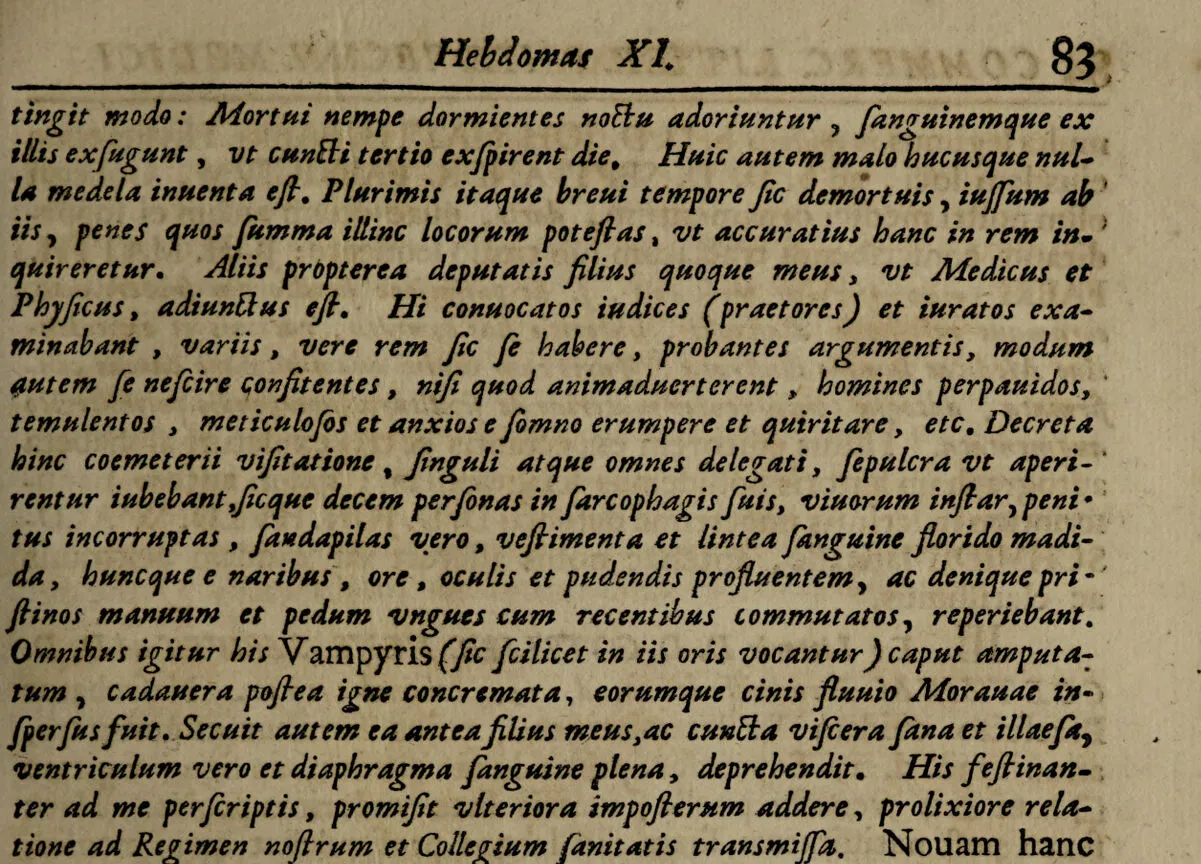
The letter of Johann Friedrich Glaser, Commercium litterarium (Nuremberg), Hebdomas XI, 12 March 1732, p. 83. Wellcome Collection, Public Domain Mark.16
Read against the archive, the letter seems to fold two visits into one. Mézes, who read the son’s own report, describes a commission under Glaser that examined ten bodies, and a second one under the surgeon Johann Flückinger, some four weeks later, which did the dissecting.15 The letter gives the son the dissection; our reading is that the father merged what his son had seen with what the second commission did.15 The full letter is on its own page.
Glaser’s own report was not printed in 1732.12 It survives in the same Vienna file as the surgeons’ report, and the Austrian State Archives shows the file online.26 Ádám Mézes, who has studied it, summarises it this way. Glaser found nothing contagious, only tertian and quartan fevers, side pains and chest complaints, which he put down to the Orthodox fast.27 The villagers told him that two dead women had become “vervampyret”, vampirized, while they lived, and would vampirize others in turn; Mézes cannot tell whether the verb was theirs or Glaser’s.28 Glaser had ten graves opened and marked each body as a vampire, very suspicious, half suspicious or decayed.29 He did not order any executions. His report ends by passing on the villagers’ request for one, and supporting it.30
Flückinger’s thirteen entries
The second commission reached Medveđa on 7 January 1732: Johann Flückinger, surgeon of the Fürstenbusch infantry regiment, two junior surgeons, and officers sent from Belgrade.11 They first heard the village’s leaders, and wrote down the story of Arnond Paole, as the Nuremberg print spells him, as those men told it.1 Paole had died about five years before, so the surgeons never saw his body; what they recorded about him is testimony.31 Its best-known line is the moment of the stake:
so haben sie demselben nach ihrer Gewohnheit einen Pfahl durchs Hertz geschlagen, wobey er einen wohlvernehmlichen Gächzer gethan, und ein häuffiges Geblüt von sich gelassen3
so they drove a stake through his heart, as is their custom, at which he gave a clearly audible groan and let out a great deal of blood
The same witnesses said Paole had attacked livestock (Vieh), and that people who ate the meat were now dying: seventeen young and old in three months, some within two or three days with no illness before.2 Then the surgeons went to the cemetery. Their report lists what they found in thirteen numbered entries, some of which cover a mother and her child.5
Stana, twenty, had died after giving birth, and had said before her death that she had smeared herself with a vampire’s blood. The surgeons found her undecayed, with fresh blood in the chest and organs as fresh as a healthy person’s.32 Miliza, about sixty, had grown fat in the grave. The haiduks standing round the dissection were amazed, the report says, since they had known her all their lives as thin and dried up, and they insisted:
daß sie in dem Grab zu eben dieser Verwunderungs-würdigen Fettigkeit gelanget sey33
that she had reached this astonishing fatness in the grave
Five bodies had decayed normally: the Hadnack’s wife and child, the corporal’s servant, and the Bariactar’s wife and child.34 Mézes points out that all five came from the households of the village’s own officers.34 No body in the list has a bite or an open wound. The one mark recorded is a bluish, bloodshot spot a finger long under the right ear of Stanoicka, the young woman who said a dead haiduk’s son, Milloe, had throttled her at midnight.35
The report ends with the executions:
Nach geschehener Visitation seynd denen Vampiren die Köpffe durch die dasige Zigeuner herunter geschlagen worden, und samt denen Cörpern verbrennet, die Aschen davon in den Fluß Morava geworffen, die verwesene Leiber aber wiederum in ihre vorgehabte Gräber geleget worden.6
When the examination was over, the vampires had their heads cut off by the local Gypsies and were burned with their bodies, and the ashes were thrown into the river Morava. The decayed bodies were laid back in their graves.
Three surgeons signed it. Two officers, the lieutenant colonel Büttener and the ensign J. H. von Lindenfels, attested at Belgrade on 26 January 1732 that everything had been done in their presence.11 The whole report, in the original German with our translation, is on its own page.
One report, four prints
The report reached readers in several versions, and they do not match. The Nuremberg printer Johann Adam Schmidt issued it as Visum et Repertum, with the 1725 report and an appendix on the dead who chew in their graves.836 A Leipzig pamphlet, the Acten-mäßige und umständliche Relation, printed it with a Vienna news item and a letter from an ensign in Belgrade.37 A third pamphlet by an author signing W. S. G. E. printed both reports with long commentary,7 and the Commercium litterarium ran a Latin summary on 19 March.17
Names drift from print to print. The dead haiduk is Arnond Paole at Nuremberg, Arnod Paole at Leipzig, Arnont Parle in W. S. G. E.’s pamphlet and Arnoldus Paulus in the Latin; the surgeon signs as Fluchinger, Flückinger, Flickinger and Flinkinger.4 Paole’s groan becomes “einen lauten Schrey”, a loud cry, in the Leipzig print, and “altum clamorem” in the Latin.3 Barber points out that the groan is hearsay.3
The prints differ on small figures: the Nuremberg print has Stanoicka buried eighteen days and Joachim eight weeks and four days, the Leipzig print thirteen days and thirty-six.38
The 1725 report changed in reprint as well. Only the Nuremberg print gives it a date, “Actum. 6. April. 1725”.8 W. S. G. E. says it first appeared in the Vienna papers “unterm 31. Jul.”, ten days after the issue of the Diarium that carries it.7 Where the provisor had passed over the “wilde Zeichen” out of respect, W. S. G. E. named them in a parenthesis: “penis erectio”.39
Even the word moved. The provisor in 1725 and Glaser’s father in 1732 say only that it is the local people’s word.40 The Vienna item printed at Leipzig calls “Vampir” the Illyrian for bloodsucker, and the ensign in Belgrade, Sieg. Alex. von Köttwitz, says that in Turkish such corpses are called vampires.40 The same Vienna item claims the Emperor thought the case important enough to send this report, and the one from seven years before, to several universities and to Professor Beyer at Altdorf.37 We found nothing else that confirms it.
Devil, astral spirit or rot
The pamphlets of 1732 disagreed about what had happened. W. S. G. E. saw the devil at work, and wrote that anyone who respected Scripture would find him among the vampires and could take hold of him “gleichsam mit Händen”, almost with his hands.36 The Nuremberg appendix also blames evil spirits for noises in graves.36
Von Köttwitz asked a Leipzig doctor whether the case was “etwas Sympathetisches, teuflisches, oder Astralischer Geister Würckung”, sympathetic, devilish, or the work of astral spirits.37 The pamphlet’s own answer chose the astral spirit, a subtle substance joining body and soul, and dismissed the idea that “alle diese Sachen, blos in der Einbildung der lebenden Menschen bestehen”, that all of it was only in the minds of the living.41 Mézes finds that most of the learned contributions of 1732 argued over this astral spirit.41
A natural explanation was in print from the start. The comment after Glaser’s letter in the Commercium suggested an epidemic disease, imagination, fear, superstition, and a putrid fermentation of the blood in the corpses.18 Paul Barber argued the same case in detail in 1988: bloating from the gases of decay, blood at the mouth, even a groan, since a stake forces air out past the throat. He notes that the Royal Prussian Society of Sciences pointed out some of this in 1732.18
The Society’s opinion, signed at Berlin on 11 March 1732 and printed at Leipzig the same year, says Paole’s groan could have come from air left in the cavity of the heart, and Miliza’s fat from putrid fermentation. It notes that the blame for vampirism had so far fallen only on poor people, and it could not believe that the dead suck blood.42
Mézes asks a different question: who decided what the surgeons saw. The villagers stood round the dissections and told the surgeons what the bodies meant, and the five bodies judged to have decayed normally all belonged to the officers’ households.3334 He reads the vampire of Medveđa as something the villagers and the Habsburg medical service made between them.33
What the 1732 prints claimed, line by line
| The story | The record | Verdict |
|---|---|---|
| First printed from Vienna on 31 July 1725 | Diarium of 21 July 17257 | Contradicted |
| Paole cried out loudly when staked | Hearsay; “Gächzer” (groan) at Nuremberg3 | Disputed |
| A dead man sucked his relatives’ blood | Deathbed accusations; no bite or wound recorded35 | Unsupported |
| Fresh blood in the opened bodies | In the undecayed ones; five had decayed3234 | Confirmed |
| An executioner staked the dead | Heads cut off by local Gypsies, then burned6 | Contradicted |
| “Vampir” is Illyrian for bloodsucker | Turkish, says an ensign; the locals’ word, say others40 | Disputed |
The newsletters had the outline right: the surgeons did open graves and find liquid blood in some bodies, and those bodies were destroyed.326 What the newsletters dropped is who said what. Several of the best-known details, Paole’s groan, the livestock, the seventeen dead, come from what villagers told the surgeons, not from anything the surgeons saw.12
Ten bodies or eleven
The surgeons’ report says the heads came off “denen Vampiren”, the vampires, and does not count them.6 Glaser’s father has ten persons found uncorrupted and beheaded.5 The Latin summary names four and then adds “et denique undecim personae”, and finally eleven persons, adults and infants of both sexes, “in eodem statu”, in the same state, without saying whether the four are among the eleven.5 Mézes, working from the archive copy, counts fifteen bodies exhumed, ten of them vampires.5 Calmet’s Dissertations of 1746, copying a French account from the Lettres juives, have about forty graves opened and seventeen bodies found with every sign of vampirism,43 the number the villagers had given for their dead.2
Our own count of the Nuremberg list gives sixteen bodies: five decayed, and eleven in the vampire state if Ruscha’s eighteen-day-old child, whose fresh blood the report mentions in a single clause, is counted.5 The villagers said seventeen had died.2 The surgeons wrote “the vampires” and left the counting to their readers.6
What we could not verify
Sources we have not seen
- Klaus Hamberger’s edition of the Vienna documents (Mortuus non mordet, 1992), which Nadine Ebert (2018) cites for the provisor’s name. It is in copyright and out of print, and Google Books shows only snippets.
- A manuscript copy of the 1725 report, which could show whether the provisor signed with his name. Later writers place it in the state archives in Vienna, whose online catalogue lists no digitised copy under “Frombald” or “Vampir”.
Resting on a single source
- The Vienna report that the Emperor sent the case to the universities and to Professor Beyer at Altdorf.
Questions we could not settle
- The provisor’s name. Modern retellings call him Frombald. Neither the 1725 Diarium, the 1732 reprints nor Calmet (1746) names him.
- Whether the 1725 report is the first printed use of “Vampyri” in German or any western language. We found no dictionary or study that says so.
- When Plogojoviz first gets a hawthorn stake and his ashes scattered in a lake, as in 2025 press reports. The 1725 print has neither, and nor does Calmet’s retelling of 1746.
Read next
CaseHermersdorf (Svobodné Heřmanice), Czechia, 1753 to 1768
Hermersdorf's vampires were burned before Vienna sent a physician
TaleMiyoshi, Hiroshima, Japan, 1749 to 1859
The Inō mononoke roku: where the demon king's mallet came from
CaseVärend, Småland, Sweden, 1883 to 1889
The lindworm reward in Småland was never claimed
Sources
- Visum et Repertum (Nürnberg: J. A. Schmidt, 1732), pp. 4 to 5 (primary)
- Paul Barber, Vampires, Burial, and Death (Yale UP, 1988), pp. 15 to 16, search "Arnod"
- Ádám Mézes, Vampire Contagion as a Forensic Fact, Historical Studies on Central Europe 1, no. 1 (2021), pp. 166 to 167↑
- Visum et Repertum (Nürnberg: J. A. Schmidt, 1732), p. 5 (primary)
- Acten-mäßige und umständliche Relation (Leipzig: A. Martini, 1732), p. 10 (primary)
- Commercium litterarium (Nürnberg), 1732, Hebdomas XII, p. 91 (primary)
- Paul Barber, Vampires, Burial, and Death (Yale UP, 1988), p. 19, search "hearsay"↑
- Visum et Repertum (Nürnberg: J. A. Schmidt, 1732), pp. 4, 10 (primary)
- Acten-mäßige und umständliche Relation (Leipzig: A. Martini, 1732), pp. 9 to 10, 15 (primary)
- W. S. G. E., Curieuse und sehr wunderbare Relation (1732), pp. 7, 14 (primary)
- Commercium litterarium (Nürnberg), 1732, Hebdomas XII, pp. 90, 92 (primary)
- Paul Barber, Vampires, Burial, and Death (Yale UP, 1988), p. 15, search "Clicksten"↑
- Commercium litterarium (Nürnberg), 1732, Hebdomas XI p. 83 and XII p. 92 (primary) transcription
- Visum et Repertum (Nürnberg: J. A. Schmidt, 1732), pp. 6 to 10 (primary)
- Ádám Mézes, Vampire Contagion as a Forensic Fact, Historical Studies on Central Europe 1, no. 1 (2021), pp. 149, 167, 169↑
- Visum et Repertum (Nürnberg: J. A. Schmidt, 1732), p. 10 (primary)
- Commercium litterarium (Nürnberg), 1732, Hebdomas XI p. 83; Hebdomas XII p. 92 (primary)
- Ádám Mézes, Vampire Contagion as a Forensic Fact, Historical Studies on Central Europe 1, no. 1 (2021), pp. 169 to 170↑
- Wienerisches Diarium, 21 July 1725, pp. 11 to 12, "Copia eines Schreibens aus dem Gradisker District in Ungarn" (primary) transcription
- W. S. G. E., Curieuse und sehr wunderbare Relation (1732), p. 3, "I. Relation"; Deutsches Textarchiv page image (primary)
- Thomas M. Bohn, Der Vampir: Ein europäischer Mythos (Böhlau, 2016), p. 277 (publisher's preview)↑
- Wienerisches Diarium, 21 July 1725, p. 12 (primary) transcription
- Visum et Repertum (Nürnberg: J. A. Schmidt, 1732), pp. 12 to 15 (primary)
- Acten-mäßige und umständliche Relation (Leipzig: A. Martini, 1732), pp. 37 to 39 (primary)
- Paul Barber, Vampires, Burial, and Death (Yale UP, 1988), p. 7, search "Provisor"↑
- Wienerisches Diarium, 21 July 1725, p. 11, right column (primary) transcription
- Paul Barber, Vampires, Burial, and Death (Yale UP, 1988), p. 6 (ch. 1, Peter Plogojowitz), search "Kisilova"↑
- Wienerisches Diarium, 21 July 1725, p. 11 (primary) transcription
- Paul Barber, Vampires, Burial, and Death (Yale UP, 1988), p. 6
- Thomas M. Bohn, Der Vampir: Ein europäischer Mythos (Böhlau, 2016), p. 277 (publisher's preview)↑
- Visum et Repertum (Nürnberg: J. A. Schmidt, 1732), pp. 3, 10 to 11 (primary) transcription
- Ádám Mézes, Vampire Contagion as a Forensic Fact, Historical Studies on Central Europe 1, no. 1 (2021), pp. 165 to 166
- Paul Barber, Vampires, Burial, and Death (Yale UP, 1988), p. 18, search "January 26"↑
- Ádám Mézes, Vampire Contagion as a Forensic Fact, Historical Studies on Central Europe 1, no. 1 (2021), pp. 151 to 152, 169
- Visum et Repertum (Nürnberg: J. A. Schmidt, 1732), pp. 3 to 11 (primary)
- Acten-mäßige und umständliche Relation (Leipzig: A. Martini, 1732), pp. 9 to 15 (primary)↑
- Ádám Mézes, Vampire Contagion as a Forensic Fact, Historical Studies on Central Europe 1, no. 1 (2021), p. 150
- Thomas M. Bohn, Der Vampir: Ein europäischer Mythos (Böhlau, 2016), p. 12 (publisher's preview)
- Acten-mäßige und umständliche Relation (Leipzig: A. Martini, 1732), title page (primary)
- W. S. G. E., Curieuse und sehr wunderbare Relation (1732), title page (primary)↑
- W. S. G. E., Curieuse und sehr wunderbare Relation (1732), pp. 6 to 7 (primary)
- Acten-mäßige und umständliche Relation (Leipzig: A. Martini, 1732), pp. 7 to 8 (primary)↑
- Commercium litterarium (Nürnberg), 1732, Hebdomas XI p. 83, "Secuit autem ea antea filius meus" (primary) transcription
- Ádám Mézes, Vampire Contagion as a Forensic Fact, Historical Studies on Central Europe 1, no. 1 (2021), pp. 162, 166 to 167
- ÖStA, FHKA SUS Kur 01.1 (formerly Hoffinanz Ungarn r.Nr. 654), Glaser's report, fol. 1134v (online image 6); our draft reading of the handwriting from the online images, not yet checked by a second reader↑
- Commercium litterarium (Nürnberg), 1732, Hebdomas XI, pp. 81 to 83 (primary) transcription
- Ádám Mézes, Vampire Contagion as a Forensic Fact, Historical Studies on Central Europe 1, no. 1 (2021), pp. 149, 158↑
- Commercium litterarium (Nürnberg), 1732, Hebdomas XII, pp. 89 to 92 (primary)
- Visum et Repertum (Nürnberg: J. A. Schmidt, 1732), p. 3 (primary)↑
- Commercium litterarium (Nürnberg), 1732, Hebdomas XI, p. 83 (primary) transcription
- Paul Barber, Vampires, Burial, and Death (Yale UP, 1988), pp. 101, 109, 161, search "Prussian"
- Gutachten der Königl. Preußischen Societät der Wissenschaften von denen Vampyren (Berlin, 11 March 1732), printed in [J. C. Fritsch], Eines Weimarischen Medici muthmaßliche Gedancken von denen Vampyren (Leipzig: M. Blochberger, 1732), pp. 75 to 80 (GDZ images 75 to 80) (primary)↑
- Thomas M. Bohn, Der Vampir: Ein europäischer Mythos (Böhlau, 2016), p. 277 (publisher's preview)
- AFP, Serbian village stakes claim to the first vampire (France 24, 30 June 2025), news report↑
- Wienerisches Diarium, 21 July 1725, pp. 11 to 12 (primary) transcription
- Paul Barber, Vampires, Burial, and Death (Yale UP, 1988), p. 6, search "Turkish times"↑
- Wienerisches Diarium, 21 July 1725, p. 12, left column (primary) transcription
- Paul Barber, Vampires, Burial, and Death (Yale UP, 1988), pp. 6 to 7, search "odor"↑
- Wienerisches Diarium, 21 July 1725, p. 12 (primary) transcription
- Paul Barber, Vampires, Burial, and Death (Yale UP, 1988), p. 7, search "stake"↑
- Ádám Mézes, Vampire Contagion as a Forensic Fact, Historical Studies on Central Europe 1, no. 1 (2021), pp. 150, 154, 158
- Commercium litterarium (Nürnberg), 1732, Hebdomas XI, p. 82 (primary) transcription
- Visum et Repertum (Nürnberg: J. A. Schmidt, 1732), pp. 3 to 4 (primary)↑
- Commercium litterarium (Nürnberg), 1732, Hebdomas XI, p. 82 (primary) transcription
- Visum et Repertum (Nürnberg: J. A. Schmidt, 1732), p. 5 (primary)
- Ádám Mézes, Vampire Contagion as a Forensic Fact, Historical Studies on Central Europe 1, no. 1 (2021), pp. 159 to 160↑
- ÖStA, FHKA SUS Kur 01.1 (formerly Hoffinanz Ungarn r.Nr. 654), Glaser's report, fol. 1134r (online image 5); our draft reading of the handwriting from the online images, not yet checked by a second reader
- Ádám Mézes, Vampire Contagion as a Forensic Fact, Historical Studies on Central Europe 1, no. 1 (2021), p. 159↑
- ÖStA, FHKA SUS Kur 01.1 (formerly Hoffinanz Ungarn r.Nr. 654), Glaser's report, fol. 1134v (online image 6); our draft reading of the handwriting from the online images, not yet checked by a second reader
- Ádám Mézes, Vampire Contagion as a Forensic Fact, Historical Studies on Central Europe 1, no. 1 (2021), pp. 159 to 160↑
- ÖStA, FHKA SUS Kur 01.1 (formerly Hoffinanz Ungarn r.Nr. 654), Glaser's report, fols. 1134v to 1135v (online images 6 to 8); our draft reading of the handwriting from the online images, not yet checked by a second reader
- Ádám Mézes, Vampire Contagion as a Forensic Fact, Historical Studies on Central Europe 1, no. 1 (2021), p. 162↑
- ÖStA, FHKA SUS Kur 01.1 (formerly Hoffinanz Ungarn r.Nr. 654), Glaser's report, fols. 1135v to 1136r (online images 8 and 9); our draft reading of the handwriting from the online images, not yet checked by a second reader
- Ádám Mézes, Vampire Contagion as a Forensic Fact, Historical Studies on Central Europe 1, no. 1 (2021), p. 165↑
- Paul Barber, Vampires, Burial, and Death (Yale UP, 1988), p. 15, search "haywagon"
- Visum et Repertum (Nürnberg: J. A. Schmidt, 1732), p. 4 (primary)↑
- Visum et Repertum (Nürnberg: J. A. Schmidt, 1732), pp. 6 to 7 (primary)
- Ádám Mézes, Vampire Contagion as a Forensic Fact, Historical Studies on Central Europe 1, no. 1 (2021), pp. 168 to 169↑
- W. S. G. E., Curieuse und sehr wunderbare Relation (1732), p. 78 (primary)
- Visum et Repertum (Nürnberg: J. A. Schmidt, 1732), pp. 16 to 18 (primary)↑
- Visum et Repertum (Nürnberg: J. A. Schmidt, 1732), pp. 8 to 9 (primary)
- Acten-mäßige und umständliche Relation (Leipzig: A. Martini, 1732), pp. 13, 15 (primary)↑
- Wienerisches Diarium, 21 July 1725, p. 12 (primary) transcription
- W. S. G. E., Curieuse und sehr wunderbare Relation (1732), p. 6 (primary)↑
- Acten-mäßige und umständliche Relation (Leipzig: A. Martini, 1732), pp. 7, 17 (primary)
- Commercium litterarium (Nürnberg), 1732, Hebdomas XI, p. 83 (primary) transcription
- Wienerisches Diarium, 21 July 1725, p. 11 (primary) transcription↑
- Gutachten der Königl. Preußischen Societät der Wissenschaften von denen Vampyren (1732), in Fritsch, Muthmaßliche Gedancken (Leipzig, 1732), pp. 76, 78 to 80 (GDZ images 76 to 80) (primary)↑
- Augustin Calmet, Dissertations sur les apparitions des anges, des démons & des esprits, et sur les revenans et vampires (Paris: De Bure, 1746), pp. 278, 280 to 283 (§§ XI to XII; IA n315 to n320); "parmi une quarantaine on en trouva dix-sept", p. 283 (primary)↑
Documents quoted
- Commercium litterarium, 12 March 1732: Johann Friedrich Glaser's letter on the vampires of Medveđa (transcribed from the page image)
- Visum et Repertum, 1732: the surgeons' report on the vampires of Medveđa (transcribed from the page image)
- Wienerisches Diarium, 21 July 1725: the provisor's report from Kisolova (transcribed from the page image)