 Twice Told
Hermersdorf's vampires were burned before Vienna sent a physician
Maria Theresa's earliest letter we found on the Hermersdorf vampires is dated 8 February 1755, eight days after an executioner burned nineteen of the dead.
Contents
Published 5 Oct 2026. Sources checked 5 Oct 2026.
The earliest letter from Maria Theresa that we found about the vampires of Hermersdorf is dated Vienna, 8 February 1755. In the text Linzbauer printed, she tells her chancellor, Count Haugwitz, to ask her physician Gerard van Swieten for a surgeon who could convince “these superstitious people” of the truth.2 By then there was little left to convince them of. On 31 January, in Hermersdorf, today Svobodné Heřmanice near Bruntál in the Czech Republic, an executioner had burned nineteen of the village’s dead.9110
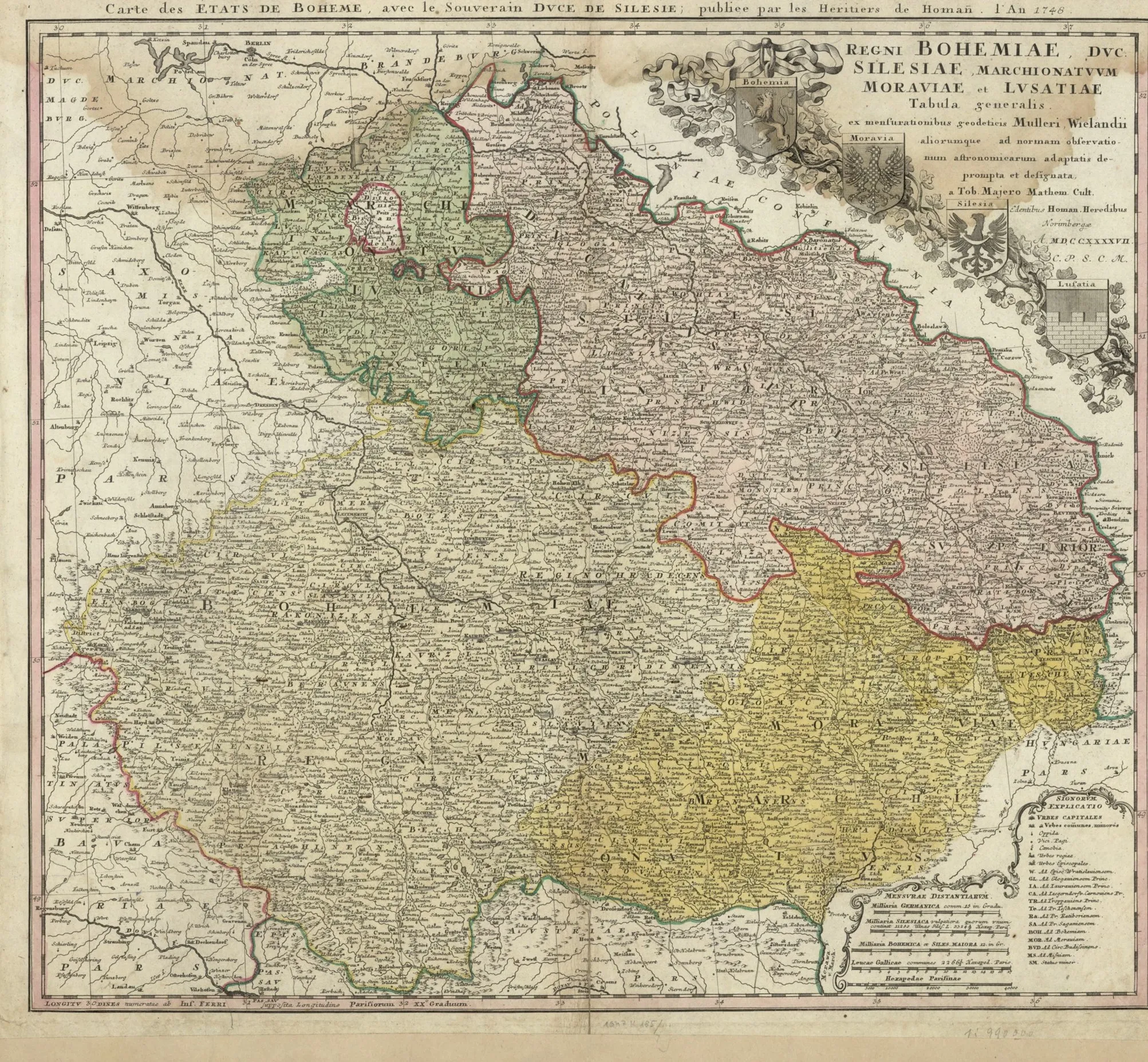
Map of Bohemia, Silesia, Moravia and Lusatia, drawn by Tobias Mayer and published by Homann Heirs, Nuremberg, 1748. Biblioteka Narodowa, Polona, ZZK 1 641, public domain.
„Wann Er diese abergläubige … (Menschen) könnte überzeigen von der Wahrheit, thätte Er dem Publico einen grossen Dienst.“2
“If he could convince these superstitious [people] of the truth, he would do the public a great service.”
This is the story as the Austrian National Library’s blog tells it.
Maria Theresa heard that a village on what is now the Czech-Polish border was in the grip of a vampire. On the advice of her physician Gerard van Swieten she sent two doctors, Johannes Gasser and Christian Wabst. They opened the grave of the accused woman, Marianna Saligerin, and those of everyone buried after her, and found bodies that had not rotted, which they put down to soil, temperature and illness.11 Van Swieten wrote up the case. In 1755 the empress issued a decree that took the opening of graves out of the clergy’s hands.11
The telling ends there, with the decree.
The papers put the doctors after the fire, not before it, and they name more people than the telling does: a church court, a village priest, a manor court, a lawyer who was fined for his part. Most of that is known only because Monika Enenklová read the church’s file in an archive for a doctoral thesis, and the rest comes from Vienna’s printed orders, a treatise printed thirteen years later, and two newspaper items.
Eight papers
The case left paper in three places. The consistory of Olomouc, the diocese’s church court, kept a file of witness hearings, medical attestations and the manor court’s report on the burning. Enenklová read it at the regional archive in Opava for her 2021 thesis at Masaryk University, and we know it only through her.12 Vienna kept the empress’s letters and the verdict of the central office, which Franz Xaver Linzbauer printed in 1852 to 1856 in an appendix to his collection of Hungarian health law.213 And a Hamburg newspaper printed two items about it in the spring of 1755.
| Paper | Written | By | Read in |
|---|---|---|---|
| Attestation of the exhumed bodies14 | 19 January 1755 | two practitioners at Horní Benešov | Enenklová (2021) |
| Report on the burning15 | February 1755 | the manor’s official and its lawyer | Enenklová (2021) |
| Two orders213 | 8 and 9 February 1755 | Maria Theresa | Linzbauer (1852 to 1856) |
| Van Swieten’s remarks1617 | February or March 1755 | van Swieten | Augsburg print of 1768 |
| Order against superstition18 | 1 March 1755 | Maria Theresa | Austrian National Library |
| Dispatch “from Upper Silesia”5 | 16 March 1755 | unsigned | Reichs-Post-Reuter, 4 April |
| Protocol of the central office19 | 17 March 1755 | the Directorium in Vienna | Linzbauer (1852 to 1856) |
| Notice from Vienna6 | 23 April 1755 | unsigned | Reichs-Post-Reuter, 6 May |
The papers nearest the village, the attestation and the manor’s report, reach us only through Enenklová. The protocol and the treatise were written in Vienna from the file. Enenklová finds no record that van Swieten went to the village at all.20
The healer of Hermersdorf
Marianna Saligerin died on 27 August 1753, aged 63, and was buried in the churchyard at Hermersdorf.21 She had married Wenzel Saliger, a retired soldier, in 1731, and the documents call her Richter Wenzlin.21 She treated the sick. Her son told the commissioners what her remedies were: crayfish eyes dissolved in water, some herbs and roots.22 In van Swieten’s reading of the file, she once told a patient, to make a cure look more mysterious, to sew four thalers into his shirt and send it to her, and the medicine would follow.22
Nothing in the file marks her death, and the incidents the witnesses later described began in July 1754. The first surviving word, in Enenklová’s reading of the consistory’s file, is a letter of 23 September 1754 from Johann Metzner, the priest of Velké Heraltice, about night disturbances in the village. He asked leave to examine 24 bodies; the house blessings and charms he had been told to try had not worked.23 On 30 November the village reeve, Paul Saliger, who was Marianna’s brother-in-law, wrote with two other men that for half a year everyone in the village had felt unrest at night, and asked for a visitation and an autopsy of the suspect bodies.23 On 13 December a commission of the consistory heard the witnesses.23
They described a weight on the chest, cats, pale figures that dragged them out of bed.23 The commissioners offered ordinary explanations at every turn, and the transcripts run as question and answer. Marianna Blaschkin, a widow of 50, said a ghost had broken her broom and pulled her quilt off; asked whether she might have dreamt that she was awake, she said she had been awake.23 The dean of Budišov, Joseph Schnerich, who led the commission, wrote to the consistory that he could extract nothing “reasonable or infallible” from the witnesses. He still argued that the villagers could be calmed only by taking the feared bodies out of the churchyard and handing them to the secular arm.23
In the attestation Enenklová describes, two practitioners at Horní Benešov, Johann Tobias Vogl and Johann Peter Wabst, examined 29 bodies on 19 January 1755 and wrote down what they saw.14 The notes mix decay and survival: some bodies wholly decayed, others with a thigh or a shoulder still muscular, mostly bloodless. Rosina Polakin, who had died on 21 or 22 December 1754, was found whole, her limbs movable and her blood liquid.24 According to Enenklová, the consistory handed the bodies to the secular authority on 23 January, and on 30 January twelve men met for the manor of Velké Heraltice, most of them village reeves and the rest manor officials, among them the lawyer Carl Joseph Czerný, and agreed that they knew no remedy but to give the bodies to the fire.25 The manor then belonged to the monastery of Velehrad, which had bought it in 1694.26
A hole in the churchyard wall
The bodies did not leave by the churchyard gate. A hole was broken in the wall, and they were pulled out through it, with their coffins, crosses and the earth that had covered them.9 The Vienna protocol lists the hole among the superstitions, and van Swieten mentions it too.9 According to the manor official’s report, as Enenklová reads it, the village remembered that bodies suspected of sorcery had always gone out that way, so the evil would not be carried through the gate to the next ones.15
Marianna’s own sons were made to drag her body out. The report says they hid in their house and refused until guards fetched them and forced them.27 Van Swieten, writing in Vienna, put it in one sentence:
Man hat die Söhne gezwungen (entsetzliche Sache) die Leiber ihrer Mutter dem Henker vorzuschleppen.27
“The sons were forced (a dreadful thing) to drag their mother’s body to the executioner.”
On the morning of 31 January the executioner was told to carry out the burning. A procession of manor officials, the bodies on a cart, the executioner and, by Enenklová’s count of the report, 120 men went to the boundary between Hermersdorf and Jakartovice, and the bodies were burned there.15 The next day the executioner and his men found bones in the ash, burned them again, crushed them and buried them.15 Van Swieten, who had the story from the file, has the fire in a wood an hour from the village, with 200 Schuh (feet) of wood, and says the sledges and tools were burned too.28 Enenklová traces the name Hexenplan, “witches’ clearing”, to a village chronicle of the 1920s by the postal director Anton Rasch, and notes that no source of the time uses it.29
Twenty-eight, twenty-nine or thirty
The protocol and Enenklová give nineteen burned, and van Swieten’s figures imply it; the dispatch has twenty. They disagree more on how many were dug up.
| Source | Dug up | Burned | Spared |
|---|---|---|---|
| Dispatch of 16 March | 305 | 19 adults, 1 child5 | 105 |
| Protocol of 17 March | not given | 1919 | not given |
| Van Swieten (1755, printed 1768) | 283 | not given | 93 |
| Enenklová (2021), from the attestation | 294 | 194 | not given |
Van Swieten’s 28 less his nine spared leaves 19; that subtraction is ours. Enenklová’s list has 29 entries, Marianna and 28 others, and she counts Marianna and 18 more burned, which leaves ten.4 The dispatch finds blood in 20 bodies, 19 adults and a child, and with the ten it spares that makes 30.5 Nothing we read explains the gap between 28 and 29, and van Swieten does not say whether his 28 includes Marianna.3
A letter asking for a surgeon
Vienna’s first two papers on the case are the empress’s own. On 8 February she told Haugwitz to ask van Swieten for a surgeon and to give him a daily allowance.2 The next day she wrote to the Bohemian-Silesian Representation and Chamber, the provincial offices, that she wanted exact news of the incident at Hermersdorf, and that she was sending the anatomist Johannes Gosser and the field physician Christian Vabst, as the letter spells them, to look at the exhumed bodies, examine every circumstance and make out a visum et repertum, a report of what they saw.13 The provincial official, the Landesältester, was to go with them and hold a protocol that asked who had been troubled by the so-called vampires, how, since when and how often, in what shape they had appeared, and:
wie und warum sowohl denen geplagten als anderen Leuten im Ort ein solches glaubwürdig geschienen13
how and why this seemed believable both to the afflicted and to other people in the place
The surgeon of 8 February had become a physician and an anatomist by the 9th. The empress does not say what she had heard or from whom. Enenklová, reading Vienna’s register, finds letters to the Silesian authorities dated 6 and 8 February already forbidding the clergy to go further; we have not seen them.8 She writes that the sources do not say how, or by whom, the royal office at Opava was told, after which Vienna acted quickly; the empress later complained to the Silesian authorities that the manor official, Ignaz Sebastian Dworský, should have reported “much earlier”.7 The preface to van Swieten’s treatise, printed in 1768, says news reached Vienna on 30 January 1755, and that the empress sent the two physicians without delay.30
By Enenklová’s account the commission reached Hermersdorf on 11 February, ten days after the fire.31 Franz Hans Zehe, the priest of Benešov, who had sat on the consistory’s commission, was questioned in seven points, in a sharp tone. Asked at whose request the inquiry had begun, he answered that it was the Hermersdorf community’s.31 The physicians then opened three bodies buried about the same time as the burned ones, two of them before Marianna’s death and so, on the villagers’ own logic, safe. They showed the same signs as the burned bodies, and the doctors put the night attacks down partly to imagination and fear and partly to epilepsy.31
What the commission found
On 17 March the Directorium, Vienna’s central office for civil and finance affairs, reported the result, and the empress approved.1932 The verdict is blunt:
nichts anders, als ein aus verderbter Einbildungskraft, und sträflichen Vorurtheilen herrührender Zusammenhang abscheulicher Superstitionen, und unverantwortlicher Illegalitäten33
nothing but a chain of abominable superstitions and unjustifiable illegalities, springing from a corrupted imagination and culpable prejudice
It says this “on the part of the church court as of the secular court”, and calls the burning a sacrilege.33 Of the commissioners it says that Wabst and Gasser had also opened bodies held to be above suspicion, buried with the others, and found undecayed parts in them and, in one, a little blood.34 Van Swieten says the same, and adds that the two men showed the “bathers” who had testified had lied.34 The protocol blames the illness the dead had died of, the heat or cold of the air and the nature of the soil for the lack of decay, and it puts the witnesses’ night frights down to dreams and to chest complaints.3533
It also names the dead woman at the centre: “Marianna Saligerin, called Richter Wenzlin, who was buried 18 weeks before”. Van Swieten says 18 months, and the register date, 27 August 1753, fits months.36
The treatise the protocol keeps citing is van Swieten’s remarks on “magia posthuma”. The 1768 preface says he wrote them in French in March 1755 for the empress, and that a German translation followed in February 1756.16 Enenklová reads a manuscript of the same text in the consistory’s file, dated 22 February 1755 and signed only “Doctor vindobonen”; on another page of her thesis she gives the same document as 22 March.17 The protocol of 17 March already cites his treatise.37 It was printed under his name in 1768, as an appendix to a book on ghosts published at Augsburg.16
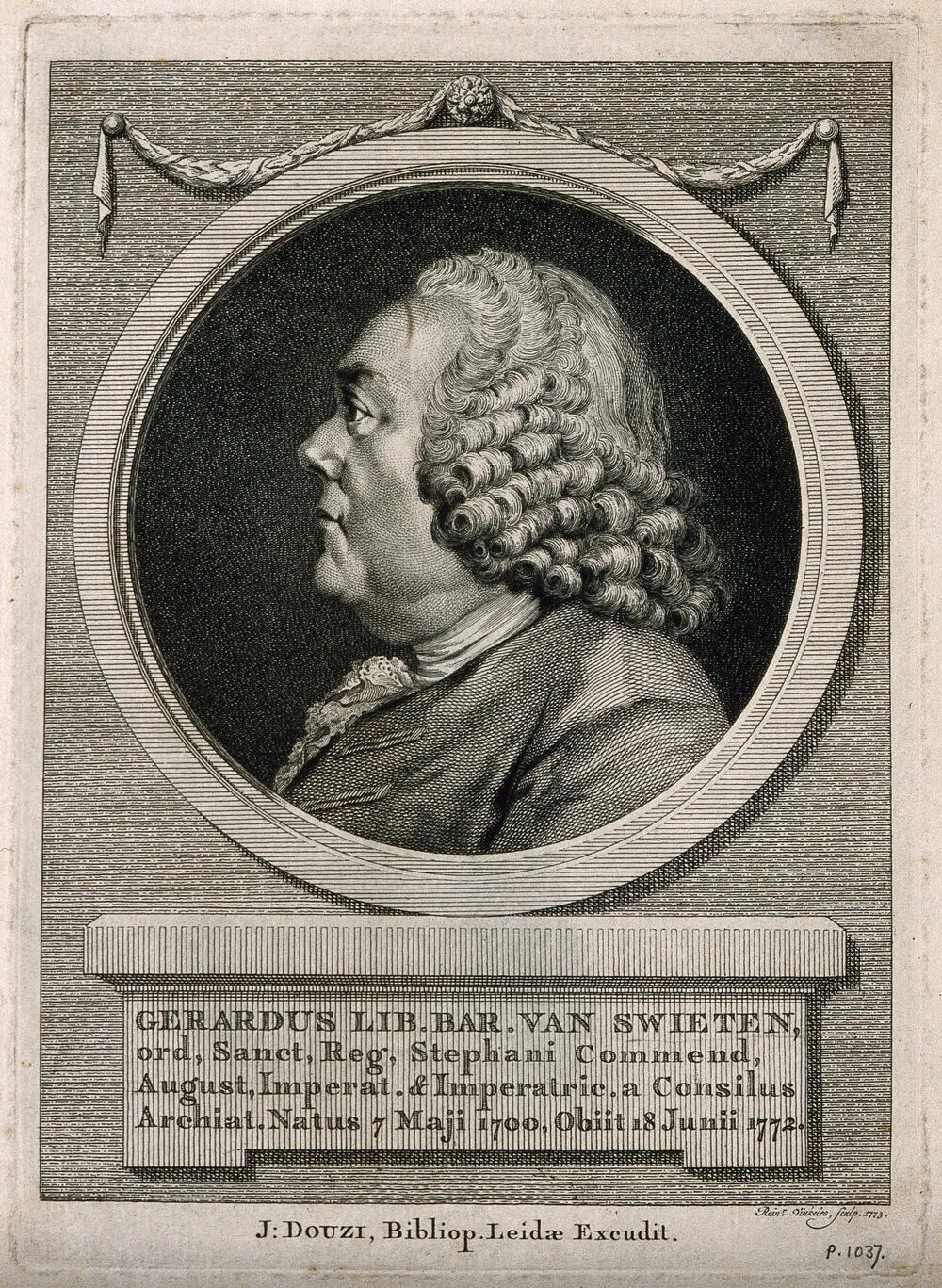
Gerard van Swieten, line engraving by Reinier Vinkeles, 1773. Wellcome Collection, Public Domain Mark.
The first body he names is Rosina Polakin’s:
Rosina Polakin stirbt den 22. December 1754. Den 19. Jenner 1755. aber wird sie ausgegraben, und als eine des Verbrennen würdige Vampyrinn erkläret, weil sie noch nicht verfaulet gewesen.24
Rosina Polakin dies on 22 December 1754. On 19 January 1755 she is dug up and declared a vampire worthy of burning, because she had not yet rotted.
Anatomists, he writes, keep bodies in open winter air for six weeks, or two months, without decay, and that winter had been unusually cold. “Welche Unwissenheit! erschreckliche Dummheit!” he writes: what ignorance, what dreadful stupidity.35 He notes that the consistory’s paper speaks of certain “signs and marks” in the vampires’ bodies and describes none.35 The witnesses on whose account the sentence was passed, he says, were two “bathers” who admitted to the commissioner that they had never seen an opened body.38 Enenklová notes that the attestation was signed by a surgeon and a town physician, so “bathers” is van Swieten’s word for them, not their title.39
He mocks the villagers’ stories too. A sow that grunted past a house, he says, was taken for a risen vampire.40 He also says Marianna received the sacraments, died in the church and was buried with Christian ceremonies, “and 18 months after her death she must be a witch worthy of burning”.41
The decree
The order of 1 March 1755 is the document the telling treats as the result.18 It is a single paragraph, and the part about Hermersdorf is one sentence:
wie dann letzthin in Marggrafthum Mähren die Sache soweit getrieben worden ist, daß von der Geistlichkeit verschiedene Körper unter dem Vorwande, daß sie mit dem sogenannten Magia posthuma behaftet gewesen, aus dem Freudhofe ausgegraben, und einige davon verbrennet worden18
as has lately gone so far in the Margraviate of Moravia that the clergy had various bodies dug up out of the churchyard on the pretext that they were afflicted with so-called magia posthuma, and some of them burned
The order blames “some clergymen full of prejudice” for encouraging the people’s credulity, says the investigation afterwards found “nothing but what was natural”, and from now on forbids the clergy to take up such matters without the political authority. Every case of a ghost, witchcraft, treasure-digging or alleged possession is to be reported to the civil authority and examined with “a sensible physician”.18 It does not name van Swieten. It places the village in Moravia, where the letters of 8 and 9 February and the protocol of 17 March say Silesia.42
No document we read says the order followed his remarks. If Enenklová’s date for the manuscript is right, his remarks are a week older than the order. The protocol of 17 March, which cites his treatise, treats the order as already issued.1737
The protocol went on to propose what to do with the village. The Jesuit college at Troppau should send one or two clergymen for four or six weeks to talk the people out of their error, with van Swieten’s treatise to help them; a provincial physician should go to treat the sick, because the villagers’ health had suffered; and the treatise should be printed in German and Latin. Underneath the proposal the empress wrote “placet”.32 The protocol also reports that the neighbouring community of Breithensdorf had asked to be separated from the burial ground it shared with Hermersdorf, and that the sick and the pregnant had themselves carried away from the village, for fear of being infected and burned.43 The Jesuits, Ignaz Zinner and Martin Baroch, arrived in mid-May. Zinner slept twice in the house of Wentzel Stoppel, a witness, where the nights were said to be restless. Metzner reported to the consistory that they kept talking to the people to calm their fear, and does not say whether it helped.44
Who paid
On 22 March the empress wrote to the bishop of Olomouc, Cardinal Troyer. In Enenklová’s reading she called what had happened “eine große Unwissenheit”, held the bishop responsible, and asked how his consistory could have been misled by two surgeons without medical training.45 The consistory had to repay the cost of the inquiry, 222 gulden 44 kreuzer.46 To the Silesian Representation she named the lawyer Czerný and the manor official Dworský. Czerný lost his practice for a year; Dworský was fined 100 gulden.47 Dworský’s plea for a pardon was refused on 4 May, and Czerný’s suspension was cut by half in November.48
Enenklová does not fully accept the empress’s division of blame. She argues that the local clergy hesitated, trying blessings and charms before asking to open graves, and that the consistory relied on its commissioners and the surgeons’ attestation.49 She also asks why Marianna was the one picked out, since nothing in the writing shows her defying the church. Several of the witnesses against her had ties to the reeve’s household, and the reeve, Paul Saliger, held his office until his death in 1757; his youngest daughter was born on 10 February 1755, in the middle of the case.50 Enenklová does not settle the question, and neither can we. Of Marianna’s three sons, Enenklová found nothing after the burning.50
Two items in a Hamburg paper
Hamburg’s Reichs-Post-Reuter printed two items on the affair. The first, on 4 April, is an unsigned dispatch “from Upper Silesia, 16 March”. It calls the dead woman “the Tyrolean doctor”, says she had told her husband to cut off her head after her death, and says thirty were dug up, ten found innocent and buried again, and the 19 adults and one child in whom blood was found beheaded, their hearts pierced and their bodies burned, “on imperial order”.5 Neither Linzbauer’s protocol, van Swieten nor Enenklová’s account of the church and manor files mentions beheading or staking, and the order did not come from Vienna: the consistory handed the bodies to the manor court on 23 January.525
The second item, printed on 6 May, is a Vienna notice dated 23 April.6 The empress, it says, sent a commission, which found that the whole affair came from the corrupted imagination of the peasants there, that what the newspapers had spread about it was false, and that
diese greuliche Execution einzig und allein aus eigenem Antriebe der dortigen Einwohner ohne Vorwissen der gehörigen Landesstelle vollzogen worden sey6
this horrible execution was carried out solely and entirely on the inhabitants’ own initiative, without the knowledge of the proper provincial office
That leaves out the consistory, its commissioners and the manor’s court and officials, whom the empress’s letters of 22 March blame.64547 Whether the provincial office knew in time is a separate matter, and the one place where the notice and the letter agree: she wrote that Dworský should have reported much earlier.7
The story against the papers
| The story | The record | Verdict |
|---|---|---|
| The dead woman told her husband to cut off her head5 | In no other source we read | Unsupported |
| The burning was on imperial order5 | The consistory handed the bodies over on 23 January25 | Contradicted |
| The dead were beheaded and staked5 | Only the dispatch says so | Unsupported |
| The villagers acted alone6 | Priests, a consistory commission and a manor court took part2325 | Disputed |
| Maria Theresa sent doctors to stop the burning11 | Burned 31 January; earliest letter we found 8 February12 | Contradicted |
| The doctors examined Marianna Saligerin’s body11 | It was ash before they arrived on 11 February; they opened three others311 | Contradicted |
| The decree followed van Swieten’s findings11 | His remarks date from February or March; no document says the order followed them1617 | Unsupported |
The telling is right about the outcome. After 1 March the clergy could not take up such cases on their own authority.18 What it leaves out is the order of events, and the two courts and the lawyer that carried the fire out.
The 1768 preface puts the news in Vienna on 30 January 1755, the day twelve men on the Heraltice manor voted for the fire.3025 Vienna’s earliest papers are dated 6 and 8 February. We found nothing that says who wrote to Vienna in the days between, or whether anyone did before the bodies were burned.
What we could not verify
Sources we have not seen
- Klaus Hamberger’s Mortuus non mordet (1992), which covers Habsburg vampire cases in Moravia and Silesia and could give the empress’s orders from the archive instead of Linzbauer’s extracts. It is in copyright and out of print, and we found only second-hand copies listed.
- Gábor Klaniczay, “Decline of Witches and Rise of Vampires in 18th Century Habsburg Monarchy” (Ethnologia Europaea, 1987), which treats van Swieten’s part. It is behind the publisher’s paywall (22 US dollars).
- Berlin newspapers of 1755. Enenklová says a Berlin paper carried a distorted account of the case. The Staatsbibliothek’s newspaper portal lists no 1755 issues of the Berlinische privilegirte Zeitung, and the Deutsches Zeitungsportal’s search of 1755 returned only Hamburg and Munich papers.
Seen only where others quote them
- The consistory’s file at the Opava archive’s Olomouc branch: the hearings, the attestation of 19 January, the manor’s report on the burning and Zehe’s account of 11 February. We read it through Enenklová (2021). The archdiocese owns the fonds, and copying and publishing need its consent, according to the archive’s own page; we found no digitised copy.
- Vienna’s “Akten Schlesien” (Austrian State Archives, Allgemeines Verwaltungsarchiv, Inneres, Hofkanzlei, Protokoll Schlesien 1755), where Enenklová finds letters of 6 and 8 February and the penalty on Dworský. We found no online finding aid or images for it.
Resting on a single source
- That the dead woman told her husband to cut off her head after her death. Only the dispatch of 16 March says so.
Questions we could not settle
- Whether the surgeon Wabst who signed the attestation of 19 January and the physician Wabst whom the empress sent are two men. Enenklová gives the first as Johann Peter and the second as Christian, and does not say.
- What van Swieten’s “23 April 1731”, when the consistory is said to have burned nine bodies, seven of them children, refers to. Enenklová lists an inquiry at Svobodné Heřmanice in 1731 among the earlier cases on the manor, but we found no source that ties the two together.
- Why the order of 1 March puts the village in Moravia.
Read next
CaseKisiljevo and Medveđa, Serbia, 1725 to 1732
Plogojowitz and Paole: the vampire reports of 1725 and 1732
TaleMiyoshi, Hiroshima, Japan, 1749 to 1859
The Inō mononoke roku: where the demon king's mallet came from
CaseVärend, Småland, Sweden, 1883 to 1889
The lindworm reward in Småland was never claimed
Sources
- Monika Enenklová, "Jinak než spálením podezřelých těl nelze" (doctoral thesis, Masaryk University, Brno, 2021), pp. 200, 211 to 213
- Reichs-Post-Reuter, 4 April 1755, p. 3 to p. 4 (primary) transcription
- Monika Slezáková, Vampyrismus a jeho projevy na severní Moravě a ve Slezsku v 17. a 18. století (bachelor's thesis, Masaryk University, Brno, 2011), p. 40↑
- Linzbauer, Codex sanitario-medicinalis Hungariae, vol. 1 (Buda, 1852-1856), Mantissa, printed p. 722 (primary) transcription↑
- Gerard van Swieten, Vampyrismus, in Abhandlung des Daseyns der Gespenster (Augsburg, 1768), p. 22, note m (primary) transcription↑
- Reichs-Post-Reuter, 4 April 1755, p. 3 right column, continued on p. 4 (primary) transcription↑
- Reichs-Post-Reuter, 6 May 1755, p. 2 right column (primary) transcription↑
- Linzbauer, Codex sanitario-medicinalis Hungariae, vol. 1 (Buda, 1852-1856), Mantissa, printed pp. 723 to 724 (primary) transcription
- Gerard van Swieten, Vampyrismus, in Abhandlung des Daseyns der Gespenster (Augsburg, 1768), p. 22, note m (primary) transcription
- Monika Enenklová, "Jinak než spálením podezřelých těl nelze" (doctoral thesis, Masaryk University, Brno, 2021), pp. 211 to 212↑
- Austrian National Library blog, "Untot seit dem 18. Jahrhundert: Der erste Vampirhype", section "Einschreiten van Swietens und der Kaiserin"↑
- Linzbauer, Codex sanitario-medicinalis Hungariae, vol. 1 (Buda, 1852-1856), Mantissa, printed p. 722 (primary) transcription
- Gerard van Swieten, Vampyrismus, in Abhandlung des Daseyns der Gespenster (Augsburg, 1768), preface, note a, pp. a2 to a3 (primary) transcription
- Monika Enenklová, "Jinak než spálením podezřelých těl nelze" (doctoral thesis, Masaryk University, Brno, 2021), p. 214 and n. 711↑
- Gerard van Swieten, Vampyrismus, in Abhandlung des Daseyns der Gespenster (Augsburg, 1768), preface p. a2, title page (primary) transcription↑
- Monika Enenklová, "Jinak než spálením podezřelých těl nelze" (doctoral thesis, Masaryk University, Brno, 2021), p. 219 and n. 723 (ZAO, ACO C13, inv. 2280, fols. 445 to 455)↑
- Theresianisches Gesetzbuch, no. 385 (Austrian National Library, ALEX), no. 385, pp. 172 to 173 (primary) transcription
- Linzbauer, Codex sanitario-medicinalis Hungariae, vol. 1 (Buda, 1852-1856), Mantissa, printed p. 724 note (primary) transcription
- Monika Enenklová, "Jinak než spálením podezřelých těl nelze" (doctoral thesis, Masaryk University, Brno, 2021), pp. 215 to 216↑
- Linzbauer, Codex sanitario-medicinalis Hungariae, vol. 1 (Buda, 1852-1856), Mantissa, printed p. 723 (primary) transcription↑
- Monika Enenklová, "Jinak než spálením podezřelých těl nelze" (doctoral thesis, Masaryk University, Brno, 2021), pp. 200 to 202, 228 (parish registers of Velké Heraltice, ZAO)
- Monika Slezáková, Vampyrismus a jeho projevy na severní Moravě a ve Slezsku v 17. a 18. století (bachelor's thesis, Masaryk University, Brno, 2011), pp. 38 to 39↑
- Monika Enenklová, "Jinak než spálením podezřelých těl nelze" (doctoral thesis, Masaryk University, Brno, 2021), pp. 202 to 208, 226 (ZAO, ACO C13, inv. 2279, 2280)↑
- Gerard van Swieten, Vampyrismus, in Abhandlung des Daseyns der Gespenster (Augsburg, 1768), p. 21 (primary) transcription
- Linzbauer, Codex sanitario-medicinalis Hungariae, vol. 1 (Buda, 1852-1856), Mantissa, printed p. 724 (primary) transcription
- Monika Enenklová, "Jinak než spálením podezřelých těl nelze" (doctoral thesis, Masaryk University, Brno, 2021), p. 211 (ZAO, ACO C13, inv. 2280, fols. 555 to 556)↑
- Gerard van Swieten, Vampyrismus, in Abhandlung des Daseyns der Gespenster (Augsburg, 1768), p. 22, note m (primary) transcription↑
- Gerard van Swieten, Vampyrismus, in Abhandlung des Daseyns der Gespenster (Augsburg, 1768), preface, note a (primary) transcription↑
- Monika Enenklová, "Jinak než spálením podezřelých těl nelze" (doctoral thesis, Masaryk University, Brno, 2021), pp. 212 to 215 and nn. 710 to 713↑
- Linzbauer, Codex sanitario-medicinalis Hungariae, vol. 1 (Buda, 1852-1856), Mantissa, printed pp. 722, 725 (primary) transcription↑
- Linzbauer, Codex sanitario-medicinalis Hungariae, vol. 1 (Buda, 1852-1856), Mantissa, printed pp. 723 to 724 (primary) transcription↑
- Linzbauer, Codex sanitario-medicinalis Hungariae, vol. 1 (Buda, 1852-1856), Mantissa, printed p. 723 (primary) transcription
- Gerard van Swieten, Vampyrismus, in Abhandlung des Daseyns der Gespenster (Augsburg, 1768), pp. 20 to 21 (primary) transcription
- Monika Enenklová, "Jinak než spálením podezřelých těl nelze" (doctoral thesis, Masaryk University, Brno, 2021), pp. 200 to 201↑
- Linzbauer, Codex sanitario-medicinalis Hungariae, vol. 1 (Buda, 1852-1856), Mantissa, printed pp. 723 to 725 (primary) transcription↑
- Theresianisches Gesetzbuch, no. 385 (Austrian National Library, ALEX), no. 385, p. 172 (primary) transcription
- Linzbauer, Codex sanitario-medicinalis Hungariae, vol. 1 (Buda, 1852-1856), Mantissa, printed pp. 722 to 723 (primary) transcription↑
- Linzbauer, Codex sanitario-medicinalis Hungariae, vol. 1 (Buda, 1852-1856), Mantissa, printed p. 724 (primary) transcription↑
- Monika Enenklová, "Jinak než spálením podezřelých těl nelze" (doctoral thesis, Masaryk University, Brno, 2021), pp. 216 to 217 (ZAO, ACO C13, inv. 2280, fols. 463 to 466)↑
Documents quoted
- Linzbauer, Codex sanitario-medicinalis Hungariae, Mantissa: Maria Theresa's letters of 8 and 9 February 1755 and the protocol of 17 March 1755 (transcribed from the page image)
- Reichs-Post-Reuter, 4 April 1755: the dispatch "Aus Oberschlesien, vom 16 März" (transcribed from the page image)
- Reichs-Post-Reuter, 6 May 1755: Vienna's notice of 23 April (transcribed from the page image)
- Theresianisches Gesetzbuch, no. 385: Maria Theresa's order of 1 March 1755 against superstition (transcribed from the page image)
- Van Swieten, Vampyrismus (Augsburg, 1768): the Hermersdorf passages and the editor's preface (transcribed from the page image)