 Twice Told
The Kinderdijk cradle and its cat: first ashore at Dordrecht
A baby in a cradle, with a cat keeping it level, is said to have given Kinderdijk its name in 1421. The oldest text we found with the cat names no dike.
Contents
Published 17 Oct 2026. Sources checked 15 Oct 2026.
In November 2022 the Kinderdijk World Heritage site announced a bronze cradle that floats and rocks on the water, in memory of a baby and a cat said to have drifted to its dike in the St Elizabeth flood.6 The oldest text we found with the cat in it names no dike and no place.7 It says only that of 72 drowned villages one infant escaped, and a cat with it, both afloat in the same cradle.7
The story, as the Kinderdijk site and the Biesboschmuseum tell it now, goes like this.
In the night of 18 November 1421 the dikes broke.6 When the survivors dared to go outside again, they saw a cradle floating along the dike, and from it came the cry of a child.6 A cat in the cradle jumped back and forth to keep it from sinking, and so kept the baby alive.6 The girl, Beatrijs, washed up healthy.8 Grown up, she married a rich merchant.8
A painting of 1850
The cat that balances the cradle is at least as old as 1850 in print. On 26 March 1850 the Rotterdamsche courant described a painting by S. Opzoomer, a Rotterdammer living in Antwerp: a sleeping child in a cradle on stormy water, and on the rim a cat that looks terrified.9 The paper called it the well-known story of the flood of 18 November 1421, when a cradle with a child came ashore on a dike near Dordrecht, “the Kinderdijk” ever since, while a cat kept the cradle level by jumping from its lowest rim to its highest.9 Other papers printed the same notice that week.9 A review of the Rotterdam exhibition in June did not care for the subject, but gave the story in a clause: a child saved by a cat’s instinct, giving the place the name Kinderdijk.10
Five years earlier van der Aa’s gazetteer had a weaker form. Its entry for the dike says that some maintain Kinderdijk took its name from a child who is said to have drifted there with a cradle in the flood, and that others hold the dike bore the name earlier.5 There is no cat.5 In 1953 P. Hoekstra, writing in De Nieuwe Stem, called the tale of the cradle and its rocking cat “evenzeer aanvechtbaar”, as open to challenge as the 72 villages.11
In 2021 Alfons van Bokhorst of the Biesboschmuseum told Omroep Brabant that the altar painting of the flood, made around 1490, shows the cradle, and called the whole tale a “broodjeaapverhaal”.8 The painting is in the Rijksmuseum, on two panels. The museum’s description lists a breach, boats, drowned people and cattle, and no cradle, and Schiereck and Visser, who go through the scenes one by one, name none either.12
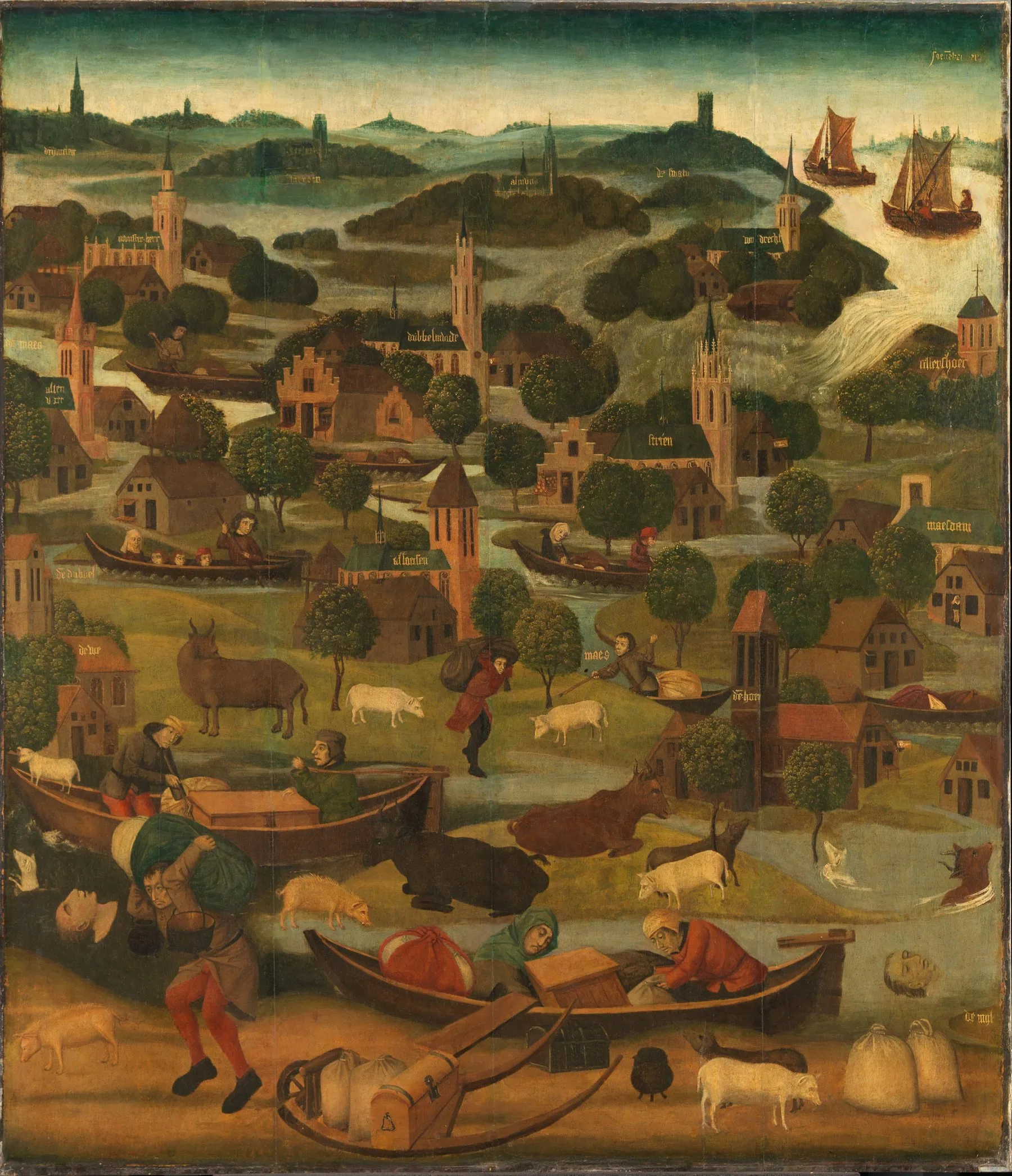
“The Saint Elizabeth’s Day Flood”, Master of the St Elizabeth Panels, c. 1490 to 1495, outer face of the right panel. Rijksmuseum, SK-A-3147-B, Public Domain Mark.
We looked at both panels in the Rijksmuseum’s scans and found no cradle. That is our reading of an image, not a finding about the painting, and the curator may mean a detail we did not see.
A baby with a family tree
In everything we could read, the cradle reaches Kinderdijk only in the 1840s. In 1677 the baby belongs to Dordrecht. Mathias Balen’s history of that city, printed there that year, is the oldest text we found that gives the child a name and puts a cat on the cradle.13 In Balen’s telling the child drifts in as the Great Waard goes under, with a cat for company, reaches Dordrecht, is named Beatrix, and later marries Jakob Roerom.13
Kwam aan drijven een Kind in een Wiege, (daar ook een Kat was op zittende;)13
A child came drifting in a cradle (with a cat sitting on it as well).
The line comes from the Roerom family entry.13 Balen uses the couple as founders of a line: many distinguished families in Dordrecht and elsewhere, he says, trace their descent from them.13 His text does not use the name Kinderdijk.14 Nor does the key of his own plate, which lists “the child in the cradle, saved”.15 The Rijksmuseum’s catalogue entry for the plate adds, in its own words, that the child is “by tradition the origin of the name Kinderdijk”.16 That is the catalogue speaking, not Balen.
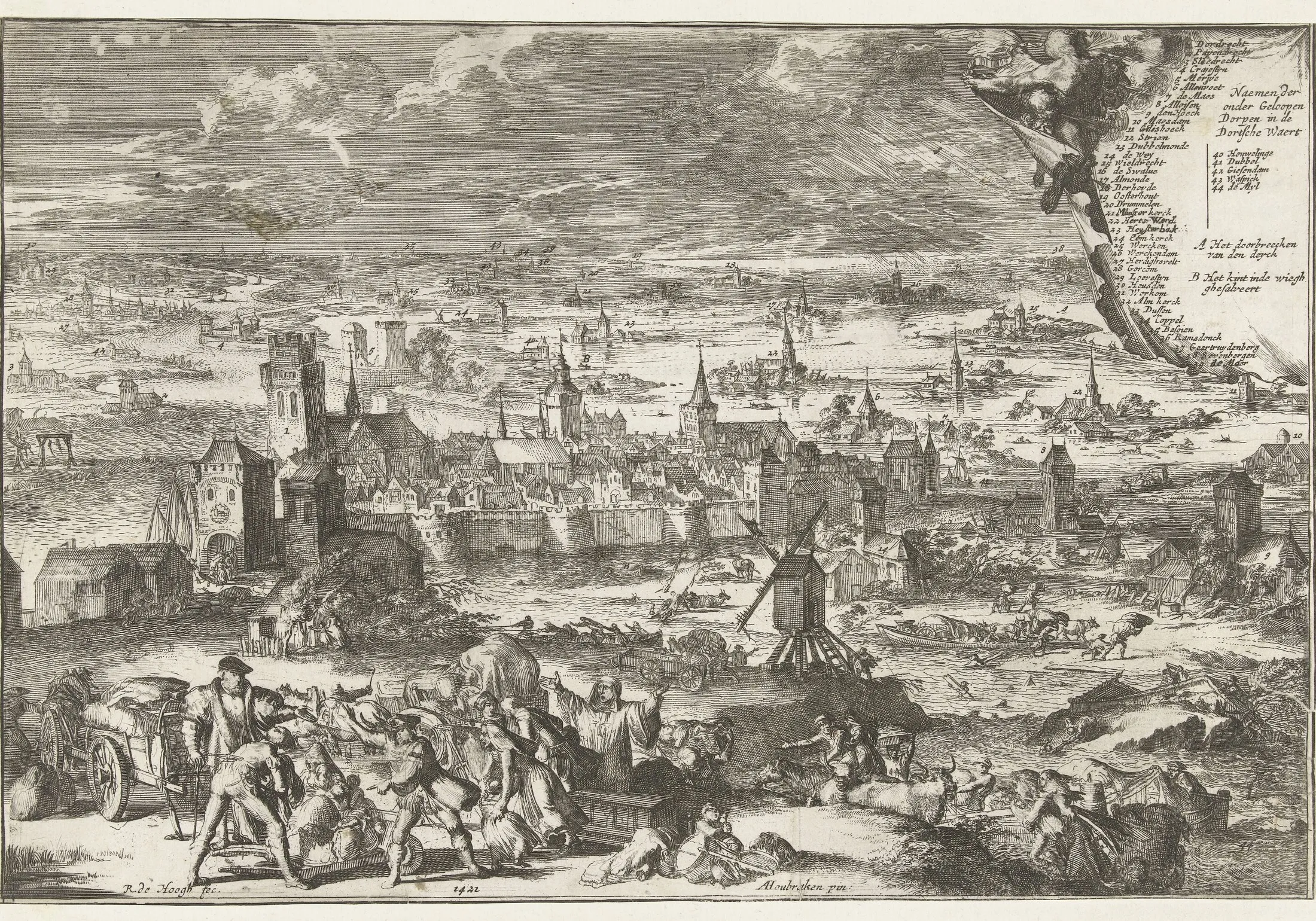
“Sint Elisabethsvloed, 1421”, Romeyn de Hooghe after Arnold Houbraken, an illustration for Balen’s Beschryvinge der stad Dordrecht, 1677. Rijksmuseum, RP-P-OB-76.843, Public Domain Mark, cropped.
The plate’s cartouche names 44 drowned villages, while Balen’s text says 72.1517 The 72 had a long life in Dordrecht: Schiereck and Visser report a rhyme about 72 parishes cut into the stones of the Spuipoort, and a city archivist who still wrote in 1931 that “our ancestors did not have lies cut in stone”.18
The Latin letter that Junius kept
Almost a century before Balen, Hadrianus Junius printed a letter that has the cat but no city. His Batavia (Leiden, 1588) breaks off to reprint a letter on Holland by a “Chrysostomus of Naples”, which Junius reckons was written in 1514.7 The letter says that 93 years earlier the Ocean, angry, its writer thinks, broke its bounds and drowned a great part of Holland, and in it 72 villages.7
è quibus omnibus vnum tantum infantem elapsum natu grandiores affirmant, & cum eo felem, vt in ijsdem fortè cunis vterque inuentus innatauit7
of all of them, the older people say, only one infant escaped, and a cat with it, both found afloat, as it happened, in the same cradle
The older people are the source, so the child and the cat are hearsay from the start, with no name, no landing place and no dike.7 The 93 years are the letter’s only date. Junius’s 1514, and the reading of those years as the flood of 1421, are his sum and ours.7 The cat is in the cradle with the child, and nothing in the sentence has it keeping anything level.
What the chroniclers wrote
The Divisiekroniek, printed at Leiden in 1517, tells the storm in one chapter, with no child, cradle or cat.219 It dates the storm to St Elizabeth’s night in 1421, says the dike between Geertruidenberg and Dordrecht gave way, and says 72 parish churches had stood in the farmland behind it.117 Guicciardini’s description of the Netherlands (1567) tells it under Dordrecht, again without a cradle.2 Over the following years most of the Grote Waard was lost and the Biesbosch took its place.20
The night itself is disputed. Fockema Andreae, as Hoekstra reports him, has the dike give way at Wieldrecht in the night of 17 to 18 November.21 Schiereck and Visser put the flooding in the night of 18 to 19 November.21 The dike at Werkendam broke again at the end of December.22 The city account of Dordrecht for 1421 records bread, beer and cheese for the poor and says nothing about the drowned.23
Kinderdijk was not in the drowned land. It is a stretch of dike in the Alblasserwaard, from the dam at Alblasserdam to the edge of Nieuw-Lekkerland, while the Grote Waard that the breach drowned lay either side of the Maas between Maasdam and Heusden.24
How many drowned
The sources disagree on the dead because they count in different ways: some report, one calculates. Hoekstra says the 72 villages come from a chronicler at Neuss and that a later writer added the 100,000.25 Schiereck and Visser call both figures impossible for a Waard with fewer than 30 villages.2526 They reach “a few dozen” by calculating flood depths and rising speeds, not from a record, and they note that the Tiel chronicle’s 2,000 is not a count for the Waard itself.327
| Source | Date | Villages | Dead |
|---|---|---|---|
| Tiel chronicle, as quoted | c. 1450 | none given | 2,000, “so it is said”27 |
| Divisiekroniek | 1517 | 72 parish churches17 | “many thousands”17 |
| Guicciardini | 1567 | 724 | over 100,0004 |
| Balen | 1677 | 72 in text, 44 on plate1715 | “many thousands”17 |
| Schiereck and Visser | 2021 | under 30 in the Waard26 | a few dozen3 |
| Rijksmuseum panel text | undated | 2328 | 2,00028 |
The range from a few dozen to over 100,000 is the width of the disagreement, not an estimate of ours.34
What we could not verify
Sources we have not seen
- The first printing of the letter Junius reprints. Search results point to a Leuven print by Dirk Martens with Martinus Dorpius, and a copy would show whether the cradle and the cat were told before 1514. No scan turned up in our title and full-text searches of archive.org on 15 October 2026, and we found only catalogue records elsewhere.
- Jacob van der Eyck’s Corte beschrijvinge of South Holland (Dordrecht, 1628), p. 74, which is cited for another derivation of the name: the dike’s upkeep given up by “the children of Giessen” after the flood. It would date an explanation of the name before 1677. It is not on archive.org, and Google Books and DBNL refused our requests.
- Junius’s own chapter on the flood, in the 2011 Dutch translation by De Glas, pp. 317 to 318, which Schiereck and Visser cite for the 72 villages and 100,000 dead. It is a modern book we could not find online.
Seen only where others quote them
- The Tiel chronicle and the Dordrecht city account of 1421, which we read only where Schiereck and Visser quote or summarise them.
Questions we could not settle
- When the name Kinderdijk first appears in writing, and what it meant. Van der Aa reports a claim that the dike bore the name before the story, and we found no document to date it.
- Whether the cradle was told in Dordrecht before Balen printed it. His book names no source for it.
Read next
TaleEdam and Haarlem, Holland, Netherlands, 1403 to 1786
Before the Edam mermaid had a tail
TaleKyoto and Obama (Wakasa), Japan, 1449 to 1764
Yao Bikuni, the nun shown in Kyoto in 1449
TaleWawel hill, Kraków, Poland, the end of the 12th century to 1597
Kraków's Wawel dragon had no cobbler until 1597
Sources
- Cornelius Aurelius (attributed), Die cronycke van Hollandt, Zeelandt ende Vrieslant (Divisiekroniek, Leiden, 1517), ed. A. de Hamer (DBNL, 2011), section on Countess Jacoba, "Hoe thele lant van Zuyt-Hollant van den storme inbrack. Dat XIX capitel", fol. 265r to 266r (DBNL page 0647): "Int jaer Ons Heren M IIII C XXI, op Sinte Lijsbetten nacht ... bisonder die dijc tusschen Geertenberge ende Dordrecht" (primary)
- G.J. Schiereck and P.J. Visser, "De Sint-Elisabethsvloed: Feiten en fictie", in H. van Asperen, M. Eekhout and L. Jensen (eds), De grote en vreeselijke vloed (De Bezige Bij, 2021), pp. 135 to 150 (accepted author manuscript, TU Delft repository), opening list of what the written sources establish: storm around 18 November, a breach "ergens in de zuidwest hoek van de dijk om de Grote Waard"
- G.J. Schiereck and P.J. Visser, "De Sint-Elisabethsvloed en de onafwendbare teloorgang van de Grote Waard", Tijdschrift voor Waterstaatsgeschiedenis 30:1 (2021), pp. 13 to 25, p. 13, second paragraph: the storm is reported "in contemporaine stukken" with damage in Zeeland and Holland↑
- Divisiekroniek, DBNL edition, ch. XIX (fol. 265r to 266r), whole chapter (primary)
- Guicciardini, Descrittione (1567), p. 178, Dordrecht entry, whole passage (primary)
- Balen, Beschryvinge der stad Dordrecht (1677), vol. 2, p. 769, whole account of 1421 (primary)↑
- Schiereck and Visser, TWG 30:1 (2021), p. 18, section 4 "Aantal slachtoffers", after rules a to c; the same conclusion is in "Feiten en fictie", section "Reconstructie"↑
- Lodovico Guicciardini, Descrittione di tutti i Paesi Bassi (Antwerp, 1567), p. 178, Dordrecht entry, last paragraph: "dall'anno M.CCCC.XXI ... settata due buoni villaggi coprirono: ne quali piu di cento mila persone ... perirono" (the scan prints the number with a tilde) (primary)↑
- A.J. van der Aa, Aardrijkskundig woordenboek der Nederlanden, vol. 6 (I to K) (Gorinchem, 1845), p. 450, entry "Kinderdijk, dijk in den Alblasserwaard" transcription↑
- Hadrianus Junius, Batavia (Leiden, 1588), pp. 182 (foot) to 183 (head), italic text beginning "Olandia omnis"; Junius's introduction on p. 182: "reuocata ad calculum ratione scripsisse videtur anno sesquimillesimo quarto et decimo" (primary) transcription↑
- Omroep Brabant, "Baby Beatrijs overleeft in drijvend wiegje de stormvloed, dankzij een kat", 24 November 2021, the quotes under the headline and the last paragraphs↑
- Rotterdamsche courant, 26 March 1850, art. 6 ("Rotterdam den 25 maart"), via Delpher; the same notice runs in the Nieuwe Rotterdamsche courant of 27 March 1850 (art. 11), the Algemeen Handelsblad of 27 March (art. 3) and the Arnhemsche courant of 28 March (art. 6), all with the same wording, which we treat as reprints, OCR text of the article, read through the KB's SRU interface; only phrases are quoted (primary)↑
- Nieuwe Rotterdamsche courant, 14 June 1850, art. 3 ("Rotterdamsche tentoonstelling. Schilderijen van levende meesters. II"), via Delpher, OCR text of the article; only phrases are quoted (primary)↑
- P. Hoekstra, De Nieuwe Stem 8 (1953), p. 342, after the sentence on the Neuss chronicler↑
- Rijksmuseum, SK-A-3147-B and SK-A-3147-A, catalogue descriptions (and our own look at the Rijksmuseum's image scans, 2026-10-15), Description field of SK-A-3147-B: breach top right, people saving themselves and belongings in boats, bodies of drowned people and cattle in the water; no cradle named
- Schiereck and Visser, "Feiten en fictie" (2021), section "Historische achtergrond", paragraph on the panels: two ships on the river, people in boats, cattle in the pasture, a mother with a child in Dordrecht, two bodies in the water↑
- Mathias Balen, Beschryvinge der stad Dordrecht (Dordrecht, 1677), vol. 2, p. 770, left column (after the Spuipoort verse), and the Roerom family entry on p. 1205 ("daar ook een Kat was op zittende"); index entry "Kind in de Wiege, op 't Water drijvende, zeldzaam gebergd, 770, 1259" (primary) transcription↑
- Balen, Beschryvinge der stad Dordrecht (1677), vol. 2, archive.org copy beschryvingeders02bale, OCR text search 2026-10-15 plus reading of pp. 769, 770, 1205 and the plate (primary)
- Balen, Beschryvinge der stad Dordrecht (1677), vol. 2, archive.org copy beschryvingeders02bale_0, OCR text search 2026-10-15 (index entry "Kind in de Wiege" lists pp. 770 and 1259 and no Kinderdijk entry appears) (primary)↑
- Balen, Beschryvinge der stad Dordrecht (1677), vol. 2, folding plate between pp. 768 and 769 (scan leaf n90): cartouche "Naemen der onder Geloopen Dorpen in de Dorsche Waert", numbers 1 to 44, key letters A and B (primary)
- Rijksmuseum, "Sint Elisabethsvloed, 1421", RP-P-OB-76.843, catalogue description: "de namen der 44 ondergelopen dorpen en aanduiding van het geredde kind in een wieg"; creation "Romeyn de Hooghe ... after painting by Arnold Houbraken"; "Illustratie voor: M. Balen, Beschryvinge der stad Dordrecht ... 1677"↑
- Rijksmuseum, "Sint Elisabethsvloed, 1421", RP-P-OB-76.843, description field (the catalogue's wording, not Balen's)↑
- Divisiekroniek, DBNL edition, ch. XIX, fol. 265r: "dair wel LXXII prochikerken in stonden" and "menich dusent menschen, dye dair verdroncken" (primary)
- Mathias Balen, Beschryvinge der stad Dordrecht (Dordrecht, 1677), vol. 2, p. 769, right column: "daar wel 72. Karspel-Kerken ... in waren, vernield, veel duyzend Menschen zijn verdronken" (primary) transcription↑
- Schiereck and Visser, "Feiten en fictie" (2021), section "Historische achtergrond", the paragraph on the Spuiboulevard stones↑
- Schiereck and Visser, "Feiten en fictie" (2021), opening list, third point: "vrijwel de hele Grote Waard verloren ... de Biesbosch is ontstaan"
- Schiereck and Visser, TWG 30:1 (2021), p. 13, first paragraph: the Grote Waard "ging ten onder en een natuurgebied, de Biesbosch, ontstond"
- P. Hoekstra, "Historische kanttekeningen bij de waterramp", De Nieuwe Stem 8 (1953), pp. 341 to 349, p. 342: the area "van 20 bij 40 km" was lost for good, more through disunity and lack of organisation than through the storm↑
- Hoekstra, De Nieuwe Stem 8 (1953), p. 342: "In de noodlottige nacht van 17 op 18 November 1421 begaf de dijk bij Wieldrecht het", after S.J. Fockema Andreae, Studien over waterschapsgeschiedenis III (1950)
- Schiereck and Visser, TWG 30:1 (2021), p. 13, first paragraph ("18/19 november 1421"); p. 18, the Tiel chronicle text in Dutch translation ("Daags na Sint Elisabeth (20 november) 1421"), quoted from J. Kuys et al. (eds), De Tielse kroniek (1983), pp. 151 to 152, which we did not open↑
- Hoekstra, De Nieuwe Stem 8 (1953), p. 342: "en in December de Merwedijk bij Werkendam"
- Schiereck and Visser, "Feiten en fictie" (2021), section "Reconstructie", paragraph after the figure: "Eind december 1421 brak ook nog eens de rivierdijk bij Werkendam"↑
- Schiereck and Visser, TWG 30:1 (2021), p. 13, second paragraph, citing J. van Herwaarden et al., Geschiedenis van Dordrecht tot 1572 (1996), pp. 160 to 161, which we did not open↑
- van der Aa, vol. 6 (1845), p. 450, entry "Kinderdijk, dijk in den Alblasserwaard": "het gedeelte van den Hoogendijk ... van den dam, gem. Alblasserdam, tot aan de limieten der gem. Nieuw-Lekkerland"
- Schiereck and Visser, "Feiten en fictie" (2021), opening list, second point: the Grote Waard, "ter weerszijden van de Maas, lopend van Maasdam tot Heusden"↑
- Hoekstra, De Nieuwe Stem 8 (1953), p. 342: a chronicler at Neuss "maakte er een calamiteit van, waarbij 72 welvarende dorpen ineens werden vernietigd" and a later writer added 100,000 dead; Hoekstra adds that Dordrecht was not made a Venice in one night
- Schiereck and Visser, TWG 30:1 (2021), p. 13, second and third paragraphs: 72 villages and 100,000 dead are "alternatieve feiten"; fewer than 30 villages lay in the Waard
- Schiereck and Visser, "Feiten en fictie" (2021), section "Historische achtergrond": 72 villages and 100,000 dead, "Dit kon dus onmogelijk waar zijn"↑
- Schiereck and Visser, TWG 30:1 (2021), p. 13, third paragraph, citing K. Leenders for the estimate↑
- Schiereck and Visser, TWG 30:1 (2021), p. 18, second quote under section 4, from Kuys et al. (eds), De Tielse kroniek (1983), pp. 151 to 152; we did not open the chronicle↑
- Rijksmuseum, "The Saint Elizabeth's Day Flood", Master of the St Elizabeth Panels, c. 1490 to c. 1495, SK-A-3147-B, English text on the record page↑
Documents quoted
- A.J. van der Aa, Aardrijkskundig woordenboek (1845): the entry for Kinderdijk (transcribed from the page image)
- Hadrianus Junius, Batavia (1588): a letter on Holland and the infant in the cradle (transcribed from the page image)
- Mathias Balen, Beschryvinge der stad Dordrecht (1677): the cradle and the cat (transcribed from the page image)