 Twice Told
Hackelberg, the wild huntsman, is buried in more than one place
Kirchhof wrote that he found Hackelberg's grave in the Solling in 1558. A Brunswick paper of 1756 reports a stone dated 1581. His identity is not secured.
Contents
Published 15 Oct 2026. Sources checked 10 Oct 2026.
Hans Wilhelm Kirchhof wrote that, if he remembered right, in 1558 he lost his way riding from Einbeck to Uslar and stumbled on Hackelberg’s grave.8 A Brunswick newspaper of 1756 reports a gravestone with the words “Anno Domini 1581. die 3 marcii”, twenty-three years after the year of Kirchhof’s ride.3 The two graves were not in one place: Kirchhof’s lay in the Solling wilderness, the stone was in a churchyard by an inn.83
The tale as the Brothers Grimm printed it, with a boar and a death in a hospital, is not in Kirchhof.910 The first place we found it is a book of 1800.2
The story, as the Brothers Grimm printed it in 1816, goes like this.
Hans von Hackelnberg was a Brunswick master of the hunt and a mighty hunter.9 One night at the Harzburg he dreamed he fought a fearsome boar, and the boar beat him after a long struggle.9 He could not shake the dream.9 Some time later he met a boar in the Vorharz that looked like the one in his dream, and this time he won.9 Glad to see it at his feet, he kicked at its terrible tusks and cried that it would not do it to him yet.9 He kicked so hard that a tusk went through his boot and wounded his foot.9
At first he took no notice and went on hunting.9 By the time he got back the foot was so swollen that the boot had to be cut off.9 He hurried back toward Wolfenbüttel, but the shaking of the wagon made the wound worse, and he only just reached the hospital at Wülperode, where he soon died.9 On his grave lies a stone showing an armoured knight on a mule.9
At midnight, in storm and rain, Hackelnberg drives with horse and hounds on a wagon through the Thuringian Forest, the Harz and, most gladly, the Hackel.11 A night owl, the Tut-Osel, flies ahead of him.11 Travellers who meet it throw themselves quietly on their bellies and let the wild huntsman pass over them, and soon they hear hounds barking.11
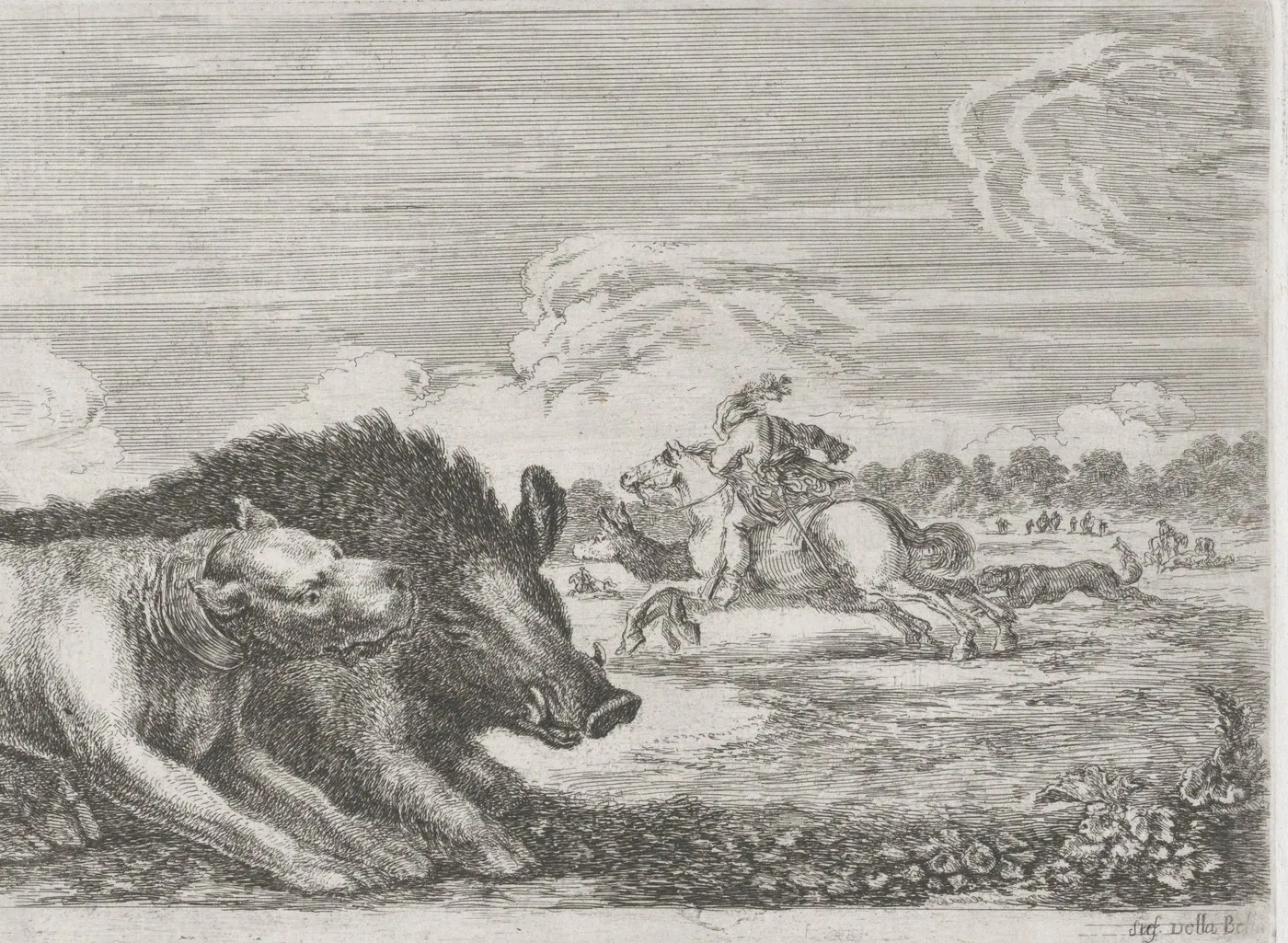
A boar chased by a hunting dog and a hunter on horseback, etching by Stefano della Bella, 1620 to 1664, from a series of hunting scenes. It is an Italian print of the seventeenth century and does not illustrate the Hackelberg story. Rijksmuseum, Amsterdam, RP-P-OB-35.014, Public Domain Mark, cropped.
A grave in the reeds
Kirchhof tells the story in Book IV of his Wendunmuth as no. 283, “Hakelberg jagt am Sölling”.10 It starts with a rumour: a master of the hunt in the Brunswick country, called Hakelberg, is said to have lived “vorzeiten”, once upon a time.1 On his deathbed he begged God, in place of his share of heaven, to let him hunt in the Solling until Judgment Day and ordered himself to be buried in that wilderness.1 His wish is granted: horns and hounds are heard at night, and when such a night hunt has been noticed, one of the men who hunt the next day is said to break a leg, an arm or his neck.1
Then Kirchhof puts himself in the story.8 He rode from Einbeck over the Solling to Uslar, “ist mir recht, anno 1558”, got lost, and came on the grave by accident.8 It was a clearing like a meadow, rough with reeds, more than one Acker, a field measure, with no trees on it.8 At the lower end lay a raised red stone, about eight or nine feet long and five wide, which he took to be a boulder.8 It lay north to south, not east to west like another gravestone.8
He had been told nobody could find the grave on purpose, and that grisly black hounds lie beside it when someone stumbles on it.12 He saw none:
Solches gespensts und wusts ward ich aber im geringsten nicht gewar, sonst hette ich wenig haar meines haupts, die nicht emporstiegen.12
I did not notice the slightest trace of such ghostly stuff and mess, or else I would have had few hairs on my head that did not stand on end.
What the entry leaves out is most of what later tellings rest on.10 It gives the hunter a surname and nothing else: no first name, no family, no year or place of death, no boar and no hospital.10 Nor does it mention Wülperode or an inscription.10
Oesterley, who edited the Wendunmuth, says Books 2 to 5 appeared in 1602 and that he had only a single print of the continuation.13 So Kirchhof’s 1558 reaches us in a book printed 44 years later, and 21 years after the date on the stone.1383 Oesterley’s own note calls the entry a “Sage” and dates the sighting “c. 1558”.14 The Brothers Grimm reprinted the passage in 1816 as Deutsche Sagen no. 171, in modern spelling.15
On our reading, if the stone’s date marks a death, the grave Kirchhof found was not that man’s.83
One stone, many addresses
The next document we could read is a reader’s query in the Braunschweigische Anzeigen, November 1756.3 It asks about an old helmet that people at the Adlerkrug inn by Wiedela ascribe to a Herr von Hackelnberg, and about a gravestone in the churchyard beside it.3 The stone shows a rider on a horse with two dogs running alongside, and carries the inscription.3
Auf dem Leichenstein stehet ein Reuter zu Pferde, nebst zween neben her laufenden Hunden mit der Ueberschrift: Anno Domini 1581. die 3 marcii.3
On the gravestone stands a rider on a horse, with two dogs running beside him, and the inscription: Anno Domini 1581, the 3rd of March.
The writer asks who the man was and whether anything else is known of him.3 Heise and Mischke, whose 2020 book on the legend we could read only in a publisher’s excerpt, quote a reply of 1757.16 The anonymous answerer noticed that descriptions of the stone differ, for instance in the number of dogs, advised sending an exact drawing to the Brunswick address office, and joked that Hackelnberg had not lived in older times, when such men were set among the stars.16 The one reading of the inscription we saw is the 1756 query’s.3
Other writers put the stone elsewhere and draw something else on it. Where each puts it, in order of date:
| Source | Where | The figure |
|---|---|---|
| Brunswick Anzeigen, 1747 (via Grimm and Heise and Mischke) | The Steinfeld | A mule and a hunting dog17 |
| Brunswick Anzeigen, 1756 | Churchyard by the Adlerkrug, Wiedela | A rider on a horse, two dogs3 |
| Hannoversches Magazin, 1764 (via Heise and Mischke) | Churchyard of the Mulms-Krug, Steinfeld | An armoured man on a mule, big hounds4 |
| Nachtigal, 1800 | Churchyard at Wülperode | An armoured knight on a mule5 |
| Grimm, Deutsche Mythologie, 1835 | Garden of the Klepperkrug | Not described6 |
The Mulms-Krug query adds that the innkeeper said the man had been dead almost 200 years, and that the grave, once fallen in, had been filled with earth and raised again.4 Nachtigal asks in a footnote whether the mule is only the sculptor’s clumsiness.5 Whether these are one stone under four descriptions, we cannot say from what we read.
The relics move too.18 The earliest notice has a rusty helmet at the inn; by 1764 there is also an iron breastplate; by 1812 a hunting cap, armour, a hunting knife, a sword and a plate for the mule’s forehead; by 1819 only the cap and the plate.18 Nachtigal, in 1800, says only the helmet is left and the armour is in Deersheim.5 Heise and Mischke wonder whether the innkeepers grew more inventive or the writers embellished.18
The man behind the stone
Nachtigal, writing as “Otmar” in 1800, makes the huntsman a person: Hans von Hakelberg, last known hunter of a noble family of that name, who died in the sixteenth century in a hospital by the road near Wülperode.5 He dates the death only to the sixteenth century and names no source.52
Grimm, in 1835, writes that the Lower Saxon legend has him born in 1521 and dead in 1581, with “soll”, “is supposed to”.6 The Niedersächsische Bibliographie’s person record carries the same two years and the title Oberjägermeister, with Wülperode as the place of death marked with a question mark, and states that the identity is “nicht gesichert”.19 It adds that some regional researchers see in him the embodiment of the saga’s figure, and traces the folk legend to 1558, which is Kirchhof’s date.198
We found no ducal court list, fief record or register entry for a Hans von Hackelberg. A Brunswick or Halberstadt archive would have to be searched. Heise and Mischke title a chapter of their 2020 book “Hans Hackelberg, eine fiktive Person” and say on the back cover that objects at Wülperode let people take him for real; we could not read the chapter.20
Other places also claim he died there: Abbenrode am Harz and Molverswende.21 Printed notices that put the grave at Wülperode run back to 1735, according to Heise and Mischke, who quote Caspar Abel’s geography: in the Fallstein “or, as others will have it, at Wilperode”.22
The boar comes late
Kirchhof’s hunter dies in bed, with a wish.1 The boar, the dream at Harzburg and the death in a hospital near Wülperode first appear, in what we read, in Nachtigal’s book of 1800, where the story is printed as a “Volks-Sage” with no source.2 Grimm printed it in 1816 and named Otmar, pages 249 and 250, as his source.9
By 1855 local collectors had more. Schambach and Müller list versions in which Hackelberg kills the boar at Nienhagen, is wounded by it at the hip at Hardegsen, and, before dying, wishes to hunt as long as the world stands or to float before heaven until the last day.23 In the Harz sagas, they add, the owl that flies ahead of the wild huntsman was a nun in her lifetime.23
Wodan’s cloak
Grimm did not take the stones for proof of a man.7 In 1835 he wrote that the sheer variety of places, “den grabsteinen im Harz und Solling zum trotz”, shows a mythical being is meant.7 He proposed that the Westphalian name Hackelberend, from hakol (cloak or armour) and berand (bearer), was an old by-name of Wodan in his broad hat and dark cloak, worn down over time into Hackelberg.7
Schambach and Müller, twenty years later, made a narrower point:
Sollten auch genauere Untersuchungen einen geschichtlichen Hackelberg nachweisen, so wird das doch nicht dazu berechtigen, diese alte mythische Sage aus einer wirklichen Jagdbegebenheit abzuleiten.24
Even if closer investigations were to prove a historical Hackelberg, that would still not entitle anyone to derive this old mythical legend from a real hunting incident.
So who lies under the stone and where the legend comes from are separate questions.24 The sources we read settle neither: Grimm’s Wodan reading is a proposal, and the library record says the identity is not secured.719
What we could not verify
Sources we have not seen
- Dieter Lent’s entry “Hackelberg, Hans von” in the Braunschweigisches Biographisches Lexikon (2006), pp. 284 to 285, cited by the Niedersächsische Bibliographie. It would show what archival basis, if any, the 1521 and 1581 dates have. We found no online copy.
- The chapters of Heise and Mischke (2020) on the memorial stone, its locations and the fictional person. The publisher’s excerpt stops before them, and the book is in copyright.
- The photograph or transcription of the stone itself, and its present location. We found no photograph, no Deutsche Inschriften entry for Wülperode or Osterwieck, and no source we could read that says where the stone stands now.
Seen only where others quote them
- The Braunschweigische Anzeigen of 1747 (89. Stück) and 1757 (62. Stück, column 1059 ff.) and the Hannoversches Magazin of 1764. We read them only as Grimm and Heise and Mischke quote them; the 1747 and 1757 volumes did not turn up among the archive.org scans we searched, and the 1764 volume is not in the scans we found.
- Caspar Abel’s Staatsgeographie (1735), Albert Ritter’s Supplementa (1748), the Beyträge zu den Actis Historico-Ecclesiasticis (1750) and the geography of 1756, all through Heise and Mischke.
Resting on a single source
- That Hackelberg died in the hospital near Wülperode: Nachtigal’s “Volks-Sage” of 1800 is the only source for it that we read in full, and he names none.
Questions we could not settle
- What the stone’s inscription really reads, and which of the sources that quote it saw it. The one reading we saw is from the 1756 query.
- Whether a Hans von Hackelberg served at the Brunswick court and died in 1581, or whether the stone’s name and date are older than the legend or later than it.
- Whether the stone at Wiedelah, the Mulms-Krug, Wülperode and the Klepperkrug are one stone.
Read next
TaleThe Dombes, near Lyon, France, 13th century to 20th century
Saint Guinefort, the greyhound in the well
TaleVauvert, Paris, France, 1257 to 1882
Where the devil of Vauvert first appears
CaseHermersdorf (Svobodné Heřmanice), Czechia, 1753 to 1768
Hermersdorf's vampires were burned before Vienna sent a physician
Sources
- Kirchhof, Wendunmuth IV no. 283 (Oesterley ed. 1869), vol. "Kirchhof. III", pp. 257 to 258, no. 283 "Hakelberg jagt am Sölling" (printed with ö), first paragraph (1602 pagination 342 to 343) (primary) transcription↑
- Nachtigal ("Otmar"), Volcks-Sagen (1800), pp. 248 to 250, the quoted paragraphs from "Hans von Hackelnberg, herzoglich braunschweigischer Oberjagermeister" to "in dem er bald nachher starb" transcription↑
- Braunschweigische Anzeigen 1756, 94. Stuck, 94. Stuck, November 1756, col. 1585, the "Aufgabe" (primary) transcription↑
- Heise and Mischke, Der wilde Jager Hans Hackelberg im Steinfeld der Oker (2020), p. 12, quoting Hannoversches Magazin 55. Stuck, 1764, col. 877 f. (secondhand)↑
- Nachtigal ("Otmar"), Volcks-Sagen (1800), pp. 247 to 248 and the footnote on p. 248, from "Veranlassung zu dem Haupttheil dieser Sage" to "in Deersheim" transcription↑
- Grimm, Deutsche Mythologie (1835), p. 518, paragraph beginning "Nach niedersachsischer sage" to the page end, and p. 519, first lines↑
- Grimm, Deutsche Mythologie (1835), p. 519, from "Schon die unvereinbare verschiedenheit" to "nicht aber in Suddeutschland erhielt" transcription↑
- Kirchhof, Wendunmuth IV no. 283 (Oesterley ed. 1869), vol. "Kirchhof. III", p. 257, from "Ich bin selbst in der person" to "gegen norden gekehret" (primary) transcription↑
- Grimm, Deutsche Sagen, vol. 1 (1816), pp. 399 to 400, no. 310 (whole entry) and its source line↑
- Kirchhof, Wendunmuth IV no. 283 (Oesterley ed. 1869), vol. "Kirchhof. III", pp. 257 to 258, the whole entry (read in full) (primary) transcription↑
- Grimm, Deutsche Sagen, vol. 1 (1816), p. 400, no. 311, first paragraph↑
- Kirchhof, Wendunmuth IV no. 283 (Oesterley ed. 1869), vol. "Kirchhof. III", pp. 257 to 258, from "Man sagt mir" to "emporstiegen" (primary) transcription↑
- Oesterley, introduction to Kirchhof, Wendunmuth, vol. "Kirchhof. V", introduction, p. 15, paragraph beginning "absatz 2" (leaf n426) and the same page's "von der fortsetzung liegt, wie bereits erwahnt, nur ein einziger druck vor"; the Book IV number from vol. "Kirchhof. III", p. 257↑
- Oesterley, notes to Kirchhof, Wendunmuth, vol. "Kirchhof. V", notes (Anmerkungen), p. 122, entry "4, 283. Hakelberg jagt am Solling"↑
- Grimm, Deutsche Sagen, vol. 1 (1816), pp. 248 to 249, no. 171 and its source line↑
- Heise and Mischke, Der wilde Jager Hans Hackelberg im Steinfeld der Oker (2020), pp. 11 to 12, quoting Braunschweigische Anzeigen 62. Stuck, 1757, col. 1059 ff. (secondhand)↑
- Grimm, Deutsche Mythologie (1835), p. 519, note *, citing "braunschw. anz. 1747 p. 1940" (secondhand)
- Heise and Mischke, Der wilde Jager Hans Hackelberg im Steinfeld der Oker (2020), pp. 8 to 9, quoting the Braunschweigische Anzeigen, 89. Stuck, 1747 (secondhand)↑
- Heise and Mischke, Der wilde Jager Hans Hackelberg im Steinfeld der Oker (2020), p. 74 and notes 136 to 140 (secondhand)↑
- Niedersachsische Bibliographie, person record, PDF export dated 10 October 2026, fields "Geburtsdatum", "Sterbeort", "Biographische Anmerkungen", "Biographische Quellen"↑
- Heise and Mischke, Der wilde Jager Hans Hackelberg im Steinfeld der Oker (2020), contents page and back cover of the excerpt PDF (chapter text not read)↑
- Heise and Mischke, Der wilde Jager Hans Hackelberg im Steinfeld der Oker (2020), pp. 8 (note 5) and 11 (note 11)↑
- Heise and Mischke, Der wilde Jager Hans Hackelberg im Steinfeld der Oker (2020), pp. 8 to 9 and notes 6 to 10 (secondhand; the prints themselves not read)↑
- Schambach and Muller, Niedersachsische Sagen und Marchen (1855), notes, p. 347, from "Hackelberg erlegt den Eber" to "dem wilden Jager voran fliegt"↑
- Schambach and Muller, Niedersachsische Sagen und Marchen (1855), notes, p. 347, the sentence beginning "Sollten auch genauere Untersuchungen" transcription↑


Documents quoted
- Braunschweigische Anzeigen, 94. Stuck, November 1756: the query about Hackelnberg's stone (transcribed from the page image)
- Hans Wilhelm Kirchhof, Wendunmuth, Book IV no. 283: Hakelberg jagt am Solling (printed 1602) (transcribed from the page image)
- Jacob Grimm, Deutsche Mythologie, 1835: Hackelnberg, the stones, and Hackelberend (transcribed from the page image)
- Otmar (Nachtigal), Volcks-Sagen, Bremen 1800: Hackelnberg and the stone at Wulperode (transcribed from the page image)
- Schambach and Muller, Niedersachsische Sagen und Marchen, 1855: a note on Hackelberg (transcribed from the page image)