 Twice Told
Where the devil of Vauvert first appears
French sends people "au diable Vauvert". The Carthusians took the château in 1257, but the earliest telling of its devil we could read dates from about 1500.
Contents
Published 17 Oct 2026. Sources checked 15 Oct 2026.
A French speaker who sends you “au diable Vauvert” means you should go very far away.7 The idiom is named after a devil said to haunt the château de Vauvert, outside Paris.89 The Carthusians who were given the house in the 1250s left a royal charter behind.10 The first telling of its devil we could read was written about 1500.12
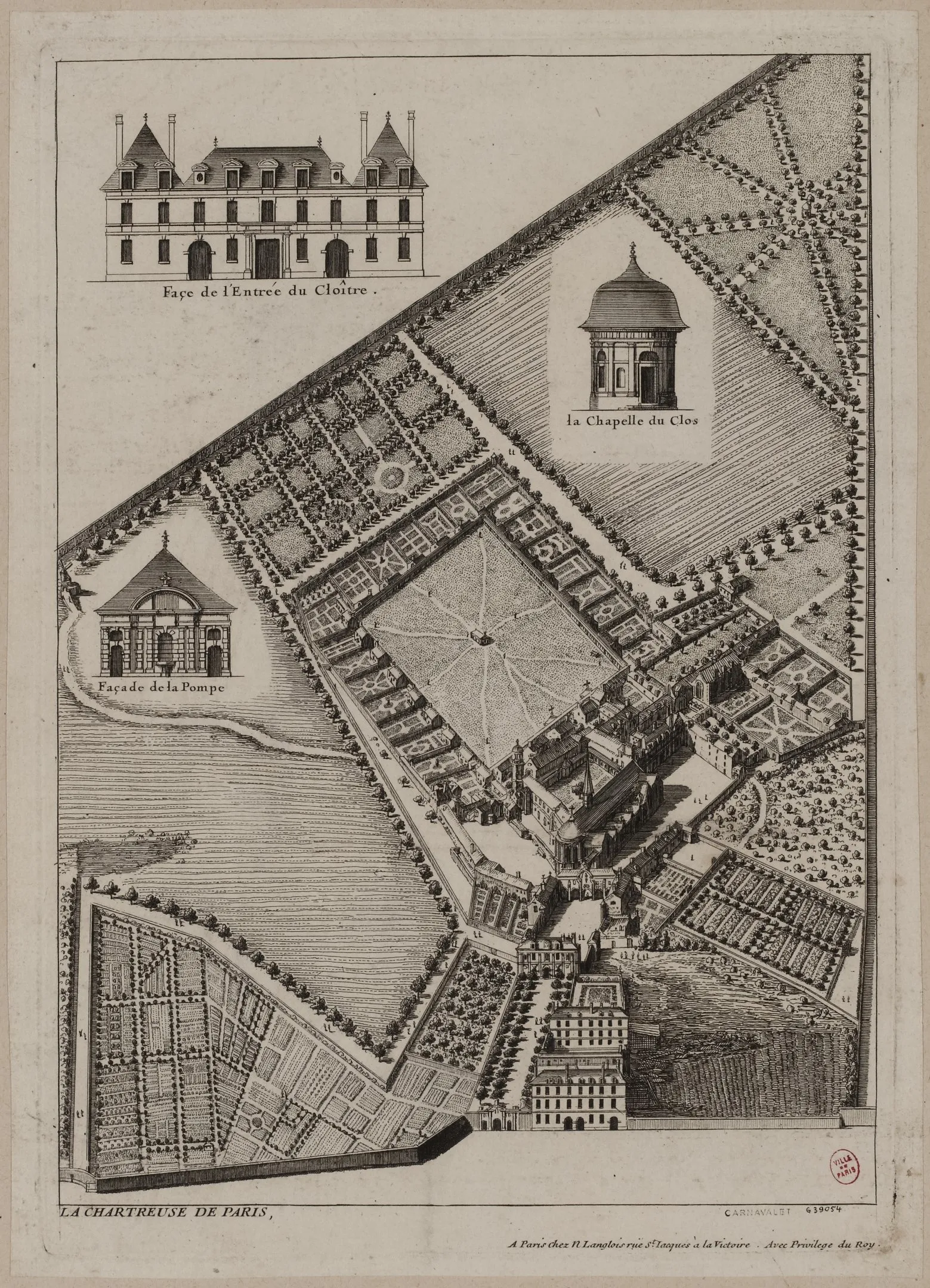
Plan of the Chartreuse de Paris with elevations of the cloister entrance, the Chapelle du Clos and the pump house, etching by Adam Pérelle, published by Nicolas Langlois, about 1680. Musée Carnavalet, Histoire de Paris, G.39054, CC0.
The story, as Jacques Du Breul told it in 1612, goes like this.9
For many years before the Carthusians came, an evil spirit called the devil of Vauvert lived in a house outside Paris.9 By God’s permission it tormented everyone who went along that road, and nobody could pass without being struck, hurt or wounded.9 Its great cries and horrible voices frightened everyone.9 The gate of the University was named the gate of Hell because of it, and the street that ran from the gate towards Notre-Dame-des-Champs kept the name of Hell.9 The townspeople lived in fear until a devout nun living in seclusion, who was thought to have the gift of prophecy, sent word to the city magistrates.9 They would be rid of the spirit, she said, only if a house of Carthusians was built on the spot.9
King Louis IX had monks sent from the Grande Chartreuse and lodged them at Gentilly.11 When their prior asked for the house of Vauvert, the king refused at first.9 It had long been deserted and was in ruins because of the spirits, he said, and other monks had not been able to stay there.9 The prior answered that with God’s grace and the order’s prayers the spirits would have no power over his men.9 The king pretended not to have heard, asked some of his council that evening, and next day told the prior to go in God’s name.9
The prior and seven other monks walked in by night, unafraid, on 21 November 1257, and spent three days and three nights in prayer.9 In that time they, their servants and some people in the city heard thunder and the sky roaring, saw the earth shake, and saw smoke and what looked like black, stinking fog that made some of the household ill.9 The spirits tried to stop them and could not.9 They had to leave the place, and they vanished like smoke.9
A phrase that outlived its story
Littré defines “aller au diable vauvert” as going very far, and says Vauvert is simply “val vert”, a green valley.712 Some people say “au diable au vert”. Littré calls that wrong, and Berty, writing in 1882, calls it a corruption of “au diable de Vauvert”.13
Berty also says that a common phrase kept the memory of the devil of Vauvert alive, and that he cannot admit so popular a tradition as pure invention.8 He records an explanation of the legend, that brigands who sheltered in the ruined buildings made the noise, and calls it a conjecture.14
Littré’s entry tells the story differently from Du Breul. It has the Carthusians covet the abandoned château and have a legion of spirits settle in it so that the king would give it up.15 We could not find that in the printing of Saint-Foix we read, where the spirits take the château by chance and the monks ask for it afterwards.6
A rumour in 1775, a green monster in 1762
Jaillot wrote in 1775 that the story was a “bruit populaire & ridicule”, and that it belonged with opinions that have “no other foundation than the pious credulity of our ancestors”.16 He found a plainer reason for the street’s name. The rue d’Enfer lies lower than the parallel rue du Faubourg Saint-Jacques, he writes, so it was called via inferior.17 Saint-Foix, in a printing of 1762, gives the same derivation, and says other people blamed the rogues who gathered in out-of-the-way streets.17
Saint-Foix also gives the spirit a shape.6 His château is full of spectres dragging chains, and among them is a green monster:6
un monstre vert, avec un grande barbe blanche, moitié homme & moitié serpent, armé d’une grosse massue6
a green monster with a great white beard, half man and half serpent, armed with a heavy club
He adds that the Carthusians asked St Louis for the château, and the “revenans” did not come back.6 It is the earliest source we read that gives the spirit this form.6
Sauval’s charter, with no devil in it
Henri Sauval’s history, printed in 1724, reports a different tradition about the house. King Robert, as tradition has it, built the Palais de Vauvert as a pleasure house, and when his successors left it empty the demons moved in.18 Berty found no testimony for the King Robert part, and notes that Du Breul, Félibien and Jaillot never mention it.18
Sauval goes on to say that in the act of 1269 the place is called a palace, but the king’s charter makes no mention of devils.19 It describes the palace and its dependencies as enclosed by very high walls.19 He suggests that the devils were thieves, and the howling the cries of crows and owls.14
Du Breul in 1612, citing a Latin chronicle
Du Breul prints the story in 1612 in his history of Paris, in the chapter on the Carthusian foundation.9 He names his sources: Pierre Sutor’s De vita Cartusiana and Dorland’s chronicle.3 The sentence that introduces the devil is short:
vn malin esprit appellé vulgairement, le diable de Vauuert, residoit audit lieu9
an evil spirit commonly called the devil of Vauvert lived in that place
Dorland’s Chronicon Cartusiense, printed at Cologne in 1608, has the story in book 6, chapter 32.1 Berty says the chronicle was written around 1500.2 The chapter tells of a demon near Paris and a nun enclosed in a cell, and of a king and queen who each meant to found a house and joined their vow into one.1 It does not name Vauvert, Louis IX or the rue d’Enfer, so the identification comes from Du Breul.13
Nemo enim illic transire poterat, qui non aut impulsus, aut percussus, aut mutilatus abiret.1
Nobody could pass there without leaving pushed, struck or maimed.
Both texts have the same shape: a demon, a recluse, and a house of Carthusians that ends it.91
A devil everyone already knew
The oldest use of the name that we found is a joke. Guillaume Coquillart, in a passage of his Droits nouveaux about gossiping spinners, says their thread is so fine that “le grant diable de Vauvert” could hardly untangle it.4
Que le grant diable de Vauvert
A peine s’en peult desmesler.4
That the great devil of Vauvert
could hardly untangle himself from it.
The poem’s editor, Charles d’Héricault, argues that if its allusions to a canon’s rank are literal, it cannot have been written before 1482, when Coquillart became a canon.5 Littré lists the line as a fifteenth-century example.4 A joke like that only works if the devil is familiar, so the story was probably current by then. That is our reading; nothing we opened says how long it had been told.4
D’Héricault’s note to the line carries a slip of its own. It says the devils raged until 1251, when St Louis installed the monks, a date no other source gives.20 Littré’s supplement adds a 1677 example from d’Assoucy’s Aventures, “On fait le diable de Vauver”.21
What the monks’ own dates say
Louis IX asked the Grande Chartreuse for monks, and a chapter of 4 August 1257 sent Dom Jean Joceran and four others.11 They were lodged at Gentilly first.11 Du Breul, Jaillot and Berty all give 21 November 1257 as the day they took Vauvert.22 Jaillot cites the Carthusians’ own titles for that date.22
The Biblissima record, drawn from BnF notes, says the king gave the château in 1258 and the monks settled in November that year.23 Jaillot does not support that. He read in the Grand Pastoral of Notre-Dame the Official’s letters of June 1258, in which canons of Saint-Étienne-des-Grès sold the prior and brothers of Vauvert two vineyard plots for 20 livres.24 The royal charter is dated at Melun in May 1259.10 Jaillot reads it as a confirmation of an earlier gift.10
A royal act of September 1265 names the house in Latin, “prior et fratres Vallis Viridis prope Parisius, Cartusiensis ordinis”.25 The place name was already old. Berty finds the Latin form in a cartulary of 1226.12
| The story | The record | Verdict |
|---|---|---|
| A devil haunted the house before 1257 | Earliest telling we read: about 15002 | Unsupported |
| King Robert built the château | No testimony found18 | Unsupported |
| Louis IX gave Vauvert to the Carthusians | Charter of May 125910 | Confirmed |
| The monks entered on 21 November 1257 | 125722; 125823 | Disputed |
| The street was named Hell for the devil | Or a lower road, via inferior17 | Disputed |
What the record cannot say is how old the story is. Du Breul and the heading of Dorland’s chapter both send the reader to Sutor’s De vita Cartusiana, and we could not open it.3
What we could not verify
Sources we have not seen
- Pierre Sutor, De vita Cartusiana: Du Breul and the heading of Dorland’s chapter cite it for the story, and it would show whether the telling is older than about 1500. We found no digitised copy on the Internet Archive; Berty cites the Cologne printing of 1609.
- The royal charter of May 1259 and the Carthusians’ titles that Jaillot read: they would settle the dates of the gift and of the monks’ arrival. We found no edition online, and Jaillot, Du Breul and Berty give only short accounts of them.
Seen only where others quote them
- Delisle’s 1852 edition of Louis IX’s act of September 1265: we read its text only through the transcription in the Scripta database of the University of Caen.
Questions we could not settle
- Whether a later printing of Saint-Foix has the monks arrange the haunting, as Littré says; the 1762 printing we read says the spirits came by chance.
- Whether the devil of Vauvert appears in writing before Coquillart. His editor dates the poem to 1482 or later, and we found no earlier text.
Read next
TaleThe Dombes, near Lyon, France, 13th century to 20th century
Saint Guinefort, the greyhound in the well
TaleHarz and Solling, Germany, 1558 to 1835
Hackelberg, the wild huntsman, is buried in more than one place
CaseHermersdorf (Svobodné Heřmanice), Czechia, 1753 to 1768
Hermersdorf's vampires were burned before Vienna sent a physician
Sources
- Dorland, Chronicon Cartusiense, ed. Theodor Petreus (Cologne, 1608), Liber VI, cap. XXXII, pp. 374 to 375 (heading p. 374; text p. 375) and the first lines of p. 376; leaves n403, n404 (primary) transcription
- Du Breul, Théâtre des antiquitez (1612), Livre 2, p. 452: cites "Dorland liure 6. chapitre 32. de sa Chronique" for the story
- Berty and Tisserand (1882), p. 74, note 1: "Pierre Borland, Chronicon cartusiense, p. 375" (the scan's text layer has Dorland misprinted as "Borland" in places)↑
- Berty and Tisserand (1882), p. 74, note 1: "La chronique de Dorland, écrite vers l'an 1500, a été publiée in-8° à Cologne, en 1608, par Théodore Pétrus"↑
- Du Breul, Théâtre des antiquitez (1612), Livre 2, p. 452: "comme rapporte Pierre Sutor, au liure premier de la vie Cartusiane, traicté 3. chap. 2. Dorland liure 6. chapitre 32"
- Dorland, Chronicon Cartusiense (1608), Liber VI, p. 374, heading of cap. XXXII: "vti constat ex Petro Sutore, lib. 1. de vita Cartusiana, tractatu 3. cap. 2"
- Berty and Tisserand (1882), p. 74, note 1: cites Sutor, De vita cartusiana, Cologne 1609, p. 65, together with Dorland↑
- Coquillart, Œuvres, ed. Charles d'Héricault, t. I (Paris, 1857), p. 186, Les Droits nouveaux, last two lines of the verse above the notes; leaf n338
- Littré, Dictionnaire de la langue française, "vauvert", Historique, XVe s.: "Que le grant diable de Vauvert à peine s'en peut demesler, Coquillart, La seconde partie des droits nouveaux" (Littré does not date the poem)↑
- Coquillart, Œuvres, ed. d'Héricault, t. I (1857), p. 36, note 2: "n'ont pu être composés avant 1482, puisque c'est à cette époque seulement qu'il fut nommé chanoine"; leaf n190↑
- Saint-Foix, Essais historiques sur Paris, t. I (1762 printing), pp. 144 to 145; leaves n147, n148 transcription↑
- Littré, Dictionnaire de la langue française, "vauvert", Head of the entry: "Mot qui n'est usité que dans cette locution : Aller au diable vauvert, aller très loin, faire une grande course"↑
- Berty and Tisserand (1882), p. 74: "il répugne d'admettre comme le résultat d'une pure invention cette tradition si populaire du diable de Vauvert, dont une locution vulgaire a perpétué le souvenir jusqu'à nos jours"
- Littré, Dictionnaire de la langue française, "vauvert", Étymologie: "Telle est l'origine du diable de Vauvert ou diable Vauvert"↑
- Du Breul, Théâtre des antiquitez (1612), Livre 2, p. 452 (the devil, the gate, the recluse), pp. 452 to 453 (the recluse's message), pp. 454 to 456 (the king's reluctance, the three days); leaves n473 to n477 (primary) transcription↑
- Du Breul, Théâtre des antiquitez (1612), Livre 2, p. 458, lines 6 to 8: "lettres en bonne forme données à Melun l'an 1259. au moys de May"; leaf n479
- Jaillot, Recherches critiques, t. V (1775), p. 44, second paragraph: "Tous nos Historiens placent en 1259", the charter "datée de Melun, au mois de Mai de cette année", "une confirmation de la donation" made earlier
- Berty and Tisserand (1882), p. 73: "seulement au mois de mai 1259 que la donation du château de Vauvert leur fut régulièrement faite par saint Louis"
- Sauval, Histoire et recherches des antiquités de la ville de Paris, t. II (Paris, 1724), Livre VII, section "Le Palais", opening page: "St Louis l'ayant accordé aux Chartreux en 1259". Sauval sends the reader to Du Breul in the next lines, so this row is not independent of Du Breul↑
- Du Breul, Le théâtre des antiquitez de Paris (Paris, 1612), Livre 2, p. 453 (the chapter of 4 August 1257, five monks under "Dom Iean Ioceran"), pp. 453 to 454 (lodged at Gentilly); leaves n474, n475
- Jaillot, Recherches critiques, t. V, quartier du Luxembourg (Paris, 1775), p. 43, article "Les Chartreux": Louis wrote in 1257 to Bernard de la Tour; four monks under Jean Jocerant; settled at Gentilli
- Berty and Tisserand, Topographie historique du vieux Paris, Région du faubourg Saint-Germain (Paris, 1882), p. 73, chapter XIV, opening paragraphs: chapter of 4 August 1257, four monks under Joceran, Gentilly property bought from Jean Ogier↑
- Berty and Tisserand (1882), p. 70, first paragraph of "Vauvert, Brisebarre": "en latin Vallis viridis, qui se rencontre dans le cartulaire de Saint-Étienne-des-Grès, à la date de 1226"
- Littré, Dictionnaire de la langue française, "vauvert", Étymologie, last sentence: "Vauvert est val vert, vallée verte"↑
- Berty and Tisserand (1882), p. 74, note 3 at the foot of the page: "On dit encore : « aller au Diable au vert, » par corruption de « au Diable de Vauvert. »"
- Littré, Dictionnaire de la langue française, "vauvert", Head of the entry: "Quelques-uns disent aller au diable au vert ; mais cela est vicieux"↑
- Sauval, Histoire et recherches, t. II (1724), Livre VII, section "Le Palais": "ces diables n'étoient peut-être que des voleurs", the howls "que des croassemens de corbeaux, de hiboux" (bottom of the opening page and top of the next)
- Berty and Tisserand (1882), p. 74: "On a expliqué cette légende en supposant qu'elle avait pour origine les violences de quelques brigands"; "Ce n'est sans doute qu'une conjecture"↑
- Littré, Dictionnaire de la langue française, "vauvert", Étymologie, first paragraph (Littré cites Saint-Foix, Essais sur Paris, without volume or page)↑
- Jaillot, Recherches critiques, t. V (1775), p. 38 (article on the rue d'Enfer: "bruit populaire & ridicule") and p. 44, first paragraph↑
- Jaillot, Recherches critiques, t. V (1775), p. 38, "À l'égard du nom d'Enfer ... Via Inferior, via Infera"
- Saint-Foix, Essais historiques sur Paris, t. I (1762 printing), p. 145, first paragraph after the story: "la rue S. Jacques s'appelloit anciennement via superior ... celle-ci ... via inferior ou infera"↑
- Sauval, Histoire et recherches, t. II (1724), Livre VII, section "Le Palais", opening page: "l'on tient par tradition, qu'il fit faire encore le Palais de Vauvert"
- Berty and Tisserand (1882), p. 70, section "Vauvert, Brisebarre": "nous la tenons pour fort douteuse"; Du Breul, Félibien and Jaillot "ne font aucune mention de l'hypothétique villa du roi Robert"↑
- Sauval, Histoire et recherches, t. II (1724), Livre VII, section "Le Palais", opening page, paragraph beginning "Dans l'Acte de 1269" (printed page number not legible in the scan)↑
- Coquillart, Œuvres, ed. d'Héricault, t. I (1857), p. 186, note 6; leaf n338↑
- Littré, Dictionnaire de la langue française, "vauvert", Supplément, Supplément, "Ajoutez": Les Aventures de M. d'Assoucy, t. II, p. 224 (Paris, 1677)↑
- Jaillot, Recherches critiques, t. V (1775), p. 44, first numbered argument: "Les Titres de ces Religieux portent qu'ils prirent possession dudit lieu de Vauvert, le 21 Novembre 1257"
- Du Breul, Théâtre des antiquitez (1612), Livre 2, p. 455, "le iour sainct Collumbain Abbé, 21. Nouembre, en l'an 1257"; leaf n476
- Berty and Tisserand (1882), p. 73: "dès le 21 novembre de la même année 1257". Berty says Du Breul is his guide for the Charterhouse (p. 74, note 2), so this row repeats Du Breul↑
- Biblissima, record "Paris. Chartreuse de Vauvert" (notes from the BnF; Cottineau 1939, vol. 2, col. 2195, cited), Record page: 1257 (call), 1258 (gift of the château), November 1258 (monks installed)↑
- Jaillot, Recherches critiques, t. V (1775), p. 44, second numbered argument. Berty p. 73 repeats the sale and probably takes it from Jaillot↑
- Scripta (Université de Caen) no. 3662, Louis IX for the priory of Vauvert, Paris, September 1265; text established from Delisle, Cartulaire normand (1852), no. 710, pp. 155 to 156, Record, first sentence of the Latin text and the closing dating clause "Actum Parisius anno Domini millesimo ducentesimo sexagesimo quinto, mense septembri" (primary)↑
Documents quoted
- Dorland, Chronicon Cartusiense (Cologne, 1608), book 6, chapter 32, pp. 374 to 376: the Paris Charterhouse and the demon (transcribed from the page image)
- Du Breul, Le théâtre des antiquitez de Paris (1612), livre 2, pp. 452 to 456: the devil of Vauvert and the Carthusians (transcribed from the page image)
- Saint-Foix, Essais historiques sur Paris, vol. 1 (1762 printing), pp. 144 to 145: the green monster of Vauvert (transcribed from the page image)