 Twice Told
Saint Guinefort, the greyhound in the well
A greyhound killed for saving a child was honoured as a martyr near Lyon. The friar who recorded the cult says he had the dog dug up and its bones burned.
Contents
Published 20 Oct 2026. Sources checked 17 Oct 2026.
Before he died around 1261, Stephen of Bourbon, a Dominican inquisitor, wrote that in the diocese of Lyon he had had a dog’s grave dug up and the bones burned.61 The dog was a greyhound, and mothers had been carrying their children to it as to a saint.7 Stephen says he heard of it in the confessional, took Guinefort for some saint, and asked who he was.7 His page is the earliest account of the cult we found, and Jorion calls him its first learned reporter.2
The story, as Stephen of Bourbon wrote it down, goes like this.
Near a village of nuns called Novile, on the land of the lord of Villars, stood a castle whose lord had a baby son.8 One day the lord, his wife and the nurse all went out and left the child alone in his cradle.8 A huge snake came into the house and made for the cradle.8 The greyhound that had stayed behind went after it, and in the fight the cradle was knocked over.8 The dog killed the snake and threw it far from the child, then stood by the cradle, mauled and smeared with the snake’s blood.8
The nurse came in, saw the blood, thought the dog had eaten the child and screamed.8 The mother ran in and thought the same.8 The knight came up, drew his sword and killed the dog.8 Then they found the child unhurt and asleep, and the snake torn by the dog’s bites.8 They threw the dog into a well in front of the castle gate, heaped a great pile of stones on it and planted trees beside it.9
By God’s will the castle was destroyed and the land left a wilderness.10 Country people heard of the dog’s noble deed, visited the place, honoured the dog as a martyr and prayed there for their illnesses.10
Paragraph 370 of a book for preachers
Stephen was born at Belleville-sur-Saône, belonged to the Dominicans and held the office of inquisitor by mandate of the Holy See.6 In his last years, at the Dominican house in Lyon, he wrote a collection of short stories for preachers to use in sermons.11 The Guinefort story is paragraph 370 of it, in Lecoy de La Marche’s edition of 1877.7 Stephen files it under superstitions that insult God, next to women who ask for health by worshipping elder trees and carry their children to anthills.12
He gives no year. The practice was recent, he says (“nuper”), and nothing on the four printed pages dates the confessions, his visit or the killing of the dog.13 His frame is plain: the people who honoured the dog as a martyr were deceived by the devil.10
What the women did at the place, in his account, was elaborate. A mother took a sick child to an old woman in a castle a league away, who taught her the ritual and led her to the spot.14 They offered salt, hung the child’s rags on the bushes and stuck a needle into the trees.14 Then the naked child was passed nine times through the gap between two tree trunks, the mother on one side and the old woman on the other, while they called on the fauns of the forest of Rimite to take the sick child and bring back their own, fat and well.14
After that the child was laid on the straw of a cradle at the foot of a tree, two candles a thumb’s measure long were lit and fixed in a log, and the mothers went away and stayed away until the candles had burned out.15 The candles burned very many children to death, Stephen writes, “sicut ibidem de aliquibus reperimus”, as we found in some cases there.15 One woman told him she had seen a wolf come out of the wood toward her child, and that it would have eaten it, or the devil in the wolf’s shape, if she had not run back.15 A child found alive was carried to the river Chalarone and dipped nine times.16
Then comes the burning.
Canem mortuum fecimus exhumari et lucum succidi, et cum eo ossa dicti canis pariter concremari1
We had the dead dog dug up and the grove cut down, and the bones of the dog burned together with it.
The “it” is the grove, as we read the Latin, since the bones are already the dog’s. Stephen writes “we” and does not say who held the spade.1 He adds that he had the lords of the land post an edict about the spoliation and ransom of anyone who gathered there for such a cause.1 Reviewers of Schmitt’s book report the act as his: he had the dog exhumed and burned (Dubois), had the wood cut (Velay-Vallantin), destroyed the cult (Jorion).17
The passage reached print in 1719, in Quétif and Échard’s Scriptores ordinis praedicatorum, 158 years before Lecoy’s edition.18 Échard says that whether the dog really fought the snake is nothing to Stephen, who only reports what people said, but that nobody can doubt the horrible superstition was in use.19
Novile, Villars or Sandrans
Stephen names no wood and no parish, only a nuns’ village called Novile in the land of the lord of “Vilarius”.20 Échard, in 1719, glosses Novile as possibly Villeneuve in the Dombes and the lord’s seat as Villars on the Chalaronne.20 Lecoy takes Villars as Villars-en-Dombes.20
The modern location is different. Reviewers report that Schmitt puts the legend and the rite in the bois de Saint-Guinefort, in what is now the commune of Sandrans, in the Ain.21 Isambert’s review of the book has weak children laid in a wood of Saint Guinefort at Neuville-les-Dames, also in the Dombes.22 We could not read Schmitt and cannot say how he joins these names.
Geary reports that digs made since the book appeared found a fortified dwelling on the site, built and abandoned soon after, probably in the twelfth century, which he takes to support Schmitt’s link between the cult and the twelfth-century clearing of the land.23 Chanaud says Schmitt reads in the legend a quarrel between peasants and lords who were tempted to dig fish ponds.24 Stephen’s text does not name the wood, and the identification at Sandrans reaches us only through reviews of a book we could not open.
After the fire
The burning and the edict did not end the cult. The reports we found run like this.
| Date | What is reported | Where |
|---|---|---|
| Before about 1261 | The dog dug up, the grove cut, an edict posted16 | Near Novile, diocese of Lyon8 |
| 1632 | A notarial deed, the only evidence for an old chapel25 | The place of the cult |
| 1719 | Échard prints Stephen’s passage18 | Paris |
| 1826 | Legend and rite still attested, much changed3 | Sandrans |
| 1873 | Guigue: the devotion would still exist, women invoke him for husbands or children3 | Romans |
| After the First World War | The cult finally vanishes, in George’s reading of Schmitt4 | The Dombes |
Guigue’s book of 1873 reaches us through Lecoy’s footnote, in the conditional (“existerait encore”).3 Chanaud, reporting Schmitt, says the legend and rite at Sandrans were still attested in 1826, with notable changes.3 Jorion says the cult, destroyed in the thirteenth century by an inquisitor, was found again in the nineteenth by folklorists in a barely changed form.26 George writes that, for Schmitt, it did not truly disappear until the aftermath of the First World War.4 Dubois says a popular cult was kept up “until today” in the wood.27 Isambert says the belief lasted at least six centuries despite the efforts to uproot it.22
So the reviews give “destroyed” and “persisted” in the same breath. Nobody we read says the burning worked.
A dog with a saint’s name
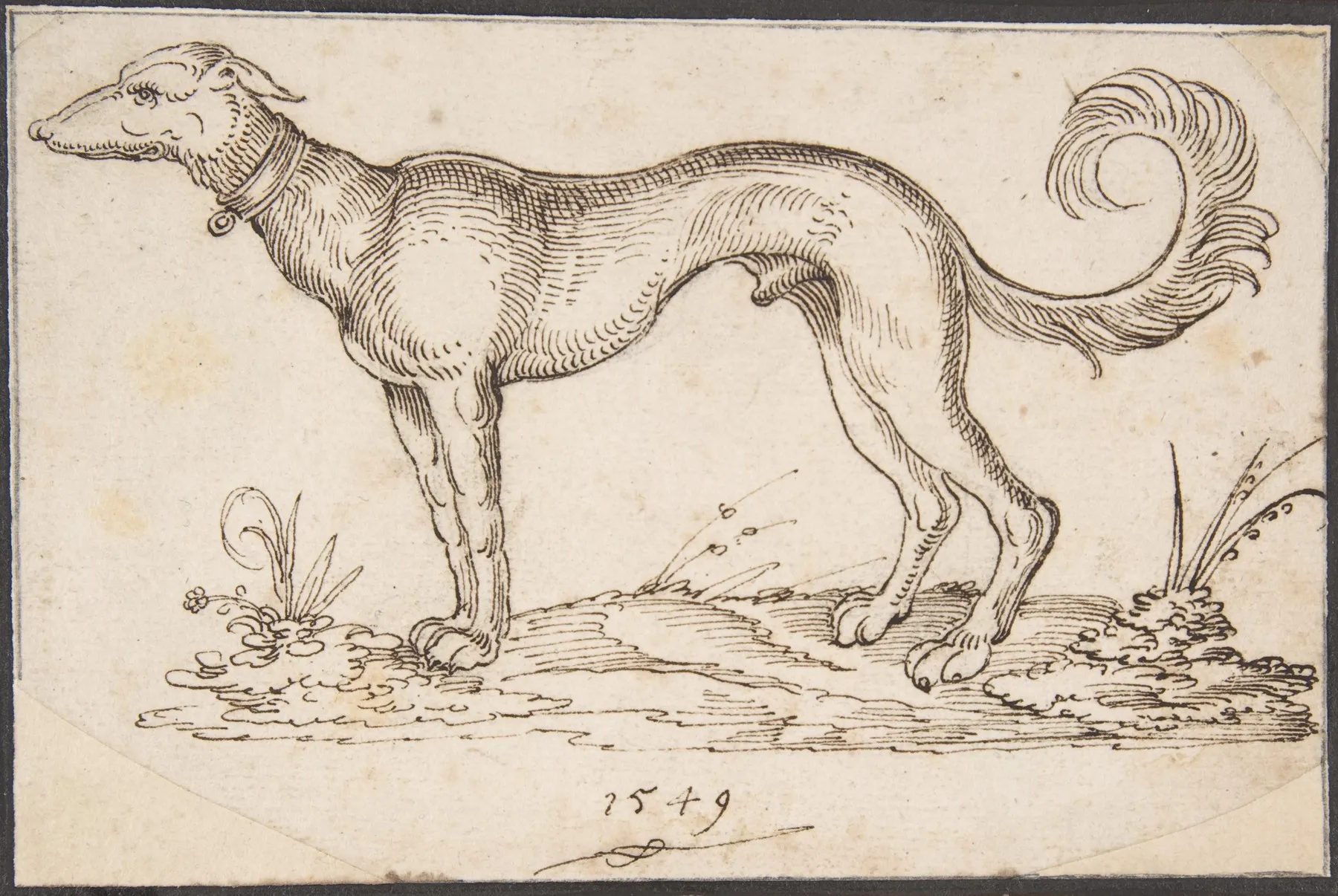
A greyhound in profile, drawn in Germany in 1549, nearly three centuries after Stephen of Bourbon wrote of the dog near Lyon. It is not an image of Guinefort or of the legend. Virgil Solis, A Greyhound in Profile Facing Left, pen and brown ink over graphite, 1549. The Metropolitan Museum of Art, 2001.497, The Elisha Whittelsey Collection, The Elisha Whittelsey Fund, 2001, public domain (CC0).
Schmitt’s Le saint lévrier came out in 1979, and in English in 1983 as The Holy Greyhound.28 The story of a dog killed by its master after saving a child from a snake is a widespread type. Geary reports twelve medieval Western versions, and Lecoy’s footnote names an analogous legend in Wales and one in the Indian book of Sindibad, from which the romance of the Seven Sages came.29 Échard adds that Johannes Junior retold the story with details and an allegory in his Scala coeli.19
The rite is a separate thing. Schmitt explains it by the belief in changelings, in which vaguely defined spirits carry off children and leave their own in their place.30 Stephen’s women called on fauns for the same exchange.14
The name is the hardest part. Isambert says the hagiography knows a Saint Guinefort of Pavia, whose legend, written in the eighth century, is a kind of doublet of that of Saint Sebastian, and whose cult appears in several places in Italy and France, always for healing children.31 Chanaud reports Schmitt’s answer to how a dog got the name: Cluniac monks carried the martyr’s cult toward the Saône, the monks of Gigny passed with relics of Saint Taurin in 1158, and the martyr’s feast on 22 August falls in the dog days.5 Geary calls the Cluny hypothesis reasonable, though not certain.32 Isambert says nothing in the archaeology of the place supports a pre-Christian animal cult.33
Nothing we read says the Church declared the greyhound a saint. Stephen’s answer was the fire, and we found no text in which the Church recognised the dog or turned him down.
What we could not verify
Sources we have not seen
- Schmitt’s Le saint lévrier (1979) and The Holy Greyhound (1983). It would give his survey of the site, the sources behind the dates of the cult and his twelve versions of the legend. The lending copy on the Internet Archive opens no text, and we found no other copy online.
- Guigue, Topographie historique de l’Ain (1873), Lecoy’s source for the devotion at Romans. It would show how the cult was described a century before Schmitt. Gallica refused our request on 17 October 2026 and the Internet Archive has no copy.
- Rebecca Rist’s article on the papacy, the Inquisition and Saint Guinefort (Reinardus, 2019). It would show how a recent historian reads Stephen’s action. The repository refused access, and the Project MUSE page gave only an excerpt.
- Johannes Junior’s Scala coeli, which Échard says retells the dog and the snake. It would date a preacher’s use of the story outside Stephen’s circle. We did not locate a text.
Seen only where others quote them
- What Schmitt argues about the Pavia martyr, the changelings, the fish ponds and the end of the cult, which we read only where seven reviewers summarise him (Dubois, George, Chanaud, Isambert, Geary, Jorion, Velay-Vallantin). They are not independent of each other on what Schmitt says.
Questions we could not settle
- Whether the Church ever ruled on Guinefort. No text we read records a decision, and Stephen’s own answer was to destroy the place.
- Which wood Stephen meant. Novile and Vilarius are glossed as Villeneuve and Villars, while the reviews put the cult at Sandrans.
- When the cult ended. Reviewers give 1826, the nineteenth century, the end of the First World War and “today”.
Read next
TaleVauvert, Paris, France, 1257 to 1882
Where the devil of Vauvert first appears
TaleHarz and Solling, Germany, 1558 to 1835
Hackelberg, the wild huntsman, is buried in more than one place
CaseHermersdorf (Svobodné Heřmanice), Czechia, 1753 to 1768
Hermersdorf's vampires were burned before Vienna sent a physician
Sources
- Albert Lecoy de La Marche (ed.), Anecdotes historiques, légendes et apologues tirés du recueil inédit d'Étienne de Bourbon (Paris: Renouard, Société de l'histoire de France, 1877), no. 370, pp. 327 (last lines: "Ad locum autem accessimus ... Canem mortuum fecimus exhumari et lucum succidi") to 328 ("et cum eo ossa dicti canis pariter concremari, et edictum poni a dominis terre de spoliacione et redempcione") (primary) transcription↑
- Paul Jorion, review of Schmitt, Le Saint lévrier, L'Homme 20:3 (1980), pp. 161 to 162, p. 161: Schmitt gives his attention first "à l'inquisiteur, premier rapporteur savant de l'existence du culte" (Persée page text; page image not checked)↑
- Albert Lecoy de La Marche (ed.), Anecdotes historiques, légendes et apologues tirés du recueil inédit d'Étienne de Bourbon (Paris: Renouard, Société de l'histoire de France, 1877), no. 370, p. 328, footnote 1: "D'après M. Guigue, la dévotion à saint Guinefort existerait encore à Romans, où les femmes l'invoqueraient, soit pour leurs maris, soit pour leurs enfants" (citing Guigue, Topographie historique de l'Ain, Trévoux, 1873, which we have not opened)
- Robert Chanaud, review of Schmitt, Le Monde alpin et rhodanien 1-2 (1980), pp. 175 to 176, p. 175 to 176: "encore attestés en 1826, quoiqu'avec de notables changements"; also "entretenu jusqu'au XIXe siècle" (Persée page text; page image not checked)↑
- Philippe George, review of Schmitt, Le saint lévrier, Moyen Age (1980), pp. 309 to 311, p. 310, first paragraph ("dans la Dombes ... dans un bois"): "ce dernier ne disparut vraiment qu'au lendemain de la Première Guerre mondiale" (page image checked)↑
- Robert Chanaud, review of Schmitt, Le Monde alpin et rhodanien 1-2 (1980), pp. 175 to 176, p. 175 to 176: "La question centrale ... est celle de l'assimilation opérée par les paysans de la Dombes du lévrier et de saint Guinefort, martyr particulièrement vénéré à Pavie", with the Cluny, Gigny 1158 and 22 August points (Persée page text; page image not checked)↑
- Albert Lecoy de La Marche (ed.), Anecdotes historiques, légendes et apologues tirés du recueil inédit d'Étienne de Bourbon (Paris: Renouard, Société de l'histoire de France, 1877), Introduction, pp. iii to iv (Bernard Gui's notice: born at Belleville, diocese of Lyon; died at the Lyon convent "anno MCCLXI vel circa"; Lecoy: a Dominican who died about 1261) and p. vii (the office of inquisitor was given him by mandate of the Holy See)
- Catherine Velay-Vallantin, "Rikki-Tikki-Tavi dans la Dombes" (review of Schmitt), Communications 39 (1984), pp. 256 to 260, p. 256, opening sentence: "le frère dominicain Etienne de Bourbon, mort en 1261 à Lyon" (Persée page text; page image not checked)
- Philippe George, review of Schmitt, Le saint lévrier, Moyen Age (1980), pp. 309 to 311, p. 310, first lines: "du Dominicain Etienne de Bourbon (± 1180-1261)" (page image checked)↑
- Albert Lecoy de La Marche (ed.), Anecdotes historiques, légendes et apologues tirés du recueil inédit d'Étienne de Bourbon (Paris: Renouard, Société de l'histoire de France, 1877), no. 370, p. 325, paragraph 370: "multe mulieres confitebantur portasse se pueros suos apud sanctum Guinefortem. Et cum crederem esse sanctum aliquem, inquisivi, et audivi ad ultimum quod esset canis quidam leporarius" (primary) transcription↑
- Albert Lecoy de La Marche (ed.), Anecdotes historiques, légendes et apologues tirés du recueil inédit d'Étienne de Bourbon (Paris: Renouard, Société de l'histoire de France, 1877), no. 370, pp. 325 (from "In diocesi Lugdunensi, prope villam monialium") to 326 (to "suaviter dormientem; inquirentes, inveniunt serpentem canis morsibus laceratum et occisum") (primary) transcription↑
- Albert Lecoy de La Marche (ed.), Anecdotes historiques, légendes et apologues tirés du recueil inédit d'Étienne de Bourbon (Paris: Renouard, Société de l'histoire de France, 1877), no. 370, p. 326: "projecerunt eum in puteum qui erat ante portam castri, et acervum maximum lapidum super eum projecerunt, et arbores juxta plantaverunt in memoriam facti" (primary) transcription↑
- Albert Lecoy de La Marche (ed.), Anecdotes historiques, légendes et apologues tirés du recueil inédit d'Étienne de Bourbon (Paris: Renouard, Société de l'histoire de France, 1877), no. 370, p. 326: "Castro autem divina voluntate destructo" to "seducti a diabolo et ludificati ibi pluries" (primary) transcription↑
- Albert Lecoy de La Marche (ed.), Anecdotes historiques, légendes et apologues tirés du recueil inédit d'Étienne de Bourbon (Paris: Renouard, Société de l'histoire de France, 1877), Introduction, p. ix (in retirement in the cloister where he began, he wrote down his memories; death surprised him at it about 1261) and p. xi (II. L'Ouvrage: a collection of exempla for preachers)
- Catherine Velay-Vallantin, "Rikki-Tikki-Tavi dans la Dombes" (review of Schmitt), Communications 39 (1984), pp. 256 to 260, p. 256: in the last years of his life he wrote a treatise on the seven gifts of the Holy Spirit, "surtout un recueil d'exempla" used by preachers (Persée page text; page image not checked)↑
- Albert Lecoy de La Marche (ed.), Anecdotes historiques, légendes et apologues tirés du recueil inédit d'Étienne de Bourbon (Paris: Renouard, Société de l'histoire de France, 1877), no. 370, p. 325: "Sexto dicendum est de supersticionibus contumeliosis" to "portando ibi pueros suos vel ad formicarios vel ad res alias, ad sanitatem consequendam" (primary) transcription↑
- Albert Lecoy de La Marche (ed.), Anecdotes historiques, légendes et apologues tirés du recueil inédit d'Étienne de Bourbon (Paris: Renouard, Société de l'histoire de France, 1877), no. 370, p. 325, "Sic faciebant nuper in diocesi Lugdunensi"; no date anywhere on pp. 325 to 328 (primary) transcription↑
- Albert Lecoy de La Marche (ed.), Anecdotes historiques, légendes et apologues tirés du recueil inédit d'Étienne de Bourbon (Paris: Renouard, Société de l'histoire de France, 1877), no. 370, pp. 326 (from "Maxime autem mulieres") to 327 (to "vivum et sanum") (primary) transcription↑
- Albert Lecoy de La Marche (ed.), Anecdotes historiques, légendes et apologues tirés du recueil inédit d'Étienne de Bourbon (Paris: Renouard, Société de l'histoire de France, 1877), no. 370, p. 327: "Et, hoc facto, accipiebant matricide puerum" to "vorasset" (primary) transcription↑
- Albert Lecoy de La Marche (ed.), Anecdotes historiques, légendes et apologues tirés du recueil inédit d'Étienne de Bourbon (Paris: Renouard, Société de l'histoire de France, 1877), no. 370, p. 327: "Si autem, redeuntes ad puerum, eum invenissent viventem" to "nec tunc vel cito post moreretur" (primary) transcription↑
- Jacques Dubois, review of Schmitt, Le saint lévrier, Bibliothèque de l'École des chartes 138 (1980), pp. 303 to 304, pp. 303 to 304, summary of the exemplum: "Il fait alors exhumer et brûler les os du chien" (Persée page text; page image not checked)
- Catherine Velay-Vallantin, "Rikki-Tikki-Tavi dans la Dombes" (review of Schmitt), Communications 39 (1984), pp. 256 to 260, p. 256: Stephen "se félicite en conclusion d'avoir extirpé l'hérésie en faisant exhumer le chien et couper le bois sacré" (Persée page text; page image not checked)
- Paul Jorion, review of Schmitt, Le Saint lévrier, L'Homme 20:3 (1980), pp. 161 to 162, pp. 161 to 162: "Le culte, détruit au xiiie siècle par un inquisiteur" (Persée page text; page image not checked)↑
- Jacques Quétif and Jacques Échard, Scriptores ordinis praedicatorum, vol. 1 (Paris, 1719), p. 193, the passage reprinted from "Sexto dicendum est de superstitionibus contumeliosis" to "de spoliatione et redemtione"; read in the archive.org OCR text (long s), page image not viewed
- Jacques Dubois, review of Schmitt, Le saint lévrier, Bibliothèque de l'École des chartes 138 (1980), pp. 303 to 304, pp. 303 to 304: "L'exemplum a été édité dès 1719" (Persée page text; page image not checked)↑
- Jacques Quétif and Jacques Échard, Scriptores ordinis praedicatorum, vol. 1 (Paris, 1719), p. 193, the paragraphs after the quotation ("Certamen canis cum serpente an verum sit, nihil ad nostrum auctorem" to "allegorice ad mores traduci in suo libro cui titulus Scala coeli verbo Foemina"); archive.org OCR text, page image not viewed↑
- Albert Lecoy de La Marche (ed.), Anecdotes historiques, légendes et apologues tirés du recueil inédit d'Étienne de Bourbon (Paris: Renouard, Société de l'histoire de France, 1877), no. 370 and Introduction, p. 325 text ("villam monialium que dicitur Novile, in terra domini de Vilario") with footnote 1 ("Villars en Dombes. D'après Échard, la localité appelée Novile serait Villeneuve"); Introduction p. viii ("à Villeneuve-en-Dombes")
- Jacques Quétif and Jacques Échard, Scriptores ordinis praedicatorum, vol. 1 (Paris, 1719), p. 193, inline glosses: "Novila ( an quae nunc villa nova in Dumbarum principatu )" and "Villarium supra Calaronam" (OCR text, long s; the first gloss is put as a question, "an")↑
- Robert Chanaud, review of Schmitt, Le Monde alpin et rhodanien 1-2 (1980), pp. 175 to 176, pp. 175 to 176: Stephen's exemplum "rapporte la légende et le rite localisés dans l'actuelle commune de Sandrans (Ain)" (Persée page text; the page break is not shown)
- Paul Jorion, review of Schmitt, Le Saint lévrier, L'Homme 20:3 (1980), pp. 161 to 162, p. 161: "Un culte se répandit dans le bois de Saint-Guinefort, à Sandrans dans l'Ain" (Persée page text; page image not checked)
- Jacques Dubois, review of Schmitt, Le saint lévrier, Bibliothèque de l'École des chartes 138 (1980), pp. 303 to 304, pp. 303 to 304: "un culte populaire s'est maintenu jusqu'à nos jours dans le bois de Saint-Guinefort à Sandrans (Ain)" (Persée page text; page image not checked)↑
- François-André Isambert, review of Schmitt, Archives de sciences sociales des religions 48:2 (1979), pp. 348 to 349, pp. 348 to 349: "Neuville-les-Dames dans les Dombes où on exposait les enfants faibles ou malades dans le bois de Saint Guinefort puis on les trempait dans la rivière"; same review: "cette croyance qui dura au moins six siècles malgré les efforts pour la déraciner" (Persée page text; apostrophes missing in the text layer)↑
- Patrick J. Geary, review of Schmitt, Annales ESC 36:2 (1981), pp. 236 to 237, p. 236: "Des fouilles archéologiques entreprises depuis la publication du livre ont confirmé qu'une habitation fortifiée existait sur le site" (Persée page text; page image not checked)↑
- Robert Chanaud, review of Schmitt, Le Monde alpin et rhodanien 1-2 (1980), pp. 175 to 176, p. 176, last paragraph on the page: "l'antagonisme entre paysans et seigneurs ... la création d'étangs artificiels fructueux pour lui mais incompatibles avec l'intérêt de celles-ci" (Persée page text, which ends in mid-sentence)↑
- Jacques Dubois, review of Schmitt, Le saint lévrier, Bibliothèque de l'École des chartes 138 (1980), pp. 303 to 304, pp. 303 to 304, last sentence: "Le seul témoignage en faveur de l'existence d'une chapelle ancienne serait un acte notarié du 27 septembre 1632 (p. 178)" (Persée page text; page image not checked)↑
- Paul Jorion, review of Schmitt, Le Saint lévrier, L'Homme 20:3 (1980), pp. 161 to 162, p. 161: "Le culte, détruit au xiiie siècle par un inquisiteur, devait être redécouvert au xixe par les folkloristes sous une forme à peine modifiée" (Persée page text; page image not checked)↑
- Jacques Dubois, review of Schmitt, Le saint lévrier, Bibliothèque de l'École des chartes 138 (1980), pp. 303 to 304, pp. 303 to 304: "Pourtant un culte populaire s'est maintenu jusqu'à nos jours dans le bois de Saint-Guinefort à Sandrans (Ain)" (Persée page text; page image not checked)↑
- Jacques Dubois, review of Schmitt, Le saint lévrier, Bibliothèque de l'École des chartes 138 (1980), pp. 303 to 304, p. 303 (header): "Paris, Flammarion, 1979. In-8°, 278 pages" (Persée page text; page image not checked)
- Internet Archive catalogue record, The holy greyhound: Guinefort, healer of children since the thirteenth century (Cambridge University Press, 1983), metadata fields: date 1983, "Translation of: Le saint lévrier", "x, 215 p." (record only; the lending copy's text did not open)↑
- Patrick J. Geary, review of Schmitt, Annales ESC 36:2 (1981), pp. 236 to 237, p. 236: "une légende indo-européenne dont l'Occident médiéval connaît douze versions" (Persée page text, which stops at p. 236)
- Albert Lecoy de La Marche (ed.), Anecdotes historiques, légendes et apologues tirés du recueil inédit d'Étienne de Bourbon (Paris: Renouard, Société de l'histoire de France, 1877), no. 370, p. 328, footnote 1: "Une légende analogue a été signalée également dans le pays de Galles et dans le livre indien de Sindibâd, d'où est sorti le roman des Sept Sages"↑
- Philippe George, review of Schmitt, Le saint lévrier, Moyen Age (1980), pp. 309 to 311, p. 311, footnote 2: "Selon cette croyance, des « esprits » mal définis, des fées ou des nains, ravissent les enfants et déposent à leur place leur propre enfant" (Schmitt, p. 109); p. 310 for the question of the cult's origins (page image checked)↑
- François-André Isambert, review of Schmitt, Archives de sciences sociales des religions 48:2 (1979), pp. 348 to 349, p. 348: "un Saint Guinefort de Pavie dont la légende écrite au VIIIe siècle est une sorte de doublet de celle de Saint Sébastien" (Persée page text; page image not checked)↑
- Patrick J. Geary, review of Schmitt, Annales ESC 36:2 (1981), pp. 236 to 237, p. 236: the hypothesis "est raisonnable même si elle n'est pas sûre" (Persée page text)↑
- François-André Isambert, review of Schmitt, Archives de sciences sociales des religions 48:2 (1979), pp. 348 to 349, pp. 348 to 349: "rien dans l'archéologie du lieu ne permet d'étayer cette hypothèse" and "avait-il un culte proprement dit de Saint Guinefort" at Neuville (Persée page text; apostrophes and some punctuation missing in the text layer)↑
Documents quoted
- Stephen of Bourbon on Saint Guinefort, the greyhound (Lecoy de La Marche's edition, 1877, no. 370) (transcribed from the page image)