 Twice Told
Before Xuanzong's dream, Zhong Kui was already a name
Shen Kuo wrote down the emperor's fever dream of Zhong Kui, and in the same item reported an epitaph that names a Zhong Kui centuries before it.
Contents
Published 26 Oct 2026. Sources checked 18 Oct 2026.
In the Huangyou years, Shen Kuo reports, a tomb was opened at Jinling, and its stone epitaph said that the general Zong Que had a younger sister named Zhong Kui.5 Zong Que belonged to the earlier Song dynasty, and the Song shu dates his Linyi campaign to 445, by our conversion.6 The legend has Emperor Xuanzong dream of Zhong Kui in the Kaiyuan years, in the Tang.78 Shen Kuo did not give up the dream because of the tomb. In a supplement to his notebook he quotes it from a colophon written by a man of the Tang, and he settles the clash by saying the name is old and only the picture began in Kaiyuan.13
This is the dream as the colophon on the palace scroll tells it, in the text Shen Kuo quotes.1
Xuanzong came back from reviewing his troops at Mount Li and fell ill with malaria.8 The fever lasted nearly a month, and shamans and physicians could do nothing.8 One night he dreamed of two ghosts, a small one and a big one.8 The small ghost, dressed in red, ran round the hall with Yang Guifei’s purple perfume pouch and the emperor’s jade flute.8 The big one wore a cap and a blue robe, with one arm bare. He seized the small ghost, tore out its eye and ate it.8 Asked who he was, he said he was Zhong Kui, a man who had failed the military examination, and that he had sworn to rid the emperor of the world’s monsters.8
The emperor woke without the fever and stronger than before.9 He sent for the painter Wu Daozi, told him the dream and had him paint it.9 Wu Daozi painted it at once, and the emperor said the two of them must have dreamed the same dream.9 He was delighted, rewarded the painter, and ordered the picture issued to the offices for the year-end driving out of evil.9
The colophon nobody signed
The dream rests on a colophon whose writer Shen Kuo does not name.1 In his supplement, the Bu bitan, he says a Wu Daozi scroll of Zhong Kui is kept in the palace and that a man of the Tang wrote a colophon at its head.1 He gives no date for the colophon, and Zelnitskiy calls his passage the earliest record of the Zhong Kui and Xuanzong story.12 We found nothing older that tells the dream: the Taiping guangji, put together in the 970s or 980s by our conversion, already has a Wu Daozi Zhong Kui in the hands of the Later Shu ruler, and no dream with it.10
The same item says what happened to the picture in Shen Kuo’s own time. In the fifth year of Xining, 1072 by our conversion, the emperor had painters copy and print it, gave a print to each minister of the two offices, and on New Year’s eve sent the palace attendant Liang Kai to hand out Zhong Kui images.11
The compendium Shiwu jiyuan, which quotes Shen Kuo elsewhere in the same entry, tells the dream with small differences.125 Its large ghost calls himself one cast out by the military examination and gouges the small ghost’s eye with his right thumb, and it adds that people therefore put his image on doors and bed-curtains.12
Shen Kuo’s own conclusion comes in the item’s last lines.
然則鍾馗之名,從來亦遠矣,非起於開元之時,始有畫耳。3
So the name Zhong Kui has long been around. It did not begin in Kaiyuan; only the picture began then.
A tomb at Jinling
Shen Kuo made the point twice. In the main Bitan he says nobody knows when painting Zhong Kui on the door at the New Year began, and in the next breath he reports the tomb.5
歲首畫鍾馗于門,不知起自何時。皇祐中,金陵發一塚,有石誌,乃宋宗慤母鄭夫人,宗慤有妹名鍾馗,則知鍾馗之說亦遠矣。5
At the New Year a picture of Zhong Kui is painted on the door, and nobody knows since when. In the Huangyou years a tomb was opened at Jinling. It held a stone epitaph for Lady Zheng, mother of Zong Que of the Song, and it says Zong Que had a younger sister named Zhong Kui. So the story of Zhong Kui goes far back.
The supplement adds that the epitaph makes Lady Zheng the daughter of Zheng Zhong, a minister of the Han.3 It lists other men called Zhongkui: a Li of the Later Wei and the Sui generals Qiao and Yang.3
We found no second report of the stone. The Song shu biography of Zong Que records his Linyi campaign and his title General Who Campaigns in the West, awarded after death, and it says nothing of a mother called Lady Zheng or of a sister.6 The volume as printed was put together from other books, so in our reading its silence settles little.6 Fang Yizhi saw another problem: a minister of the Han and a general of the Song are far apart, and he wondered whether Lady Zheng was a great-granddaughter.13
Yao Xuan, styled Ward-off-evil
The Wei shu says that Yao Xuan was first named Zhongkui, written 鍾葵, and styled Bixie, “ward off evil”.14 Gu Yanwu and Zhao Yi each list more men with the name under the Wei, Qi, Zhou and Sui.14
Which way the name travelled is where readers part. Hu Yuanrui, quoted by Fang Yizhi, holds that the spirit already existed in the Six Dynasties, that a story was attached to him later, and that men such as Yao Xuan took their names from the spirit.15 Shen Kuo reads names like these as proof that the name is old.3
The mallet theory
The Zhouli’s Kaogong ji says that the Son of Heaven’s great jade tablet, three chi long, had a zhongkui head, and the commentary Zhao Yi cites glosses the word as a mallet.16 Gu Yanwu, who lived from 1613 to 1682, argued that 終葵 was that mallet, that the people of Qi called it so, and that the ancients drove ghosts away with a mallet, as in the great exorcism.416 He thought the dream story “not necessarily so”.4
Zhao Yi agreed with Gu’s reading and found the name of Yao Xuan plausible.174 He still saw no explanation for how the tablet’s word became a person’s name, and he judged the dream story false without needing argument.17
Zelnitskiy adds that the deity’s name is written with different characters from the mallet’s.4 He reports that Danielle Eliasberg rejected the derivation on phonetic and historical grounds, and that she found a figure named Zhongkui who drives out disease spirits in a Six Dynasties text, the Taishang dongyuan shenzhou jing.18 His own guess is that Xuanzong’s court took the figure up partly because of that text and the Daoist leanings of the reign.19
A picture that came with the almanac
By the Tang the picture had a job. At year’s end the court gave officials a Zhong Kui painting together with the new calendar, and some of the thank-you memorials survive: one is attributed to Zhang Yue in the Quan Tang wen, and two are by Liu Yuxi, written for a Vice Censor-in-Chief Li and a Chancellor Du.20 Zelnitskiy, after Eliasberg, puts the earliest such letters in Xuanzong’s reign, by Zhang Yue and Sun Ti.20 We did not check the attribution of Zhang Yue’s memorial.
繢其神象,表去癘之方;頒以曆書,敬授時之始。21
The spirit’s image is painted to show the way to drive off plague, and the calendar is issued to begin the respectful announcing of the seasons.
None of the three memorials we read mentions a dream, Xuanzong or Wu Daozi.22 They thank for a painting and a calendar and speak of driving off pestilence.2122
Painters, then performers
By the tenth century court painters were making him, and Wu Daozi’s own picture was among them. The Taiping guangji, quoting the Yeren xianhua, describes Wu Daozi’s Zhong Kui in a blue robe, with leather on one foot, one eye, a tablet in his belt and loose hair, holding a ghost in his left hand and gouging its eye with the second finger of his right.10 The Shu ruler hung it in his bedroom and asked Huang Quan to redraw it with the thumb; Huang said Wu’s force was in the second finger and painted a separate thumb version.10 The Yizhou minghua lu says that at the Later Shu court the painters of spirits presented a Zhong Kui every year in the last ten days of the last winter month.23 The Tuhua jianwen zhi lists Zhong Kui pictures by Five Dynasties painters, among them a monk’s “Dancing Zhong Kui” presented under Zhou Taizu.23
The Yizhou minghua lu also tells of two painters whose Zhong Kui differed by one finger. Zhao Zhongyi’s poked the ghost’s eye with the second finger and Pu Shixun’s gouged it with the thumb; Huang Quan preferred Pu’s, and the Shu ruler thought them equal and rewarded both.24
In the city memoirs he is a New Year trade and a costume. The Dongjing menghua lu says that shops printed and sold Zhong Kui before the festival, and that the court’s exorcism troupe on New Year’s eve included performers dressed as Zhong Kui and a “little sister”.25 The Mengliang lu has households hang a Zhong Kui that night and puts him in the court troupe as well.25
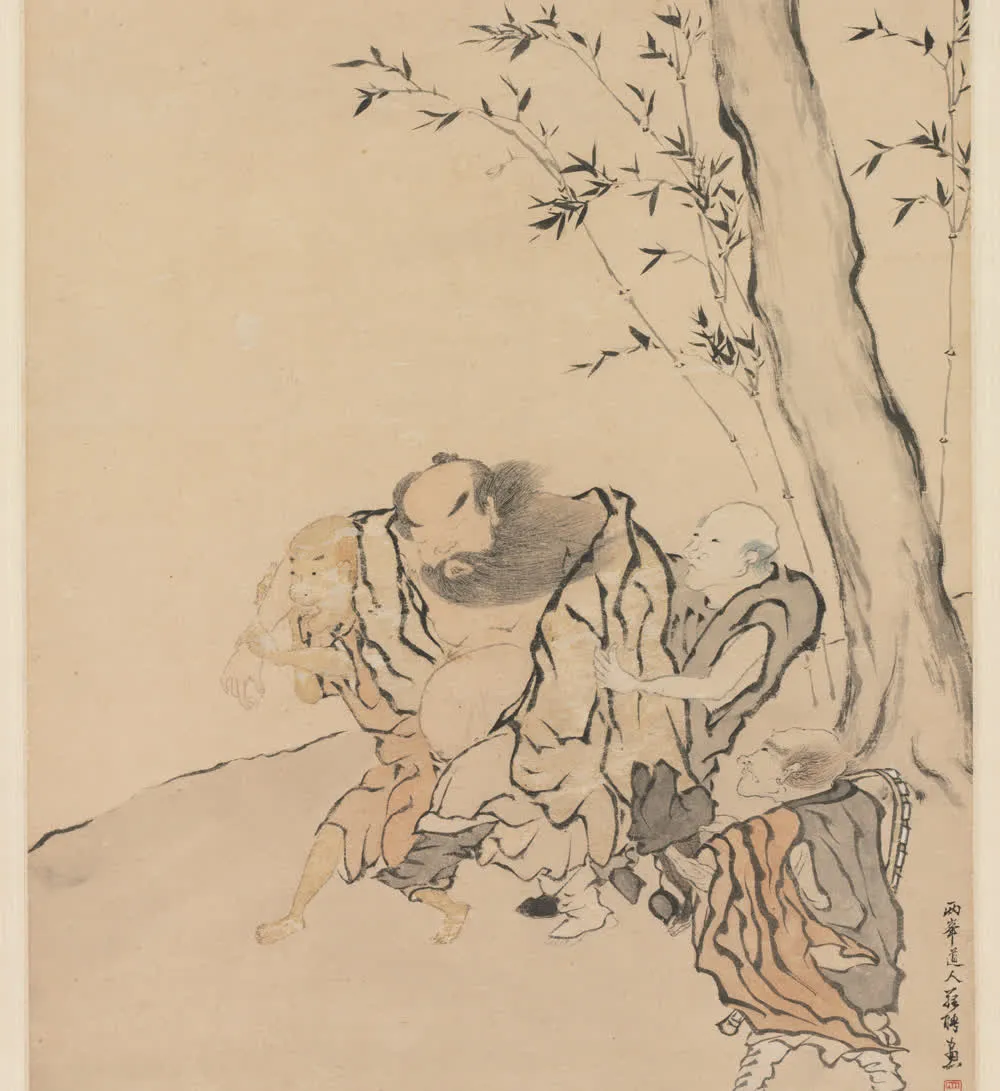
Luo Ping, Zhong Kui Supported by Ghosts (鍾馗逐鬼), 1700s, hanging scroll (detail). The Cleveland Museum of Art, 1959.185, CC0.
The same dream, longer
The Tianzhong ji and the Gujin shiwen leiju give a fuller dream and cite a Tang yishi for it, and the Jinxiu wanhua gu, whose preface is dated 1188 by our conversion, gives a short form that cites a Suishi ji.26 The small ghost now has a name, Xuhao, “Waste”.26 The big ghost is a Zhongnan jinshi who failed the examination in the Wude years, struck the palace steps and died, and was buried in a green robe the emperor gave him.26 The colophon in Shen Kuo’s text has its Zhong Kui fail the military examination instead.8
Laid beside the colophon, the Tang yishi text as the two compilations quote it shares much of its wording: the same opening, the same small ghost, the same theft of the pouch and the flute, the same eye, the same remark about the shared dream.27 It adds Xuhao’s speech and the jinshi account and leaves out the colophon’s year-end edict.27 We read the Tang yishi only through these quotations, so we cannot say which text came first. Zhao Yi, who also could not see the Tang yishi, judged the dream story false without needing argument.17
The story against the record
| The story | The record | Verdict |
|---|---|---|
| The name began with the dream | A sister named Zhong Kui on an epitaph; Yao Xuan in the Wei shu514 | Contradicted |
| Xuanzong dreamed it in Kaiyuan | One colophon, quoted by Shen Kuo18 | Disputed |
| Zhong Kui was a failed jinshi | A military examination in the colophon; a jinshi in the Tang yishi text826 | Disputed |
| The picture went out at the New Year | Tang memorials thank for it2022 | Confirmed |
Shen Kuo is where our trail to the colophon and the epitaph begins, and nothing we read says who wrote the one or where the other stone went.15
What we could not verify
Sources we have not seen
- Eliasberg’s Le roman du pourfendeur de démons (1976) is the source Zelnitskiy cites for the Zhongkui of the Dongyuan shenzhou jing; it would show what that text says about him. We found no readable copy online.
- A Columbia dissertation by Chun-Yi Joyce Tsai on Zhong Kui in Song and Yuan painting, and an article by Shi-yee Liu in Ars Orientalis 53 (2023): either could carry the picture’s later history. Both servers answered our requests with a bot check on 18 October 2026.
- The Tang yishi and the Suishi ji themselves: either would date the longer dream and show which text borrowed from which. We found neither as a book, only the quotations in the compilations above.
Seen only where others quote them
- Hu Yuanrui’s view that the name is older than the dream, read only where Fang Yizhi quotes it.
- Eliasberg’s argument against the mallet, and the Zhongkui of the Dongyuan shenzhou jing, read only as Zelnitskiy reports them.
- The Tang yishi text, read only as the Tianzhong ji and the Gujin shiwen leiju quote it.
Resting on a single source
- The epitaph with the sister named Zhong Kui, and the colophon on Wu Daozi’s scroll: each is known from Shen Kuo’s text alone.
Questions we could not settle
- Who wrote the colophon, and when. Shen Kuo does not say.
- Whether the memorial under Zhang Yue’s name in the Quan Tang wen is his. We did not test it.
- Zelnitskiy attributes to the Xin Tang shu an undated passage on Zhong Kui calendars given at year’s end. We searched every volume of the Wikisource text for the name and found only a genealogical table and a general named Zhang Zhongkui, so the passage is not confirmed.
Read next
TaleChina, Zuozhuan to the Tang
Meng Jiangnü's wall was a city wall first
TaleChina, 1679 to 1985
Before jiangshi hopped, they ran
TaleLeifeng Pagoda, Hangzhou, China, 975 to 2002
Lady White Snake and the fall of Leifeng Pagoda
Sources
- Shen Kuo 沈括, Mengxi bitan 夢溪筆談, Bu bitan 補筆談 (Supplement), juan xia 卷下, Siku quanshu (Wenyuange) edition, vol. 862, page image read; documents/bu-bitan-zhong-kui.md, Commons page 886, the sentence 禁中舊有吳道子畫鍾馗,其卷首有唐人題記曰 (the print may read 題寄; see the document file); the colophon runs to 仍告天下,悉令知會 () (primary) transcription↑
- Shen Kuo 沈括, Mengxi bitan 夢溪筆談, Bu bitan 補筆談 (Supplement), juan xia 卷下, Siku quanshu (Wenyuange) edition, vol. 862, page image read; documents/bu-bitan-zhong-kui.md, Commons page 886, second half-leaf, from 觀此題相記,似始於開元時 to 鍾馗字一作鍾葵 () (primary) transcription↑
- Gu Yanwu 顧炎武, Rizhilu 日知錄 juan 32, entry 終葵, text at zh.wikisource (not a page image), sentences 《考工記》 ... 《方言》:「齊人謂椎為終葵」 ... 蓋古人以椎逐鬼,若大儺之為耳 ... 未必然也
- Zhao Yi 趙翼, Gaiyu congkao 陔餘叢考 juan 35, entry 鍾馗, text at zh.wikisource (not a page image), the sentences from 顧寧人乃引馬融《廣成頌》 to 此說近之 (Zhao Yi summarises Gu and agrees)
- A. D. Zelnitskiy, "The figure of the deity Zhongkui and the historical and political context of the Tang dynasty", Vestnik nauki 2024 (CC BY), read on cyberleninka.ru; it reports Eliasberg (1976), de Groot and Ma Shutian at second hand, footnote 1 and the paragraph it belongs to, summarising Gu Yanwu's Rizhilu and noting that the deity's name is written with different characters↑
- Shen Kuo 沈括, Mengxi bitan 夢溪筆談 juan 24, Siku quanshu (Wenyuange) edition, vol. 862, page image read; documents/bitan-24-zhong-kui.md, Commons page 845, lower register, last columns on the right: 歲首畫鍾馗于門,不知起自何時。皇祐中,金陵發一塚,有石誌,乃宋宗慤母鄭夫人,宗慤有妹名鍾馗,則知鍾馗之說亦遠矣 () (primary) transcription
- Gao Cheng 高承, Shiwu jiyuan 事物紀原 juan 8, entry 鍾馗, Siku quanshu edition, text at zh.wikisource (not a page image), entry 鍾馗, the last sentence, quoting 沈括筆談: 嵗首畫鍾馗不知起自何時 ... 有妹曰鍾馗 (primary)
- Zhao Yi 趙翼, Gaiyu congkao 陔餘叢考 juan 35, entry 鍾馗, text at zh.wikisource (not a page image), entry 鍾馗, the parenthesis after 又宗懿妹名鍾葵: 此事見沈括《筆談》。皇祐中,金陵發一塚,有石誌,乃宗愨母鄭夫人,宗愨有妹名鍾馗↑
- Shen Yue 沈約, Song shu 宋書 juan 76, biography of Zong Que 宗慤, text at zh.wikisource (not a page image); the Wikisource note says this volume was lost and reassembled from other books, juan 76, section 宗慤: 元嘉二十二年,伐林邑 ... 卒,贈征西將軍,諡曰肅侯; the header note on the lost original (primary)↑
- Shen Kuo 沈括, Mengxi bitan 夢溪筆談, Bu bitan 補筆談 (Supplement), juan xia 卷下, Siku quanshu (Wenyuange) edition, vol. 862, page image read; documents/bu-bitan-zhong-kui.md, Commons page 886, first half-leaf, from the heading 補第二十六卷一件 to 乃詔畫工吳道子,告之以夢 () (primary) transcription
- Gao Cheng 高承, Shiwu jiyuan 事物紀原 juan 8, entry 鍾馗, Siku quanshu edition, text at zh.wikisource (not a page image), entry 鍾馗, first sentences: 開元中明皇病痁 ... 夢二鬼一大一小 ... 臣武舉所棄鍾馗也 ... 因命吳生如夢圖之 (primary)↑
- Shen Kuo 沈括, Mengxi bitan 夢溪筆談, Bu bitan 補筆談 (Supplement), juan xia 卷下, Siku quanshu (Wenyuange) edition, vol. 862, page image read; documents/bu-bitan-zhong-kui.md, Commons page 886, from 明皇開元講武驪山 to 即武舉不捷之士也,誓與陛下除天下之妖孽 () (primary) transcription↑
- Shen Kuo 沈括, Mengxi bitan 夢溪筆談, Bu bitan 補筆談 (Supplement), juan xia 卷下, Siku quanshu (Wenyuange) edition, vol. 862, page image read; documents/bu-bitan-zhong-kui.md, Commons page 886, from 乃詔畫工吳道子 to 仍告天下,悉令知會 () (primary) transcription↑
- Li Fang 李昉 and others, Taiping guangji 太平廣記 juan 214, entry 黃筌 (source note: 野人閒話), text at zh.wikisource and its Siku quanshu copy (not page images); the Wikisource header note gives the compilation as presented in the third year of Taiping xingguo (978, our conversion) or finished in the eighth (983), and says which is right is not known, juan 214, entry 黃筌: 昔吳道子所畫一鍾馗 ... 以右手第二指剜鬼眼睛 ... 筌今所畫 ... 意思並在拇指 〈出《野人閒話》〉 (primary)
- Zhu Mu 祝穆, Gujin shiwen leiju 古今事文類聚, qianji juan 6, Siku quanshu edition (the Siku abstract names Zhu Mu of the Song as author of the qianji), text at zh.wikisource (not a page image), qianji juan 6, entry 畫鍾馗, same story, ending 〈野人閒話〉 (primary)↑
- Shen Kuo 沈括, Mengxi bitan 夢溪筆談, Bu bitan 補筆談 (Supplement), juan xia 卷下, Siku quanshu (Wenyuange) edition, vol. 862, page image read; documents/bu-bitan-zhong-kui.md, Commons page 886, from 熙寧五年上令畫工摸搨錢板印賜兩府輔臣各一本 to 給賜鍾馗之象 () (primary) transcription↑
- Gao Cheng 高承, Shiwu jiyuan 事物紀原 juan 8, entry 鍾馗, Siku quanshu edition, text at zh.wikisource (not a page image), entry 鍾馗, from 開元中明皇病痁居小殿 to 由是故今人以其像施於門帳中也 (primary)↑
- Fang Yizhi 方以智, Tongya 通雅 juan 21, entry 鍾馗, Siku quanshu edition, text at zh.wikisource (not a page image), entry 鍾馗, after the epitaph: 漢鄭衆相去遠,或其曾孫女乎↑
- Wei Shou 魏收, Wei shu 魏書 juan 42, biography of Yao Xuan 堯暄, text at zh.wikisource (not a page image), first sentence of the biography of 堯暄: 堯暄,字辟邪 ... 本名鍾葵,後賜為暄 (primary)
- Gu Yanwu 顧炎武, Rizhilu 日知錄 juan 32, entry 終葵, text at zh.wikisource (not a page image), sentence 《魏書》:「堯暄本名鐘葵,字辟邪」 and the list that follows (楊鐘葵, 丘鐘葵, 李鐘葵, 慕容鐘葵, 喬鐘葵 ...)
- Zhao Yi 趙翼, Gaiyu congkao 陔餘叢考 juan 35, entry 鍾馗, text at zh.wikisource (not a page image), the long paragraph after the Tianzhong ji quotation, from 後魏、北齊及周、隋間多有名鍾葵者 to 則《天中記》之說真附會也↑
- Fang Yizhi 方以智, Tongya 通雅 juan 21, entry 鍾馗, Siku quanshu edition, text at zh.wikisource (not a page image), entry 鍾馗, the sentence 元瑞曰六朝已有鍾馗,後人附㑹作傳,諸取名者皆以鬼神為名也↑
- Zhouli 周禮, Dongguan kaogong ji 冬官考工記, text at zh.wikisource (not a page image), the jade-workers' measures: 大圭長三尺,杼上終葵首,天子服之 (the gloss is not in this text) (primary)
- Zhao Yi 趙翼, Gaiyu congkao 陔餘叢考 juan 35, entry 鍾馗, text at zh.wikisource (not a page image), entry 鍾馗, the sentence 《周禮•考工記》大圭「終葵首」注:齊人謂椎曰終葵↑
- Zhao Yi 趙翼, Gaiyu congkao 陔餘叢考 juan 35, entry 鍾馗, text at zh.wikisource (not a page image), entry 鍾馗: 而大圭之終葵何以轉為人名之終葵,則未見的義 and 然此事不辨可知其妄也↑
- A. D. Zelnitskiy, "The figure of the deity Zhongkui and the historical and political context of the Tang dynasty", Vestnik nauki 2024 (CC BY), read on cyberleninka.ru; it reports Eliasberg (1976), de Groot and Ma Shutian at second hand, the paragraph after footnote 1, with footnotes 3 and 4 (Eliasberg 1976, pp. 19-20 and 22-23)↑
- A. D. Zelnitskiy, "The figure of the deity Zhongkui and the historical and political context of the Tang dynasty", Vestnik nauki 2024 (CC BY), read on cyberleninka.ru; it reports Eliasberg (1976), de Groot and Ma Shutian at second hand, the paragraphs on the Kaiyuan reforms and on why Zhongkui was chosen, with the abstract↑
- Zhang Yue 張說 (as attributed in the Quan Tang wen 全唐文 juan 223), 謝賜鍾馗及曆日表, text at zh.wikisource (not a page image), whole memorial: 賜臣畫鍾馗一及新曆日一軸 (primary)
- Liu Yuxi 劉禹錫, Liu Mengde wenji 劉夢得文集 juan 17, two memorials written on behalf of others, Sibu congkan chubian reproduction, page images read; documents/liu-yuxi-zhong-kui-memorials.md, Commons pages 43 (代李中丞謝鍾馗曆日) and 44 (又代杜相公謝鍾馗曆日) () (primary) transcription
- Zhao Yi 趙翼, Gaiyu congkao 陔餘叢考 juan 35, entry 鍾馗, text at zh.wikisource (not a page image), entry 鍾馗: 朝廷之上,每歲暮以鍾馗與曆日同賜大臣 ... 劉禹錫有《代杜相公謝賜鍾馗曆日表》 and 《代李中丞謝表》
- A. D. Zelnitskiy, "The figure of the deity Zhongkui and the historical and political context of the Tang dynasty", Vestnik nauki 2024 (CC BY), read on cyberleninka.ru; it reports Eliasberg (1976), de Groot and Ma Shutian at second hand, main text after footnote 5: the earliest letters of thanks date to Xuanzong's reign; footnote 6 names Sun Ti and Zhang Shuo (Zhang Yue) after Eliasberg↑
- Liu Yuxi 劉禹錫, Liu Mengde wenji 劉夢得文集 juan 17, two memorials written on behalf of others, Sibu congkan chubian reproduction, page images read; documents/liu-yuxi-zhong-kui-memorials.md, page 43, 代李中丞謝鍾馗曆日: 伏以將慶新年,聿循故事。繢其神象,表去癘之方; page 44, 又代杜相公: 伏以圖寫威神,驅除羣癘 () (primary) transcription
- Zhao Yi 趙翼, Gaiyu congkao 陔餘叢考 juan 35, entry 鍾馗, text at zh.wikisource (not a page image), entry 鍾馗, the quoted lines 圖寫威神,驅除群厲 and 繪其神像,表去厲之方↑
- Zhang Yue 張說 (as attributed in the Quan Tang wen 全唐文 juan 223), 謝賜鍾馗及曆日表, text at zh.wikisource (not a page image), whole memorial; 屏袪群厲,繢神像以無邪 (primary)
- Liu Yuxi 劉禹錫, Liu Mengde wenji 劉夢得文集 juan 17, two memorials written on behalf of others, Sibu congkan chubian reproduction, page images read; documents/liu-yuxi-zhong-kui-memorials.md, pages 43 and 44, the two memorials in full () (primary) transcription↑
- Huang Xiufu 黃休復, Yizhou minghua lu 益州名畫録 juan zhong, Siku quanshu edition, text at zh.wikisource (not a page image), the entry on Zhao Zhongyi 趙忠義: 先是每年杪冬末旬,翰林攻畫鬼神者例進鍾馗焉 (primary)
- Guo Ruoxu 郭若虛, Tuhua jianwen zhi 圖畫見聞誌 juan 2, text at zh.wikisource (not a page image), the Five Dynasties list: 梁駙馬都尉趙喦 ... 《鍾馗》; 王道求 ... 《挾鬼鍾馗》; 僧智蘊 ... 周祖時進《舞鍾馗圖》,賜紫衣 (primary)↑
- Huang Xiufu 黃休復, Yizhou minghua lu 益州名畫録 juan zhong, Siku quanshu edition, text at zh.wikisource (not a page image), the entry on Zhao Zhongyi 趙忠義: 丙辰歲忠義進鍾馗以第二指挑鬼眼睛 ... 並厚賜金帛 (primary)↑
- Meng Yuanlao 孟元老, Dongjing menghua lu 東京夢華錄 juan 10, text at zh.wikisource (not a page image), section 十二月: 市井皆印賣門神、鐘馗、桃板、桃符; section 除夕: 又裝鍾馗、小妹、土地、竈神之類 (primary)
- Wu Zimu 吳自牧, Mengliang lu 夢粱錄 juan 6, Siku quanshu edition, text at zh.wikisource (not a page image), section 十二月: 鋪席有貨畫門神桃符 ... 印鍾馗; section 除夜: 換門神,掛鍾馗,釘桃符 ... 伶工裝將軍符使判官鍾馗六丁六甲 (primary)↑
- Chen Yaowen 陳耀文, Tianzhong ji 天中記 juan 4, entry 夢鍾馗, Siku quanshu edition (the Siku abstract gives the author as a man of the Ming), text at zh.wikisource (not a page image), juan 4, entry 夢鍾馗, from 明皇開元講武驪山 to 賜與百金〈唐逸史〉 (primary)
- Zhu Mu 祝穆, Gujin shiwen leiju 古今事文類聚, qianji juan 6, Siku quanshu edition (the Siku abstract names Zhu Mu of the Song as author of the qianji), text at zh.wikisource (not a page image), qianji juan 6, entry 夢鍾馗, same text, ending 〈唐逸史〉 (primary)
- Jinxiu wanhua gu 錦繡萬花谷, houji juan 4, entry 鍾馗啖鬼, Siku quanshu edition (the Siku abstract reads a preface dated the 15th year of Chunxi, 1188 by our conversion), text at zh.wikisource (not a page image), houji juan 4, entry 鍾馗啖鬼: 明皇晝寢忽夢虛耗二鬼 ... 乃曰終南山進士鍾馗也 ... 〈出歲時記〉 (primary)
- Zhao Yi 趙翼, Gaiyu congkao 陔餘叢考 juan 35, entry 鍾馗, text at zh.wikisource (not a page image), entry 鍾馗: 今按《天中記》引《唐逸史》 ... 《唐逸史》不可見↑
- Shen Kuo 沈括, Mengxi bitan 夢溪筆談, Bu bitan 補筆談 (Supplement), juan xia 卷下, Siku quanshu (Wenyuange) edition, vol. 862, page image read; documents/bu-bitan-zhong-kui.md, Commons page 886, from 明皇開元講武驪山 to 道子奉旨 ... 是卿與我同夢 () (primary) transcription
- Chen Yaowen 陳耀文, Tianzhong ji 天中記 juan 4, entry 夢鍾馗, Siku quanshu edition (the Siku abstract gives the author as a man of the Ming), text at zh.wikisource (not a page image), juan 4, entry 夢鍾馗 (whole entry) (primary)
- Zhu Mu 祝穆, Gujin shiwen leiju 古今事文類聚, qianji juan 6, Siku quanshu edition (the Siku abstract names Zhu Mu of the Song as author of the qianji), text at zh.wikisource (not a page image), qianji juan 6, entry 夢鍾馗 (whole entry) (primary)↑
Documents quoted
- Liu Yuxi: two memorials of thanks for a Zhong Kui painting (transcribed from the page image)
- Shen Kuo, Bitan juan 24: the epitaph of Lady Zheng (transcribed from the page image)
- Shen Kuo, Bu bitan: the Zhong Kui item (transcribed from the page image)