 Twice Told
Meng Jiangnü's wall was a city wall first
The wall that falls for Qi Liang's widow was a city wall for centuries. Tang texts, one a Japanese manuscript of 747, move her to the Great Wall.
Contents
Published 19 Oct 2026. Sources checked 17 Oct 2026.
In the oldest account of Qi Liang’s widow nobody weeps and no wall falls.1 A duke of Qi meets her in the country after her husband’s death and offers condolences. She says the house is the place for them, and he goes there.2 The Great Wall, the First Emperor and the name Meng Jiangnü all arrive later.67
This is the legend as it was told in the Ming and Qing centuries, in the outline Wilt Idema gives.8
Meng Jiangnü is a teenage bride whose husband, Qi Liang, is taken from her to work on the Great Wall.8 Once he has gone north he does not come back.7 She makes winter clothes, and with no one to send them with, she carries them herself.7 At the Wall she learns that he is dead and buried in it.8 She weeps, and the Wall collapses.9 Bones of many of the Wall’s dead lie in a heap, and she cannot tell which are his.9 In a Dunhuang text of perhaps the ninth or tenth century she bites her finger and sprinkles blood on them to find her husband’s.9
In many later versions the First Emperor sees her and wants to marry her.10 She agrees if he will meet her conditions, and when he has, she drowns herself.10 At Shanhaiguan, where the Wall meets the sea, the sea is where she goes in.8
Temples before any full text
Meng Jiangnü had temples in the eleventh century, and no complete telling from the next five centuries survives.1112 Idema finds temples to Meng Jiangnü and her husband mentioned from the eleventh century on, among the earliest at Ansu and Tongguan.11 At Yongqiu in 1176 the temple was devoted to Qi Liang, his wife and General Meng Tian, and Qi Liang had become a man named Fan, perhaps through a misread character or through mishearing “the criminal Qi Liang” (fan Qi Liang).11
No complete account of the legend as novel, play or ballad survives from the eleventh to the sixteenth century, Idema writes, though it was staged early.12 The scholar Zheng Qiao (1104 to 1162) complained that characters who had earned a few words in the Classics, Qi Liang’s wife among them, were being spun into tales “of millions of words”.12
The legend even shaped what the Ming called their own walls. Idema says they avoided the name Long Wall for their border fortifications because of what the legend had made of it.13 Seventeenth-century Jesuits were the first to identify the Qin wall with the Ming works, and the Wall became a proud national symbol in China only in the twentieth century.13
In the Tang Qi Liang becomes a conscript
In the Tang the story moves from Duke Zhuang’s attack to the Qin wall.6 One Tang version survives in a Japanese manuscript of 747, the Diaoyuji, which quotes a book called the Tongxian ji for two accounts side by side.5 The first is the old story of Duke Zhuang’s condolence on the road. In the second, Qi Liang is a conscript of the First Emperor who flees the Long Wall, marries Zhongzi in the garden of Meng Qi, is beaten to death and built into the wall; she weeps until it falls and tests his bones with her blood.5 The compiler adds that he does not know which account is correct.5 Idema writes that little is known of the Diaoyuji’s date and provenance, and even less of the Tongxian ji.5
The monk Guanxiu, who lived from 832 to 912, wrote a poem that puts the widow at the Qin wall.14
一號城崩塞色苦,再號杞梁骨出土。14
At her first cry the wall fell, and the frontier light turned bitter. At her second cry Qi Liang’s bones came out of the earth.
Gu Jiegang, as Wu Zhen quotes him, called this poem the opening of a new era of legends about the building of the Qin wall.15 Gu’s own 1924 study, which Wu calls the start of the modern research, had found two independent Tang versions, “the elegy of Qi Liang’s wife” and a tale of Meng Zhongzi dripping blood on bones.16 The manuscript of 747 already has the conscript and the blood, so by Idema’s dates Guanxiu was not the first to write it down.514
The name comes later still. Idema says the maiden Meng Jiang first appears in an anonymous song from Dunhuang, probably of the ninth or tenth century, in which she carries winter clothes to a husband who has gone north and not come back.7 “Meng Jiang” itself is old: in the Book of Odes “that beautiful eldest Jiang” is a beauty of the Jiang family, and meng means eldest.17 In the Tang legend, Idema says, meng is read as the surname Meng.17
The Dunhuang prose-and-verse text, Pelliot chinois 5039, loses both its beginning and its end.9 In it Qi Liang’s ghost appears to Meng Jiang in a dream at the Great Wall, the wall falls at her weeping, and she sprinkles blood on the heap of bones to find her husband’s.9 The other dead then ask her to carry a message home.9
Liu Xiang’s wall
Idema credits the wall to Liu Xiang: when he put her story into the Lienü zhuan, he added that her weeping brought down a wall.18 He dates Liu Xiang to 79 to 6 BCE and the book to the final years of the first century BCE.19 His entry on Qi Liang’s wife keeps the Zuozhuan’s exchange with the duke and then adds a second half.218
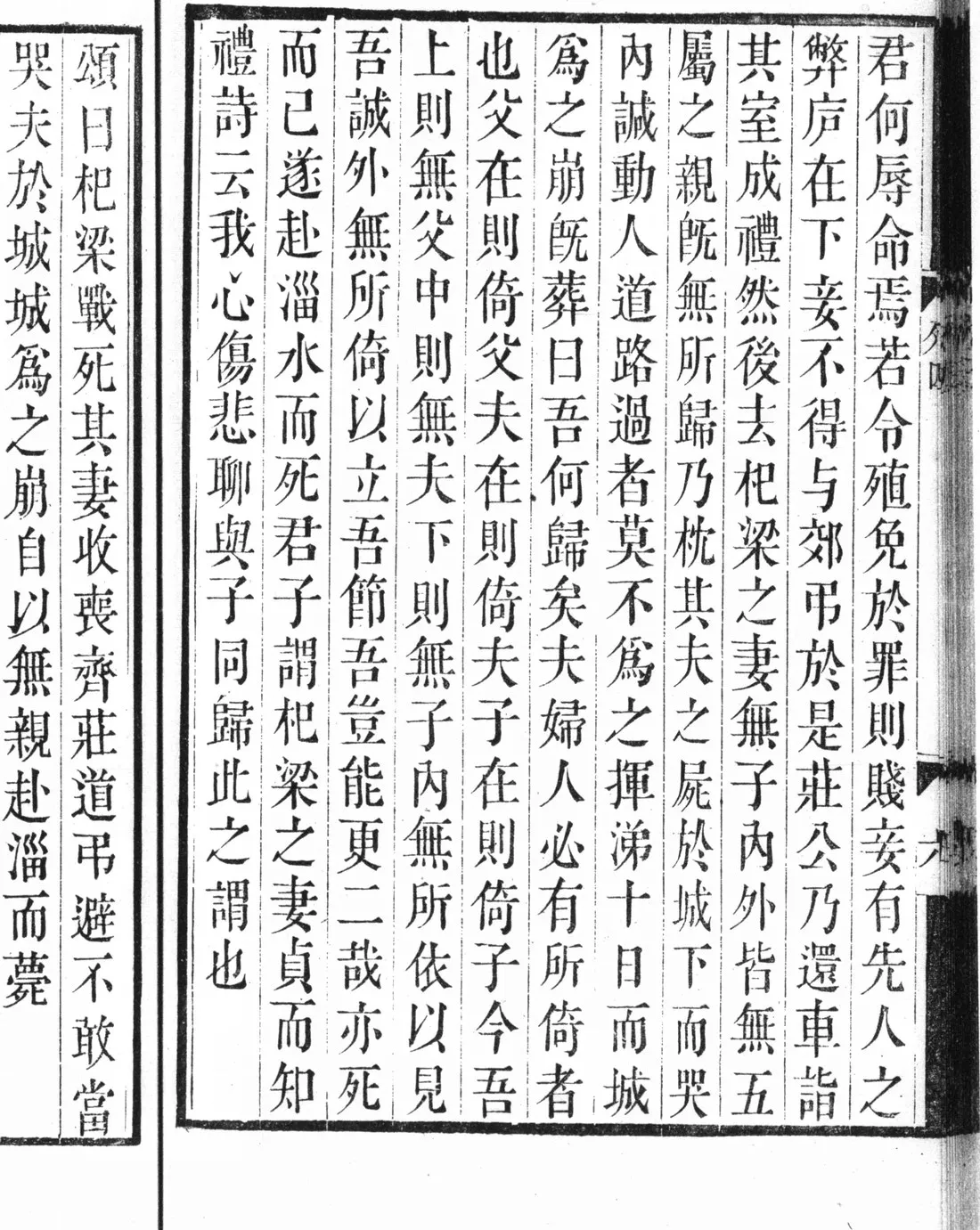
The end of the Lienü zhuan entry on Qi Liang’s wife18: the right-hand leaf runs from her answer to the duke to her death in the Zi River, and the first two columns of the hymn on her stand at the left. Liu Xiang, Gu Lienü zhuan (古列女傳), juan 4, Yuanhe Gu family print of 1796, cropped. National Diet Library Digital Collections, call number わ159-113, public domain (PDM).
既無所歸,乃枕其夫之屍于城下而哭,內誠動人 … 十日而城為之崩。18
With nowhere to go, she rested her head on her husband’s body at the foot of the wall and wept. Her sincerity moved people … and after ten days the wall collapsed on her account.
She has no son and no kin. After the burial she says she has no one to lean on, and she throws herself into the Zi River.18
No early version names the Great Wall.6 Beyond that the texts differ. The Lienü zhuan says only “the wall”.3 The Shuoyuan has her weep and the city wall slump, with one corner falling.20 A quotation in the Taiping yulan of 977 has the people of Ju’s wall of corpses.3 Cui Bao’s Gujin zhu has the capital city of Qǐ crumble.3
Two readers who did not believe it
Wang Chong’s Lunheng takes “Qi Liang’s wife wept and the wall fell” as a claim to be refuted.21 He says Qi Liang died on campaign, the widow met the coffin and refused the condolence on the road, and no account has her weeping at a city wall.21 His verdict is that the collapse is an empty saying, and he calls the duke the lord of Lu.21
Gu Yanwu makes a different point in his Rizhilu: what fell was a city wall, and no text says Great Wall.4 Qi’s own long wall was built under King Wei, over a hundred years after Duke Zhuang, and it was not the First Emperor’s.4 He adds that later people tell of a wife named Meng Jiang, of the house of Fan Lang, who brought winter clothes to the wall, and says this is no longer Qi Liang’s wife’s story.22 He blames the monk Guanxiu for writing Qi Liang into the Qin builders.22
Weeping before the wall
The weeping was there before the wall. In the Mencius, Chunyu Kun says the wives of Hua Zhou and Qi Liang were so good at weeping for their husbands that they changed the customs of the state.23 Idema says this weeping is deliberate, loud and public, close to song, not spontaneous grief.23
The Liji’s Tangong chapter has Zeng Zi say that Kuai Shang, who took a condolence at the roadside, knew ritual less well than Qi Liang’s wife.24 She met her husband’s coffin on the road and wept for him with grief, and she answered the duke’s messenger with a refusal of her own.24 Gu Yanwu observes that weeping first appears in these two books, and the collapse of a wall only in the Shuoyuan and the Lienü zhuan.23242018
What the Zuozhuan says
The Zuozhuan, which Idema dates to the fourth or third century BCE, tells it under Duke Xiang’s 23rd year.25 Duke Zhuang of Qi attacks Ju by surprise; Ju’s side takes Qi Liang, who is called Qi Zhi in the same passage.126 When the duke comes home he meets Qi Liang’s widow in the countryside and sends condolences.1
殖之有罪,何辱命焉。2
If Zhi has committed a crime, why should you trouble yourself to send condolences?
She adds that if he is spared there is still the humble house of his forebears, and that as a lowly wife she cannot receive condolences in the open.2 The passage ends with the duke doing as she says: Qi hou diao zhu qi shi, “Lord Qi then offered condolences at her house”.1 The words for weeping and for a wall do not occur in it.1
What we could not verify
Sources we have not seen
- Gu Jiegang’s essay “Meng Jiangnü gushi de zhuanbian” (1924) and the 1928 collection that reprints it. It would show how he sorted the Tang versions at first hand; we found no open copy, and know it only through Wu Zhen and Idema.
- The Tongxian ji and the Diaoyuji. They would settle how old the Qin-conscript version is; the quotations we read come through Idema, and we found no open text of either.
Seen only where others quote them
- The Taiping yulan’s quotation of the Lienü zhuan (977), and the Dunhuang song and manuscript P. 5039, read in Idema’s and Wu Zhen’s translations and descriptions.
Questions we could not settle
- Whether the wall in the Lienü zhuan is Ju’s wall, a city of Qi or another: the sources we read do not say, and Idema marks it “(of Ju?)”.
- Which Tang text first set Qi Liang at the Qin wall, since little is known of the date of the Tongxian ji.
Read next
TaleChina, Tang to Song
Before Xuanzong's dream, Zhong Kui was already a name
TaleChina, 1679 to 1985
Before jiangshi hopped, they ran
TaleLeifeng Pagoda, Hangzhou, China, 975 to 2002
Lady White Snake and the fall of Leifeng Pagoda
Sources
- Zuozhuan 左傳, Duke Xiang 襄公 23rd year, text at ctext.org (checked against the Wikisource text of the same chapter; neither is a page image), paragraph opening 齊侯還自晉,不入 (ctext paragraph 19645): 遂襲莒 ... 獲杞梁。莒人行成。齊侯歸,遇杞梁之妻於郊 ... 齊侯弔諸其室; the characters 哭 and 城 do not occur in it, and 獲 is the verb used for Qi Liang (primary)
- Gu Yanwu 顧炎武, Rizhilu 日知錄 25, entry 杞梁妻, text at Wikisource (not a page image), entry 杞梁妻, after quoting the Zuozhuan sentences: 左氏之文不過如此而已 (the Zuo text goes no further than this)
- Wilt L. Idema, Meng Jiangnü Brings Down the Great Wall: Ten Versions of a Chinese Legend (University of Washington Press, 2008), essay "Meng Jiangnü: The Development of a Legend", pp. 3-23, p. 5: the Zuo tradition recounts the surprise attack on Ju and the widow's refusal of condolences; no wall or weeping is mentioned↑
- Zuozhuan 左傳, Duke Xiang 襄公 23rd year, text at ctext.org (checked against the Wikisource text of the same chapter; neither is a page image), same paragraph, speech 殖之有罪,何辱命焉?若免於罪,猶有先人之敝廬在,下妾不得與郊弔; closing 齊侯弔諸其室 (primary)
- Lienü zhuan 列女傳, juan 4, 齊杞梁妻, Sibu congkan chubian reproduction of a Ming print (Ye family's Guan gu tang copy), page images read; documents/lienu-zhuan-qi-liang-qi.md, page 76, columns 2-5: the same refusal in nearly the same words, ending 莊公乃還車詣其室成禮然後去 () (primary) transcription
- Wilt L. Idema, Meng Jiangnü Brings Down the Great Wall: Ten Versions of a Chinese Legend (University of Washington Press, 2008), essay "Meng Jiangnü: The Development of a Legend", pp. 3-23, p. 5: the widow refused the duke's condolences offered on the road, an inappropriate place; p. 6 gives Liu Xiang's version↑
- Wilt L. Idema, Meng Jiangnü Brings Down the Great Wall: Ten Versions of a Chinese Legend (University of Washington Press, 2008), essay "Meng Jiangnü: The Development of a Legend", pp. 3-23, p. 6: early authors disagree as to which wall; p. 7: the Taiping yulan (977) quotes the Lienü zhuan with a wall of corpses built by the people of Ju
- Yuefu shiji 樂府詩集 73, Guo Maoqian (Song), entries 杞梁妻 and 同前 (僧貫休) under 雜曲歌辭, Sibu congkan chubian reproduction of a Jigu ge print, page images read (Commons file part 16-13, pages 20-21); documents/yuefu-shiji-guanxiu-qi-liang-qi.md, page 20, the same note: 乃抗聲長哭,杞都城感之而頹 (primary)
- Gu Yanwu 顧炎武, Rizhilu 日知錄 25, entry 杞梁妻, text at Wikisource (not a page image), entry 杞梁妻, the same Gujin zhu passage quoted, with Gu Yanwu's remark that it makes the fallen city the capital of Qǐ↑
- Gu Yanwu 顧炎武, Rizhilu 日知錄 25, entry 杞梁妻, text at Wikisource (not a page image), entry 杞梁妻: 且其崩者城耳,未云長城。長城築於威王之時,去莊公百有餘年,而齊之長城又非秦始皇所築之長城也↑
- Wilt L. Idema, Meng Jiangnü Brings Down the Great Wall: Ten Versions of a Chinese Legend (University of Washington Press, 2008), essay "Meng Jiangnü: The Development of a Legend", pp. 3-23, pp. 7-9: the Diaoyuji, juan 12, Ganying pian, as a Japanese manuscript of 747; both versions translated; the closing note that the compiler does not know which is correct
- Wu Zhen, "The Tale of Meng Jiangnü: Its Salvation: Theme and Ritual Function", Memoirs of the Research Department of the Toyo Bunko 69 (2011), pp. 19-49, p. 19: Gu finds the two Tang tales synthesised in the Diaoyuji; p. 27: the Tongxian ji as recorded in the Diaoyuji, the only extant version existing in Japan↑
- Wilt L. Idema, Meng Jiangnü Brings Down the Great Wall: Ten Versions of a Chinese Legend (University of Washington Press, 2008), essay "Meng Jiangnü: The Development of a Legend", pp. 3-23, p. 5: in the earliest versions the Great Wall and the First Emperor are absent and enter in Tang-dynasty times; p. 7: in Tang sources the setting is the Qin and the wall is the Great Wall
- Wu Zhen, "The Tale of Meng Jiangnü: Its Salvation: Theme and Ritual Function", Memoirs of the Research Department of the Toyo Bunko 69 (2011), pp. 19-49, pp. 19-20: Gu Jiegang finds the legend's Great Wall form synthesised in the Tang and fixed after Guanxiu's poem↑
- Wilt L. Idema, Meng Jiangnü Brings Down the Great Wall: Ten Versions of a Chinese Legend (University of Washington Press, 2008), essay "Meng Jiangnü: The Development of a Legend", pp. 3-23, pp. 10-11, the passage opening "But it is only in one of the anonymous songs recovered from Dunhuang"↑
- Wilt L. Idema, Meng Jiangnü Brings Down the Great Wall: Ten Versions of a Chinese Legend (University of Washington Press, 2008), essay "Meng Jiangnü: The Development of a Legend", pp. 3-23, p. 3, first two paragraphs, and p. 4 (the husband conscripted to the Wall, where he soon died)↑
- Wilt L. Idema, Meng Jiangnü Brings Down the Great Wall: Ten Versions of a Chinese Legend (University of Washington Press, 2008), essay "Meng Jiangnü: The Development of a Legend", pp. 3-23, pp. 11-13: the manuscript, probably of the ninth or tenth century, with the beginning and ending missing; translated passages
- Wu Zhen, "The Tale of Meng Jiangnü: Its Salvation: Theme and Ritual Function", Memoirs of the Research Department of the Toyo Bunko 69 (2011), pp. 19-49, pp. 21-22 and p. 27: P. 5039 and its scene of her speaking to the many skulls at the Wall; the text is the starting point of the article↑
- Wilt L. Idema, Meng Jiangnü Brings Down the Great Wall: Ten Versions of a Chinese Legend (University of Washington Press, 2008), essay "Meng Jiangnü: The Development of a Legend", pp. 3-23, p. 14, the last paragraph of the Dunhuang discussion, before "Later Developments"↑
- Wilt L. Idema, Meng Jiangnü Brings Down the Great Wall: Ten Versions of a Chinese Legend (University of Washington Press, 2008), essay "Meng Jiangnü: The Development of a Legend", pp. 3-23, p. 15, section "Later Developments", after the paragraph on temples↑
- Wilt L. Idema, Meng Jiangnü Brings Down the Great Wall: Ten Versions of a Chinese Legend (University of Washington Press, 2008), essay "Meng Jiangnü: The Development of a Legend", pp. 3-23, p. 4, paragraph on the Wall's construction and the Jesuits↑
- Yuefu shiji 樂府詩集 73, Guo Maoqian (Song), entries 杞梁妻 and 同前 (僧貫休) under 雜曲歌辭, Sibu congkan chubian reproduction of a Jigu ge print, page images read (Commons file part 16-13, pages 20-21); documents/yuefu-shiji-guanxiu-qi-liang-qi.md, page 21, the poem headed 同前 (僧貫休) after Wu Maiyuan's 杞梁妻 (): 秦之無道兮四海枯,築長城兮遮北胡 ... 一號城崩塞色苦,再號杞梁骨出土 (the print reads 塞; Wikisource's text has 寒) (primary) transcription
- Wilt L. Idema, Meng Jiangnü Brings Down the Great Wall: Ten Versions of a Chinese Legend (University of Washington Press, 2008), essay "Meng Jiangnü: The Development of a Legend", pp. 3-23, p. 10: the poem translated; Guanxiu given as 832-912
- Wu Zhen, "The Tale of Meng Jiangnü: Its Salvation: Theme and Ritual Function", Memoirs of the Research Department of the Toyo Bunko 69 (2011), pp. 19-49, p. 20: the poem translated; cites Quan Tang shi, vol. 826, p. 9304↑
- Wu Zhen, "The Tale of Meng Jiangnü: Its Salvation: Theme and Ritual Function", Memoirs of the Research Department of the Toyo Bunko 69 (2011), pp. 19-49, p. 19, quoting Gu Jiegang, Meng Jiangnü gushi yanjiuji (1928; Shanghai guji 1984 reprint, p. 38), note 2↑
- Wu Zhen, "The Tale of Meng Jiangnü: Its Salvation: Theme and Ritual Function", Memoirs of the Research Department of the Toyo Bunko 69 (2011), pp. 19-49, p. 19, opening paragraph and note 2 (the title of Gu's essay, 孟姜女故事的轉變)↑
- Shijing 詩經, Zheng feng, You nü tong che 有女同車, text at ctext.org (not a page image), Mao 83, 有女同車, the line 彼美孟姜,洵美且都 (Legge: "That beautiful eldest Jiang") (primary)
- Wilt L. Idema, Meng Jiangnü Brings Down the Great Wall: Ten Versions of a Chinese Legend (University of Washington Press, 2008), essay "Meng Jiangnü: The Development of a Legend", pp. 3-23, p. 11: the name Meng Jiang occurs in the Book of Odes, where meng is not a surname and means the eldest daughter of the Jiang family; in the Tang legend meng is read as the surname Meng↑
- Lienü zhuan 列女傳, juan 4, 齊杞梁妻, Sibu congkan chubian reproduction of a Ming print (Ye family's Guan gu tang copy), page images read; documents/lienu-zhuan-qi-liang-qi.md, page 76, columns 6-10 and page 77, columns 1-3: 杞梁之妻無子 ... 乃枕其夫之屍于城下而哭 ... 十日而城為之崩 ... 遂赴淄水而死; the hymn on page 77 repeats it () (primary) transcription
- Wilt L. Idema, Meng Jiangnü Brings Down the Great Wall: Ten Versions of a Chinese Legend (University of Washington Press, 2008), essay "Meng Jiangnü: The Development of a Legend", pp. 3-23, pp. 5-6: Liu Xiang added the detail that her weeping brought down the wall (of Ju?) and that she committed suicide after the funeral; p. 6 gives the whole entry in translation
- Yuefu shiji 樂府詩集 73, Guo Maoqian (Song), entries 杞梁妻 and 同前 (僧貫休) under 雜曲歌辭, Sibu congkan chubian reproduction of a Jigu ge print, page images read (Commons file part 16-13, pages 20-21); documents/yuefu-shiji-guanxiu-qi-liang-qi.md, page 20, the note under 杞梁妻: the Lienü zhuan quoted: 乃就其夫之尸於城下而哭,十日而城為之崩 (page 20, last column) ... 既葬,遂赴淄水而死 (page 21, column 1) (primary)↑
- Wilt L. Idema, Meng Jiangnü Brings Down the Great Wall: Ten Versions of a Chinese Legend (University of Washington Press, 2008), essay "Meng Jiangnü: The Development of a Legend", pp. 3-23, p. 5 (Liu Xiang (79-6 b.c.e.)); p. 4 (Lienü zhuan, of the final years of the first century b.c.e.)↑
- Shuoyuan 說苑, chapter Lijie 立節, text at ctext.org (not a page image), the anecdote opening 齊莊公且伐莒; its last sentences 遂進鬥,殺二十七人而死。其妻聞之而哭,城為之阤,而隅為之崩 (primary)
- Gu Yanwu 顧炎武, Rizhilu 日知錄 25, entry 杞梁妻, text at Wikisource (not a page image), entry 杞梁妻: 《說苑》則曰:「杞梁、華舟迸鬪,殺二十七人而死,其妻聞之而哭,城為之陁也,而隅為之崩」。言崩城者始自二書 (the collapse of the wall first appears in the Shuoyuan and the Lienü zhuan)↑
- Lunheng 論衡, chapter 43 Biandong 變動, text at Wikisource (not a page image), chapter 43, the section after the Zou Yan example: 杞梁從軍,死不歸。其婦迎之 ... 不言哭於城下 ... 則杞梁之妻哭而崩城,復虛言也 (the text calls the duke 魯君, the lord of Lu) (primary)↑
- Gu Yanwu 顧炎武, Rizhilu 日知錄 25, entry 杞梁妻, text at Wikisource (not a page image), entry 杞梁妻: 後人相傳乃謂秦築長城,有范郎之妻孟姜送寒衣至城下 ... 唐僧貫休乃據以作詩↑
- Mengzi 孟子, Gaozi II 告子下, text at ctext.org (not a page image), Chunyu Kun's speech in the exchange with Mencius: 華周、杞梁之妻善哭其夫,而變國俗 (Legge 6.2.6) (primary)
- Gu Yanwu 顧炎武, Rizhilu 日知錄 25, entry 杞梁妻, text at Wikisource (not a page image), entry 杞梁妻: 《孟子》則曰「華周、杞梁之妻,善哭其夫而變國俗」。言哭者始自二書 (the weeping first appears in the Liji and the Mencius)
- Wilt L. Idema, Meng Jiangnü Brings Down the Great Wall: Ten Versions of a Chinese Legend (University of Washington Press, 2008), essay "Meng Jiangnü: The Development of a Legend", pp. 3-23, p. 5: other sources from the Warring States period mention that Qi Liang's widow was good at weeping↑
- Liji 禮記, Tangong II 檀弓下, text at ctext.org (not a page image), Tangong II, the sentence 曾子曰:「蕢尚不如杞梁之妻之知禮也 ... 其妻迎其柩於路而哭之哀 ... (primary)
- Gu Yanwu 顧炎武, Rizhilu 日知錄 25, entry 杞梁妻, text at Wikisource (not a page image), entry 杞梁妻: 《檀弓》則曰:「其妻迎其柩於路,而哭之哀。」
- Wu Zhen, "The Tale of Meng Jiangnü: Its Salvation: Theme and Ritual Function", Memoirs of the Research Department of the Toyo Bunko 69 (2011), pp. 19-49, p. 22: Gu Jiegang's account of the Tangong passage of the Liji, "Mourning Qi Liang with Bitter Tears"↑
- Wilt L. Idema, Meng Jiangnü Brings Down the Great Wall: Ten Versions of a Chinese Legend (University of Washington Press, 2008), essay "Meng Jiangnü: The Development of a Legend", pp. 3-23, p. 4 (Zuo zhuan, of the fourth or third century b.c.e.) and p. 5 (549 b.c.e.)↑
- Zuozhuan 左傳, Duke Xiang 襄公 23rd year, text at ctext.org (checked against the Wikisource text of the same chapter; neither is a page image), same paragraph: 杞殖華還 near the start, 獲杞梁 and 杞梁之妻 later (primary)
- Wilt L. Idema, Meng Jiangnü Brings Down the Great Wall: Ten Versions of a Chinese Legend (University of Washington Press, 2008), essay "Meng Jiangnü: The Development of a Legend", pp. 3-23, p. 5: Qi Liang (also known as Qi Zhi)
- Yuefu shiji 樂府詩集 73, Guo Maoqian (Song), entries 杞梁妻 and 同前 (僧貫休) under 雜曲歌辭, Sibu congkan chubian reproduction of a Jigu ge print, page images read (Commons file part 16-13, pages 20-21); documents/yuefu-shiji-guanxiu-qi-liang-qi.md, page 20, the note under 杞梁妻 quoting Cui Bao's Gujin zhu: 梁,殖之字也 (Liang is Zhi's courtesy name) (primary)↑
Documents quoted
- Lienü zhuan, juan 4: The Wife of Qi Liang of Qi (transcribed from the page image)
- Yuefu shiji 73: Cui Bao's note on "Qi Liang's Wife" and the monk Guanxiu's poem (transcribed from the page image)