 Twice Told
Yingge Rock's cannon story was in print by 1871, without Koxinga
A 2006 heritage notice says Koxinga's cannon broke the neck of Yingge Rock. A museum journal of 2021 says his army never came this far north.
Contents
Published 3 Oct 2026. Sources checked 10 Oct 2026.
The New Taipei City registry lists Yingge Rock, on the hills north of the town, as a cultural landscape, designated in 2006.67 Its description says the rock’s miasma stopped Koxinga’s army and that his cannon broke the rock’s neck.3 The Yingge Ceramics Museum, in a journal of 2021, tells the tale with two birds and then calls it invented, because on the historical record Koxinga’s army never reached the north.48 The earliest text we found with the cannon in it is a gazetteer of 1871, and it does not use Koxinga’s name.12
This is the version in the registry’s description of the rock.
Koxinga was leading his army when he came to the rock.3 The rock breathed out mist and ate people, and the miasma it made covered the sky and blocked the road.3 The army was held up, and soldiers were eaten.3 Koxinga had a great cannon fired and broke the rock’s neck.3 The miasma cleared, and the army could go on.3
Rock in one text, birds in another
The registry puts the whole monster in the rock.3 The museum’s journal, in a short tour of the Yingge area, gives the town’s name a source: a rock shaped like a parrot on the slope of the northern hills.9107 In its telling two strange birds were making trouble, and Koxinga’s army, lost in their miasma, was ordered to shoot them down with cannon.114 The shot broke the neck of one bird, which fell and became Yingge Rock.4 The other fell across the river at Sanxia and became Yuanshan.4
The New Taipei City Library’s record of a photograph of the town office from the Showa years of Japanese rule calls the same rock eagle-shaped.12
The texts line up like this, oldest first.
| Text | Date | Who fires | What is hit |
|---|---|---|---|
| Tamsui gazetteer | 187113 | The false Zheng1 | A mountain’s neck, and a second peak114 |
| Japanese photo album | 191815 | The army of the Zheng15 | The rock’s neck15 |
| Tablet at the cave | 192716 | Not in the quoted text16 | A stone shaped like a bird16 |
| Heritage registry | 20066 | Koxinga3 | The rock itself3 |
| Museum journal | 20214 | Koxinga’s army11 | One of two birds4 |
A tablet that spells it another way
A tablet beside a rock cave at the site is dated 1 October 1927, according to the New Taipei City Library’s record of a photograph taken in 1955.16 The library quotes its inscription, which names the Yingge village head, Huang Chunqing, as its author.16
鸚哥,鳥名,石狀如鳥,故稱鸚哥石,鸚哥與鶯歌同音,今稱鶯歌,誤也。16
鸚哥 is the name of a bird. The stone is shaped like a bird, so it is called 鸚哥 Rock. 鸚哥 and 鶯歌 sound the same, and calling it 鶯歌 now is a mistake.
The tablet wants the name written 鸚哥, parrot, and not 鶯歌.16 A Japanese photo album of 1918 had explained the name another way: the rock looks like a hawk standing, it was once called 鷹哥石, and 鶯 stands for the Taiwanese word for hawk, not for the warbler that the character means in Japan.15 The gazetteer of 1871 has a third spelling, 鶯哥, and calls the place a mountain.1 The settlement below it was 鶯歌石莊 in the late Qing, then 鶯歌石庄 and, from 1905, 鶯歌石區 under Japanese rule, until 鶯歌庄 replaced it in 1920.17 The library’s record also mentions the Koxinga folk tale beside the tablet, but the inscription as quoted says nothing of him or of a cannon.1116
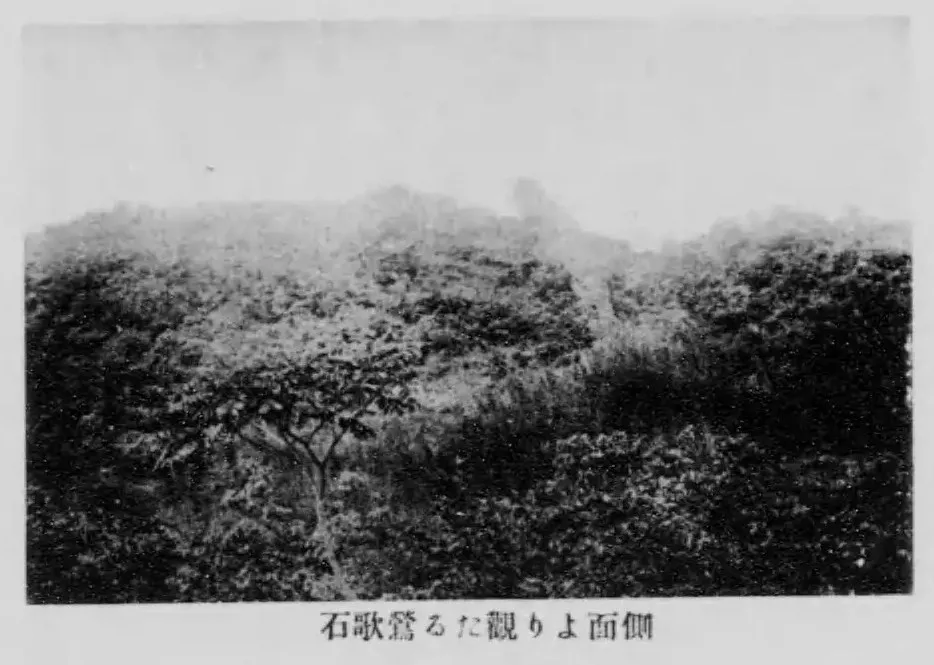
「側面より観たる鶯歌石」, a photograph of Yingge Rock seen from the side, in 台湾拓殖画帖 (Taiwan takushoku gachō), Taiwan Takushoku Gachō Kankōkai, 1918, cropped. National Diet Library Digital Collections, call number 412-34, pid 966627.
What the 1871 gazetteer says
The Danshui tingzhi, the gazetteer of the Tamsui sub-prefecture, was compiled under the sub-prefect Chen Peigui, and its prefaces are dated 1871.13 In its chapter on historic sites, two short entries follow one another.114
鶯哥山:在三角湧,與鳶山對峙。相傳吐霧成瘴,偽鄭進軍迷路,礮斷其頸。1
Yingge Mountain. At Sanjiaoyong, facing Yuan Mountain. Tradition says it breathed out mist that turned into miasma. The false Zheng advanced his army and lost his way, and cannon broke its neck.
鳶山:卽飛鳶山,在三角湧,偽鄭亦礮擊其尖,斷痕宛然。14
Yuan Mountain. Also called Feiyuan Mountain, at Sanjiaoyong. The false Zheng also fired cannon at its peak, and the broken mark is still plain to see.
The entry calls the place a mountain, not a rock, and does not say it was a bird.1 The mountain section of the same book lists both peaks and says they face each other.18 We take 鶯哥山 to be the rock, because the names match, the museum places Yingge in Sanjiaoyong in 1871, and the tale is the same.19 That identification is ours.
The firing is by 偽鄭, the false Zheng.1 That is the gazetteer’s name for the Zheng regime, and it uses it 14 times, while the name 鄭成功 never appears in the sixteen juan as transcribed.2 Lian Heng says Koxinga was called 國姓, “the imperial surname”, after the Longwu emperor gave him the surname Zhu.20 The gazetteer knows the byname and uses it twice, for a well and for a fish.2 The first entry opens its story with 相傳, “tradition says”; the second has no such word and offers the broken peak as a mark that can still be seen.114
The compilers tied other stories to the false Zheng.21 At Jade Mountain, tradition says he led foot soldiers to the foot of the range and stopped at a stream so poisonous that many who waded it died.21 At Guoxing’s Well near Dajia, tradition says he camped his troops where the water was full of miasma, struck the ground with his sword and found a spring.21 Miasma or poison runs through all three, and Lian Heng writes of Tamsui and Keelung in the Spanish period the same way, as wild places where settlers sickened and died of it.22
The book was disputed from the start. Lian Heng says Chen had Yang Jun of Houguan rewrite the draft that Lin Hao had compiled for the previous sub-prefect, and that Lin Hao answered with a critique, the Dingmiu.23 In it Lin Hao says Chen’s team took the Jilong islet of Penghu for the Keelung of the Tamsui district, and calls the author ignorant of history.24 That is a different entry, and the transcription of the critique has no remark on Yingge or Yuan Mountain.25
Which Zheng
Koxinga died on Taiwan in 1662, aged 39.26 His son Zheng Jing succeeded him, and the regime lasted until 1683.2728 The sources we read put Zheng forces in the far north after his death. The 1747 gazetteer of Taiwan says that in 1666 Zheng Jing sent the commander Huang An against the Dutch who had rebuilt the fort at Keelung, and that in 1681 the commander He You was ordered to garrison Keelung.29 Lian Heng says He You built a wall at Tamsui in 1683.30 He also says that in 1683 a party under the supervisor Chen Fu was sent to Tamsui to look for gold, while the Tamsui gazetteer itself puts a gold party in 1682 under a Chen Tinghui, and elsewhere names Chen Fu without a date.31
So “the false Zheng” in 1871 could mean any of the regime’s armies, or Koxinga; the entry does not say, and that reading is ours. The museum’s journal answers flatly that no army of his reached the north.8 We found no source that puts Koxinga himself in the north, and none that rules it out beyond the museum’s statement.
Gaps on either side of 1871
The Taiwan gazetteers of 1685, 1717 and 1747 have no place called Yingge Mountain or Yuan Mountain in the transcriptions we searched.5 After the gazetteer, the next dated telling we found is in that 1918 album, beside its photograph of the rock.15 Oral tradition, it says, has the rock breathing poison mist until the army of the Zheng, 鄭氏の軍, lost its way there about two hundred years earlier and broke its neck with cannon, and the clouds cleared at once.15 Like the gazetteer, it gives no first name.15 The tablet of 1927 has no cannon in it.16 The first text we could open that puts the cannon in Koxinga’s hands is the registry’s, written for a designation of 2006.36 No text we opened from between 1871 and 2006 names Koxinga as the one who fired, so we cannot date the moment Koxinga’s name entered it.
What we could not verify
Sources we have not seen
- Japanese-period surveys, newspapers and the work 台灣史跡志 might show whether Koxinga’s name was attached to the cannon under Japanese rule. We found no free, searchable text of any of them.
Seen only where others quote them
- The 1927 tablet is known to us only from the library’s transcription of its inscription.
Questions we could not settle
- Whether the rock is the 鶯哥山 of 1871. The names, the district and the tale agree, but no source we read says so in as many words.
- Whether any Zheng army entered the Sanxia valley, and which Zheng the 1871 compilers meant.
- When Koxinga’s name entered the story.
Read next
TaleChina, Tang to Song
Before Xuanzong's dream, Zhong Kui was already a name
TaleNewfoundland and the Gulf of St Lawrence, Canada, 1542 to 1575
Marguerite de La Roque: the woman on the Isle of Demons
TaleThe Dombes, near Lyon, France, 13th century to 20th century
Saint Guinefort, the greyhound in the well
Sources
- Tamsui 1871, juan 13 (考三 古蹟考), entry 鶯哥山, folio 1 last column to folio 2 first column, after 龍峒山 and before 鳶山 (primary) transcription↑
- Tamsui 1871, our text search of juan 1 to 16; 國姓井 in juan 13 (entry after 月眉崎 list, "國姓井:在大甲堡鐵砧山巔"); 國姓魚 in juan 12 (fish list: "俗呼國姓魚,偽鄭至臺始有之") (primary)↑
- Registry 2006, description field, one sentence ("據傳此石昔時常吐霧食人 ... 瘴氣即散,始得進軍")↑
- Museum 2021, p. 4, section 鶯歌石: "民間傳說以前有兩隻怪鳥在此地作亂 ... 另一隻掉落對岸三峽化為鳶山"↑
- Jiang 1685, all ten juan searched for 鶯哥, 鳶山, 鶯歌石, 鸚哥石: no hit as a place name (primary)
- Zhuluo 1717, juan 1 to 12 searched: the northern mountains are in juan 1 (山川), which names Keelung, Jinbaoli and Bali but not these two (primary)
- Fan 1747, the whole transcription searched in its simplified forms (莺哥山, 鸢山, 莺歌): no place of either name; 莺哥 occurs once, as the name of a Penghu fish (primary)↑
- Registry 2006, notice 北府文資字第0950007368號 of 2006-08-28; 指定理由↑
- Museum 2021, p. 4: "北面山脈一塊狀如鸚哥的巨石"
- Office photo, description, second paragraph: "鶯歌北面山脈斜坡有一顆巨型"↑
- Museum 2021, p. 4, section 鶯歌石 ("但依據史實,鄭成功軍隊未曾到過北部,更未實際佔領過北部,這段漢人史觀的傳說當然也是虛構的")↑
- Museum 2021, p. 4: "「鶯歌」名稱源自於北面山脈一塊狀如鸚哥的巨石"
- Office photo, description, second paragraph: "自古以來被稱為「鶯歌石」,這也是該地地名的由來"
- Registry 2006, 指定理由: the rock "也是鶯歌地名的由來"↑
- Museum 2021, p. 4: "一塊狀如鸚哥的巨石"
- Photo 1955, description, first paragraph ("因形狀像一隻鸚鵡") and the 1927 inscription ("石狀如鳥 ... 鸚哥")↑
- Registry 2006, description field: "明朝鄭成功領台率軍,路經此地被瘴氣所阻,士兵被食遂開巨炮斷其頸"
- Museum 2021, p. 4, section 鶯歌石: "鄭成功軍隊受其瘴氣影響迷路 ... 下令軍隊用大炮將他們打下來,擊斷了其中一隻的頸部"
- Photo 1955, description, second paragraph: "鄭成功架砲擊斃巨鳥有關的民間傳說"↑
- Office photo, description, second paragraph ("形狀就像一隻老鷹,自古以來被稱為「鶯歌石」")↑
- Tamsui 1871, juan 1: 譔輯姓氏 lists 纂輯 "陳培桂"; the 黎序 is dated 同治十年四月之望 and the 陳序 同治十年歲次辛未夏五月 (primary)
- Lian 1918, juan 34 (列傳), life of Lin Hao: "陳培桂任同知,別延侯官楊浚修之"↑
- Tamsui 1871, juan 13 (考三 古蹟考), entry 鳶山, folio 2, first column (primary) transcription↑
- 台湾拓殖画帖, Taiwan Takushoku Gachō Kankōkai, 1918, National Diet Library 412-34, frame 88, text headed 側面より観たる鶯歌石 (桃園廳管內), left half of the page: 鶯歌石は、桃園廳海山堡鶯歌石庄に在り ... 巖の形狀、宛も鷹の佇立せるに似たるを以て、鷹哥石の名ありき。今鶯歌石と稱するは、鶯は臺語鷹の義にして、內地の鶯にあらず ... 口碑の傳ふる所によれば、往昔此の石毒霧を吐き瘴氣天を蔽ひしが、今より約二百年前、鄭氏の軍、此處に到り、路を失ひて進む能はず、乃ち礮擊して其の頸を斷ちしに、雲霧忽ち霽れたりといふ。Read from the page image by the editor, 2026-10-10 (primary)↑
- Photo 1955, description, second paragraph, the quoted inscription ("鸚哥,鳥名,石狀如鳥 ... 今稱鶯歌,誤也。昭和2年(1927)10月1日,鶯歌庄長黃純青記,海山郡守李讚生書"); the tablet itself not seen↑
- Museum 2021, p. 4, 鶯歌的沿革 ("清末 ... 「鶯歌石莊」。日治時期大正9年(1920年)設置鶯歌庄")
- Office photo, description, second paragraph ("稱為鶯歌石庄;明治38年(1905)7月改為鶯歌石區。至大正9年(1920)7月 ... 成立鶯歌庄")↑
- Tamsui 1871, juan 2 (志一 封域志), 山川: the list of northern mountains (folio 6, "鳶山 互見勝蹟" and "鶯哥山 互見勝蹟" in small type) and, on folio 11, the sentence "又有鳶山與鶯哥山對峙,亦隸焉" in the paragraph on the range through 大姑嵌 and 三坑仔 (primary)↑
- Museum 2021, p. 4, under the quoted gazetteer line↑
- Tamsui 1871, juan 13 (考三 古蹟考), entries 玉山 (folio 1) and 國姓井 (folio 6), both introduced by "相傳" (primary)↑
- Lian 1918, juan 1 (開闢紀), the Spanish return to Tamsui: "草茀瘴毒,居者輒病死"; juan 5, Keelung: "林深瘴盛"
- Tamsui 1871, juan 13, entries 鶯哥山 ("吐霧成瘴"), 玉山 ("毒甚") and 國姓井 ("水多瘴毒") (primary) transcription↑
- Lin Hao, Dingmiu, the entry on the 兵燹 volume opening ("培桂於「兵燹」卷首 ... 乃培桂誤認澎之雞籠為淡之雞籠") (primary)↑
- Lin Hao, Dingmiu, the whole transcription (自序 and the numbered corrections) searched (primary)↑
- Lian 1918, juan 2 (建國紀), year 三十七年 (1683): "五月,淡水通事李滄請採金裕餉。命監紀陳福、宣毅前鎮葉明率所部往"
- Tamsui 1871, juan 11 (考二 風俗考, the passage on the eastern mountains): "偽鄭時,上淡水通事李滄願取金自效 ... 偽監紀陳福偕行" (no date); juan 16 (附錄三 志餘, 紀事): "康熙壬戌,鄭氏遣偽官陳廷輝往淡水雞籠採金", citing 陳小崖 外紀 (壬戌 = 1682) (primary)↑
Documents quoted
- Danshui tingzhi (1871), juan 13 and juan 2: the entries on Yingge Mountain and Yuan Mountain (transcribed from the page image)