 Twice Told
Marguerite de La Roque: the woman on the Isle of Demons
The Queen of Navarre's marooned couple have no demons, no lover and no names. Thevet's book of 1575 has all three, and says the woman told it to him herself.
Contents
Published 22 Oct 2026. Sources checked 18 Oct 2026.
The oldest printed story we found of a woman marooned by Roberval has no Marguerite in it.7 In the 67th tale of the Queen of Navarre’s Heptaméron, the castaways are an unnamed traitor and his wife, left with a New Testament, an arquebus and some lions, and there are no demons.8129 The name, the lover, the maid Damienne and the spirits first appear, in the texts we read, in André Thevet’s Cosmographie universelle of 1575.10311 Thevet says the woman told him the story herself.12
The story, as the Library of Congress map blog tells it, goes like this.
In 1542 Marguerite de La Rocque sailed with her uncle, Jean-François de La Roque de Roberval, to a colony in what is now Quebec.13 On the voyage she began a romance with a sailor.13 Roberval disapproved and left Marguerite, her handmaid Damienne and the sailor stranded on the Isle of Demons with some food and firearms.13 Marguerite gave birth on the island.13 The sailor, Damienne and the child died there.13 Marguerite survived by hunting wild game, and fishermen rescued her after she had spent two years on the island.13
The Queen of Navarre’s couple
Pierre Boaistuau printed the Heptaméron first, in a selection of 67 tales in 1558, where this story is number 56.7 Claude Gruget’s edition of 1559 prints it as the 67th, in Marguerite de Navarre’s own order.87 We read both printings, and the 1558 tale tells the same story in slightly different words.2
Simontault, one of the storytellers, says he heard it from Captain Roberval and several of his company.8 Roberval is sailing by the king’s command to “l’isle de Canadas”, where he means to build towns and castles.1 A craftsman he brought betrays him.1 The craftsman’s wife, who followed him across the sea, begs for his life, and the pair are left on a small island where only wild beasts live, with leave to take what they need.1
The wife brings a New Testament and reads it without stopping.9 When the lions and other beasts come close, the pair fight them off:
« le mary auec sa harquebuze, & elle auec des pierres se deffendoient si bien »9
“the husband with his arquebus and she with stones defended themselves so well”
The husband dies, swollen from the food and the water.9 She is his doctor and his confessor, buries him, and from her hut fires the arquebus to keep the beasts off the grave.9 “After some time” a ship of the fleet passes, sees smoke and takes her aboard, and the ladies of the town give her their daughters to teach to read and write.14 The tale gives no date, no length of stay and no name for the island.214 Saintsbury’s English translation adds that the ship took her straight to La Rochelle, which the 1559 text does not say; we did not check what text he translated.14
Simontault tells it as praise of a woman, and the man she follows is the traitor.81
One modern account remembers it differently. The Dictionary of Canadian Biography entry on Marguerite says that in the Queen’s account a young man is put off the ship, Marguerite goes to share his fate, and the servant-girl Damienne goes with them.4 The 1559 text says none of this.2
Thevet, who says he met her
Thevet prints the story in book 23 of the Cosmographie universelle, chapter 6.10 Roberval, he writes, took gentlemen, craftsmen and some women to Canada, among them a young kinswoman called Marguerite, whom he trusted with his affairs.10 A gentleman of the company came more for love of her than for the king’s service, and the two became lovers at sea, while her old Norman servant Damienne kept watch.3 Roberval learned of it and, when his ships came near the Isle of Demons, put the young woman and the old servant ashore with four arquebuses and munitions.315
The gentleman, afraid of the same treatment, went to join her with his own arquebus and supplies, and Roberval sailed on.16 The woman became pregnant.17 The gentleman died about eight months in, the servant in the sixteenth or seventeenth month, and the child soon after.17
Thevet is specific about the demons, and he does not overdo them. Evil spirits tried to pull down the hut in the shapes of frightful animals, and at night there were cries like those of more than a hundred thousand men.11 After the first two nights, the woman told him, they came near the hut or showed themselves only while she was alone and in despair, and they vanished when she prayed.11 She also assured him she once shot three bears in a day, one as white as an egg.18 A woodcut in the book shows her fighting animals with an arquebus.19
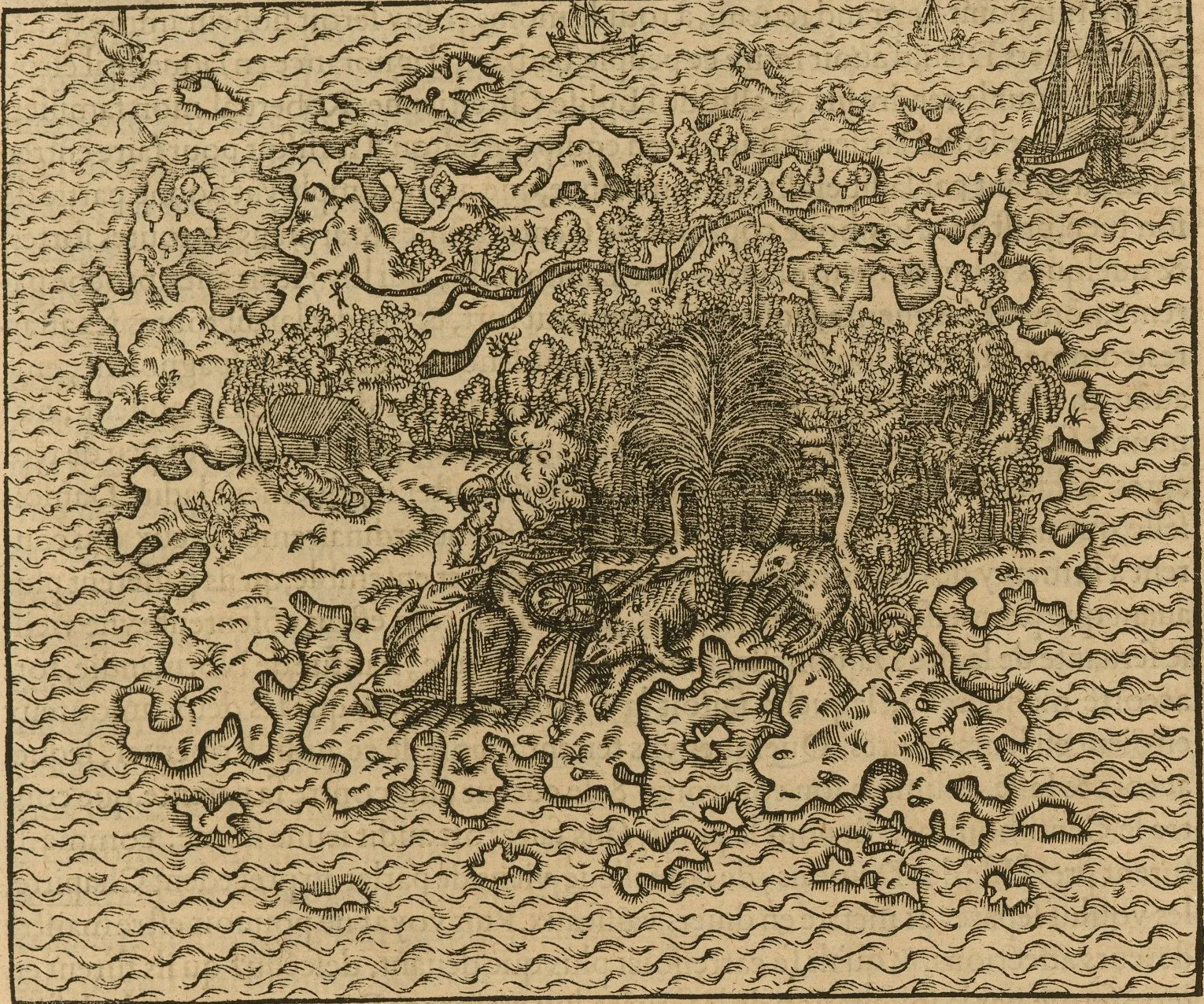
“L’Isle où vne Damoiselle Françoise fut exilée”, woodcut from André Thevet, La cosmographie vniuerselle (Paris: Pierre L’Huillier, 1575), leaf 1019 verso, cropped. Courtesy of the John Carter Brown Library, E575 T418c, CC BY 4.0.19
After two years and five months, ships from Lower Brittany passing to fish saw her signal with smoke and fire.20 The crews first took it for an illusion of the demons, then took her aboard and brought her to France.20 Thevet says he heard it from her in the town of Nontron in Périgord, and calls Roberval “mon familier”.12
Near the end he has her say she wished to die on the island “comme son mary”, like her husband, after calling the man her lover.21
In his manuscript Grand Insulaire, Thevet gives Marguerite an entry of her own, “Isle de Roberual”, which says he named the island after Roberval and that it is also called the Isle of Demons.22 He refers back to the printed story of 1575 rather than retelling it, and puts her banishment down to Roberval, whom he calls, as we read the hand, her uncle.23 He explains the phantoms: they came only after she lost her lover, and solitude lent them force.24 Yet his separate entry “Isle des Demons” speaks of “another island” he named for Roberval, “quite near” it.25
Thevet also knew the story was already being embellished. He writes that some “folastres euentez”, after hearing him tell it, put lies of their own into their fables and tragic histories; he does not say whose.26
« y ont augmenté des folies & mensonges »26
“added follies and lies to it”
The three tellings, in date order:
| Text | Marguerite named | Lover | Demons | Time on the island |
|---|---|---|---|---|
| Heptaméron, 1559 | No2 | None2 | None2 | “Some time”14 |
| Thevet, 1575 | Yes, a kinswoman10 | A gentleman, who joins her16 | Spirits and phantoms11 | 2 years 5 months20 |
| Library of Congress blog, 2022 | Yes, a niece13 | A sailor13 | Not mentioned in the telling13 | 2 years13 |
The island was on the maps first
The Isle of Demons did not begin with Marguerite. Ruysch’s map carries a Latin note, in Berson’s translation, saying that sailors who came near were so tormented by demons that they could hardly escape.27 Berson dates the map to 1507 and the Library of Congress to 1508.27 Ramusio’s map of 1556 draws three winged demons on the island, and islands of that name stay on maps until the middle of the 17th century.27
Thevet knew the place. In the chapter before Marguerite’s he calls it the largest and finest of its islands, abandoned because of devils, and says pilots told him they heard human voices in the air there in storms.28 Then, in chapter 6, he puts her exile at that island.15 Berson reads the joining as a trade: Marguerite’s misfortunes gain credibility from a charted island, and the island becomes real through what is said to have happened on it.29
Mercator’s world map of 1569, Berson writes, already draws the Isle of Demons and the island of Roberval’s tragedy apart, the second at the mouth of the Saint-Paul river, where an Île de la Demoiselle is still named in memory of Marguerite.30
Where the demons really were is open. Berson thinks the large island of the maps was Belle Isle and Lark Island, or Quirpon, misjudged in size and shape.31 The Library of Congress post names Quirpon and Harrington Harbour as proposals, and writes that “we will never know the actual location”.32
The voyage as Hakluyt printed it
Roberval’s expedition was real. Three ships carrying 200 people, men, women and children, sailed from La Rochelle.33 They left on 16 April 1542 and reached Saint John’s in Newfoundland in early June, where Jacques Cartier, on his way home, met them.33
Hakluyt’s English account of the winter, first printed in 1600, says Roberval “used very good justice”.5 Michael Gaillon was hanged for theft, John of Nantes was put in irons, and men and women were whipped.5 It records nobody being put ashore on an island, and it names no woman.5
That silence proves little. The account is short, and it takes the fleet from Saint John’s to a harbour west of the Isle of Orleans in a single sentence.34 The Dictionary of Canadian Biography entry on Roberval says the expedition went up the river “without incident except for the romantic adventure” of Marguerite, who was “left on an island with her lover”.35 A lover is in Thevet’s version and not in the Queen’s.32 The entry’s list of sources includes both.35
The same biographer’s entry on Marguerite says she was co-seigneuress of Pontpoint and pledged fealty and homage in 1536 for lands in Périgord and Languedoc, and that historians accept that both accounts rest on an actual happening.6 We have not seen the 1536 deed.
What we could not verify
Sources we have not seen
- Biggar’s Collection of documents relating to Jacques Cartier and the Sieur de Roberval (1930), which prints Roberval’s commission and the king’s orders of 1543. The Internet Archive holds it only as a restricted lending copy.
- The 1536 deed of Marguerite de La Roque, Archives nationales, Anciens hommages et aveux, pièce 820, which would show whether she existed outside the stories. We know it only from the Dictionary of Canadian Biography.6
Seen only where others quote them
Resting on a single source
- The Dictionary of Canadian Biography quotes Thevet as saying Roberval had six men hanged and banished some to an island in leg-irons. We did not find that passage in the pages of the Cosmographie we read.5
Questions we could not settle
- Whether Marguerite’s island and the Isle of Demons of the maps are one: Thevet puts the exile at the Isle of Demons in 1575, treats them as one island and as two neighbours in the Grand Insulaire, and Berson says Mercator drew two.15222530
- Whether any document outside Thevet and the Heptaméron records Marguerite’s journey, her stay or her return.
Read next
TaleNew Mexico and Texas, 1629 to 1690
The Lady in Blue had no name in 1630
TaleAdams, Robertson County, Tennessee, 1820 to 2017
Andrew Jackson and the Bell Witch: one letter from 1894
TaleChina, Tang to Song
Before Xuanzong's dream, Zhong Kui was already a name
Sources
- Gruget (ed.), L'Heptaméron (Paris, 1559), ff. 195 and 195v (Gallica views 403 and 404), from "Roberval faisant vn voyage sur la mer" to "ce dont ils auoient necessité"; page images () (primary) transcription
- Saintsbury (trans.), Heptameron, vol. 5, Tale LXVII, first three paragraphs; a translation (source text may differ from Gruget, see C5)
- Pierre Boaistuau (ed.), Histoires des amans fortunez (Paris: Gilles Robinot, 1558), Gallica copy btv1b86001442, ff. 157 and 158 (views 357 and 358), "Histoire cinquantesixiesme": "Robertual faisant vn voyage sur la mer ... en l'isle de Canadas" to "ce dont ilz auoient necessité"; page images; the captain is spelled "Robertual" (primary)↑
- Gruget (ed.), L'Heptaméron (Paris, 1559), ff. 195 to 196 (Gallica views 403 to 405), the whole tale read; all three page images () (primary) transcription
- Saintsbury (trans.), Heptameron, vol. 5, Tale LXVII in full; a translation (source text may differ from Gruget, see C5), whose note 2 calls the lions "rather perplexing" and suggests the "lion marin", the seal
- Pierre Boaistuau (ed.), Histoires des amans fortunez (Paris: Gilles Robinot, 1558), Gallica copy btv1b86001442, ff. 157 to 158 (views 357 to 359), the whole tale read; it has the same persons and beasts ("les lions & autres bestes"), no names for the couple and no lover, maid or demons; page images (primary)↑
- Thevet, Cosmographie (1575), vol. 2, f. 1019 (scan leaf n1182), from "Entre les Gentilshômes qui l'acompagnoient" to "quatre harquebuses & de la munition pour se deffendre des bestes"; page image () (primary) transcription
- La Roque de Roquebrune, "La Roque, Marguerite de", DCB vol. 1, second paragraph: Roberval "set her down on an island called Île des Démons", the servant-girl "Damienne, 'a native of Normandy'", the lover not named↑
- La Roque de Roquebrune, "La Roque, Marguerite de", DCB vol. 1, second paragraph ("In the Queen of Navarre's account, it was the young man who was put off the ship and Marguerite who went to share his fate")↑
- Hakluyt, Principal Navigations, vol. 8 (1904), p. 286 (scan leaf n313), the paragraph "Monsieur Roberval used very good justice", page image. The whole account (pp. 283 to 289, scan leaves n310 to n316) was searched in OCR for island, exile, demon, Marguerite and lover: no hit except Belle Isle, the Isle of Ascension and the Isle of Orleans (OCR, so a search is not proof for every page) (primary)
- La Roque de Roquebrune, "La Rocque de Roberval, Jean-François de", DCB vol. 1, paragraph beginning "Roberval undertook some exploring": it quotes Thevet on six men hanged, some banished to an island in leg-irons and others flogged; we did not find that passage in the Cosmographie pages we read↑
- La Roque de Roquebrune, "La Roque, Marguerite de", DCB vol. 1, first paragraph and the last paragraph of the text; the entry's bibliography names an Archives nationales deed of 1536 (Anciens hommages et aveux, pièce 820) which we did not see↑
- Anatole de Montaiglon and Le Roux de Lincy (eds.), L'Heptaméron des nouvelles de Marguerite de Navarre, vol. 1 (Paris: Auguste Eudes, 1880), "Notice des éditions", section I (the 1558 edition, "soixante-sept Nouvelles") and the concordance table, row "56 / LXVII"; read in the Wikisource transcription, not on a page image
- Pierre Boaistuau (ed.), Histoires des amans fortunez (Paris: Gilles Robinot, 1558), Gallica copy btv1b86001442, f. 157 (view 357), the heading "HISTOIRE CINQVANTESIXIESME" over the Roberval tale; the 1559 edition (view 403) heads it "NOVVELLE SOIXANTESEPTIESME"; page images (primary)↑
- Claude Gruget (ed.), L'Heptaméron des nouvelles de très illustre et très excellente princesse Marguerite de Valois, royne de Navarre (Paris: Vincent Sertenas, 1559), Gallica copy btv1b86171930, f. 195 (Gallica view 403), last sentence of Simontault's opening speech, "ce que i'ay ouy dire au capitaine Roberval, & à plusieurs de sa compagnie"; read from the page image () (primary) transcription
- Marguerite of Navarre, The Tales of the Heptameron, vol. 5, trans. George Saintsbury (London: Society of English Bibliophilists, 1894), Project Gutenberg #17705, Day 7, the lines before "Tale LXVII" ("something that I heard from Captain Robertval and divers of his company"); a translation; the Gutenberg record names Le Roux de Lincy as contributor, so its source text may differ from Gruget in small points
- Pierre Boaistuau (ed.), Histoires des amans fortunez (Paris: Gilles Robinot, 1558), Gallica copy btv1b86001442, f. 157 (Gallica view 357), "Ce m'est chose si nouuelle, mes dames, d'ouir dire de vous quelque acte vertueux ... ce que i'ay ouy dire au capitaine Roberual, & à plusieurs de sa compagnie"; page image; the wording differs slightly from 1559 (primary)↑
- Gruget (ed.), L'Heptaméron (Paris, 1559), f. 195v (Gallica view 404), from "porta pour sa sauue-garde, nourriture, & consolation, le nouueau testament" to "que la chair de son mary n'eust tel sepulchre"; page image (primary)
- Saintsbury (trans.), Heptameron, vol. 5, Tale LXVII, paragraphs 4 to 6 (the New Testament, "the husband with his arquebuss and she with stones", "firing with the arquebuss from her cabin"); a translation (source text may differ from Gruget, see C5)
- Pierre Boaistuau (ed.), Histoires des amans fortunez (Paris: Gilles Robinot, 1558), Gallica copy btv1b86001442, f. 157v (view 358): "le nouueau testament, lequel elle lisoit incessemment", "le mary auec sa harquebuse, & elle auec des pierres se defendoient si bien", "defendoit à coups de harquebuse"; page image (primary)↑
- André Thevet, La Cosmographie vniverselle (Paris: Pierre L'Huillier, 1575), vol. 2, John Carter Brown Library copy on the Internet Archive (lacosmographievn02thev), f. 1019 (scan leaf n1182), the long paragraph "Roberual mon familier ... entre autres vne Damoiselle, qui luy estoit assez proche parente, nômee Marguerite"; read from the page image () (primary) transcription
- R. La Roque de Roquebrune, "La Roque, Marguerite de", Dictionary of Canadian Biography, vol. 1 (University of Toronto/Université Laval; signed entry, 1966, revised 1979), first paragraph ("Her family relationship to Roberval was very close, according to Thevet") and third paragraph↑
- Thevet, Cosmographie (1575), vol. 2, ff. 1019v and 1020 (scan leaves n1183 and n1184), from "c'estoit pitié d'ouyr les rauages, que ces malings esprits" and "depuis les deux premieres nuictz"; page images (primary)↑
- Thevet, Cosmographie (1575), vol. 2, f. 1019 (n1182): "Roberual mon familier" and "venuë en la ville de Nautron, pays de Perigort lors que i'y estois, me feit le discours de toutes ses fortunes"; f. 1020 (n1184): "de la bouche de laquelle i'ay sceu & entendu ceste pitoyable histoire"; page images (primary)
- La Roque de Roquebrune, "La Roque, Marguerite de", DCB vol. 1, fourth paragraph ("Thevet states that he was told of this episode by the heroine herself, whom he met at Nontron in Périgord"); the "mon familier" phrase is only in Thevet↑
- Smith, "The Elusive Isle of Demons" (Library of Congress, 2022), paragraph beginning "Andre Thevet, a 16th century cosmographer"↑
- Gruget (ed.), L'Heptaméron (Paris, 1559), ff. 195v and 196 (Gallica views 404 and 405), from "au bout de quelque temps vn des nauires de ceste armée" to "gaigna le surplus de sa vie"; page images (primary)
- Saintsbury (trans.), Heptameron, vol. 5, Tale LXVII, paragraphs 7 to 9 ("after some time", "straight to La Rochelle", "to learn to read and write"); a translation whose Gutenberg record names Le Roux de Lincy as contributor, so its source text may be his manuscript-based edition, not Gruget
- Pierre Boaistuau (ed.), Histoires des amans fortunez (Paris: Gilles Robinot, 1558), Gallica copy btv1b86001442, ff. 157v and 158 (views 358 and 359): "au bout de quelque temps vn des nauires de ceste armée", "aux habitans", "leurs filles pour aprendre à lire, & à escrire"; no La Rochelle; page images (primary)↑
- Thevet, Cosmographie (1575), vol. 2, f. 1019 (scan leaf n1182), the two passages quoted ("comme ils furent pres l'Isle des Demons" and "comme il fut audroit de ceste Isle des Demôs"); page image (primary)
- Berson, "L'île aux démons : cartographie d'un mirage" (2020), paragraph beginning "Cette île aux Démons est souvent identifiée" and the next one on the fusion of the two stories ("la fusion des deux histoires")↑
- Thevet, Cosmographie (1575), vol. 2, ff. 1019 and 1019v (scan leaves n1182 and n1183), from "que le Gentilhomme, voyant ceste cruauté" to "ou Robernal les laissa" (the page prints "Robernal"); page images (primary)
- La Roque de Roquebrune, "La Roque, Marguerite de", DCB vol. 1, second paragraph: "According to Thevet, the young man joined her there"↑
- Thevet, Cosmographie (1575), vol. 2, ff. 1019v and 1020 (scan leaves n1183 and n1184), from "Durant ce temps, ceste femme deuint grosse" to "l'enfant ... suyuant la route des deux premiers"; page images (primary)
- La Roque de Roquebrune, "La Roque, Marguerite de", DCB vol. 1, second paragraph: she "gave birth to a child, who died; the young man succumbed too, as did the servant-girl"; the entry gives no months↑
- Thevet, Cosmographie (1575), vol. 2, f. 1019v (scan leaf n1183), "elle m'a asseuré auoir tué trois Ours, dont l'vn estoit aussi blanc qu'vn œuf"; page image (primary)↑
- Thevet, Cosmographie (1575), vol. 2, f. 1019v (scan leaf n1183), the woodcut and its marginal caption; page image (primary)
- Berson, "L'île aux démons : cartographie d'un mirage" (2020), the captioned illustration "L'Isle où vne Damoiselle Françoise fut exilee" from Thevet, La Cosmographie universelle (Paris, 1575); Berson does not describe the picture↑
- Thevet, Cosmographie (1575), vol. 2, f. 1020 (scan leaf n1184), from "A la fin, ayant par l'espace ... de deux ans cinq mois" to "ramenerent en France"; page image (primary)
- La Roque de Roquebrune, "La Roque, Marguerite de", DCB vol. 1, second paragraph: she "was one day picked up by fishermen who took her away to France"; the entry gives no length of stay↑
- Thevet, Cosmographie (1575), vol. 2, f. 1020 (scan leaf n1184), the sentence "Et me dit outre, que lors quelle s'embarqua dans ces nauires de bretaigne"; page image (primary)↑
- André Thevet, Le grand Insulaire et pilotage (1586), BnF Manuscrits, Français 15452, first volume (Gallica btv1b9065908x), printed folio 145 and the leaf after it (scan leaf n310): the heading "Isle de Roberual", the sentences "Icy donques je mettray pied en une Isle, nommée par moy l'Isle de Roberual ... on luy donne le nom d'Isle des Demons" and the marginal note; handwriting read from the page image, some words uncertain; the volume ends with an alphabetical table of islands with folios (scan leaves n455 to n463) (primary)↑
- André Thevet, Le grand Insulaire et pilotage (1586), BnF Manuscrits, Français 15452, first volume (Gallica btv1b9065908x), scan leaves n310 and n311 (printed folio 146 at the top of n311): "relegueé par le Capitaine Roberual, son oncle" (reading of "son oncle" uncertain), and "toute l'histoire imprimee a Paris 1575 de ceste damoiselle au sixiesme chapitre du vingt troisiesme livre de ma Cosmographie, je me deporteray d'en faire de rechef nouveau recit"; page images (primary)↑
- André Thevet, Le grand Insulaire et pilotage (1586), BnF Manuscrits, Français 15452, first volume (Gallica btv1b9065908x), scan leaves n311 and n312: "n'avoit esté harassée ... de ces hideux phantosmes ... sinon depuis qu'elle eut perdu le Gentil-homme son amoureux", "la solitude donnoit grande force à l'esblouissement de ces apparitions" (marginal note "Solitude sujette aux apparitions"), "c'estoit les ours qui la tourmentoient le plus", "tué de nuict pres Sainct Innocent a Paris ... j'ay marqué et donné nom de Roberual a ceste presente Isle"; handwriting read from the page images, some words uncertain (primary)↑
- André Thevet, Le grand Insulaire et pilotage (1586), BnF Manuscrits, Français 15452, first volume (Gallica btv1b9065908x), scan leaf n327 (printed folio 153): heading "Isle des Demons" and the sentence "comme ie vous ay dit d'vne autre Isle que i'ay nommee Roberual assez voisine de ceste cy"; scan leaf n329 (printed folio 154): "En ceste Isle de [Fische?] fut bannie la damoiselle de laquelle ie vous ay parlé, laquelle a esté depuis nommée par moy l'Isle de Roberual" (the island name is uncertain); page images (primary)↑
- Thevet, Cosmographie (1575), vol. 2, f. 1020 (scan leaf n1184), "Ie sçay bien, que quelques folastres euentez, apres m'en auoir ouy faire le discours" to "desrobees deçà & delà"; page image (primary)↑
- Berson, "L'île aux démons : cartographie d'un mirage" (2020), paragraph 2 ("Insulae Demonium" on Ruysch 1507 and its note), paragraph on Ramusio 1556 with three winged demons, the paragraph on Münster, Ortelius and Mercator, and the last paragraph (last appearance 1659)
- Cynthia Smith, "The Elusive Isle of Demons", Worlds Revealed (Library of Congress Geography and Map Division), 26 October 2022, paragraphs 1 to 4 (island off Newfoundland labelled "Isle of Demons" from the early 16th century; Ruysch dated 1508 there; Gastaldi 1556; Hondius and Jansson 1622; removed from official cartographic records in the mid-17th century); the post does not give the Latin note↑
- Thevet, Cosmographie (1575), vol. 2, f. 1018v (scan leaf n1181), from "celle qu'on appelle des Demons, qui est la plus grande & plus belle" to the "voix d'hommes" passage; page image () (primary) transcription
- Alban Berson, "L'île aux démons : cartographie d'un mirage", Carnet de la Bibliothèque nationale (Bibliothèque et Archives nationales du Québec), 22 October 2020, Internet Archive snapshot of 6 February 2023, paragraph beginning "Cette île aux Démons est souvent identifiée": Thevet places Marguerite's story on the Isle of Demons, which he calls the "île des Diables"; Berson does not describe the voices↑
- Berson, "L'île aux démons : cartographie d'un mirage" (2020), paragraph beginning "En outre, à l'horreur de la situation": "la fusion des deux histoires permet de renforcer mutuellement leur crédibilité"↑
- Berson, "L'île aux démons : cartographie d'un mirage" (2020), paragraph beginning "Cependant, en 1569, sur sa mappemonde"; we did not see the Mercator map↑
- Berson, "L'île aux démons : cartographie d'un mirage" (2020), paragraph beginning "À moins d'être purement imaginaires" and the paragraph beginning "En un siècle et demi"↑
- Smith, "The Elusive Isle of Demons" (Library of Congress, 2022), paragraphs beginning "During the mid-17th century" and "In my opinion, we will never know" (re-opened by the editor 2026-10-18)↑
- Richard Hakluyt, The Principal Navigations, Voyages, Traffiques and Discoveries of the English Nation, vol. 8 (Glasgow: MacLehose, 1904; first printed 1600), Internet Archive copy principalnavigat0008rich_o3s2, pp. 282 to 284 (scan leaves n310 and n311): the heading and first paragraph ("200. persons, aswel men as women", "set sayle from Rochel the 16. of April 1542"), "The eight of this Moneth wee entred into the Rode of Saint John"; p. 283 read from the page image (primary)
- R. La Roque de Roquebrune, "La Rocque de Roberval, Jean-François de", Dictionary of Canadian Biography, vol. 1 (University of Toronto/Université Laval; signed entry, 1966), the paragraph on the departure: three ships, "from La Rochelle. The crossing lasted from 16 April to 8 June, on which date Roberval met Cartier at Newfoundland"; the entry names Hakluyt vol. 8, pp. 283 to 289, as "the only English account"↑
- Hakluyt, Principal Navigations, vol. 8 (1904), p. 284 (scan leaf n311), the sentence "At length, about the last of the aforesayde Moneth, wee departed hence, and entred into the Grand Baye"; the page carries the margin mark [III. 241.] of the 1600 edition; page image (primary)↑
- La Roque de Roquebrune, "La Rocque de Roberval, Jean-François de", DCB vol. 1, paragraph beginning "The expedition navigated the Gulf of St. Lawrence"↑
Documents quoted
- André Thevet on the Isle of Demons and the abandoned Marguerite, Cosmographie universelle (1575) (transcribed from the page image)
- Marguerite de Navarre, Heptaméron, tale 67 (Gruget's edition, 1559) (transcribed from the page image)