 Twice Told
How the Recta Provincia of Chiloé was tried and freed
In 1881 a judge at Ancud gave one of Chiloé's warlock kings three years. The appeal court at Concepción freed everyone, and the 1908 pamphlet never says so.
Contents
Published 15 Oct 2026. Sources checked 10 Oct 2026.
A pamphlet printed in Santiago in 1908 ends the case of the warlocks of Chiloé with the judge’s sentence. Mateo Coñuecar, 70, got three years in prison and three others got 541 days; that, the pamphlet says, brought about “la desaparición de los demás brujos”.310
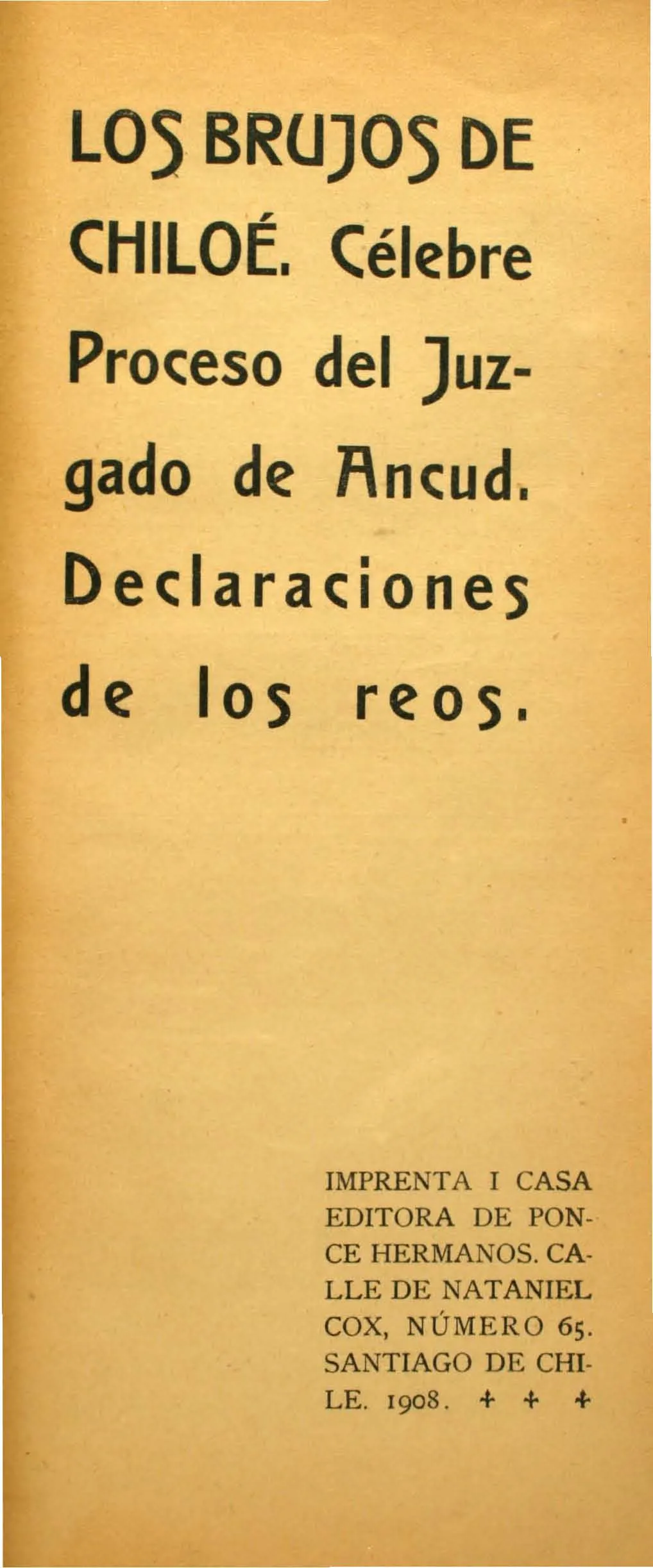
Title page of Los brujos de Chiloé. Célebre proceso del Juzgado de Ancud. Declaraciones de los reos (Santiago: Ponce Hermanos, 1908). Biblioteca Nacional de Chile, Memoria Chilena, MC0033459, from the library’s record, which says the document may be used and reproduced freely.3
The pamphlet does not mention what came next. The Court of Appeals of Concepción set the sentence aside and freed every one of the accused.210
The sentence had been for illicit association, not for witchcraft.1 It lists the society’s officers: a king and queen, presidents, intendants and commanders.11 The cave and the creature in it appear in one defendant’s statement to the judge, and the creature looks different in the folklore book of 1914.867
This is the story as Cavada’s folklore of 1914 and the dictionaries after it tell it.
In Chiloé the brujos were a society, and its members were said to have a pact with the Devil.12 A man who wished to join had to kill his wife or his child.12 The society had a king and a queen with a court, and a viceroy on every island.13 Its royal seat was a cave at Quicaví, the Casa Grande.137
In the cave lived the Invunche.7 The brujos had twisted him from his first months until his face turned to his back and one leg grew fast to his neck.7 They kept him shut in and fed him the flesh of a newborn child.7 When they wanted harm done they took him out and whipped him to the place, and his bleating terrified the neighbours and told them misfortune was near.7
He lives, as a rule, in the Casa Grande at Quicaví.7
An Intendant’s roundup
The roundup was the Intendant’s, not a court’s.14 Luis Martiniano Rodríguez had heard so many complaints of the brujos’ abuses, Ramón Espech wrote two years later, that he decided to root them out.15 On the model of the Jesuits’ expulsion in 1767, Espech says, the Intendant ordered that on one given day every brujo in the archipelago be rounded up and sent to Ancud with his herbs as evidence.15 Then, in Espech’s account, he shut himself in with them and convinced them one by one of the powerlessness of their institution, and kept for trial only those implicated in ordinary crimes.15
His decree of 7 April 1880 put “machis, brujos o hechiceros” on one list with military deserters.16 Anyone who hid either kind of man was to be arrested too, and all of them “deben ser preferidos para el servicio”, “must be given preference for the service”; the decree’s own opening lines are about men called up to military service.16 Catepillan sets the April arrests beside the war then under way with Bolivia and Peru.17
By May the Intendant was writing that the persecution had put the brujos to flight, and he asked each subdelegate for a monthly report on anyone who passed as a healer and on any brujo who came back.1819 He denied in print on 21 May that he had had healers flogged; the rumour was that he had taken them to a cliff, whipped them and told them to fly.20
The counts of people caught up differ because they count different things. Catepillan says at least 54 were jailed.21 Rojas Flores says more than 80 had been put under investigation by 10 May, many of them released for lack of grounds.22 The prosecutor says about a hundred “figured” in the file.23 Thirty-eight healers were freed by three orders in 1880, and the appeal court later approved those releases.22
A killing in 1879
The pamphlet does not begin with the society. It begins with a killing in February 1879.24 Cipriano Rain and Santiago Rain, two farmers, killed Andrés Netor on Caucahué island, and told the judge they believed Netor, one of the island’s chief brujos, was the cause of their illnesses.24 The judge was the same Beytia who sentenced the society two years later.251 He gave them 15 and 10 years in the penitentiary, and 100 lashes each.25 The appeal court at Concepción confirmed it in June 1879, set both terms at 12 years and dropped the lashes.25
No source we read says whether this killing set off the Intendant’s roundup.
What is left of the file
The original file, more than 260 folios under the title “Contra Mateo Coñuecar y otros por asociaciones ilícitas y envenenamientos”, is missing, apparently lost in a fire at the Ancud court, says Rojas Flores.26 The pamphlet’s editors said in 1908 that it was in the court of letters of Ancud.27
What exists is a copy of part of it. Ramón Espech copied a run of folios from the case against the brujos, and a shorter run from another, for Benjamín Vicuña Mackenna.1528 Catepillan dates the copy to 1882.28 The copy is in the Archivo Nacional, and Cipriano Osorio printed all of it in 1960.29 He thinks a few declarations in the 1908 pamphlet were taken from the same copy.29 Catepillan calls the surviving documentation precarious: the two sentences, some provincial press, orders from local authorities, and the Espech copy.30
The pamphlet’s editors say they print the case “a fin de destruir esos cuentos de pura fantasía”.31 They describe the accused as ignorant and wicked families of wholly Indigenous descent, and close by saying warlocks will exist as long as there are superstitious Indigenous people and an uneducated lower class.31 That is the editors’ view, not a finding of the court.
Death asked for, three years given
una asociación secreta, compuesta en la generalidad de indígenas, y que tiene por objeto castigar a los que hacen mal, arreglado a sus leyes que nos son enteramente desconocidas32
a secret association, made up in general of Indigenous people, whose aim is to punish those who do harm, according to its own laws, which are entirely unknown to us
That is the prosecutor, José N. González, describing the Recta Provincia to the judge.32 He says the penalty most often used was death, that its councils named local chiefs, “reparadores”, to carry out the penalties, and that its healers charged fees.32 He says about a hundred people figured in the case and nine or ten deserved heavier penalties.23 For Mateo Coñuecar, “el más criminal de todos”, he asks for death; for the 98-year-old Santiago Rain and the 90-year-old José María Chiguai he proposes that time served be enough.33
The judge did not go that far. Beytia dropped every homicide charge for lack of proof.5 He found a society with a king and queen, presidents and vice-presidents, intendants, secretaries, commanders, reparadores and doctors, and convicted those implicated of illicit association.111
The record does not agree with itself about the date or the list of convicts. The sentence is dated 2 March 1881 in the pamphlet, in Catepillan and in Rojas Flores, and 2 February in Osorio’s introduction.34 The three accounts of it list different convicts.
| Sentence dated | Read in | What it gives |
|---|---|---|
| 2 March 1881 | Pamphlet, 1908 | Four convicts, 541 days to three years3 |
| 2 March 1881 | Rojas Flores, 2002 | Six sentences, three men freed on time served5 |
| 2 March 1881 | Catepillan, 2019 | Nine convicted, “tres años”4 |
On 24 May 1881 the Court of Appeals of Concepción, by three votes to one, changed the sentence almost entirely.2 It held that nothing showed the society aimed to harm social order, morals, persons or property, that the small gifts the healers received paid for their services, and that no body of the offence had been established in the homicide charges.35 Espech, copying the file, put it in one line: the first-instance sentence gave “algunas de las penas pedidas por el fiscal”, but the second-instance sentence acquitted them.36
A cave nobody found
The cave and its two prisoners come from one statement. On 26 March 1880 Mateo Coñuecar, a farmer from Tenaun, told the judge that at Quicaví there was an underground house lined with timber, with a table, chairs and benches, its door hidden under turf.8 Twenty years earlier, he said, he had been sent to carry meat to some animals inside.6 When the door opened two disfigured beings came out:
el otro era un hombre desnudo i con barba i el pelo que le llegaba a la mitad del cuerpo era completamente blanco6
the other was a naked man with a beard, and the hair that reached to the middle of his body was completely white
They called him the “Ibunchi”.6 The other, the Chibato, dragged himself along, and bristles had been grown on his body with a herb.6 The council chose such men, took them by force and shut them in, and fed them goat, kid, or the bodies of dead children stolen from the graveyard.6 Coñuecar said he took meat to them twice and saw them once more at a council in the cave.6
He said the key was kept in a belfry that burned down shortly before the arrests, and that when two men went to open the cave the door was barred from inside.37 Aurora Quinchem, questioned the next day, said she had never gone to it.38 Miguel Raicahuin, 85, denied that he had ever been sent to open it.39 A police party sent to Quicaví on 7 April 1880 to inspect the cave came back after a week without finding it, according to Rojas Flores, who quotes a local paper.9
The Invunche grows a leg
Memoria Chilena says popular imagination later built many legends on the trial.40 Cavada’s Invunche of 1914 is not the man Coñuecar described. In his Chiloé y los chilotes the Invunche is a deformed being with its face turned to its back and one leg stuck to its neck, made from a child twisted out of shape from its first months and fed on the flesh of a newborn child.7 Cavada says the common belief makes him the coven’s chief, which he corrects: the Invunche is a consultant and an instrument for the brujos’ vengeance.41
Romo’s dictionary, which collects the later tradition, still has the Invunche as a child whose leg the brujos fix to his back, and as the cave’s guardian.42 Its note on the word quotes Latcham, who transcribes a dictionary of 1777: “ivumche”, “hombre bestia”, and sorcerers said to rear nursing children in their caves with the anus sewn shut.43 Rojas Flores argues that tradition kept only a fragment of the two men Coñuecar described and fused them into one monster with the look of a goat.44
Set against the file, the story’s main claims come out like this.
| The story | The record | Verdict |
|---|---|---|
| A secret society with a king and queen | Officers named in the sentence11 | Confirmed |
| A cave at Quicaví | One statement, one fruitless search89 | Disputed |
| The brujos tried as warlocks | Illicit association1 | Contradicted |
| The sentence stood | All freed on appeal2 | Contradicted |
| The Invunche, a deformed child | White-haired man in 1880, child in 191445 | Disputed |
Presidents at Salamanca
Mateo Coñuecar described how he was brought in. His brother Andrés, “Comandante de la Tierra”, took him to Juan Quinchepane, who asked “Jura usted por indíjena” and made him promise secrecy and obedience on pain of death.46 He traced the society’s beginning to a man called Moraleda who came to Payos on a Spanish ship and lost a contest of magic to a woman called Chillpila, who got his book of sorcery and took it to Quicaví.47
The officers have papers behind them. An order of 26 July 1878, signed by Domingo Coñuecar as “presidente” and dated from the “Presidencia de Salamanca de Quicabí”, names a local chief and tells him to obey the civil and political judges.48 In the society’s own names, Quicaví was Lima or Salamanca, Payos was España and Achao was Buenos Aires.49 Cavada, for his part, sets “nuestra Salamanca o sea nuestra «Casa Grande» de Quicavi” beside the necromancers’ Acheron in Campania.50
Other papers in the file speak of Spain. A letter of 23 November 1866 mentions a queen in the capital of Spain, and notes signed Pedro Chiguai in 1880 speak of his “vuelta de España”.51 The letter is addressed to Cosme Damián Antil, a Chiloé cacique whom the governor of Castro had sent to Ancud in 1856 as a reputed brujo, and who after another arrest in 1864 was sentenced to a madhouse.52
Two scholars read the file as more than witchcraft. Catepillan calls the Recta Provincia a “República de la Raza”, whose members spoke Spanish, called themselves Indigenous and were not organised as resistance to Chile, and proposes that it drew on the colonial república de indios.53 Valenzuela objects that it is a fallacy to say brujos appeared in the case just because the sentence finds at least two of the accused guilty; he reads the file as discourse that makes witchcraft real.54 He summarises Rojas Flores, who traces “La Mayoría” to the eighteenth century and to the kalku of Mapuche-Huilliche tradition.55 Earlier writing, Catepillan says, treated the case as a relic, as resistance, or as a stand-in for a weak court system.56
In March 1882, travelling between Castro and Achao, Espech was told that since the Intendant’s persecution the brujos cure only in hiding.57
What we could not verify
Sources we have not seen
- The Gaceta de los Tribunales of Santiago, 11 June 1881, which Catepillan cites for both sentences. It would settle the date of the first sentence and who was convicted. A web search on 10 October 2026 found no open scan of the 1881 volume.
- Hernández Aracena’s master’s thesis on the case (Universidad de Chile, 2013). The repository’s page lets us read its abstract only; the file sits behind a bot check that we did not pass on 10 October 2026.
Seen only where others quote them
- The Ancud newspapers El Liberal and El Chilote for April and May 1880, which carry the Intendant’s decree and note and the report of the police search; we read them only as Romo, Rojas Flores and Catepillan quote them.
- The dictionary of 1777 behind “ivumche”, known to us only through Romo’s note quoting Latcham.
Questions we could not settle
- Where the original file is, and whether it burned.
- Whether the Quicaví cave existed, and who first described it other than Mateo Coñuecar.
- Whether the killing of Andrés Netor and the roundup of 1880 are linked.
- Whether the Spanish queen and the “vuelta de España” in the papers fit Catepillan’s reading that the society did not resist the Chilean state.
Read next
TaleChina, Tang to Song
Before Xuanzong's dream, Zhong Kui was already a name
TaleNewfoundland and the Gulf of St Lawrence, Canada, 1542 to 1575
Marguerite de La Roque: the woman on the Isle of Demons
TaleThe Dombes, near Lyon, France, 13th century to 20th century
Saint Guinefort, the greyhound in the well
Sources
- Pamphlet 1908, p. 37, "Última declaración i sentencia del Juez" (primary) transcription
- Romo, Diccionario, Introducción histórica, quoted first-instance sentence: "Se ha seguido esta causa por el delito de asociación ilícita..."
- Catepillan 2019, section 2, fourth paragraph: the accused were charged with homicides by poison and illicit association, and the nine convicted were convicted only of illicit association↑
- Osorio 1960, p. 156, Espech's note after the Vista Fiscal: "la sentencia de 2ª instancia los absolvió" (primary) transcription
- Catepillan 2019, section 2, fourth paragraph and note 32 (Gaceta de los Tribunales, Santiago, 11 June 1881): the court found the organisation did not threaten social order, morals, persons or property, nor did it find the Indigenous law the society rested on to contradict Chilean law
- Rojas 2002, pp. 176 to 177 ("Epílogo"): on 24 May 1881 the Court of Appeals of Concepción, by three votes to one, changed the first-instance sentence almost entirely and ordered all the accused released↑
- Pamphlet 1908, pp. 38 to 39 (primary) transcription↑
- Catepillan 2019, note 29↑
- Rojas 2002, p. 176↑
- Pamphlet 1908, pp. 20 to 22 (the two visits and the council on p. 22; printed with the spellings "Ibunchi", "Ibunche", "Chibato") (primary) transcription↑
- Cavada 1914, pp. 99 to 100, "El Invunche"↑
- Pamphlet 1908, pp. 19 to 20, declaration of Mateo Coñuecar (a cave built "desde un tiempo mui remoto"; furniture and the turf-covered door on p. 20) (primary) transcription
- Osorio 1960, pp. 127 to 128 (declaration of Mateo Coñuecar, 26 March 1880: cave, door, furniture on p. 128) (primary)↑
- Rojas 2002, pp. 171 to 172 and notes 220 and 222 (the paper's own text is cited there as *El Chilote*, Ancud, 11 and 15 April 1880, through Marino and Osorio)↑
- Pamphlet 1908, pp. 37 to 40 (the whole booklet was read; no word on an appeal, the Concepción court or an acquittal) (primary) transcription↑
- Pamphlet 1908, pp. 37 to 38 (primary) transcription
- Romo, Diccionario, Introducción histórica, quoted sentence "...lo forman de un rei i reina, jefes supremos, de presidente i vice, intendentes, secretarios, comandantes, reparadores i médicos"
- Catepillan 2019, section 2, fourth paragraph, citing the first-instance sentence (note 31)↑
- Cavada 1914, pp. 106 to 107, "Los Brujos"↑
- Romo, Diccionario, Introducción histórica, quotation from Molina↑
- Osorio 1960, p. 124, editorial introduction (also quoted in Valenzuela 2014, p. 36, as "Espech, 1960: 124") (primary)
- Catepillan 2019, section 2, "El proceso judicial contra los brujos de Chiloé", third paragraph: between February and March 1880 the Intendant ordered the detention of all with a reputation as brujos↑
- Osorio 1960, p. 125, "Introducción", signed R. Espech (primary) transcription↑
- Romo, Diccionario, Introducción histórica, note 5↑
- Catepillan 2019, section 2, third paragraph↑
- Romo, Diccionario, Introducción histórica, note 5 continued: the Intendant's note quoted from *El Liberal* no. 84, Ancud, 10 May 1880
- Catepillan 2019, section 2, third paragraph and note 28: by May 1880 the province's chief authority said he knew how the secret society was organised and had put its "médicos o hechiceros" to flight; decree of 10 May 1880 in *El Chilote* 13 May and *El Liberal* 11 May↑
- Romo, Diccionario, Introducción histórica, note 5, the May 1880 note from *El Liberal* no. 84↑
- Rojas 2002, p. 173 and p. 178↑
- Catepillan 2019, section 2, first paragraph↑
- Rojas 2002, pp. 172 to 173 and p. 177↑
- Osorio 1960, p. 154, Vista Fiscal, second paragraph (primary) transcription↑
- Pamphlet 1908, pp. 1 to 13: declarations of Santiago Rain (11 March and 13 May 1879) and Cipriano Rain, who says Netor was "el principal de todos" (primary)
- Osorio 1960, pp. 156 to 162: "Causa seguida contra Santiago Rain y otros por homicidio", first-instance sentence of 3 March 1879 (primary)↑
- Osorio 1960, pp. 161 to 162 (primary)↑
- Rojas 2002, p. 174 and note 228↑
- Pamphlet 1908, preface pp. III to IV, and the editors' note on p. 40 (primary)↑
- Osorio 1960, p. 124, editorial introduction ("sacó copia de las declaraciones más importantes y las envió a don Benjamín Vicuña Mackenna") (primary)
- Catepillan 2019, section 2, second paragraph: "Copia de algunas piezas del proceso de los brujos de Chiloé", copies Espech ordered made in 1882
- Romo, Diccionario, bibliography no. 12: "Copias de algunas piezas del proceso de los brujos de Chiloé tomadas del expediente original, del año 1880, del Juzgado de Ancud, por don Ramón Espech, y obsequiadas a don Benjamín Vicuña Mackenna"↑
- Osorio 1960, p. 124, editorial introduction (primary)↑
- Catepillan 2019, section 2, second paragraph↑
- Pamphlet 1908, preface p. II; closing p. 40 (primary)↑
- Osorio 1960, p. 154, Vista Fiscal, first paragraph (the same passage is quoted in Romo's Introducción histórica, from the Gaceta de los Tribunales, Santiago 1881, pp. 455 to 456) (primary) transcription↑
- Osorio 1960, pp. 154 to 156, Vista Fiscal (Mateo Coñuecar on pp. 155 to 156; Rain and Chiguai on p. 154) (primary) transcription↑
- Pamphlet 1908, p. 37: "la sentencia de 2 de Marzo de 1881, del juez Beytia" (primary) transcription
- Catepillan 2019, note 24: "La sentencia de primera instancia data del 2 de marzo de 1881"
- Osorio 1960, p. 124, editorial introduction: "dictada por el juez señor Beytia el 2 de febrero de 1881" (primary)
- Rojas 2002, p. 176: "el Juez Beytía resolvió el 2 de marzo de 1881"↑
- Rojas 2002, p. 177↑
- Osorio 1960, p. 156, note signed Espech (primary) transcription↑
- Pamphlet 1908, p. 24 (primary)↑
- Pamphlet 1908, pp. 35 to 36 (primary)↑
- Osorio 1960, p. 147, declaration of Miguel Raicahuin (primary)↑
- Memoria Chilena, summary paragraph on the page (w3-article-95073)↑
- Cavada 1914, p. 100↑
- Romo, Diccionario, entries "Imbunche", "Cuevas", "Casa grande"↑
- Romo, Diccionario, note 24 to the entry "Imbunche" (seen only through Romo, who cites Latcham 1922)↑
- Rojas 2002, p. 138↑
- Cavada 1914, pp. 99 to 100
- Pamphlet 1908, p. 20 (primary) transcription↑
- Pamphlet 1908, pp. 14 to 17 (primary)↑
- Pamphlet 1908, pp. 17 to 19 (primary)↑
- Osorio 1960, p. 151, order of 26 July 1878 (primary)
- Catepillan 2019, section 4, fifth paragraph (a document taken from the 1880 accused, dated Quicavía, 26 July 1878, in which president Domingo Coñuecar tells his subordinates not to quarrel with the "jueces civiles y políticos")↑
- Catepillan 2019, section 4, third paragraph: Quicaví "el de Lima o Salamanca", Payos "España", Achao "Buenos Aires"
- Pamphlet 1908, p. 18, Mateo Coñuecar: Moraleda left Quicaví "con el nombre de España i Lima" (primary)
- Osorio 1960, p. 151, order dated "Presidencia de Salamanca de Quicabí" (primary)↑
- Cavada 1914, p. 86, parallel no. 17↑
- Osorio 1960, pp. 152 to 153 (primary)↑
- Catepillan 2019, opening section, paragraphs 1 to 3, and section 4, the paragraph beginning "Cosme Damián Antil, con quien inicié este artículo"↑
- Catepillan 2019, abstract; section 4, paragraphs on "la primera novedad", "la segunda novedad" and "Mi hipótesis"↑
- Valenzuela 2014, p. 41↑
- Valenzuela 2014, pp. 37 to 38 (Rojas Flores 2002, p. 59 is quoted there)↑
- Catepillan 2019, section 2, fifth and sixth paragraphs↑
- Osorio 1960, pp. 125 to 126, Espech's introduction and his note "Preocupaciones de los chilotes" (primary) transcription↑
Documents quoted
- Los brujos de Chiloé, 1908: the closing pages, with the first-instance sentence and the four convicts (transcribed from the page image)
- Mateo Coñuecar's declaration of 26 March 1880: the Quicaví cave and the Ibunche, as printed in 1908 (transcribed from the page image)
- Ramón Espech's introduction to his copy of the Chiloé brujos file (1882, printed 1960) (transcribed from the page image)
- The prosecutor's Vista Fiscal on the Chiloé brujos, and Espech's note on the appeal (copied 1882, printed 1960) (transcribed from the page image)