 Twice Told
Hōichi the Earless was “ear-cut” in the book Hearn owned
The samurai in Hearn's Hōichi calls out "Kaimon!" at the gate. In the 1782 book Hearn owned he says only "open", and the player is "ear-cut", not earless.
Contents
Published 4 Oct 2026. Sources checked 10 Oct 2026.
At the gate where he leads the blind biwa player, the samurai in Lafcadio Hearn’s “Mimi-nashi-Hōïchi” calls out “Kaimon!”, and there is a sound of unbarring.10 The word is not in the 1782 tale that Hearn owned and that Miyata Hisashi names as the story’s source, where the stranger says only ひらけ, “open”.1104 Setsu, Hearn’s wife, wrote in her memoir that Hearn thought “open the gate” had no force and that after thinking over various words they settled on 開門, kaimon; Kondō Sugaye quotes the passage from a biography of her.11
The book is the Gayū kidan, five volumes credited to Isseki Sanjin and printed in Kyoto by Kikuya Yasubee in 1782.12 Hōichi’s tale opens the second volume under the title “Biwa hikyoku yūrei wo nakashimu”.12 Hearn’s own copy, with his seal stamped on the pages, is in the Hearn Library of the University of Toyama, which has put all five volumes online.1
This is the story as Lafcadio Hearn told it in Kwaidan (1904), where it is the best-known tale.13
The Heiké clan had perished at Dan-no-ura, in the straits of Shimonoséki, with its women and its infant emperor.14 On that shore, at Akamagaséki, stood the temple Amidaji, built to appease the drowned, with a cemetery of their tombs beside it.1514 A blind man named Hōïchi, famous for reciting the history of the Heiké to the biwa, lived in a room at the temple.14
One summer night, with the priest away at a service, a deep voice called Hōïchi’s name from the garden.14 A samurai said that his lord, a person of exceedingly high rank, was staying in the town with many noble attendants and wished to hear the battle of Dan-no-ura.14 Hōïchi followed him through a gate, where the samurai called “Kaimon!”, and in a vast room full of the rustling of silk he recited the battle until the listeners wept so loudly that he was frightened.1014 He was told to come back every night for the next six and to tell no one.14
On the third night the temple’s servants went after him and found him sitting alone in the rain before the memorial tomb of the emperor Antoku, with demon-fires burning over the graves.714 The priest told him that he had been sitting among the tombs of the Heiké, and that if he obeyed them again they would tear him in pieces.314 The priest and his acolyte wrote the Heart Sūtra over every part of Hōïchi’s body and told him to sit still and silent on the verandah.14
The voice called three times. Then it said that of the biwa-player it saw “only two ears”, and that it would carry them to its lord as proof.1614 The priest came back before sunrise and found blood. He had trusted his acolyte to write on the ears, and the acolyte had not.1714
Hōïchi recovered. Noble persons came to Akamagaséki to hear him, he grew wealthy, and from then on he was known only as Mimi-nashi-Hōïchi, “Hōïchi-the-Earless”.1814
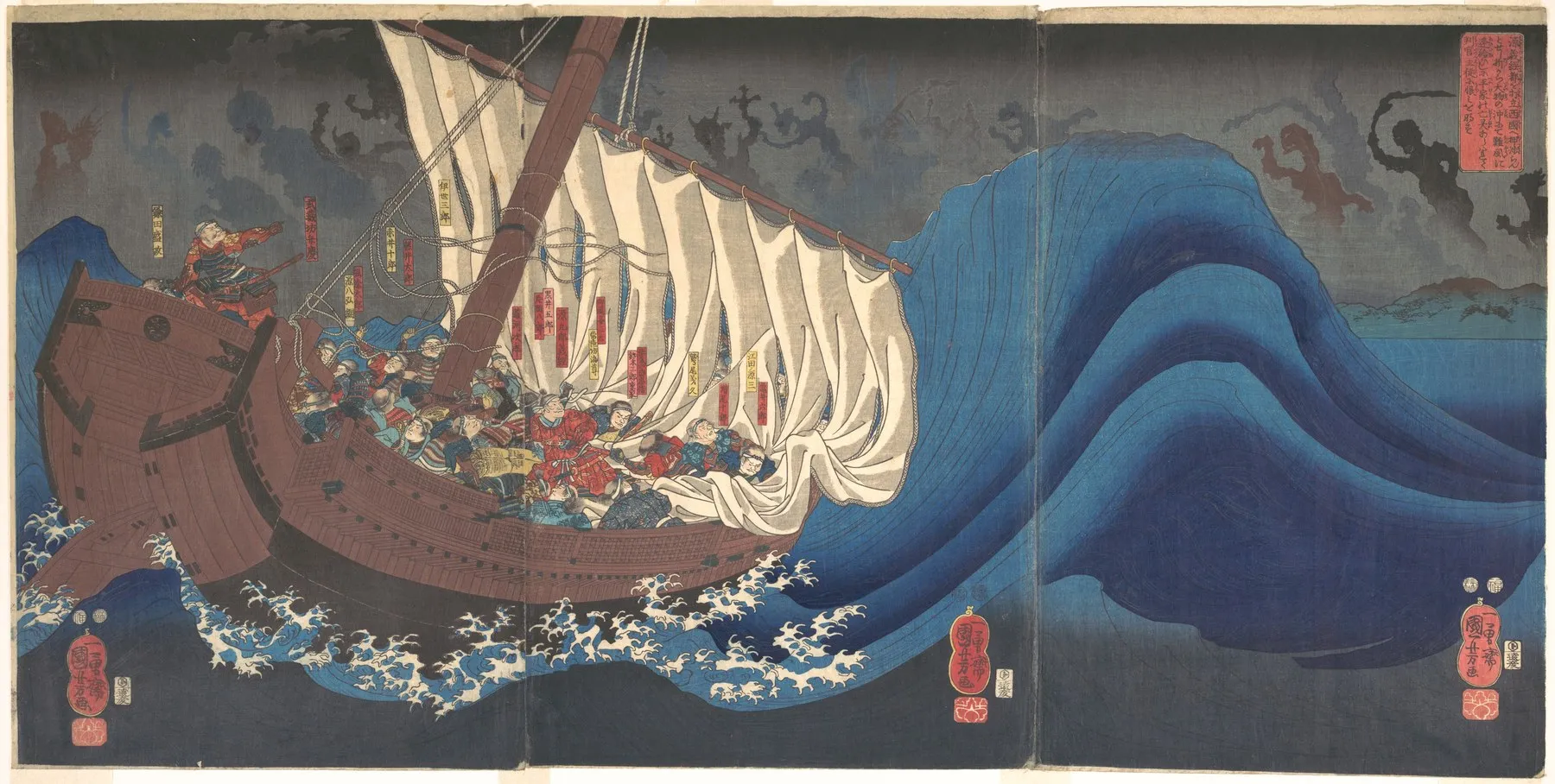
Utagawa Kuniyoshi, Ghosts of the Taira at Daimotsu Bay, colour woodblock triptych. The Metropolitan Museum of Art, Fletcher Fund, 1929, JP1565, public domain (CC0).
Where the two tellings part
Miyata finds that Hearn follows the 1782 plot faithfully, down to small points of construction, and changes few things.4 Both tellings have the same skeleton: a blind biwa player at the Amidaji at Akamagaseki, a summons at night to play the Dan-no-ura chapter of the Heike story, the Heart Sūtra written on his body, and the ears left bare.15 The differences are in the details, set out here in the order of the story.
| Point | Gayū kidan, 1782 | Kwaidan, 1904 |
|---|---|---|
| The strait at the opening | Fires and strange cries19 | Adds Heike crabs with human faces19 |
| The call at the gate | “Open”10 | “Kaimon!”10 |
| The priest’s warning | His yang energy will be overcome by yin, costing him his life3 | The dead will tear him in pieces3 |
| Who left out the ears | The abbot himself17 | An acolyte the priest trusted17 |
| How it ends | His biwa is known as ear-cut Hōichi’s18 | He grows wealthy and is called Mimi-nashi18 |
The change that counts is the warning. The 1782 abbot speaks of yin and yang, not of the dead.3
汝連夜彼地に至らば恐らくは陽気陰気に壓れて命を害するに及ぶべし3
If you go to that place every night, I fear your yang energy will be overcome by yin energy, to the point of costing you your life.
Hearn’s priest says that if Hōïchi obeys the dead again they will tear him in pieces.3 Miyata sets the two speeches side by side and agrees that both lead to death, but says that only Hearn’s has the dead actively doing harm.3 He judges the tearing to be Hearn’s own enlargement of the 1782 words.20
The ears are the abbot’s blunder in both versions.17 In 1782 he writes the sutra himself with the monks and afterwards says “I left out the ears by my mistake”; in Hearn the priest blames himself for trusting an acolyte.17 In both, the visitor takes the ears away as proof to report back.16
Neither text says who the lord is.7 Miyata argues from six clues that he is the child emperor Antoku, and that the old woman who speaks for him is Antoku’s grandmother Nii-no-ama, one of the clues being that the searchers find Hōichi at Antoku’s tomb.8 That is his reading.8 He also thinks that the dead Heike would hardly ask for the sea battle, and that an abbot who takes them for killers is out of step with older Japanese ghost stories, where a ghost punishes only the person who wronged it.21
Ear-cut
The 1782 tale ends on the man’s name, and it is not Hearn’s.2
琵琶ハ尚々妙をきハめて世に耳きれ芳一が琵琶と称じけるとぞ2
His biwa grew ever more wonderful, and, the book says, in the world it was called “the biwa of ear-cut Hōichi”.
The printed 耳きれ means “ear-cut”.2 Kondō, who transcribed the tale, writes that the other tellings he knows all say “mimi-kire”, and that he has not yet seen any text other than Hearn’s that calls the man “mimi-nashi”.22
A similar tale was already in print in the 1660s.23 Kondō’s note lists Sorori monogatari (1663), where the man is “Mimi-kire Unichi”, and Tonoigusa (1677), where he is “Mimi-kire Danichi” in the tale of the court lady Koshōshō’s ghost.23 Miyata’s table adds Otogi atsugeshō of 1734, in which a player called Tsuruichi lives near Akamagaseki and the ghost is Nii-no-ama at Amidaji.24 He reads the four as one story growing toward the 1782 book: the ghost passes from a nun to Koshōshō to Nii-no-ama to Antoku with a samurai as messenger, and the part torn off grows from an ear to the left ear to both.25 All of this rests on Kondō’s note and Miyata’s table.
Miyata also notices that the player’s name ends in -ichi in every version.26 Calling it a rough guess, he wonders whether players of the Ichikata school of biwa were advertising themselves with the tale.26
Whose words are Hearn’s
Hearn’s note to Kwaidan, dated Tokyo, 20 January 1904, says that most of the tales were taken from old Japanese books, such as Yasō kidan, Bukkyō hyakka zenshō, Kokon chomonshū, Tama sudare and Hyaku monogatari.6 It does not name the Gayū kidan.6 The Toyama library’s own description of the book gives the tale in volume 2 as the original source of “Mimi-nashi Hōichi”.27
How the 1782 text reached Hearn is told second hand. Miyata reports that Hearn could not read Japanese, so Setsu read the book and told him the story in her own words, which Hearn’s great-grandson Koizumi Bon calls “retelling literature”.28 Miyata allows that the tearing in pieces may be her reading of the abbot’s words rather than Hearn’s.20
The hall at Akama
The Amidaji where the tale is set is now Akama Jingū, and the shrine’s own guide says the story was handed down at the Amidaji and became famous when Hearn translated it into English for Kwaidan.29
The shrine’s Hōichi hall was built in March 1957, and the camphor-wood statue in it was carved by Oshida Masao of Hōfu.30 Miyata says the hall stands in front of the Heike graves, so most visitors assume it is old, and that few notice the plaque was written by Kishi Nobusuke, who had become prime minister that February.31 The shrine holds a Hōichi memorial rite on 15 July and says it has kept it since the hall went up.32
In Miyata’s table the Amidaji first appears in the book of 1734, and we found nothing older that puts the story there.24
What we could not verify
Seen only where others quote them
- Setsu’s memoir, quoted by Kondō from Hasegawa Yōji’s 2014 biography of her, and Koizumi Bon’s 2004 account of her retelling, as Miyata gives it. They would settle how much of the English text is Hearn’s and how much came through Setsu. Both are in copyright, and we found no open copy.
Questions we could not settle
- Whether any document older than 1734 puts Hōichi, or any ear-cut biwa player, at the Amidaji in Akamagaseki.
- Who the lord in the tale is meant to be.
Read next
TaleMusashi (now Tokyo), Japan, 1685 to 1993
Yuki-onna, the snow woman of Kwaidan, 1904
TaleYotsuya, Edo (now Shinjuku, Tokyo), Japan, 1727 to 1952
Oiwa of Yotsuya was divorced in the old text and drugged on the stage
TaleMiyoshi, Hiroshima, Japan, 1749 to 1859
The Inō mononoke roku: where the demon king's mallet came from
Sources
- University of Toyama Library, ToRepo record for 臥遊奇談 (hdl 10110/2541), Item metadata: collection Y-03-01 ヘルン文庫 > 和漢書; 内容記述 gives it as the former holding of Lafcadio Hearn, "ヘルン文庫配架番号2246-2250"; five files, one per volume
- Kondō 2020, p. 49 (the copy used is from the Hearn Library); p. 50, the legend "[文学(印)] [小泉八雲(印)]: the characters of the seals stamped on the original"
- Miyata Hisashi (宮田尚), 「"芳一ばなし"から「耳なし芳一のはなし」へ」, 梅光学院大学・女子短期大学部論集 39 (2006), p. 19, section 8 (the copy Hearn used is in the Hearn Library and its seals are visible in the online colour photographs)↑
- 臥遊奇談 vol. 2, Toyama copy, ; view 8, last two lines of the tale (p. 12, lines 1 and 2): 琵琶ハ尚々妙をきハめて世に耳きれ芳一が琵琶と称じけるとぞ (primary) transcription
- Kondō 2020, p. 52 to 53, transcription p. 12 [1] and [2]; note to p. 12 [2], p. 54↑
- 臥遊奇談 vol. 2, Toyama copy, ; view 7, right-hand page, first lines (p. 9 lines 1 and 2): 汝連夜彼地に至らば恐らくは陽気陰気に壓れて命を害するに及ぶべし (primary) transcription
- Hearn, Kwaidan (1904), "The Story of Mimi-nashi-Hōïchi", The priest's speech after Hōichi is found in the cemetery: "If you obey them again, after what has already occurred, they will tear you in pieces." (primary)
- Miyata 2006, p. 19 to 20, section 8: the two lines set side by side; 結果として死に至るであろうと和尚が指摘している点は共通するが、亡霊が積極的に危害を加えると判断しているかどうかという点で、両者は決定的に違っている↑
- Miyata 2006, p. 19, section 8 (「耳なし芳一のはなし」には典拠があった ... かなり忠実に原話にしたがっている)↑
- Kondō 2020, English summary, p. 55 (Gayu Kidan (1782) ... one of which is); Japanese, p. 49 (原話の一つ)↑
- Hearn, Kwaidan (1904), Unnumbered note before the first story, "Most of the following Kwaidan, or Weird Tales, have been taken from old Japanese books,—such as...", signed L. H. (primary)↑
- 臥遊奇談 vol. 2, Toyama copy, ; view 6 (p. 8 [1] to [2]: 安徳帝御陵の御前に芳一琵琶を弾じて座す) and view 3 (p. 3 [1] to [3]: 縉紳の御方) (primary) transcription
- Hearn, Kwaidan (1904), The servants find Hōïchi "sitting alone in the rain before the memorial tomb of Antoku Tennō"; the stranger speaks only of "My present lord, a person of exceedingly high rank" (primary)↑
- Miyata 2006, pp. 14 to 15, section 2, clues 1 to 6 and conclusion (これは安徳帝だと察せられる)↑
- Akama Jingū, official precinct guide, 安徳天皇阿弥陀寺陵, Section on the mausoleum: 壇ノ浦に御歳8歳で入水された御幼帝の御尊骸を葬り
- Miyata 2006, p. 15, section 2 (Nii-no-ama held the eight-year-old Antoku and went into the sea at Dan-no-ura: 八歳の安徳帝を抱いて入水した)
- Hearn, Kwaidan (1904), Opening of the story: the Heiké perished at Dan-no-ura "with their women and children, and their infant emperor likewise" (primary)↑
- 臥遊奇談 vol. 2, Toyama copy, ; view 3, right-hand page, line 7 (p. 3 [7]): 芳一こそ召れゝ。ひらけと云入給へば官女とおぼしく多く立出てをり (primary) transcription
- Kondō 2020, Note to p. 3 [7], p. 53 to 54: the word 開門 is not in the original, which has only 「ひらけ」
- Hearn, Kwaidan (1904), "Kaimon!" the samurai called, and note [4] to the story: "A respectful term, signifying the opening of a gate" (primary)↑
- Kondō 2020, Note to p. 3 [7], p. 53 to 54, quoting Koizumi Setsu, 思ひ出の記, from Hasegawa Yōji, 『八雲の妻 小泉セツの生涯』(2014), p. 328↑
- Waseda University Library, record for 臥遊竒談, call number ヘ13 01457, Catalogue record: title, author 一夕散人, imprint Kyoto, Kikuya Yasubee, Tenmei 2 [1782], 5 vols. The record does not name the tales
- National Diet Library, NDL Search, 臥遊奇談 5巻, Catalogue record R100000002-I000007281306: author 一夕散人, publisher 菊屋安兵衛, 天明2刊, 5冊, genre 読本
- Kondō Sugaye (近藤清兄), 翻刻「琵琶秘曲泣幽霊」, 聖霊女子短期大学紀要 48 (2020), p. 49 (opening paragraph), p. 50 (the heading and first lines of the transcription: 臥遊奇談巻之二, 琵琶秘曲泣幽霊)
- 臥遊奇談 vol. 2, Hearn's copy, Toyama University Library, view 2 (title line "臥遊奇談 巻之二", then the tale's title "琵琶秘曲泣幽霊" and its first lines) (primary)↑
- Hearn, Kwaidan (1904), The story is the first in the book; the book's introduction is dated March 1904 (primary)
- Miyata 2006, p. 13, section 1 (『怪談』所収各話の中では、突出して一人歩きしている)↑
- Hearn, Kwaidan (1904), "The Story of Mimi-Nashi-Hōïchi", from the opening paragraphs to the last paragraph (primary)
- Miyata 2006, Table on p. 22 (the Kwaidan column) and the summary of the Kwaidan version in section 1, p. 13↑
- Hearn, Kwaidan (1904), The whole story, from "Some centuries ago there lived at Akamagaséki a blind man named Hōïchi" to the ears; the sūtra is "the holy sûtra called Hannya-Shin-Kyō" (primary)
- 臥遊奇談 vol. 2, Toyama copy, ; views 2 to 8 (p. 1 to p. 12): the call at night (p. 2 [7] to [9]), the Dan-no-ura chapter (p. 4 [2] to [6]), the tomb (p. 8 [2]), the 般若心経 (p. 9 [5] to [6]), the ears (p. 10) (primary) transcription
- Miyata 2006, Table on p. 22, rows 演目 (壇浦合戦の篇), 座頭発見の場所, 経典 (般若心経), ちぎられた部位 (両耳), where the 1782 column and the Kwaidan column agree↑
- 臥遊奇談 vol. 2, Toyama copy, ; view 7, left-hand page, last lines (p. 10 [6] to [8]): 耳を証見に上へ訴へ申べし ... 両の耳朶に諸手をかけ何気なく引ちぎり (primary) transcription
- Hearn, Kwaidan (1904), "Now to my lord those ears I will take, in proof that the august commands have been obeyed, so far as was possible"; "At that instant Hōïchi felt his ears gripped by fingers of iron, and torn off!" (primary)
- Kondō 2020, Transcription p. 10 [5] to p. 11 [3], pp. 52 to 53↑
- 臥遊奇談 vol. 2, Toyama copy, ; view 7, right-hand page, middle lines (p. 9 [5] to [6]: 和尚自ら筆をとり又衆僧にも命じ) and view 8, right-hand page, first lines (p. 11 [6] to [7]: 我誤つて耳を落して経文を書せず) (primary) transcription
- Hearn, Kwaidan (1904), The priest and his acolyte write the sūtra; afterwards: "I trusted my acolyte to do that part of the work; and it was very, very wrong of me not to have made sure that he had done it!" (primary)
- Kondō 2020, Transcription p. 9 [5] to [6] and p. 11 [6] to [7], pp. 52 to 53↑
- 臥遊奇談 vol. 2, Toyama copy, ; view 8, left-hand page, first two lines of the tale's end (p. 12 [1] and [2]) (primary) transcription
- Hearn, Kwaidan (1904), Last paragraph of the story: "Many noble persons went to Akamagaséki to hear him recite; and large presents of money were given to him,—so that he became a wealthy man", and the name "Mimi-nashi-Hōïchi: Hōïchi-the-Earless" (primary)
- Miyata 2006, Table on p. 22, row 後日譚 (the 1782 column: 琵琶の評判が高まった; the Kwaidan column: 裕福になった)↑
- 臥遊奇談 vol. 2, Toyama copy, ; view 2, right-hand page, first lines (p. 1 [1] to [4]: 月明かなれバ海面にあやしき声をきく。雨しきる夜ハ平砂に鬼火を飛ばす) (primary) transcription
- Hearn, Kwaidan (1904), Opening of the story: Heike crabs "which have human faces on their backs", with note [1] pointing to Hearn's Kottō; "Oni-bi, or demon-fires" (primary)↑
- Miyata 2006, p. 20, section 8: 「八つ裂き」云々は、じつは八雲の発想による改変だった ... セツの解釈である可能性もあり得る↑
- Miyata 2006, pp. 15 to 18, sections 3 to 7↑
- Kondō 2020, Note to p. 12 [2], p. 54: 類話は色々あるが、いずれも「耳切れ○○」と言っており、ハーンの作品以外に「耳なし」と呼ぶものを翻刻者はまだ見ていない↑
- Kondō 2020, Note to p. 12 [2], p. 54, citing Takada Mamoru's editions (1989a, 1989b)
- Miyata 2006, Table on p. 22, rows 刊行年, 章名, 主人公: 曽呂利物語 寛文三 1663 「耳切れうん市が事」 うん市 (座頭); 宿直草 延宝五 1677 「小宰相の局、ゆうれいの事」 団都 (座頭)↑
- Miyata 2006, p. 21, section 9 (この段階で、寺の名も阿弥陀寺と絞り込まれる), and the table on p. 22 (御伽厚化粧, 享保十九 1734, 「面戸留幽鬼」?, 鶴都 (琵琶法師), 赤間阿弥陀寺, 二位尼)↑
- Miyata 2006, p. 21, section 9, and the table on p. 22 (rows 呼びにきた使者, 演奏の聞き手, ちぎられた部位)↑
- Miyata 2006, p. 21, section 9, last paragraphs (いささか短絡的ではあるが)↑
- University of Toyama Library, ToRepo record for 臥遊奇談, 内容記述: 巻2「琵琶秘曲泣幽霊」は「耳なし芳一」の原典とされる↑
- Miyata 2006, p. 20, section 8, citing 小泉凡「小泉八雲と「耳なし芳一」」, 赤間神宮叢書15 (平成16, 2004)↑
- Akama Jingū, official precinct guide, Hōichi hall section: 阿弥陀寺(今の赤間神宮)に伝わる説話 ... ラフカディオ・ハーン(小泉八雲)が英訳し「怪談」に掲載したことで一躍有名になりました↑
- Akama Jingū, official precinct guide, 芳一堂, Section on the Hōichi hall: 昭和32年3月、芳一堂を建立し鎮座しました; the statue by 押田政夫, a pupil of Yamazaki Chōun, of クスノキ
- Agency for Cultural Affairs, Art Platform Japan, 耳なし芳一像 (W1133949), data from Akama Jingū Hōmotsuden, Record: maker 押田政夫, material 木, held by 赤間神宮宝物殿; note: commissioned in 1957, a camphor tree from Miyazaki made in one piece, placed in the Hōichi hall
- Miyata 2006, p. 13, section 1 (芳一堂の建立は昭和三十二年(1957); the statue by 押田政夫)↑
- Miyata 2006, p. 13, section 1 (扁額の揮毫が、この年の二月に首相になった岸信介であることに気付く観光客はほとんどいない)↑
- Akama Jingū, official precinct guide, Same section: 以来7月15日を祭日として、耳なし芳一琵琶供養祭が続けられています
- Miyata 2006, p. 13 to 14, section 1 (例年、七月十五日に芳一まつりを行っている)↑
Documents quoted
- Gayū kidan, vol. 2, "Biwa hikyoku yūrei wo nakashimu" (1782): the opening, the gate, the abbot's warning, the ears and the ending (transcribed from the page image)